Student Organization Funding Guidelines
Membership in student organizations at TTU is open to all students based solely on GPA, college, and classification. To apply for funding, organizations must be fully registered, meet risk management compliance, and follow a thorough application process starting in September. Failure to meet requirements can result in funding penalties and eventual forfeiture. Utilization of funding requires additional steps, including attending SGA funding training sessions. Non-compliant organizations risk losing their allocated funding over time.

Download Presentation

Please find below an Image/Link to download the presentation.
The content on the website is provided AS IS for your information and personal use only. It may not be sold, licensed, or shared on other websites without obtaining consent from the author.If you encounter any issues during the download, it is possible that the publisher has removed the file from their server.
You are allowed to download the files provided on this website for personal or commercial use, subject to the condition that they are used lawfully. All files are the property of their respective owners.
The content on the website is provided AS IS for your information and personal use only. It may not be sold, licensed, or shared on other websites without obtaining consent from the author.
E N D
Presentation Transcript
Summary Update delegates about the next steps in the development of a new Pacific Regional Aquaculture Strategy, to guide and support members aspirations for aquaculture and build upon the region s strengths and experiences: Process and funding to develop the Strategy, and; A suggested scope for the Strategy itself.
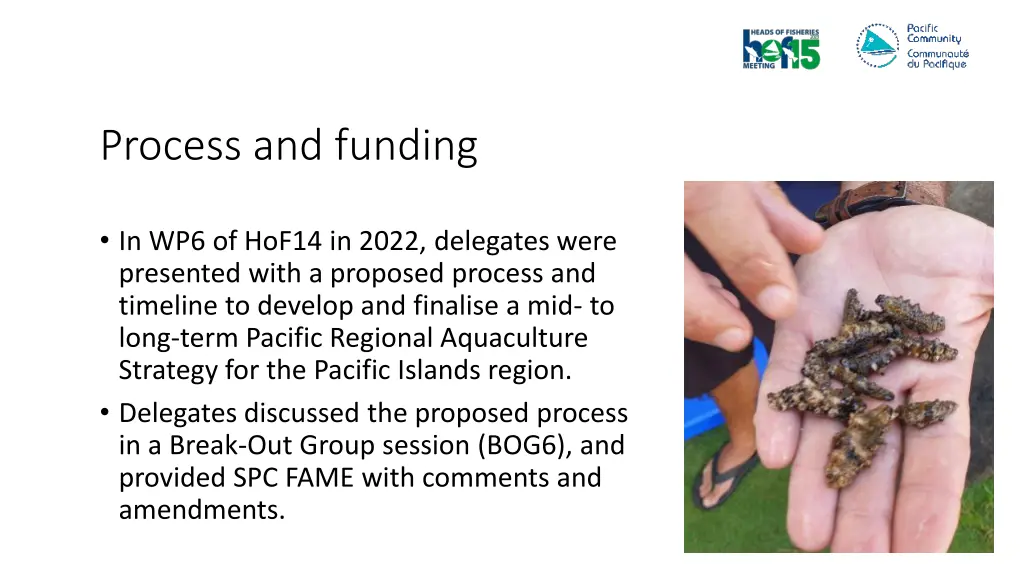
Process and funding In WP6 of HoF14 in 2022, delegates were presented with a proposed process and timeline to develop and finalise a mid- to long-term Pacific Regional Aquaculture Strategy for the Pacific Islands region. Delegates discussed the proposed process in a Break-Out Group session (BOG6), and provided SPC FAME with comments and amendments.
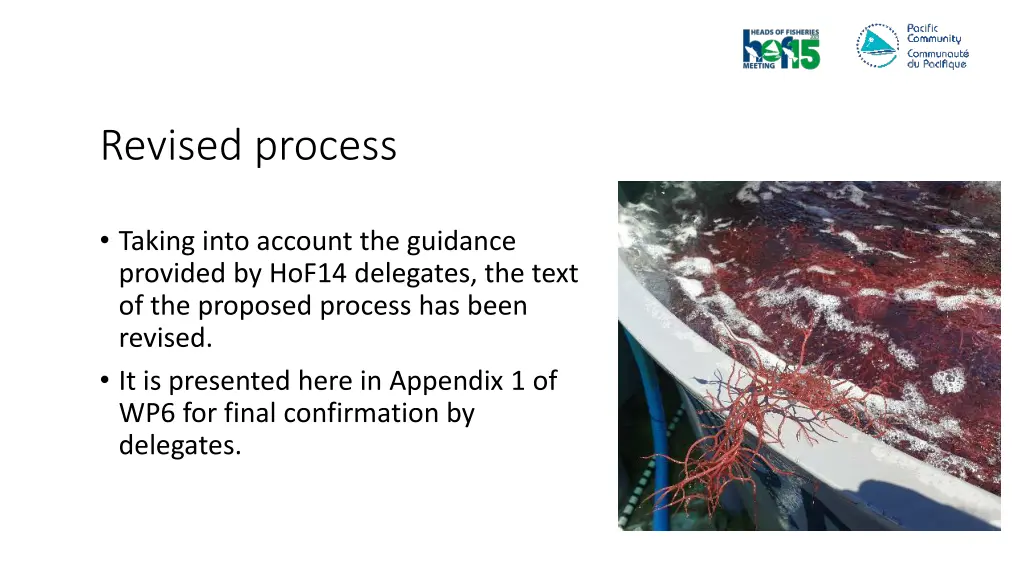
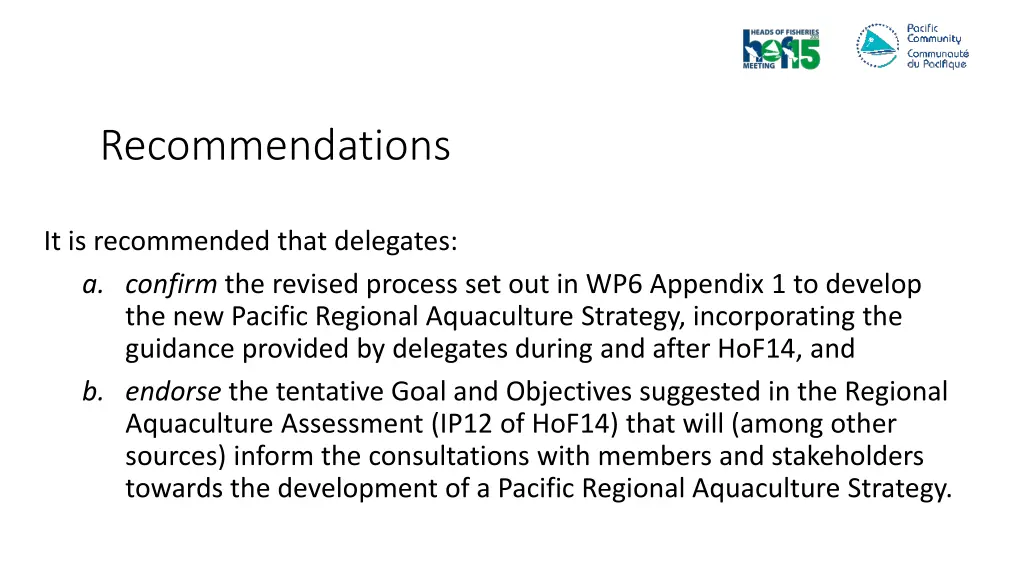
Revised process Taking into account the guidance provided by HoF14 delegates, the text of the proposed process has been revised. It is presented here in Appendix 1 of WP6 for final confirmation by delegates.
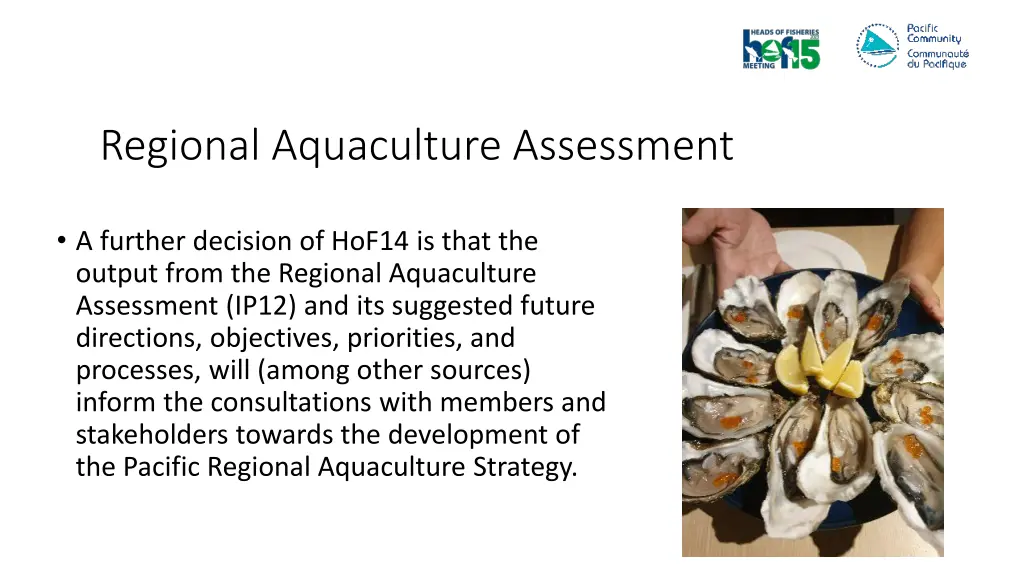
Regional Aquaculture Assessment A further decision of HoF14 is that the output from the Regional Aquaculture Assessment (IP12) and its suggested future directions, objectives, priorities, and processes, will (among other sources) inform the consultations with members and stakeholders towards the development of the Pacific Regional Aquaculture Strategy.
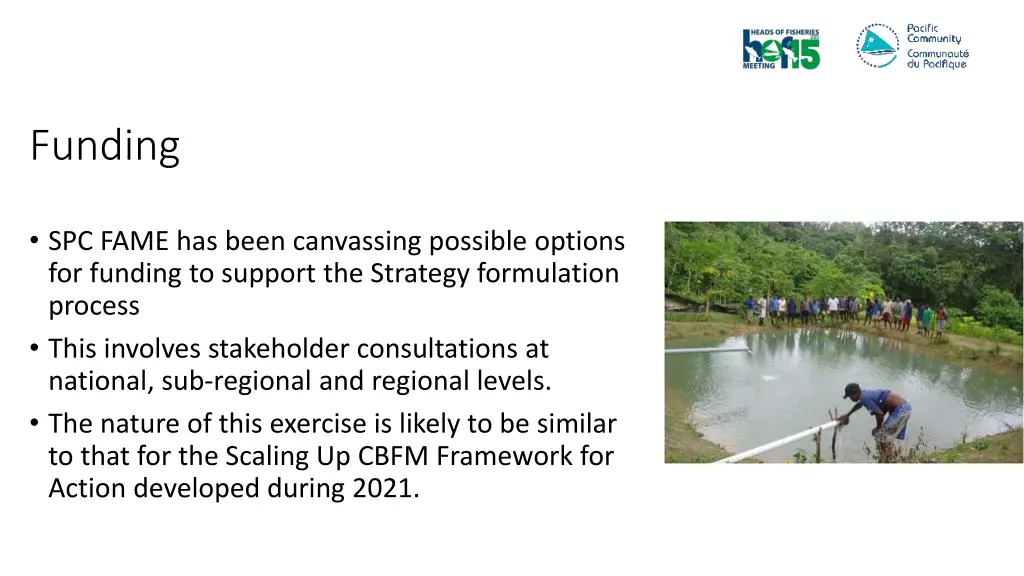
Funding SPC FAME has been canvassing possible options for funding to support the Strategy formulation process This involves stakeholder consultations at national, sub-regional and regional levels. The nature of this exercise is likely to be similar to that for the Scaling Up CBFM Framework for Action developed during 2021.
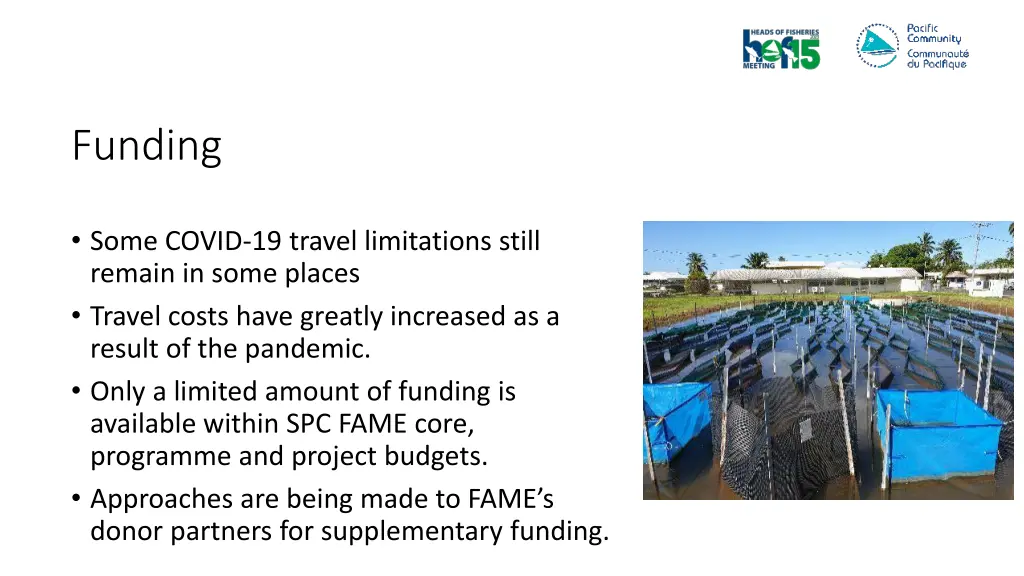
Funding Some COVID-19 travel limitations still remain in some places Travel costs have greatly increased as a result of the pandemic. Only a limited amount of funding is available within SPC FAME core, programme and project budgets. Approaches are being made to FAME s donor partners for supplementary funding.
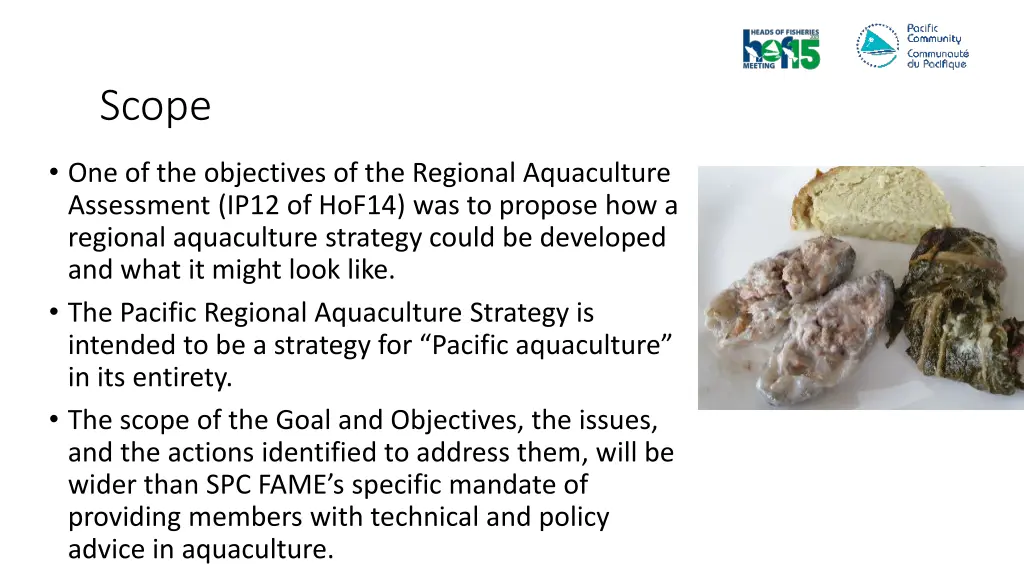
Scope One of the objectives of the Regional Aquaculture Assessment (IP12 of HoF14) was to propose how a regional aquaculture strategy could be developed and what it might look like. The Pacific Regional Aquaculture Strategy is intended to be a strategy for Pacific aquaculture in its entirety. The scope of the Goal and Objectives, the issues, and the actions identified to address them, will be wider than SPC FAME s specific mandate of providing members with technical and policy advice in aquaculture.
Regional Aquaculture Assessment The Regional Assessment proposed suggestions for the Goal and Objectives simply as a starting point for the Strategy, to be reviewed and further refined by the consultative process engaging the region s primary aquaculture stakeholders. The nature of Pacific aquaculture encompasses: Community-based aquaculture (often in conjunction with CBFM); Land or coastal based small-scale aquaculture for food security and income; Commercial aquaculture (with the main motivation being profits), and; Reseeding and restocking (may be not-for-profit).
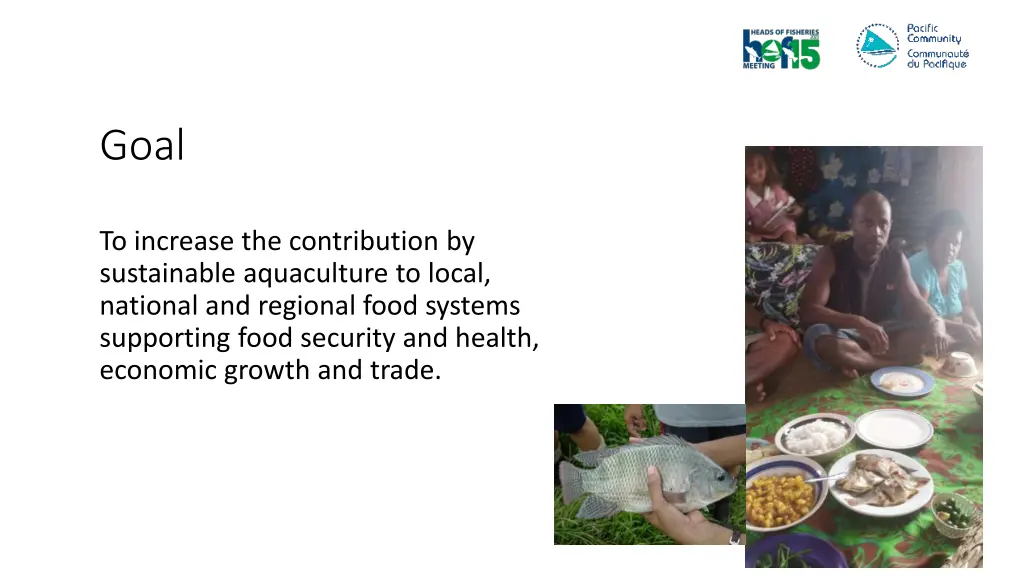
Goal To increase the contribution by sustainable aquaculture to local, national and regional food systems supporting food security and health, economic growth and trade.
Potential priority objectives: To mainstream aquaculture into the economic and social development agendas of PICTs. To increase aquaculture production of edible and non-edible aquatic products for income and food security in the commercial, community and small holder subsectors. To improve capacity in the aquaculture sector. To improve biosecurity in the region
Potential priority objectives: To assess the effects of climate change and other natural disasters in the region and develop outline plans for mitigating measures. To improve market access and supply chains. To establish regional cooperative institutional frameworks. To improve quality of post-harvest products. To mainstream cross cutting issues such as health, environment and gender in the whole aquaculture value chain throughout the region.
Supporting information for consultations An Information Brief can be prepared to inform stakeholder consultations and to assist in defining the scope of the Strategy. Resource Persons and Background Information provided about aspirations, expectations, and potentials for aquaculture in the Pacific. International and national instruments which describe ways for aquaculture to contribute toward the SDGs through the activities of governments, the private sector, and communities. These will set the scene to determine the vision is that drives Pacific governments, private sector and communities to engage in aquaculture, and define how to achieve it.
Recommendations It is recommended that delegates: a. confirm the revised process set out in WP6 Appendix 1 to develop the new Pacific Regional Aquaculture Strategy, incorporating the guidance provided by delegates during and after HoF14, and b. endorse the tentative Goal and Objectives suggested in the Regional Aquaculture Assessment (IP12 of HoF14) that will (among other sources) inform the consultations with members and stakeholders towards the development of a Pacific Regional Aquaculture Strategy.