Student Transitions and Assessments: Supporting Success in Education
Explore key topics such as student transitions, assessments, multicultural perspectives, and postsecondary partnerships. Learn about legislation, flexibility in graduation requirements, and the role of assessments in higher education admissions.

Download Presentation

Please find below an Image/Link to download the presentation.
The content on the website is provided AS IS for your information and personal use only. It may not be sold, licensed, or shared on other websites without obtaining consent from the author. If you encounter any issues during the download, it is possible that the publisher has removed the file from their server.
You are allowed to download the files provided on this website for personal or commercial use, subject to the condition that they are used lawfully. All files are the property of their respective owners.
The content on the website is provided AS IS for your information and personal use only. It may not be sold, licensed, or shared on other websites without obtaining consent from the author.
E N D
Presentation Transcript
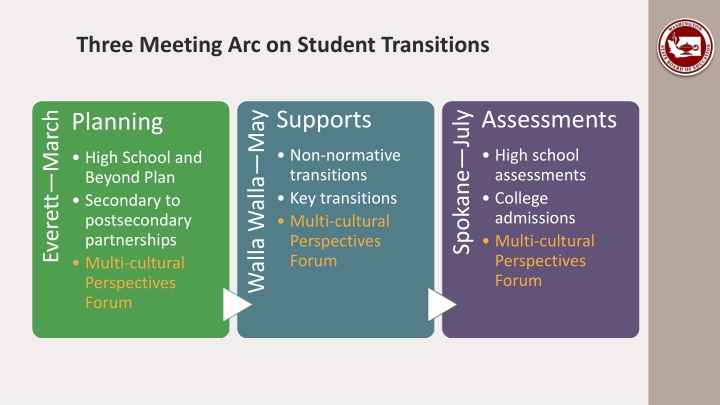
Three Meeting Arc on Student Transitions Walla Walla MaySupports Spokane JulyAssessments Multi-cultural Perspectives Forum Everett March Planning Non-normative transitions Key transitions Multi-cultural Perspectives Forum High school assessments College admissions High School and Beyond Plan Secondary to postsecondary partnerships Multi-cultural Perspectives Forum
Panel Discussion Outline with guiding questions on page 284 of the packet. Smarter Balanced Consortium and the high school Smarter Balanced assessments. Update on Bridge to College Courses and the agreement by Washington postsecondary institutions on the use of the high school Smarter Balanced assessments for placement. University and college admissions and the role of assessment in admissions to higher education. 2
Quotes about Examining Legislation You do not examine legislation in the light of the benefits it will convey if properly administered, but in the light of the wrongs it would do and the harms it would cause if improperly administered. Lyndon B. Johnson. The older I get the more wisdom I find in the ancient rule of taking first things first. A process which often reduces the most complex human problem to a manageable proportion. Dwight D. Eisenhower 3
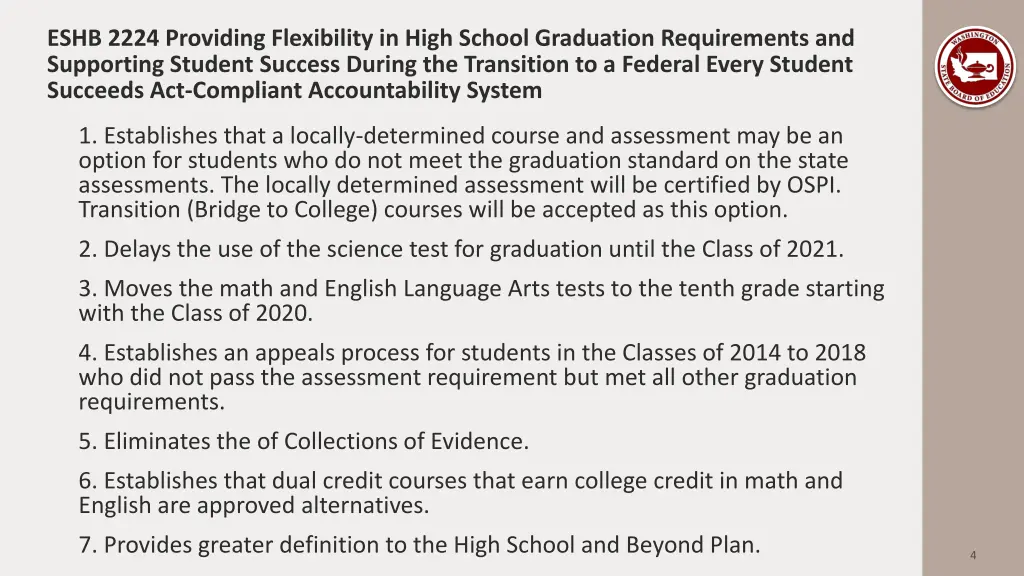
ESHB 2224 Providing Flexibility in High School Graduation Requirements and Supporting Student Success During the Transition to a Federal Every Student Succeeds Act-Compliant Accountability System 1. Establishes that a locally-determined course and assessment may be an option for students who do not meet the graduation standard on the state assessments. The locally determined assessment will be certified by OSPI. Transition (Bridge to College) courses will be accepted as this option. 2. Delays the use of the science test for graduation until the Class of 2021. 3. Moves the math and English Language Arts tests to the tenth grade starting with the Class of 2020. 4. Establishes an appeals process for students in the Classes of 2014 to 2018 who did not pass the assessment requirement but met all other graduation requirements. 5. Eliminates the of Collections of Evidence. 6. Establishes that dual credit courses that earn college credit in math and English are approved alternatives. 7. Provides greater definition to the High School and Beyond Plan. 4
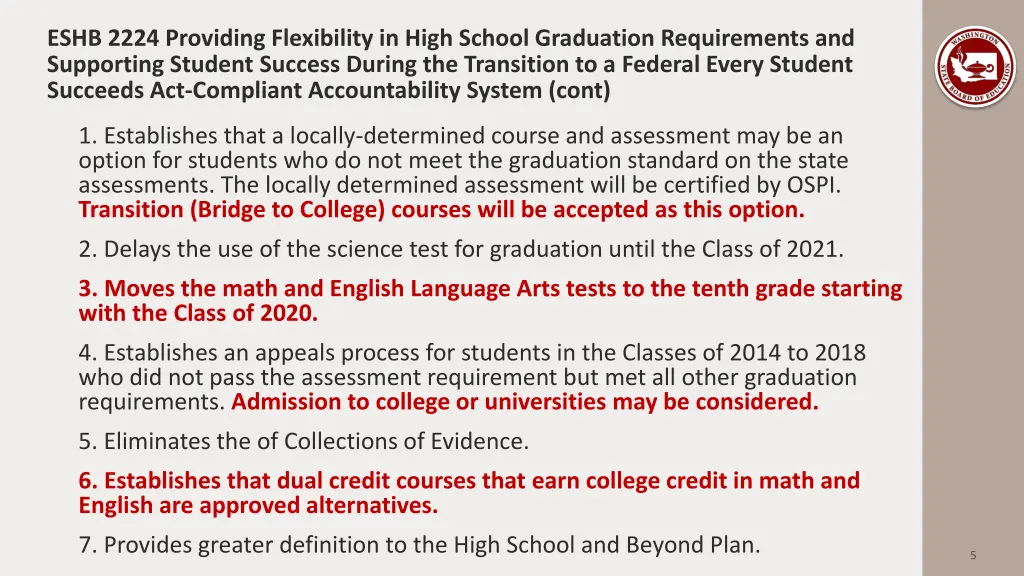
ESHB 2224 Providing Flexibility in High School Graduation Requirements and Supporting Student Success During the Transition to a Federal Every Student Succeeds Act-Compliant Accountability System (cont) 1. Establishes that a locally-determined course and assessment may be an option for students who do not meet the graduation standard on the state assessments. The locally determined assessment will be certified by OSPI. Transition (Bridge to College) courses will be accepted as this option. 2. Delays the use of the science test for graduation until the Class of 2021. 3. Moves the math and English Language Arts tests to the tenth grade starting with the Class of 2020. 4. Establishes an appeals process for students in the Classes of 2014 to 2018 who did not pass the assessment requirement but met all other graduation requirements. Admission to college or universities may be considered. 5. Eliminates the of Collections of Evidence. 6. Establishes that dual credit courses that earn college credit in math and English are approved alternatives. 7. Provides greater definition to the High School and Beyond Plan. 5
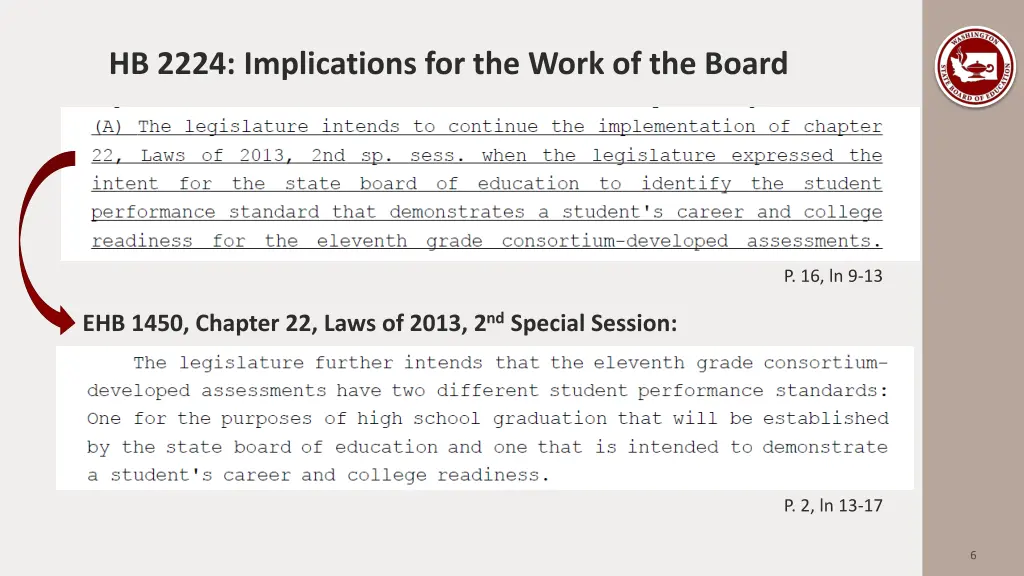
HB 2224: Implications for the Work of the Board P. 16, ln 9-13 EHB 1450, Chapter 22, Laws of 2013, 2nd Special Session: P. 2, ln 13-17 6
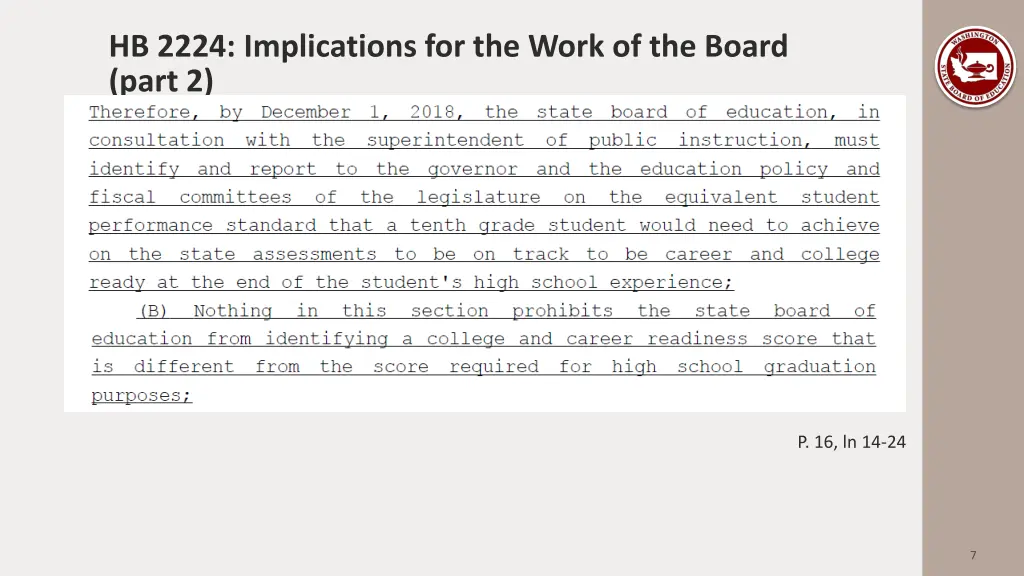
HB 2224: Implications for the Work of the Board (part 2) P. 16, ln 14-24 7
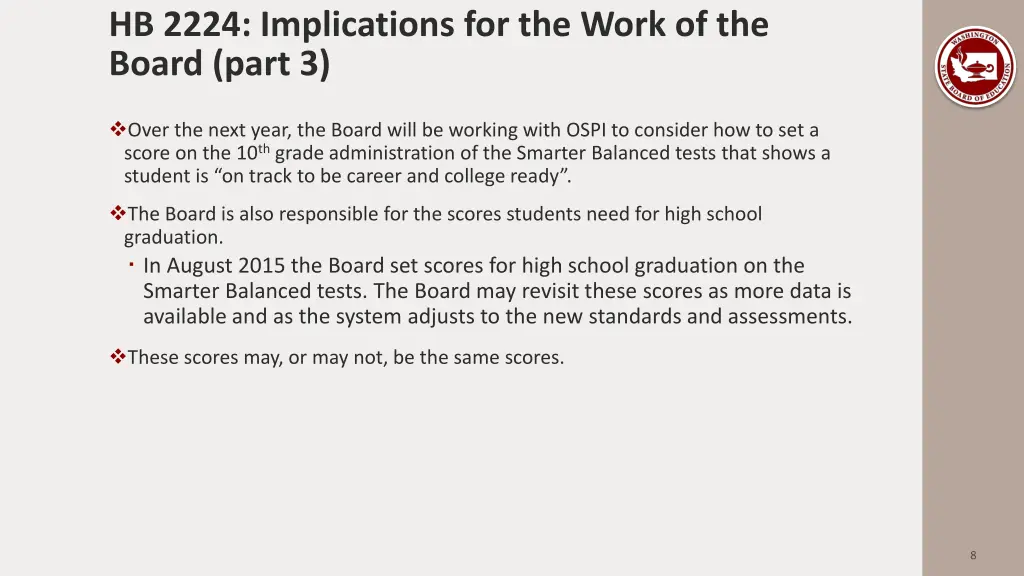
HB 2224: Implications for the Work of the Board (part 3) Over the next year, the Board will be working with OSPI to consider how to set a score on the 10th grade administration of the Smarter Balanced tests that shows a student is on track to be career and college ready . The Board is also responsible for the scores students need for high school graduation. In August 2015 the Board set scores for high school graduation on the Smarter Balanced tests. The Board may revisit these scores as more data is available and as the system adjusts to the new standards and assessments. These scores may, or may not, be the same scores. 8
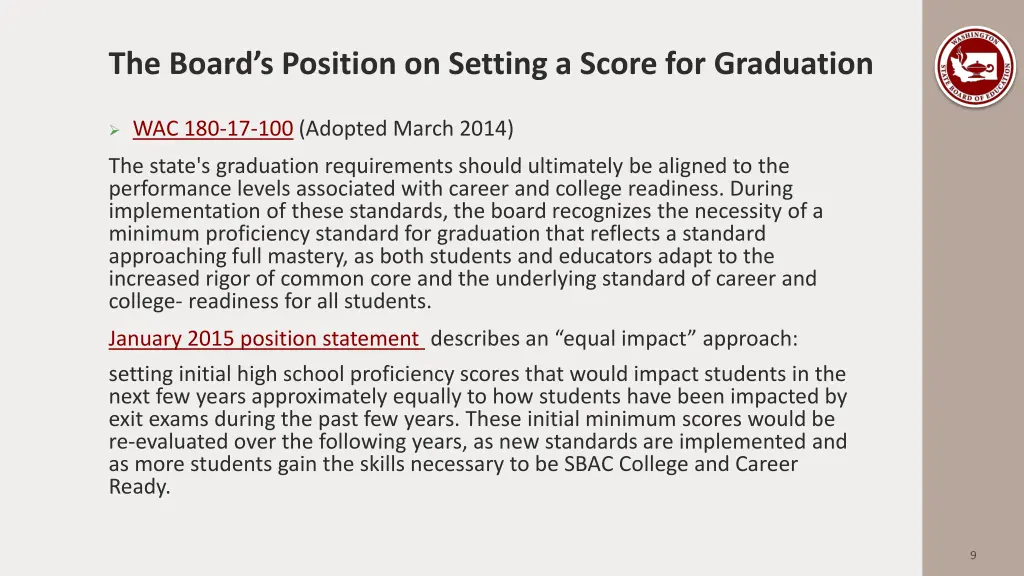
The Boards Position on Setting a Score for Graduation WAC 180-17-100 (Adopted March 2014) The state's graduation requirements should ultimately be aligned to the performance levels associated with career and college readiness. During implementation of these standards, the board recognizes the necessity of a minimum proficiency standard for graduation that reflects a standard approaching full mastery, as both students and educators adapt to the increased rigor of common core and the underlying standard of career and college- readiness for all students. January 2015 position statement describes an equal impact approach: setting initial high school proficiency scores that would impact students in the next few years approximately equally to how students have been impacted by exit exams during the past few years. These initial minimum scores would be re-evaluated over the following years, as new standards are implemented and as more students gain the skills necessary to be SBAC College and Career Ready. 9