Supporting Policy Design: Lessons in Water Management Complexity - A Case Study in Apulia, Italy
This presentation delves into the challenges of supporting public policy design in water management, focusing on the Apulia region in Italy. It explores the intricate network of interactions among diverse stakeholders, the consequences of policy resistance mechanisms, and the case of agricultural water management in the face of environmental issues and conflicts. The role and struggles of decision agents at various levels are also highlighted, showcasing the complexities of managing water resources in a region prone to drought events.

Uploaded on | 0 Views
Download Presentation

Please find below an Image/Link to download the presentation.
The content on the website is provided AS IS for your information and personal use only. It may not be sold, licensed, or shared on other websites without obtaining consent from the author. If you encounter any issues during the download, it is possible that the publisher has removed the file from their server.
You are allowed to download the files provided on this website for personal or commercial use, subject to the condition that they are used lawfully. All files are the property of their respective owners.
The content on the website is provided AS IS for your information and personal use only. It may not be sold, licensed, or shared on other websites without obtaining consent from the author.
E N D
Presentation Transcript
Supporting Policy Design: Lesson Learned From Water Management In The Apulia Region (Italy) Irene Pluchinotta LAMSADE-CNRS, Paris Dauphine University (France) BOR Summer school SLIDE 1 LAMSADE-CNRS, Paris Dauphine University (France) Irene Pluchinotta
How to support public policy design Water management complexity Multiple DMs with disparity of interests, backgrounds, societal positions and values Densely ramified network of interactions btw actors with different problem frames Water is used by several competing actors and owned by no one: what other DMs are going to do is unknown POLICY RESISTANCE MECHANISMS: lack of decision legitimacy, unexpected reactions, dysfunctional dynamics BOR Summer school SLIDE 2 LAMSADE-CNRS, Paris Dauphine University (France) Irene Pluchinotta
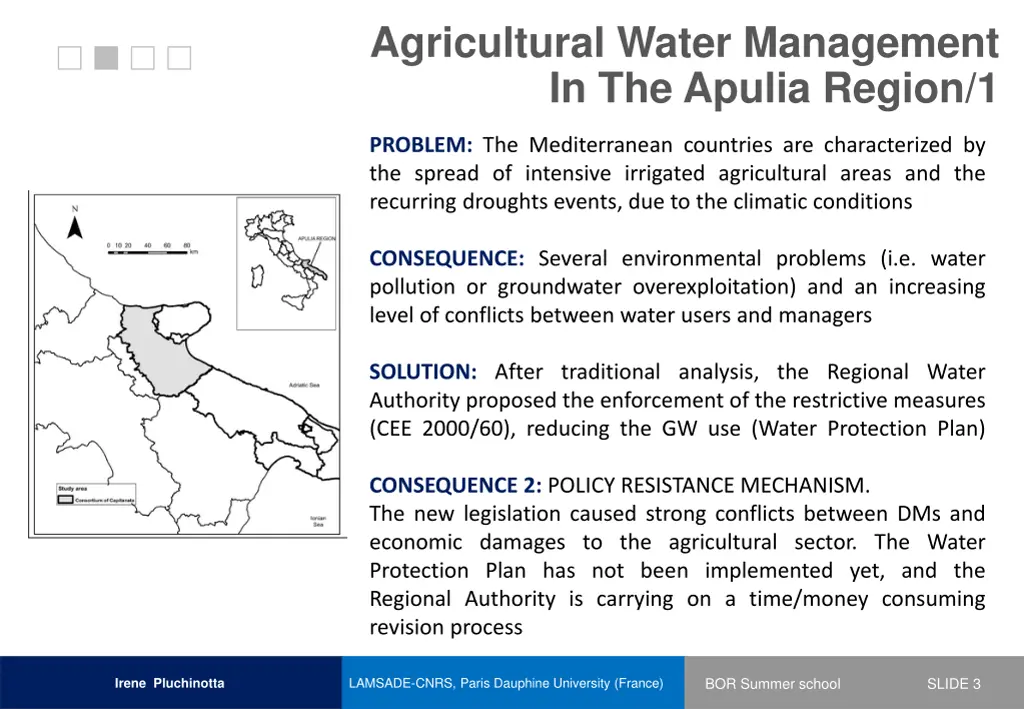
Agricultural Water Management In The Apulia Region/1 PROBLEM: The Mediterranean countries are characterized by the spread of intensive irrigated agricultural areas and the recurring droughts events, due to the climatic conditions CONSEQUENCE: Several environmental problems (i.e. water pollution or groundwater overexploitation) and an increasing level of conflicts between water users and managers SOLUTION: After traditional analysis, the Regional Water Authority proposed the enforcement of the restrictive measures (CEE 2000/60), reducing the GW use (Water Protection Plan) CONSEQUENCE 2: POLICY RESISTANCE MECHANISM. The new legislation caused strong conflicts between DMs and economic damages to the agricultural sector. The Water Protection Plan has not been implemented yet, and the Regional Authority is carrying on a time/money consuming revision process BOR Summer school SLIDE 3 LAMSADE-CNRS, Paris Dauphine University (France) Irene Pluchinotta
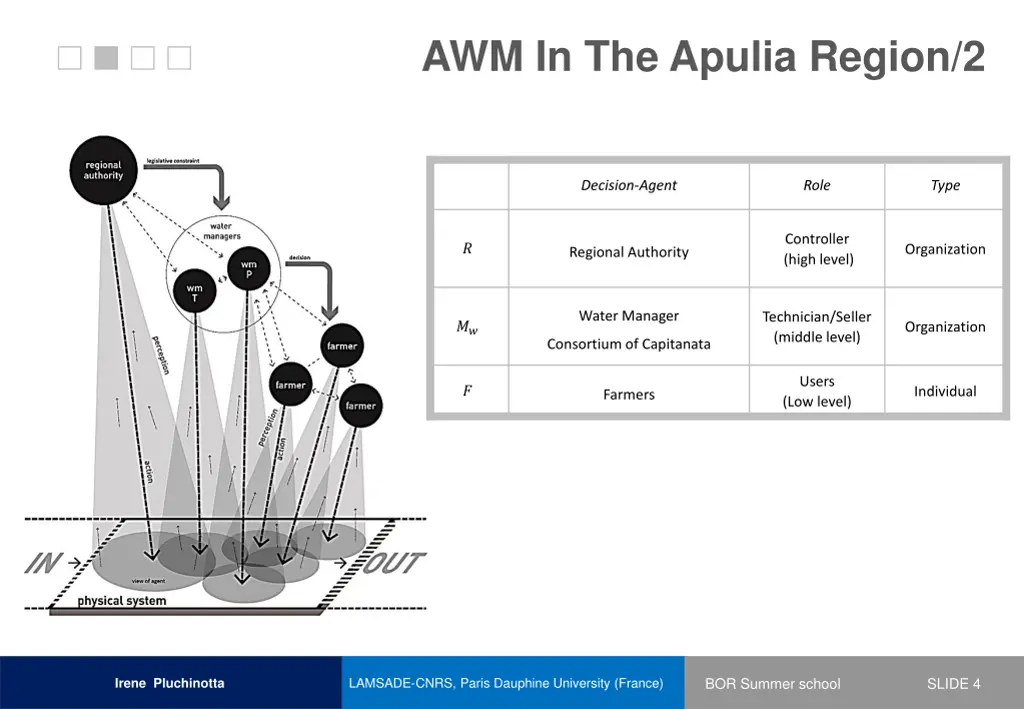
AWM In The Apulia Region/2 Role Type Decision-Agent Controller (high level) ? Organization Regional Authority Water Manager Technician/Seller (middle level) ?? Organization Consortium of Capitanata Users (Low level) ? Individual Farmers BOR Summer school SLIDE 4 LAMSADE-CNRS, Paris Dauphine University (France) Irene Pluchinotta
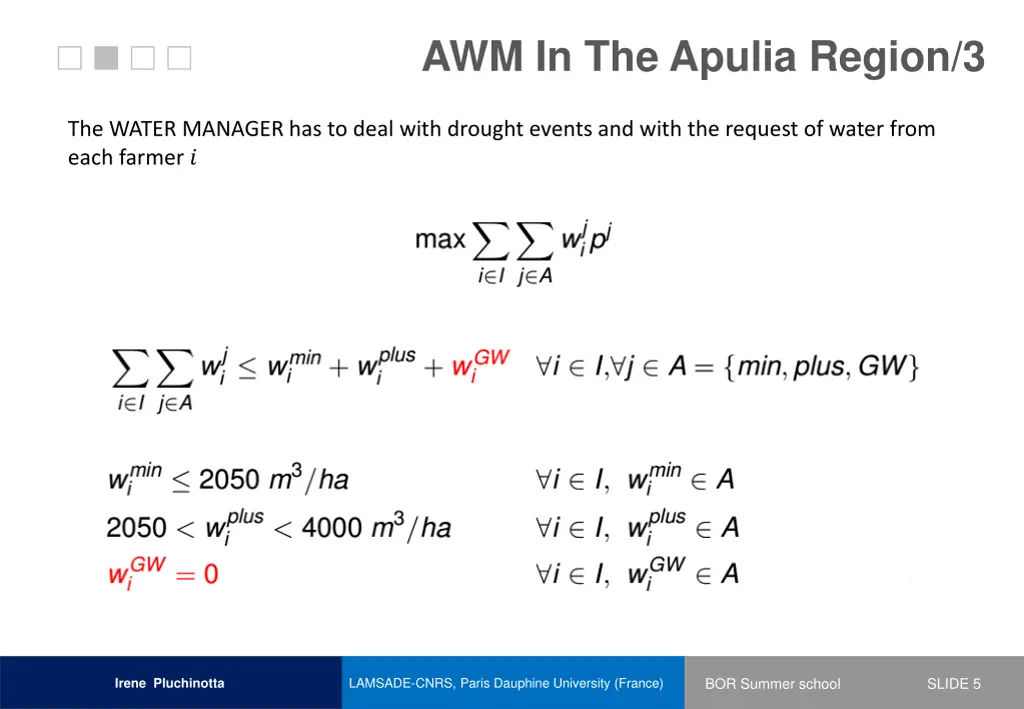
AWM In The Apulia Region/3 The WATER MANAGER has to deal with drought events and with the request of water from each farmer ? BOR Summer school SLIDE 5 LAMSADE-CNRS, Paris Dauphine University (France) Irene Pluchinotta
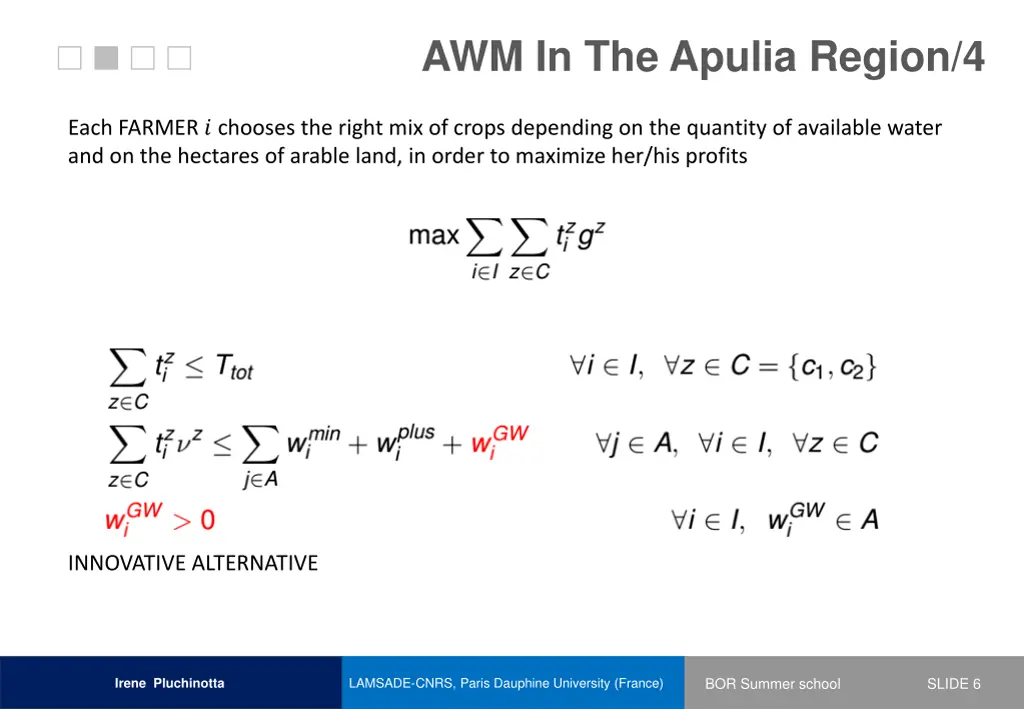
AWM In The Apulia Region/4 Each FARMER ? chooses the right mix of crops depending on the quantity of available water and on the hectares of arable land, in order to maximize her/his profits INNOVATIVE ALTERNATIVE BOR Summer school SLIDE 6 LAMSADE-CNRS, Paris Dauphine University (France) Irene Pluchinotta
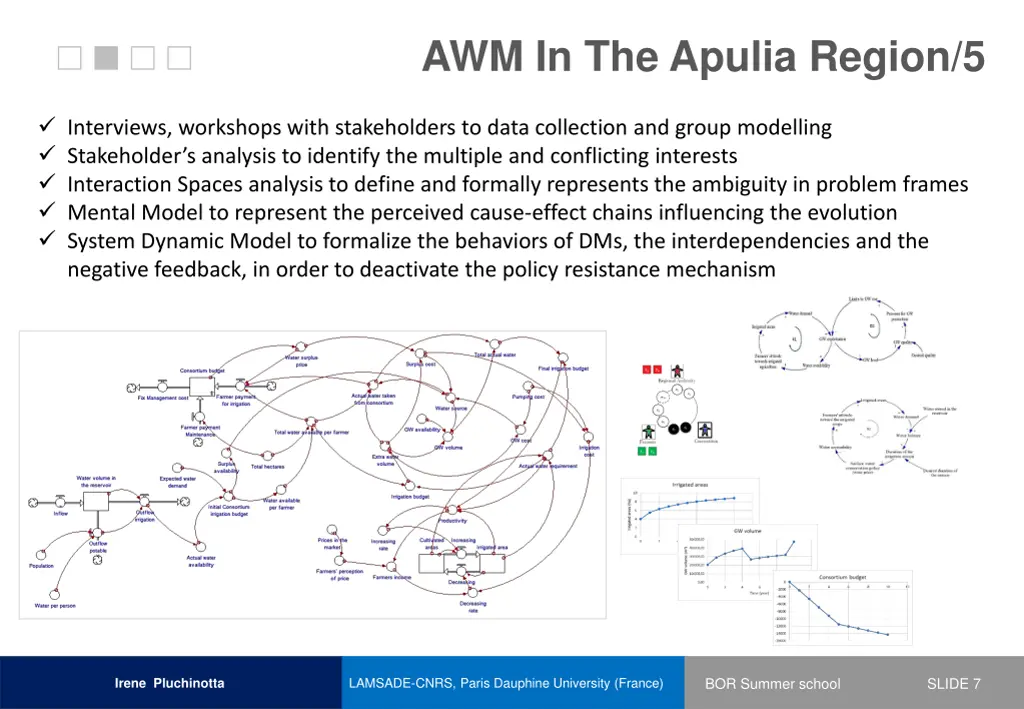
AWM In The Apulia Region/5 Interviews, workshops with stakeholders to data collection and group modelling Stakeholder s analysis to identify the multiple and conflicting interests Interaction Spaces analysis to define and formally represents the ambiguity in problem frames Mental Model to represent the perceived cause-effect chains influencing the evolution System Dynamic Model to formalize the behaviors of DMs, the interdependencies and the negative feedback, in order to deactivate the policy resistance mechanism BOR Summer school SLIDE 7 LAMSADE-CNRS, Paris Dauphine University (France) Irene Pluchinotta
Public Policy Design BEHAVIORAL PERSPECTIVE The traditional set of alternatives is defined as a compromise between different constraints and technical criteria and often it brings unexpected behavioral reactions The DMs as well as the analyst are subject to behavioral effects. Embracing the behavioral perspective helps generating theoretical insights and innovative alternatives INNOVATIVE POLICY DESIGN The innovation is the capacity to expand the boundaries of the decision space, modifying the set of alternatives and inducing the adjustment of the actors behaviors A worthy policy design process has a preponderant impact on the quality of the alternative policies being considered DESIGN PROCESS Design theory could develop a different perspective on the problem in order to explore how innovative policies can be laid out BOR Summer school SLIDE 8 LAMSADE-CNRS, Paris Dauphine University (France) Irene Pluchinotta
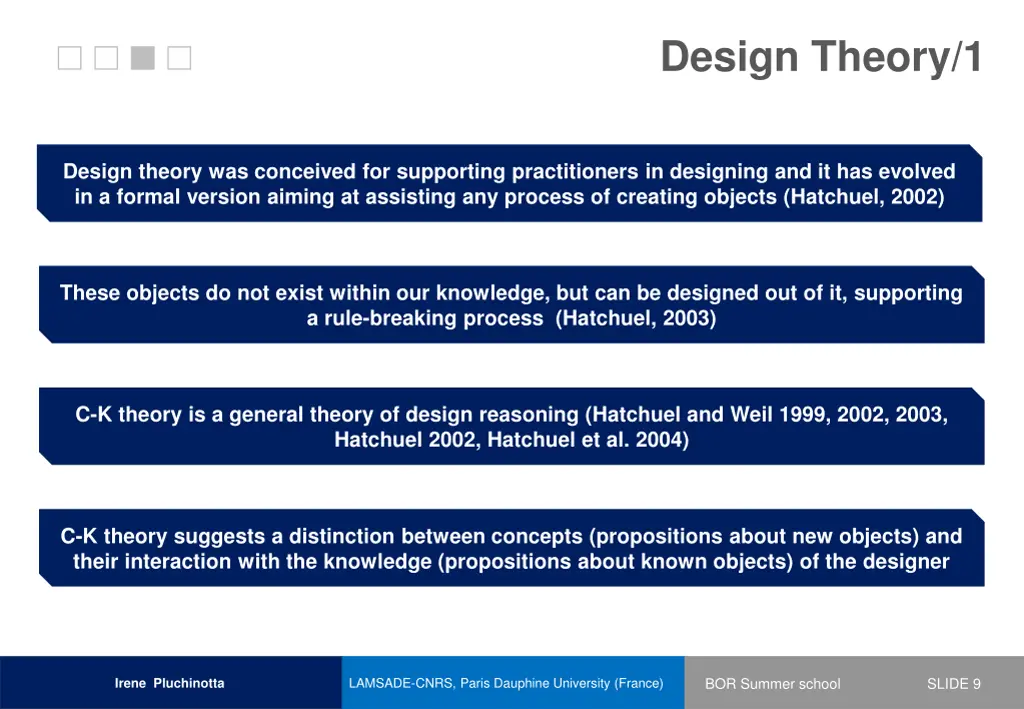
Design Theory/1 Design theory was conceived for supporting practitioners in designing and it has evolved in a formal version aiming at assisting any process of creating objects (Hatchuel, 2002) These objects do not exist within our knowledge, but can be designed out of it, supporting a rule-breaking process (Hatchuel, 2003) C-K theory is a general theory of design reasoning (Hatchuel and Weil 1999, 2002, 2003, Hatchuel 2002, Hatchuel et al. 2004) C-K theory suggests a distinction between concepts (propositions about new objects) and their interaction with the knowledge (propositions about known objects) of the designer BOR Summer school SLIDE 9 LAMSADE-CNRS, Paris Dauphine University (France) Irene Pluchinotta
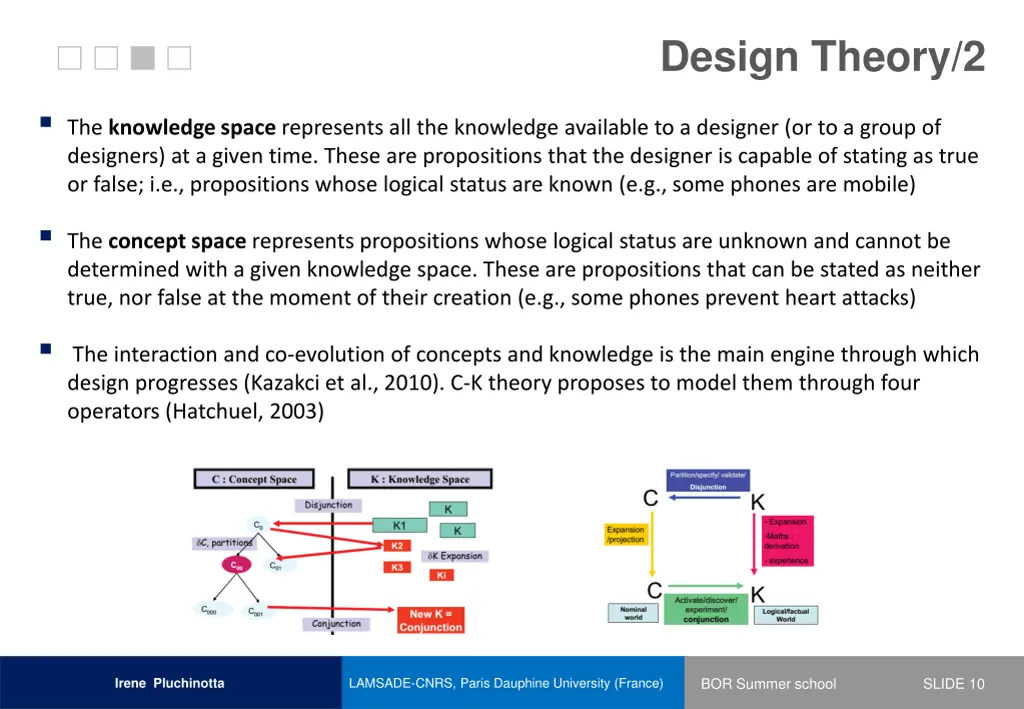
Design Theory/2 The knowledge space represents all the knowledge available to a designer (or to a group of designers) at a given time. These are propositions that the designer is capable of stating as true or false; i.e., propositions whose logical status are known (e.g., some phones are mobile) The concept space represents propositions whose logical status are unknown and cannot be determined with a given knowledge space. These are propositions that can be stated as neither true, nor false at the moment of their creation (e.g., some phones prevent heart attacks) The interaction and co-evolution of concepts and knowledge is the main engine through which design progresses (Kazakci et al., 2010). C-K theory proposes to model them through four operators (Hatchuel, 2003) BOR Summer school SLIDE 10 LAMSADE-CNRS, Paris Dauphine University (France) Irene Pluchinotta
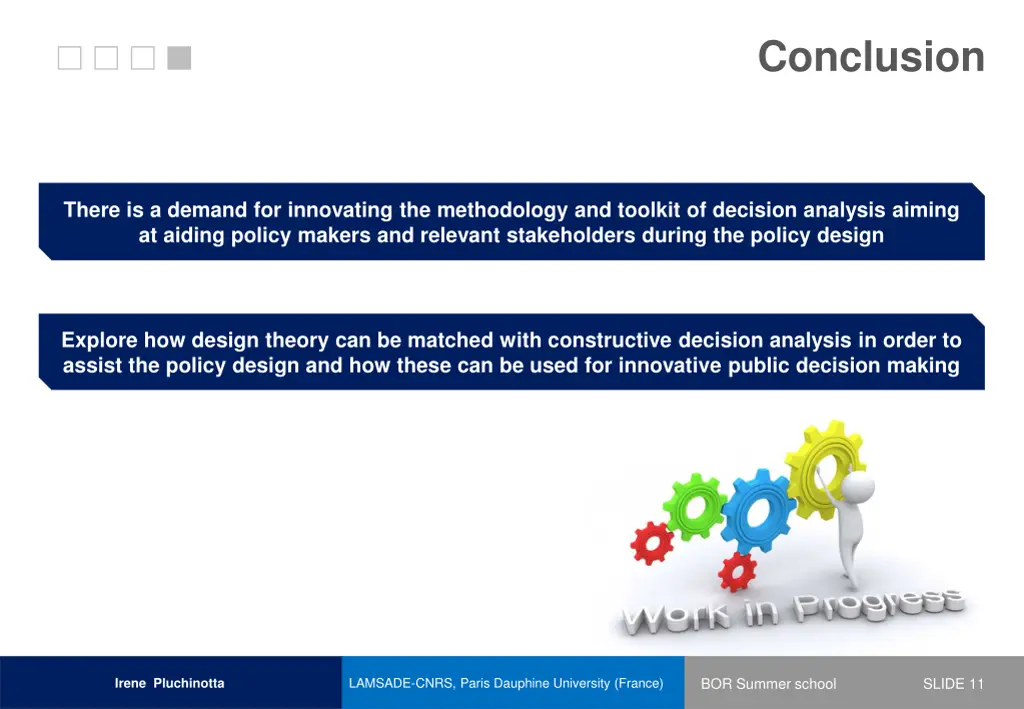
Conclusion There is a demand for innovating the methodology and toolkit of decision analysis aiming at aiding policy makers and relevant stakeholders during the policy design Explore how design theory can be matched with constructive decision analysis in order to assist the policy design and how these can be used for innovative public decision making BOR Summer school SLIDE 11 LAMSADE-CNRS, Paris Dauphine University (France) Irene Pluchinotta
PAPERS: Giordano, R. et al., (2013). Bayesian Belief Network to support conflict analysis for groundwater protection: The case of the Apulia region. Journal of Environmental Management, 15, 136-146. Portoghese, I., et al., (2013). An integrated modelling tool to evaluate the acceptability of irrigation constraint measures for groundwater protection. Environmental Modelling & Software, 46, 90-103. Giordano, R. et al., (2015). Evaluating acceptability of groundwater protection measures under different agricultural policies. Agricultural Water Management, Giordano R., Brugnach M., Pluchinotta I., Ambiguity in problem framing as a barrier to collective actions: some hints from groundwater protection policy in the Apulia Region, Group Decision and Negotiation. Under review Pluchinotta I. et al., A System Dynamic Analysis to deal with complexity in water resources management: the case of groundwater protection in the Apulia region. Paper in progress Ferretti V., Pluchinotta I., Tsouki s A., How to design innovatively public policies? Paper in progress Pluchinotta I., Kazakci A., Tsouki s A, Innovative public policy making assisted by design theory: is it possible? Paper in progress BOR Summer school SLIDE 12 LAMSADE-CNRS, Paris Dauphine University (France) Irene Pluchinotta
Thank you! Irene Pluchinotta irene.pluchinotta@dauphine.fr BOR Summer school SLIDE 13 LAMSADE-CNRS, Paris Dauphine University (France) Irene Pluchinotta