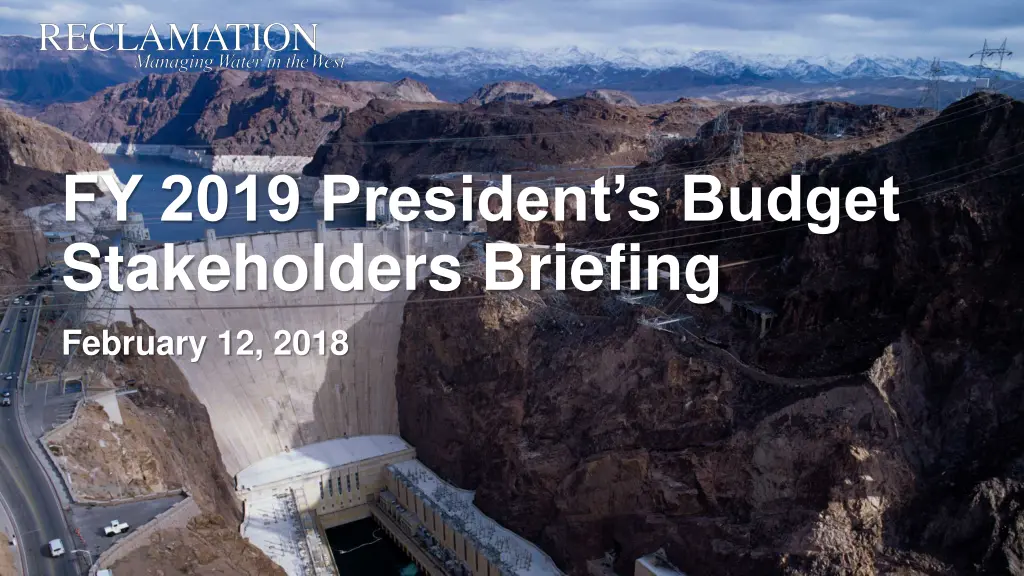
The FY 2019 budget for the Bureau of Reclamation continues to prioritize water management, development, and protection to ensure water reliability, energy efficiency, recreation opportunities, and environmental responsibilities in the West. The budget focuses on maintaining water supplies, efficient energy generation through hydropower, and promoting conservation efforts for future water delivery and power generation.
Please find below an Image/Link to download the presentation.
The content on the website is provided AS IS for your information and personal use only. It may not be sold, licensed, or shared on other websites without obtaining consent from the author. If you encounter any issues during the download, it is possible that the publisher has removed the file from their server.
You are allowed to download the files provided on this website for personal or commercial use, subject to the condition that they are used lawfully. All files are the property of their respective owners.
The content on the website is provided AS IS for your information and personal use only. It may not be sold, licensed, or shared on other websites without obtaining consent from the author.
They FY 2019 budget continues to support Reclamation s mission The mission of the Bureau of Reclamation is to manage, develop, and protect water and related resources in an environmentally and economically sound manner in the interest of the American public. 2
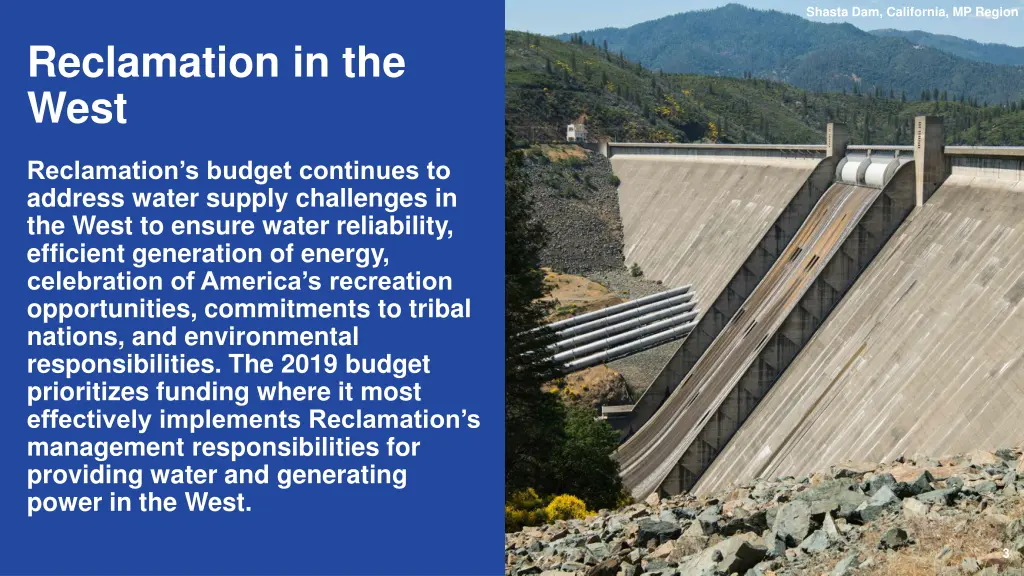
Shasta Dam, California, MP Region Reclamation in the West Reclamation s budget continues to address water supply challenges in the West to ensure water reliability, efficient generation of energy, celebration of America s recreation opportunities, commitments to tribal nations, and environmental responsibilities. The 2019 budget prioritizes funding where it most effectively implements Reclamation s management responsibilities for providing water and generating power in the West. 3
Planning for our Future Water Reliability Water reliability is a key cornerstone of the Reclamation mission Maintaining efficient water supplies that ensure a safe and sound infrastructure, ensure treaty agreements and tribal obligations are met, meet environmental standards all play a critical role Efficient Energy Generation As the Nation s second largest producer of hydroelectric power, Reclamation s projects and programs constitute an important driver of economic growth Maintaining and modernizing hydropower infrastructure to improve generation efficiency and reliability and improve cost effectiveness is a high priority. Significant funding is provided directly by power customers and Western and Bonneville Power Administrations 4
Planning for our Future (cont.) Recreation Access Many Reclamation projects provide multi-purpose water resource development benefits, including recreation Recreation areas developed represent today some of the most popular areas for water-based outdoor recreation activities Conservation Theodore Roosevelt, sometimes referred to as the conservationist president , established a legacy through land and wildlife conservation Endorsing those principles, Reclamation strives to ensure future water delivery and power generation through the responsible use and conservation of its resources Water storage studies are ongoing to determine where resources can be focused now to deliver a broad return later; the WaterSMART and R&D programs continually strive to discover more efficient use of our resources 5
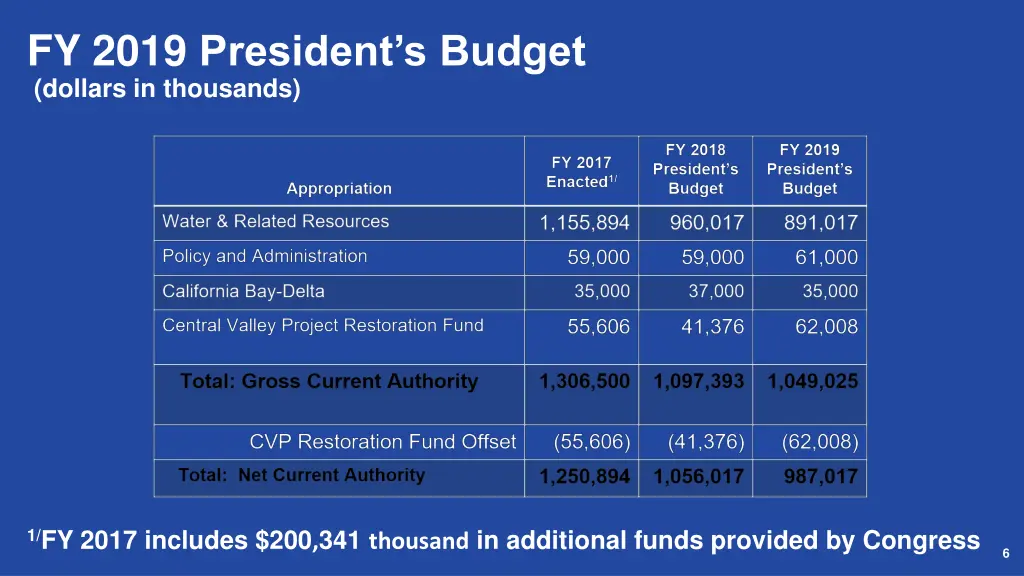
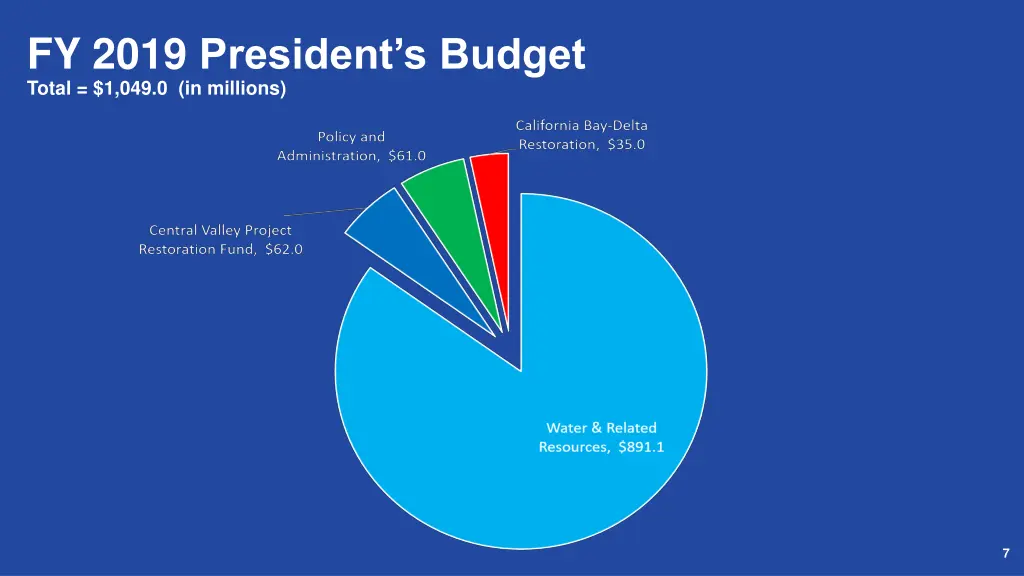
FY 2019 Presidents Budget (dollars in thousands) 1/FY 2017 includes $200,341 thousand in additional funds provided by Congress 6
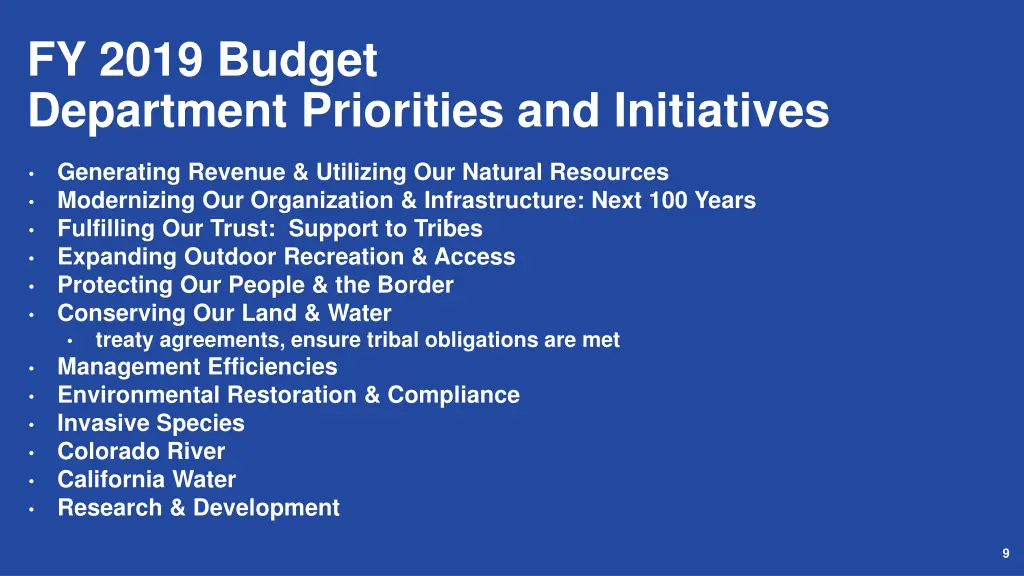
FY 2019 Budget Department Priorities and Initiatives Generating Revenue & Utilizing Our Natural Resources Modernizing Our Organization & Infrastructure: Next 100 Years Fulfilling Our Trust: Support to Tribes Expanding Outdoor Recreation & Access Protecting Our People & the Border Conserving Our Land & Water treaty agreements, ensure tribal obligations are met Management Efficiencies Environmental Restoration & Compliance Invasive Species Colorado River California Water Research & Development 9
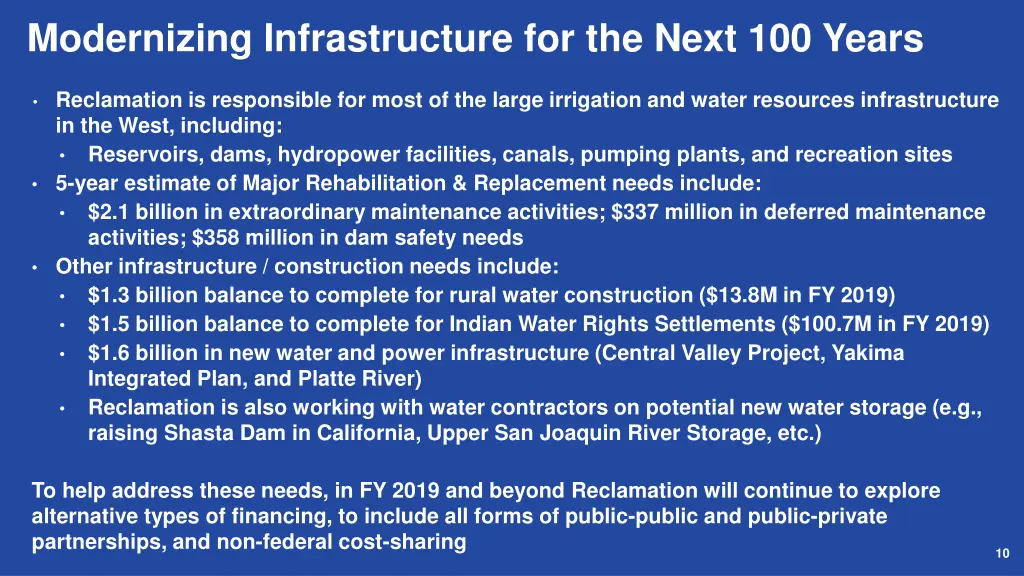
Modernizing Infrastructure for the Next 100 Years Reclamation is responsible for most of the large irrigation and water resources infrastructure in the West, including: Reservoirs, dams, hydropower facilities, canals, pumping plants, and recreation sites 5-year estimate of Major Rehabilitation & Replacement needs include: $2.1 billion in extraordinary maintenance activities; $337 million in deferred maintenance activities; $358 million in dam safety needs Other infrastructure / construction needs include: $1.3 billion balance to complete for rural water construction ($13.8M in FY 2019) $1.5 billion balance to complete for Indian Water Rights Settlements ($100.7M in FY 2019) $1.6 billion in new water and power infrastructure (Central Valley Project, Yakima Integrated Plan, and Platte River) Reclamation is also working with water contractors on potential new water storage (e.g., raising Shasta Dam in California, Upper San Joaquin River Storage, etc.) To help address these needs, in FY 2019 and beyond Reclamation will continue to explore alternative types of financing, to include all forms of public-public and public-private partnerships, and non-federal cost-sharing 10
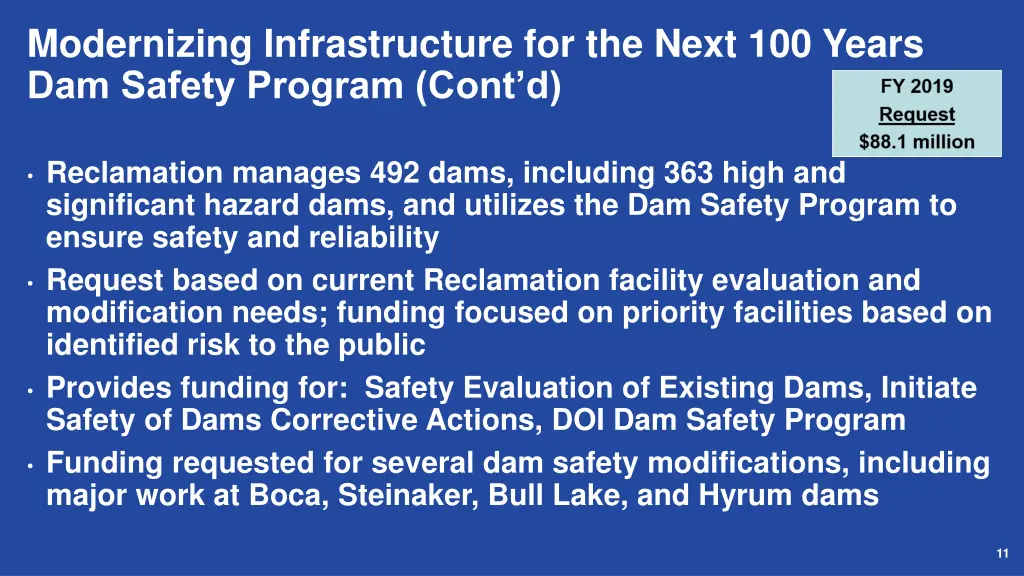
Modernizing Infrastructure for the Next 100 Years Dam Safety Program (Cont d) Reclamation manages 492 dams, including 363 high and significant hazard dams, and utilizes the Dam Safety Program to ensure safety and reliability Request based on current Reclamation facility evaluation and modification needs; funding focused on priority facilities based on identified risk to the public Provides funding for: Safety Evaluation of Existing Dams, Initiate Safety of Dams Corrective Actions, DOI Dam Safety Program Funding requested for several dam safety modifications, including major work at Boca, Steinaker, Bull Lake, and Hyrum dams 11
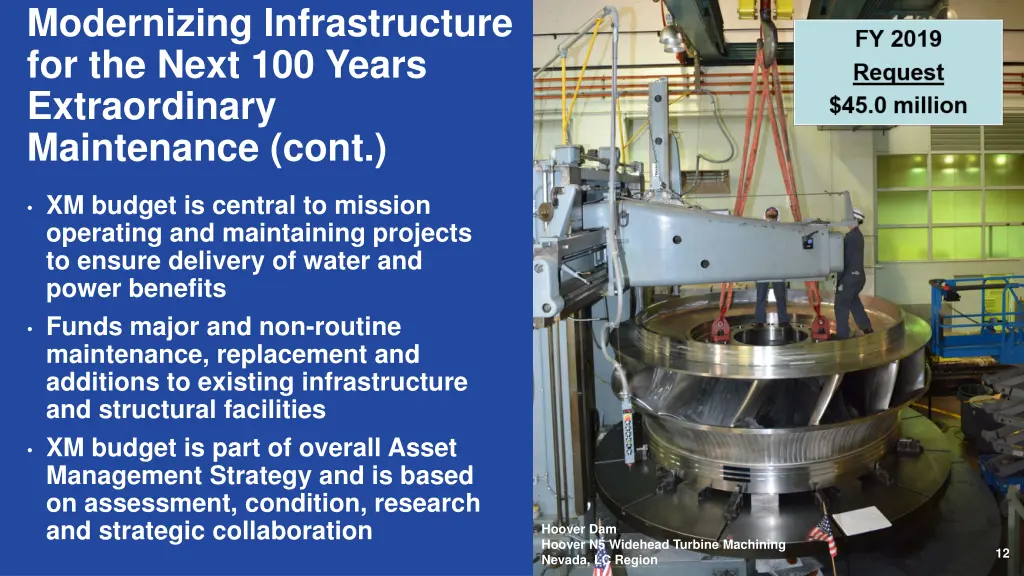
Modernizing Infrastructure for the Next 100 Years Extraordinary Maintenance (cont.) XM budget is central to mission operating and maintaining projects to ensure delivery of water and power benefits Funds major and non-routine maintenance, replacement and additions to existing infrastructure and structural facilities XM budget is part of overall Asset Management Strategy and is based on assessment, condition, research and strategic collaboration Hoover Dam Hoover N5 Widehead Turbine Machining Nevada, LC Region 12
Generating Revenue and Utilizing Our Natural Resources - Economy Per the DOI Economic Report of FY 2016, Reclamation activities are estimated to contribute $48.1 billion in economic output and support approximately 388,000 jobs Western economies are built on Reclamation water projects Maintain and modernize infrastructure Help develop and construct new infrastructure Environmental Restoration supports recreation based services As the largest wholesale supplier and manager of water in the nation, Reclamation projects and activities are foundational to economic growth Reclamation operates 53 hydroelectric power plants that account for 15% of the hydroelectric capacity and generation in the U.S. Reclamation generates 37 billion kilowatt hours of electricity to meet the needs of over 3.5 million households, and it collects over $1.0 billion in gross power revenues. 13
Generating Revenue and Utilizing Our Natural Resources - Energy The FY 2019 President s Budget includes $1.1 million to support domestic energy security initiatives Goal is to achieve operational efficiencies of hydropower facilities and promote development of new, non-federal hydropower on existing non-powered Reclamation facilities Small Federal investment leverages large non-Reclamation investments (e.g., Bonneville Power Administration, other power customers) Funding supports ongoing work for automated data collection, performance testing, regulatory compliance, etc. The FY 2019 budget also requests significant funds for ongoing operation and maintenance at a number of hydroelectric power plants. In addition to the budget request, approximately 80 percent of power generation and infrastructure costs come directly from customers and other federal agencies 14
Fulfilling our Trust: Support to Tribes Reclamation s efforts to support tribal nations are long standing and include implementation of water rights settlements, technical assistance, fisheries restoration, and rural water supply projects . The FY 2019 request funds a number of projects supporting tribal nations. Examples include: $127.4 million for Indian water rights settlements including: Navajo-Gallup Water Supply Project (NM); Crow Tribe Water Rights Settlement (MT); Aamodt Litigation Settlement (NM); Blackfeet Water Rights Settlement (MT); Nez Perce Settlement (ID) ; Ak-Chin Indian Water Rights Settlement (AZ); San Carlos Apache (AZ); and the Colorado Ute Settlement Act (CO) $33.9 million for rural water projects that support tribal nations $10.6 million for the Native American Affairs Program Many other projects that include tribal benefits, such as: Klamath Project; Trinity River Restoration Program; and the Yakima River Basin Water Enhancement Project 15
Expanding Outdoor Recreation and Access Reclamation uses a multipurpose approach to water resource development that includes recreation, and plays a major role in providing access to recreation facilities and opportunities Projects include approximately 6.5 million acres of land and water and over 290 recreation areas (Reclamation directly manages 42) available to the public resulting in approximately 90 million visits annually Over 166 recreation areas are managed through public partnership arrangements to meet public needs and expectations. Reclamation's land and water-based outdoor recreation opportunities often include camping, hiking, boating, and many other activities Projects have created national wildlife refuges and state wildlife management areas that offer valuable fish and wildlife habitat along with hunting and fishing opportunities 16
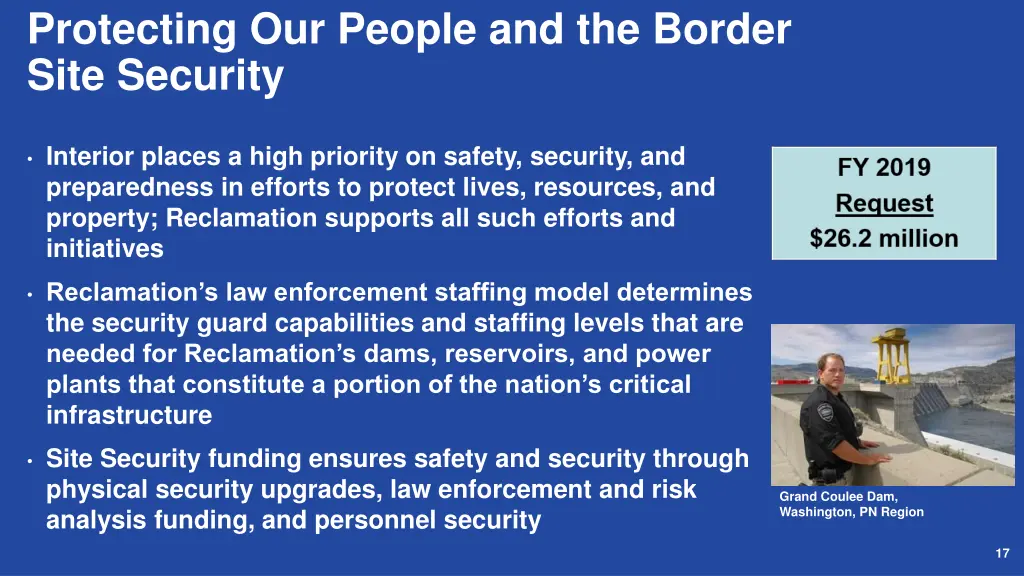
Protecting Our People and the Border Site Security Interior places a high priority on safety, security, and preparedness in efforts to protect lives, resources, and property; Reclamation supports all such efforts and initiatives Reclamation s law enforcement staffing model determines the security guard capabilities and staffing levels that are needed for Reclamation s dams, reservoirs, and power plants that constitute a portion of the nation s critical infrastructure Site Security funding ensures safety and security through physical security upgrades, law enforcement and risk analysis funding, and personnel security Grand Coulee Dam, Washington, PN Region 17
Conserving Land and Water WaterSMART supports Reclamation s collaboration with non- Federal partners in efforts to address emerging water demands and water shortage issues in the West, to promote water conservation and improved water management, and to take actions to mitigate adverse environmental impacts of Reclamation projects Promotes reliable solutions and economic productivity Includes funding for cost-shared grants, basin-wide efforts to address water supply, Title XVI water recycling, collaborative watershed groups, and water conservation/drought activities 18
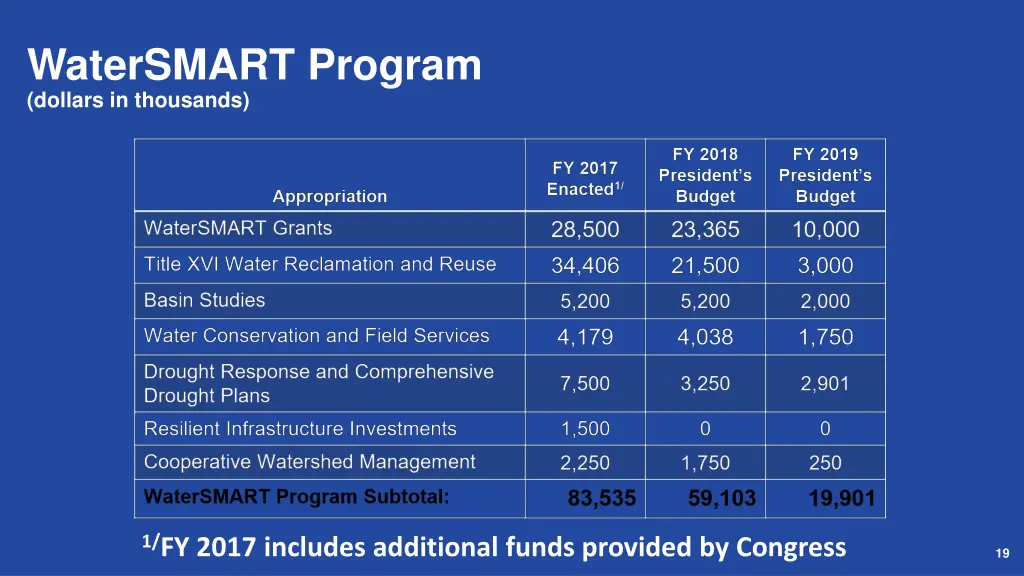
WaterSMART Program (dollars in thousands) 1/FY 2017 includes additional funds provided by Congress 19
Management Efficiencies Reclamation s FY 2019 budget includes efforts to support and improve Federal effectiveness, efficiency, cybersecurity, and accountability through: Title Transfer Legislative Proposal would facilitate transfer of title when beneficial to all parties Partner Funding continued emphasis to seek leveraging of non-Federal and other Federal dollars Ensure resources are located where needed to best serve public Limited footprint in East for impact in West Federal IT Acquisition Reform Act (FITARA) evaluating, upgrading, and potentially replacing IT systems to manage facilities and protect infrastructure Data Modernization support of the open water data initiative 20
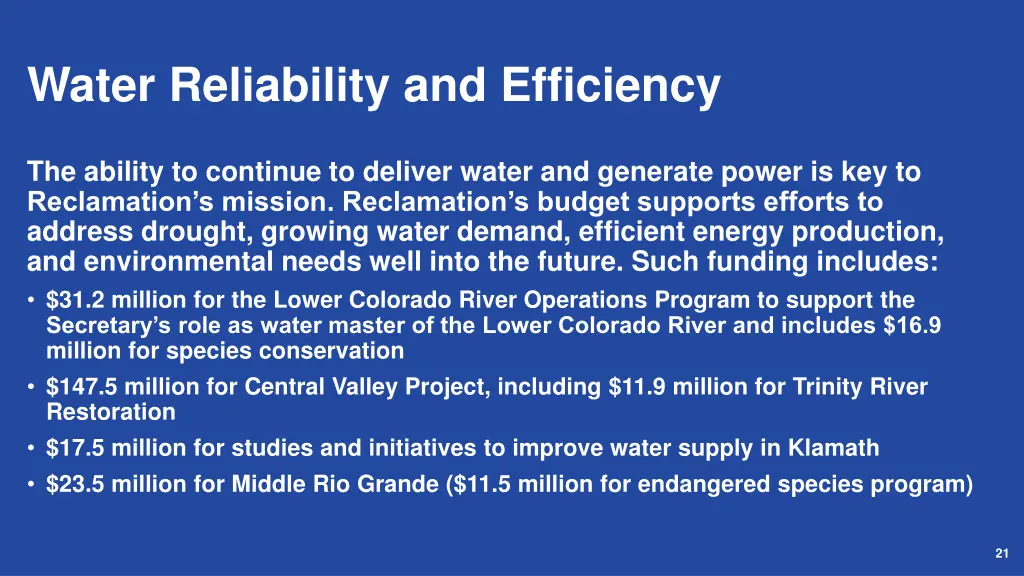
Water Reliability and Efficiency The ability to continue to deliver water and generate power is key to Reclamation s mission. Reclamation s budget supports efforts to address drought, growing water demand, efficient energy production, and environmental needs well into the future. Such funding includes: $31.2 million for the Lower Colorado River Operations Program to support the Secretary s role as water master of the Lower Colorado River and includes $16.9 million for species conservation $147.5 million for Central Valley Project, including $11.9 million for Trinity River Restoration $17.5 million for studies and initiatives to improve water supply in Klamath $23.5 million for Middle Rio Grande ($11.5 million for endangered species program) 21
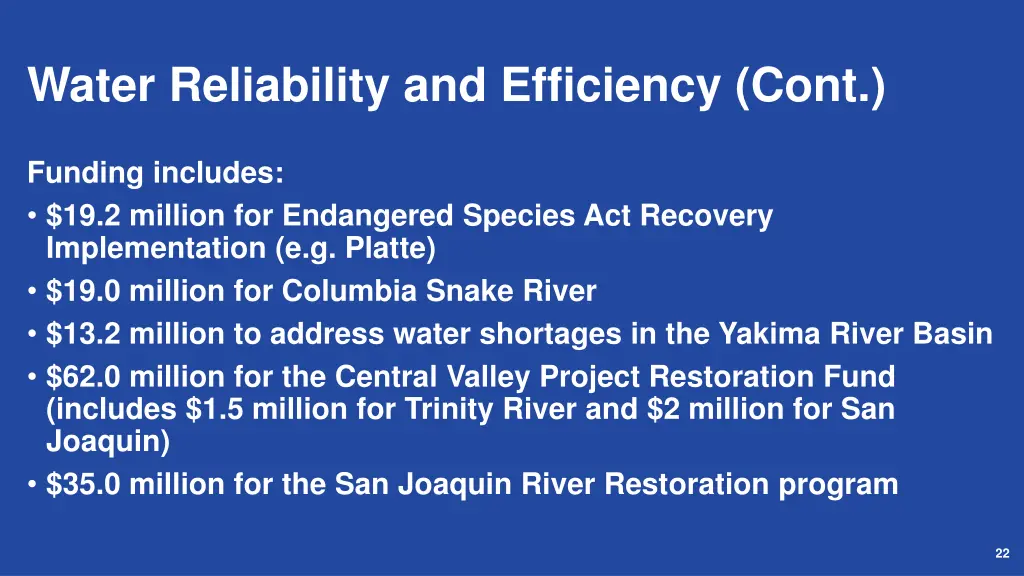
Water Reliability and Efficiency (Cont.) Funding includes: $19.2 million for Endangered Species Act Recovery Implementation (e.g. Platte) $19.0 million for Columbia Snake River $13.2 million to address water shortages in the Yakima River Basin $62.0 million for the Central Valley Project Restoration Fund (includes $1.5 million for Trinity River and $2 million for San Joaquin) $35.0 million for the San Joaquin River Restoration program 22
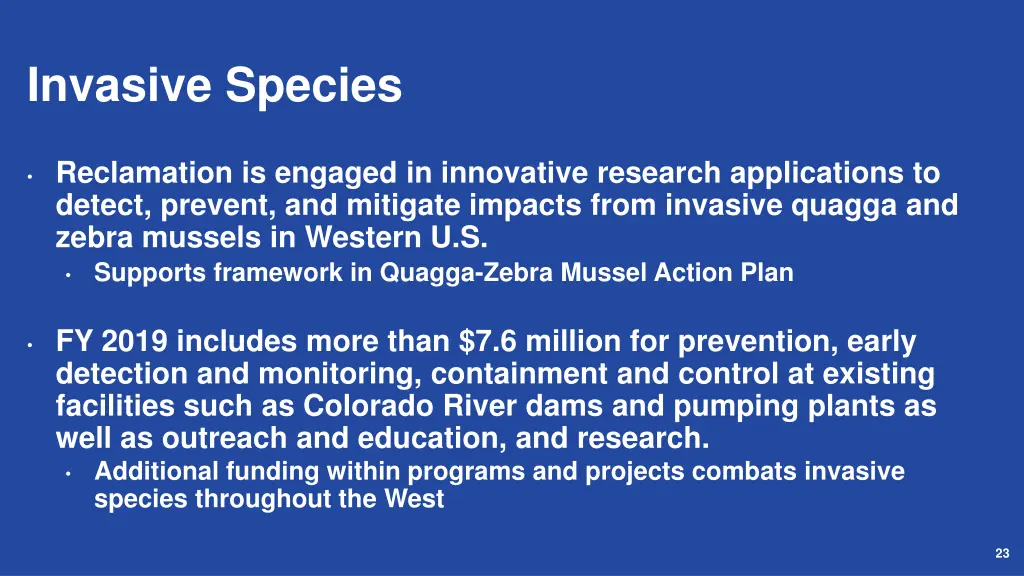
Invasive Species Reclamation is engaged in innovative research applications to detect, prevent, and mitigate impacts from invasive quagga and zebra mussels in Western U.S. Supports framework in Quagga-Zebra Mussel Action Plan FY 2019 includes more than $7.6 million for prevention, early detection and monitoring, containment and control at existing facilities such as Colorado River dams and pumping plants as well as outreach and education, and research. Additional funding within programs and projects combats invasive species throughout the West 23
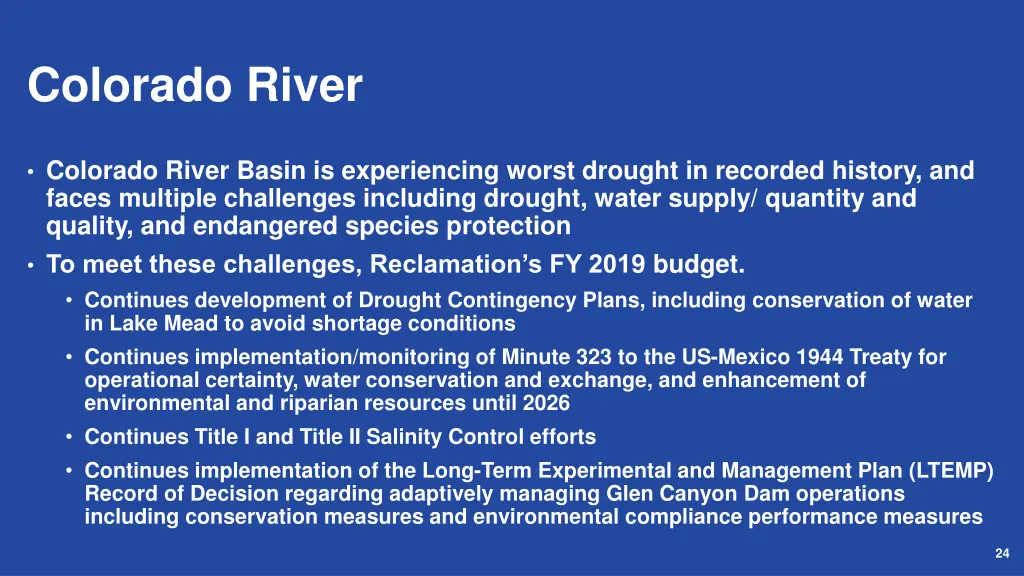
Colorado River Colorado River Basin is experiencing worst drought in recorded history, and faces multiple challenges including drought, water supply/ quantity and quality, and endangered species protection To meet these challenges, Reclamation s FY 2019 budget. Continues development of Drought Contingency Plans, including conservation of water in Lake Mead to avoid shortage conditions Continues implementation/monitoring of Minute 323 to the US-Mexico 1944 Treaty for operational certainty, water conservation and exchange, and enhancement of environmental and riparian resources until 2026 Continues Title I and Title II Salinity Control efforts Continues implementation of the Long-Term Experimental and Management Plan (LTEMP) Record of Decision regarding adaptively managing Glen Canyon Dam operations including conservation measures and environmental compliance performance measures 24
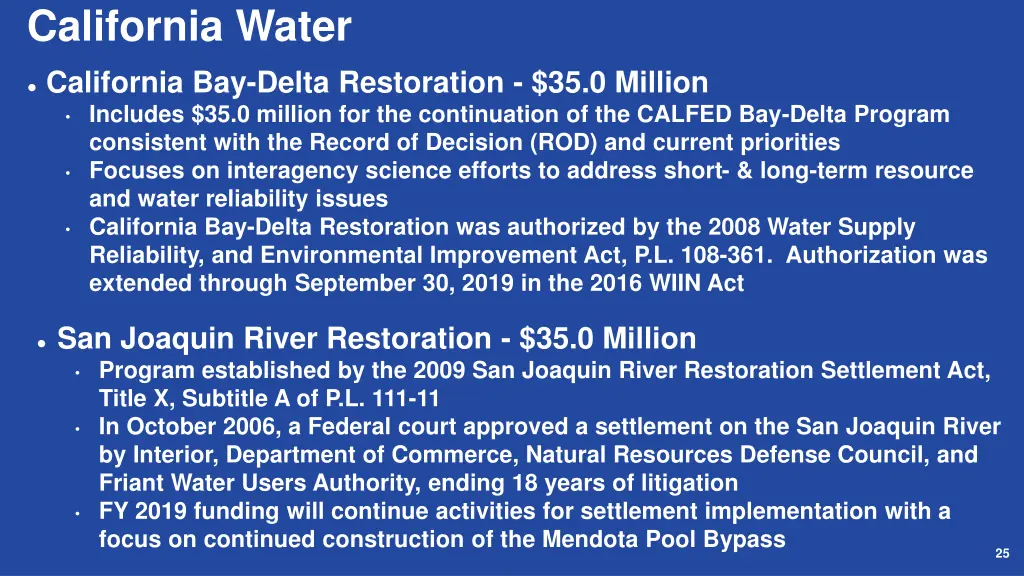
California Water California Bay-Delta Restoration - $35.0 Million Includes $35.0 million for the continuation of the CALFED Bay-Delta Program consistent with the Record of Decision (ROD) and current priorities Focuses on interagency science efforts to address short- & long-term resource and water reliability issues California Bay-Delta Restoration was authorized by the 2008 Water Supply Reliability, and Environmental Improvement Act, P.L. 108-361. Authorization was extended through September 30, 2019 in the 2016 WIIN Act San Joaquin River Restoration - $35.0 Million Program established by the 2009 San Joaquin River Restoration Settlement Act, Title X, Subtitle A of P.L. 111-11 In October 2006, a Federal court approved a settlement on the San Joaquin River by Interior, Department of Commerce, Natural Resources Defense Council, and Friant Water Users Authority, ending 18 years of litigation FY 2019 funding will continue activities for settlement implementation with a focus on continued construction of the Mendota Pool Bypass 25
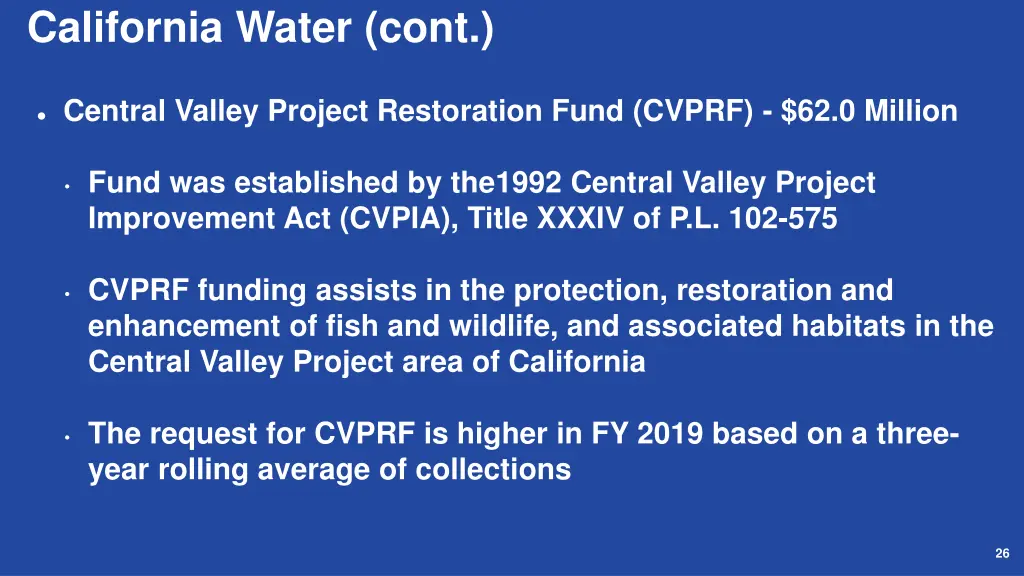
California Water (cont.) Central Valley Project Restoration Fund (CVPRF) - $62.0 Million Fund was established by the1992 Central Valley Project Improvement Act (CVPIA), Title XXXIV of P.L. 102-575 CVPRF funding assists in the protection, restoration and enhancement of fish and wildlife, and associated habitats in the Central Valley Project area of California The request for CVPRF is higher in FY 2019 based on a three- year rolling average of collections 26
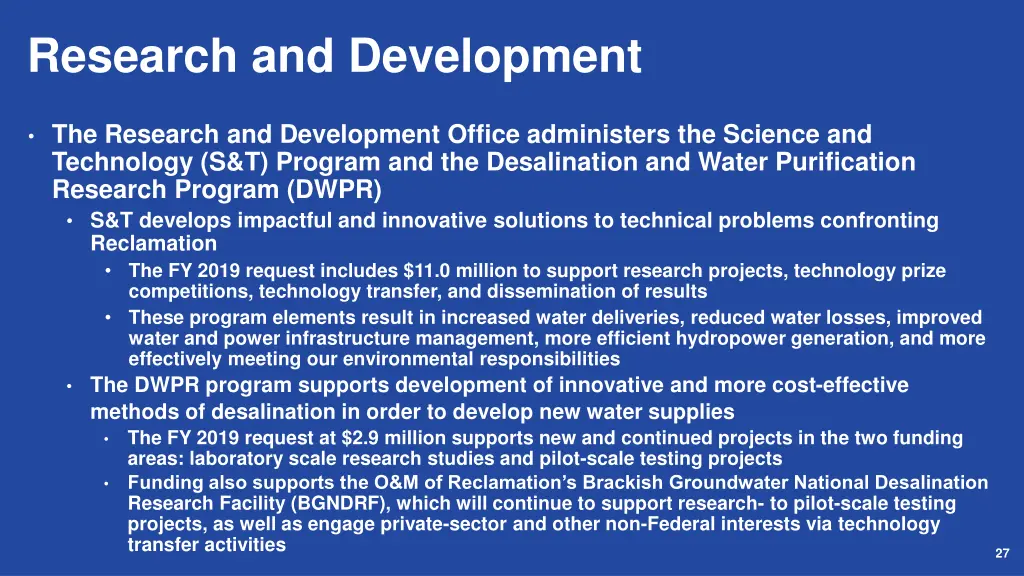
Research and Development The Research and Development Office administers the Science and Technology (S&T) Program and the Desalination and Water Purification Research Program (DWPR) S&T develops impactful and innovative solutions to technical problems confronting Reclamation The FY 2019 request includes $11.0 million to support research projects, technology prize competitions, technology transfer, and dissemination of results These program elements result in increased water deliveries, reduced water losses, improved water and power infrastructure management, more efficient hydropower generation, and more effectively meeting our environmental responsibilities The DWPR program supports development of innovative and more cost-effective methods of desalination in order to develop new water supplies The FY 2019 request at $2.9 million supports new and continued projects in the two funding areas: laboratory scale research studies and pilot-scale testing projects Funding also supports the O&M of Reclamation s Brackish Groundwater National Desalination Research Facility (BGNDRF), which will continue to support research- to pilot-scale testing projects, as well as engage private-sector and other non-Federal interests via technology transfer activities 27
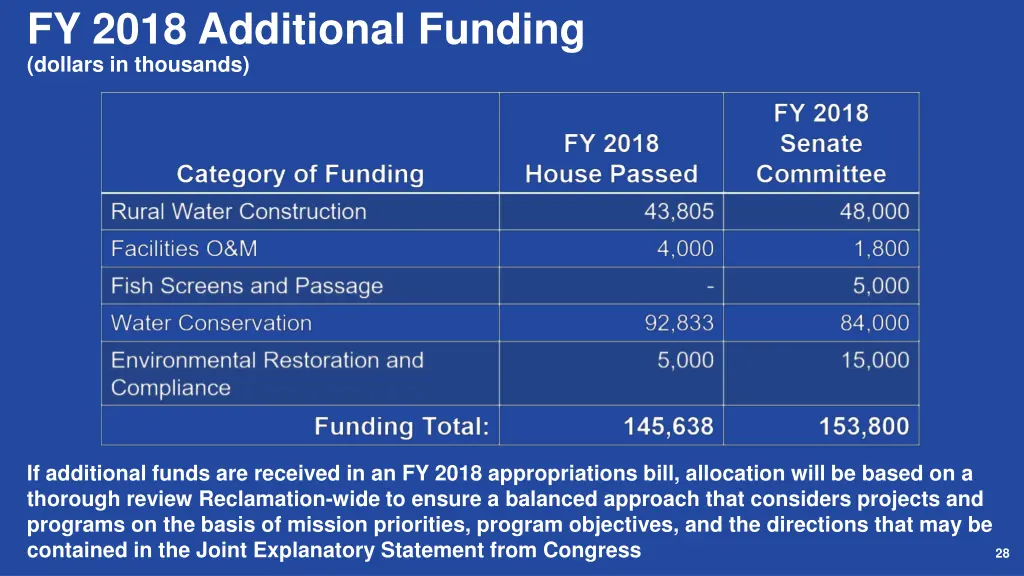
FY 2018 Additional Funding (dollars in thousands) If additional funds are received in an FY 2018 appropriations bill, allocation will be based on a thorough review Reclamation-wide to ensure a balanced approach that considers projects and programs on the basis of mission priorities, program objectives, and the directions that may be contained in the Joint Explanatory Statement from Congress 28