Supporting Sustainable Development and Fisheries Management in the Pacific Region
Providing resources, knowledge, and partnerships to fight poverty and enhance environmental sustainability. The World Bank Group, through its various bodies like IBRD, IDA, and IFC, aims to reduce poverty, support development in middle-income and poorer countries, and assist small island economies. The office in Sydney serves member countries in the Pacific Islands, focusing on strategic guidance for sustainable fisheries management.

Download Presentation

Please find below an Image/Link to download the presentation.
The content on the website is provided AS IS for your information and personal use only. It may not be sold, licensed, or shared on other websites without obtaining consent from the author. If you encounter any issues during the download, it is possible that the publisher has removed the file from their server.
You are allowed to download the files provided on this website for personal or commercial use, subject to the condition that they are used lawfully. All files are the property of their respective owners.
The content on the website is provided AS IS for your information and personal use only. It may not be sold, licensed, or shared on other websites without obtaining consent from the author.
E N D
Presentation Transcript
Aims to fight poverty and help people help themselves and their environment by providing resources, sharing knowledge, building capacity and forging partnerships in the public and private sectors Provides low-interest loans, interest-free credits and grants to developing countries for investments in education, health, public administration, infrastructure, financial and private sector development, agriculture and environmental and natural resource management Founded in 1944, now owned by 187 member countries 10,000 staff in offices in over 100 countries 2
The two main development bodies: International Bank for Reconstruction and Development middle-income and creditworthy poorer countries International Development Association on poorest countries, also supports small island economies which are above the operational cut-off (US$ 1,165 GNI/ capita in FY 2011) but lack the creditworthiness needed to borrow from IBRD. Also includes: International Finance Corporation private sector development Several other specialised agencies International Bank for Reconstruction and Development (IBRD) - aims to reduce poverty in International Development Association (IDA) - focuses International Finance Corporation (IFC) supports 3
The World Bank Group office in Sydney, Australia services Bank member countries in Timor-Leste, PNG and the Pacific Islands. Represents IBRD, IDA, IFC and other WBG agencies PI Bank member countries are FSM, Fiji, Kiribati, Marshall Islands, Samoa, Solomon Islands, Palau, PNG, Tonga, Tuvalu and Vanuatu. Timor-Leste is also included WBG has not historically supported the PI fisheries sector very much, but is now developing a fisheries engagement strategy in recognition of the economic importance of fisheries to the region 4
Will provide 3-5 year strategic guidance to the way the WBG supports sustainable development and management of fisheries in its PI member countries Includes both oceanic and coastal fisheries components Aims to use the Bank s strengths in areas of policy development, economic analysis and leverage, synergies through partnerships and cooperation, knowledge products and inter-regional information sharing Must complement and enhance current national/ regional strategies and ongoing/ planned fisheries activities without duplication 5
In regard to Oceanic Fisheries, the FES will propose: Organisational/ institutional development of the Parties to the Nauru Agreement (PNA) Office Operationalisation of the PNA Vessel-Day Scheme (VDS) for tuna purse-seine fishery management; Possible extension of the VDS (or other rights-based scheme) to tuna longline fisheries, especially in the Te Vaka Moana (TVM) member countries Specialised technical studies crew placement, labour mobility, investment opportunities/ barriers, IUU, energy issues in industrial fisheries (some already done or started) 6
Guiding principles are: Supporting national efforts to improve sustainable development and management of coastal resources Strengthening management at various levels policy, legislation, MCS, private sector and communities Development and use of economic incentives/ disincentives that improve fishery management Promoting regional cooperation where this leads to economic gain or improved efficiency (e.g. harmonised management approaches, information-sharing, TCDC, collective bargaining, coordination of external relations) Consideration of non-fishery impacts (coastal development, climate change) and ecosystem issues 7
Proposed core activity under FES is rebuilding and restoration of sea cucumber (BDM) fisheries: BDM fisheries drastically over-exploited and present significant management challenges in all PI countries Great economic potential at community and national levels, which justifies the funding Potential economic benefits from regional cooperation/ harmonisation of management approaches (a BDM cartel ) and information/ knowledge sharing Opportunity/ need for participation/ intervention at several levels government (policy, MCS), technical/ R&D (e.g restocking), private sector, communities, civil society and NGO/ CBO BDM fishery restoration presents opportunity to demonstrate fishery management benefits more broadly 8
Series of national sub-projects in interested countries, each with clearly defined goals, work programmes and financing arrangements Not all components need be replicated in each country or implemented at the same rate national programmes tailored to needs and capacity Brought together by an umbrella or coordination arrangement responsible for promoting regional cooperation and information exchange Regional component best carried out through existing regional fishery institution(s) rather than creating something new 9
FES will not be restricted exclusively to BDM fishery restoration this is a core component but national sub-projects may identify additional needs/ priorities Need initial assessment of costs and economic benefits of proposed activities to justify funding (benefits BDM fishery restoration anticipated to be very significant in most cases) Requires partnership with agencies having relevant specialist knowledge and skills (e.g. in community outreach, BDM hatchery/ restocking, etc) Support to community-level activities should not be restricted exclusively to BDM fisheries, but encompass broader CBM/ EACFM interests 10
WBG manages Trust Funds from various developed member countries, including Australia and New Zealand, which can be used to support smaller projects, studies and technical assistance Larger projects can be supported through IDA grants and credits. IDA credits are interest-free* loans with repayments over 35 to 40 years, including a 10-year grace period All PI Bank member countries except Fiji and Palau are eligible for IDA grants and credits Fiji, Palau and PNG are also eligible for IBRD loans *Service fee of 0.75% p.a. 11
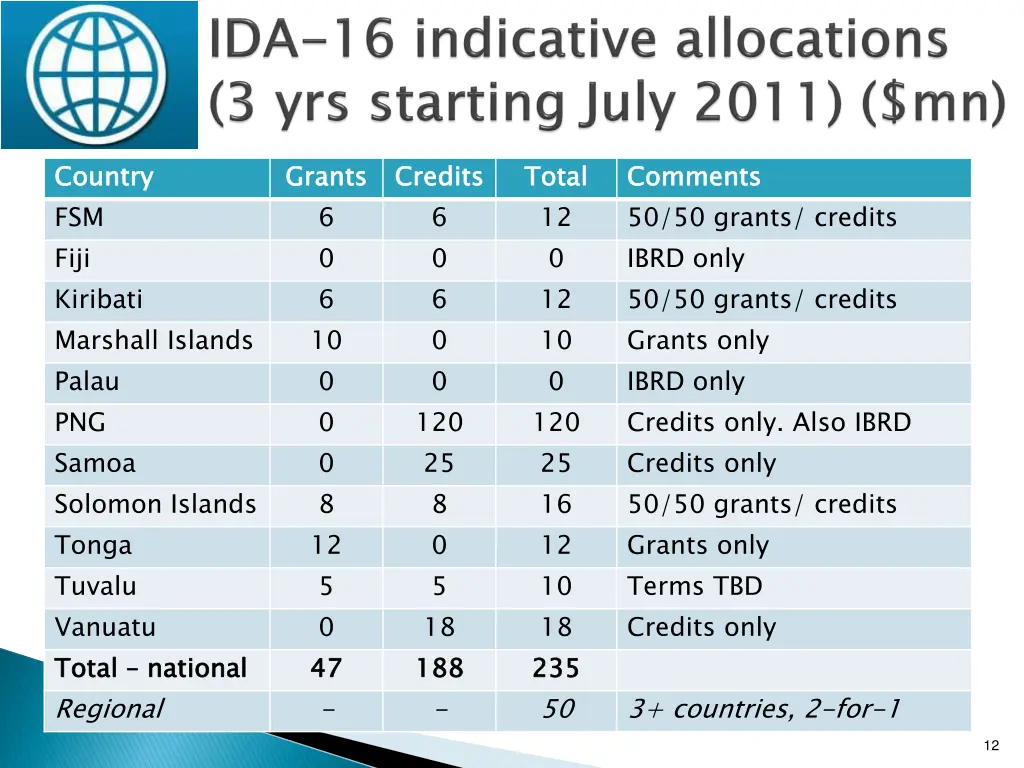
Country FSM Fiji Kiribati Marshall Islands Palau PNG Samoa Solomon Islands Tonga Tuvalu Vanuatu Total Regional Country Grants 6 0 6 10 0 0 0 8 12 5 0 47 - Grants Credits 6 0 6 0 0 120 25 8 0 5 18 188 - Credits Total Total 12 0 12 10 0 120 25 16 12 10 18 235 50 Comments Comments 50/50 grants/ credits IBRD only 50/50 grants/ credits Grants only IBRD only Credits only. Also IBRD Credits only 50/50 grants/ credits Grants only Terms TBD Credits only Total national national 47 188 235 3+ countries, 2-for-1 12
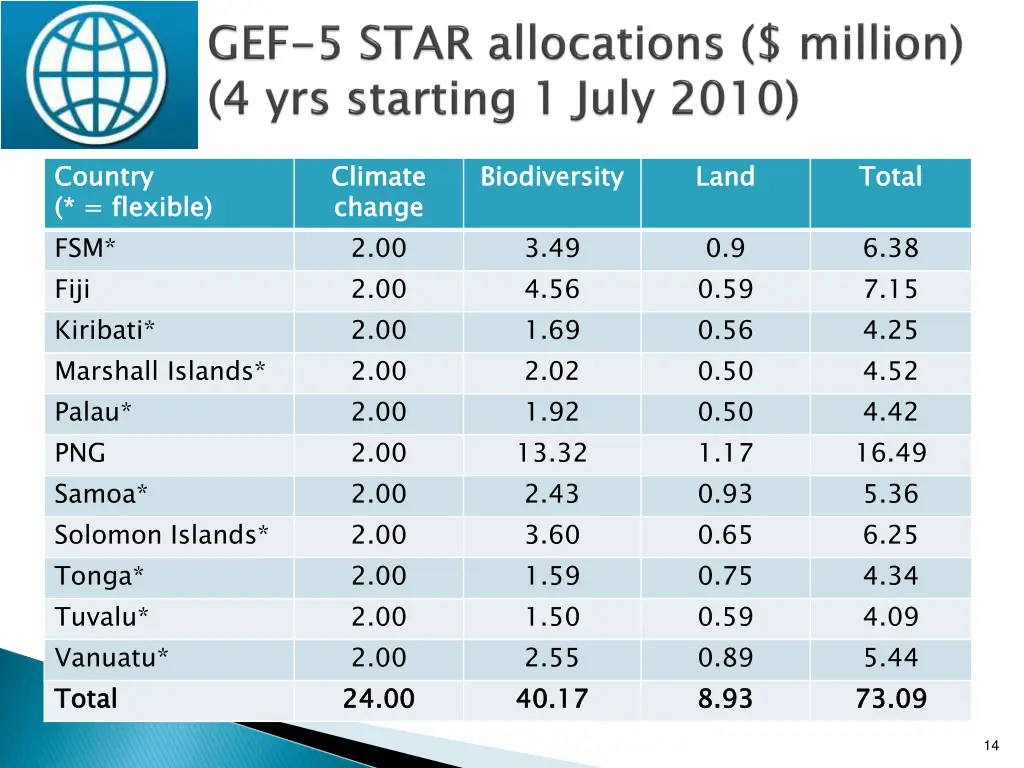
GEF provides incremental funding i.e. additional funds that enhance environmental benefits by supplementing activities already underway WB is one of 10 partner agencies through which GEF funds are channelled GEF 5 (July 2010 July 2014) uses a new System for Transparent Allocation of Resources (STAR) to pre-allocate funds to countries in 3 areas Climate Change, Biodiversity Conservation and Land Management All PI Bank member countries have GEF STAR allocations, managed through GEF focal points (usually Environment Depts) 13
Country (* = flexible) FSM* Fiji Kiribati* Marshall Islands* Palau* PNG Samoa* Solomon Islands* Tonga* Tuvalu* Vanuatu* Total Country (* = flexible) Climate change 2.00 2.00 2.00 2.00 2.00 2.00 2.00 2.00 2.00 2.00 2.00 24.00 Climate change Biodiversity Biodiversity Land Land Total Total 3.49 4.56 1.69 2.02 1.92 13.32 2.43 3.60 1.59 1.50 2.55 40.17 0.9 0.59 0.56 0.50 0.50 1.17 0.93 0.65 0.75 0.59 0.89 8.93 6.38 7.15 4.25 4.52 4.42 16.49 5.36 6.25 4.34 4.09 5.44 73.09 Total 24.00 40.17 8.93 73.09 14
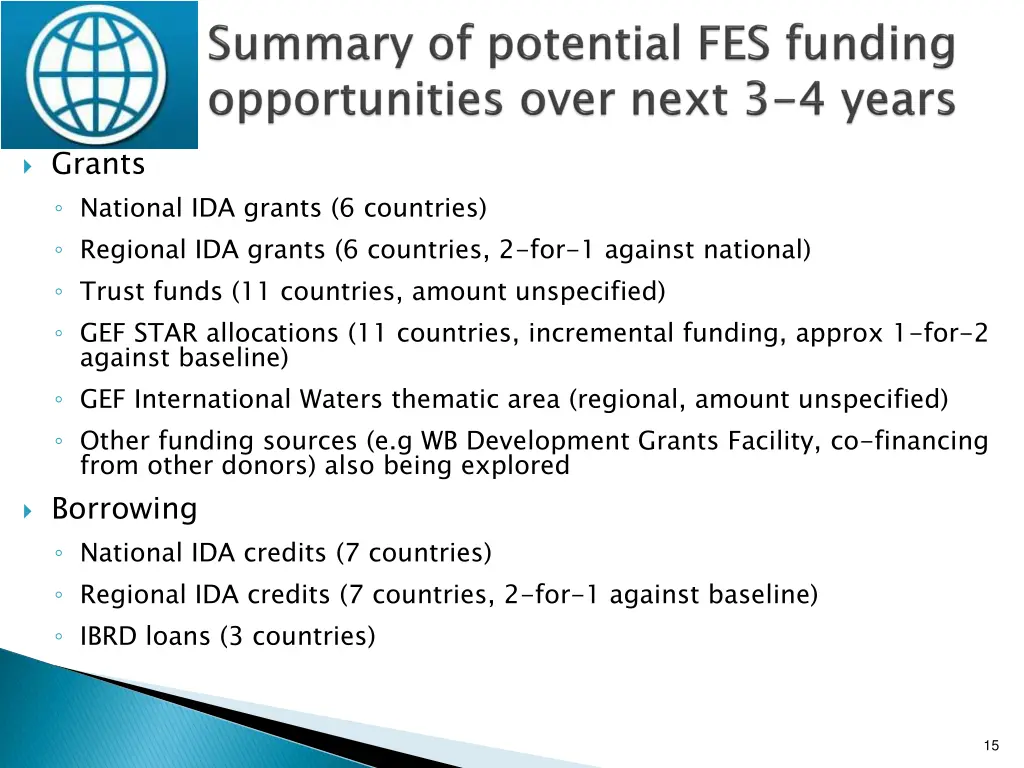
Grants National IDA grants (6 countries) Regional IDA grants (6 countries, 2-for-1 against national) Trust funds (11 countries, amount unspecified) GEF STAR allocations (11 countries, incremental funding, approx 1-for-2 against baseline) GEF International Waters thematic area (regional, amount unspecified) Other funding sources (e.g WB Development Grants Facility, co-financing from other donors) also being explored Borrowing National IDA credits (7 countries) Regional IDA credits (7 countries, 2-for-1 against baseline) IBRD loans (3 countries) 15
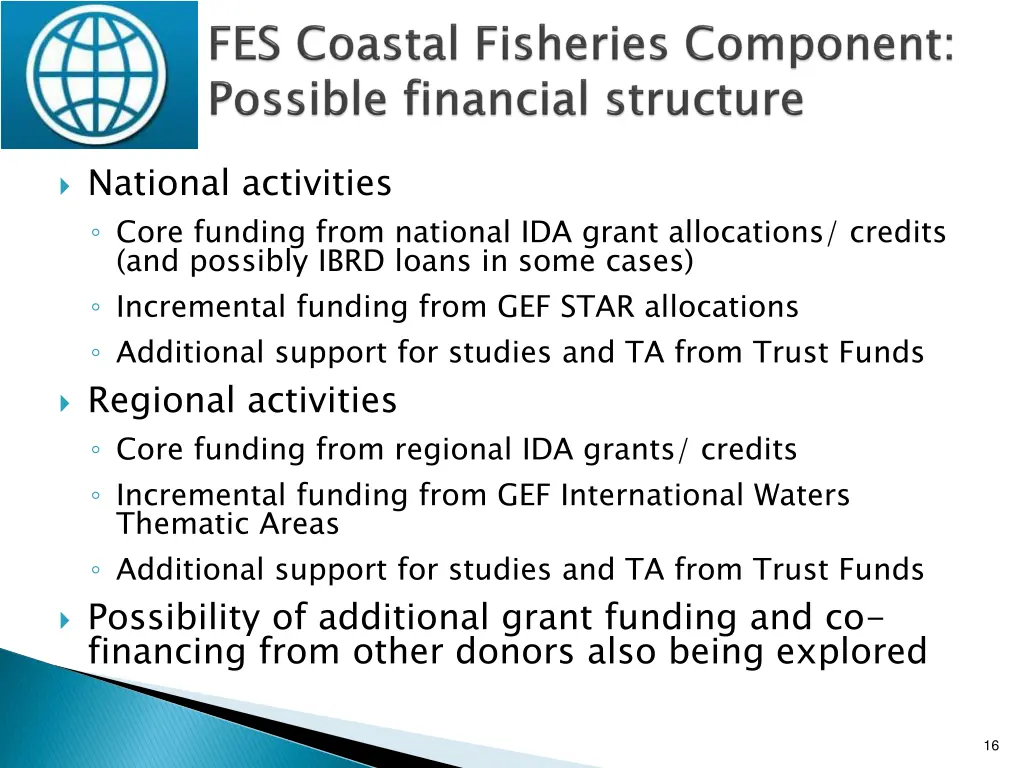
National activities Core funding from national IDA grant allocations/ credits (and possibly IBRD loans in some cases) Incremental funding from GEF STAR allocations Additional support for studies and TA from Trust Funds Regional activities Core funding from regional IDA grants/ credits Incremental funding from GEF International Waters Thematic Areas Additional support for studies and TA from Trust Funds Possibility of additional grant funding and co- financing from other donors also being explored 16
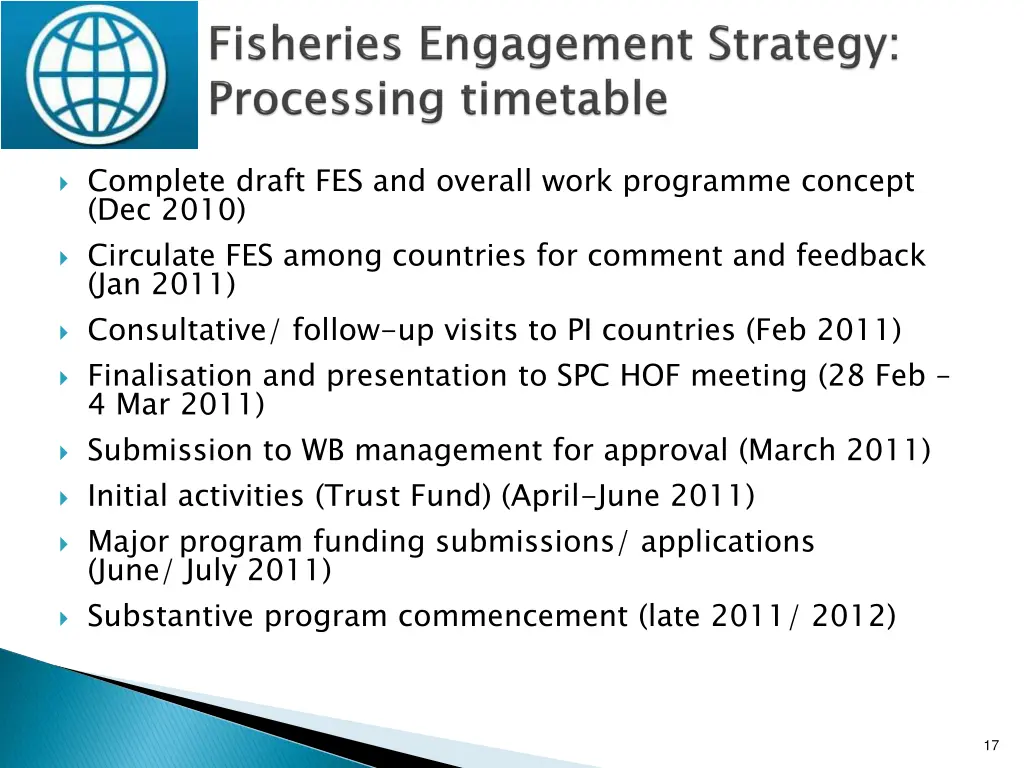
Complete draft FES and overall work programme concept (Dec 2010) Circulate FES among countries for comment and feedback (Jan 2011) Consultative/ follow-up visits to PI countries (Feb 2011) Finalisation and presentation to SPC HOF meeting (28 Feb 4 Mar 2011) Submission to WB management for approval (March 2011) Initial activities (Trust Fund) (April-June 2011) Major program funding submissions/ applications (June/ July 2011) Substantive program commencement (late 2011/ 2012) 17
Summary information circulated to by WBG to national Fisheries/ Environment Departments Awareness-raising by Fisheries/ Environment Departments to bring the FES to the attention of national decision-makers and Central Agencies (Ministries of Finance and Planning) for consideration for IDA grant/ credit funding Dialogue between Fisheries/ Environment Departments and other stakeholders to assess prospects for accessing GEF STAR national allocations 18