Explore significant Supreme Court decisions regarding criminal and immigration law for the 2021-2022 term. Cases include Flying Fickle Finger of Fate Award - Denezpi v. United States and First Step Act - Concepcion v. United States. Delve into discussions on double jeopardy, sentencing guidelines, and the First Step Act's impact on retroactive relief. Stay informed of key legal developments with expert analysis by Michael B. Shapiro, J.D., and Peter Fenton, J.D.
Please find below an Image/Link to download the presentation.
The content on the website is provided AS IS for your information and personal use only. It may not be sold, licensed, or shared on other websites without obtaining consent from the author. If you encounter any issues during the download, it is possible that the publisher has removed the file from their server.
You are allowed to download the files provided on this website for personal or commercial use, subject to the condition that they are used lawfully. All files are the property of their respective owners.
The content on the website is provided AS IS for your information and personal use only. It may not be sold, licensed, or shared on other websites without obtaining consent from the author.
E N D
Presentation Transcript
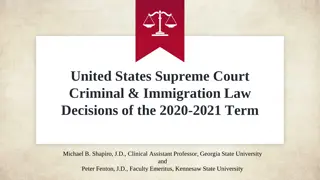
United States Supreme Court Criminal & Immigration Law Decisions of the 2021-2022 Term Michael B. Shapiro, J.D., Clinical Associate Professor, Georgia State University and Peter Fenton, J.D., Kennesaw State University
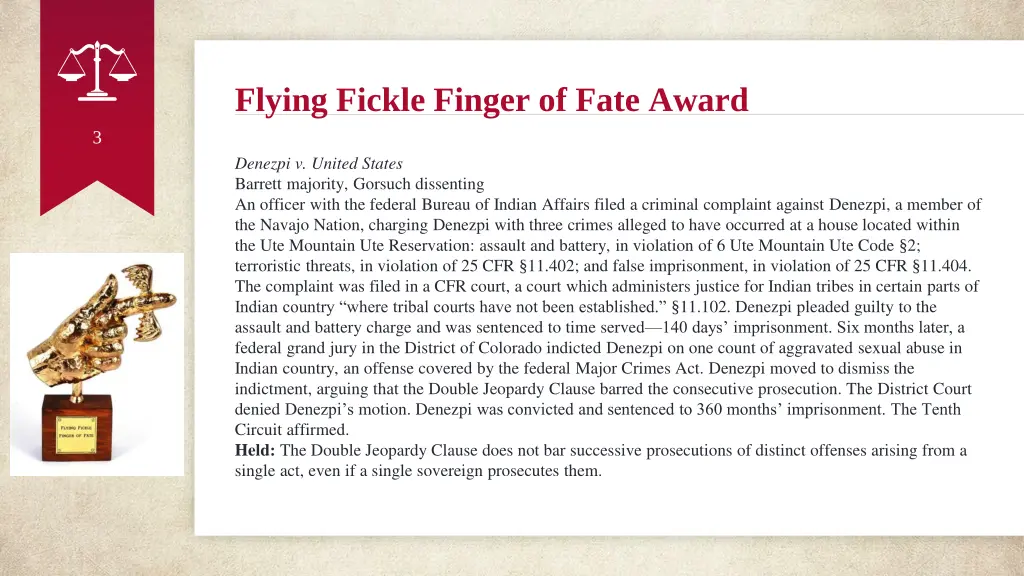
Flying Fickle Finger of Fate Award 3 Denezpi v. United States Barrett majority, Gorsuch dissenting An officer with the federal Bureau of Indian Affairs filed a criminal complaint against Denezpi, a member of the Navajo Nation, charging Denezpi with three crimes alleged to have occurred at a house located within the Ute Mountain Ute Reservation: assault and battery, in violation of 6 Ute Mountain Ute Code 2; terroristic threats, in violation of 25 CFR 11.402; and false imprisonment, in violation of 25 CFR 11.404. The complaint was filed in a CFR court, a court which administers justice for Indian tribes in certain parts of Indian country where tribal courts have not been established. 11.102. Denezpi pleaded guilty to the assault and battery charge and was sentenced to time served 140 days imprisonment. Six months later, a federal grand jury in the District of Colorado indicted Denezpi on one count of aggravated sexual abuse in Indian country, an offense covered by the federal Major Crimes Act. Denezpi moved to dismiss the indictment, arguing that the Double Jeopardy Clause barred the consecutive prosecution. The District Court denied Denezpi s motion. Denezpi was convicted and sentenced to 360 months imprisonment. The Tenth Circuit affirmed. Held: The Double Jeopardy Clause does not bar successive prosecutions of distinct offenses arising from a single act, even if a single sovereign prosecutes them.
First Step Act 4 Concepcion v. United States Sotomayor majority, Kavanaugh dissenting In 2007, Concepcion pleaded guilty to distributing five or more grams of crack cocaine and was sentenced in 2009 to 19 years (228 months) in prison as a career offender, increasing his Sentencing Guidelines range from 57 to 71 months to 262 to 327 months. Subsequently Congress passed the Fair Sentencing Act of 2010 to correct the wide disparity between crack and powder cocaine sentencing, but the Act did not apply retroactively. In2011, the Sentencing Commission amended the Guidelines to lower the range for crack-cocaine offenses and applied that reduction retroactively for some defendants. Because Concepcion was sentenced as a career offender, he was not eligible for relief under the Sentencing Commission s 2011 amendment. In 2018, Congress enacted the First Step Act, authorizing district courts to impose a reduced sentence on defendants serving sentences for certain crack-cocaine offenses. In 2019, Concepcion filed for a sentence reduction under the First Step Act, contending that retroactive application of the Fair Sentencing Act lowered his Guidelines range from 262 to 327 months to 188 to 235 months, arguing that he would no longer be considered a career offender because one of his prior convictions had been vacated and thus his revised Guidelines range should be 57 to 71 months. The District Court denied Concepcion s motion based on its judgment that the First Step Act did not authorize such relief. The Court of Appeals affirmed in a divided opinion and added to the disagreement among the Circuits as to whether a district court deciding a First Step Act motion must, may, or may not consider intervening changes of law or fact. Held: The First Step Act allows district courts to consider intervening changes of law or fact in exercising their discretion to reduce a sentence.
Sixth Amendment Confrontation Clause 5 Hemphill v. New York Sotomayor majority, Alito concurring, Thomas dissenting In 2006, a stray 9-millimeter bullet killed a child after a street fight. Police determined Gilliam was involved and that Morris had been at the scene. A search of Morris apartment revealed a 9-millimeter cartridge and three .357-caliber bullets. Gilliam initially identified Morris as the shooter, but later said that Hemphill, Gilliam s cousin, was the shooter. Despite the recantation, the State charged Morris with murder and possession of a 9-millimeter handgun. As part of a plea, the State dismissed Morris murder charge and allowed him to plead guilty to a new charge of possession of a .357 revolver, noti the weapon that had killed the victim. Years later, the State indicted Hemphill for the murder after learning that his DNA matched a blue sweater found in Morris apartment shortly after the murder. At his trial, Hemphill elicited undisputed testimony that police had recovered 9-millimeter ammunition from Morris apartment, thus pointing to Morris as the culprit. Morris was outside the United States and thus not available to testify at Hemphill s trial. Over Hemphill s objection, the trial court allowed the State to introduce parts of the transcript of Morris plea allocution to the .357 gun possession charge as evidence to rebut Hemphill s theory that Morris committed the murder, reasoning that Hemphill s arguments and evidence had opened the door and admission of the statements was reasonably necessary to correct the misleading impression Hemphill had created. The State, in its closing argument, cited Morris plea allocution and emphasized that possession of a .357 revolver, not murder, was the crime Morris committed. The jury found Hemphill guilty, and the conviction was affirmed on appeal. Held: The trial court s admission of the transcript of Morris plea allocution over Hemphill s objection violated Hemphill s Sixth Amendment right to confront the witnesses against him.
Crimes Committed in Indian Country 6 Oklahoma v. Castro-Huerta Kavanaugh majority, Gorsuch dissenting In 2015, respondent Victor Manuel Castro-Huerta was charged by the State of Oklahoma for child neglect. Castro- Huerta was convicted in state court and sentenced to 35 years of imprisonment. While Castro-Huerta s state-court appeal was pending, this Court decided McGirt v. Oklahoma, 591 U. S. ___. There, the Court held that the Creek Nation s reservation in eastern Oklahoma had never been properly disestablished and therefore remained Indian country. Id., at ___. In light of McGirt, the eastern part of Oklahoma, including Tulsa, is recognized as Indian country. Following this development, Castro-Huerta argued that the Federal Government had exclusive jurisdiction to prosecute him (a non-Indian) for a crime committed against his step-daughter (a Cherokee Indian) in Tulsa (Indian country), and that the State therefore lacked jurisdiction to prosecute him. The Oklahoma Court of Criminal Appeals agreed and vacated his conviction. This Court granted certiorari to determine the extent of a State s jurisdiction to prosecute crimes committed by non-Indians against Indians in Indian country. Held: The Federal Government and the State have concurrent jurisdiction to prosecute crimes committed by non- Indians against Indians in Indian country.
Execution, Religious Accommodation 7 Ramirez v. Collier Roberts majority, Sotomayor concurring, Kavanaugh concurring, Thomas dissenting A Texas jury sentenced Ramirez to death for a 2004 murder. In February of 2021, Texas informed Ramirez that his execution would be in September. Ramirez filed a prison grievance requesting that his long-time pastor to be present in the execution chamber. Texas initially denied the request, then amended its execution protocol to allow a prisoner s spiritual advisor to enter the execution chamber. Subsequently, Ramirez filed another prison grievance asking that, as part of his faith, his pastor be permitted to lay hands on him and pray over him during his execution. Texas denied the request stating that spiritual advisors are not allowed to touch an inmate in the execution chamber, but pointed to no provision of its execution protocol requiring this result, and the State had a history of allowing prison chaplains to engage in such activities during executions. Ramirez appealed within the prison system. With less than a month until his execution date, and no ruling on his Step 2 grievance, Ramirez filed suit in Federal District Court alleging that the refusal of prison officials to allow his pastor to lay hands on him in the execution chamber violated his rights under the Religious Land Use and Institutionalized Persons Act of 2000 (RLUIPA) and the First Amendment. Ramirez sought injunctive relief barring state officials from executing him unless they granted the requested religious accommodation and a stay of execution while the District Court considered his claims. The District Court denied the request, as did the Fifth Circuit. Held: Ramirez is likely to succeed on his RLUIPA claims because Texas s restrictions on religious touch and audible prayer in the execution chamber burden religious exercise and are not the least restrictive means of furthering the State s compelling interests.
Mens Rea Requirement 8 Ruan v. United States Breyer majority, Alito Sotomayor concurring Ruan and Kahn are medical doctors licensed to prescribe controlled substances. Each was tried for violating 21 U. S. C. 841, which makes it a federal crime, [e]xcept as authorized[,] . . . for any person knowingly or intentionally . . . to manufacture, distribute, or dispense . . . a controlled substance. A federal regulation authorizes registered doctors to dispense controlled substances via prescription, but only if the prescription is issued for a legitimate medical purpose by an individual practitioner acting in the usual course of his professional practice. 21 CFR 1306.04(a). At issue in Ruan s and Kahn s trials was the mens rea required to convict under 841 for distributing controlled substances not as authorized. Each was ultimately convicted under 841 for prescribing in an unauthorized manner. Their convictions were separately affirmed by the Courts of Appeals. Held: Section 841 s knowingly or intentionally mens rea applies to the statute s except as authorized clause. Once a defendant meets the burden of producing evidence that his or her conduct was authorized, the Government must prove beyond a reasonable doubt that the defendant knowingly or intentionally acted in an unauthorized manner.
Federal Habeas Corpus 9 Shinn, Director, Arizona Department of Corrections, Rehabilitation and Reentry v. Ramirez Thomas majority, Sotomayor dissenting Ramirez and Jones were each convicted of capital crimes in Arizona state court and sentenced to death. The Arizona Supreme Court affirmed, and each prisoner was denied state postconviction relief. Each also filed for federal habeas relief under 28 U.S.C. 2254, arguing that trial counsel had been ineffective for failing to conduct adequate investigations. The Federal District Court held in each case that the prisoner s ineffective-assistance claim was procedurally defaulted because it was not properly presented in state court. To overcome procedural default in such cases, a prisoner must demonstrate cause to excuse the procedural defect and actual prejudice. Coleman v. Thompson, 501 U. S. 722, 750 (1991). To demonstrate cause, Ramirez and Jones relied on Martinez v. Ryan, 566 U. S. 1 (2012), which held that ineffective assistance of postconviction counsel may be cited as cause for the procedural default of an ineffective-assistance-of-trial-counsel claim. In Ramirez s case, the District Court permitted him to supplement the record with evidence not presented in state court, excused the procedural default but rejected Ramirez s ineffective-assistance claim on the merits. The Ninth Circuit reversed and remanded for more evidentiary development. In Jones case, the District Court held a lengthy evidentiary hearing on cause and prejudice, forgave his procedural default, and held that his state trial counsel had provided ineffective assistance. The State of Arizona petitioned this Court in both cases, arguing that 2254(e)(2) does not permit a federal court to order evidentiary development simply because postconviction counsel is alleged to have negligently failed to develop the state-court record. Held: Under 2254(e)(2), a federal habeas court may not conduct an evidentiary hearing or otherwise consider evidence beyond the state-court record based on the ineffective assistance of state postconviction counsel.
Qualified Immunity 10 City of Tahlequah v. Bond Per Curiam Rollice s ex-wife called 911 complaining that Rollice was in her garage intoxicated and would not leave. After police arrived and encountered Rollice, he grabbed a hammer from the back wall over the workbench and turned around to face the officers, holding the handle with both hands as if preparing to swing a baseball bat and pulled it up to shoulder level. The officers backed up, drawing their guns, yelling at Rollice to drop the hammer. Rollice took a few steps coming out from behind a piece of furniture so that he had an unobstructed path to one officer and raised the hammer higher as if he was about to throw it or charge at the officers. Both officers fired, killing Rollice. Rollice s estate filed suit against alleging that the officers were liable under 42 U.S.C. 1983, for violating Rollice s Fourth Amendment right to be free from excessive force. The officers moved for summary judgment, both on the merits and on qualified immunity grounds. The District Court granted their motion., concluding the officers use of force was reasonable, and even if not, qualified immunity prevented the case from going further. A panel of the Court of Appeals for the Tenth Circuit reversed. Held: The officers plainly did not violate any clearly established law. Rather, they engaged in a conversation with Rollice, followed him into a garage at a distance of 6 to 10 feet, and did not yell until after he picked up a hammer. Allen v. Muskogee, 119 F. 3d 837 (CA10 1997) did not clearly establish that their conduct was reckless or that their ultimate use of force was unlawful.
1983 & Termination of Criminal Prosecution 11 Thompson v. Clark, et al. Kavanaugh majority, Alito dissenting Thompson was living with his fianc e (now wife) and their newborn baby. Thompson s sister-in-law, who apparently suffered from a mental illness, called 911 to report that Thompson was sexually abusing the baby. When Emergency Medical Technicians arrived, Thompson denied that anyone had called 911. When EMTs returned four police officers, Thompson told them they could not enter without a warrant, however police nonetheless entered and handcuffed Thompson. EMTs took the baby to the hospital where medical professionals found no signs of abuse. Meanwhile, Thompson was arrested and charged with obstructing governmental administration and resisting arrest. He was held for two days before being released and the charges were dismissed before trial without any explanation by the prosecutor or judge. Thompson filed suit under 42 U.S.C. 1983, alleging several constitutional violations, including a Fourth Amendment claim for malicious prosecution. To maintain that Fourth Amendment claim under 1983, a plaintiff must demonstrate that he obtained a favorable termination of the underlying criminal prosecution, which Second Circuit precedent required a showing of some affirmative indication of innocence. The District Court held that Thompson s criminal case had not ended in a way that affirmatively indicated his innocence because Thompson could not offer any substantial evidence to explain why his case was dismissed. The Second Circuit affirmed. Held: To demonstrate a favorable termination of a criminal prosecution for purposes of the Fourth Amendment claim under 1983 for malicious prosecution, a plaintiff need not show that the criminal prosecution ended with some affirmative indication of innocence. A plaintiff need only show that his prosecution ended without a conviction. Thompson has satisfied that requirement here.
Armed Career Criminal Act 12 Wooden v. United States Kagan majority, Sotomayor concurring, Barrett concurring, Gorsuch concurring Wooden was convicted of being a felon in possession of a firearm in violation of 18 U.S.C. 922(g). The Government asked for sentencing under the Armed Career Criminal Act (ACCA) which mandates a 15-year minimum penalty for 922(g) offenders with at least three prior convictions for specified felonies committed on occasions different from one another. 924(e)(1). Wooden had ten burglary convictions arising out of a single criminal episode in 1997, when he unlawfully entered a one-building storage facility and stole items from ten different units. Prosecutors indicted Wooden on ten counts of burglary and Wooden pleaded guilty to all counts. Years later, at Wooden s sentencing hearing on his 922(g) conviction, the District Court applied ACCA s penalty enhancement in accordance with the Government s view that Wooden had commenced a new occasion of criminal activity each time he left one storage unit and entered another. The resulting sentence was almost sixteen years, much higher than the statutory maximum for Wooden s crime absent such an enhancement. The Sixth Circuit affirmed, reasoning that ACCA s occasions clause is satisfied whenever crimes take place at different moments in time that is, sequentially rather than simultaneously. Held: Wooden s ten burglary offenses arising from a single criminal episode did not occur on different occasions and thus count as only one prior conviction for purposes of ACCA.
Cases to Watch in the 2022-2023 Term 13 Cruz v. Arizona (Arizona Supreme Court) Cruz was sentenced to death in 2005. Cruz argues that he was unable to inform the jury that if he were given a sentence of life in prison, he would be ineligible for parole. After several appeals, Cruz petitioned the U.S. Supreme Court to review his case. Cruz argued the Arizona Supreme Court violated U.S. Supreme Court precedent from two previous cases. Question(s) presented: Whether the Arizona Supreme Court s holding that Arizona Rule of Criminal Procedure 32.1(g) precluded post-conviction relief is an adequate and independent state-law ground for the judgment?
Cases to Watch in the 2022-2023 Term 14 Canales v. Lumpkin (Fifth Circuit Court of Appeals) In Canales s Texas capital habeas corpus case, the U.S. Court of Appeals for the Fifth Circuit first ruled in 2014 that his trial counsel rendered deficient penalty phase performance under the standard of a reasonable probability that at least one juror would have struck a different balance. Wiggins v. Smith, 539 U.S. 510, 537 (2003. The case, which is not governed by 28 U.S.C. 2254(d)(1) deference, returned to the district court for a de novo determination of prejudice. Despite the presentation of a welter of, as the district court admitted, compelling mitigating evidence that Petitioner s jury had not heard, the district court did not find prejudice and the Fifth Circuit Court of Appeals affirmed. Question(s) presented: 1. For penalty phase ineffective assistance of counsel violations, has Harrington v. Richter, 562 U.S. 86 (2011) established a substantial likelihood standard for evaluating prejudice that exceeds the Wiggins standard of a reasonable probability that at least one juror would have struck a different balance on whether to punish by death? 2. Did the Fifth Circuit s failure to reweigh the evidence in aggravation against the totality of available mitigating evidence conflict with Wiggins and Andrus v. Texas, 590 U.S. __, 140 S. Ct. 1875 (2020)?
Cases to Watch in the 2022-2023 Term 15 Reed v. Goertz (Fifth Circuit Court of Appeals) Reed was convicted of murdering Stacey Sites in 1998 based on DNA evidence. He was sentenced to death. In 2014, Reed filed an appeal in Texas state court for DNA testing. After his motion was denied, he continued to file appeals in the Texas judicial system. The courts denied his appeal each time. Reed then filed a lawsuit in federal court claiming that the Texas courts had violated his constitutional rights. The district court dismissed Reed's lawsuit. On appeal, the 5th Circuit affirmed the lower court's decision. Reed petitioned the U.S. Supreme Court for review. Question(s) presented: [W]hether the statute of limitations for a 1983 claim seeking DNA testing of crime-scene evidence begins to run at the end of state court litigation denying DNA testing, including any appeals (as the Eleventh Circuit has held), or whether it begins to run at the moment the state trial court denies DNA testing, despite any subsequent appeal (as the Fifth Circuit, joining the Seventh Circuit, held below)?
Thanks! Any questions? You can find us at mshapiro5@gsu.edu & pfenton@kennesaw.edu 16






![Legal Dispute Analysis: FCA v ARCH and Others [2021] UKSC 1](/thumb/189783/legal-dispute-analysis-fca-v-arch-and-others-2021-uksc-1.jpg)