Explore the survey design focusing on the work and life of individuals with developmental disabilities in Korea. Learn about the efforts of KEAD in promoting employment, vocational rehabilitation, and support for employers. Discover key terms, definitions, and the background of the survey reflecting the changing demographics in Korea.
Please find below an Image/Link to download the presentation.
The content on the website is provided AS IS for your information and personal use only. It may not be sold, licensed, or shared on other websites without obtaining consent from the author. If you encounter any issues during the download, it is possible that the publisher has removed the file from their server.
You are allowed to download the files provided on this website for personal or commercial use, subject to the condition that they are used lawfully. All files are the property of their respective owners.
The content on the website is provided AS IS for your information and personal use only. It may not be sold, licensed, or shared on other websites without obtaining consent from the author.
E N D
Presentation Transcript
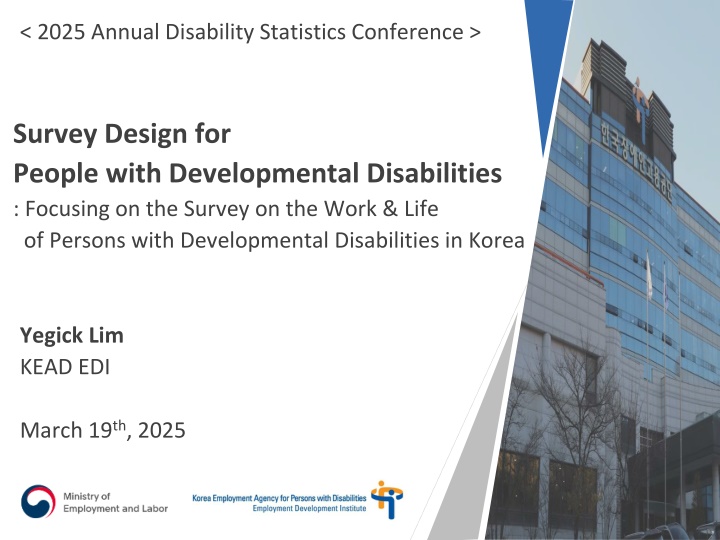
< 2025 Annual Disability Statistics Conference > Survey Design for People with Developmental Disabilities : Focusing on the Survey on the Work & Life of Persons with Developmental Disabilities in Korea Yegick Lim KEAD EDI March 19th, 2025
About KEAD Purpose for Establishment -To contribute to the employment promotion, vocational rehabilitation and employment of PWDs and support business employers Support Area - Employment Support Assistive Technology, Personal assistance, rehabilitation, etc. - Employer Support Disability employment incentives under Disability Employment Quota system, Standard work places, free equipment, etc. - Research & Development 2
Survey on the Employment of PWDs Survey on the Economic Activity Status of the PWDs - Calculation of economic activity indicators Panel Survey of Employment for PWDs - Analysis of changes and developments in the job market, Identification of key factors of changes and developments in PWDs Survey on the Current Situation of Disability Employment in Businesses - Estimation of scales of employment of PWDS in the business sector Survey on the Work & Life of Persons with Developmental Disabilities 3
Key terms and Definitions Developmental disabilities - In South Korea, The term developmental disabilities is commonly used to encompass both intellectual disabilities and developmental disabilities. - In this presentation, PwDD(People with Developmental Disabilities) and IDD(Intellectual and Developmental Disabilities) are used interchangeably to refer to the same concept. PwDD (People with Developmental Disabilities) TAPI (Tablet-Assisted Personal Interviewing) AAC (Augmentative and Alternative Communication) 5
Background of the survey Rapid growth in the population of People with Developmental Disabilities over the past decade in Korea - Young PwDD growth shifts Korea s disability demographics Age Distribution Developmental vs Physical Disabilities (%) 90.0 76.8 80.0 66.0 65.4 70.0 53.5 60.0 49.4 49.4 42.3 41.5 50.0 39.9 40.0 23.0 30.0 17.2 20.0 10.6 7.5 4.8 3.1 1.9 10.0 1.0 0.3 0.0 0~9 10~19 20~29 30~39 40~49 50~59 60~69 70~79 80~ Physical Disabilities Developmental Disabilities 6
Survey Overview Purpose - Assessment of living conditions, employment status, and service needs of PwDD to inform policy development Sampling Frame - Previous year-end disability registry from the Ministry of Health and Welfare Survey Subjects - 3,000 households with PwDD aged 15+ and their caregivers, residing in Korea (2024 Survey: 2,199 PwDD & 3,000 Caregivers) Survey cycle and schedule - Yearly Survey (Jun-Sep) since 2020 Survey Methodology - TAPI(Tablet-Assisted Personal Interviewing) 7
Survey Structure Paired Survey of Caregivers and PwDD - Surveying both caregivers and PwDD For ensuring data accuracy and reducing burden on PwDD Survey Structure Self- reported Data PwDD Caregivers Focus on Main respondents (Verification of objective conditions of PwDD) direct self-reporting items (e.g., needs, satisfaction) Caregiver- Reported Data Annual participation: 3,000 caregivers (mandatory) and approximately 2,000 PwDD (based on ability) 8
Paired respondent survey Framework Caregivers are surveyed before PwDD No duplicate questions* for PwDD if already answered by caregivers *(e.g., employment status, current education level) Paired respondent survey Framework [survey interviewer Question] Is (PwDD name) currently employed, either for income(wages, self-employment) or as an unpaid family worker? [Caregivers Answer] Yes, he is currently employed and working. 9
Paired respondent survey Framework, Contd Survey Interviewer already known PwDD s info PwDD survey content adapts based on caregiver responses via TAPI Paired respondent survey Framework [survey interviewer Question] (Since employment is known, questions skip to job details directly.) Do you enjoy your work? [PwDD Answer] Yes, I enjoy my work. 10
Framework of Assessment Indicators for Participation Expert-developed screening indicators for direct surveys of PwDD Four group PwDD classification via screening indicators Framework of Assessment Indicators for Participation Plain Language Group (15-year-old literacy level) Communication levels Receptive/Expressive language Easy to Read group (preschool literacy level) Vocabulary Graphic Symbols Group(AAC) (Verbal/written questions reading difficulties) Syntax reading ability Literacy Ineligible Group 11
Examples of Screening Questions Five screening items* arranged from simple to complex - Symbol clarity test, Yes/No responses to questions, Sentence completion and arrangements, Reading comprehension of texts Examples of Screening Questions - Symbol clarity test Please choose from these pictures what I am saying (Wash, Clean, Work, Stay home, Throw away, Greet) 12
Examples of Guidelines for Screening Questions Guidelines* provided for accurate responses to five questions *Guidelines assist survey interviewers unfamiliar with PwDD *Questions + Response scoring criteria(correct/incorrect) Examples of Guidelines for Screening Questions [ Symbol Clarity Test Questions ] Let's go through the pictures one by one. Please pick the picture that best matches what I say. [Selected the right image] Pointing to the symbol with a finger Nodding or Responding vocally when the examiner reads the symbol Self-corrects wrong answers 13
Examples of Guidelines for Screening Questions, Contd Guidelines* provided for accurate responses to five questions *Guidelines assist survey interviewers unfamiliar with PwDD *Questions + Response scoring criteria(correct/incorrect) Examples of Guidelines for Screening Questions [Selected the wrong image] Selecting incorrect answers or providing off-list responses no response after 5-10 seconds Repeatedly requesting question repetition [Proceeding after test results] Unable to survey(Identifies 3 out of 6 images), Graphic Symbols Group(Identifies 4 images), Proceed to next question(Identifies 5 images) 14
Response questionnaires by group Four-group classification system with level-appropriate questionnaires, excluding the ineligible group Three types of PwDD questionnaires developed and utilized Response questionnaires by group Easy-to-read questionnaire + Adding a difficult question Plain Language Group (PL) Easy to Read Group (ER) Easy-to-read questionnaire Graphic Symbols Group (AAC) AAC questionnaire Ineligible Group 15
Example of easy-to-read questionnaires Created and applied guidelines* for easy-to-read questionnaires *(e.g., all ERs accessible level, single predicate per sentence, simple language, affirmative phrasing, etc.) Example of easy-to-read questionnaires for PL and ER Group [Symbol support for multiple response options] [Easy questions with simple responses] [Emotional expression symbols] 16
Example of AAC questionnaires AAC response options provided for an individual with challenges using easy-to-read Korean questionnaires Example of AAC questionnaires for Graphic Symbols Group Do you want to work or not? 17
Methods for Direct Surveys of PwDD Video Training Video training for survey interviewers using AAC guidelines* *Verbal(echoing words, responding 'yes without meaning), Behavioral(attention difficulties, non-verbal sounds) Example of Video Guidelines for AAC group echoing words 18
Video Script - Echoing Words pt 1 of 3 English version of Korean Video Script - echoing words [Survey Interviewer (she/her)] Can you clean? Can t you clean? [PwDD(he/him)] No, I can t. [Survey Interviewer (she/her)] Can you throw away trash? [Survey Interviewer (she/her)] Can t you throw away trash? [PwDD(he/him)] No, I can t [Survey Interviewer (she/her)] Can you take a shower? [Survey Interviewer (she/her)] Can t you take a shower? [PwDD(he/him)] No, I can t PwDD echoed(repeated) the last words three times 19
Video Script - Echoing Words pt 2 of 3 English version of Korean Video Script - echoing words [Survey Interviewer (she/her)] Oh, sir. Then I ll ask you again. -- Attention redirection -- the survey interviewer changed the order of the sentence and asked again. [Survey Interviewer (she/her)] Can t you throw away trash? [Survey Interviewer (she/her)] Can you throw away trash? [PwDD(he/him)] Yes, I can [Survey Interviewer (she/her)] Can t you take a shower? [Survey Interviewer (she/her)] Can you take a shower? [PwDD(he/him)] Yes, I can 20
Video Script - Echoing Words pt 3 of 3 English version of Korean Video Script - echoing words -- Again, noticing echolalia, the interviewer reordered the sentence. [Survey Interviewer (she/her)] Can you throw away trash? [Survey Interviewer (she/her)] Can t you throw away trash? [PwDD(he/him)] No, I can t (Result) Persistent terminal echolalia after three attempts classified as non-response 21
Assessing the Reliability of PwDD Survey Data Post-survey analysis excluded inappropriate PL and ER responses - Data releases completely omit all content from samples identified as inappropriate responses Three-Dimensional Assessment of Inappropriate Responses - (Step 1) Evaluation by survey interviewer of problematic response patterns(e.g., echoing, number fixation, repetition, non- response, refusal, etc.) - (Step 2) Qualitative assessment of comprehension and reliability (5-point scale) - (Step 3) Non-response verification (categorized by extent of missing responses) 22
Results of On-site Assessment and Non- Response Validation (unit: person) Fully unable Mostly unable Mostly Able Consistently able Average Total All non- response 5 18 4 6 1 34 Most non- response 1 2 0 1 0 4 Partial(4-6) 0 6 3 1 2 12 Partial(1-3) 0 6 19 33 51 109 No non- response 6 51 205 427 949 1,638 Total 12 83 231 468 1,003 1,797 Final analysis Sample(1,753 PL/ER) 23
Survey Category Caregivers - Data Most questions directed to caregivers as primary respondents - Survey Category 1. Personal & Disability information 2. Education 3. Employment status 3-1. Employed Characteristics 3-2. Unemployed Characteristics 4. Job skills & Services 5. Daily Life 6. Household & Caregiver 7. COVID-19 (2022~2023 Supplementary Survey) 24
Survey Categories, Contd Plain language and Easy-to-Read group - Survey category 1. Employment & Jobs 2. Daily Life Graphic Symbol Group - Daily Life Performance, Desired activities For detailed information, please refer to the appendix For detailed information, please refer to the appendix. 25
New findings from the survey The number of PwDD aspiring for employment exceeded caregiver expectations - Despite caregivers believing individuals did not desire employment, 17.6% of PwDD reported wanting to work. Self-reported employment aspirations Caregiver-perceived employment interest Caregiver-perceived employment disinterest Total Self-reported preference for employment Self-reported preference for non-employment 35.8 % 17.6 % 53.4 % 3.7 % 41.5 % 45.3 % No response 0.3 % 1.0 % 1.3 % Total 39.8 % 60.2 % 100.0 % 26
New findings from the survey, Contd Employment generates positive outcomes for individuals with developmental disabilities as well as their family - Employment benefits not only PwDD themselves but also reduces family caregiving burden and increases caregivers' life satisfaction Employment outcomes Job-seeking unemployed individuals Non-Job-seeking unemployed individuals Employed individuals (Caregivers response) Percentage reporting caregiving burden (Caregivers response) Quality of life among caregivers (Self-reported responses) Rate of strong self- satisfaction 32.6 % 51.6 % 66.4 % 35.0 % 25.3 % 15.1 % 46.1 % 40.8 % 15.4 % 27
Thank you Yegick Lim yglim@kead.or.kr https://edi.kead.or.kr 28