Sustainable Farming Practices for Net-Zero Emissions
Agriculture at the farm level plays a crucial role in achieving sustainable practices for a net-zero future. Prof. Michael Lee emphasizes the three pillars of sustainability - society, economy, and environment. Trade-offs must be carefully considered, including factors like animal performance, emissions, and economic aspects. Agriculture is a significant source of emissions, with livestock contributing significantly. Understanding the dairy footprint at the farm level highlights the challenges and opportunities for reducing carbon emissions within agriculture.

Download Presentation

Please find below an Image/Link to download the presentation.
The content on the website is provided AS IS for your information and personal use only. It may not be sold, licensed, or shared on other websites without obtaining consent from the author. If you encounter any issues during the download, it is possible that the publisher has removed the file from their server.
You are allowed to download the files provided on this website for personal or commercial use, subject to the condition that they are used lawfully. All files are the property of their respective owners.
The content on the website is provided AS IS for your information and personal use only. It may not be sold, licensed, or shared on other websites without obtaining consent from the author.
E N D
Presentation Transcript
Towards Sustainable Net Zero at Farm Level the role of Future Farm Prof Michael Lee Deputy Vice-Chancellor Harper Adams University
Sustainability three equally important pillars SOCIETY (PEOPLE) Food Quality & Safety Farmers Skills Rural Social & Economic Conditions Health Food Supply Farmers Income Sustainable Food Products Soil/Water/Air Energy Biodiversity Climate Change ECONOMY (PROFIT) ENVIRONMENT (PLANET)
Trade offs Criteria Measure Units Animal performance Carrying capacity Nutritional quality Daily weight gain Animals per hectare Nutrients per hectare (e.g. calories, protein, minerals) Losses per hectare per day SOC CO2 (or equivalent) per unit of animal product (S and P equivalents) Costs of preventive veterinary care and treatment of diseases Negative and Positive assessment Kg weight gain/day Kg weight/ha Kg nutrient/ha Nutrient and soil loss to water Soil Health Greenhouse gas emissions Sulphonation Eutrophication Animal health Kg/ha/day % Kg CO2eq/kg product (S and P equivalents) Veterinary costs ( ) Animal Welfare Disease/EU Behaviour /time Biodiversity Inputs labour) Outputs (beef cattle) Range of wildlife and plant species Species/ha Purchase cost (fertiliser, machinery, Sales value
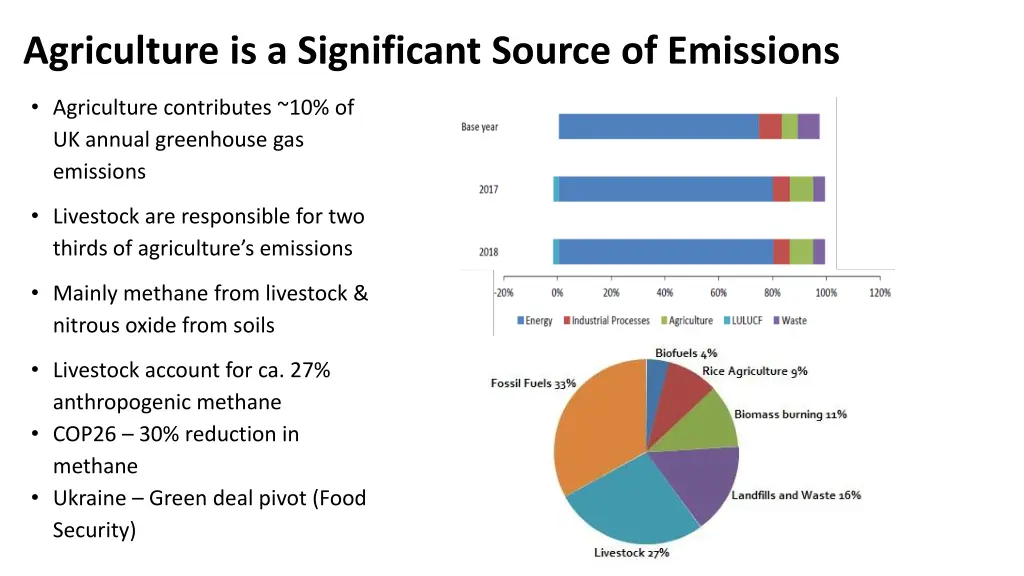
Agriculture is a Significant Source of Emissions Agriculture contributes ~10% of UK annual greenhouse gas emissions Livestock are responsible for two thirds of agriculture s emissions Mainly methane from livestock & nitrous oxide from soils Livestock account for ca. 27% anthropogenic methane COP26 30% reduction in methane Ukraine Green deal pivot (Food Security)
Dairy Footprint (Farm level) Agriculture cannot de-carbonise like other sectors Main agricultural emissions Carbon dioxide (CO2) burning fossil fuels Methane (CH4) enteric fermentation Nitrous oxide (N2O) Soil and manures Challenge and opportunities Farms are complex biological systems Farms emit and sequester Set boundaries The Carbon Calculation Two main elements 1. A database or model that contains standard figures for emissions and sequestration rates associated with an individual item or process 2. Farm specific data i.e. cattle numbers, crop yields, slurry usage. This is largely based on a financial year though cropping cuts across years. 3. Many models none are perfect
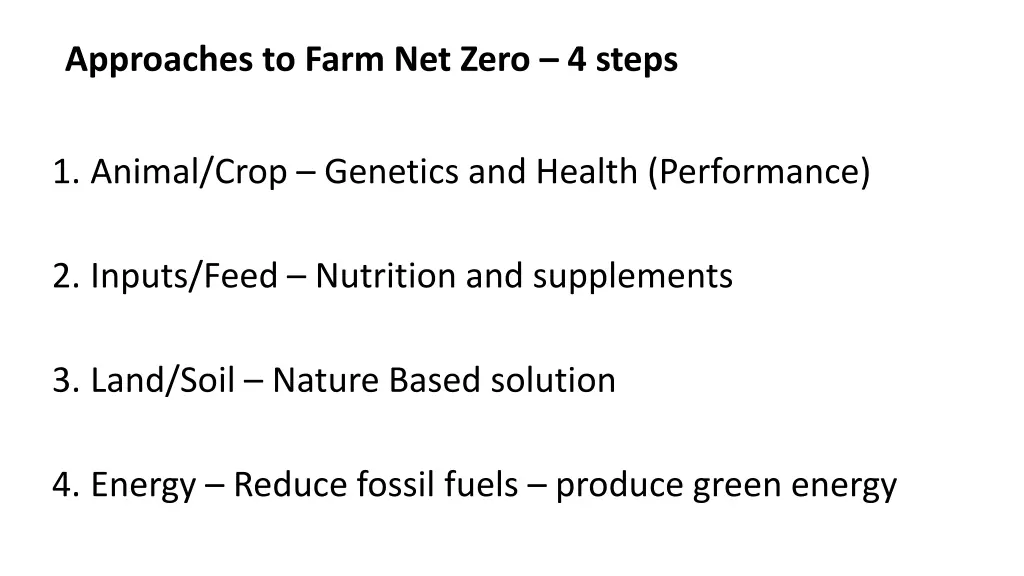
Approaches to Farm Net Zero 4 steps 1. Animal/Crop Genetics and Health (Performance) 2. Inputs/Feed Nutrition and supplements 3. Land/Soil Nature Based solution 4. Energy Reduce fossil fuels produce green energy
Landex network of sustainability farms A farm network with net zero pledges (and wider sustainability targets biodiversity, welfare etc.) Trialling calculators and data platforms (e.g. LEAF, GFM, CIEL) Sharing data and best practice Collating material to map journeys towards net zero / BPS transition Feeding into a What works centre / TIAH for solutions for the sector Possible future central data collection dash board and virtual farm development, could be hosted by www.schoolofsustainablefoodandfarming.org