Sustainable Intensification of Farming Systems in Africa RISING Project
Explore the Africa RISING project focused on sustainable intensification of farming systems across different regions of Africa. Supported by USAID, this research-for-development program aims to combat hunger and poverty by implementing innovative agricultural technologies. Collaborative efforts with international and national research institutions drive the project towards achieving its goal. Learn about the research hypotheses guiding the project activities.

Download Presentation

Please find below an Image/Link to download the presentation.
The content on the website is provided AS IS for your information and personal use only. It may not be sold, licensed, or shared on other websites without obtaining consent from the author. If you encounter any issues during the download, it is possible that the publisher has removed the file from their server.
You are allowed to download the files provided on this website for personal or commercial use, subject to the condition that they are used lawfully. All files are the property of their respective owners.
The content on the website is provided AS IS for your information and personal use only. It may not be sold, licensed, or shared on other websites without obtaining consent from the author.
E N D
Presentation Transcript
Africa RISING: an overview Bekele Hundie Kotu Study to Monitor Adoption of Africa RISING Technologies Training of Field Staff July 29- August 2, 2015 Tamale
What does the name imply? Africa: Research In Sustainable Intensification for the Next Generation:- Africa RISING What is it? Africa RISING (AR) is a research-for- development program. It comprises three projects in different parts of Africa
Sustainable intensification of in cereal-based farming systems of the Guinea-Sudano-Savanna of West Africa (Ghana and Mali)-Led by IITA Sustainable intensification of cereal-legume-livestock integrated farming systems in East and Southern Africa (Tanzania, Malawi, and Zambia)-Led by IITA Sustainable intensification of crop-livestock integrated farming systems in the Ethiopian highlands (Ethiopia) Led by ILRI
Who is the donor? AR is supported by the United States Agency for International Development (USAID) as part of the U.S. government s Feed the Future initiative. Who are the participants? AR is a collaborative research-for-development program implemented by international research institutions, national research institutions, other development partners.
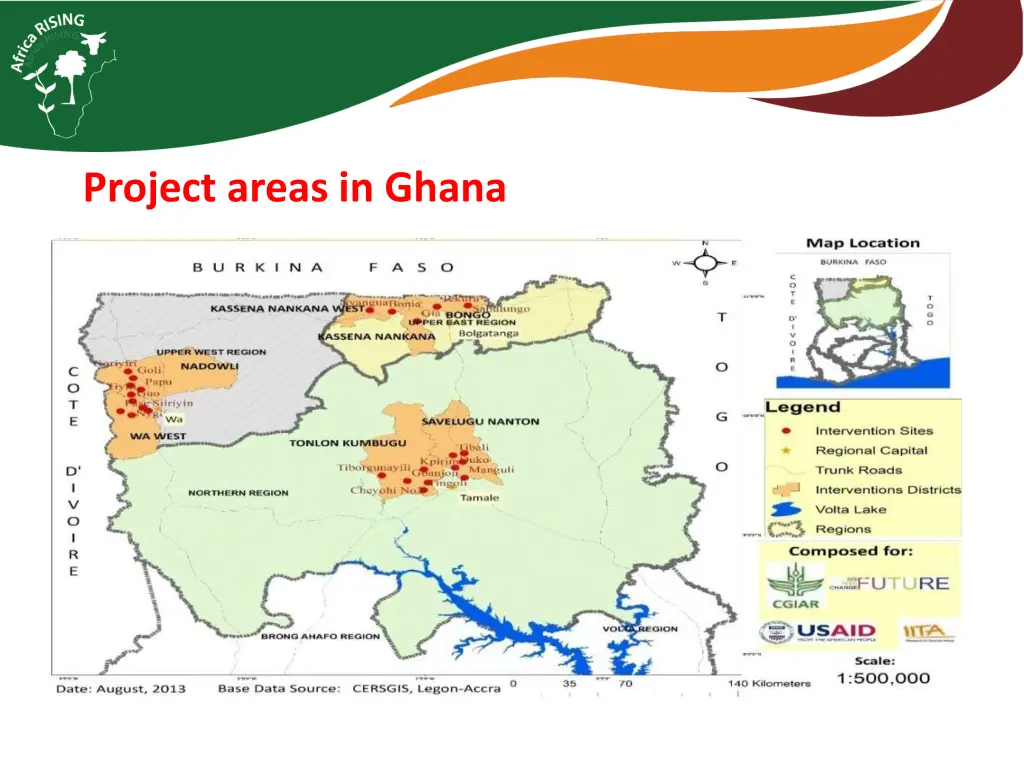
In Ghana collaborating institutions include: IITA, IFPRI, CIAT, AVRDC, ILRI, SARI, ARI,, ILRI, UDS, KNUST, MOFA What is the goal of the project? The overall aim is to provide pathways out of hunger and poverty for smallholder families through sustainable intensification of farming systems When did it start? AR was launched in 2011. The first experiments in Ghana were conducted in 2013
Research Hypotheses Integration hypothesis: Integrating technological components into SI systems confers more benefits to smallholder farmers than single components. Adoption hypothesis: Integrating technological components into SI systems stimulates more adoption compared to single components. Trade-off hypothesis: Effective targeting of innovations reduces the negative impacts of trade-offs between farm productivity and environmental sustainability and helps to identify potential win-win options for SI.
Scalability hypothesis: Agricultural SI interventions that are tailored to diverse local conditions on smallholder farms are more likely to be scalable to similar populations and environmental settings. Innovation sequencing hypothesis: The adoption of innovations that lead to SI is affected by the sequence in which the component technologies, practices, and knowledge are integrated and applied
Sustainable intensification: the core agenda in AR Sustainability: Benefiting the current generation with no/minimal adverse affects to the next generation Agricultural intensification: Agricultural intensification can be defined as an increase in agricultural production per unit of inputs (which may be labour, land, time, fertilizer, seed, feed or cash) (FAO, 2004).
Sustainable intensification: Defined as producing more output from the same area of land while reducing the negative environmental impacts and at the same time increasing contributions to natural capital and the flow of environmental services AR considers three types of SI Genetic intensification: the use of varieties/breeds with more desirable traits (e.g. yield, disease resistance, etc)
Ecological intensification: undertaking more agricultural practices with no/minimal adverse effects on the environment or natural resource base (e.g. integrated pest management, integrated soil fertility management) Socio-economic intensification: the existence of more and more efficient and integrative institutions to facilitate commercialization (e.g. the existence of good market institutions)
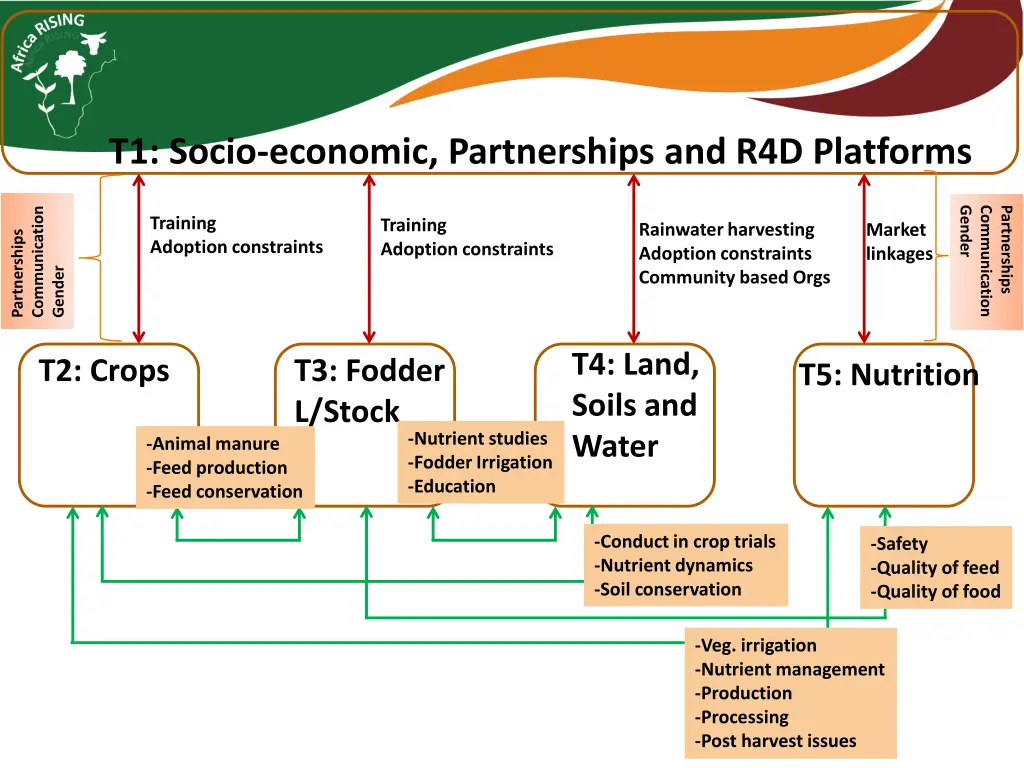
Areas of Research in Ghana Partnerships and socioeconomics Analysis Intensification of cereal-legume-vegetable cropping systems Intensive livestock and crop-livestock systems Land, soil and water management Nutrition, food storage, value addition and mycotoxin management
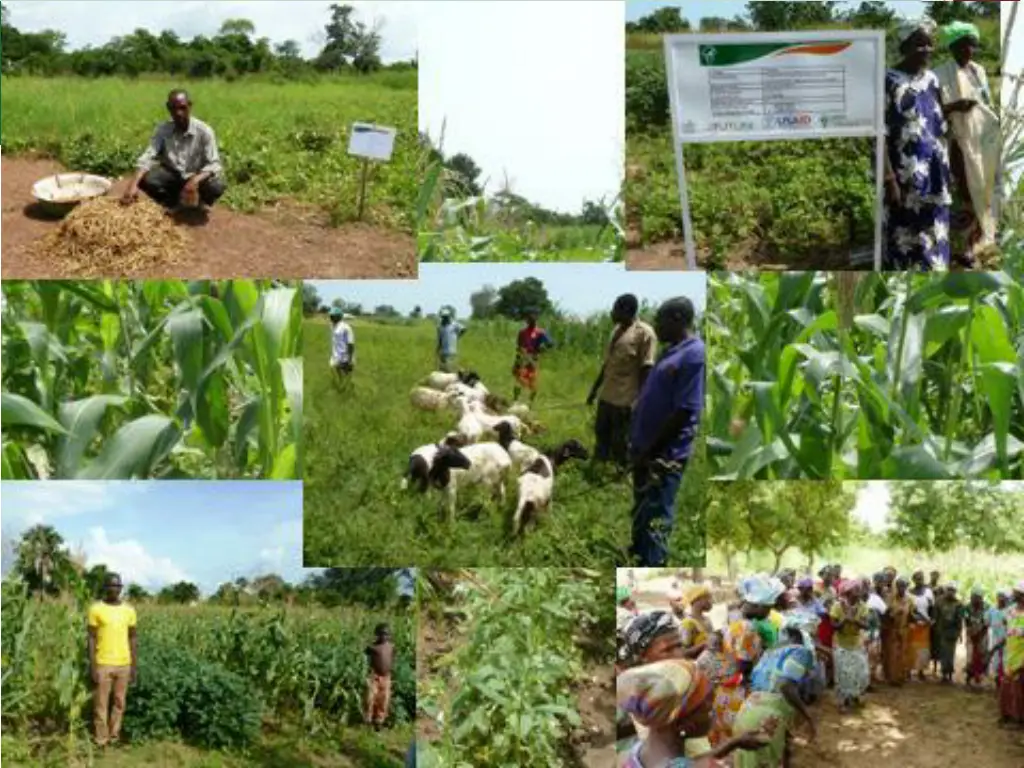
Scope of research More than 70 research and development activities are underway this year Crops covered include: Maize, Rice, Soybean, groundnut, cowpea, Vegetables (okra, pepper, rozell, eggplant), sesame Livestock include: poultry, sheep and goats, and pigs
T1: Socio-economic, Partnerships and R4D Platforms Gender Communication Partnerships Communication Training Adoption constraints Training Adoption constraints Rainwater harvesting Adoption constraints Community based Orgs Market linkages Partnerships Gender T4: Land, Soils and Water T2: Crops T3: Fodder L/Stock T5: Nutrition -Nutrient studies -Fodder Irrigation -Education -Animal manure -Feed production -Feed conservation -Conduct in crop trials -Nutrient dynamics -Soil conservation -Safety -Quality of feed -Quality of food -Veg. irrigation -Nutrient management -Production -Processing -Post harvest issues
Research approach A participatory research approach is promoted in Africa RISING. Farmers participate in two types of trials in Ghana, namely mother trials and baby trials. Mother trials constitute almost all trials to be conducted in each community. They serve as demonstration and training sites for farmers.
Mother trials are managed by a group of voluntary farmers with a close guidance of researchers. Baby trials constitute a few technologies chosen by farmers from mother trials to try in their fields. They are managed by farmers with a little guidance of researchers. Some of the baby trials are now on upscaling stage whereby farmers apply the technologies on bigger fields.
Thank You Africa Research in Sustainable Intensification for the Next Generation africa-rising.net The presentation has a Creative Commons licence. You are free to re-use or distribute this work, provided credit is given to ILRI.