Explore the fundamentals of synchronous machine modeling, subtransient models, GENSAL model details, block diagram, and an example scenario. Learn about important concepts and industry trends in power system stability.
Please find below an Image/Link to download the presentation.
The content on the website is provided AS IS for your information and personal use only. It may not be sold, licensed, or shared on other websites without obtaining consent from the author. If you encounter any issues during the download, it is possible that the publisher has removed the file from their server.
You are allowed to download the files provided on this website for personal or commercial use, subject to the condition that they are used lawfully. All files are the property of their respective owners.
The content on the website is provided AS IS for your information and personal use only. It may not be sold, licensed, or shared on other websites without obtaining consent from the author.
E N D
Presentation Transcript
ECEN 667 Power System Stability Lecture 8: Synchronous Machine Modeling Prof. Tom Overbye Dept. of Electrical and Computer Engineering Texas A&M University overbye@tamu.edu
Announcements Read Chapter 5 and Appendix A Homework 2 is due today Homework 3 is due on Tuesday October 1 Exam 1 is Thursday October 10 during class 1
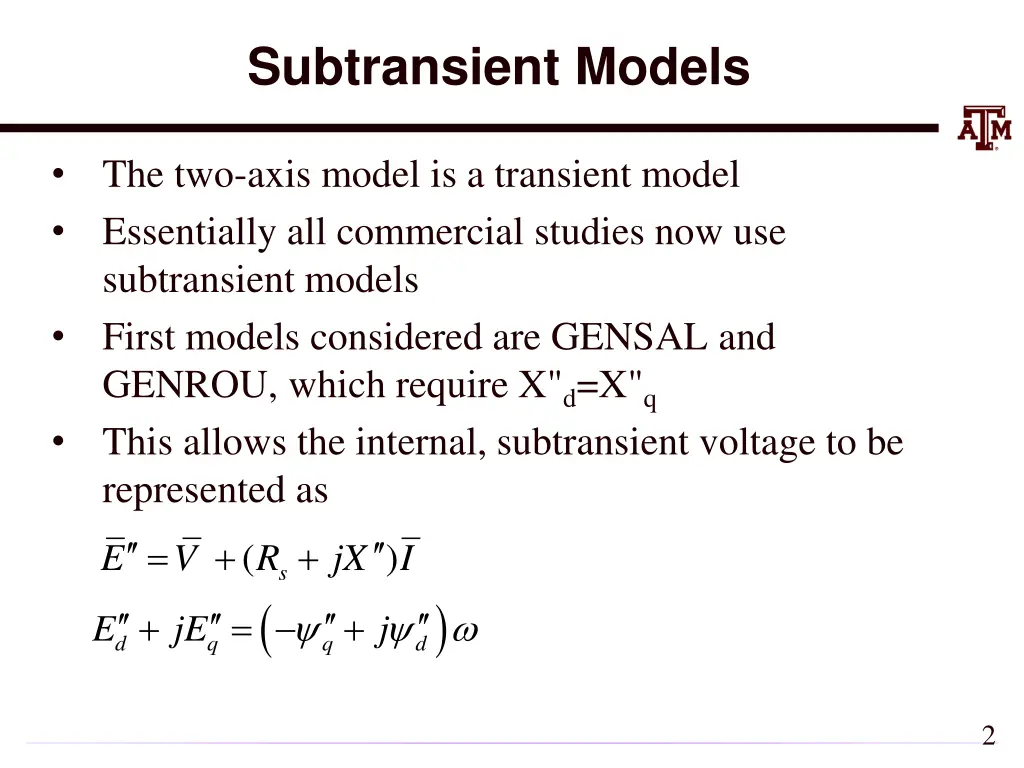
Subtransient Models The two-axis model is a transient model Essentially all commercial studies now use subtransient models First models considered are GENSAL and GENROU, which require X"d=X"q This allows the internal, subtransient voltage to be represented as = + + ( d q q d E jE j + = + ( ) E V R jX I s ) 2
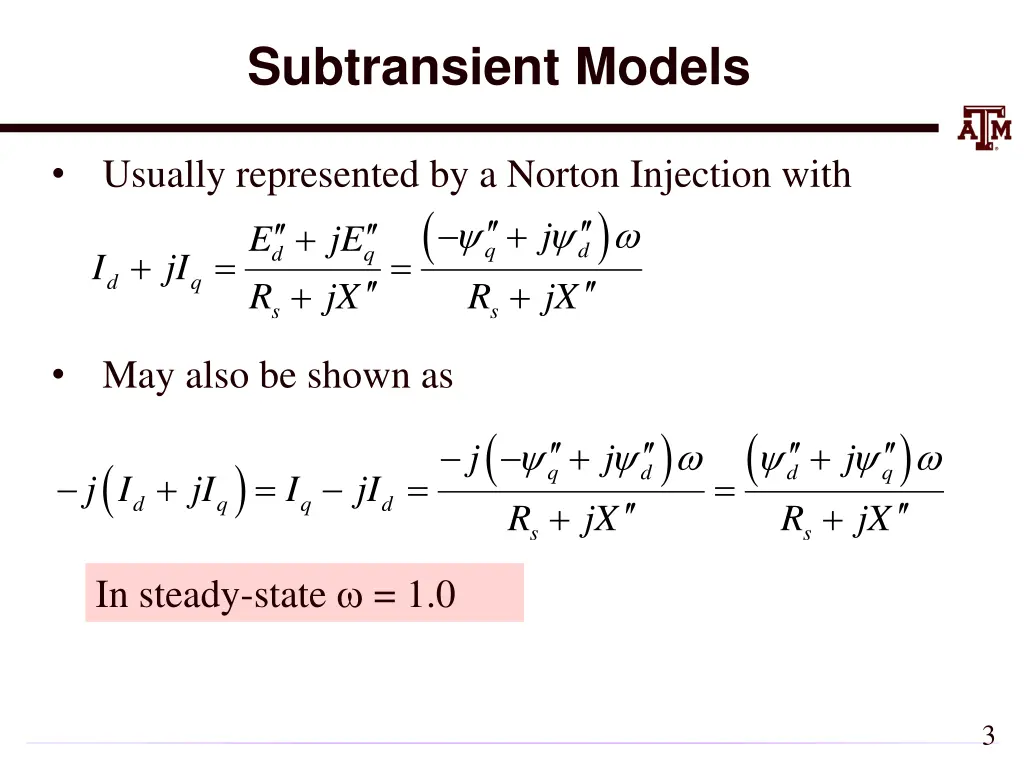
Subtransient Models Usually represented by a Norton Injection with ( d q d q s R jX R + ) q d + + j + E jE + = = I jI jX s May also be shown as ( ) ( ) q + d d q + j + j j ( ) + = = = j I jI I jI d q q d + R jX R jX s s In steady-state = 1.0 3
GENSAL The GENSAL model had been widely used to model salient pole synchronous generators In salient pole models saturation is only assumed to affect the d-axis In the 2010 WECC cases about 1/3 of machine models were GENSAL; in 2013 essentially none are, being replaced by GENTPF or GENTPJ A 2014 series EI model had about 1/3 of its machines models set as GENSAL In November 2016 NERC issued a recommendation to use GENTPJ rather than GENSAL for new models. See www.nerc.com/comm/PC/NERCModelingNotifications/Use%20of%20GENTPJ%20Generator%20Model.pdf 4
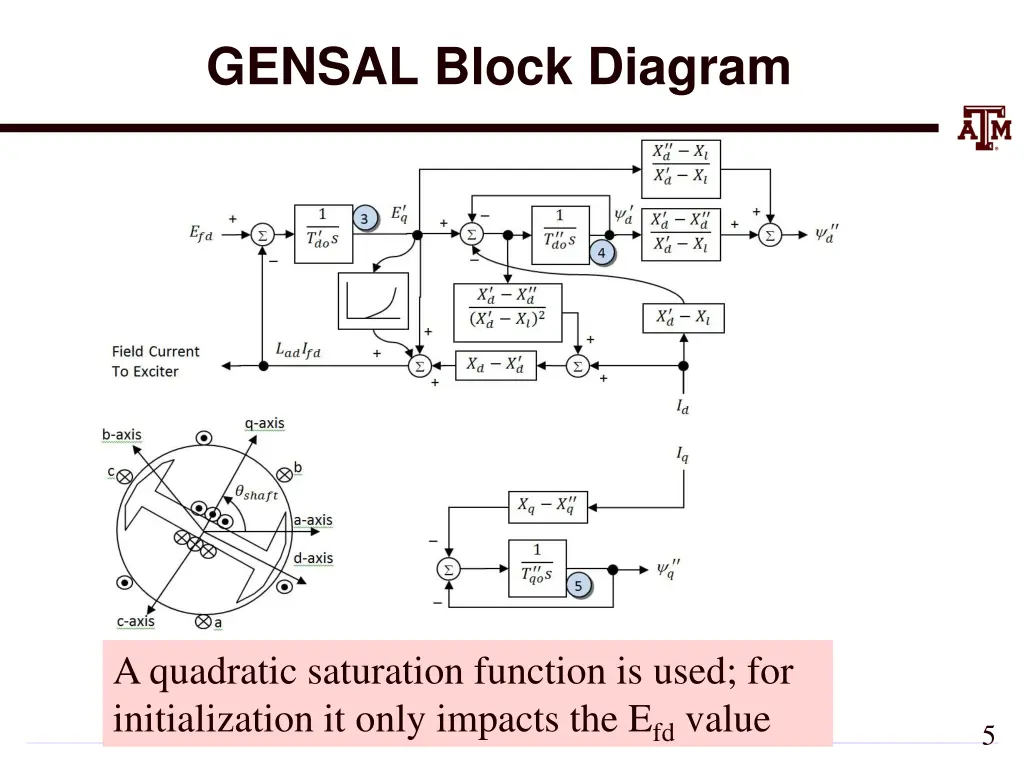
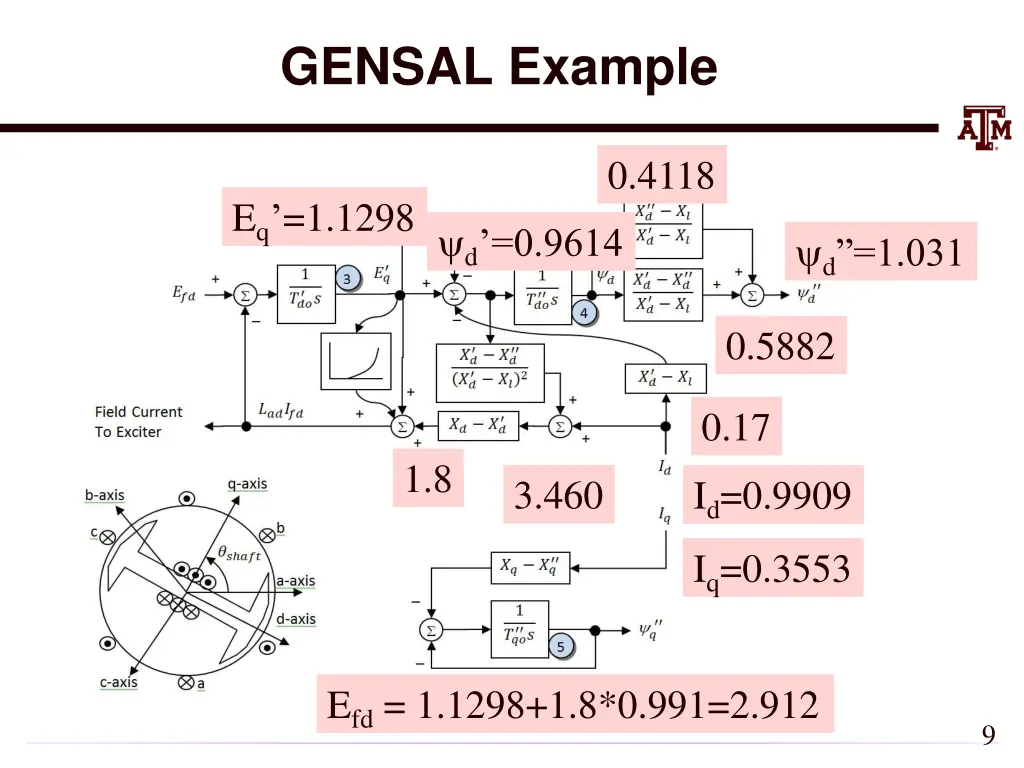
GENSAL Block Diagram A quadratic saturation function is used; for initialization it only impacts the Efd value 5
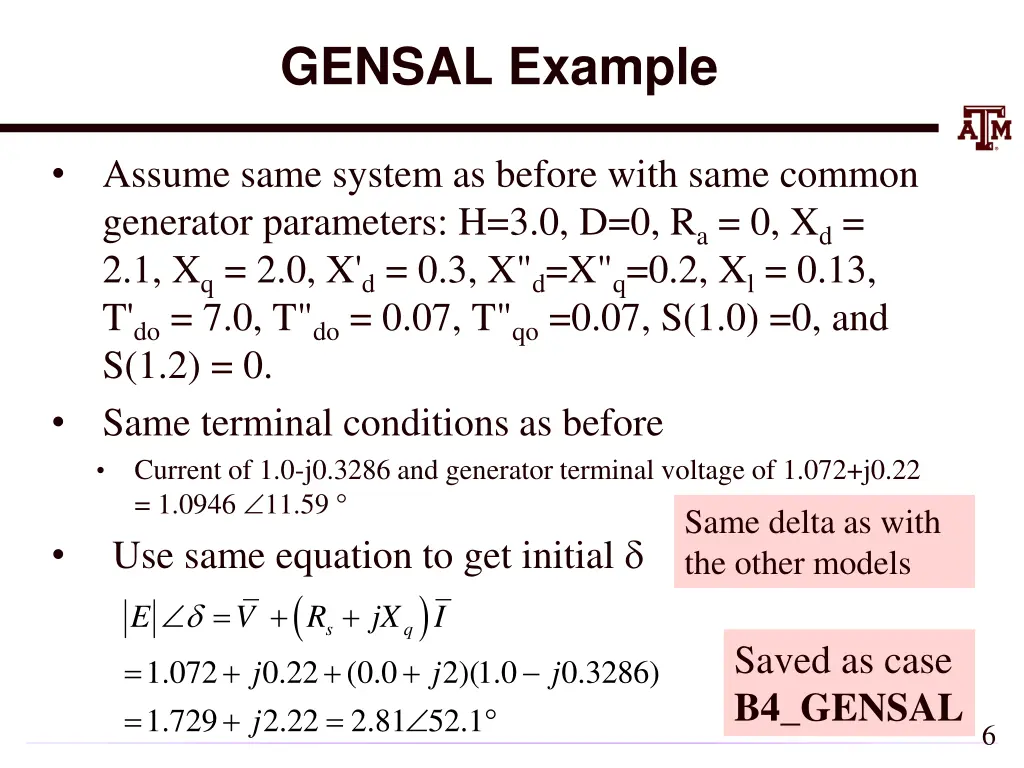
GENSAL Example Assume same system as before with same common generator parameters: H=3.0, D=0, Ra = 0, Xd = 2.1, Xq = 2.0, X'd = 0.3, X"d=X"q=0.2, Xl = 0.13, T'do = 7.0, T"do = 0.07, T"qo =0.07, S(1.0) =0, and S(1.2) = 0. Same terminal conditions as before Current of 1.0-j0.3286 and generator terminal voltage of 1.072+j0.22 = 1.0946 11.59 Use same equation to get initial ( 1.072 0.22 (0.0 2)(1.0 1.729 2.22 2.81 52.1 j = + = Same delta as with the other models ) = + + E V R jX I s + q + Saved as case B4_GENSAL = + 0.3286) j j j 6
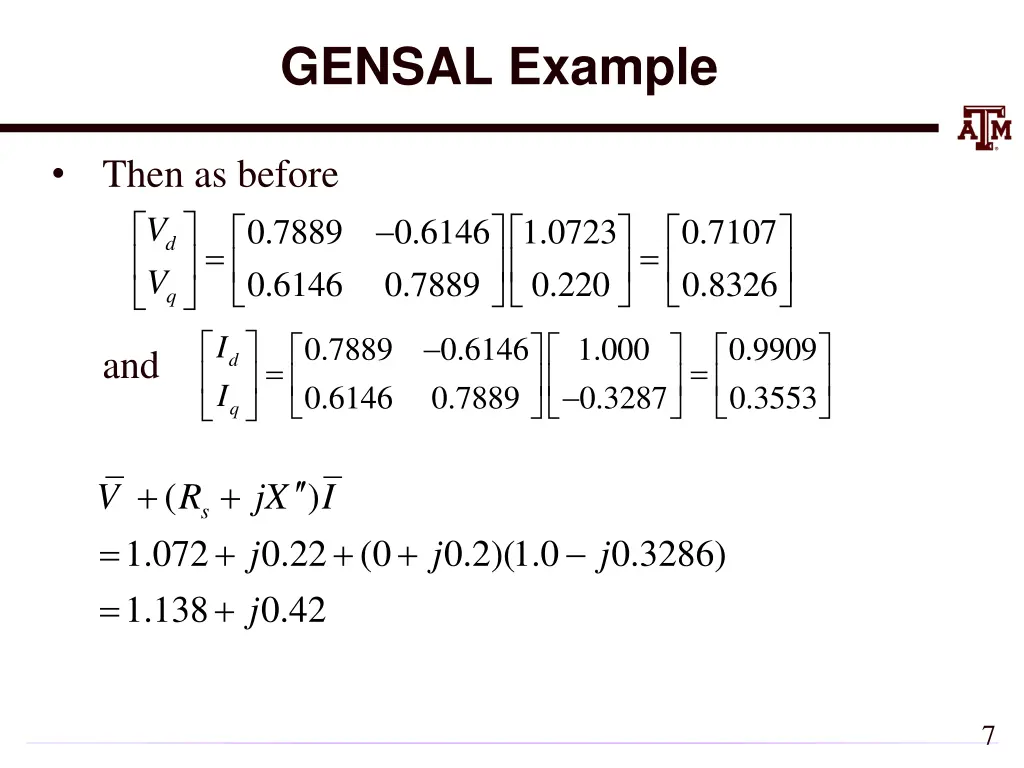
GENSAL Example Then as before V V I I 0.7889 0.6146 0.6146 1.0723 0.7889 0.7107 0.8326 d = = 0.220 q 0.7889 0.6146 0.6146 0.7889 1.000 0.3287 0.9909 0.3553 and d = = q + + + + ( ) V = = R jX j j I s + + 1.072 1.138 0.22 (0 0.42 0.2)(1.0 0.3286) j j 7
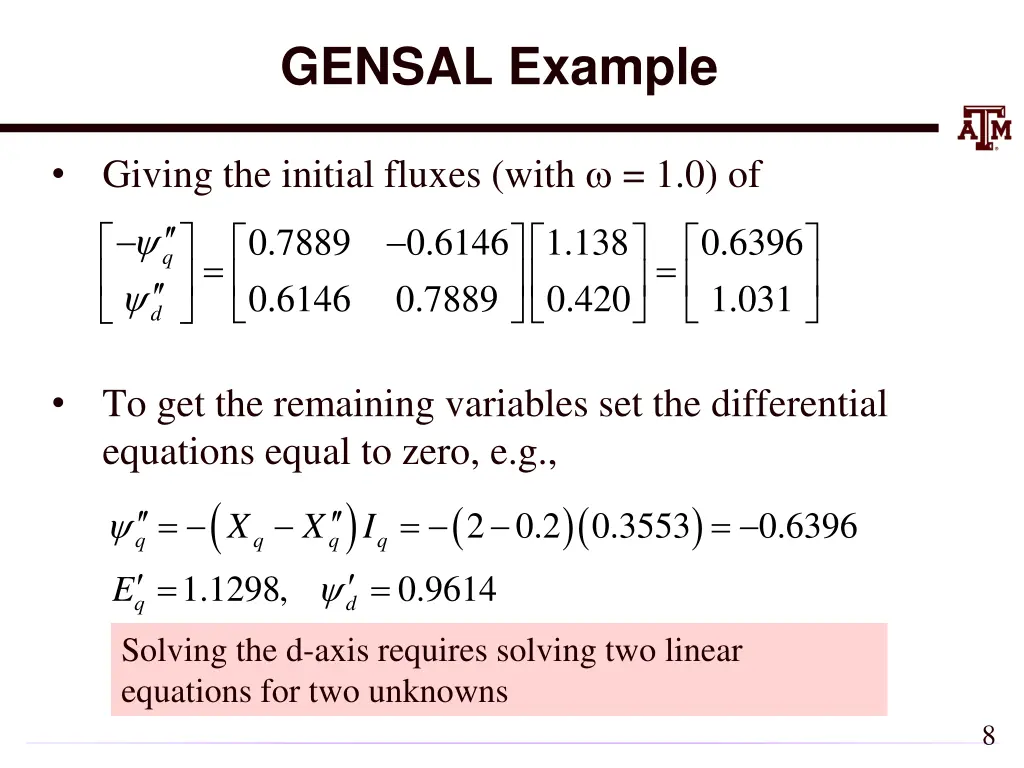
GENSAL Example Giving the initial fluxes (with = 1.0) of = 0.7889 0.6146 0.6146 0.7889 1.138 0.420 0.6396 1.031 q = d To get the remaining variables set the differential equations equal to zero, e.g., ( 2 0.2 0.3553 1.1298, 0.9614 q d E = = Solving the d-axis requires solving two linear equations for two unknowns ) ( )( ) q q = = = 0.6396 X X I q q 8
GENSAL Example 0.4118 Eq =1.1298 d =0.9614 d =1.031 0.5882 0.17 1.8 3.460 Id=0.9909 Iq=0.3553 Efd = 1.1298+1.8*0.991=2.912 9
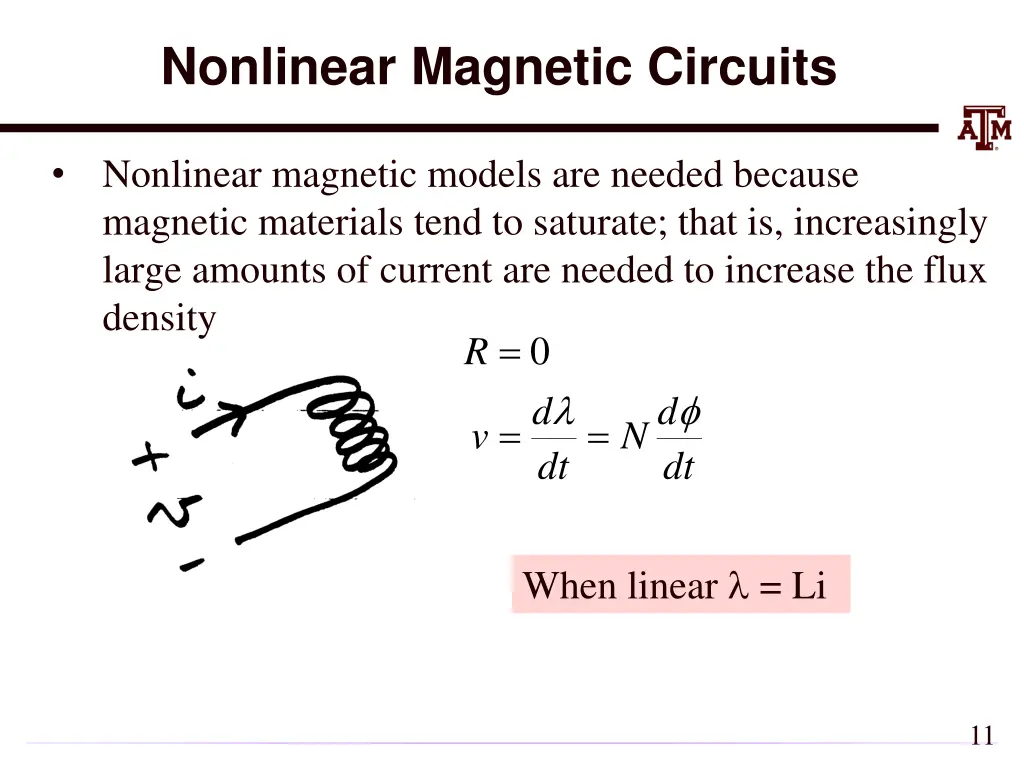
Nonlinear Magnetic Circuits Nonlinear magnetic models are needed because magnetic materials tend to saturate; that is, increasingly large amounts of current are needed to increase the flux density R = = = 0 d d v N dt dt When linear = Li 11
Relative Magnetic Strength Levels Earth s magnetic field is between 30 and 70 T (0.3 to 0.7 gauss) A refrigerator magnet might have 0.005 T A commercial neodymium magnet might be 1 T A magnetic resonance imaging (MRI) machine would be between 1 and 3 T Strong lab magnets can be 10 T Frogs can be levitated at 16 T (see www.ru.nl/hfml/research/levitation/diamagnetic A neutron star can have 100 MT! 13
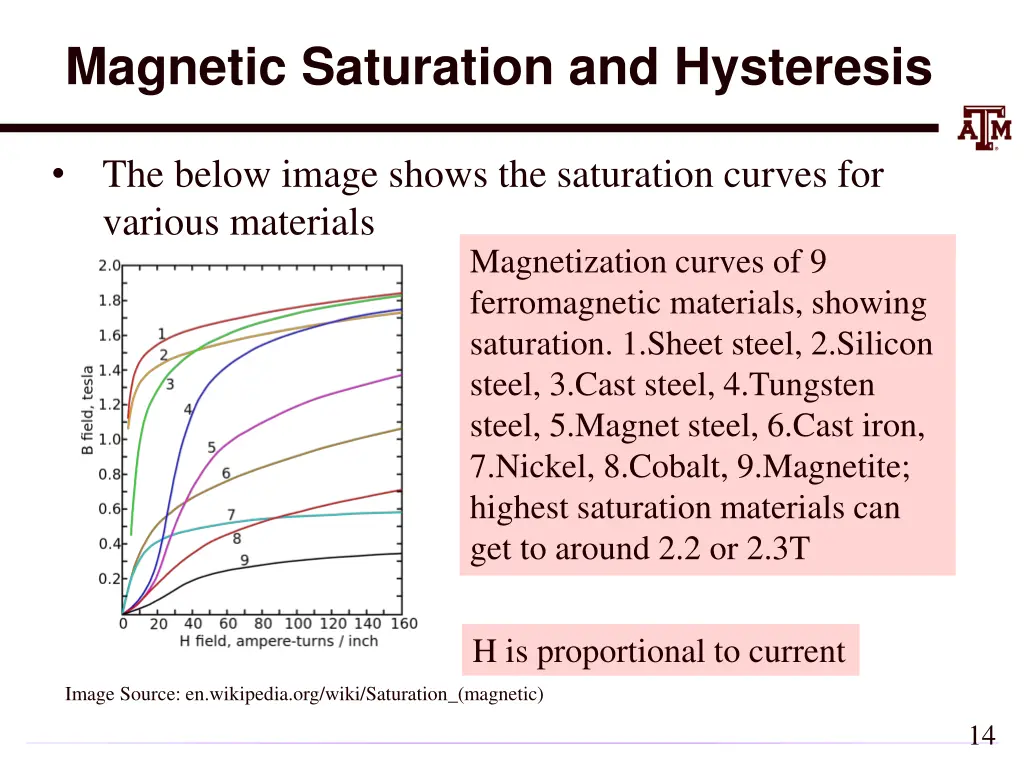
Magnetic Saturation and Hysteresis The below image shows the saturation curves for various materials Magnetization curves of 9 ferromagnetic materials, showing saturation. 1.Sheet steel, 2.Silicon steel, 3.Cast steel, 4.Tungsten steel, 5.Magnet steel, 6.Cast iron, 7.Nickel, 8.Cobalt, 9.Magnetite; highest saturation materials can get to around 2.2 or 2.3T H is proportional to current Image Source: en.wikipedia.org/wiki/Saturation_(magnetic) 14
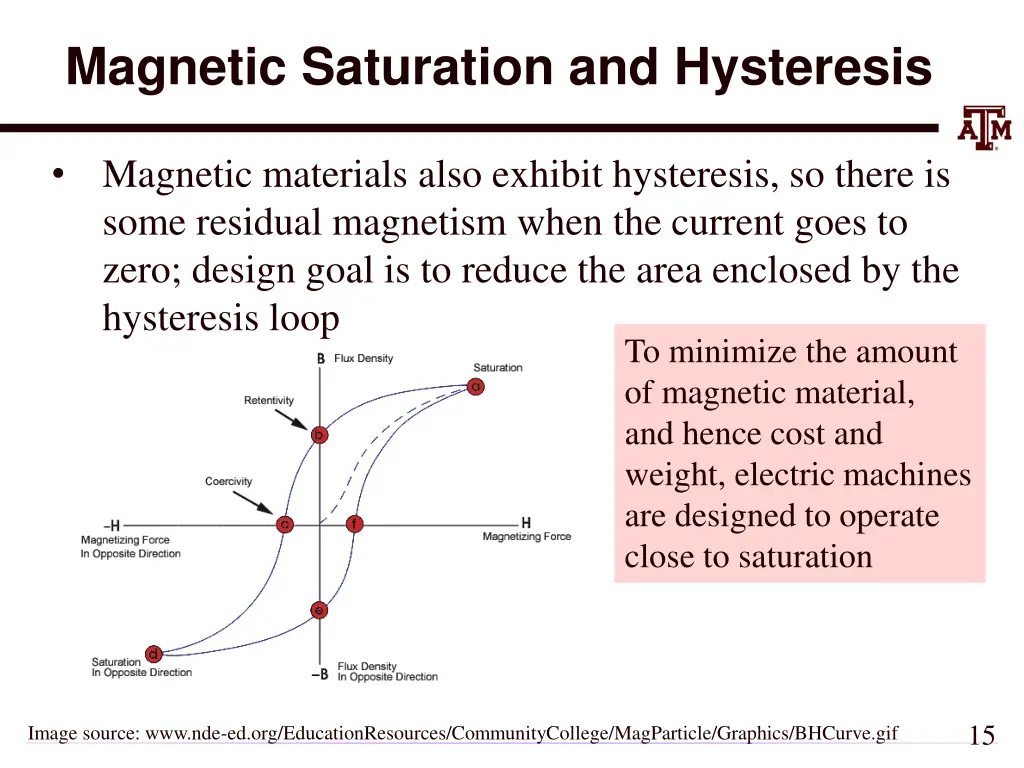
Magnetic Saturation and Hysteresis Magnetic materials also exhibit hysteresis, so there is some residual magnetism when the current goes to zero; design goal is to reduce the area enclosed by the hysteresis loop To minimize the amount of magnetic material, and hence cost and weight, electric machines are designed to operate close to saturation 15 Image source: www.nde-ed.org/EducationResources/CommunityCollege/MagParticle/Graphics/BHCurve.gif
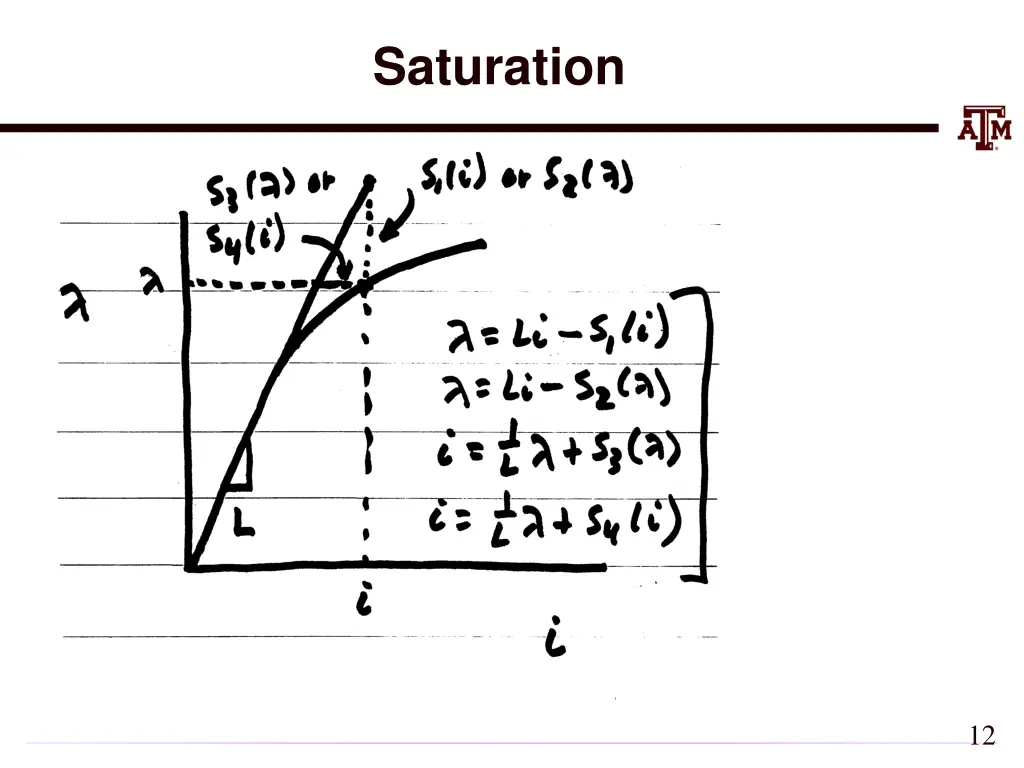
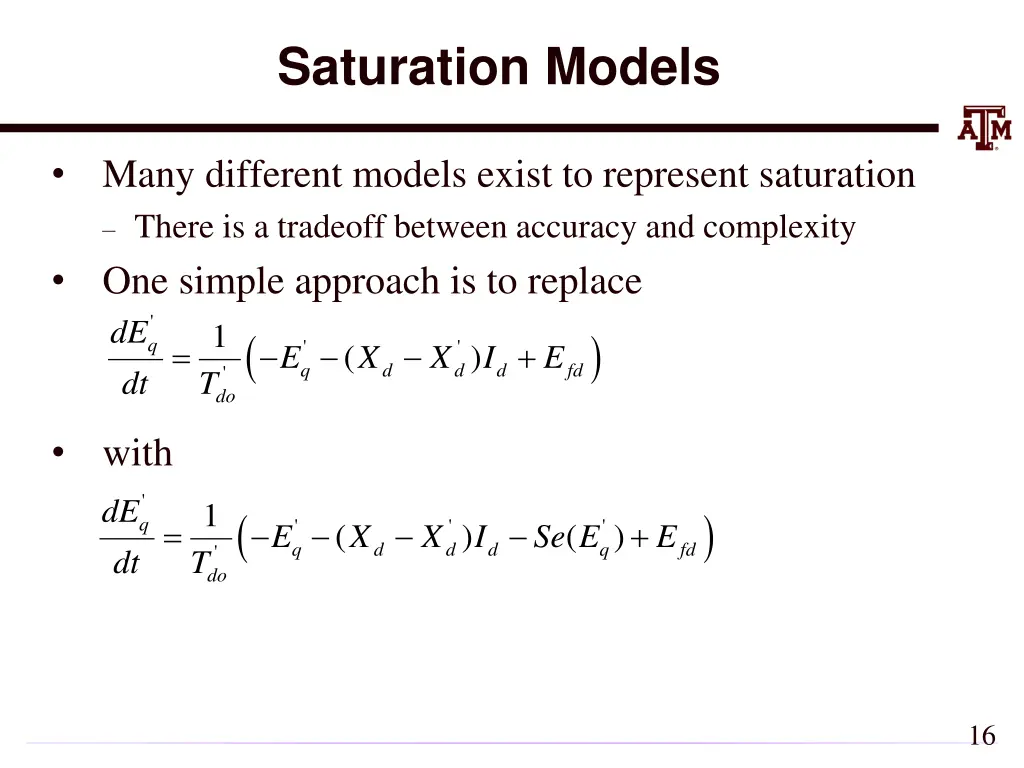
Saturation Models Many different models exist to represent saturation There is a tradeoff between accuracy and complexity One simple approach is to replace ( ' ( ) q d d d do dt T ' dE 1 ) q = + ' ' E X X I E fd with ' dE dt 1 ( ) q = + ' ' ' ( ) ( ) E X X I Se E E q d d d q fd ' T do 16
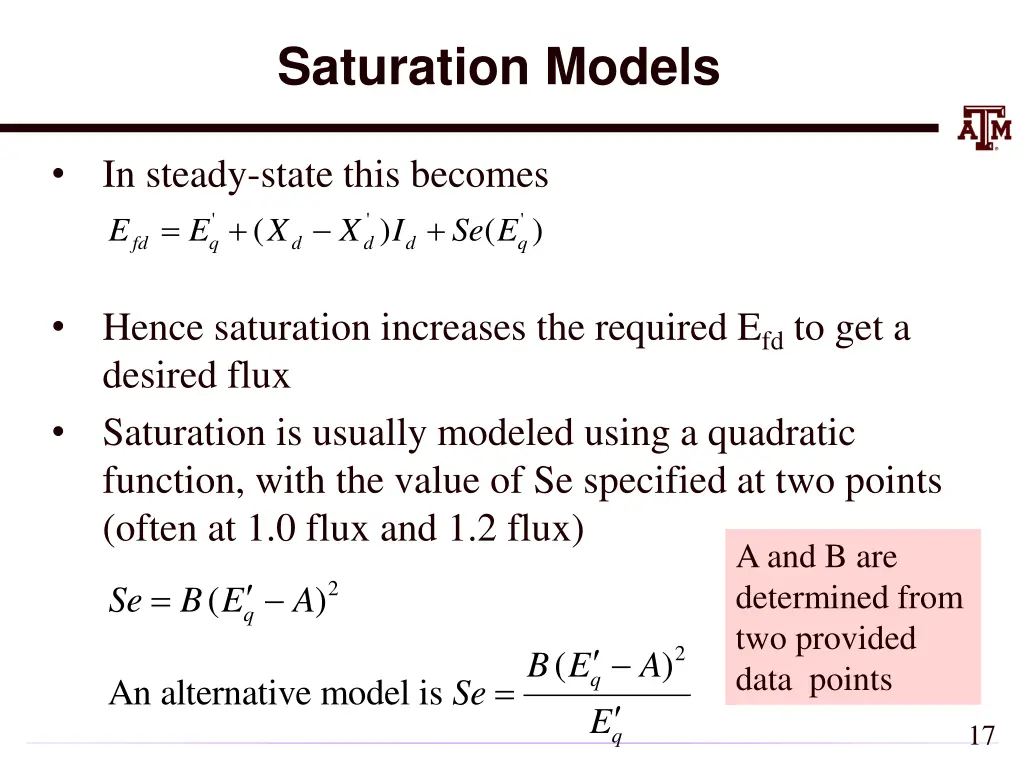
Saturation Models In steady-state this becomes ( fd q d E E X = + + ' ' ' ) ( ) X I Se E d d q Hence saturation increases the required Efd to get a desired flux Saturation is usually modeled using a quadratic function, with the value of Se specified at two points (often at 1.0 flux and 1.2 flux) A and B are determined from two provided data points q = 2 ( ) Se B E A 2 ( ) B E A q E = An alternative model is Se q 17
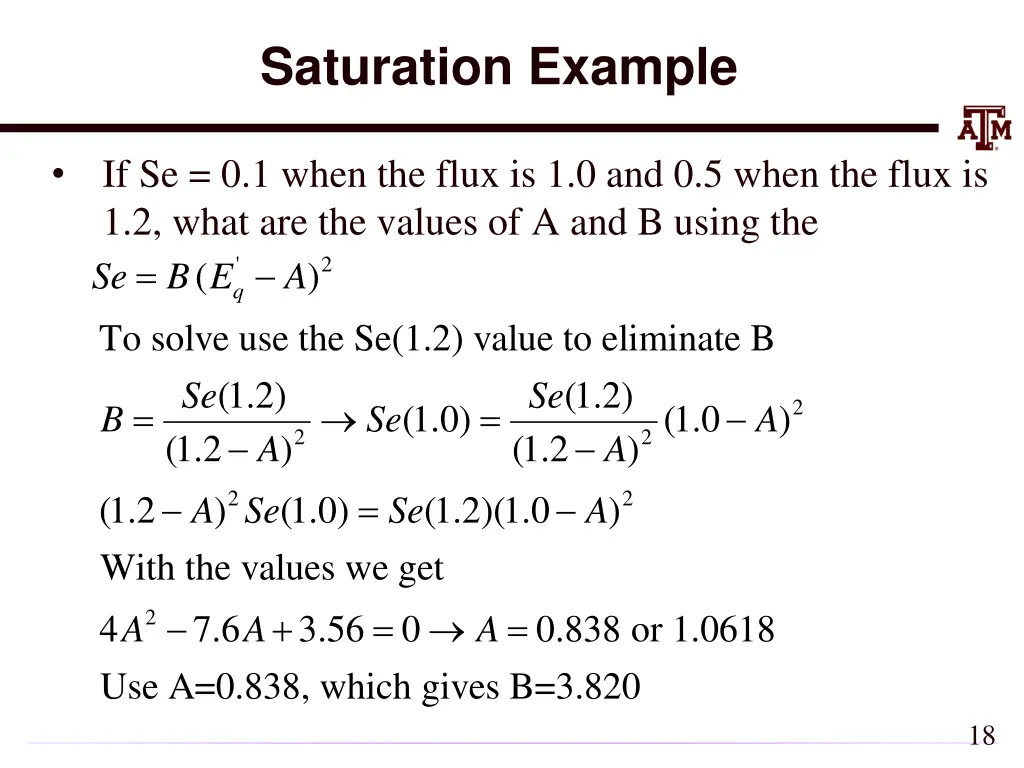
Saturation Example If Se = 0.1 when the flux is 1.0 and 0.5 when the flux is 1.2, what are the values of A and B using the ' 2 ( ) q Se B E A = To solve use the Se(1.2) value to eliminate B (1.2) (1.0) (1.2 ) (1.2 (1.2 ) (1.0) (1.2)(1.0 With the values we get 4 7.6 3.56 0 0.838 or 1.0618 Use A=0.838, which g ives B=3.820 (1.2) Se Se = = 2 (1.0 ) B Se A 2 2 ) A A = 2 2 ) A Se Se A + = = 2 A A A 18
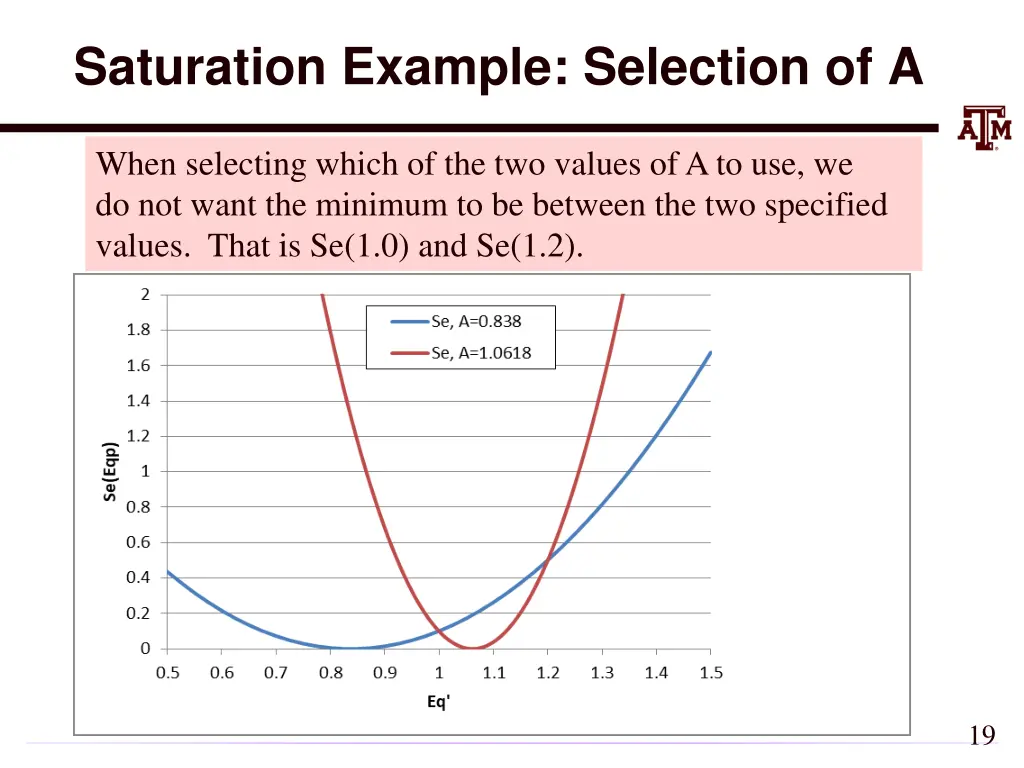
Saturation Example: Selection of A When selecting which of the two values of A to use, we do not want the minimum to be between the two specified values. That is Se(1.0) and Se(1.2). 19
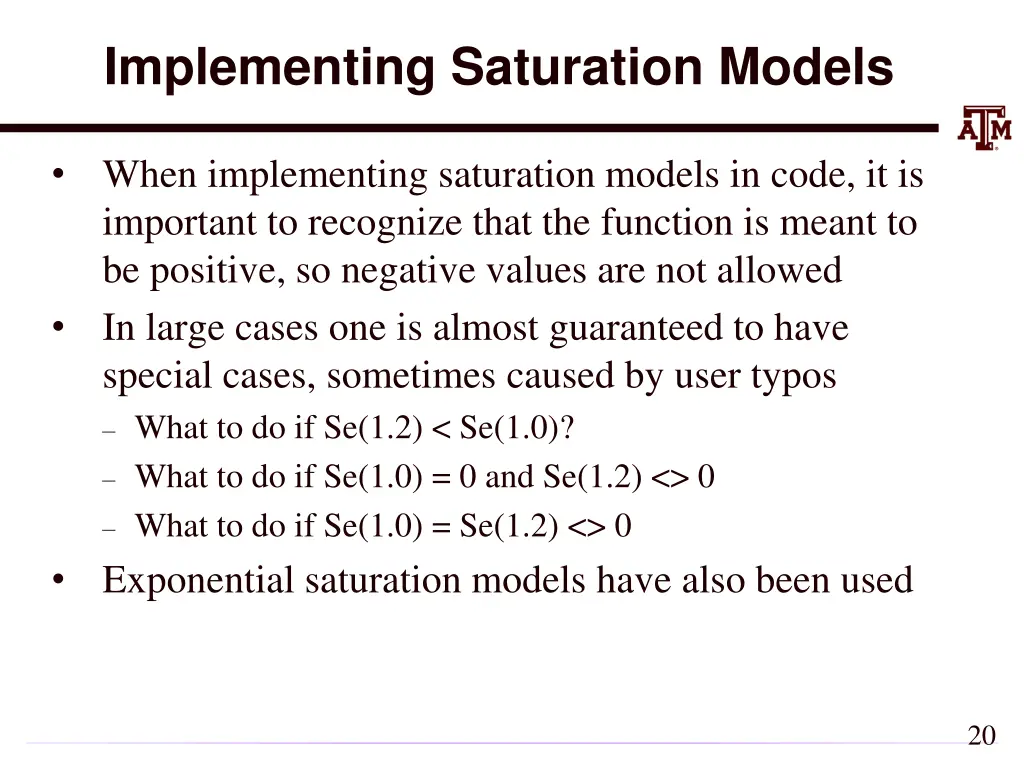
Implementing Saturation Models When implementing saturation models in code, it is important to recognize that the function is meant to be positive, so negative values are not allowed In large cases one is almost guaranteed to have special cases, sometimes caused by user typos What to do if Se(1.2) < Se(1.0)? What to do if Se(1.0) = 0 and Se(1.2) <> 0 What to do if Se(1.0) = Se(1.2) <> 0 Exponential saturation models have also been used 20
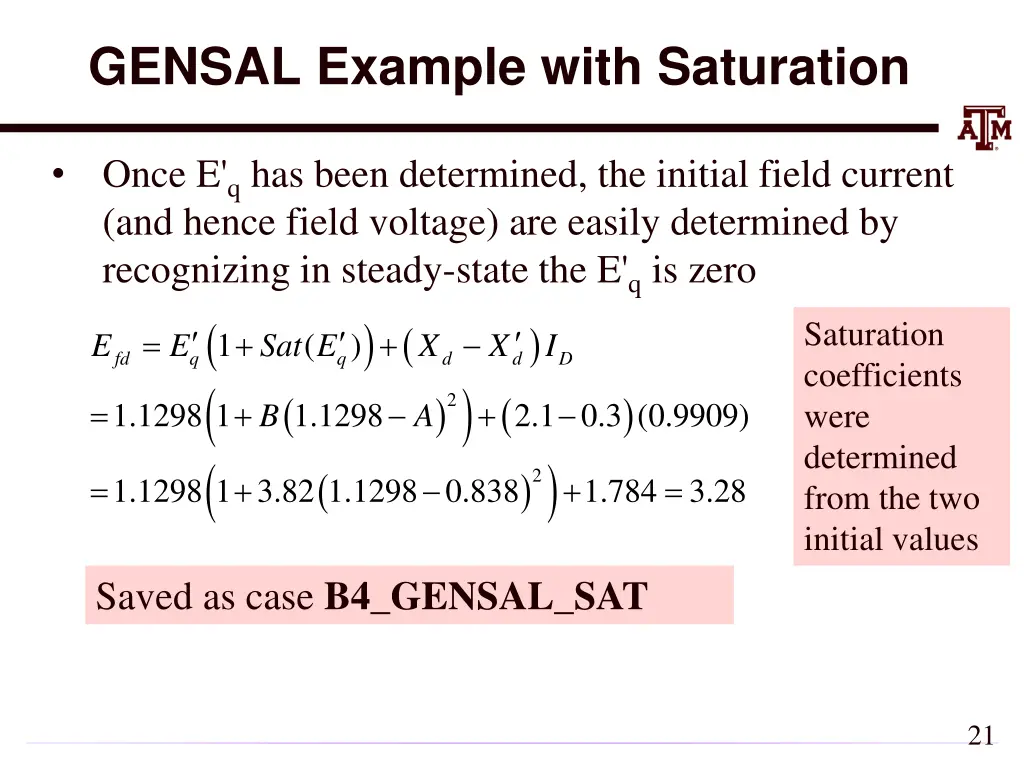
GENSAL Example with Saturation Once E'q has been determined, the initial field current (and hence field voltage) are easily determined by recognizing in steady-state the E'q is zero ( ( ) ( ) ( + Saturation coefficients were determined from the two initial values ) q q d = + 1 ( ) E E Sat E X X I fd d D ( ) ( ) 2 = + + 2.1 0.3 (0.9909) 1.1298 1 1.1298 B A ) ( ) 2 = 1.1298 1 3.82 1.1298 0.838 + + = 1.784 3.28 Saved as case B4_GENSAL_SAT 21
GENROU The GENROU model has been widely used to model round rotor machines Saturation is assumed to occur on both the d-axis and the q-axis, making initialization slightly more difficult 22
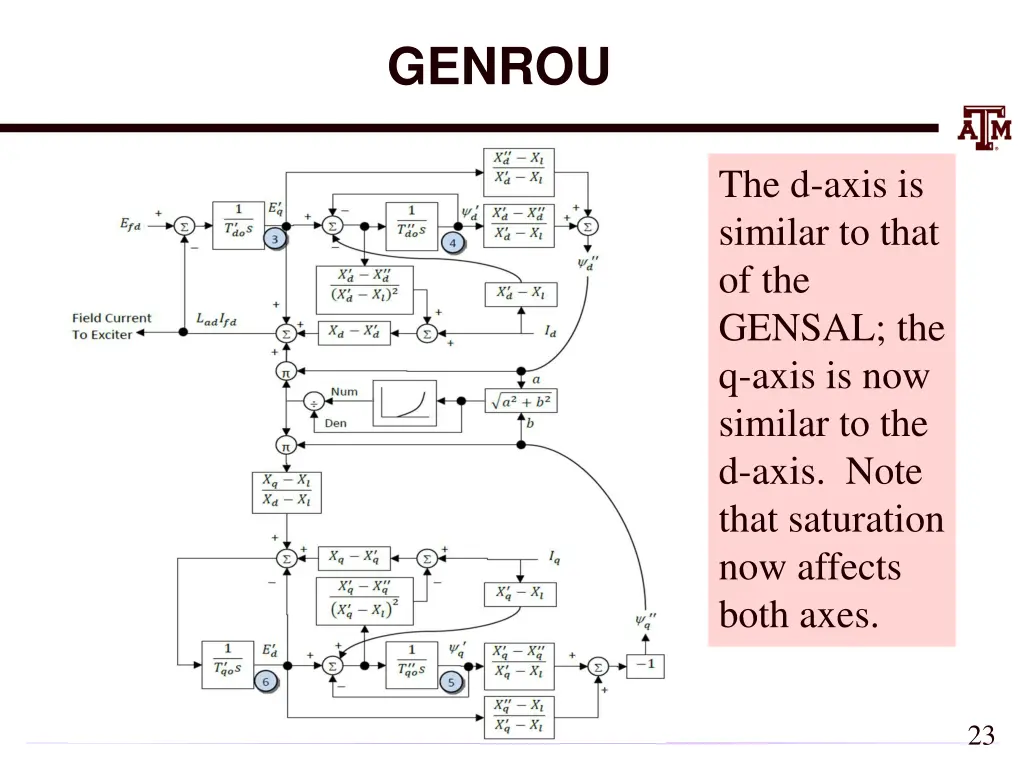
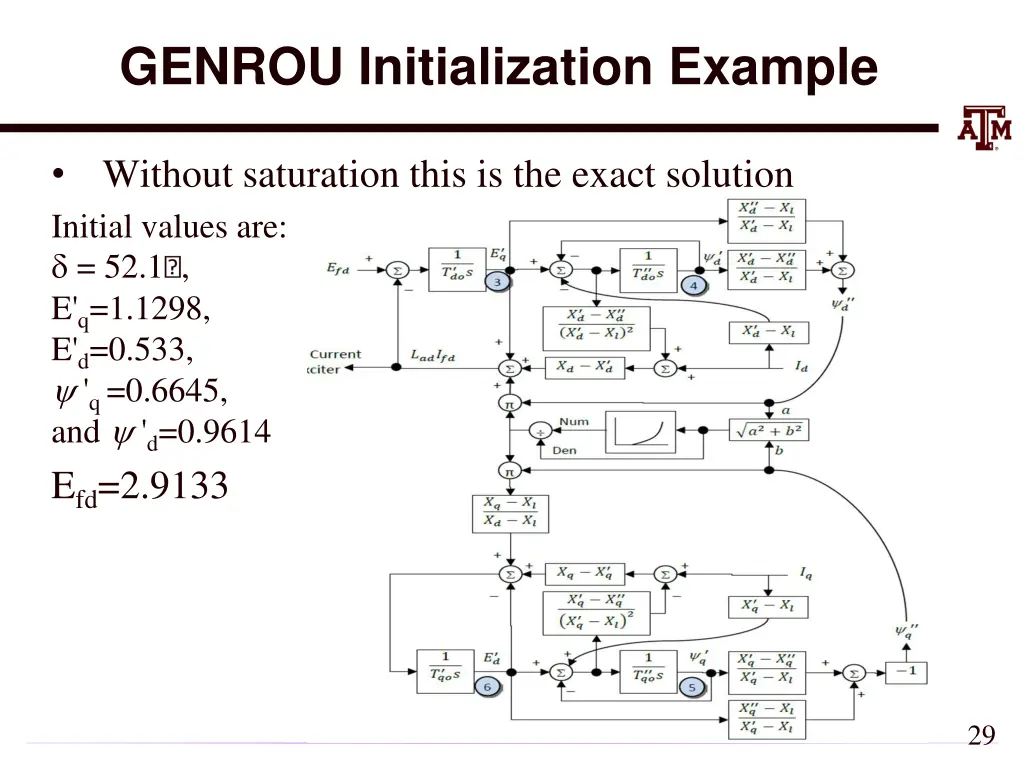
GENROU The d-axis is similar to that of the GENSAL; the q-axis is now similar to the d-axis. Note that saturation now affects both axes. 23
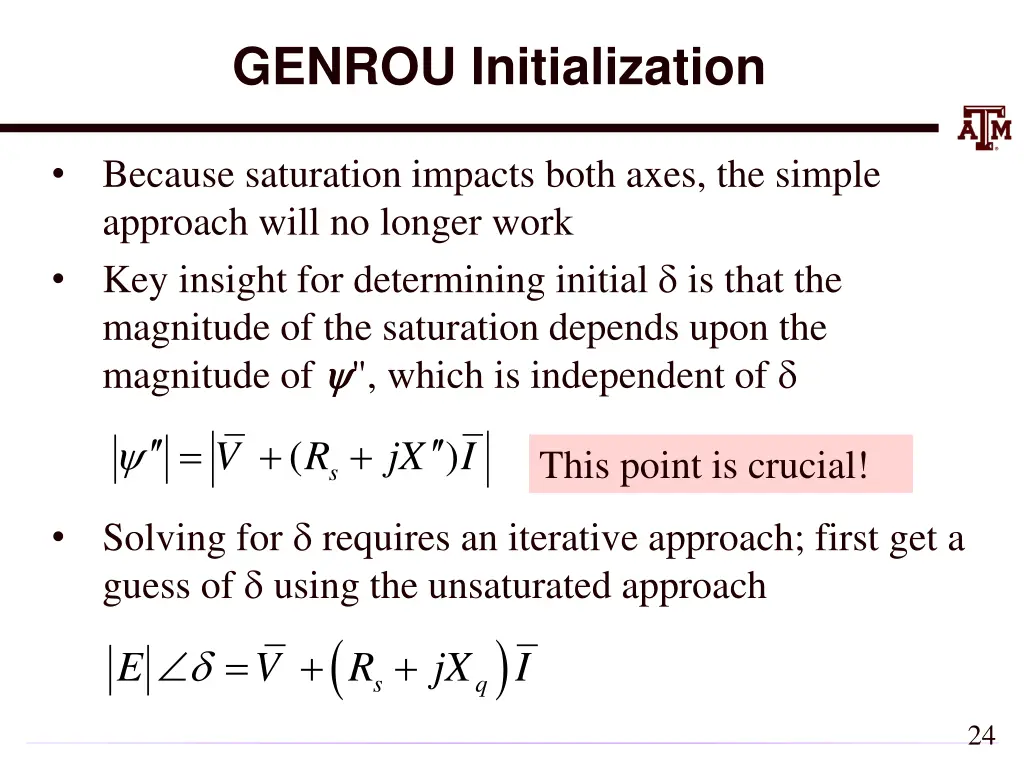
GENROU Initialization Because saturation impacts both axes, the simple approach will no longer work Key insight for determining initial is that the magnitude of the saturation depends upon the magnitude of ", which is independent of jX I = + + ( ) V R This point is crucial! s Solving for requires an iterative approach; first get a guess of using the unsaturated approach ( s q E V R jX I = + + ) 24
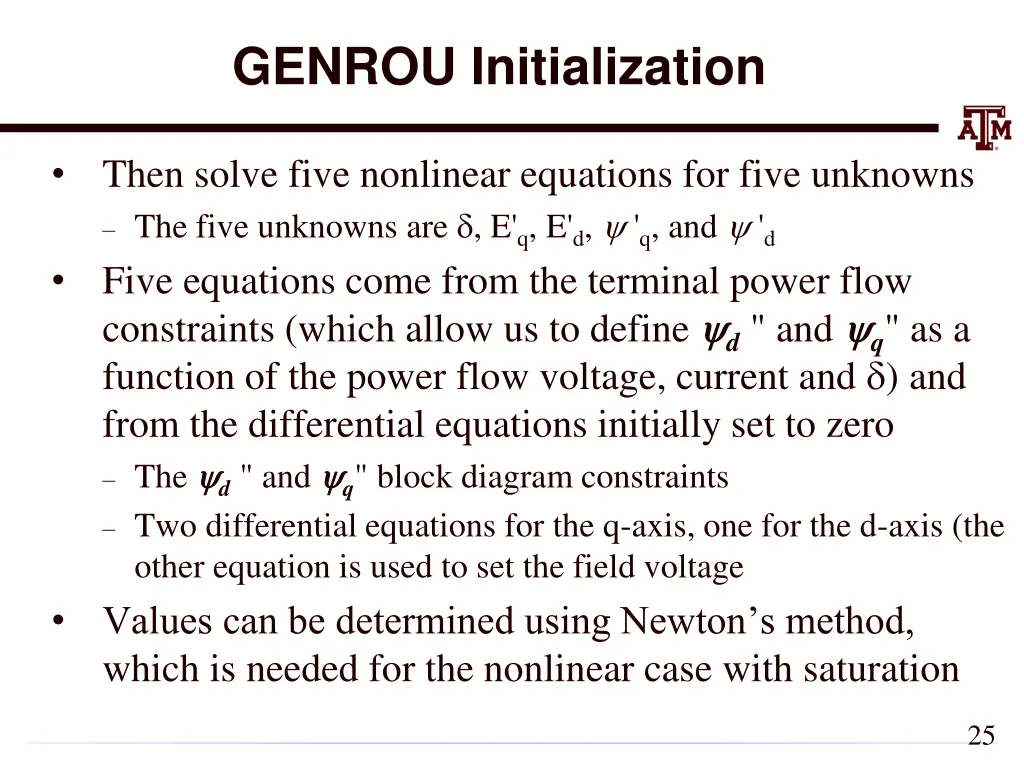
GENROU Initialization Then solve five nonlinear equations for five unknowns The five unknowns are , E'q, E'd, 'q, and 'd Five equations come from the terminal power flow constraints (which allow us to define d " and q" as a function of the power flow voltage, current and ) and from the differential equations initially set to zero The d " and q" block diagram constraints Two differential equations for the q-axis, one for the d-axis (the other equation is used to set the field voltage Values can be determined using Newton s method, which is needed for the nonlinear case with saturation 25
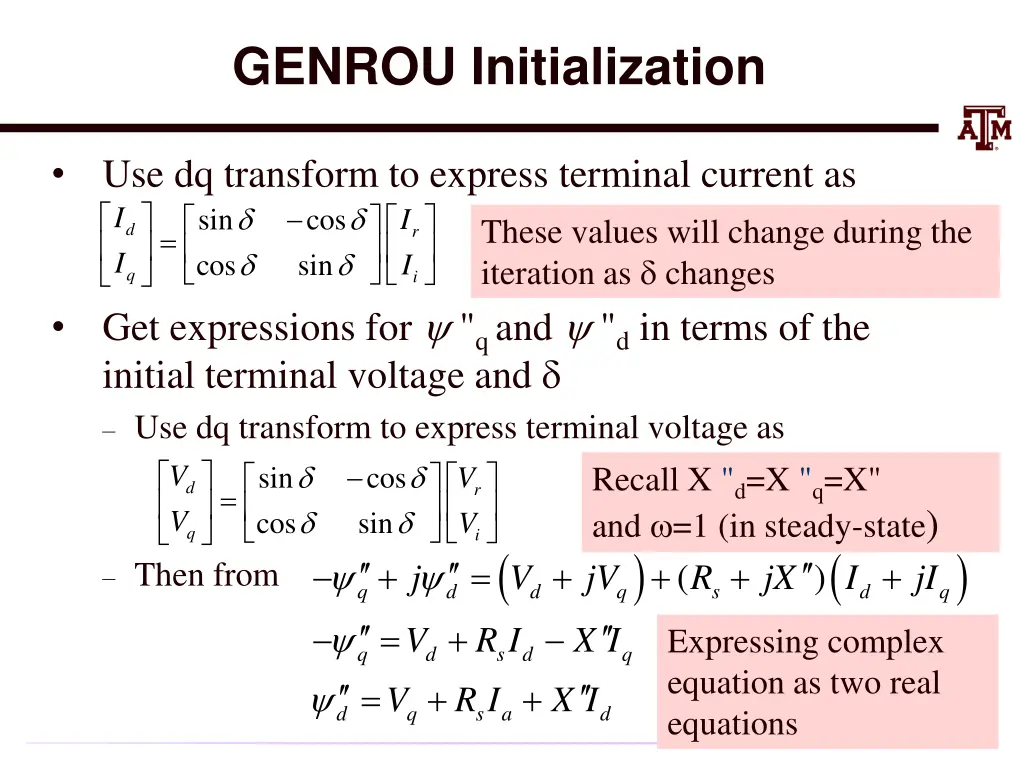
GENROU Initialization Use dq transform to express terminal current as sin cos cos sin q i I I I I These values will change during the iteration as changes d r = Get expressions for "q and "d in terms of the initial terminal voltage and Use dq transform to express terminal voltage as sin cos cos sin q i V V j + = = + = + V Recall X "d=X "q=X" and =1 (in steady-state) V d r = ( ) ( ) + + + + Then from ( ) V jV R jX I jI q d d q s d q V R I X I Expressing complex equation as two real equations q d s d q + V R I X I d q s a d 26
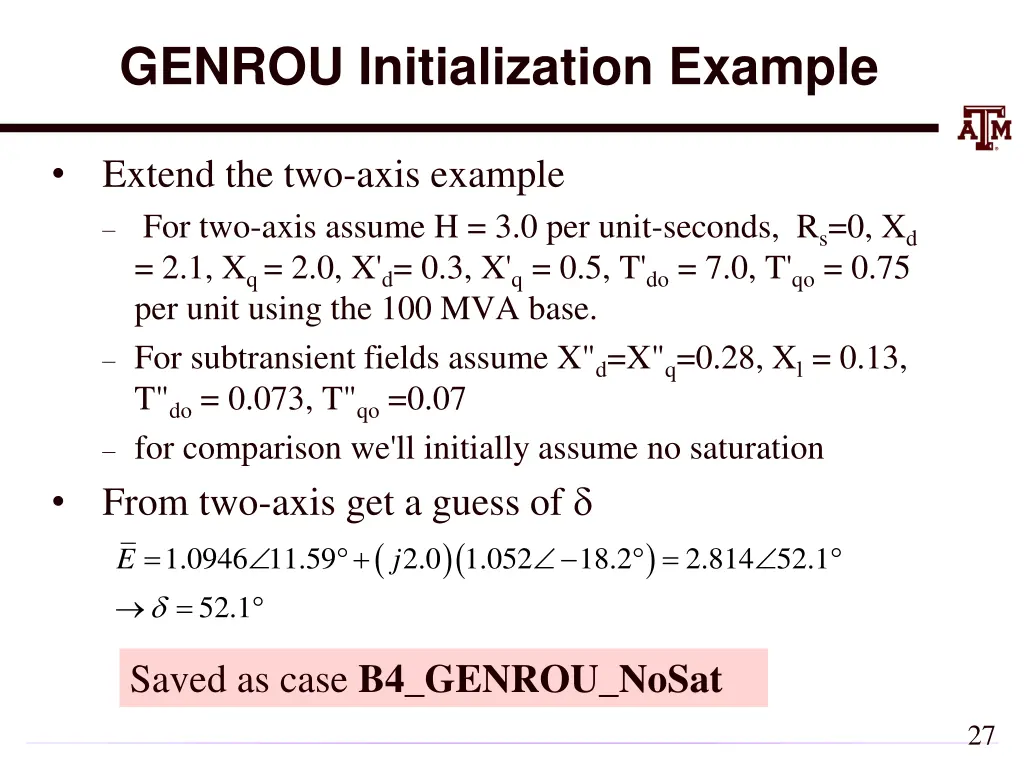
GENROU Initialization Example Extend the two-axis example For two-axis assume H = 3.0 per unit-seconds, Rs=0, Xd = 2.1, Xq = 2.0, X'd= 0.3, X'q = 0.5, T'do = 7.0, T'qo = 0.75 per unit using the 100 MVA base. For subtransient fields assume X"d=X"q=0.28, Xl = 0.13, T"do = 0.073, T"qo =0.07 for comparison we'll initially assume no saturation From two-axis get a guess of ( )( 1.0946 11.59 2.0 1.052 52.1 = ) = + = 2.814 52.1 18.2 E j Saved as case B4_GENROU_NoSat 27
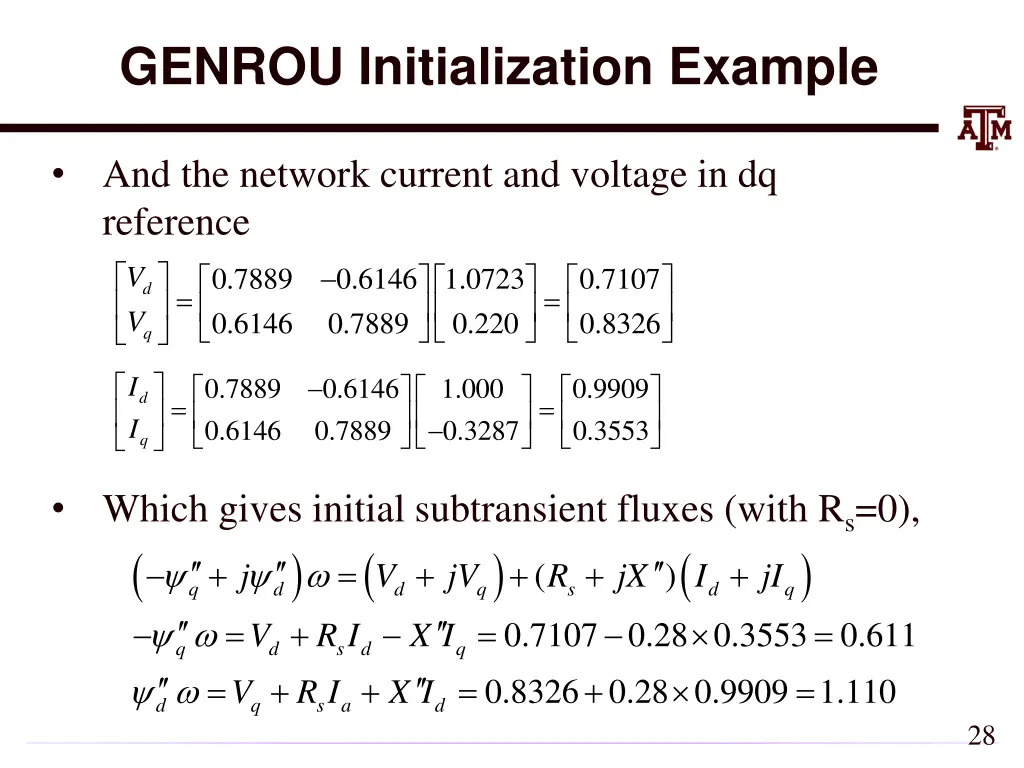
GENROU Initialization Example And the network current and voltage in dq reference V V 0.7889 0.6146 0.6146 1.0723 0.7889 0.7107 0.8326 d = = 0.220 q I I 0.7889 0.6146 0.6146 0.7889 1.000 0.3287 0.9909 0.3553 d = = q Which gives initial subtransient fluxes (with Rs=0), ( 0.7107 0.28 0.3553 q d s d q V R I X I V R I X I = + + = ) + ( ) ( ) q d + j = + + + + ( ) V jV R jX I jI d q = s d q = = 0.611 0.8326 0.28 0.9909 1.110 + = d q s a d 28
GENROU Initialization Example Without saturation this is the exact solution Initial values are: = 52.1 , E'q=1.1298, E'd=0.533, 'q =0.6645, and 'd=0.9614 Efd=2.9133 29
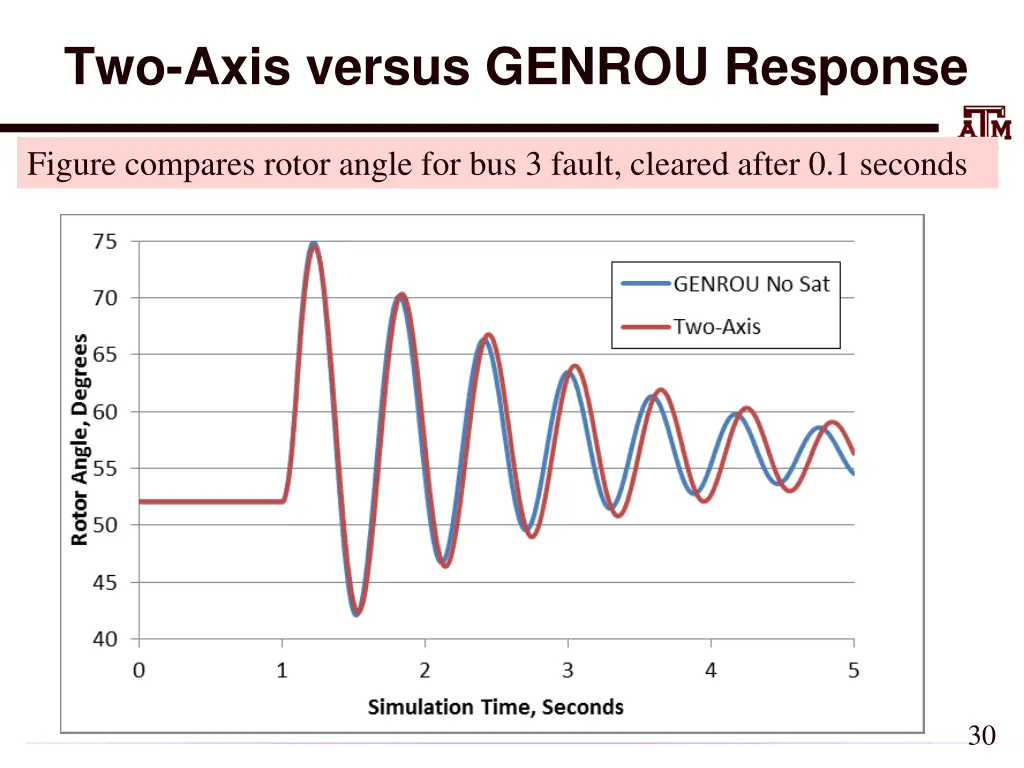
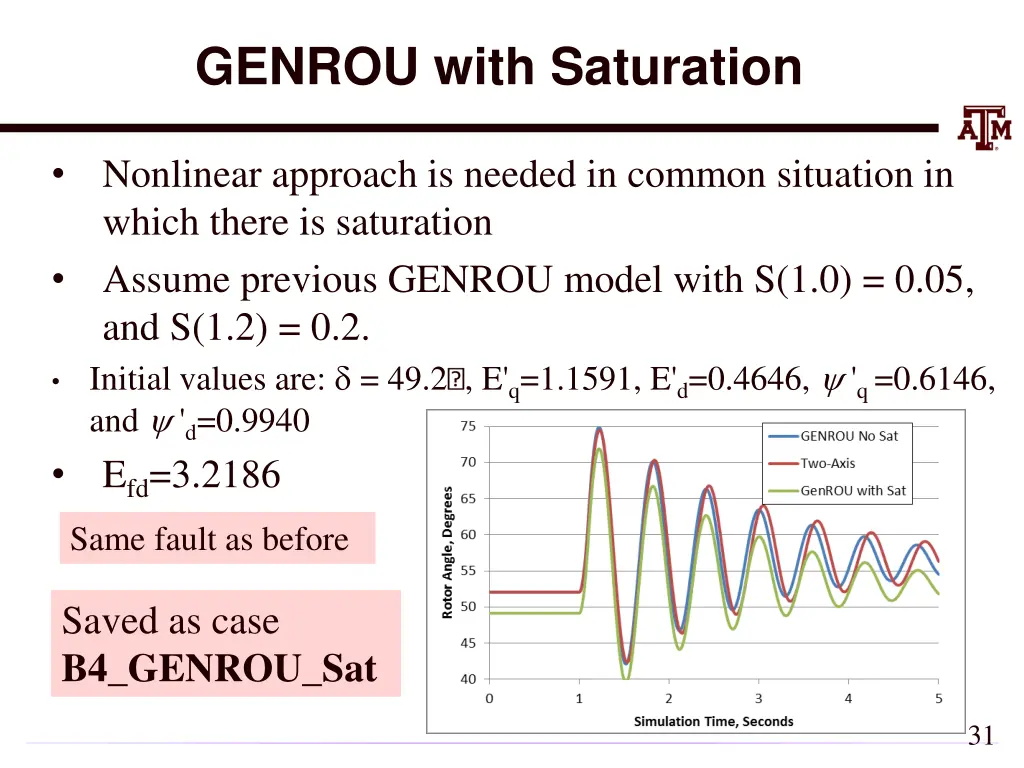
GENROU with Saturation Nonlinear approach is needed in common situation in which there is saturation Assume previous GENROU model with S(1.0) = 0.05, and S(1.2) = 0.2. Initial values are: = 49.2 , E'q=1.1591, E'd=0.4646, 'q =0.6146, and 'd=0.9940 Efd=3.2186 Same fault as before Saved as case B4_GENROU_Sat 31
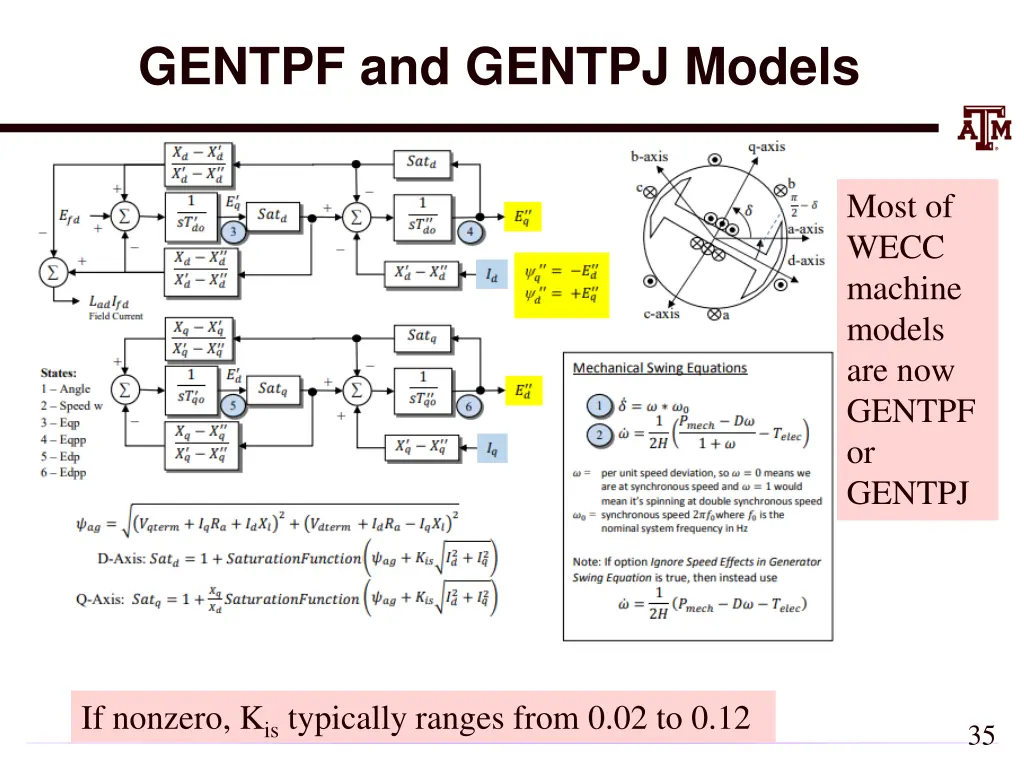
GENTPF and GENTPJ Models These models were introduced in 2009 to provide a better match between simulated and actual system results for salient pole machines Desire was to duplicate functionality from old BPA TS code Allows for subtransient saliency (X"d <> X"q) Can also be used with round rotor, replacing GENSAL and GENROU Useful reference is available at below link; includes all the equations, and saturation details https://www.wecc.biz/Reliability/gentpj-typej-definition.pdf 32
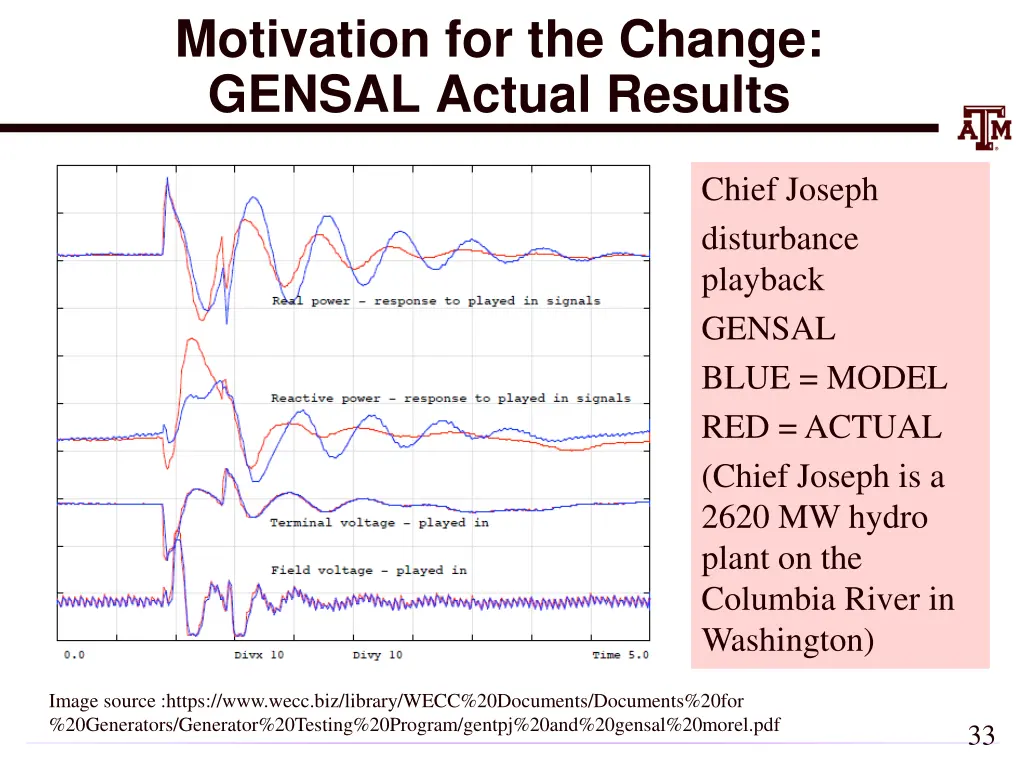
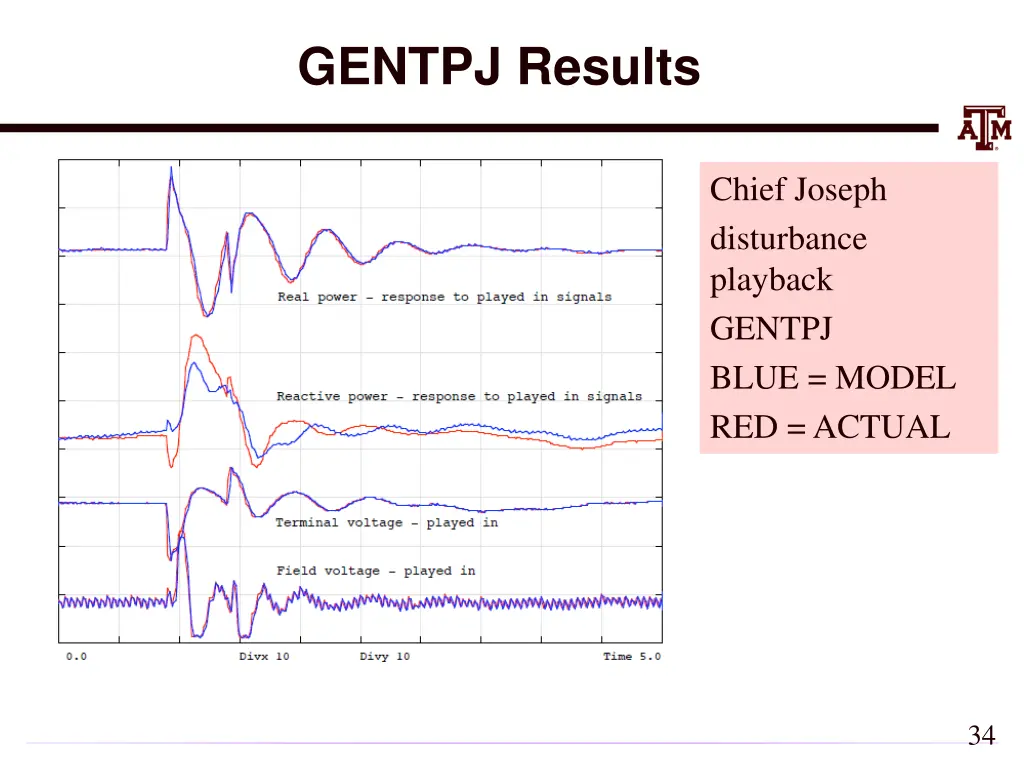
Motivation for the Change: GENSAL Actual Results Chief Joseph disturbance playback GENSAL BLUE = MODEL RED = ACTUAL (Chief Joseph is a 2620 MW hydro plant on the Columbia River in Washington) Image source :https://www.wecc.biz/library/WECC%20Documents/Documents%20for %20Generators/Generator%20Testing%20Program/gentpj%20and%20gensal%20morel.pdf 33
GENTPJ Results Chief Joseph disturbance playback GENTPJ BLUE = MODEL RED = ACTUAL 34
GENTPF and GENTPJ Models Most of WECC machine models are now GENTPF or GENTPJ If nonzero, Kis typically ranges from 0.02 to 0.12 35
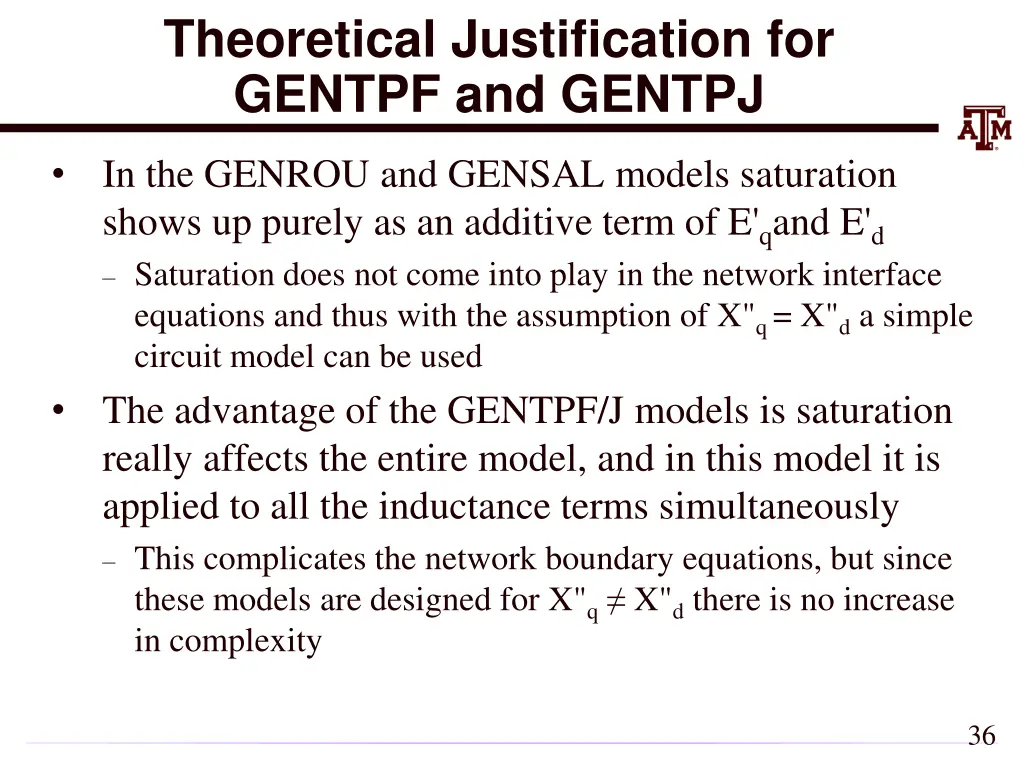
Theoretical Justification for GENTPF and GENTPJ In the GENROU and GENSAL models saturation shows up purely as an additive term of E'qand E'd Saturation does not come into play in the network interface equations and thus with the assumption of X"q = X"d a simple circuit model can be used The advantage of the GENTPF/J models is saturation really affects the entire model, and in this model it is applied to all the inductance terms simultaneously This complicates the network boundary equations, but since these models are designed for X"q X"d there is no increase in complexity 36
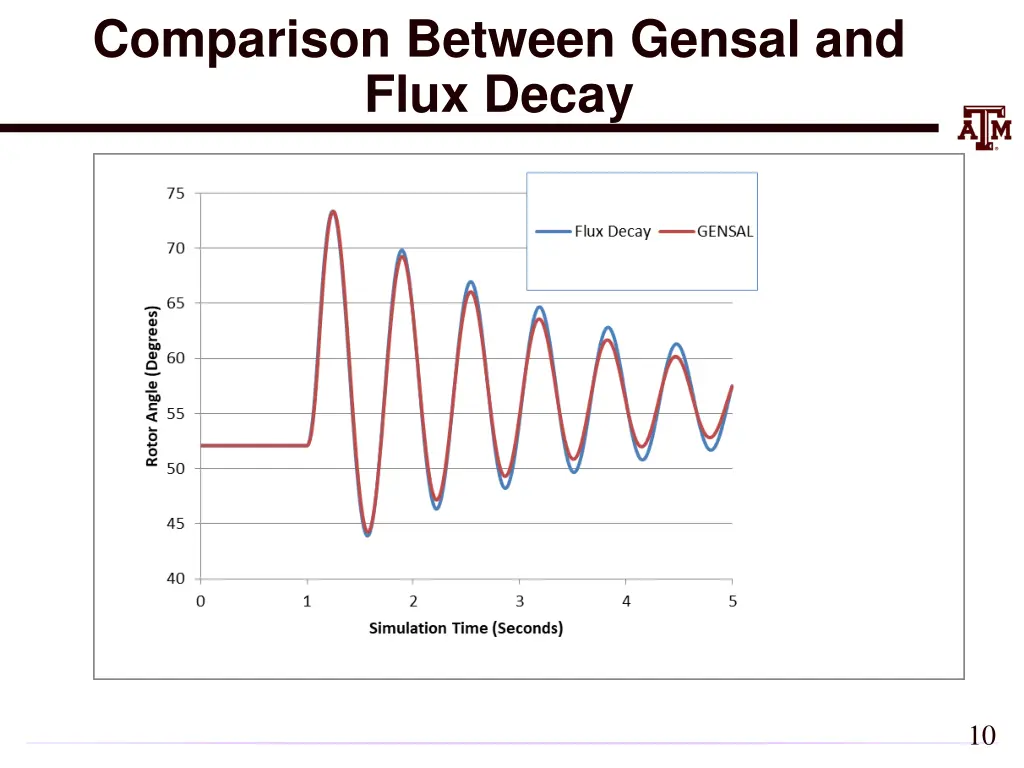
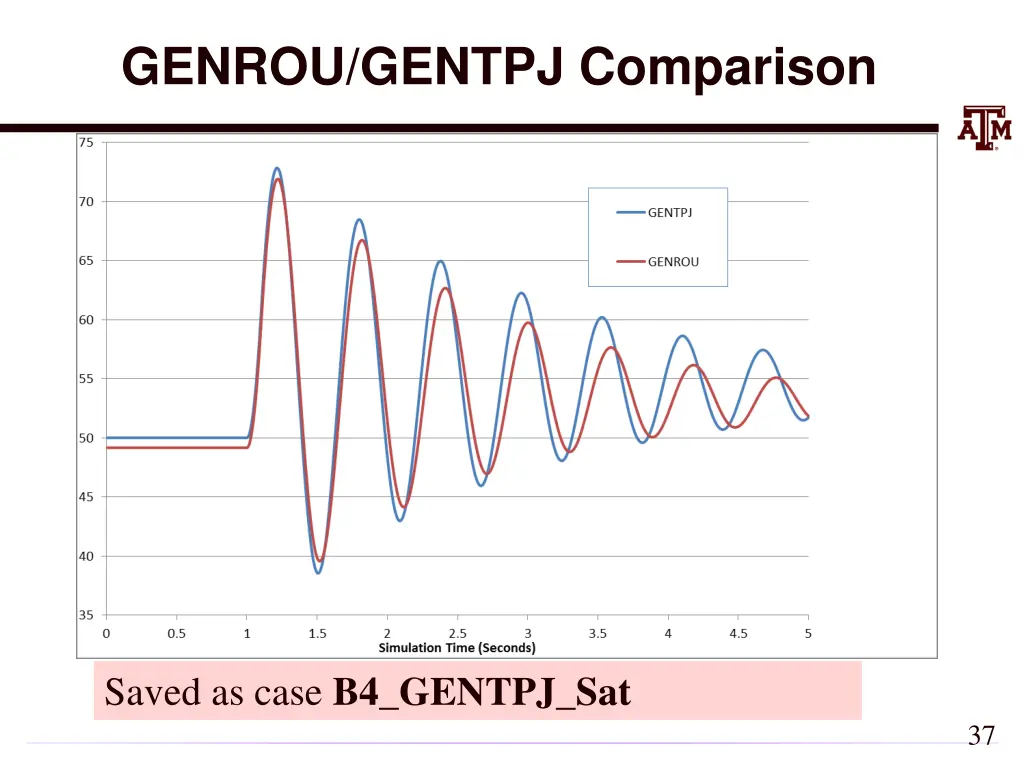
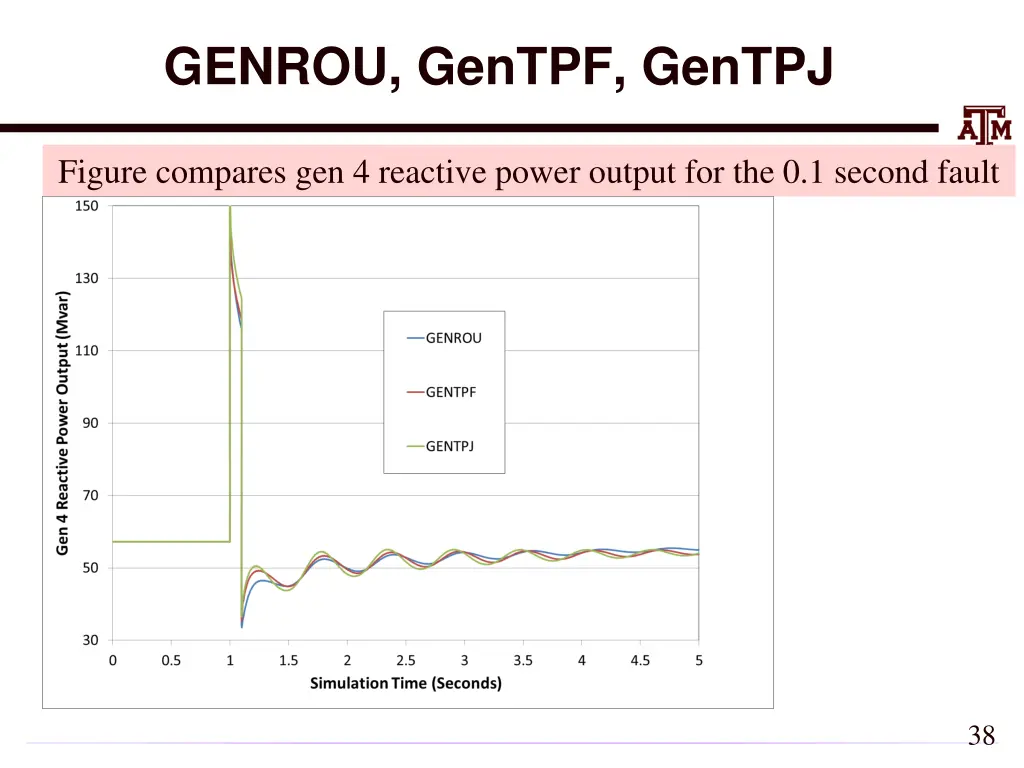
GENROU, GenTPF, GenTPJ Figure compares gen 4 reactive power output for the 0.1 second fault 38
Why does this even matter? GENROU and GENSAL models date from 1970, and their purpose was to replicate the dynamic response the synchronous machine They have done a great job doing that Weaknesses of the GENROU and GENSAL model has been found to be with matching the field current and field voltage measurements Field Voltage/Current may have been off a little bit, but that didn t effect dynamic response It just shifted the values and gave them an offset Shifted/Offset field voltage/current didn t matter too much in the past 39