Synthesis of D-Alanine Cephalexin Condensed Drug Polymer
A new condensed drug polymer was synthesized from the polycondensation of cephalexin acid chloride and D-alanine acid chloride, producing a bioactive and drug polymer. The peptide polymer was characterized using 1H-NMR, FTIR, and UV spectroscopy, with controlled release rates measured at different pH values. Experimental procedures for the synthesis and characterization are detailed in the study.

Download Presentation

Please find below an Image/Link to download the presentation.
The content on the website is provided AS IS for your information and personal use only. It may not be sold, licensed, or shared on other websites without obtaining consent from the author. If you encounter any issues during the download, it is possible that the publisher has removed the file from their server.
You are allowed to download the files provided on this website for personal or commercial use, subject to the condition that they are used lawfully. All files are the property of their respective owners.
The content on the website is provided AS IS for your information and personal use only. It may not be sold, licensed, or shared on other websites without obtaining consent from the author.
E N D
Presentation Transcript
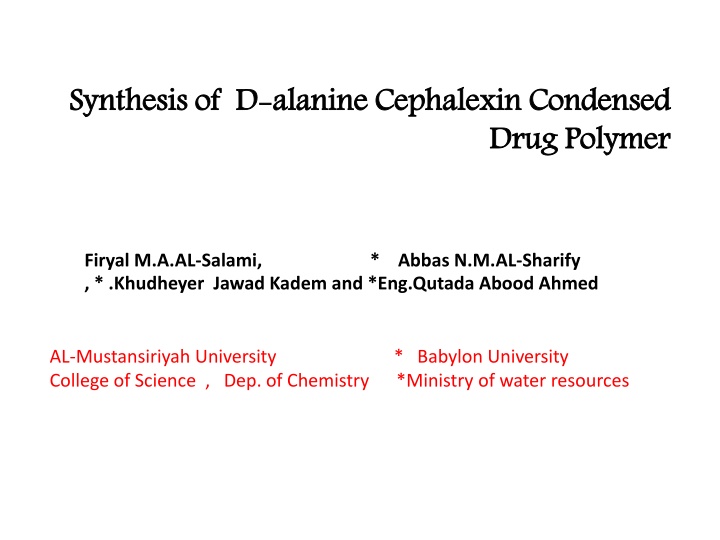
Synthesis of D Synthesis of D- -alanine alanine Cephalexin Cephalexin Condensed Drug Polymer Condensed Drug Polymer Firyal M.A.AL-Salami, * Abbas N.M.AL-Sharify , * .Khudheyer Jawad Kadem and *Eng.Qutada Abood Ahmed AL-Mustansiriyah University * Babylon University College of Science , Dep. of Chemistry *Ministry of water resources
Abstract:- In this paper a new condensed drug polymer were synthesized from polycondensation of cephalexin acid chloride and D-alanine acid chloride producing polyamide as a bioactive and drug polymer. The prepared peptide polymer was characterized by using 1H-NMR ,FTIR and UV. Spectroscopy. Intrinsic viscosity was 0.5 dl/g .The swelling % was calculated for the polymer. The controlled release rates were measured in different pH values at 370C.
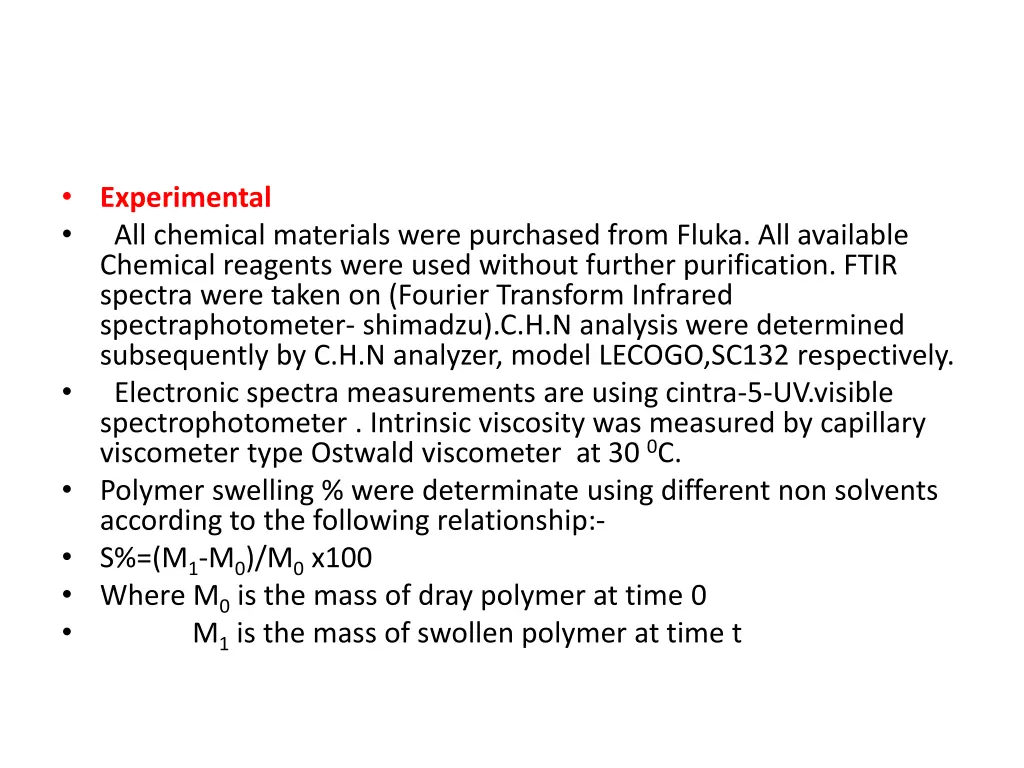
Experimental All chemical materials were purchased from Fluka. All available Chemical reagents were used without further purification. FTIR spectra were taken on (Fourier Transform Infrared spectraphotometer- shimadzu).C.H.N analysis were determined subsequently by C.H.N analyzer, model LECOGO,SC132 respectively. Electronic spectra measurements are using cintra-5-UV.visible spectrophotometer . Intrinsic viscosity was measured by capillary viscometer type Ostwald viscometer at 30 0C. Polymer swelling % were determinate using different non solvents according to the following relationship:- S%=(M1-M0)/M0 x100 Where M0 is the mass of dray polymer at time 0 M1 is the mass of swollen polymer at time t
Conversion of D-alanine or Cephalexin to acidchloride derivatives In a round bottom flask provided with magnatic bar was placed dissolved D-alanine in dioxane, and the stochiometric amount of thionylchloride was added drop wise at 00C . The mixture was stirred 20 min. The product was isolated and washed by ether and dried. The same conditions was used with cephalexin to convert to acidchloride derivative.
Polycondensation of D-alanine acidchloride and cephalexine acidchloride A 100 ml round-bottomed flask equipped with a magnetic stirrer, athermometer and reflux condenser was charged with 10 ml of dioxane, ( 0.1mole) D- alanine and (0.1mole). The mixture was stirred and refluxed for about 3h. and homogenous solution was achieved. The mixture was cooled at room temperature, and the precipitate condensed polymer was collected. The produced polymer was rapidly washed with alcohol and dried at 50 0C in vacuum overnight, the yield was 90%.with in =0.5.
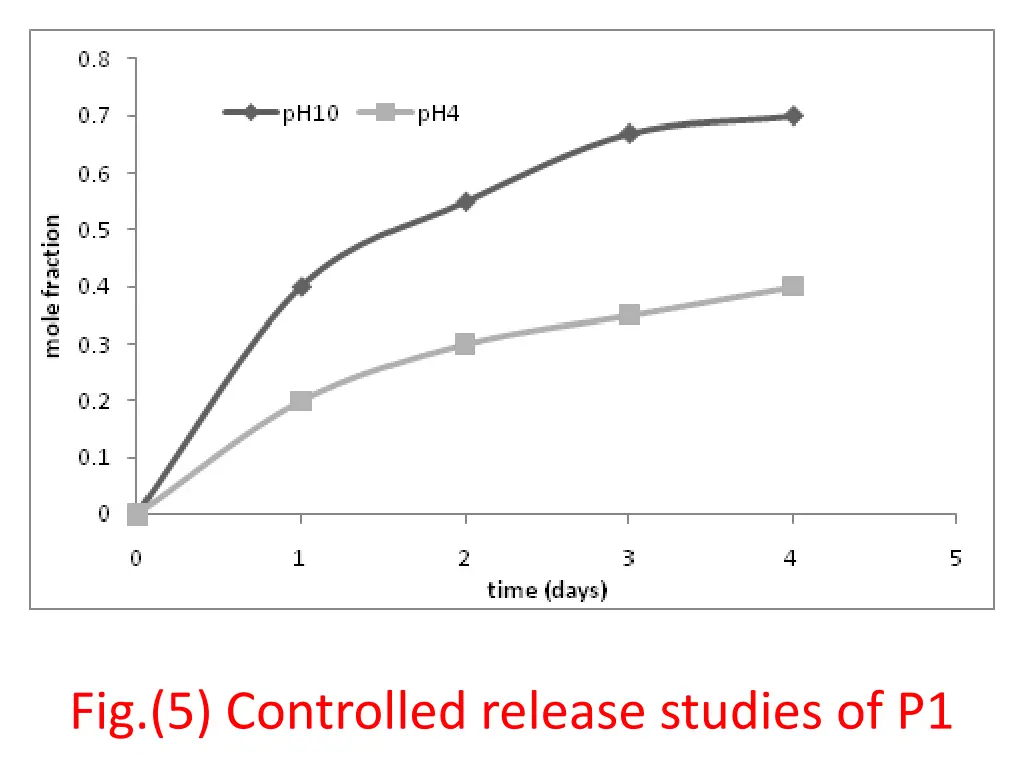
Controlled drug release studies 50 mg was placed in 100ml of buffer solution with pH 4 and 10 at 37 0C. At periodic intervals 3ml of solution containg drug polymer withdrawing and tested at max 290 nm using UV- VIS spectrophotometer. The release media were changed periodically with fresh KCl-HCl solution. The release studies were continued until the absorbance of the final solution was zero. The amount of released cephalexine was quantified using appropriate calibration curve.
Results and Discussion The objective of this research work was to incorporating cephalexine and D-alanine through backbone of condensed polymer containing amide groups. In basic idea behind the development of such a system is to maintain a constant level of drug in the blood plasma in spite of the fact that the drug does not undergo disintegration [15].
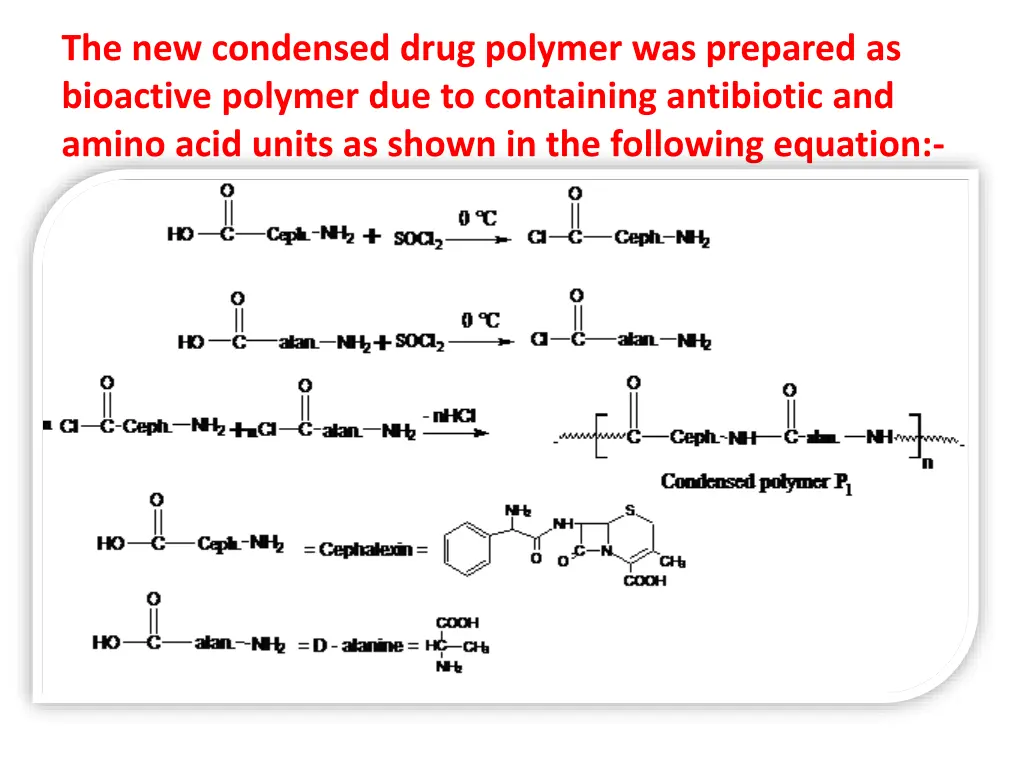
The new condensed drug polymer was prepared as bioactive polymer due to containing antibiotic and amino acid units as shown in the following equation:-
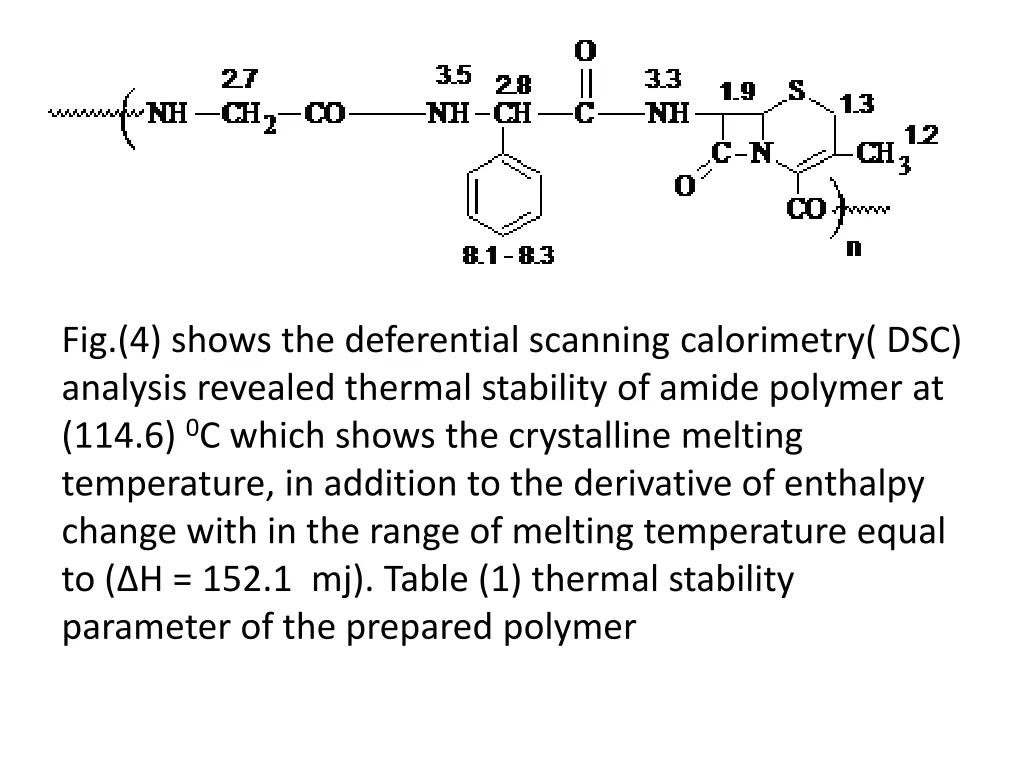
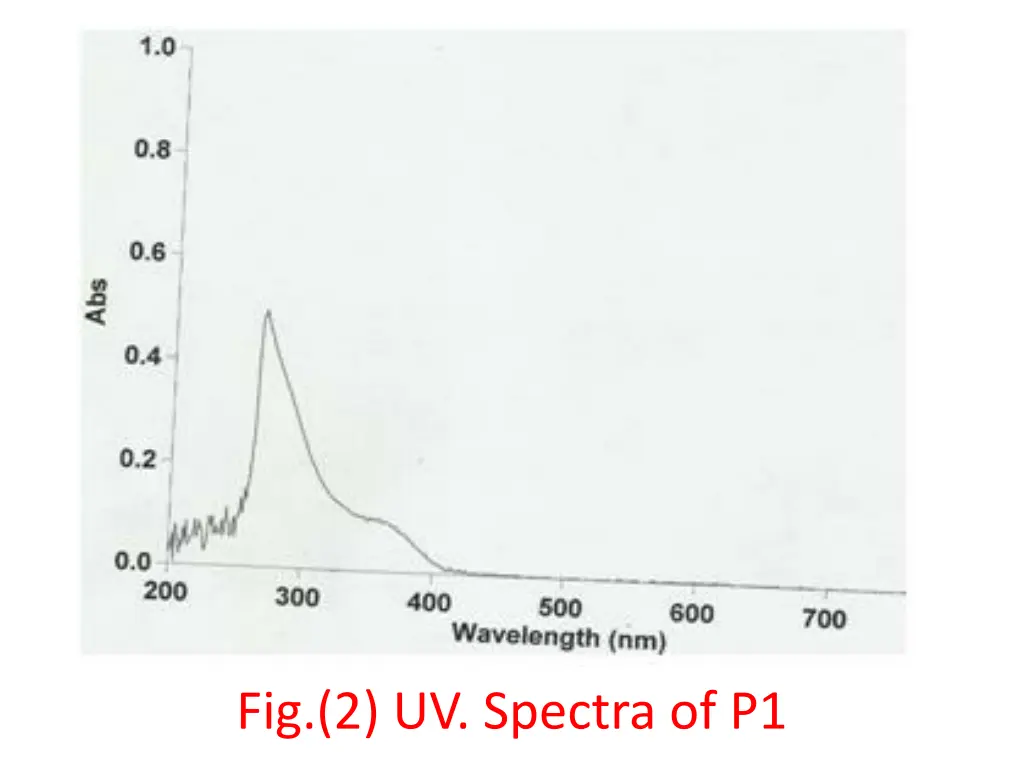
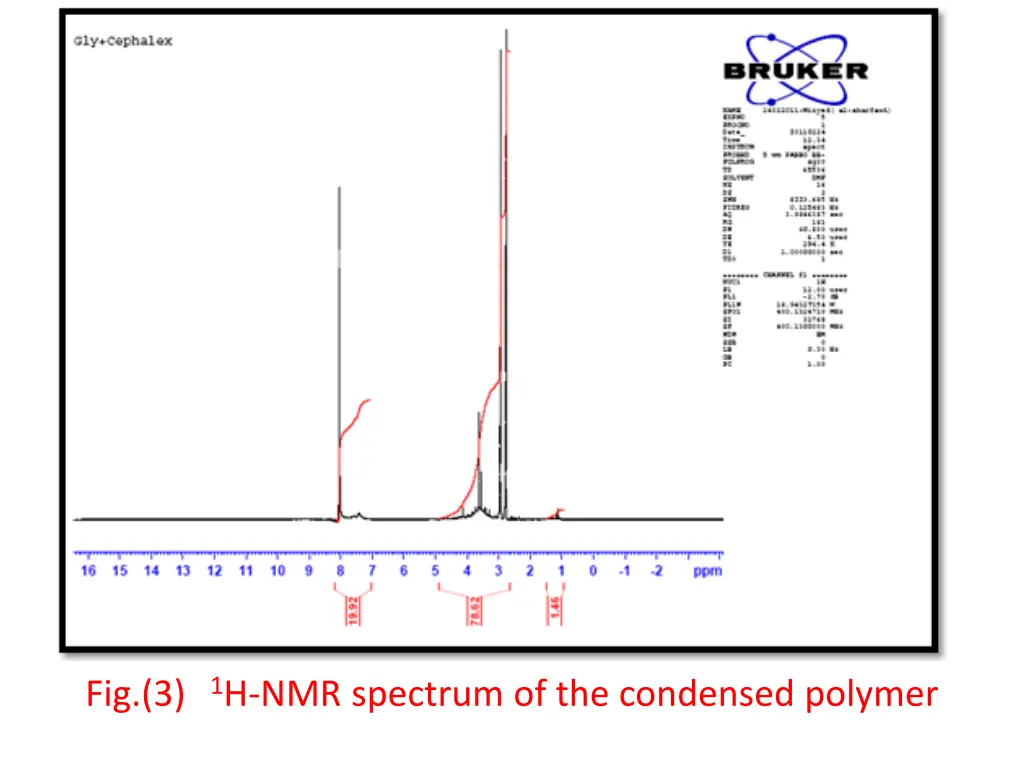
This amide polymer P1 was characterized by FTIR spectroscopy, Fig.(1) shows the absorption at 3200cm-1for -NH group and 1656cm-1due to -C=O amide and around 2950-2860 cm-1due to - C-H aliphatic and the other at 3100 cm-1which attributed to - C-H aromatic and -C=O acid at 1724 cm-1. Fig.(2) of UV. Spectra shows the two peaks at max(360,260)nm due to (n- *) and ( - *) transitions. Fig.(3) of the 1H-NMR spectra of the prepared polymer shows the chemical shifts as shown follow:- ( 1.2 ) ppm (CH2,CH3) ( 8.3 ) ppm ( for different environment aromatic protons) ( 3.5 ) ppm ( for HN-C=O amide) ( 2.7 ) ppm (CH neighboring amide and carbonyl )
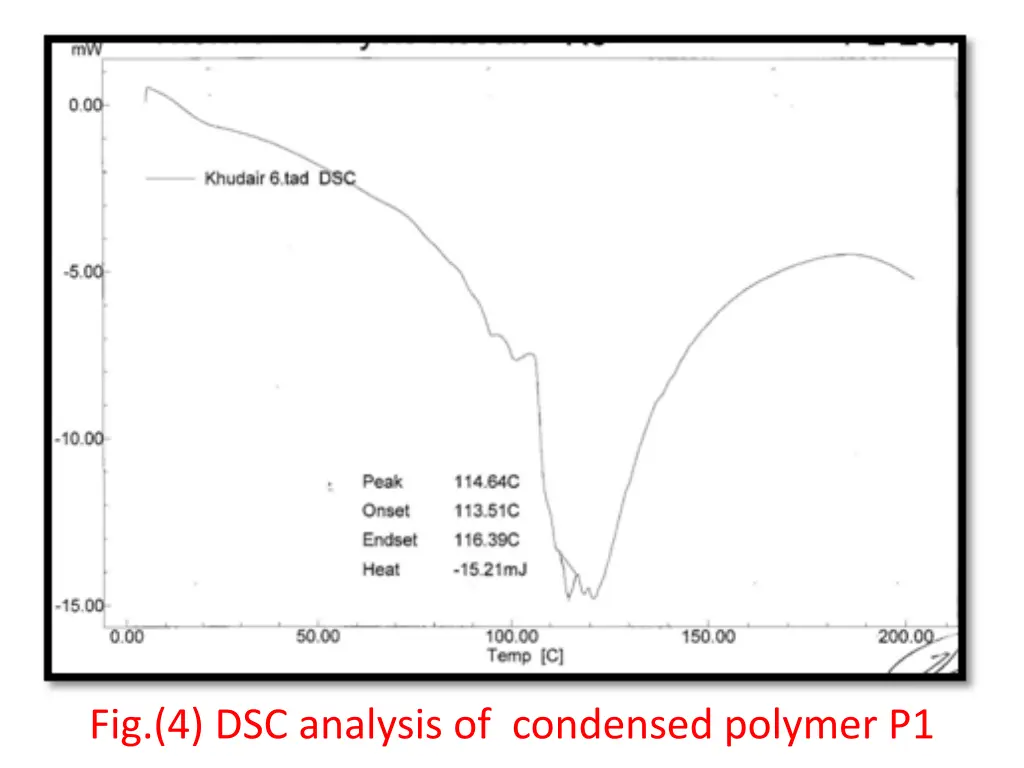
Fig.(4) shows the deferential scanning calorimetry( DSC) analysis revealed thermal stability of amide polymer at (114.6) 0C which shows the crystalline melting temperature, in addition to the derivative of enthalpy change with in the range of melting temperature equal to ( H = 152.1 mj). Table (1) thermal stability parameter of the prepared polymer
Conclusions The synthesized condensed polymer containing medicinal compounds such as cephalexin, and aminoacid such as D-alanine as bioactive materials were incorporating through the backbone of amide polymer which could hydrolysis in different pH values at 370C to be desirable for long term drug delivery, and release over a prolong time, and to minimize the drug side effects.