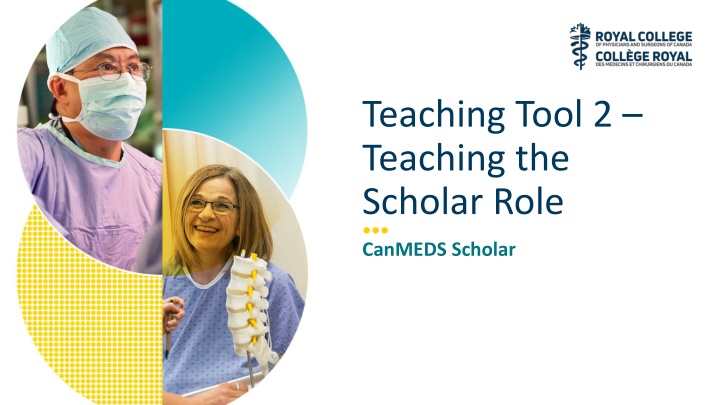
Learn about the Scholar role in medical education, including its importance, components, and how physicians can continuously learn, teach others, evaluate evidence, and contribute to scholarship. Explore the objectives, agenda, and details of this critical role in shaping competent healthcare professionals.
Please find below an Image/Link to download the presentation.
The content on the website is provided AS IS for your information and personal use only. It may not be sold, licensed, or shared on other websites without obtaining consent from the author. If you encounter any issues during the download, it is possible that the publisher has removed the file from their server.
You are allowed to download the files provided on this website for personal or commercial use, subject to the condition that they are used lawfully. All files are the property of their respective owners.
The content on the website is provided AS IS for your information and personal use only. It may not be sold, licensed, or shared on other websites without obtaining consent from the author.
The unmodified content below was created for the CanMEDS Teaching and Assessment Tools Guide by S Glover Takahashi, D Richardson and D Martin and is owned by the Royal College of Physicians and Surgeons of Canada. You may use, reproduce and modify the content for your own non- commercial purposes provided that your modifications are clearly indicated and you provide attribution to the Royal College. The Royal College may revoke this permission at any time by providing written notice. NOTICE: The content below may have been modified from its original form and may not represent the opinion or views of the Royal College. 2 T2 - Teaching the Scholar Role
Objectives and Agenda 1. Recognize the process and content of the four different components of Scholar 2. Apply key leadership skills to examples from day-to-day practice 3. Develop a personal Leadership resource for day-to-day practice 3 T2 - Teaching the Scholar Role
Why the Scholar Role matters 1. Learning does not end 2. Teaching others consolidates the information for the teacher 3. All learners and physicians have responsibilities for education 4. Physicians need to know what information is evidence and which evidence is applicable to day-to-day decisions 5. Physicians must understand and interpret research 4 T2 - Teaching the Scholar Role
The details: What is the Scholar Role As Scholars, physicians demonstrate a lifelong commitment to excellence in practice through continuous learning and by teaching others, evaluating evidence, and contributing to scholarship. 5 T2 - Teaching the Scholar Role
Recognizing the Scholar Role Assessing Motivating Orienting Providing feedback Researching Supervising Teaching Pursuing scholarly activity Coaching Enhancing Evaluating Maintaining Mentoring Monitoring 6 T2 - Teaching the Scholar Role
Recognizing the Scholar Role Community of practice, Lifelong learning Objectives Continuing competence Performance assessment Critical appraisal Portfolio Evidence Scholarship Scholarly inquiry Evidence informed, evidence-based Scientific principles Goals Self-directed learning/guided self-directed learning Learning climate, learning environment Learning plan 7 T2 - Teaching the Scholar Role
Four distinct parts of the Scholar Role 1. maintenance and acquisition of new knowledge throughout one s career through lifelong learning, 2. sharing of knowledge through teaching and assessment, 3. use of knowledge in evidence-informed decision-making, and 4. creation of knowledge through research and scholarly inquiry. 8 T2 - Teaching the Scholar Role
The responsibilities in the Scholar Role are shared by all practising physicians vis- -vis teaching, the use of evidence to inform practice, and through lifelong learning. Need to pursue focused opportunities for learning and skill development in each of the four parts of the Scholar Role. 9 T2 - Teaching the Scholar Role
Learning is a lifelong process for improvement and maintenance 1. Take FIRM control of learning. 2. Competent = skilled + current + connected 3. ASK for, look for, receive, and integrate feedback. Receiver is the key player in the feedback exchange. 10 T2 - Teaching the Scholar Role
Worksheet T3 Planning for learning 11 T2 - Teaching the Scholar Role
Tips to practice asking for feedback 1. Ask someone who is willing and can be constructive 2. Ask for SPECIFIC feedback 3. Listen and focus on what is helpful and specific 4. Thank them for their input. 12 T2 - Teaching the Scholar Role
R2C2 Feedback model Relationship building Reactions exploration about feedback Content exploration Coaching for performance change 13 T2 - Teaching the Scholar Role
Worksheet T4 Coaching Learners to Give and Receive Feedback 14 T2 - Teaching the Scholar Role
Steps to EIDM process 1. Ask by framing a focused question 2. Acquire the evidence in efficient manner 3. Appraise the evidence for quality and applicability 4. Integrate the evidence 5. Adapt the evidence for your clinical problem 6. Apply the evidence in your clinical plan 7. Analyze if the plan worked 15 T2 - Teaching the Scholar Role
Coaching Steps 1. Goals 2. Practice of knowledge, skills and abilities 3. Feedback 4. Reflection on performance 5. Setting goals 6. Planning for improvement 16 T2 - Teaching the Scholar Role
Objectives 1. Recognize the process and content of the four different components of Scholar 2. Apply key leadership skills to examples from day-to-day practice 3. Develop a personal Leadership resource for day-to-day practice 17 T2 - Teaching the Scholar Role
References Stone D, Heen S. Thanks for the feedback: the science and art of receiving feedback well. New York: Viking; 2014. Sargeant J, Lockyer J, Mann K, Holmboe E, Silver I, Armson H, Driessen E, MacLeod T, Yen W, Ross K, Power M. Facilitated reflective performance feedback: Developing an evidence- and theory- based model that builds relationship, explorse reactions and content, and coaches for performance change. Acad Med, 2015. (in press) Ciliska, D. Introduction to evidence-informed decision making. Last retrieved July 31, 2015 http://www.cihr-irsc.gc.ca/e/45245.html Richardson D, Oswald A, Chan M-K, Lang ES, Harvey BJ. Scholar. In: Frank JR, Snell L, Sherbino J, editors. CanMEDS 2015 Physician Competency Framework. Ottawa: Royal College of Physicians and Surgeons of Canada; 2015. 18 T2 - Teaching the Scholar Role
Scholar Key Competencies Physicians are able to: 1. Engage in the continuous enhancement of their professional activities through ongoing learning 2. Teach students, learners, the public, and other health care professionals 3. Integrate best available evidence into practice 4. Contribute to the creation and dissemination of knowledge and practices applicable to health 20 T2 - Teaching the Scholar Role
Scholar Key Competency 1 Physicians are able to: 1. Engage in the continuous enhancement of their professional activities through ongoing learning 1.1 Develop, implement, monitor, and revise a personal learning plan to enhance professional practice 1.2 Identify opportunities for learning and improvement by regularly reflecting on and assessing their performance using various internal and external data sources 1.3 Engage in collaborative learning to continuously improve personal practice and contribute to collective improvements in practice 21 T2 - Teaching the Scholar Role
Scholar Key Competency 2 Physicians are able to: 2. Teach students, learners, the public, and other health care professionals 2.1 Recognize the influence of role-modelling and the impact of the formal, informal, and hidden curriculum on learners 2.2 Promote a safe learning environment 2.3 Ensure patient safety is maintained when learners are involved 2.4 Plan and deliver a learning activity 2.5 Provide feedback to enhance learning and performance 2.6 Assess and evaluate learners, teachers, and programs in an educationally appropriate manner 22 T2 - Teaching the Scholar Role
Scholar Key Competency 3 Physicians are able to: 3. Integrate best available evidence into practice 3.1 Recognize practice uncertainty and knowledge gaps in clinical and other professional encounters and generate focused questions that address them 3.2 Identify, select, and navigate pre-appraised resources 3.3 Critically evaluate the integrity, reliability, and applicability of health-related research and literature 3.4 Integrate evidence into decision-making in their practice 23 T2 - Teaching the Scholar Role
Scholar Key Competency 4 Physicians are able to: 4. Contribute to the creation and dissemination of knowledge and practices applicable to health 4.1 Demonstrate an understanding of the scientific principles of research and scholarly inquiry and the role of research evidence in health care 4.2 Identify ethical principles for research and incorporate them into obtaining informed consent, considering potential harms and benefits, and considering vulnerable populations 4.3 Contribute to the work of a research program 4.4 Pose questions amenable to scholarly inquiry and select appropriate methods to address them 4.5 Summarize and communicate to professional and lay audiences, including patients and their families, the findings of relevant research and scholarly inquiry 24 T2 - Teaching the Scholar Role