Team Pitfalls: Recognizing and Addressing Common Challenges
Teams face common pitfalls like blamestorming, blowhard jamboree, groupthink, and heroics that hinder productivity. Learn how to identify and fix these issues to promote a healthy team dynamic and effective decision-making processes.

Download Presentation

Please find below an Image/Link to download the presentation.
The content on the website is provided AS IS for your information and personal use only. It may not be sold, licensed, or shared on other websites without obtaining consent from the author.If you encounter any issues during the download, it is possible that the publisher has removed the file from their server.
You are allowed to download the files provided on this website for personal or commercial use, subject to the condition that they are used lawfully. All files are the property of their respective owners.
The content on the website is provided AS IS for your information and personal use only. It may not be sold, licensed, or shared on other websites without obtaining consent from the author.
E N D
Presentation Transcript
Mini-Module: Common Team Pitfalls Designed for chapter 6, section 6.1, pages 180-183 of Project Team Leadership and Communication by Samuel Malachowsky, ISBN 9781732378902, 9781732378919.
Team Pitfall: Blamestorming Team members spend excess time analyzing and admiring the problem rather than productively working to find a solution. Has the tone of an inquisition. Blame and responsibility become more important than the issue itself Team members are afraid to make (and learn from) mistakes External pressures such as a difficult stakeholder or missed deadline can be a factor Related: scapegoating, witch-hunt, cover-your-rear mentality The Fix: Measurements of progress should be based on facts rather than opinion Focus on the most important issues (and the actions needed to resolve them) first Encourage a culture of learning from mistakes rather than hiding them
Team Pitfall: Blowhard Jamboree Opinions, misinformation, or bias are often shared as facts, improperly influencing important decisions (planning, estimates, etc.) Can be unintentional: confirmation bias or poor sources of information Can be intentional: intentionally influencing important decisions for personal benefit The Fix: Honesty about why you have an opinion Spend additional time analyzing problems and potential solutions Seek better quality information: specialists, fact-based sources Brown, William J., Malveau, Raphael C., McCormick, Hays W., Mowbray, Thomas J. Anti-Patterns - Refactoring software, architectures, and projects in crisis. John Wiley & Sons. p. 214. 1998.
Team Pitfall: Groupthink Teams value harmony and conformity over diversity of though, leading to less creative decision-making and opposing viewpoints Making a decision as a group generally is beneficial because of diversity; groupthink erases that benefit, leading to wasted time for more individuals Can be caused by a fear of conflict, which can emerge from debate A strong, central leader can cause team members to hesitate in showing opposing viewpoints The Fix: Split the group into sub-groups, who discuss topics independently then recombine Use a meeting coordinator rather than the boss If needed, assign a devil s advocate to introduce opposing viewpoints Whyte, W. H., Jr. "Groupthink". Fortune. p. 114 117, 142, 146. March 1952.
Team Pitfall: Heroics In spite of all obstacles (lack of time or resources, poor planning, etc.), a few heroes push to complete the project Team members who have a realistic view of the project may be seen as pessimists or non-believers Heroes often are left feeling overworked and underappreciated, opting to leave The Fix: Most important is a realistic view of schedules, resources, and what can be accomplished. Accuracy (not optimism) in estimating should be valued A sustainable pace is an important organizational value constant panic mode can lead to high resource turnover
Team Pitfall: Intellectual Violence One party understands a theory, technology, or jargon, and uses this knowledge to intimidate or subjugate others in public or a meeting Fear of not knowing something can cause a more closed, less collaborative environment Can happen inadvertently and often stifles creativity within the team The Fix: Team leaders should monitor for intellectual violence continuously, including their own behavior Teams must embrace mentorship instead of defensiveness Brown, William J., Malveau, Raphael C., McCormick, Hays W., Mowbray, Thomas J. Anti-Patterns - Refactoring software, architectures, and projects in crisis. John Wiley & Sons. p. 243. 1998.
Team Pitfall: Loose Cannon A single member of the team constantly causes disruption within the team environment affecting the outcomes the team is working towards Can be exasperated by tight deadlines, limited resources, or difficult work Loose cannons often prioritize workplace politics above substantive work May have long-term effects such as degrading stakeholder relations or team members leaving rather than continue to work with the loose cannon The Fix: Personal attention by the team leader (mentoring, one-on-one time) may help address the individual causes directly Isolation (work from home, separate office location) or termination of the loose cannon may become necessary
Team Pitfall: Poor Project Team/Stakeholder Relations Poor relations between individual stakeholders (the customer, other teams, etc.) can have a significant impact on the viability of any project Different agendas, motivators, influencers, and personality types can cause friction Contract negotiation, financial risk, and market forces can exasperate the situation The Fix: Limiting contact, such as having one point person for each group can be effective, especially if conflicting information is coming from multiple sources Eliminating stressors by engaging in appropriate planning and risk management can be effective Consistent, clear communication is key
Team Pitfall: Wishful Thinking Optimism, uncertainty, or ignorance can lead to inappropriate assumptions and poor decision making by project leaders and team members Can lead to insufficient planning, ignored risks, and overly optimistic schedules Often includes assumptions that outsourced/contracted work will be delivered on time and with sufficient attention to quality Regressive renegotiation can lead teams to promise an expanded scope in exchange for an extended deadline, leaving the project even further behind The Fix: Schedules and risk scenarios should be considered carefully when creating schedules If the team tends to avoid negativity, they may also fail to consider legitimate issues
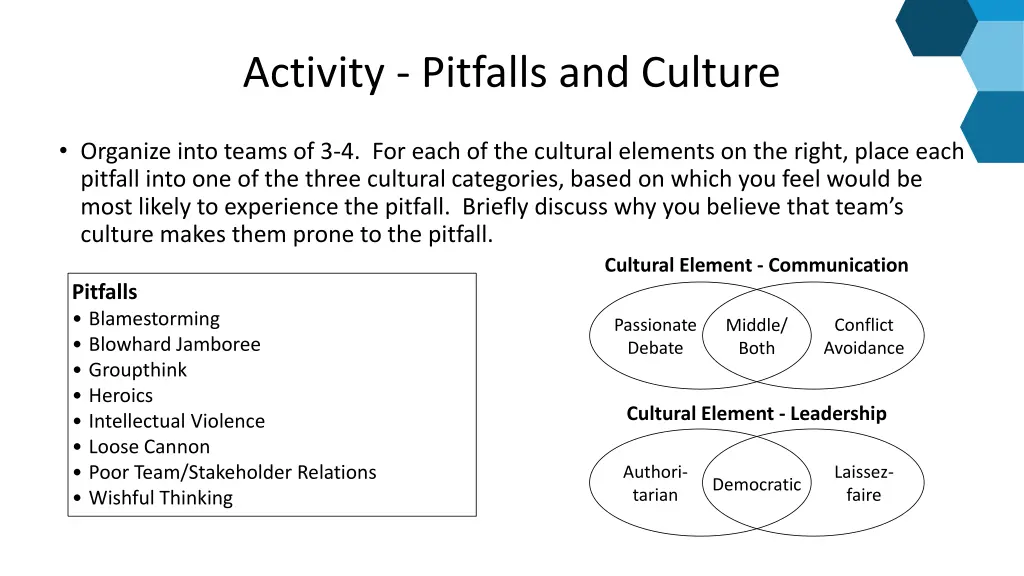
Activity - Pitfalls and Culture Organize into teams of 3-4. For each of the cultural elements on the right, place each pitfall into one of the three cultural categories, based on which you feel would be most likely to experience the pitfall. Briefly discuss why you believe that team s culture makes them prone to the pitfall. Cultural Element - Communication Pitfalls Blamestorming Blowhard Jamboree Groupthink Heroics Intellectual Violence Loose Cannon Poor Team/Stakeholder Relations Wishful Thinking Passionate Debate Conflict Avoidance Middle/ Both Cultural Element - Leadership Authori- tarian Laissez- faire Democratic