Technician Class January/February 2022 Study Resources

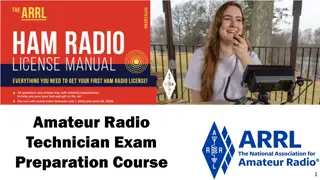
In this collection of study resources for the Technician Class exam, you will find links to helpful websites, online study materials, the entire question pool, FCC rules and regulations, and more. Prepare for your exam with the best resources available.

Download Presentation

Please find below an Image/Link to download the presentation.
The content on the website is provided AS IS for your information and personal use only. It may not be sold, licensed, or shared on other websites without obtaining consent from the author.If you encounter any issues during the download, it is possible that the publisher has removed the file from their server.
You are allowed to download the files provided on this website for personal or commercial use, subject to the condition that they are used lawfully. All files are the property of their respective owners.
The content on the website is provided AS IS for your information and personal use only. It may not be sold, licensed, or shared on other websites without obtaining consent from the author.
E N D
Presentation Transcript
Technician Class January / February 2022
https://hamstudy.org EVERYONE should register here and use it for study / practice tests. https://www.youtube.com/watch?v=0mP- Qe2SYwI&list=PLuapIzKwhZN_30dcgsDbGU3J7C8BAYJcG Dave Casler s Technician Class License Series. http://www.arrl.org/shop/Ham-Radio-License-Manual/ ARRL Ham Radio License Manual 4thEdition. https://ARRL.org National Association for Amateur Radio. W5YI Group one of the earlier getting licensed organizations, some materials free others paid. https://w5yi.org FCC Rules and Regulations Part 97: https://www.ecfr.gov/current/title-47/chapter- I/subchapter-D/part-97
Entire Question Pool published online Current Pool Expires after June of this Year Pool divided into ten sections T1-T0 Each section divided into a variable number of sub sections, 35 sub sections in total. Sub sections have a variable number of questions. All questions are multiple choice. Each test will have one question from each sub section. No penalty for guessing. Question Pool size: 423 35 questions on test Must pass 26 questions
T3A05 (B) When using a directional antenna, how might your station be able to access a distant repeater if buildings or obstructions are blocking the direct line of sight path? Change from vertical to horizontal polarization Try to find a path that reflects signals to the repeater Try the long path Increase the antenna SWR A. B. C. D. http://ncvec.org/
FCC Rules and Regulations Part 97.1 Basis and Purpose: a) Recognition and enhancement of the value of the amateur service to the public as a voluntary noncommercial communication service, particularly with respect to providing emergency communications. b) Continuation and extension of the amateur's proven ability to contribute to the advancement of the radio art. c) Encouragement and improvement of the amateur service through rules which provide for advancing skills in both the communication and technical phases of the art. d) Expansion of the existing reservoir within the amateur radio service of trained operators, technicians, and electronics experts. e) Continuation and extension of the amateur's unique ability to enhance international goodwill.
International Telecommunication Union (ITU) United Nations Agency that establishes international treaties and standards regarding communications technologies. Established as International Telegraph Union on 17 May 1865 making it the oldest existent international organization. Splits world into three regions for managing radio spectrum: Region 1: Europe, Africa, The Former Soviet Union, Mongolia, The Middle East west of the Persian Gulf, western boundary is defined by line B Region 2: Americas, Greenland and some Pacific Islands. Eastern Boundary is defined by line B Region 3: Most of non Former Soviet Union Asia (FSU) including Iran and most of Oceana.
Federal Communication Commission (FCC) Established by Congress 19 June 1934 to regulate communications technologies in the US. Currently regulates: Radio Television Wire Satellite Cable
Frequency Coordinators In the Utah VHF Society http://utahvhfs.org Coordinators are agreed upon by the Amateur Radio operators who have eligible stations. Their purpose is recommending transmit / receive channels and parameters for auxiliary and repeater stations.
ARRL Amateur Radio Relay League Largest Amateur Radio Society / Club in US. Most of the current rules were advocated for by the ARRL. Advocates for Amateur Radio Interests with ITU, FCC, and Congress. Publishes information about Amateur Radio. I encourage everyone to join if they become licensed. http://www.arrl.org RACES Radio Amateur Civil Emergency Service Allows local governments to use Amateur radio in times of disaster if their own equipment falls over. Managed by the individual states with licensed Amateur Radio operators. https://dem.utah.gov/resources-for-ems/radio-ares-and-races/ ARES Amateur Radio Emergency Services Not codified in part 97 rules. Created by ARRL In Utah tends to work on the county level. I.E. Salt Lake County ARES http://www.slcoares.net
Utah Amateur Radio Club (UARC) Founded 1927 Open to everyone in Utah interested in Amateur Radio. https://user.xmission.com/~uarc/ Salt Lake Crossroads Amateur Radio Club Affiliated with SLC EMS https://Slcarc.org Works with safe neighborhoods program Salt Lake County ARES Focused on providing public service communications in the Salt Lake County Area https://www.slcoares.net Utah County ARES Focused on providing public service communications in the Utah County Area https://www.ucares.org UtahSAG Focuses on providing communication at public service events Works with other clubs particularly the ARES clubs. Conducts licensing sessions https://utahsag.org West Valley Amateur Radio Club Focused on West Valley City https://www.wvarc.org Utah DX Association Focused on long distance communications and contests https://www.udxa.org Many more
Regular station, portable, car, boat, plane, house Auxiliary station Beacon For the purpose of studying propagation and similar experiements Repeater Station Repeats signals. Space Station Located 50 km above earth s surface Earth Station Below 50 km above earth s surface. Space Telecommand Station Controls a space station from ground Telecommand of an amateur station Telecommand of model craft
Operator / Primary station Most Amateur radio stations Club station One person called a trustee designated by club an officer of the club Club must have at least four persons (only trustee must be licensed) Must have a Name Management Document of Organization Primary Purpose devoted to amateur service activities consistent with part 97 of FCC rules. Military recreation station Held by license custodian designated by the official in charge of the US military recreational premises where the station is located. No required to be a licensed Amateur Radio Operator Cannot be a representative of a foreign government.
In the US we tend to use the ARRL published band plan https://www.arrl.org/band-plan & local frequency coordinator plans http://utahvhfs.org/bandplan1.html . No one owns a frequency, but more rigid systems have been allocated a spot hoped to be non interfering. It is never permissible to intentionally interfere with another station.
Unless specified otherwise max output 1500 Watts if you can do it safely All signals are wider than their center frequencies, width is determined by how much information is embedded in the signal. License class constrains which frequencies can be used. Technicians can use all frequencies above 50 MHz, which is the six meter band or shorter (VHF, UHF, SHF, Microwaves).
Novice* 200 Watt Power limit Technician - 200 Watt Power Limit on HF Technician Plus General 1500 Watt Power Limit Advanced* Extra 1500 Watt Power Limit *no longer licensed but can renew
2x3 Novices KD7NLF, WE7LUV, 1x3 Technician & General class. W7HPW, K6BDE, K7BYU, K7UTE 2x2 Advanced class AF7SJ, KK7JO 1x2 and 2x1 Extra class A7SJ, N5OM US Call signs start with A, N, K, or W Numbers are based on initial licensed region. The vanity license program allows any licensed amateur to request unassigned calls from any pool.
Must maintain valid mail contact information with the FCC Licensed for ten years There is a two year grace period during which you can renew without retaking the test. While expired you cannot operate until renewal is published in FCC database. Validity is always based on FCC ULS Database: https://wireless2.fcc.gov/UlsApp/UlsSearch/sear chAmateur.jsp
Anywhere in US jurisdiction except for radio silence locations. On any US flagged craft. Any country that permits it (Canada yes, Mexico no).
Permitted one way transmissions: Morse code practice Information bulletins Transmissions to provide emergency communications Telemetry Beacons Brief station setup and tests. No music on voice emissions except when authorized to and retransmitting manned spacecraft communication. You can on occasion sell or trade your amateur radio equipment over the air as long is it isn t a regular occurrence. No indecent or obscene language Can speak with no country that has notified the ITU that it doesn t want US Amateurs to communicate with its citizens. Only with signals to control space stations or radio controlled craft can the message be encoded to hide the meaning. You can be paid to operate a ham radio if you are a educator at a education institution if it is incidental to class room instruction.
Broadcasting are messages designed to reach the general public, we are forbidden from broadcasting. If immediate safety of human life or protection of property comes up the rules don t matter until the situation is resolved. Signals to control model craft do not need to be identified over the air, but the transmitter needs to have the station call sign clearly affixed to it. Control of model craft is limited to a power output of one watt. A station must always have a control operator. Even if operating in automatic mode.
Two types of licenses: Station license Operator license Operator license determines the privileges. Station license holder determines who is allowed to operate. Both are equally responsible for following the rules.
There must always be a control operator Automatic control is permitted for: Auxiliary Repeaters Space Stations Beacons You are only responsible for your input frequency, not the output frequency of any repeating station. Remote control means you control the station and manipulate the controls from a remote control point. The control point is wherever the station is controlled from. Clubs of 4 or more individuals can apply for a club station license.
Must ID at the end of a communication and every ten minutes during the communication. ID must be in English CW (Morse Code) is always allowed for identification purposes, no matter the mode being used. For speaking call sign you can use the phrases stroke, slant, slash to preface custom call modifiers. For example if I m operating in California I might give my call sign as AF7SJ/W6. The W indicates the lower 48 states, and 6 is the call sign area. If I was operating in DE I could do AF7SJ/W3.
Retransmit signals automatically Control operator of the originating station is responsible to the FCC for rules violations
A non licensed person is allowed to speak to a foreign station if the US has a third party agreement with that country. No restrictions on third party communications in the US other than standard ham radio rules.
Most radio transmission is called simplex which means the station is either transmitting or receiving but not both at the same time. Repeaters are duplex which means they transmit and receive at the same time. To transmit and receive at the same time means you need a separate transmit and receive frequency.
Some frequency ranges are identified in the regulations for simplex operation only. 146.52 MHz is the national simplex frequency on the 2 meter band. Simplex frequencies allow communication without tying up repeater inputs.
TX frequency is the output frequency of the repeater (you will set your radio s RX to the frequency). RX frequency is the frequency the repeater listens on (you set your radio s TX to that frequency). On the 2 meter band the RX frequency is either + or 600 kHz from the TX frequency. On the 70 centimeter band the RX frequency is + or 5 MHz from the TX frequency. Some radios have a reverse split button that reverses their TX and RX frequencies. This can be used to work around poorly received stations if you are closer to the station than the repeater.
You must always identify if transmitting on the air, even when testing. CQ means calling any station. On a repeater just putting out your call sign indicates you are there and would love to talk to anyone. Band plans are voluntary, but important. Before starting a contact: Make sure you have the rights to talk on the frequency Listen to see if anyone is using the desired frequency Ask if anyone is using the frequency Call CQ or put out your call sign. When responding to a CQ state the stations call sign followed by your call sign. If two stations are trying to use the same frequency common courtesy should prevail. No one owns a frequency.
SSB - (Single Side Band) used on most bands and every VHF / UHF band, equipment is kind of expensive. Very good for weak signal work. Transmitters tend to be bulky, but highly efficient. CW - (Morse Code) used everywhere. FM -VHF and above. DMR -VHF and above.
Reverse split listens to the input frequency of the repeater. A weak station might be hearable this way. CTCSS & DCS is used to only allow certain signals to be repeated. You can overdrive the audio and it will break up in the repeater making it hard to understand you. If told this is happening talk farther from the microphone.
Digital voice modulation Split into talk groups on the repeater. You only hear the groups your radio currently subscribes to. You need to program these talk groups into the radio
Links repeaters over the internet Is controlled using DTMF (the old touch tone phone standard). Allows repeaters to have a global audience.
Used as a quick way to express or query something. QSY? Should we change frequency QSY 146.52 I m changing to 146.52 QRM? are you having signal interference? QRM I m experiencing signal interference.
FCC rules always apply Having said that, the rules state you can operate outside your frequency privileges if it involves immediate safety of human life or protection of property.
Formal sessions using specific frequencies Net Control Station or NCS is the station running the net. The net will start with a preamble to describe the purpose and protocols of the net. If you need immediate attention to report a emergency begin your transmission with priority or emergency followed by your call sign. Traffic refers to formal messages for the net.
Remain on the frequency for the duration of the Net. Only transmit when directed. You should pass any message exactly as it was received. Check refers to the number of words in the body of the message. Tactical call signs can be used. E.G. NCS, race 1, bike 2, corner 5, etc. When using tactical calls signs you still must use your own call sign every ten minutes and at the end of the conversation.
Licensed amateurs who have voluntarily registered their qualifications and equipment for communications duty in the public service.