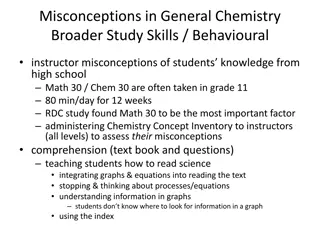
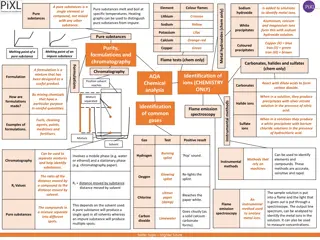
Technicolor Flames in Chemistry
Explore the fascinating phenomenon of flame tests in chemistry where different metal atoms produce colorful flames when heated. Learn how compounds are made of atoms and the significance of flame tests in identifying elements. Discover the relationship between flame colors and electron movements within atoms. Engage in a practical application by predicting flame colors based on compound compositions.

Download Presentation

Please find below an Image/Link to download the presentation.
The content on the website is provided AS IS for your information and personal use only. It may not be sold, licensed, or shared on other websites without obtaining consent from the author.If you encounter any issues during the download, it is possible that the publisher has removed the file from their server.
You are allowed to download the files provided on this website for personal or commercial use, subject to the condition that they are used lawfully. All files are the property of their respective owners.
The content on the website is provided AS IS for your information and personal use only. It may not be sold, licensed, or shared on other websites without obtaining consent from the author.
E N D
Presentation Transcript
Finish Introduction to Process Introduction to File Systems David E. Culler CS162 Operating Systems and Systems Programming Lecture 2 & 3 Sept 5, 2014 Reading: A&D 3.1-3, 11.1-2 HW: 0 out, due 9/8
Recall:User/Kernal(Priviledged) Mode User Mode interrrupt exception syscall rtn rfi exit Kernel Mode exec Limited HW access Full HW access 9/3/14 UCB CS162 Fa14 L2 2
Recall: Interrupt Vector Address and properties of each interrupt handler interrupt number (i) intrpHandler_i () { . } Where else do you see this dispatch pattern? 9/3/14 UCB CS162 Fa14 L2 3
Simple B&B: User => Kernel 0000 code Proc 1 Proc 2 Proc n Static Data heap OS stack sysmode 0 1000 code Base 1000 0000 Static Data Bound 1100 FFFF heap uPC xxxx 1100 stack PC 0000 1234 3000 code regs Static Data 00FF heap How to return to system? 3080 stack FFFF 9/3/14 UCB CS162 Fa14 L2 4
Simple B&B: Interrupt 0000 code Proc 1 Proc 2 Proc n Static Data heap OS stack sysmode 1 1000 code Base 1000 0000 Static Data Bound 1100 FFFF heap 0000 1234 uPC 1100 stack IntrpVector[i] PC 3000 code regs Static Data 00FF heap How to save registers and set up system stack? 3080 stack FFFF 9/3/14 UCB CS162 Fa14 L2 5
Simple B&B: Switch User Process 0000 code Proc 1 Proc 2 Proc n RTU Static Data heap OS stack sysmode 1 1000 code 1000 Base 3000 0000 Static Data 1100 Bound 0080 FFFF heap 0000 1234 0000 0248 uPC 1100 stack regs 0001 0124 PC 00FF 3000 code regs Static Data 00D0 heap How to save registers and set up system stack? 3080 stack FFFF 9/3/14 UCB CS162 Fa14 L2 6
Simple B&B: resume 0000 code Proc 1 Proc 2 Proc n RTU Static Data heap OS stack sysmode 0 1000 code 1000 Base 3000 0000 Static Data 1100 Bound 0080 FFFF heap 0000 1234 xxxx xxxx uPC 1100 stack regs PC 000 0248 00FF 3000 code regs Static Data 00D0 heap How to save registers and set up system stack? 3080 stack FFFF 9/3/14 UCB CS162 Fa14 L2 7
Whats wrong with this simplistic address translation mechanism? 9/3/14 UCB CS162 Fa14 L2 8
x86 segments and stacks code Static Data heap Processor Registers CS EIP stack SS ESP CS: code EIP: EAX EBX DS ES ECX EDX ESI EDI Static Data heap SS: Start address, length and access rights associated with each segment stack ESP: 9/3/14 UCB CS162 Fa14 L2 9
Virtual Address Translation Simpler, more useful schemes too! Give every process the illusion of its own BIG FLAT ADDRESS SPACE Break it into pages More on this later 9/3/14 UCB CS162 Fa14 L2 10
Running Many Programs ??? We have the basic mechanism to switch between user processes and the kernel, the kernel can switch among user processes, Protect OS from user processes and processes from each other Questions ??? How do we decide which user process to run? How do we represent user processes in the OS? How do we pack up the process and set it aside? How do we get a stack and heap for the kernel? Aren t we wasting are lot of memory? 9/3/14 UCB CS162 Fa14 L2 11
Process Control Block Kernel represents each process as a process control block (PCB) Status (running, ready, blocked, ) Register state (when not ready) Process ID (PID), User, Executable, Priority, Execution time, Memory space, translation, Kernel Scheduler maintains a data structure containing the PCBs Scheduling algorithm selects the next one to run 9/3/14 UCB CS162 Fa14 L2 12
Scheduler if ( readyProcesses(PCBs) ) { nextPCB = selectProcess(PCBs); run( nextPCB ); } else { run_idle_process(); } 9/3/14 UCB CS162 Fa14 L2 13
Putting it together: web server syscall syscall RTU RTU wait wait interrupt interrupt 9/3/14 UCB CS162 Fa14 L2 14
4 OS concepts working together Privilege/User Mode The hardware can operate in two modes, with only the system mode having the ability to access certain resources. Address Space Programs execute in an address space that is distinct from the memory space of the physical machine Process An instance of an executing program is a process consisting of an address space and one or more threads of control Protection The OS and the hardware are protected from user programs and user programs are isolated from one another by controlling the translation from program virtual addresses to machine physical addresses 9/3/14 UCB CS162 Fa14 L2 15
4/12/2025 cs162 fa14 L# 16
Introduction to File Systems David E. Culler CS162 Operating Systems and Systems Programming Lecture 3 Sept 5, 2014 Reading: A&D 3.1-3, 11.1-2 HW: 0 out, due 9/8
Objective of this lecture Show how Operating System functionality distributes across layers in the system. Introduce I/O & storage services i.e., file systems 4/12/2025 cs162 fa14 L# 18
Reflecting on the process intro You said that applications request services from the operating system via syscall, but I ve been writing all sort of useful applications and I never ever saw a syscall !!! That s right. It was buried in the programming language runtime library (e.g., libc.a) Layering 4/12/2025 cs162 fa14 L# 19
OS run-time library Proc 1 Proc 2 Proc n OS login Window Manager Appln OS library OS library OS library OS 4/12/2025 cs162 fa14 L# 20
A Kind of Narrow Waist Word Processing Compilers Web Browsers Email Web Servers Databases Application / Service OS Portable OS Library User System Call Interface System Portable OS Kernel Software Platform support, Device Drivers Hardware x86 PowerPC ARM PCI Ethernet (10/100/1000) 802.11 a/b/g/n SCSI IDE Graphics 4/12/2025 cs162 fa14 L# 21
Key Unix I/O Design Concepts Uniformity file operations, device I/O, and interprocess communication through open, read/write, close Allows simple composition of programs find | grep | wc Open before use Provides opportunity for access control and arbitration Sets up the underlying machinery, i.e., data structures Byte-oriented Even if blocks are transferred, addressing is in bytes Kernel buffered reads Streaming and block devices looks the same, read blocks yielding processor to other task Kernel buffered writes Completion of out-going transfer decoupled from the application, allowing it to continue Explicit close 4/12/2025 cs162 fa14 L# 22
I/O & Storage Layers Application / Service streams High Level I/O handles Low Level I/O registers Syscall File System descriptors I/O Driver Commands and Data Transfers Disks, Flash, Controllers, DMA 4/12/2025 cs162 fa14 L# 23
The file system abstraction File Named collection of data in a file system File data Text, binary, linearized objects File Metadata: information about the file Size, Modification Time, Owner, Security info Basis for access control Directory Folder containing files & Directories Hierachical (graphical) naming Path through the directory graph Uniquely identifies a file or directory /home/ff/cs162/public_html/fa14/index.html Links and Volumes (later) 4/12/2025 cs162 fa14 L# 24
C high level File API streams (review) Operate on streams - sequence of bytes, whether text or data, with a position #include <stdio.h> FILE *fopen( const char *filename, const char *mode ); int fclose( FILE *fp ); Mode Text Binary Descriptions r rb Open existing file for reading w wb Open for writing; created if does not exist a ab Open for appending; created if does not exist r+ rb+ Open existing file for reading & writing. w+ wb+ Open for reading & writing; truncated to zero if exists, create otherwise a+ ab+ Open for reading & writing. Created if does not exist. Read from beginning, write as append 4/12/2025 cs162 fa14 L# 25
Connecting Processes, Filesystem, and Users Process has a current working directory Absolute Paths /home/ff/cs152 Relative paths index.html, ./index.html - current WD ../index.html - parent of current WD ~, ~cs152 - home directory 4/12/2025 cs162 fa14 L# 26
C API Standard Streams Three predefined streams are opened implicitly when the program is executed. FILE *stdin normal source of input, can be redirected FILE *stdout normal source of output, can too FILE *stderr diagnostics and errors STDIN / STDOUT enable composition in Unix 4/12/2025 cs162 fa14 L# 27
C high level File API stream ops #include <stdio.h> // character oriented int fputc( int c, FILE *fp ); int fputs( const char *s, FILE *fp ); // rtn c or EOF on err // rtn >0 or EOF int fgetc( FILE * fp ); char *fgets( char *buf, int n, FILE *fp ); // block oriented size_t fread(void *ptr, size_t size_of_elements, size_t number_of_elements, FILE *a_file); size_t fwrite(const void *ptr, size_t size_of_elements, size_t number_of_elements, FILE *a_file); // formatted int fprintf(FILE *restrict stream, const char *restrict format, ...); int fscanf(FILE *restrict stream, const char *restrict format, ... ); 4/12/2025 cs162 fa14 L# 28
C Stream API positioning int fseek(FILE *stream, long int offset, int whence); long int ftell (FILE *stream) void rewind (FILE *stream) High? Level? I/O? ? Low? Level? I/O? ? Syscall? File? System? Upper? I/O? Driver? Lower? I/O? Driver? Preserves high level abstraction of a uniform stream of objects 4/12/2025 cs162 fa14 L# 29
Whats below the surface ?? Application / Service streams High Level I/O handles Low Level I/O registers Syscall File System descriptors I/O Driver Commands and Data Transfers Disks, Flash, Controllers, DMA 4/12/2025 cs162 fa14 L# 30
C Low level I/O Operations on File Descriptors as OS object representing the state of a file User has a handle on the descriptor #include <fcntl.h> #include <unistd.h> #include <sys/types.h> int open (const char *filename, int flags [, mode_t mode]) int creat (const char *filename, mode_t mode) int close (int filedes) Bit vector of: Access modes (Rd, Wr, ) Open Flags (Create, ) Operating modes (Appends, ) Bit vector of Permission Bits: User|Group|Other X R|W|X http://www.gnu.org/software/libc/manual/html_node/Opening-and-Closing-Files.html 4/12/2025 cs162 fa14 L# 31
C Low Level: standard descriptors #include <unistd.h> STDIN_FILENO - macro has value 0 STDOUT_FILENO - macro has value 1 STDERR_FILENO - macro has value 2 int fileno (FILE *stream) FILE * fdopen (int filedes, const char *opentype) Crossing levels: File descriptors vs. streams Don t mix them! 4/12/2025 cs162 fa14 L# 32
C Low Level Operations ssize_t read (int filedes, void *buffer, size_t maxsize) - returns bytes read, 0 => EOF, -1 => error ssize_t write (int filedes, const void *buffer, size_t size) - returns bytes written off_t lseek (int filedes, off_t offset, int whence) int fsync (int fildes) wait for i/o to finish void sync (void) wait for ALL to finish When write returns, data is on its way to disk and can be read, but it may not actually be permanent! 4/12/2025 cs162 fa14 L# 33
And lots more ! TTYs versus files Memory mapped files File Locking Asynchronous I/O Generic I/O Control Operations Duplicating descriptors int dup2 (int old, int new) int dup (int old) 4/12/2025 cs162 fa14 L# 34
Whats below the surface ?? Application / Service streams High Level I/O handles Low Level I/O registers Syscall File System descriptors I/O Driver Commands and Data Transfers Disks, Flash, Controllers, DMA 4/12/2025 cs162 fa14 L# 35
SYSCALL Low level lib parameters are set up in registers and syscall instruction is issued 4/12/2025 cs162 fa14 L# 36
Internal OS File Descriptor Internal Data Structure describing everything about the file Where it resides Its status How to access it 4/12/2025 cs162 fa14 L# 37
File System: from syscall to driver In fs/read_write.c ssize_t vfs_read(struct file *file, char __user *buf, size_t count, loff_t *pos) { ssize_t ret; if (!(file->f_mode & FMODE_READ)) return -EBADF; if (!file->f_op || (!file->f_op->read && !file->f_op->aio_read)) return -EINVAL; if (unlikely(!access_ok(VERIFY_WRITE, buf, count))) return -EFAULT; ret = rw_verify_area(READ, file, pos, count); if (ret >= 0) { count = ret; if (file->f_op->read) ret = file->f_op->read(file, buf, count, pos); else ret = do_sync_read(file, buf, count, pos); if (ret > 0) { fsnotify_access(file->f_path.dentry); add_rchar(current, ret); } inc_syscr(current); } return ret; } 4/12/2025 cs162 fa14 L# 38
Low Level Driver Associated with particular hardware device Registers / Unregisters itself with the kernel Handler functions for each of the file operations 4/12/2025 cs162 fa14 L# 39
So what happens when you fgetc? Application / Service streams High Level I/O handles Low Level I/O registers Syscall descriptors File System Commands and Data Transfers I/O Driver Disks, Flash, Controllers, DMA 4/12/2025 cs162 fa14 L# 40