Technological Changes in Poland: Implications for Work and Employment

The report delves into the impact of game-changing technologies on Poland's economy, discussing the shift in traditional vs. emerging occupations, labor market dynamics, and the potential risks posed by new technologies. It also explores the history of trade unions in Poland and the essential factors for work humanization, offering insights into the evolution of industrial relations and workplace dynamics.

Download Presentation

Please find below an Image/Link to download the presentation.
The content on the website is provided AS IS for your information and personal use only. It may not be sold, licensed, or shared on other websites without obtaining consent from the author.If you encounter any issues during the download, it is possible that the publisher has removed the file from their server.
You are allowed to download the files provided on this website for personal or commercial use, subject to the condition that they are used lawfully. All files are the property of their respective owners.
The content on the website is provided AS IS for your information and personal use only. It may not be sold, licensed, or shared on other websites without obtaining consent from the author.
E N D
Presentation Transcript
National Report National Report - - Poland Poland
Table Table of of contents contents Things in Poland Introduction Technological changes in the UE (definitions of game-changing technologies the Eurofound report), implications of new technologies for work, employment and employment relations Impact on the labour market, projections about job losses, Traditional occupations vs. emerging occupations Social partners and their approach to technological change, Technological changes in the Polish economy (latecomer, process of modernisation in various periods), Technological changes in the Polish economy after 1990 (privatisation) The data on the specific technologies robots in the economy. Potential impact new technologies on work and employment in Poland (many jobs under danger)
Eight game-changing technologies, the Eurofound report industrial biotechnologies, blockchain (a verifiable record of electronic transactions, and the foundation of cryptocurrencies such as Bitcoin) virtual and augmented reality (VR/AR) advanced robotics additive manufacturing (that is 3D printing for industrial purposes) Internet of Things (IoT), specifically industrial IoT (IIoT) and wearable devices electric vehicles autonomous vehicles (for example driverless cars)
Chapter I Elements of trade union history in Poland Industrial relations (unionisation, tripartite system with the Social Dialogue Council, hybrid model of IR, collective agreements) Industrial relations in selected period of Poland s history The long tradition of feuds/disputes between employees and their superiors, including between office employees and the factory floor workers
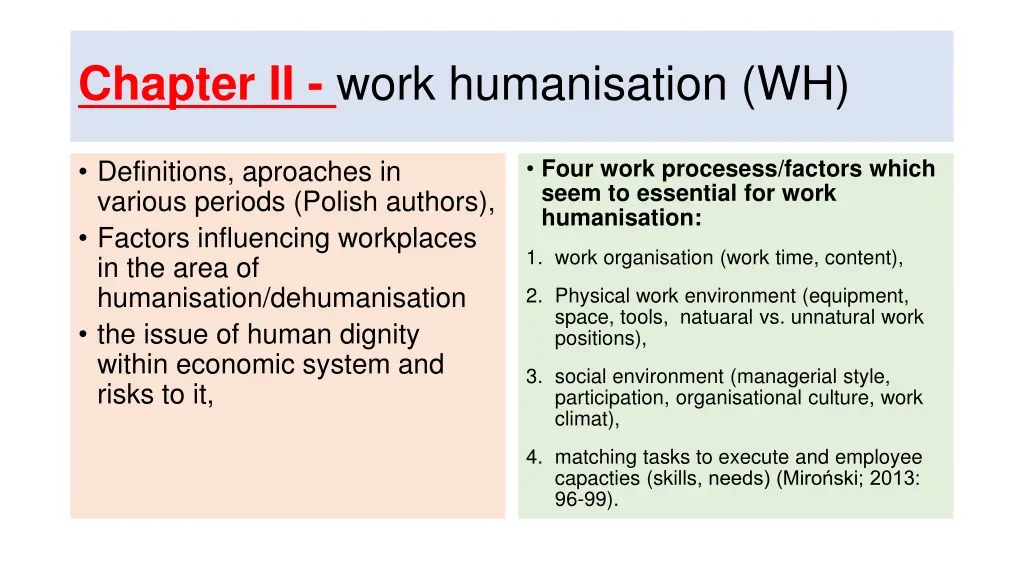
Chapter II - work humanisation (WH) Four work procesess/factors which seem to essential for work humanisation: Definitions, aproaches in various periods (Polish authors), Factors influencing workplaces in the area of humanisation/dehumanisation the issue of human dignity within economic system and risks to it, 1. work organisation (work time, content), 2. Physical work environment (equipment, space, tools, natuaral vs. unnatural work positions), 3. social environment (managerial style, participation, organisational culture, work climat), 4. matching tasks to execute and employee capacties (skills, needs) (Miro ski; 2013: 96-99).
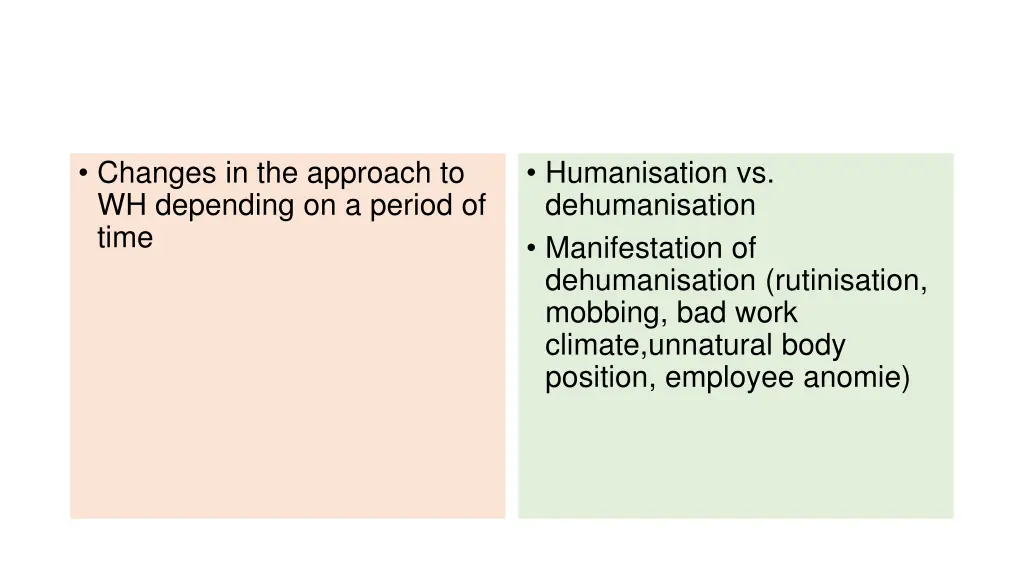
Changes in the approach to WH depending on a period of time Humanisation vs. dehumanisation Manifestation of dehumanisation (rutinisation, mobbing, bad work climate,unnatural body position, employee anomie)
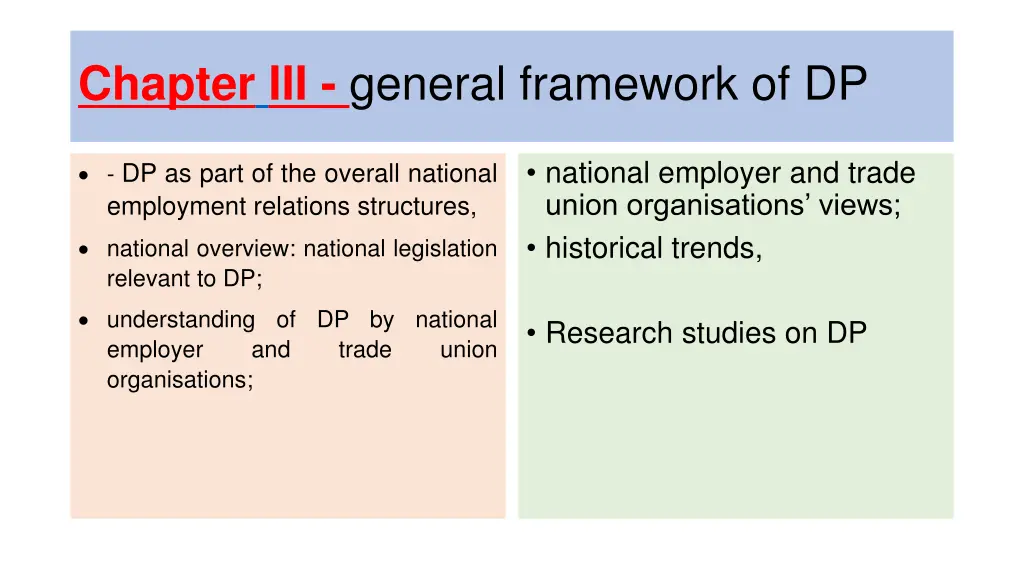
Chapter III - general framework of DP national employer and trade union organisations views; historical trends, - DP as part of the overall national employment relations structures, national overview: national legislation relevant to DP; understanding of DP by national employer and organisations; Research studies on DP trade union
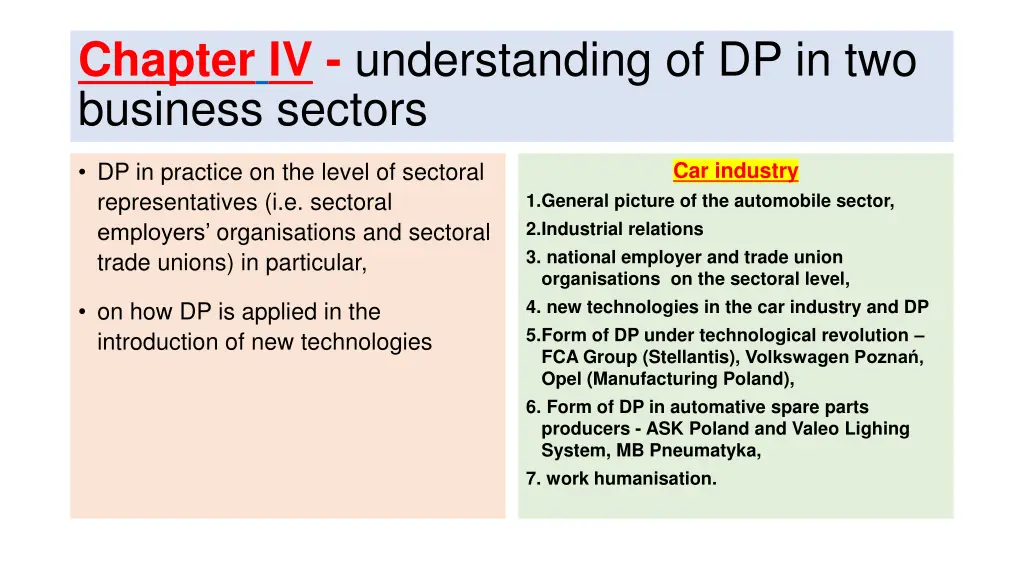
Chapter IV - understanding of DP in two business sectors DP in practice on the level of sectoral representatives (i.e. sectoral employers organisations and sectoral trade unions) in particular, Car industry 1.General picture of the automobile sector, 2.Industrial relations 3. national employer and trade union organisations on the sectoral level, 4. new technologies in the car industry and DP 5.Form of DP under technological revolution FCA Group (Stellantis), Volkswagen Pozna , Opel (Manufacturing Poland), 6. Form of DP in automative spare parts producers - ASK Poland and Valeo Lighing System, MB Pneumatyka, 7. work humanisation. on how DP is applied in the introduction of new technologies
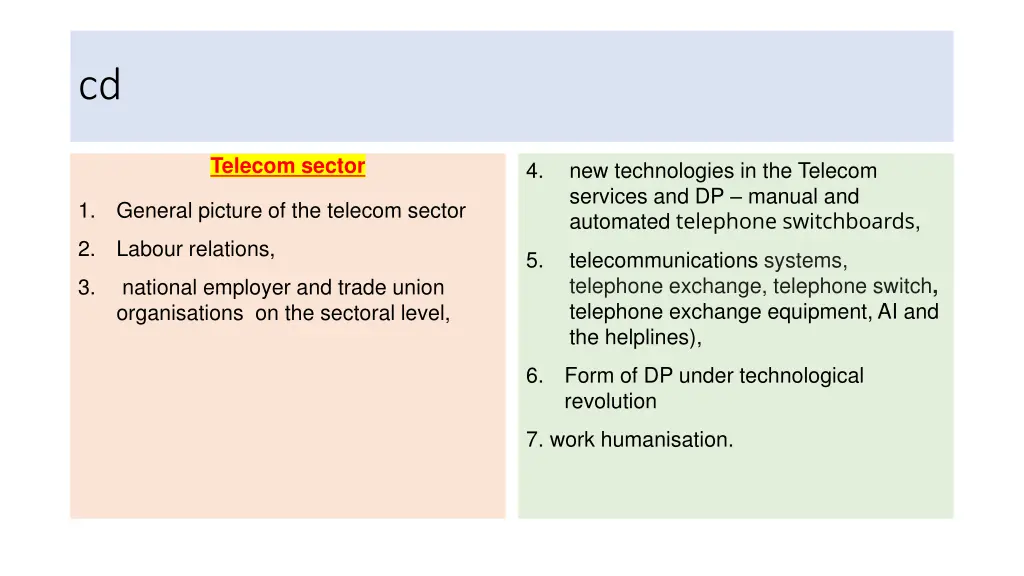
cd Telecom sector 4. new technologies in the Telecom services and DP manual and automated telephone switchboards, 1. General picture of the telecom sector 2. Labour relations, 5. telecommunications systems, telephone exchange, telephone switch, telephone exchange equipment, AI and the helplines), 3. national employer and trade union organisations on the sectoral level, 6. Form of DP under technological revolution 7. work humanisation.
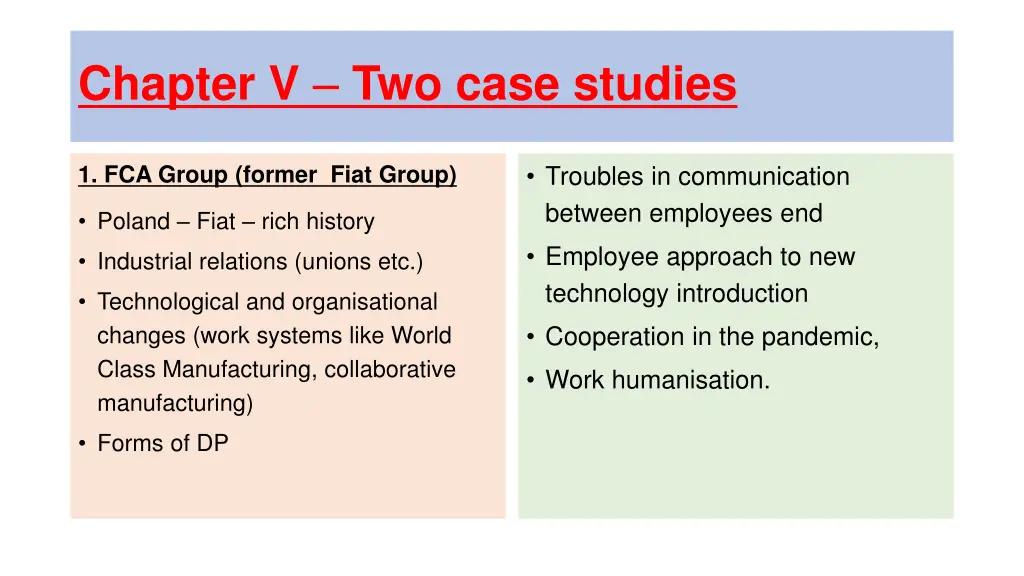
Chapter V Two case studies 1. FCA Group (former Fiat Group) Troubles in communication between employees end Poland Fiat rich history Employee approach to new technology introduction Industrial relations (unions etc.) Technological and organisational changes (work systems like World Class Manufacturing, collaborative manufacturing) Cooperation in the pandemic, Work humanisation. Forms of DP
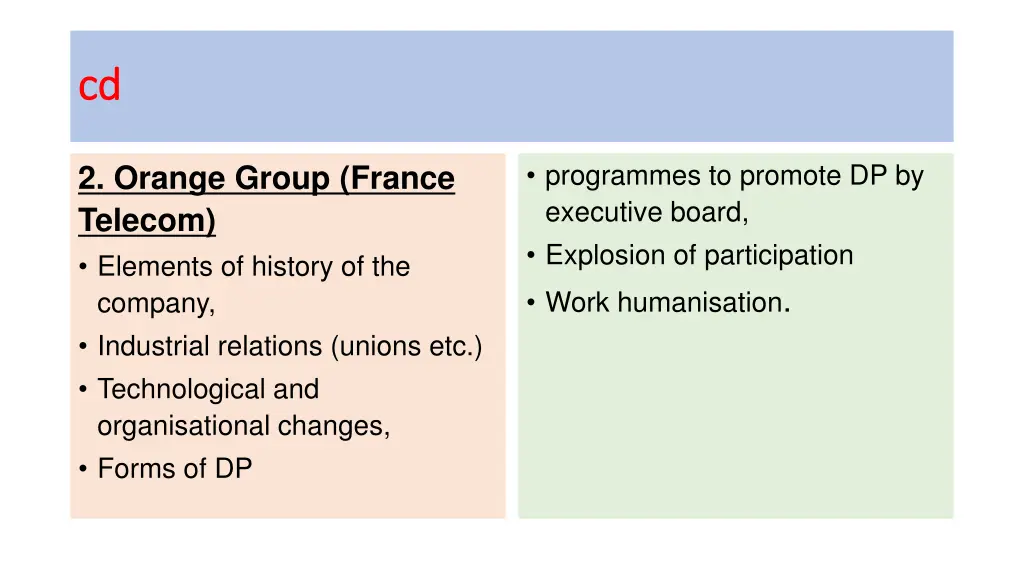
cd cd programmes to promote DP by executive board, Explosion of participation Work humanisation. 2. Orange Group (France Telecom) Elements of history of the company, Industrial relations (unions etc.) Technological and organisational changes, Forms of DP