Tellurium-Loaded Organic Scintillators
Neutrinoless double beta decay could reveal key insights into lepton number violation and neutrino mass properties. Tellurium's high natural abundance makes tellurium-loaded liquid scintillators a prime candidate for future mega-projects aimed at observing this rare process. Various element concentrations and scintillation base compositions are explored to enhance sensitivity and reduce background interference in experiments. Understanding these factors is crucial for the ongoing search for evidence of neutrinoless decay.

Download Presentation

Please find below an Image/Link to download the presentation.
The content on the website is provided AS IS for your information and personal use only. It may not be sold, licensed, or shared on other websites without obtaining consent from the author.If you encounter any issues during the download, it is possible that the publisher has removed the file from their server.
You are allowed to download the files provided on this website for personal or commercial use, subject to the condition that they are used lawfully. All files are the property of their respective owners.
The content on the website is provided AS IS for your information and personal use only. It may not be sold, licensed, or shared on other websites without obtaining consent from the author.
E N D
Presentation Transcript
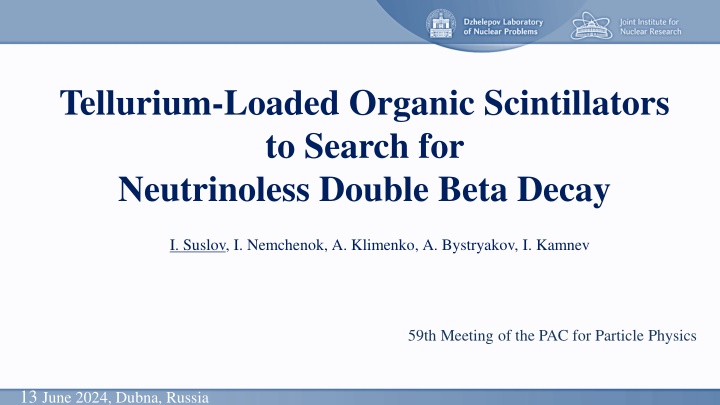
Tellurium-Loaded Organic Scintillators to Search for Neutrinoless Double Beta Decay I. Suslov, I. Nemchenok, A. Klimenko, A. Bystryakov, I. Kamnev 59th Meeting of the PAC for Particle Physics 13 June 2024, Dubna, Russia
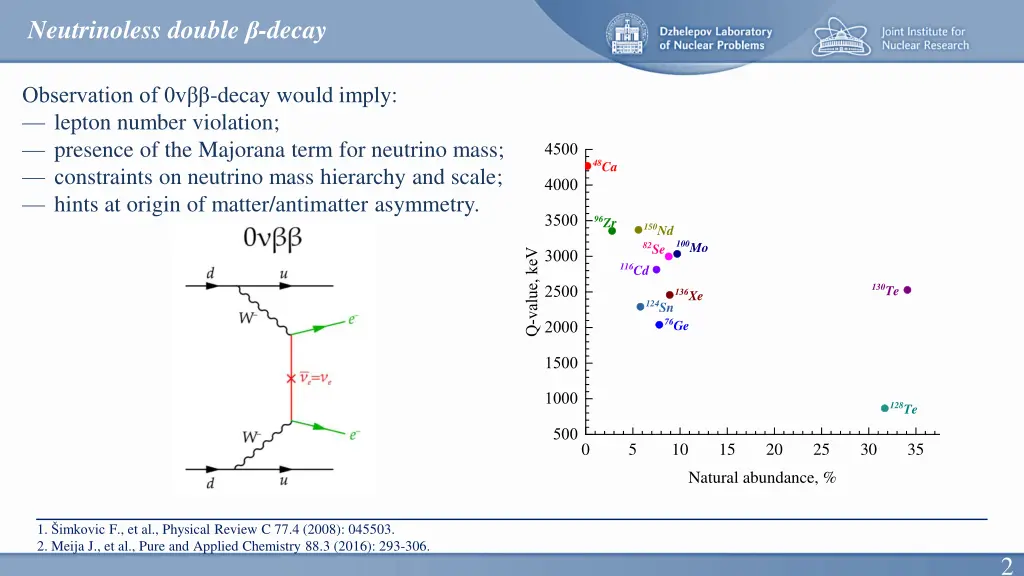
Neutrinoless double -decay Observation of 0v -decay would imply: lepton number violation; presence of the Majorana term for neutrino mass; onstraints on neutrino mass hierarchy and scale; hints at origin of matter/antimatter asymmetry. 4500 48Ca 4000 3500 96Zr 150Nd 100Mo 82Se 3000 Q-value, keV 116Cd 130Te 2500 136Xe 124Sn 76Ge 2000 1500 1000 128Te 500 0 5 10 15 20 25 30 35 Natural abundance, % 1. imkovic F., et al., Physical Review C 77.4 (2008): 045503. 2. Meija J., et al., Pure and Applied Chemistry 88.3 (2016): 293-306. 2
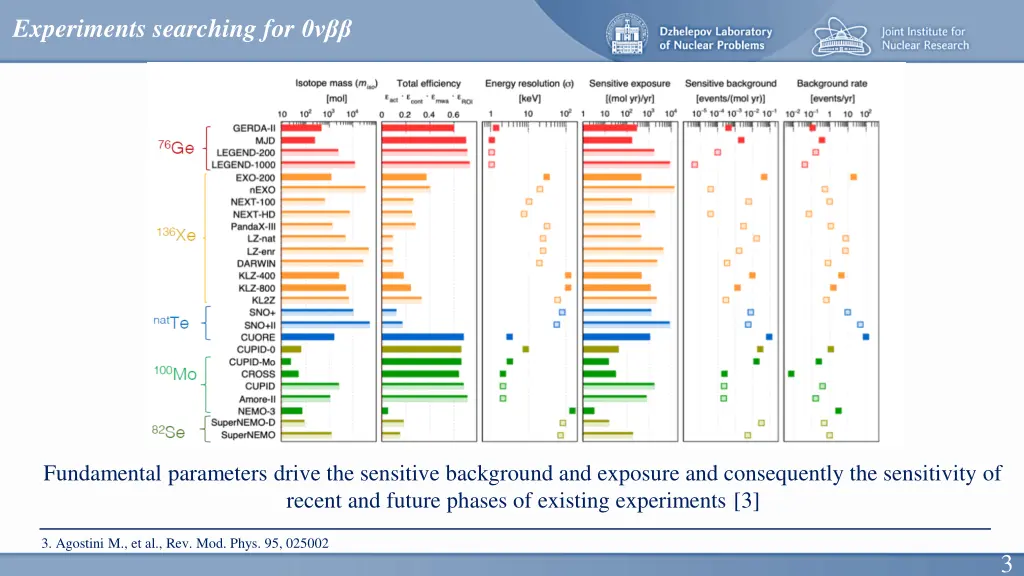
Experiments searching for 0 Fundamental parameters drive the sensitive background and exposure and consequently the sensitivity of recent and future phases of existing experiments [3] 3. Agostini M., et al., Rev. Mod. Phys. 95, 025002 3
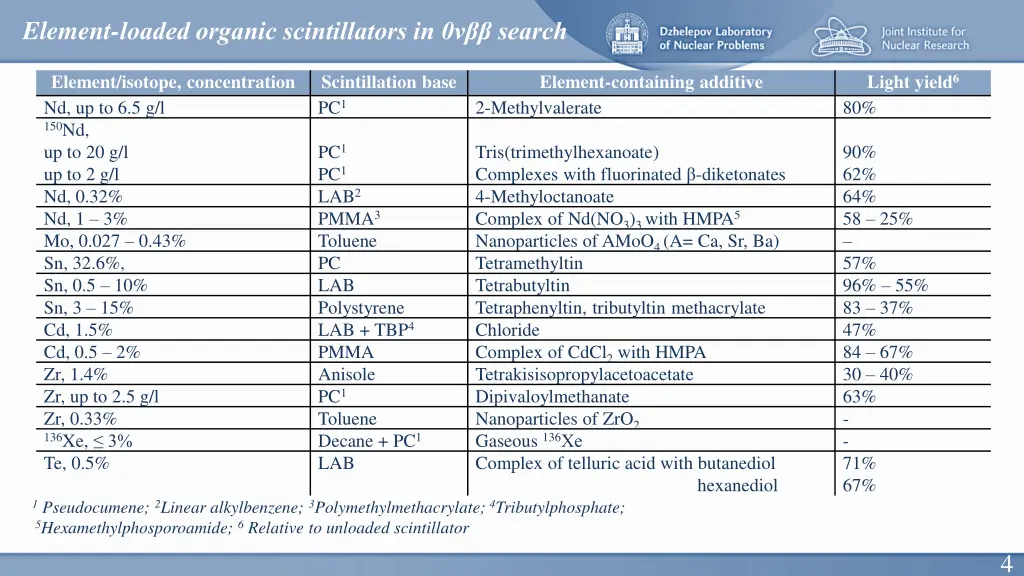
Element-loaded organic scintillators in 0 search Element/isotope, concentration Nd, up to 6.5 g/l 150Nd, up to 20 g/l up to 2 g/l Nd, 0.32% Nd, 1 3% Mo, 0.027 0.43% Sn, 32.6%, Sn, 0.5 10% Sn, 3 15% Cd, 1.5% Cd, 0.5 2% Zr, 1.4% Zr, up to 2.5 g/l Zr, 0.33% 136Xe, 3% Te, 0.5% Scintillation base PC1 Element-containing additive 2-Methylvalerate Light yield6 80% PC1 PC1 LAB2 PMMA3 Toluene PC LAB Polystyrene LAB + TBP4 PMMA Anisole PC1 Toluene Decane + PC1 LAB Tris(trimethylhexanoate) Complexes with fluorinated -diketonates 4-Methyloctanoate Complex of Nd(NO3)3with HMPA5 Nanoparticles of AMoO4(A= Ca, Sr, Ba) Tetramethyltin Tetrabutyltin Tetraphenyltin, tributyltin methacrylate Chloride Complex of CdCl2with HMPA Tetrakisisopropylacetoacetate Dipivaloylmethanate Nanoparticles of ZrO2 Gaseous 136 Complex of telluric acid with butanediol 90% 62% 64% 58 25% 57% 96% 55% 83 37% 47% 84 67% 30 40% 63% - - 71% 67% hexanediol 1Pseudocumene;2Linear alkylbenzene;3Polymethylmethacrylate;4Tributylphosphate; 5Hexamethylphosporoamide;6Relative to unloaded scintillator 4
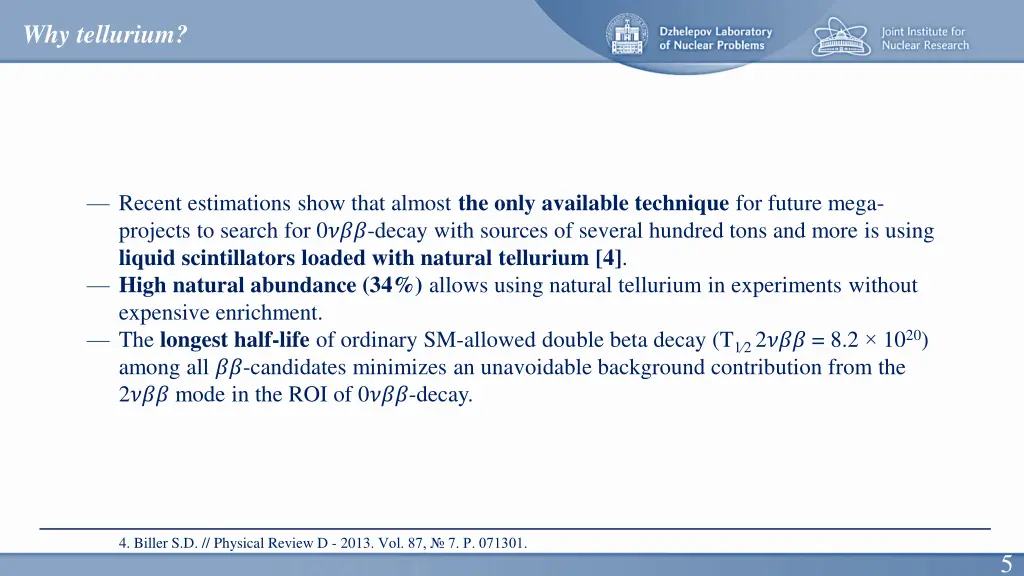
Why tellurium? Recent estimations show that almost the only available technique for future mega- projects to search for 0???-decay with sources of several hundred tons and more is using liquid scintillators loaded with natural tellurium [4]. High natural abundance (34%) allows using natural tellurium in experiments without expensive enrichment. The longest half-life of ordinary SM-allowed double beta decay (T1 2 2??? = 8.2 1020) among all ??-candidates minimizes an unavoidable background contribution from the 2??? mode in the ROI of 0???-decay. 4. Biller S.D. // Physical Review D - 2013. Vol. 87, 7. P. 071301. 5
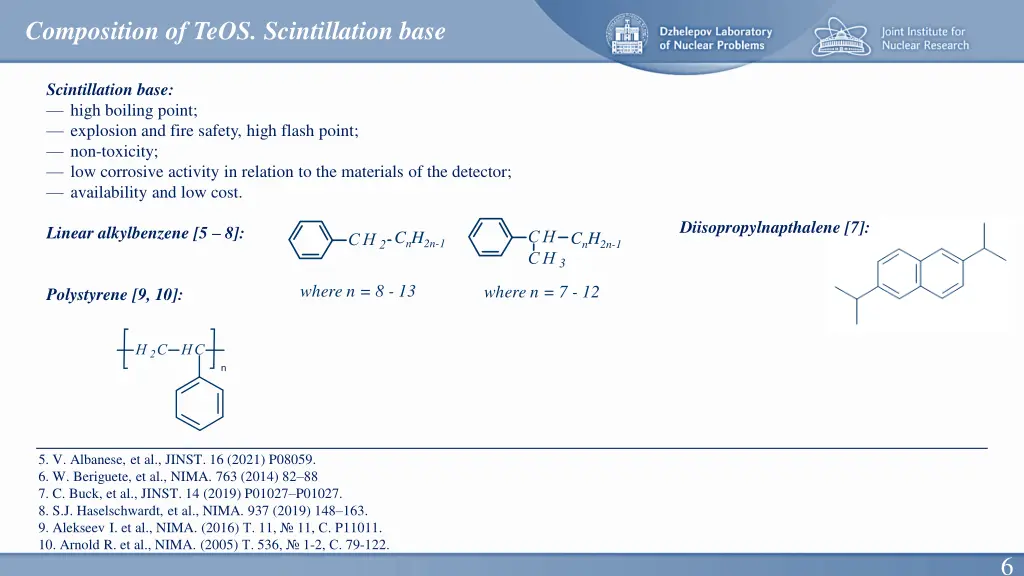
Composition of TeOS. Scintillation base Scintillation base: high boiling point; explosion and fire safety, high flash point; non-toxicity; low corrosive activity in relation to the materials of the detector; availability and low cost. Diisopropylnapthalene [7]: Linear alkylbenzene [5 8]: CnH2n-1 CnH2n-1 wheren = 8 - 13 wheren = 7 - 12 Polystyrene [9, 10]: 5. V. Albanese, et al., JINST. 16 (2021) P08059. 6. W. Beriguete, et al., NIMA. 763 (2014) 82 88 7. C. Buck, et al., JINST. 14 (2019) P01027 P01027. 8. S.J. Haselschwardt, et al., NIMA. 937 (2019) 148 163. 9. Alekseev I. et al., NIMA. (2016) . 11, 11, . P11011. 10. Arnold R. et al., NIMA. (2005) . 536, 1-2, . 79-122. 6
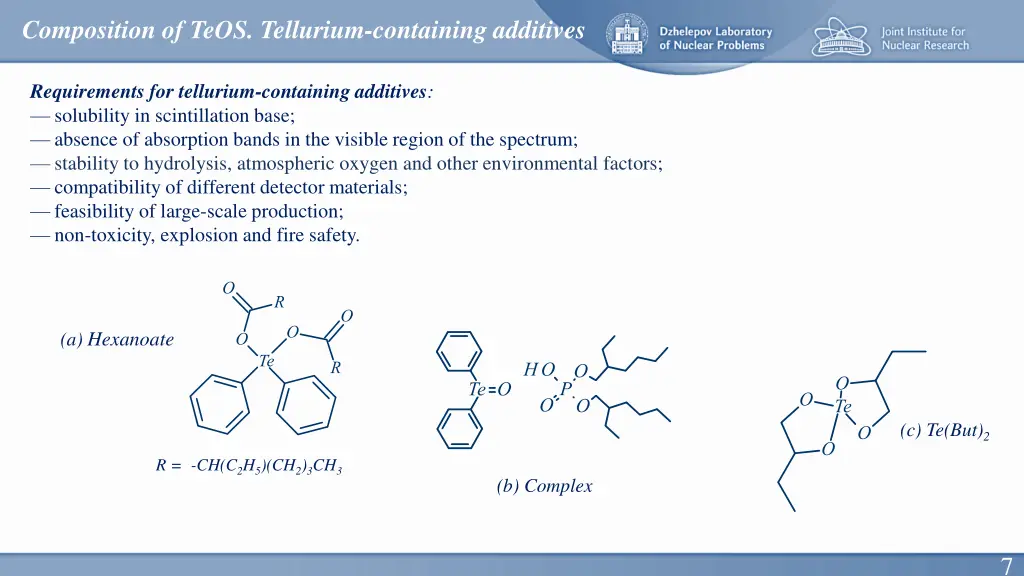
Composition of TeOS. Tellurium-containing additives Requirements for tellurium-containing additives: solubility in scintillation base; absence of absorption bands in the visible region of the spectrum; stability to hydrolysis, atmospheric oxygen and other environmental factors; compatibility of different detector materials; feasibility of large-scale production; non-toxicity, explosion and fire safety. (a) Hexanoate (c) Te(But)2 R = -CH(C2H5)(CH2)3CH3 (b) Complex 7
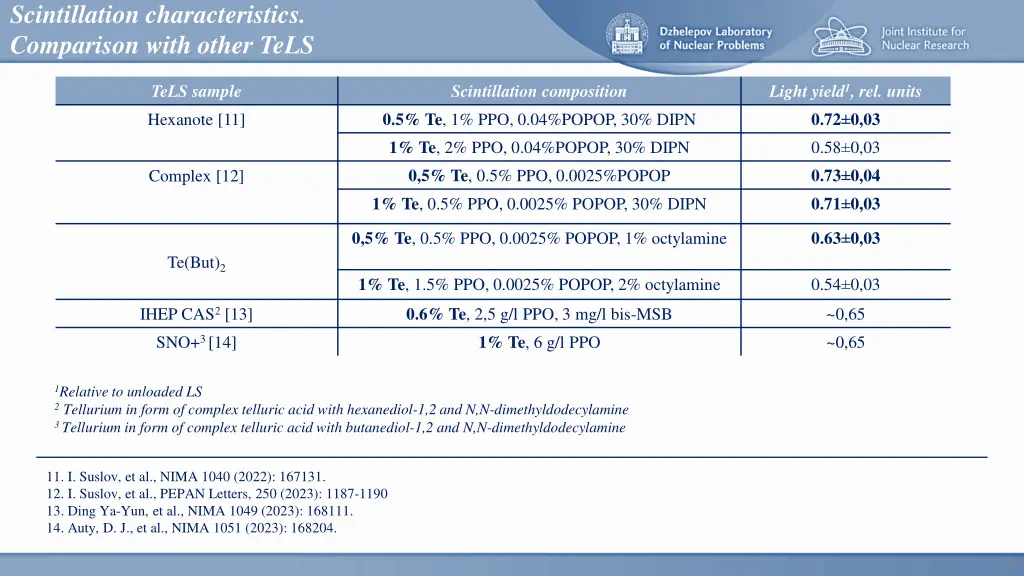
Scintillation characteristics. Comparison with other TeLS TeLS sample Scintillation composition 0.5% Te, 1% PPO, 0.04%POPOP, 30% DIPN 1% Te, 2% PPO, 0.04%POPOP, 30% DIPN 0,5% Te, 0.5% PPO, 0.0025%POPOP 1% Te, 0.5% PPO, 0.0025% POPOP, 30% DIPN Light yield1, rel. units 0.72 0,03 Hexanote [11] 0.58 0,03 0.73 0,04 0.71 0,03 Complex [12] 0,5% Te, 0.5% PPO, 0.0025% POPOP, 1% octylamine 0.63 0,03 Te(But)2 1% Te, 1.5% PPO, 0.0025% POPOP, 2% octylamine 0.54 0,03 0.6% Te, 2,5 g/l PPO, 3 mg/l bis-MSB 1% Te, 6 g/l PPO IHEP CAS2[13] ~0,65 SNO+3[14] ~0,65 1Relative to unloaded LS 2Tellurium in form of complex telluric acid with hexanediol-1,2 and N,N-dimethyldodecylamine 3Tellurium in form of complex telluric acid with butanediol-1,2 and N,N-dimethyldodecylamine 11. I. Suslov, et al., NIMA 1040 (2022): 167131. 12. I. Suslov, et al., PEPAN Letters, 250 (2023): 1187-1190 13. Ding Ya-Yun, et al., NIMA 1049 (2023): 168111. 14. Auty, D. J., et al., NIMA 1051 (2023): 168204. 8
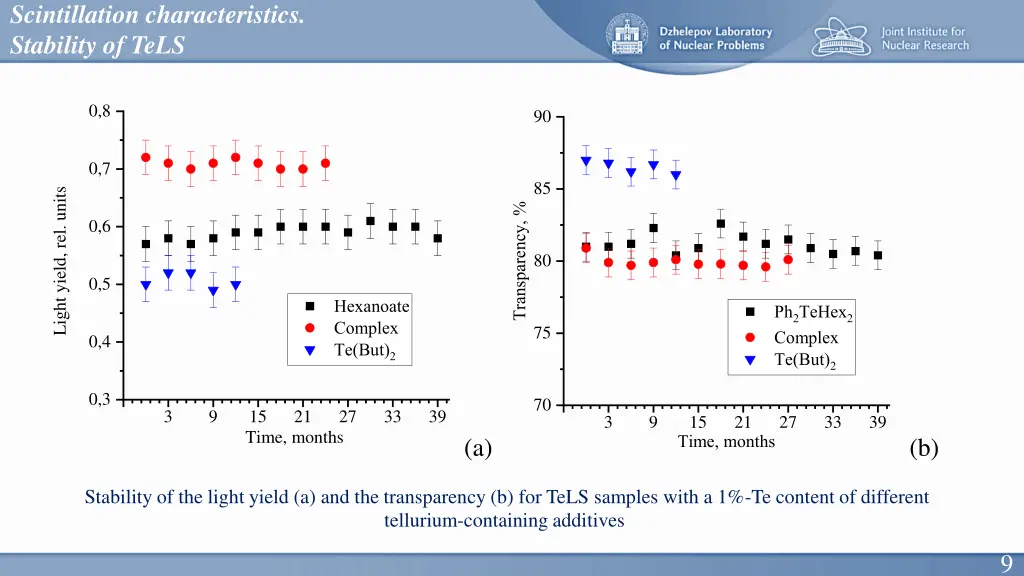
Scintillation characteristics. Stability of TeLS 0,8 90 0,7 85 Light yield, rel. units Transparency, % 0,6 80 0,5 Hexanoate Complex Te(But)2 Ph2TeHex2 Complex Te(But)2 75 0,4 0,3 70 3 9 15 Time, months 21 27 33 39 3 9 15 21 27 33 39 Time, months (a) (b) Stability of the light yield (a) and the transparency (b) for TeLS samples with a 1%-Te content of different tellurium-containing additives 9
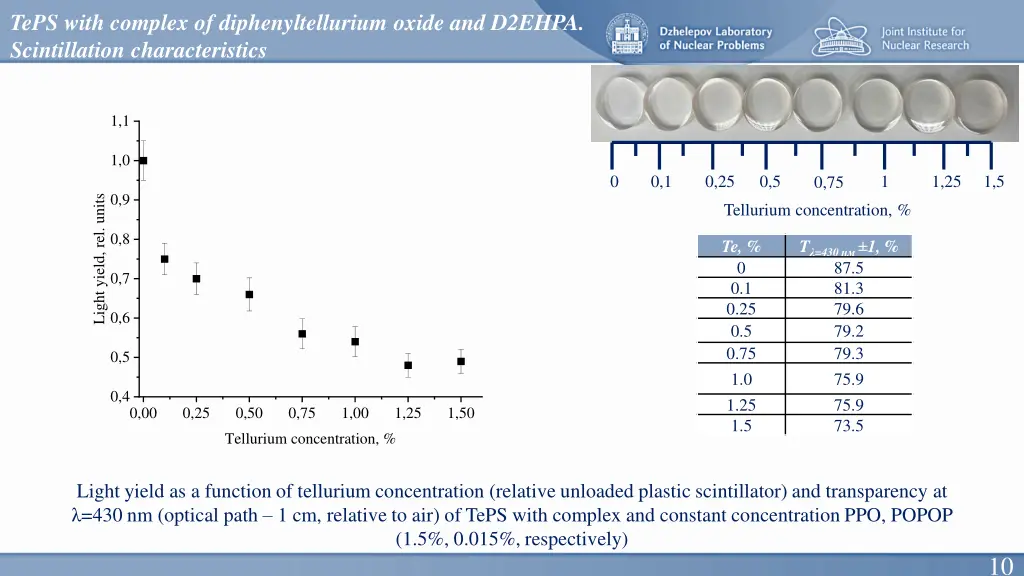
TePS with complex of diphenyltellurium oxide and D2EHPA. Scintillation characteristics 1,1 1,0 0 0,1 0,25 0,5 1,5 1 1,25 0,75 0,9 Light yield, rel. units Tellurium concentration, % 0,8 Te, % 0 0.1 0.25 0.5 0.75 1.0 1.25 1.5 T =430 1, % 87.5 81.3 79.6 79.2 79.3 75.9 75.9 73.5 0,7 0,6 0,5 0,4 0,00 0,25 0,50 0,75 1,00 1,25 1,50 Tellurium concentration, % Light yield as a function of tellurium concentration (relative unloaded plastic scintillator) and transparency at =430 nm (optical path 1 cm, relative to air) of TePS with complex and constant concentration PPO, POPOP (1.5%, 0.015%, respectively) 10
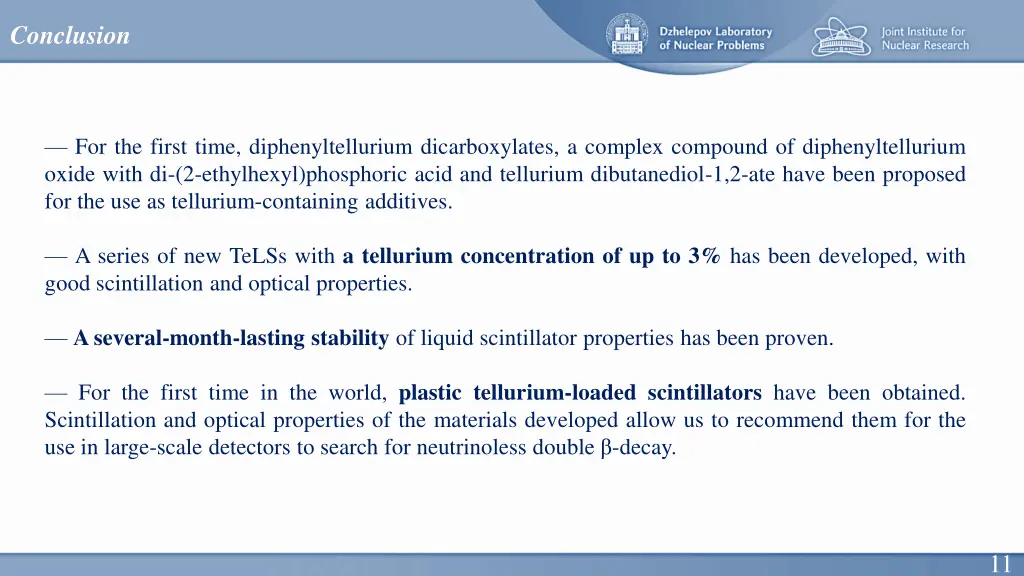
Conclusion For the first time, diphenyltellurium dicarboxylates, a complex compound of diphenyltellurium oxide with di-(2-ethylhexyl)phosphoric acid and tellurium dibutanediol-1,2-ate have been proposed for the use as tellurium-containing additives. A series of new TeLSs with a tellurium concentration of up to 3% has been developed, with good scintillation and optical properties. Aseveral-month-lasting stability of liquid scintillator properties has been proven. For the first time in the world, plastic tellurium-loaded scintillators have been obtained. Scintillation and optical properties of the materials developed allow us to recommend them for the use in large-scale detectors to search for neutrinoless double -decay. 11
Backup 12
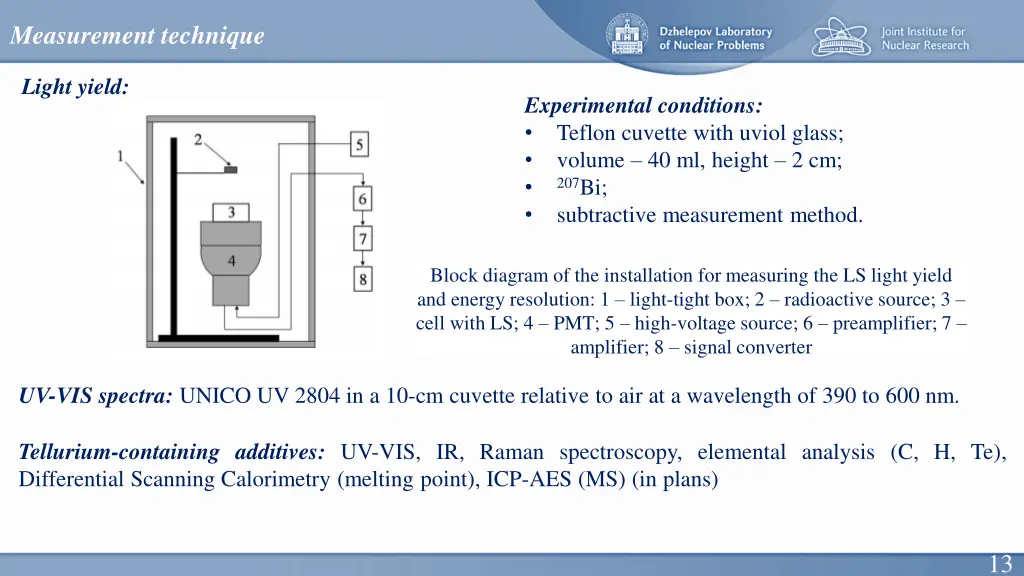
Measurement technique Light yield: Experimental conditions: Teflon cuvette with uviol glass; volume 40 ml, height 2 cm; subtractive measurement method. 207Bi; Block diagram of the installation for measuring the LS light yield and energy resolution: 1 light-tight box; 2 radioactive source; 3 cell with LS; 4 PMT; 5 high-voltage source; 6 preamplifier; 7 amplifier; 8 signal converter UV-VIS spectra: UNICO UV 2804 in a 10-cm cuvette relative to air at a wavelength of 390 to 600 nm. Tellurium-containing additives: UV-VIS, IR, Raman spectroscopy, elemental analysis (C, H, Te), Differential Scanning Calorimetry (melting point), ICP-AES (MS) (in plans) 13
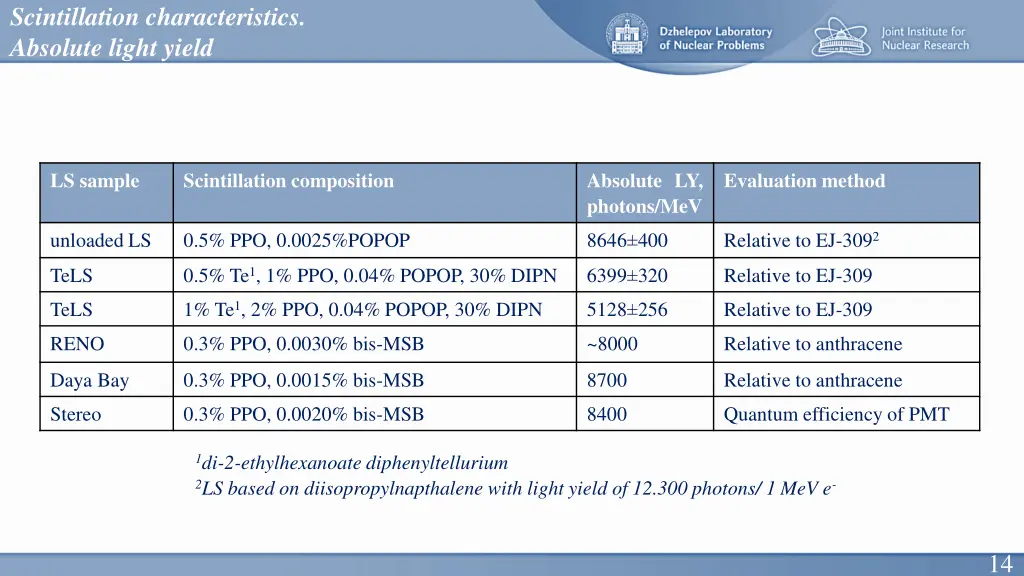
Scintillation characteristics. Absolute light yield LS sample Scintillation composition Absolute LY, photons/MeV Evaluation method unloaded LS 0.5% PPO, 0.0025%POPOP 8646 400 Relative to EJ-3092 TeLS 0.5% Te1, 1% PPO, 0.04% POPOP, 30% DIPN 6399 320 Relative to EJ-309 TeLS 1% Te1, 2% PPO, 0.04% POPOP, 30% DIPN 5128 256 Relative to EJ-309 RENO 0.3% PPO, 0.0030% bis-MSB ~8000 Relative to anthracene Daya Bay 0.3% PPO, 0.0015% bis-MSB 8700 Relative to anthracene Stereo 0.3% PPO, 0.0020% bis-MSB 8400 Quantum efficiency of PMT 1di-2-ethylhexanoate diphenyltellurium 2LS based on diisopropylnapthalene with light yield of 12.300 photons/ 1 MeV e- 14
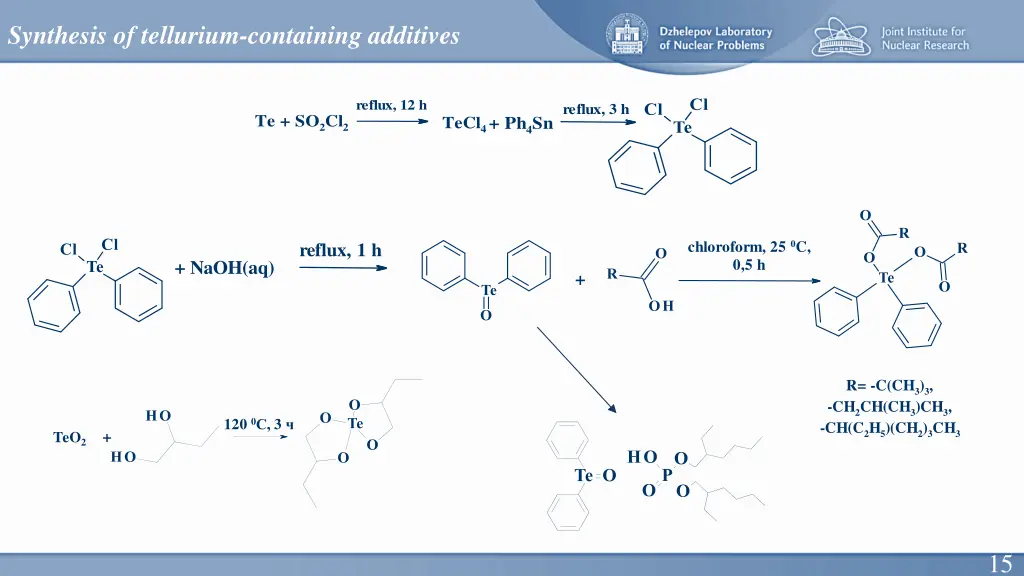
Synthesis of tellurium-containing additives reflux, 12 h reflux, 3 h Te + SO2Cl2 + Ph4Sn TeCl4 chloroform, 25 0C, 0,5 h reflux, 1 h + NaOH(aq) R= -C(CH3)3, -CH2CH(CH3)CH3, -CH(C2H5)(CH2)3CH3 120 0 , 3 TeO2 15