Testing Hardware Perspective with Gladys O. Ducoudray

This content delves into testing from a hardware perspective with insights from Gladys O. Ducoudray. It covers topics such as testing approaches, test planning, controllability, accessability, integration, and the cost of detection. The information provided offers a valuable understanding of hardware testing processes and considerations.

Download Presentation

Please find below an Image/Link to download the presentation.
The content on the website is provided AS IS for your information and personal use only. It may not be sold, licensed, or shared on other websites without obtaining consent from the author.If you encounter any issues during the download, it is possible that the publisher has removed the file from their server.
You are allowed to download the files provided on this website for personal or commercial use, subject to the condition that they are used lawfully. All files are the property of their respective owners.
The content on the website is provided AS IS for your information and personal use only. It may not be sold, licensed, or shared on other websites without obtaining consent from the author.
E N D
Presentation Transcript
Intro to Testing A hardware perspective Gladys O. Ducoudray
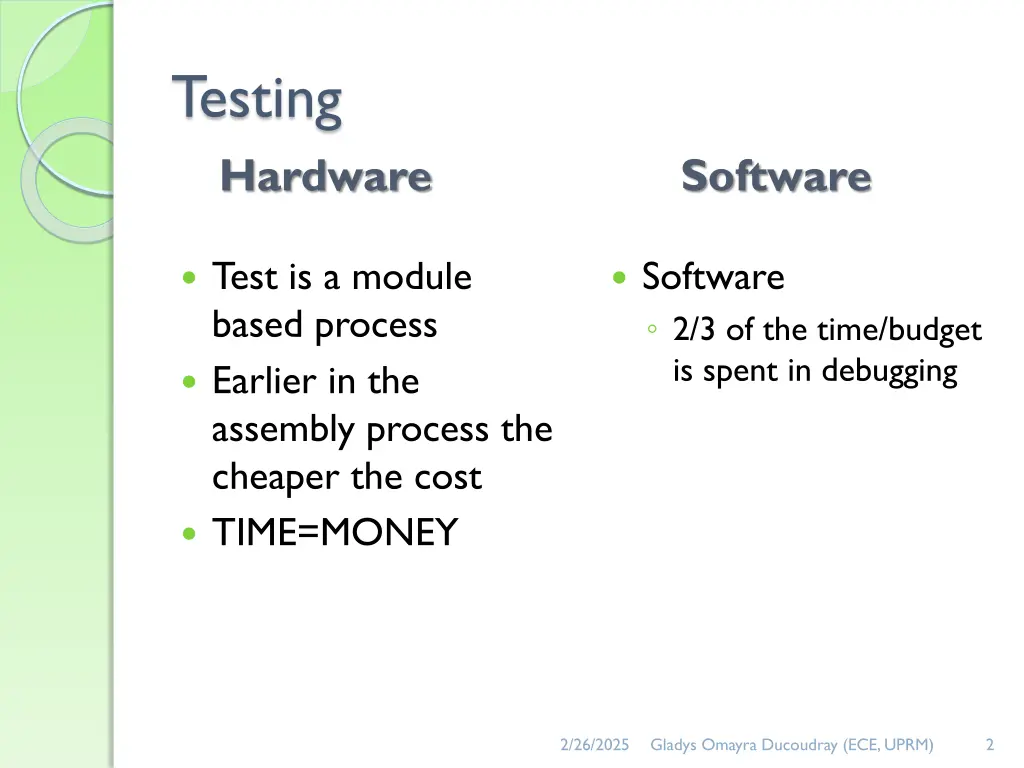
Testing Hardware Software Test is a module based process Earlier in the assembly process the cheaper the cost TIME=MONEY Software 2/3 of the time/budget is spent in debugging 2/26/2025 Gladys Omayra Ducoudray (ECE, UPRM) 2
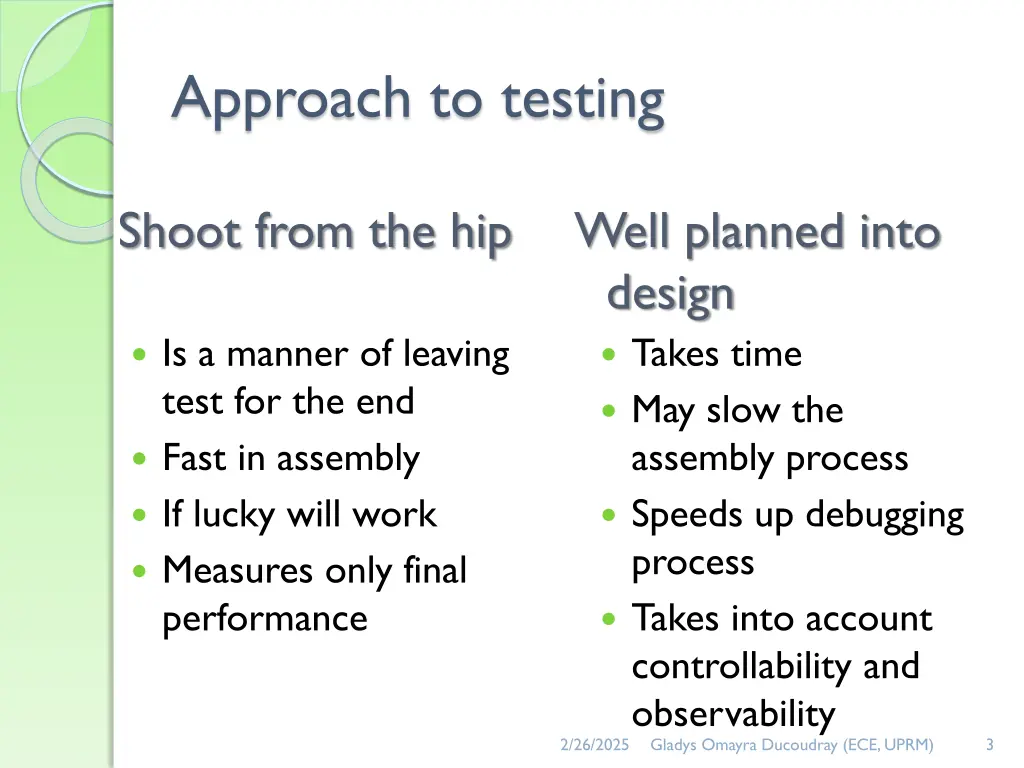
Approach to testing Shoot from the hip Well planned into design Is a manner of leaving test for the end Fast in assembly If lucky will work Measures only final performance Takes time May slow the assembly process Speeds up debugging process Takes into account controllability and observability 2/26/2025 Gladys Omayra Ducoudray (ECE, UPRM) 3
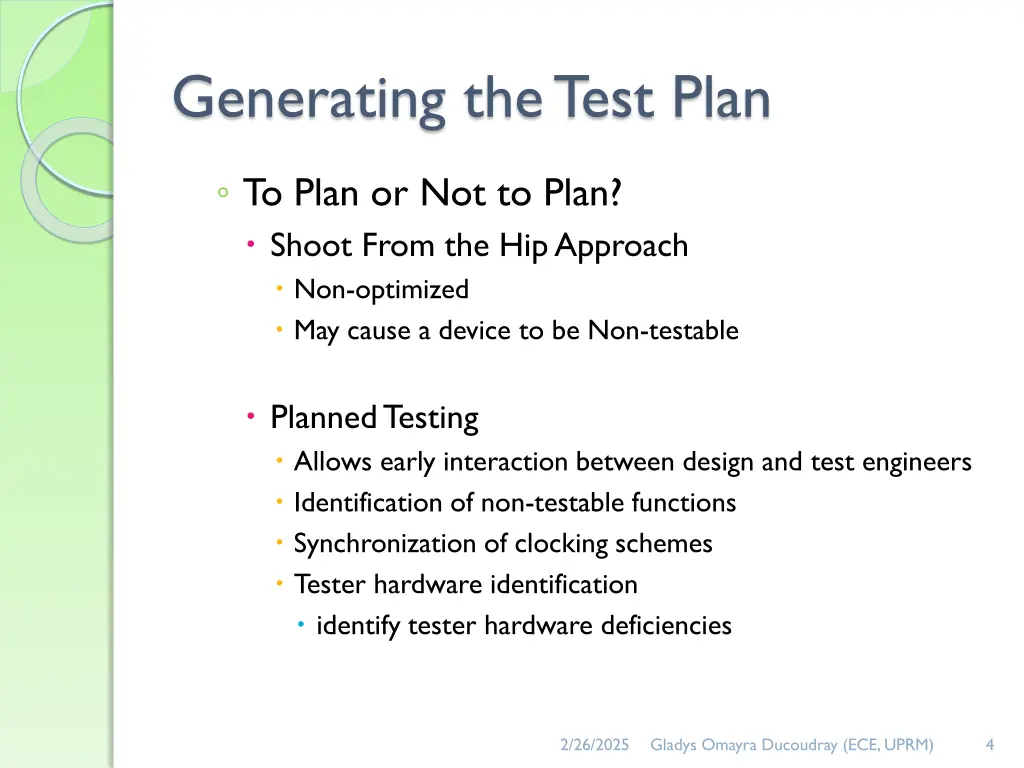
Generating the Test Plan To Plan or Not to Plan? Shoot From the Hip Approach Non-optimized May cause a device to be Non-testable Planned Testing Allows early interaction between design and test engineers Identification of non-testable functions Synchronization of clocking schemes Tester hardware identification identify tester hardware deficiencies 2/26/2025 Gladys Omayra Ducoudray (ECE, UPRM) 4
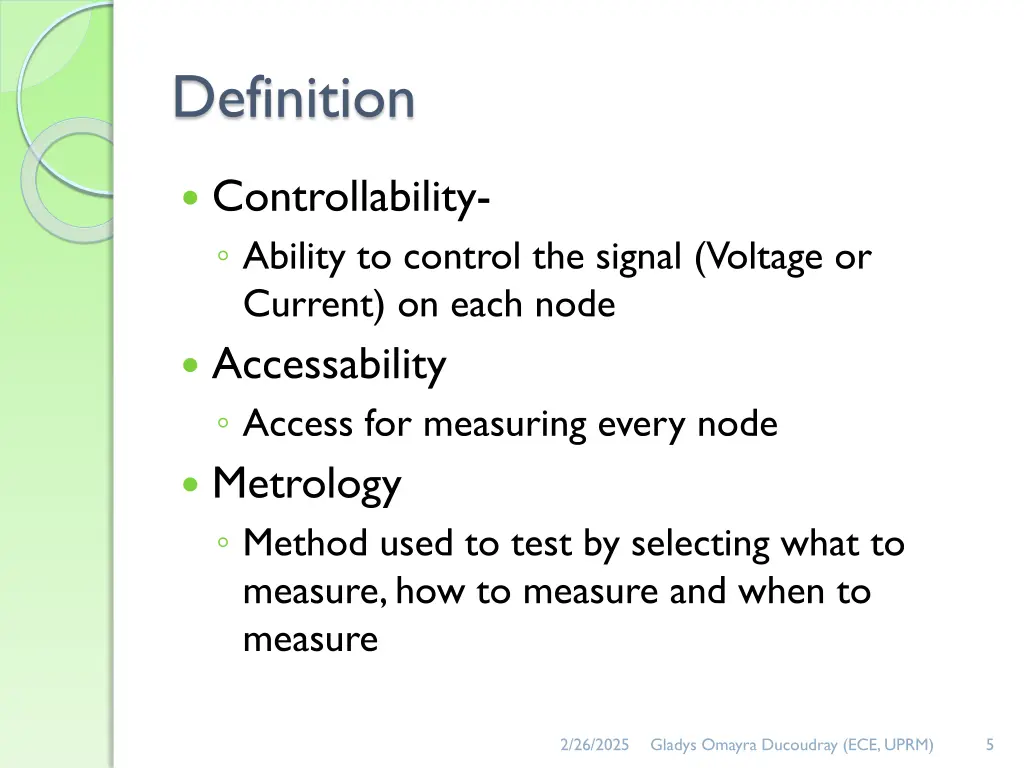
Definition Controllability- Ability to control the signal (Voltage or Current) on each node Accessability Access for measuring every node Metrology Method used to test by selecting what to measure, how to measure and when to measure 2/26/2025 Gladys Omayra Ducoudray (ECE, UPRM) 5
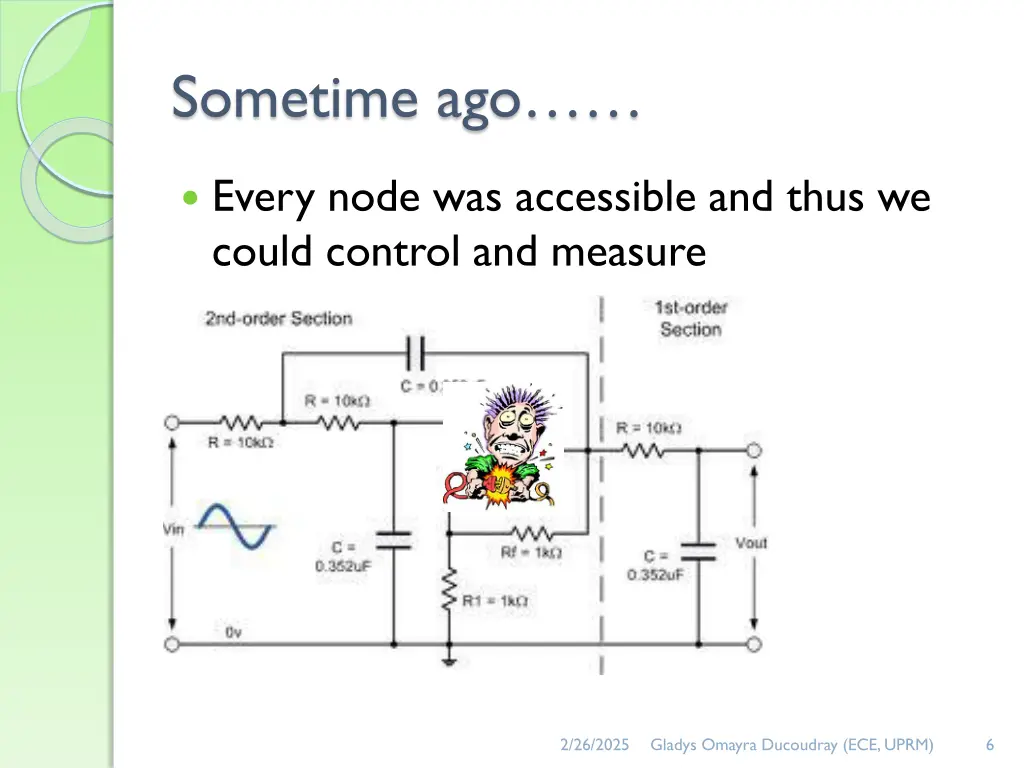
Sometime ago Every node was accessible and thus we could control and measure 2/26/2025 Gladys Omayra Ducoudray (ECE, UPRM) 6
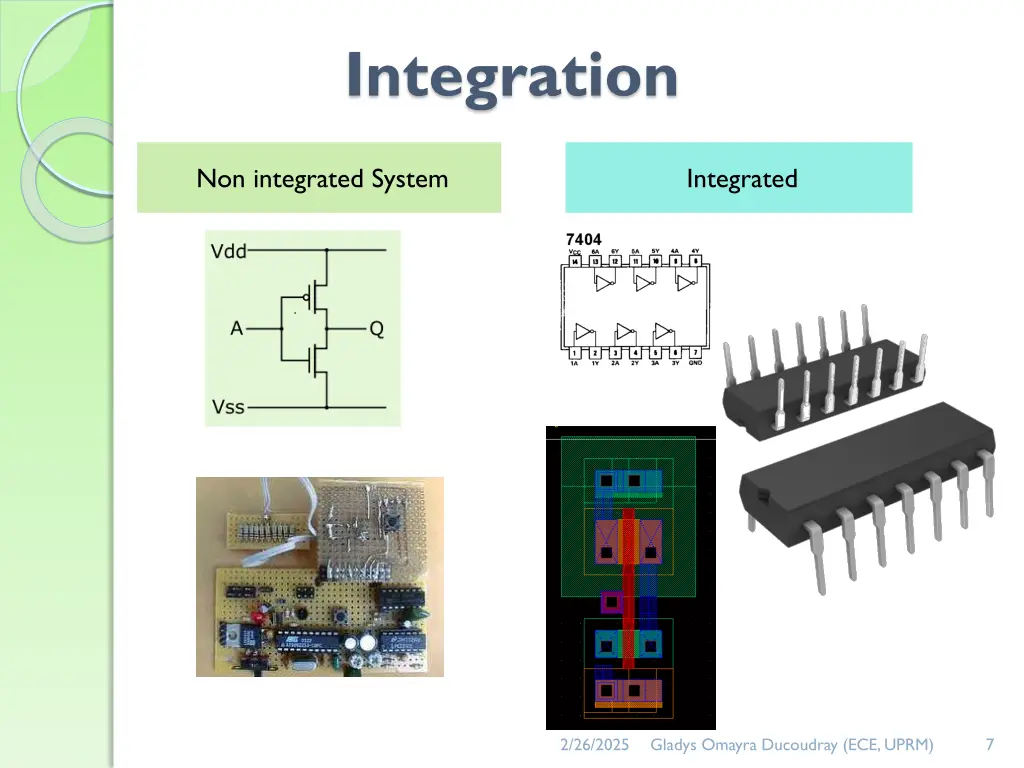
Integration Non integrated System Integrated 2/26/2025 Gladys Omayra Ducoudray (ECE, UPRM) 7
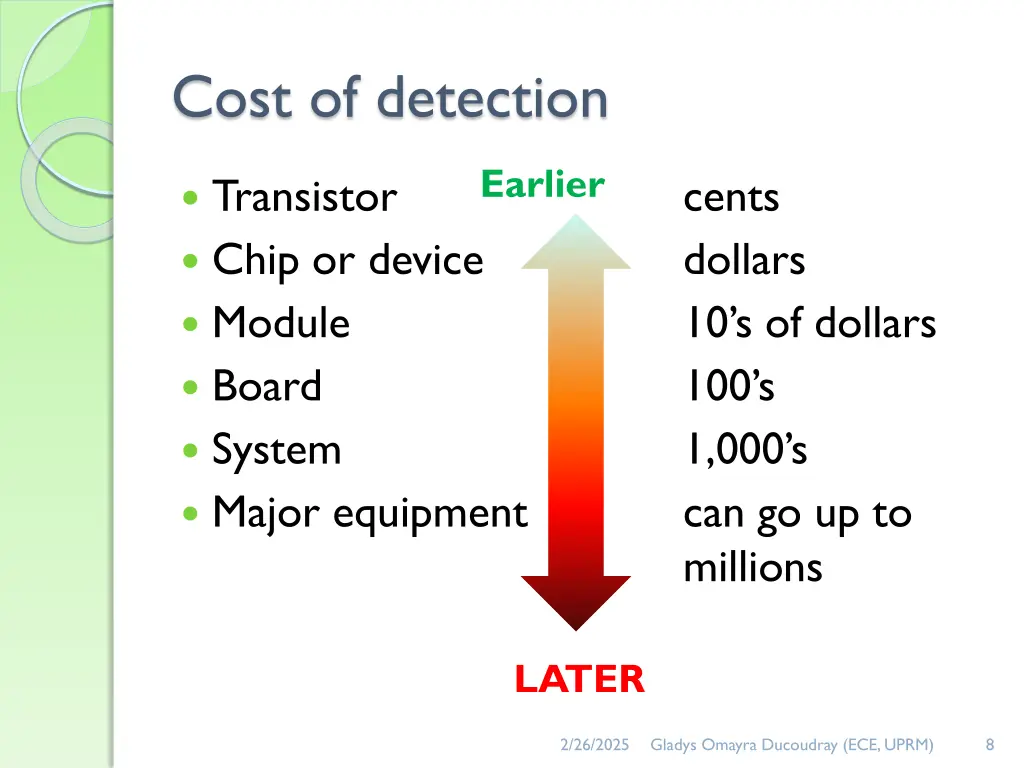
Cost of detection Earlier Transistor Chip or device Module Board System Major equipment cents dollars 10 s of dollars 100 s 1,000 s can go up to millions LATER 2/26/2025 Gladys Omayra Ducoudray (ECE, UPRM) 8
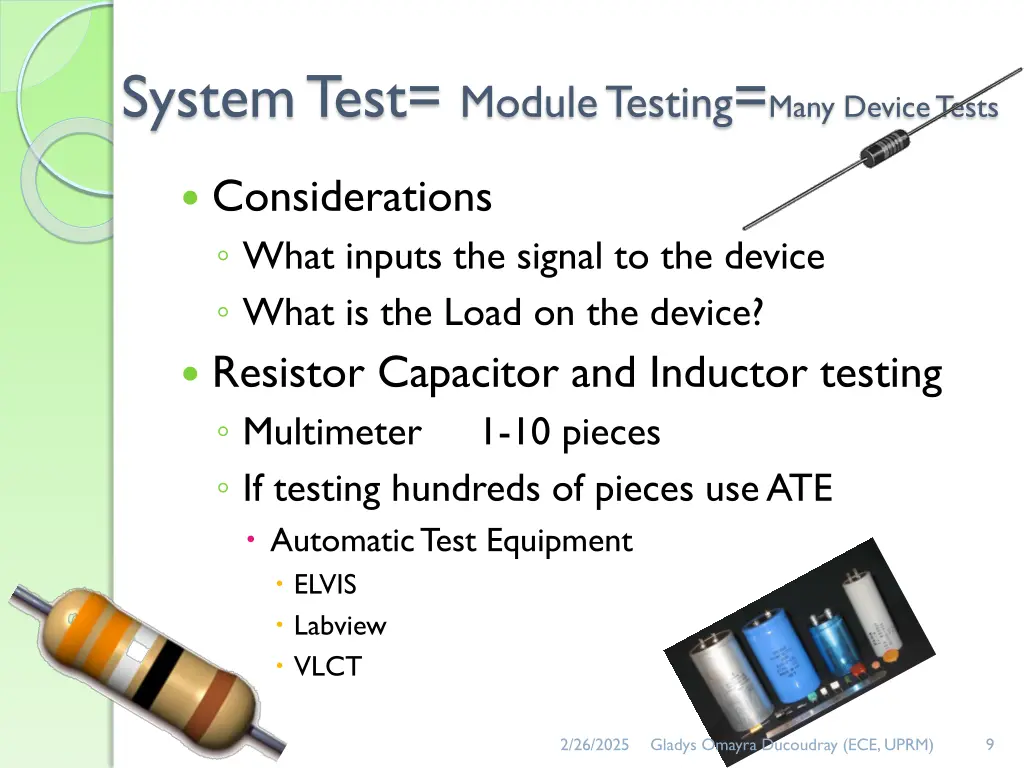
System Test= Module Testing=Many Device Tests Considerations What inputs the signal to the device What is the Load on the device? Resistor Capacitor and Inductor testing Multimeter 1-10 pieces If testing hundreds of pieces use ATE Automatic Test Equipment ELVIS Labview VLCT 2/26/2025 Gladys Omayra Ducoudray (ECE, UPRM) 9
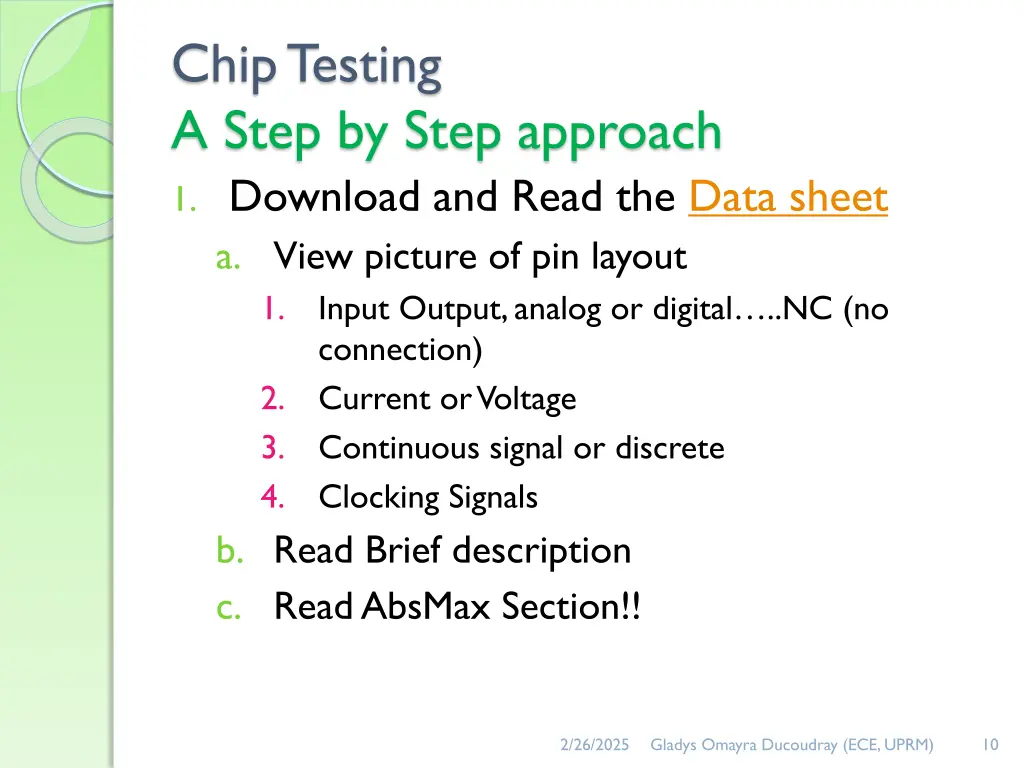
Chip Testing A Step by Step approach 1. Download and Read the Data sheet a. View picture of pin layout 1. Input Output, analog or digital ..NC (no connection) 2. Current or Voltage 3. Continuous signal or discrete 4. Clocking Signals b. Read Brief description c. Read AbsMax Section!! 2/26/2025 Gladys Omayra Ducoudray (ECE, UPRM) 10
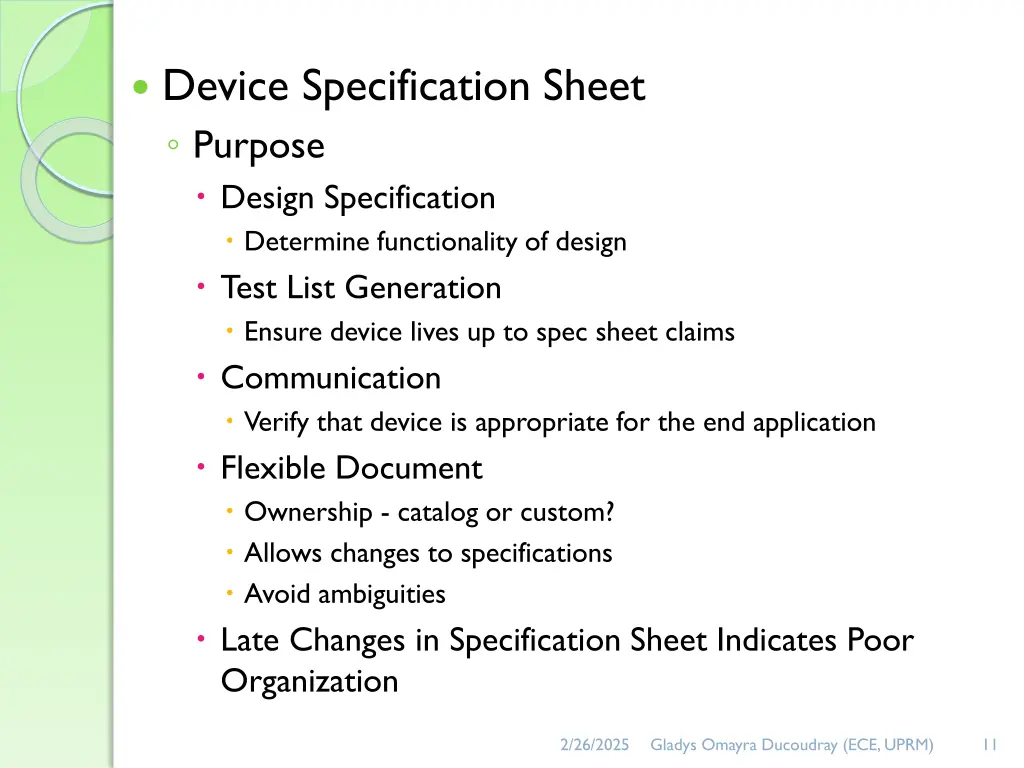
Device Specification Sheet Purpose Design Specification Determine functionality of design Test List Generation Ensure device lives up to spec sheet claims Communication Verify that device is appropriate for the end application Flexible Document Ownership - catalog or custom? Allows changes to specifications Avoid ambiguities Late Changes in Specification Sheet Indicates Poor Organization 2/26/2025 Gladys Omayra Ducoudray (ECE, UPRM) 11
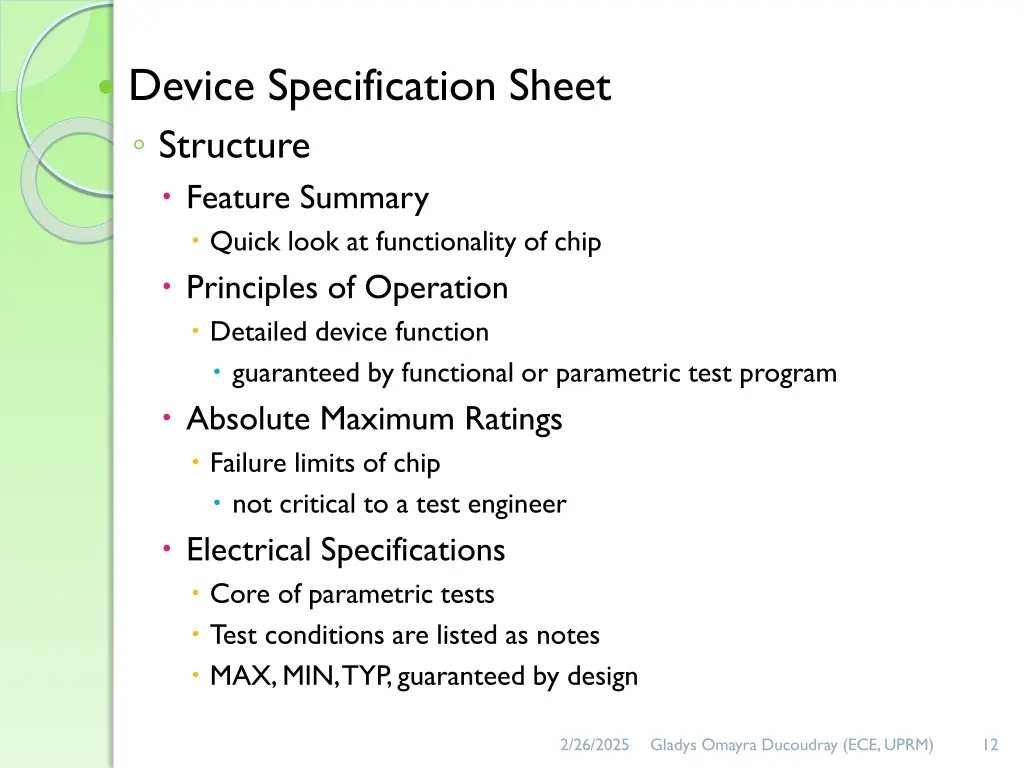
Device Specification Sheet Structure Feature Summary Quick look at functionality of chip Principles of Operation Detailed device function guaranteed by functional or parametric test program Absolute Maximum Ratings Failure limits of chip not critical to a test engineer Electrical Specifications Core of parametric tests Test conditions are listed as notes MAX, MIN, TYP, guaranteed by design 2/26/2025 Gladys Omayra Ducoudray (ECE, UPRM) 12
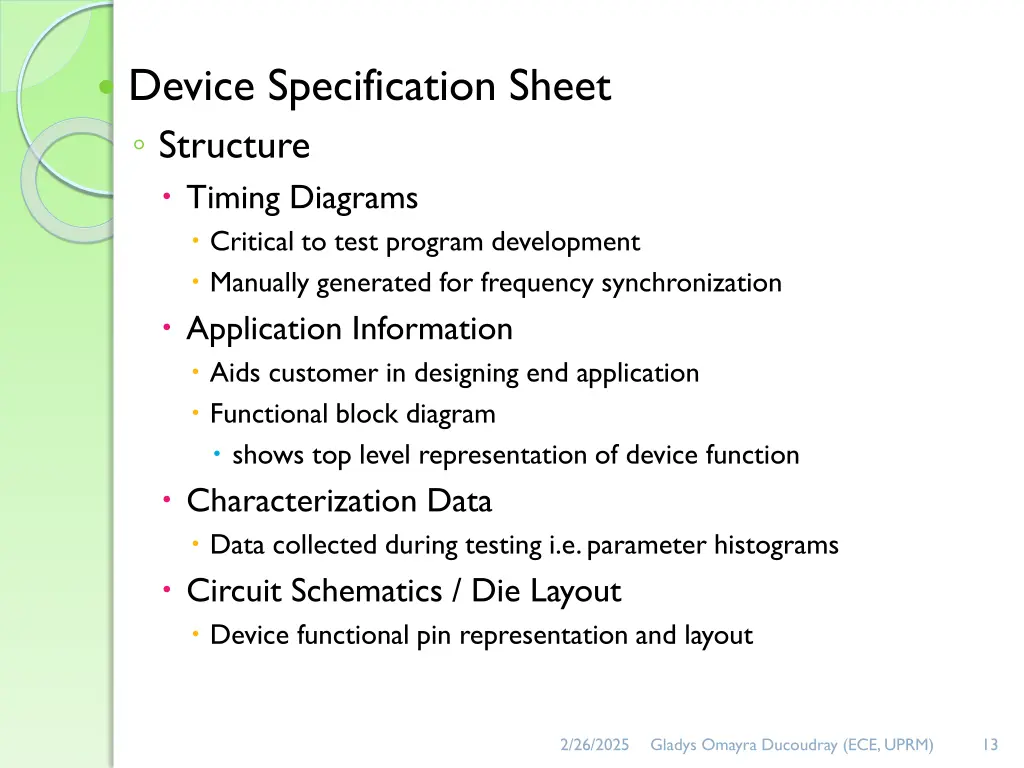
Device Specification Sheet Structure Timing Diagrams Critical to test program development Manually generated for frequency synchronization Application Information Aids customer in designing end application Functional block diagram shows top level representation of device function Characterization Data Data collected during testing i.e. parameter histograms Circuit Schematics / Die Layout Device functional pin representation and layout 2/26/2025 Gladys Omayra Ducoudray (ECE, UPRM) 13
ABS MAX NEVER TEST FOR THIS!!! 2/26/2025 Gladys Omayra Ducoudray (ECE, UPRM) 14
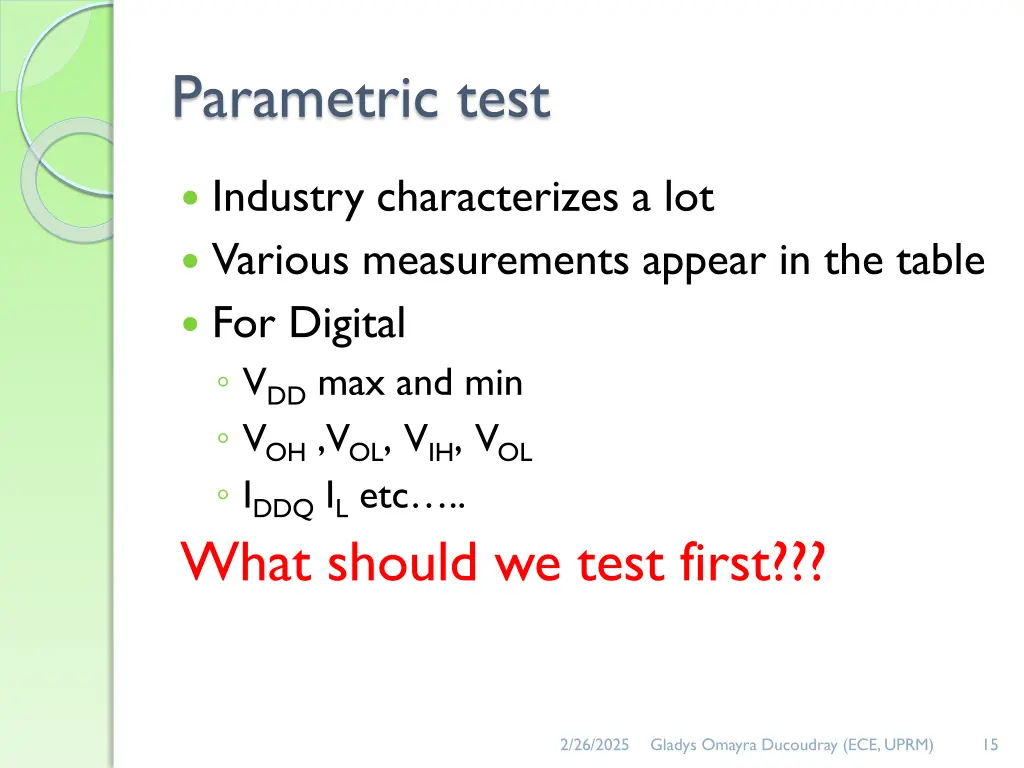
Parametric test Industry characterizes a lot Various measurements appear in the table For Digital VDD max and min VOH ,VOL, VIH, VOL IDDQ ILetc .. What should we test first??? 2/26/2025 Gladys Omayra Ducoudray (ECE, UPRM) 15
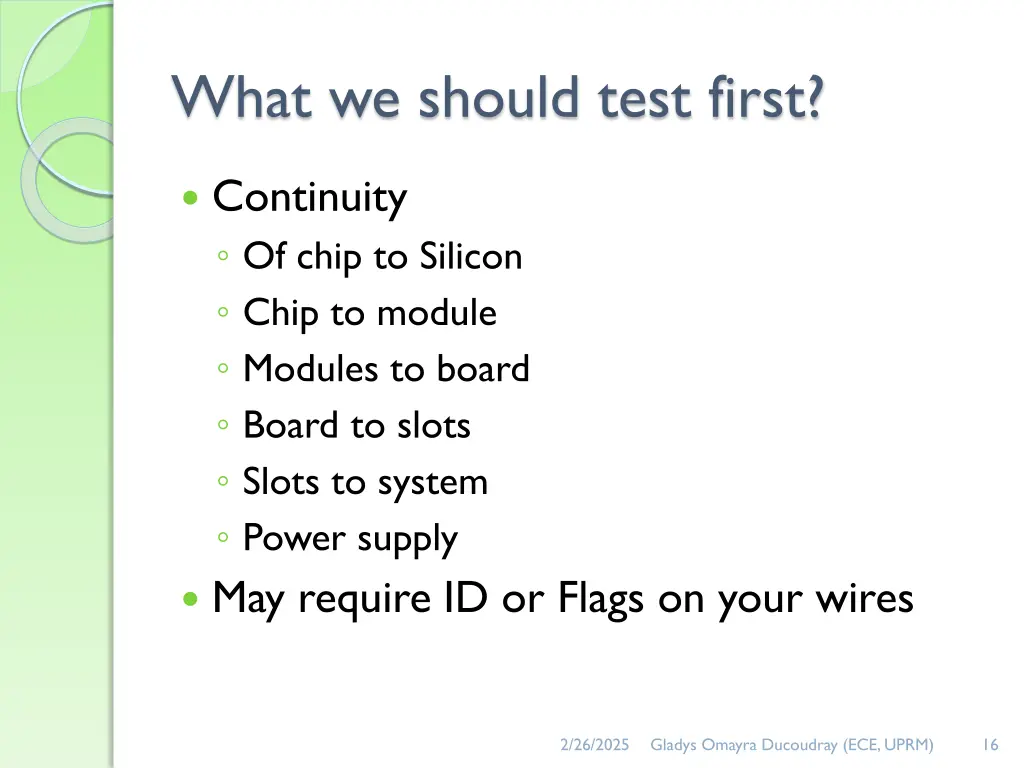
What we should test first? Continuity Of chip to Silicon Chip to module Modules to board Board to slots Slots to system Power supply May require ID or Flags on your wires 2/26/2025 Gladys Omayra Ducoudray (ECE, UPRM) 16
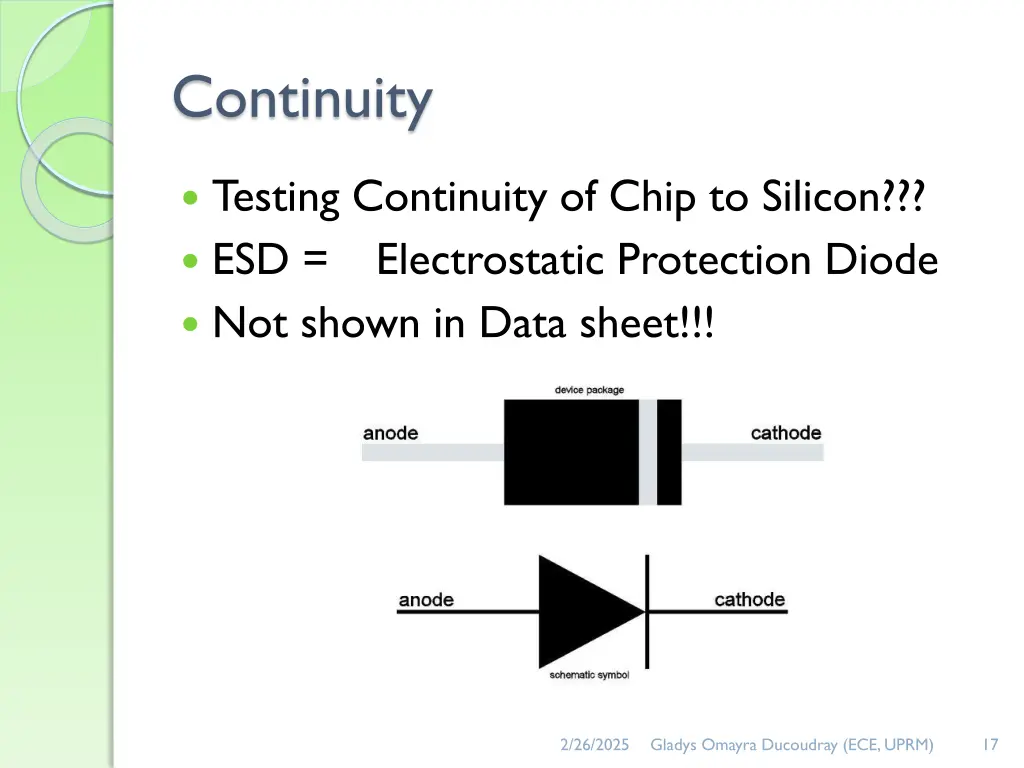
Continuity Testing Continuity of Chip to Silicon??? ESD = Electrostatic Protection Diode Not shown in Data sheet!!! 2/26/2025 Gladys Omayra Ducoudray (ECE, UPRM) 17
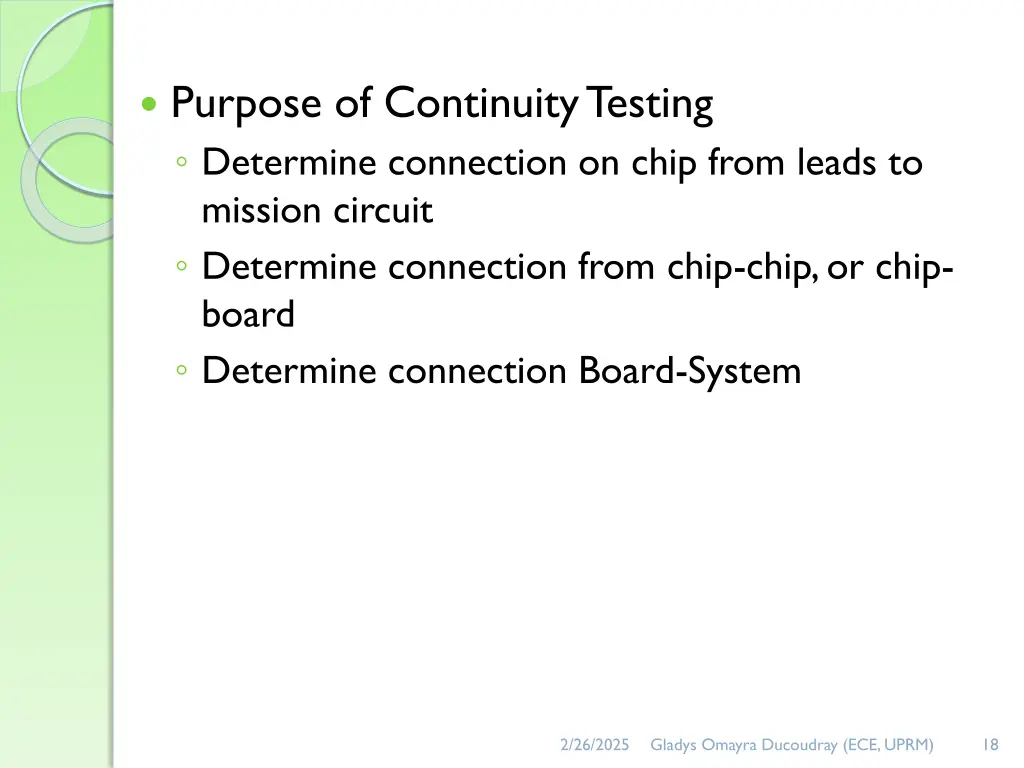
Purpose of Continuity Testing Determine connection on chip from leads to mission circuit Determine connection from chip-chip, or chip- board Determine connection Board-System 2/26/2025 Gladys Omayra Ducoudray (ECE, UPRM) 18
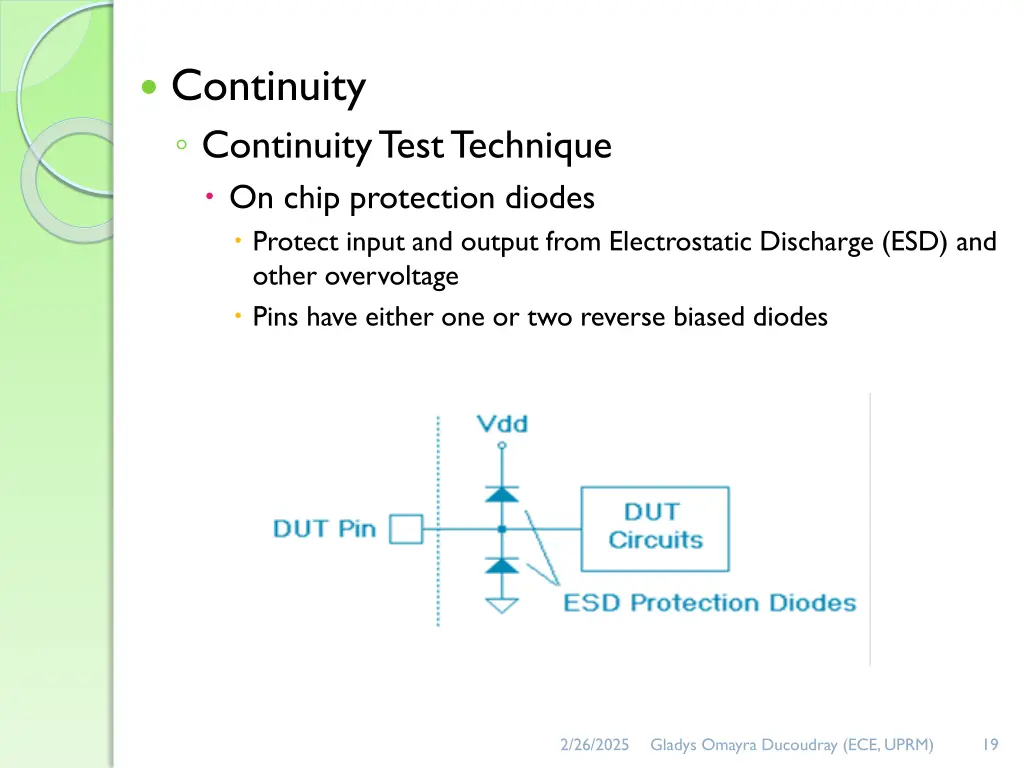
Continuity Continuity Test Technique On chip protection diodes Protect input and output from Electrostatic Discharge (ESD) and other overvoltage Pins have either one or two reverse biased diodes 2/26/2025 Gladys Omayra Ducoudray (ECE, UPRM) 19
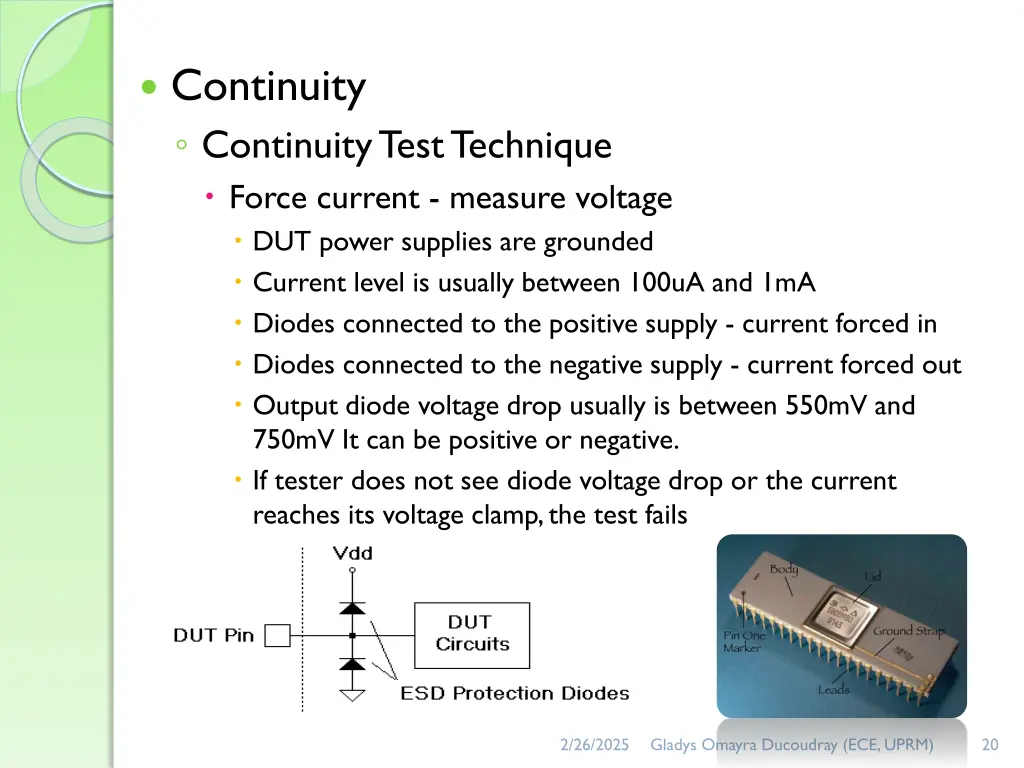
Continuity Continuity Test Technique Force current - measure voltage DUT power supplies are grounded Current level is usually between 100uA and 1mA Diodes connected to the positive supply - current forced in Diodes connected to the negative supply - current forced out Output diode voltage drop usually is between 550mV and 750mV It can be positive or negative. If tester does not see diode voltage drop or the current reaches its voltage clamp, the test fails 2/26/2025 Gladys Omayra Ducoudray (ECE, UPRM) 20
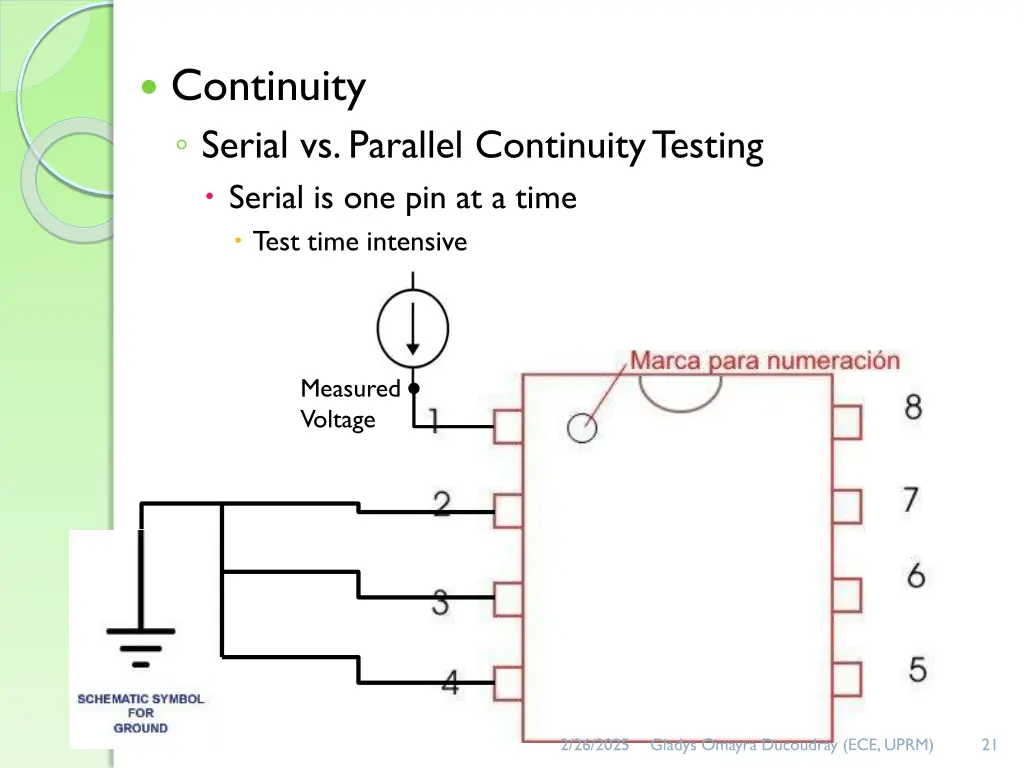
Continuity Serial vs. Parallel Continuity Testing Serial is one pin at a time Test time intensive Measured Voltage 2/26/2025 Gladys Omayra Ducoudray (ECE, UPRM) 21
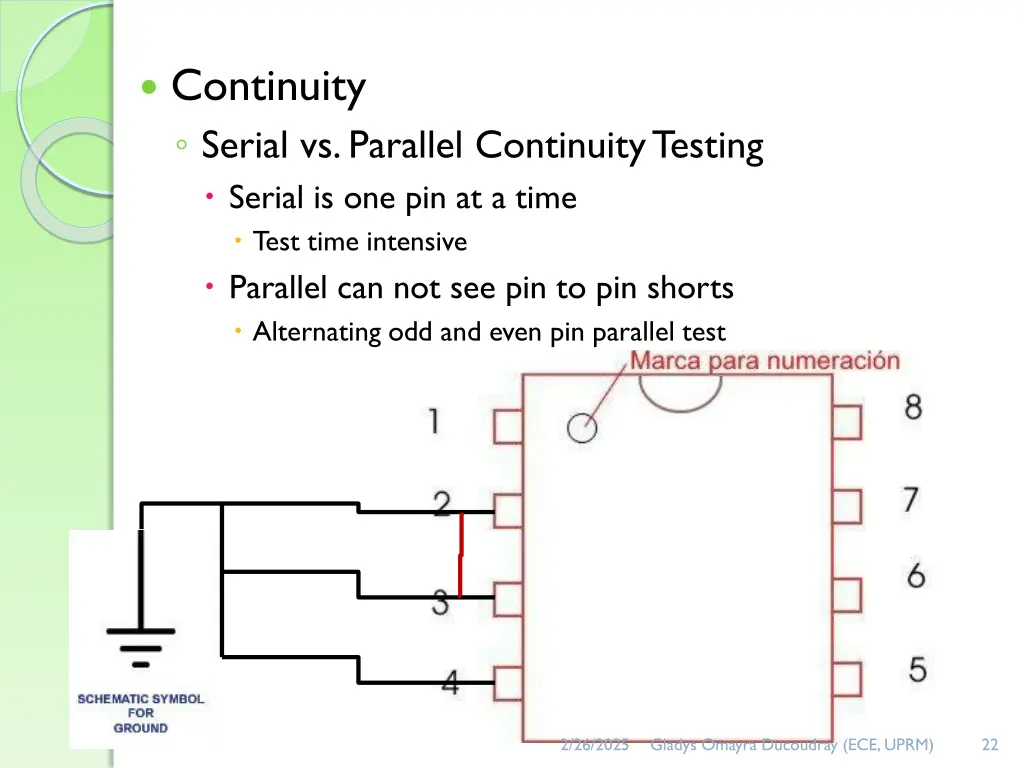
Continuity Serial vs. Parallel Continuity Testing Serial is one pin at a time Test time intensive Parallel can not see pin to pin shorts Alternating odd and even pin parallel test 2/26/2025 Gladys Omayra Ducoudray (ECE, UPRM) 22
Continuity Serial vs. Parallel Continuity Testing Serial is one pin at a time Test time intensive Parallel can not see pin to pin shorts Alternating odd and even pin parallel test Analog parallel per-pin measurement is not available in some testers Single current source and volt meter can be used one pin at a time Digital per-pin measurement is available, but may introduce noise into sensitive analog circuit 2/26/2025 Gladys Omayra Ducoudray (ECE, UPRM) 23
Leakage Currents Purpose of Leakage Testing Good design should have leakage current of less than 1uA Detects poorly processed integrated circuits Improper operation in customer end application Detect weak devices Initially function but eventually fail after unacceptably short lifetime (Infant mortality) 2/26/2025 Gladys Omayra Ducoudray (ECE, UPRM) 24
Leakage Currents Leakage Test Technique Force DC voltage - measure small current Typically measured twice input voltage equal to positive supply input voltage set to ground or negative supply Input current high (IIH) and input current low (IIL) Digital and analog inputs Output leakage current (IOZ) Measured same as IIH & IIL output pin must be placed in a high impedance (HIZ) state using test modes 2/26/2025 Gladys Omayra Ducoudray (ECE, UPRM) 25
Leakage Currents Serial vs. Parallel Leakage Testing Serial is one pin at a time Test time intensive Less possibility of errors Leakage currents can flow from pin to pin Alternating odd and even pin parallel test is recommended Again, analog parallel per-pin measurement is not available in some testers Single voltage source and current meter can be used one pin at a time Again, digital per-pin measurement is available, but may introduce noise into sensitive analog circuit 2/26/2025 Gladys Omayra Ducoudray (ECE, UPRM) 26
Power Supply Currents (IDDQ iDD) Importance of Supply Current Tests Fast method for determining catastrophic failure Large current draw from power supplies Tests are run early in test protocol to weed out defective chips without wasting valuable test time Customer specific application characteristic Battery operated instruments like a cellular phone require minimal current draw by electronics 2/26/2025 Gladys Omayra Ducoudray (ECE, UPRM) 27
Power Supply Currents Test Techniques Basic test is simple Testers have the ability to measure current draw from power supplies (Idd and Icc) Actual test is never basic Test conditions must be clearly identified in test plan power up mode, standby mode, normal operational mode digital supply (Iddd and Iccd) and analog supply (Idda and Icca) measured separately Worst case requires complete characterization 2/26/2025 Gladys Omayra Ducoudray (ECE, UPRM) 28
Test Techniques - cont. Multiple power supply pins designers may need to know the current flow into each pin Settling time 5 to 10 milliseconds in active mode hundreds of milliseconds to stabilize to within 1mA 2/26/2025 Gladys Omayra Ducoudray (ECE, UPRM) 29
DC References and Regulators Voltage Regulators High voltage input - regulated lower voltage output Output voltage simple voltmeter reading Output voltage regulation ability of regulator to maintain specific output under load Dropout voltage minimum input voltage before output drops below specified level Input regulation ability of regulator to maintain steady output with a range of input voltages 2/26/2025 Gladys Omayra Ducoudray (ECE, UPRM) 30
DC References and Regulators Voltage References Low power voltage regulators Not always accessible from external pin test engineer may need to request test modes to test references May not have a separate specification in the data sheet DC reference test modes allow the program to trim the DC references for more precise device operation 2/26/2025 Gladys Omayra Ducoudray (ECE, UPRM) 31
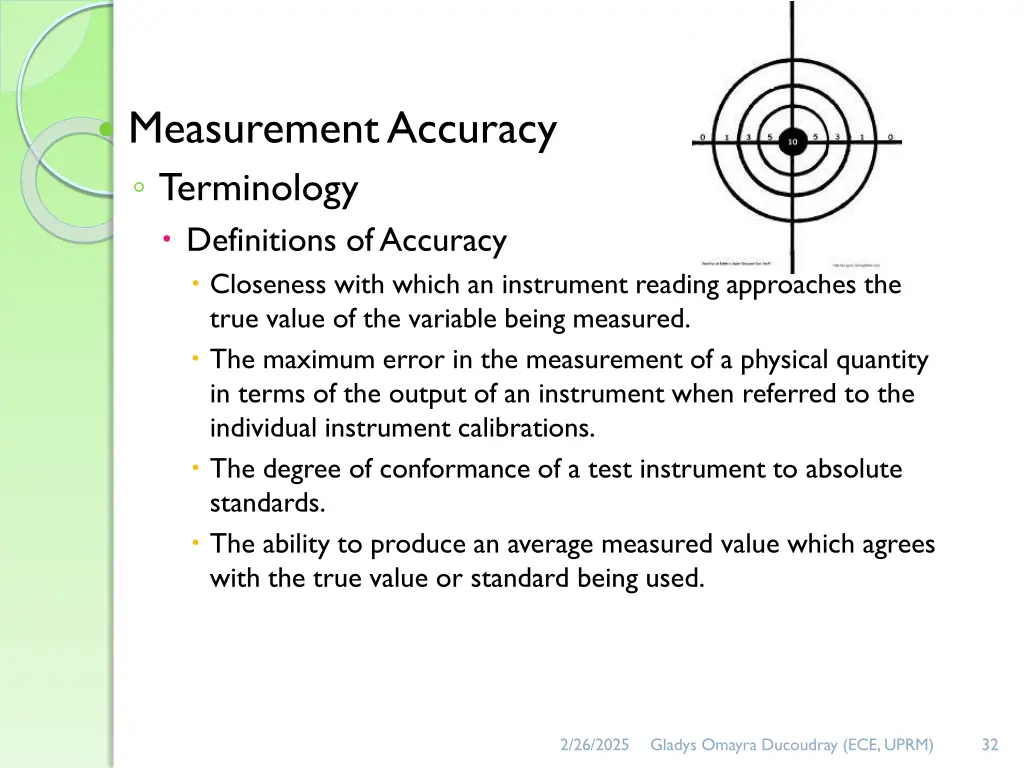
Measurement Accuracy Terminology Definitions of Accuracy Closeness with which an instrument reading approaches the true value of the variable being measured. The maximum error in the measurement of a physical quantity in terms of the output of an instrument when referred to the individual instrument calibrations. The degree of conformance of a test instrument to absolute standards. The ability to produce an average measured value which agrees with the true value or standard being used. 2/26/2025 Gladys Omayra Ducoudray (ECE, UPRM) 32
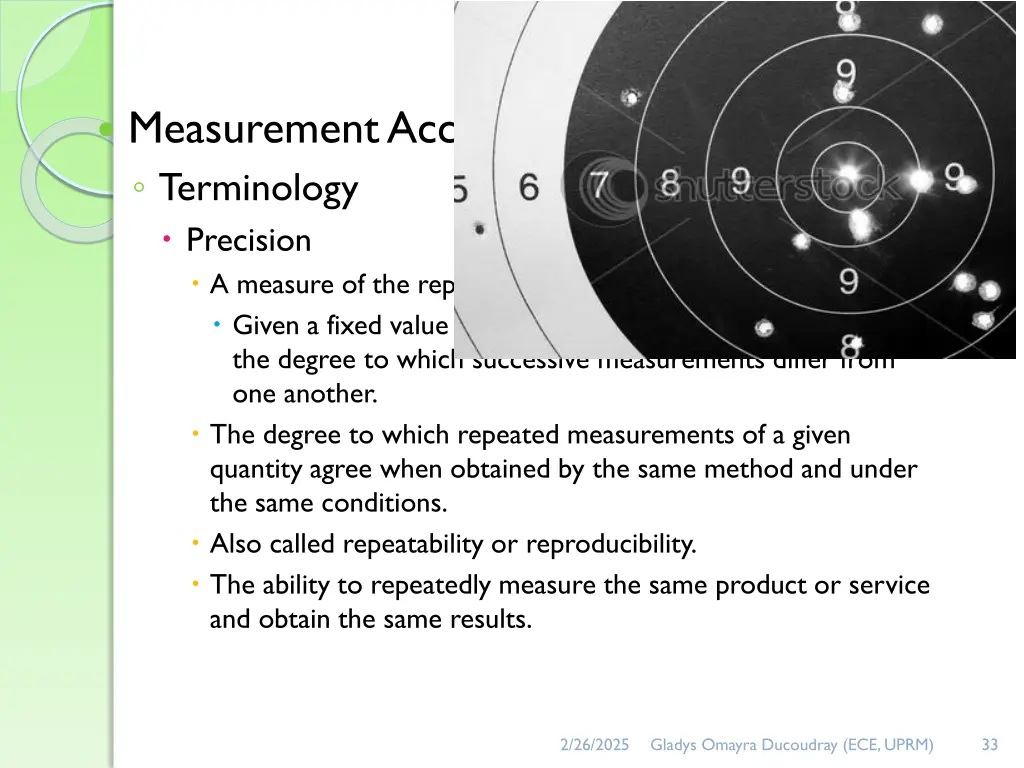
Measurement Accuracy Terminology Precision A measure of the reproducibility of the measurements. Given a fixed value of a variable, precision is a measure of the degree to which successive measurements differ from one another. The degree to which repeated measurements of a given quantity agree when obtained by the same method and under the same conditions. Also called repeatability or reproducibility. The ability to repeatedly measure the same product or service and obtain the same results. 2/26/2025 Gladys Omayra Ducoudray (ECE, UPRM) 33
Measurement Accuracy Book Terminology Accuracy - to refers to the overall closeness of an averaged measurement to the true value. Repeatability - the consistency with which that measurement can be made. The word precision will be avoided. Accuracy takes all error sources into account Systematic Errors Random Errors Resolution (Quantization Errors) 2/26/2025 Gladys Omayra Ducoudray (ECE, UPRM) 34
Measurement Accuracy Terminology Systematic Errors Errors that appear consistently from measurement to measurement Ideal Value = 100mV Measurements : 101mV, 103mV, 102mV, 101mV, 102mV, 103mV, 103mV, 101mV, 102mV Average Error : 2mV Caused by DC offsets, gain errors, non-linearities in the DVM Systematic errors can often be reduced through calibrations. 2/26/2025 Gladys Omayra Ducoudray (ECE, UPRM) 35
Measurement Accuracy Terminology Random Errors Notice that the list of numbers in the last slide vary from 101mV to 103mV. All measurement tools have random errors even $2 Million Automated test instruments Random Errors are perfectly normal in analog and mixed-signal measurements. Big challenge is in determining whether the random error is caused by a bad DIB design, bad DUT design or by the tester itself. 2/26/2025 Gladys Omayra Ducoudray (ECE, UPRM) 36
Measurement Accuracy Terminology Resolution (Quantization Errors) Notice that in the previous list of numbers, the measurement was always rounded off to the nearest milivolt. Limited resolution results from the fact that continuous analog signals must be converted to digital format (using ADC s) before a computer can evaluate the test results. The inherent error in ADCs and measurement instrumentation is called Quantization Error. Quantization error is a result of the conversion from an infinitely variable input voltage to a finite set of possible outputs from the ADC. 2/26/2025 Gladys Omayra Ducoudray (ECE, UPRM) 37
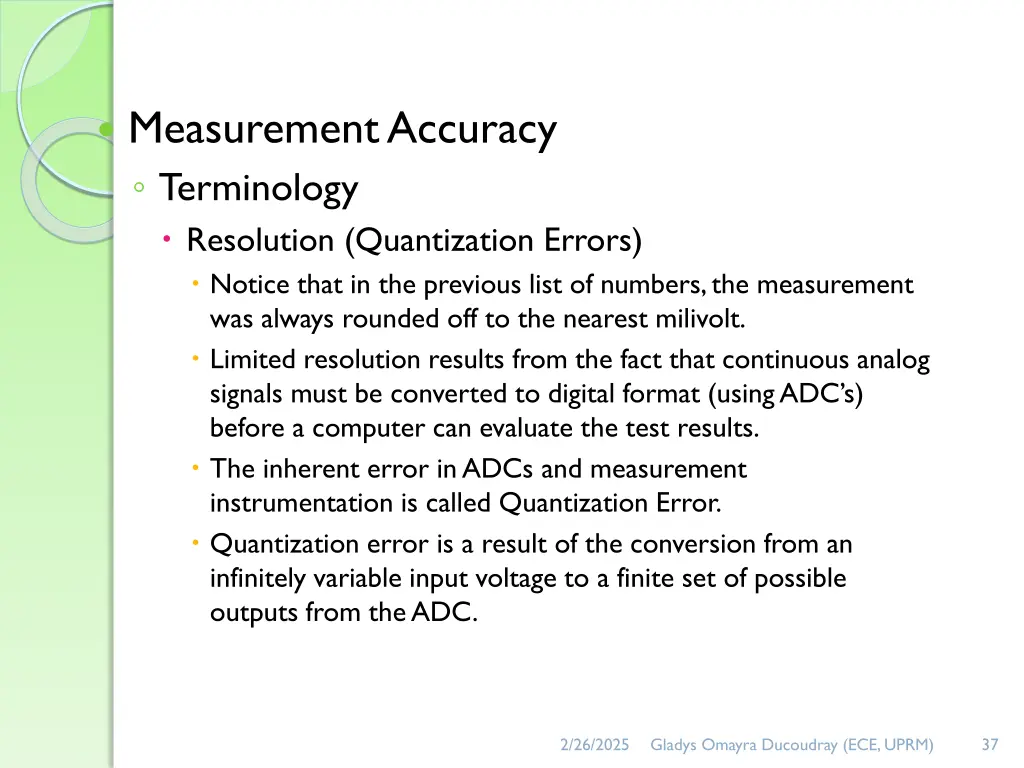
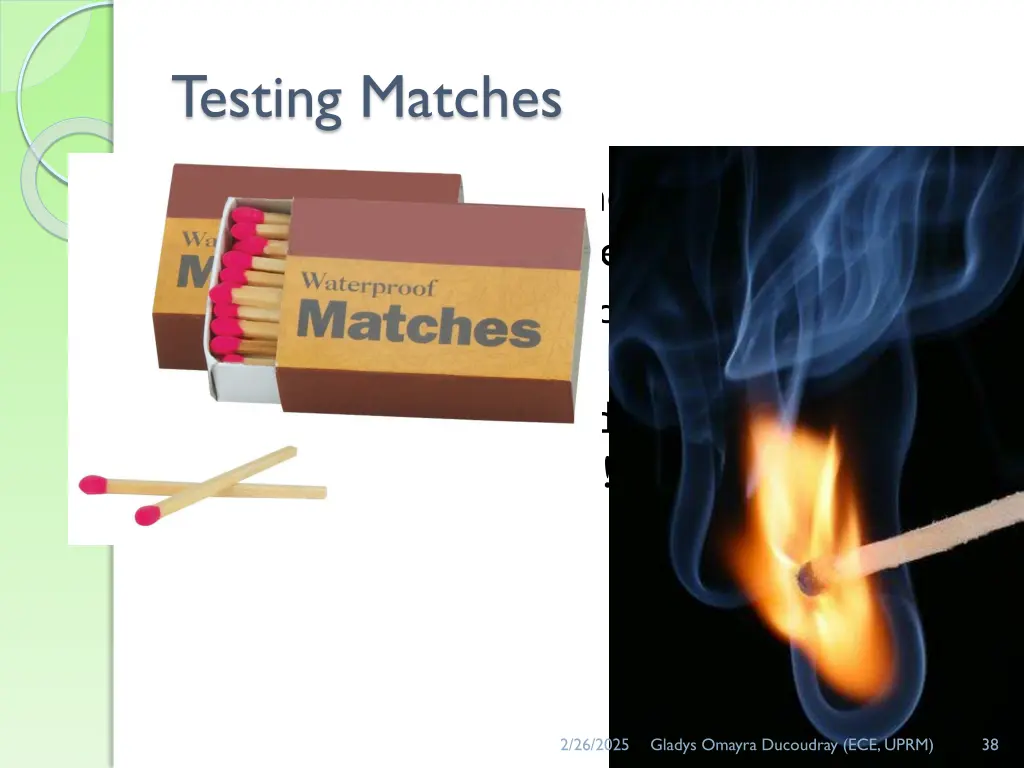
Testing Matches If the match has all the elements and If conditions are the predetermine ones Then the match should light up when stroke against the side of the Box Match box factories do NOT test each Match by striking it!!!!! 2/26/2025 Gladys Omayra Ducoudray (ECE, UPRM) 38
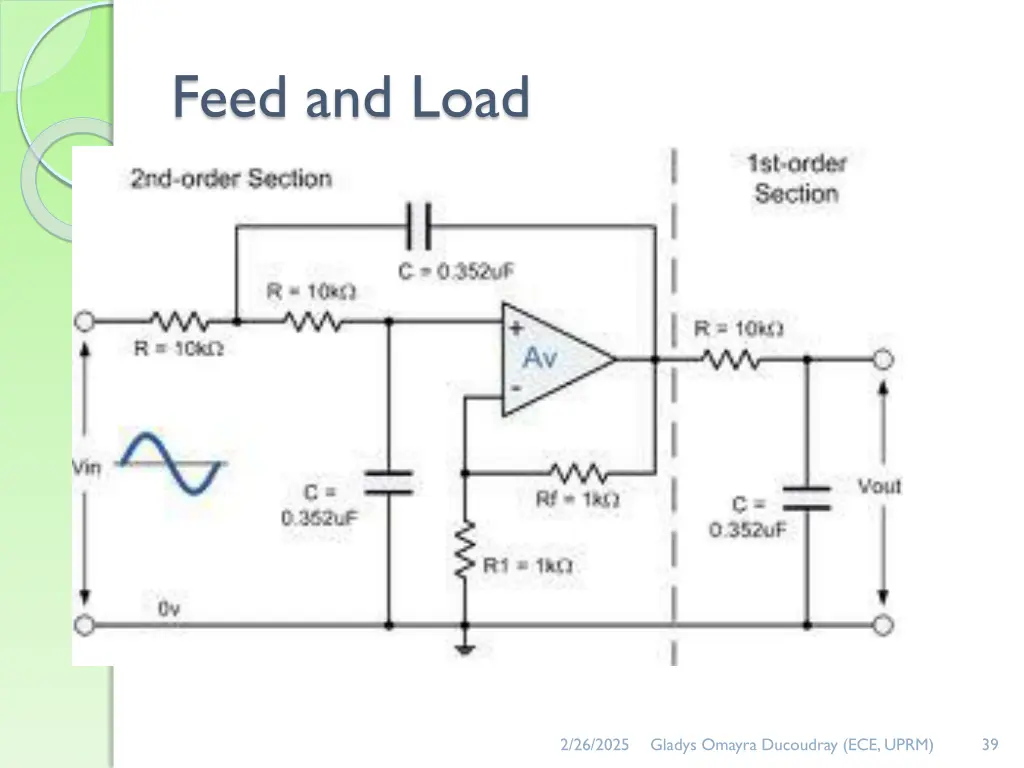
Feed and Load 2/26/2025 Gladys Omayra Ducoudray (ECE, UPRM) 39
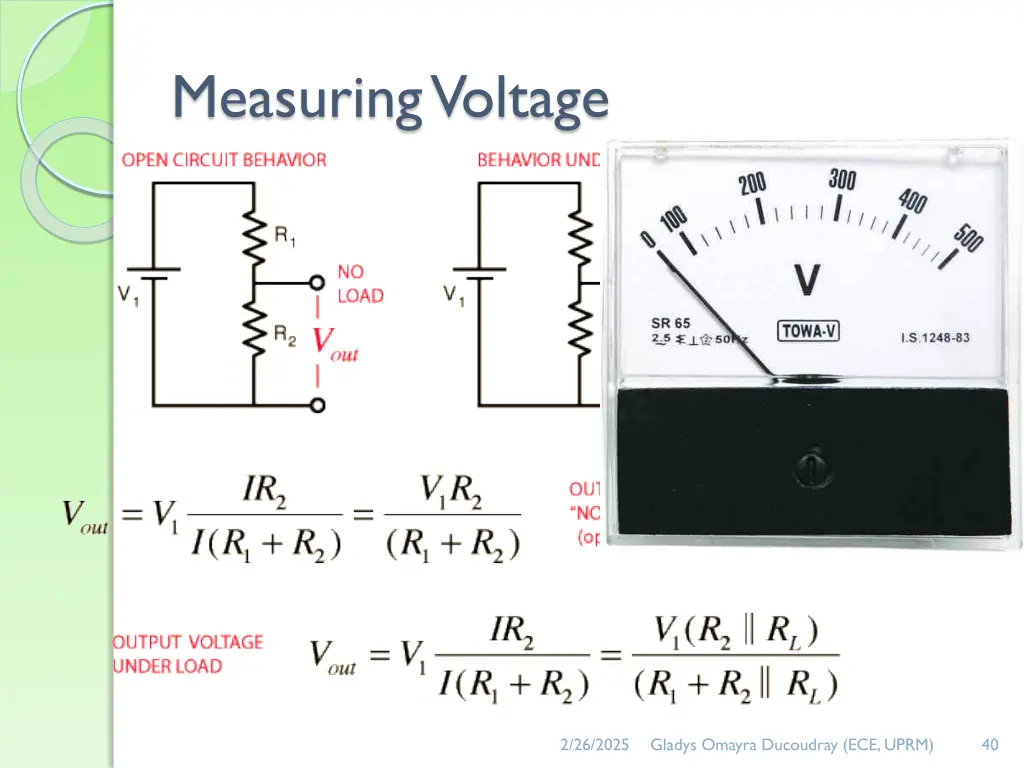
Measuring Voltage 2/26/2025 Gladys Omayra Ducoudray (ECE, UPRM) 40
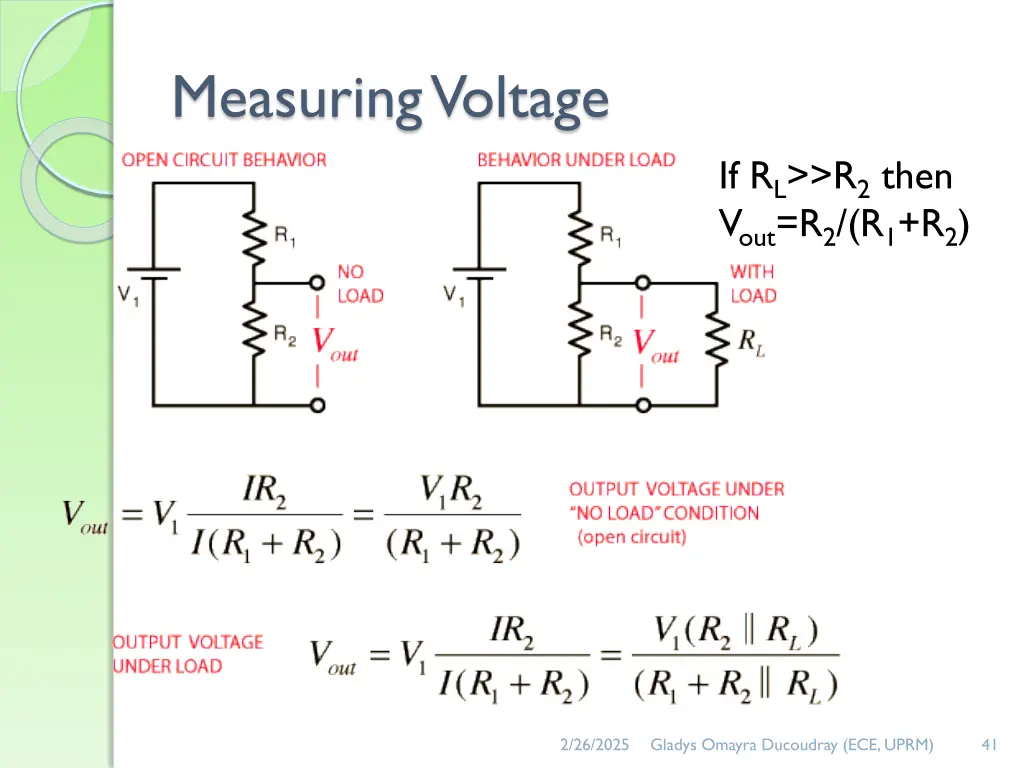
Measuring Voltage If RL>>R2 then Vout=R2/(R1+R2) 2/26/2025 Gladys Omayra Ducoudray (ECE, UPRM) 41
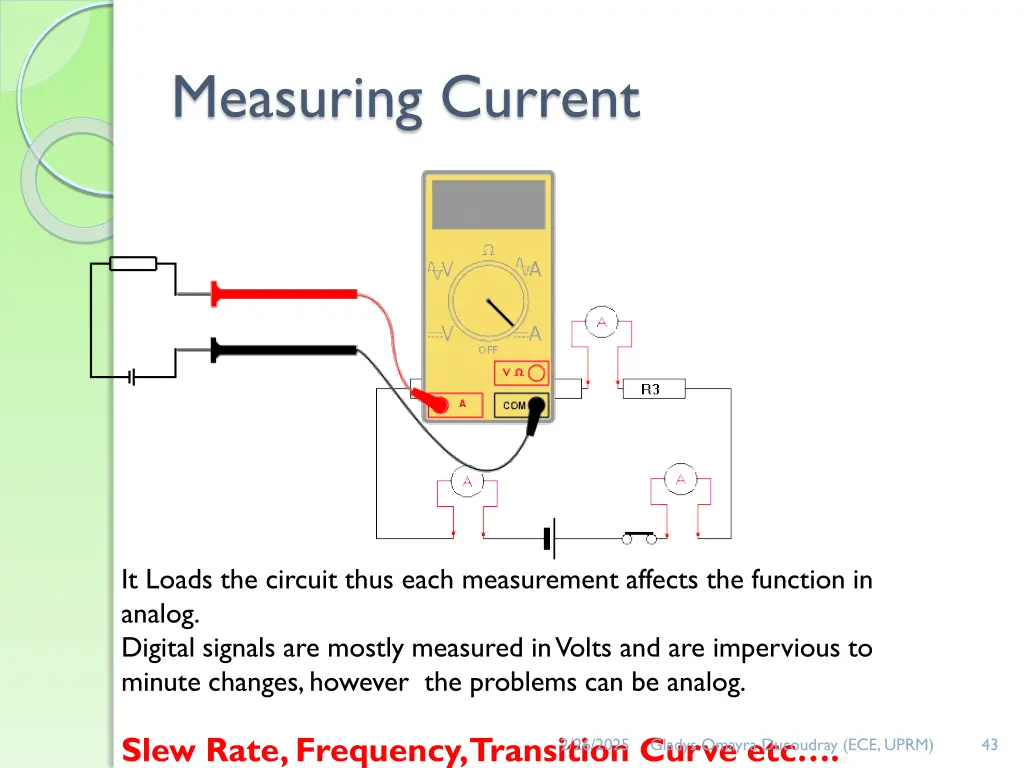
Measuring Current Current is measured in series The Circuit must Be Broken to measure the signal 2/26/2025 Gladys Omayra Ducoudray (ECE, UPRM) 42
Measuring Current It Loads the circuit thus each measurement affects the function in analog. Digital signals are mostly measured in Volts and are impervious to minute changes, however the problems can be analog. Slew Rate, Frequency, Transition Curve etc . 2/26/2025 Gladys Omayra Ducoudray (ECE, UPRM) 43
Testing Modules and Systems Ideal or real Input signals Ideal Voltage or Current Signals indicates proper functionality at the input. Real Inputs have, Noise Load tolerance Variations Maximum frequency 2/26/2025 Gladys Omayra Ducoudray (ECE, UPRM) 44
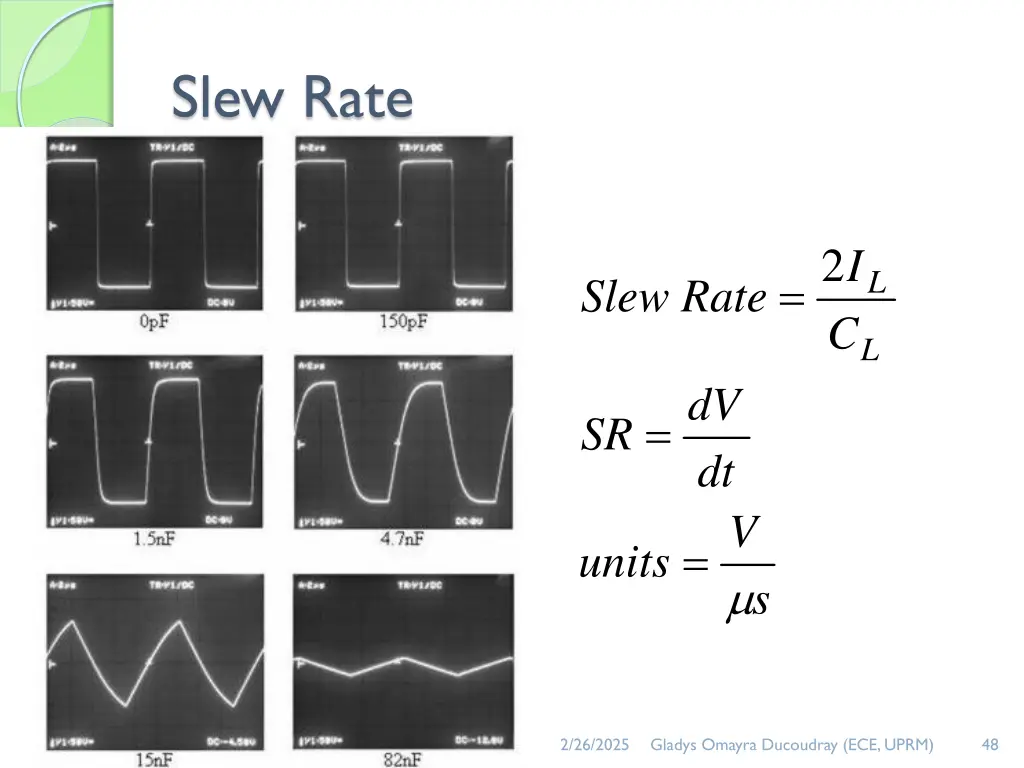
Real Input Possible Problems Fan Out Slew rate Exceeds Load Regulations Frequency incompatibility Ground Bouncing Poorly defined States 2/26/2025 Gladys Omayra Ducoudray (ECE, UPRM) 45
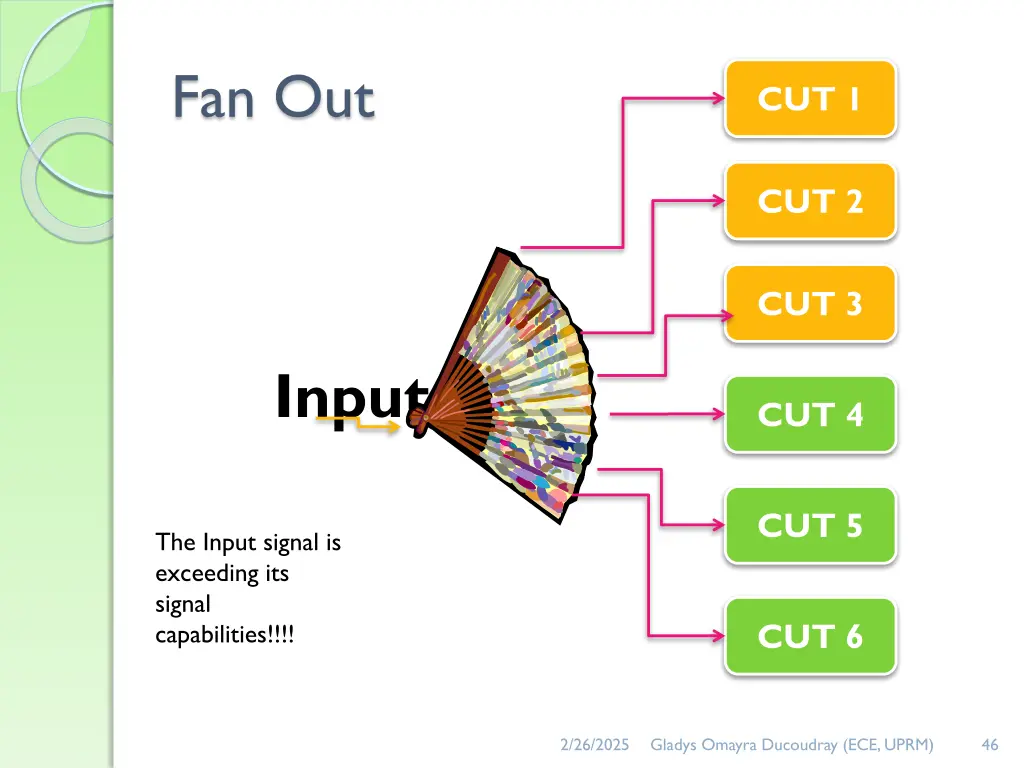
Fan Out CUT 1 CUT 2 CUT 3 Input CUT 4 CUT 5 The Input signal is exceeding its signal capabilities!!!! CUT 6 2/26/2025 Gladys Omayra Ducoudray (ECE, UPRM) 46
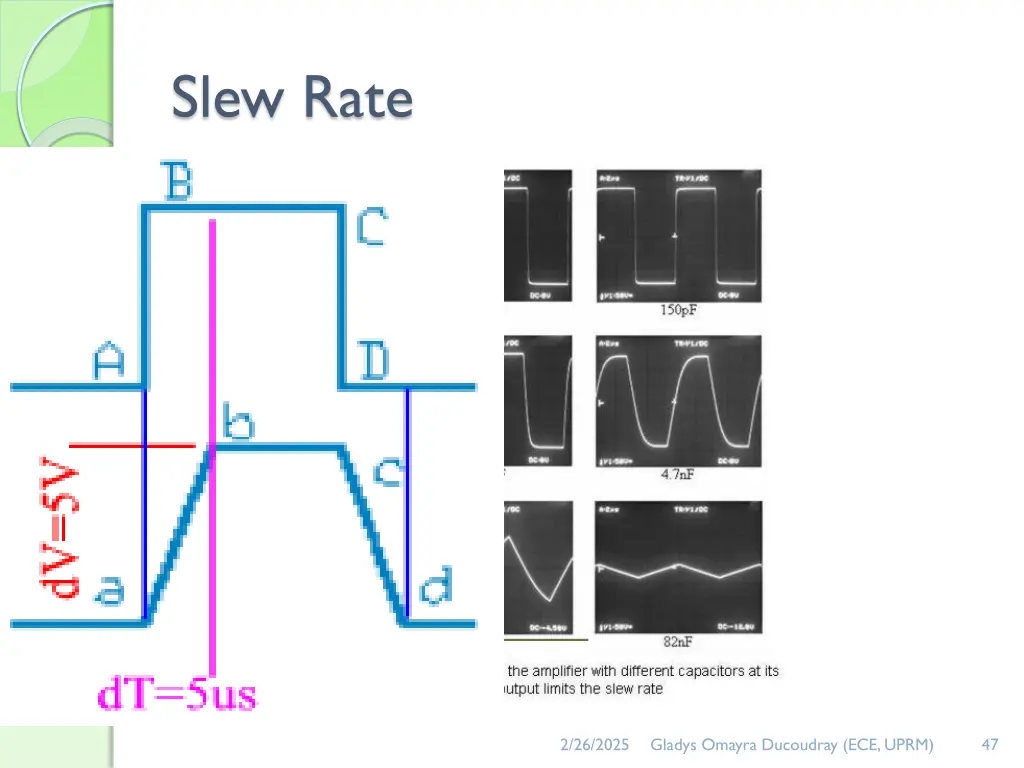
Slew Rate 2/26/2025 Gladys Omayra Ducoudray (ECE, UPRM) 47
Slew Rate =2 I L Slew Rate C L dV = SR dt V = units s 2/26/2025 Gladys Omayra Ducoudray (ECE, UPRM) 48
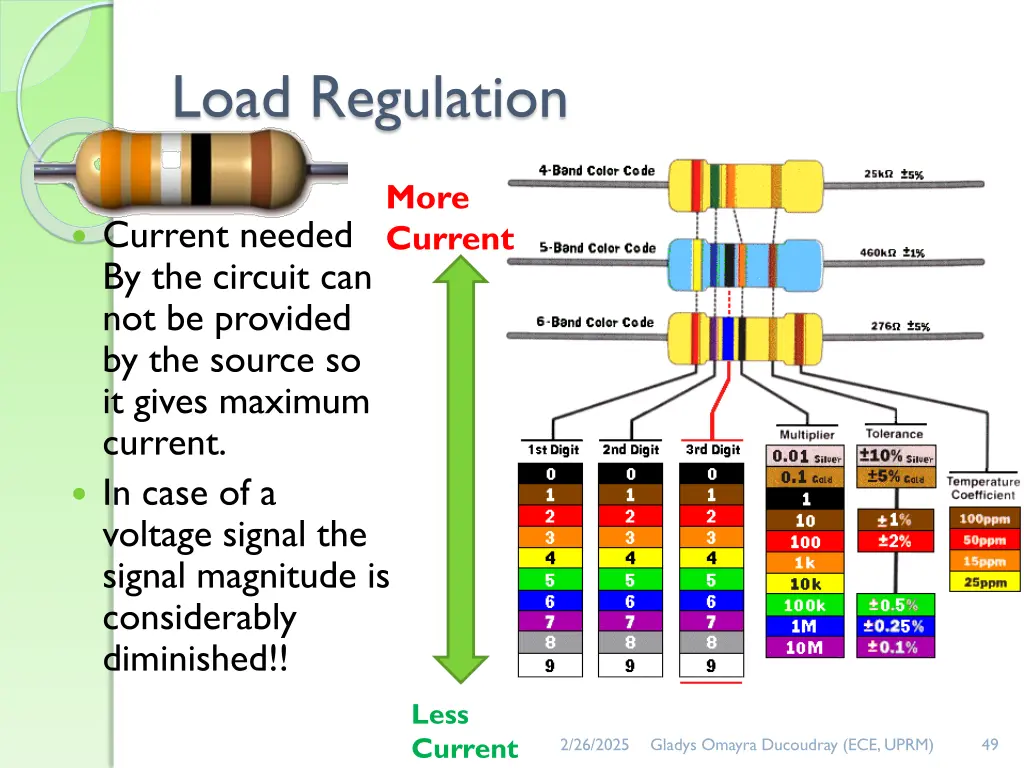
Load Regulation More Current Current needed By the circuit can not be provided by the source so it gives maximum current. In case of a voltage signal the signal magnitude is considerably diminished!! Less Current 2/26/2025 Gladys Omayra Ducoudray (ECE, UPRM) 49
Frequency problems The input signal varies at a higher rate than the maximum frequency response of the circuit The input signal is much slower that the circuit and the output may be processing the transition region False zeroes or ones if the signal is a clock signal and it is not synchronized 2/26/2025 Gladys Omayra Ducoudray (ECE, UPRM) 50