The Architecture of Language Through Networks
Explore the concept of language as a network rather than isolated boxes, delving into semantics, syntax, morphology, and more. Gain insights into the interconnected nature of linguistic elements for a comprehensive understanding of language structure.

Download Presentation

Please find below an Image/Link to download the presentation.
The content on the website is provided AS IS for your information and personal use only. It may not be sold, licensed, or shared on other websites without obtaining consent from the author. If you encounter any issues during the download, it is possible that the publisher has removed the file from their server.
You are allowed to download the files provided on this website for personal or commercial use, subject to the condition that they are used lawfully. All files are the property of their respective owners.
The content on the website is provided AS IS for your information and personal use only. It may not be sold, licensed, or shared on other websites without obtaining consent from the author.
E N D
Presentation Transcript
The Architecture of Language Richard ( Dick ) Hudson APLO July 2024 37 slides 1
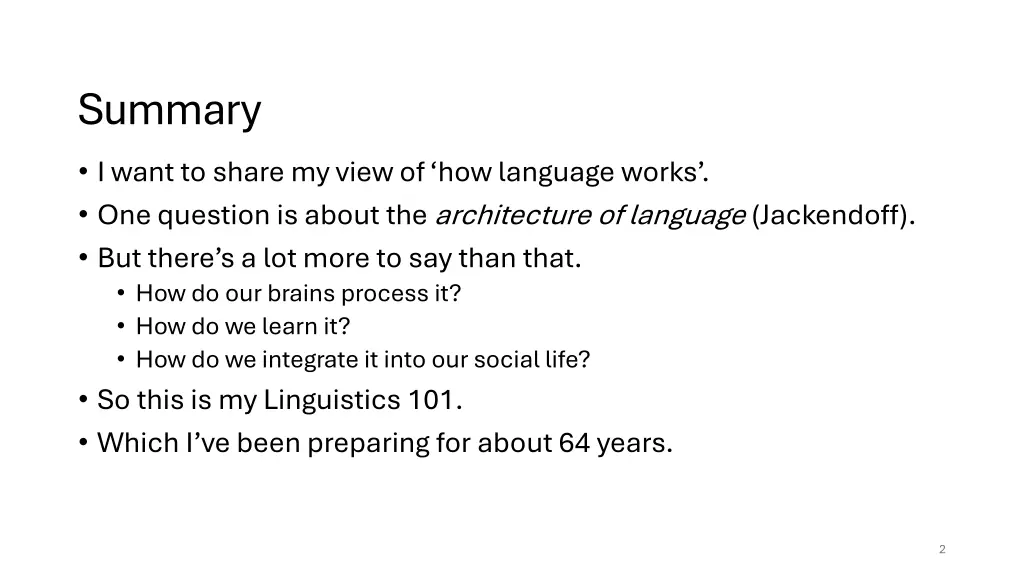
Summary I want to share my view of how language works . One question is about the architecture of language (Jackendoff). But there s a lot more to say than that. How do our brains process it? How do we learn it? How do we integrate it into our social life? So this is my Linguistics 101. Which I ve been preparing for about 64 years. 2
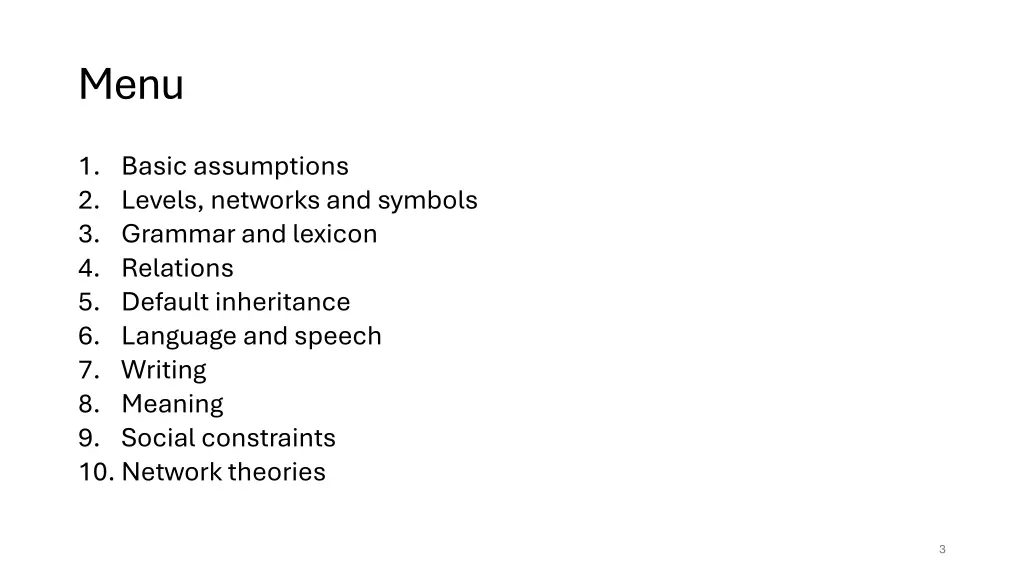
Menu 1. Basic assumptions 2. Levels, networks and symbols 3. Grammar and lexicon 4. Relations 5. Default inheritance 6. Language and speech 7. Writing 8. Meaning 9. Social constraints 10. Network theories 3
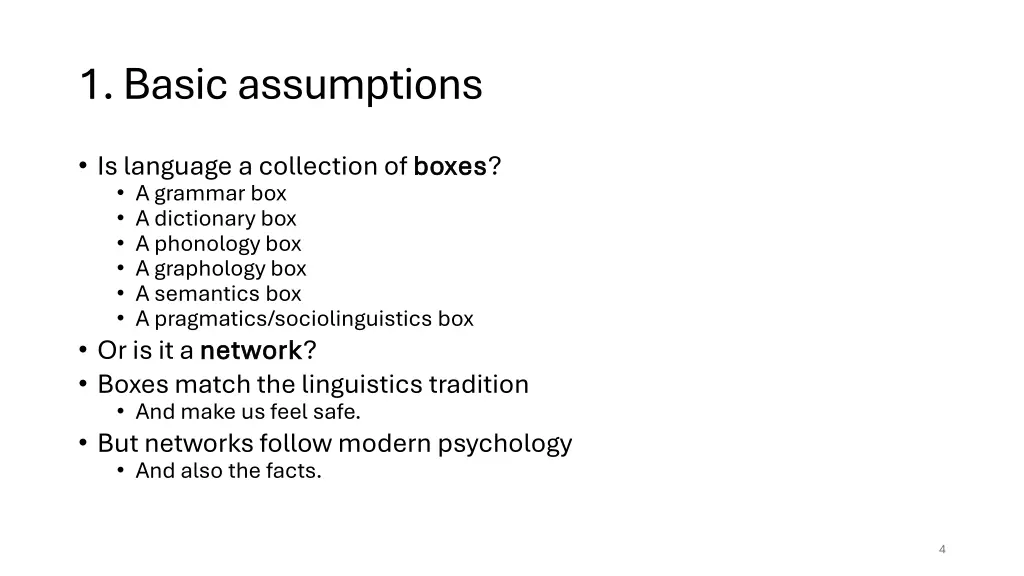
1. Basic assumptions Is language a collection of boxes A grammar box A dictionary box A phonology box A graphology box A semantics box A pragmatics/sociolinguistics box Or is it a network network? Boxes match the linguistics tradition And make us feel safe. But networks follow modern psychology And also the facts. boxes? 4
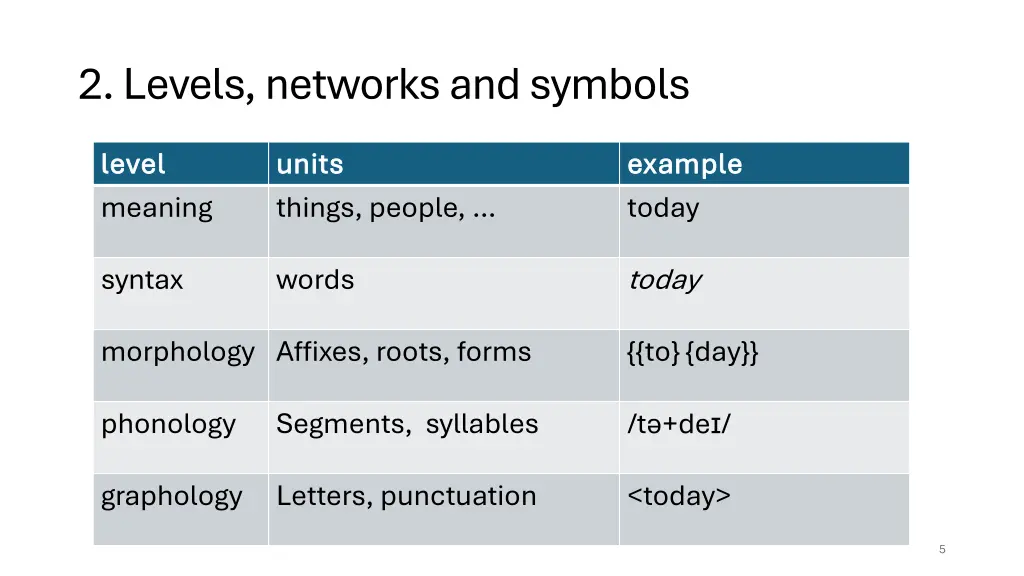
2. Levels, networks and symbols level level meaning units units things, people, example example today syntax words today morphology Affixes, roots, forms {{to} {day}} phonology Segments, syllables /t +de / graphology Letters, punctuation <today> 5
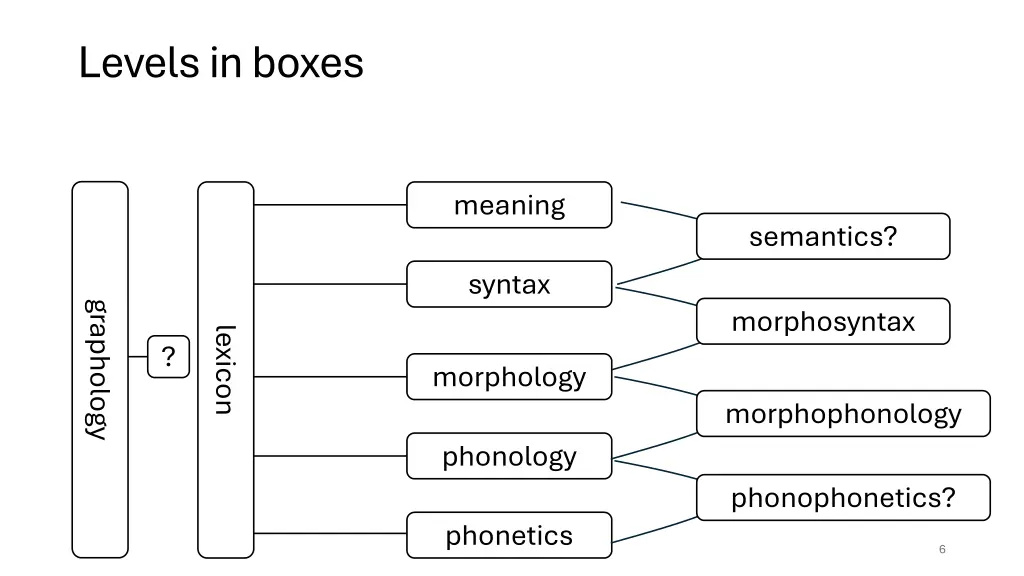
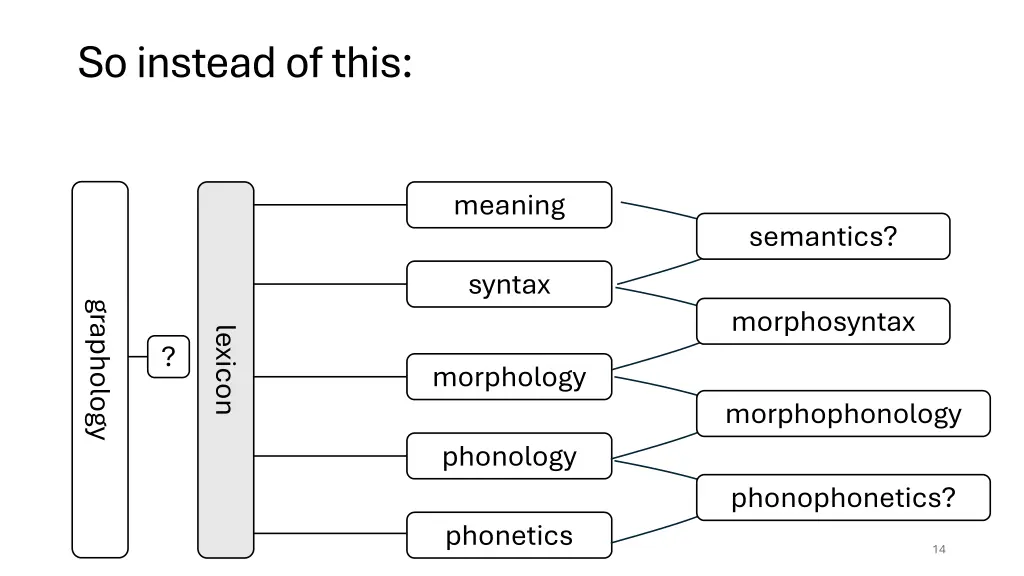
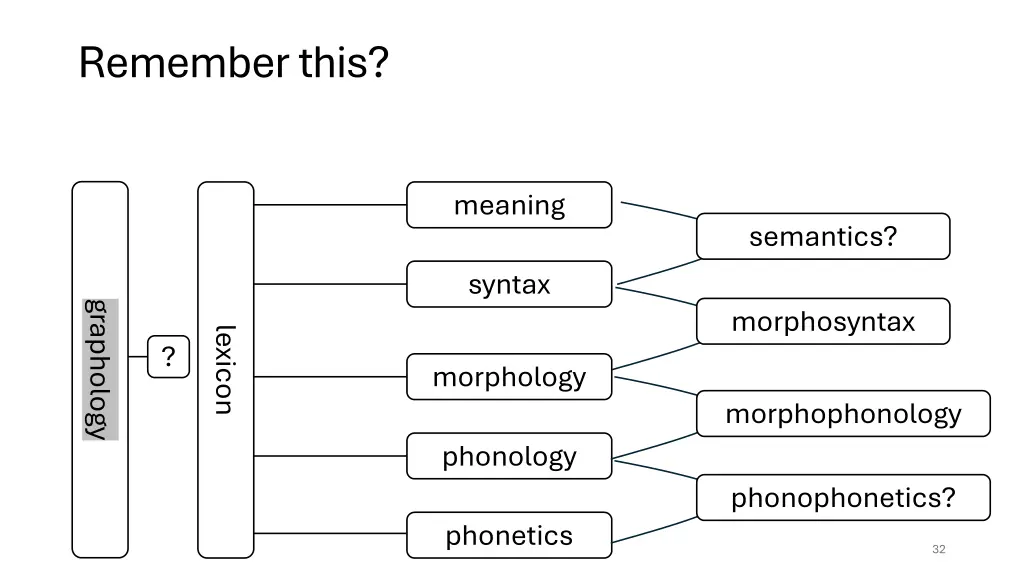
Levels in boxes meaning semantics? syntax graphology morphosyntax lexicon ? morphology morphophonology phonology phonophonetics? phonetics 6
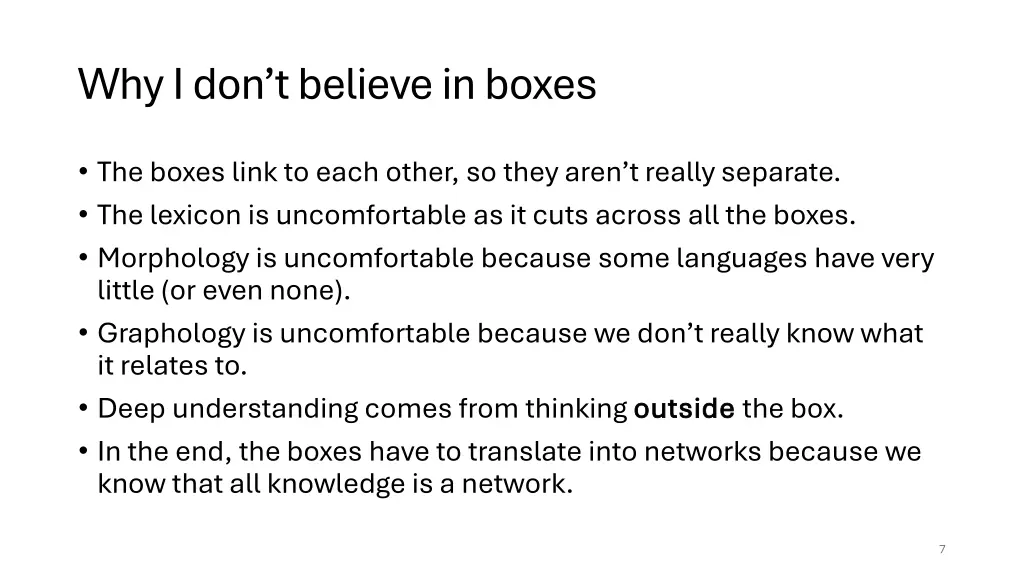
Why I dont believe in boxes The boxes link to each other, so they aren t really separate. The lexicon is uncomfortable as it cuts across all the boxes. Morphology is uncomfortable because some languages have very little (or even none). Graphology is uncomfortable because we don t really know what it relates to. Deep understanding comes from thinking outside In the end, the boxes have to translate into networks because we know that all knowledge is a network. outside the box. 7
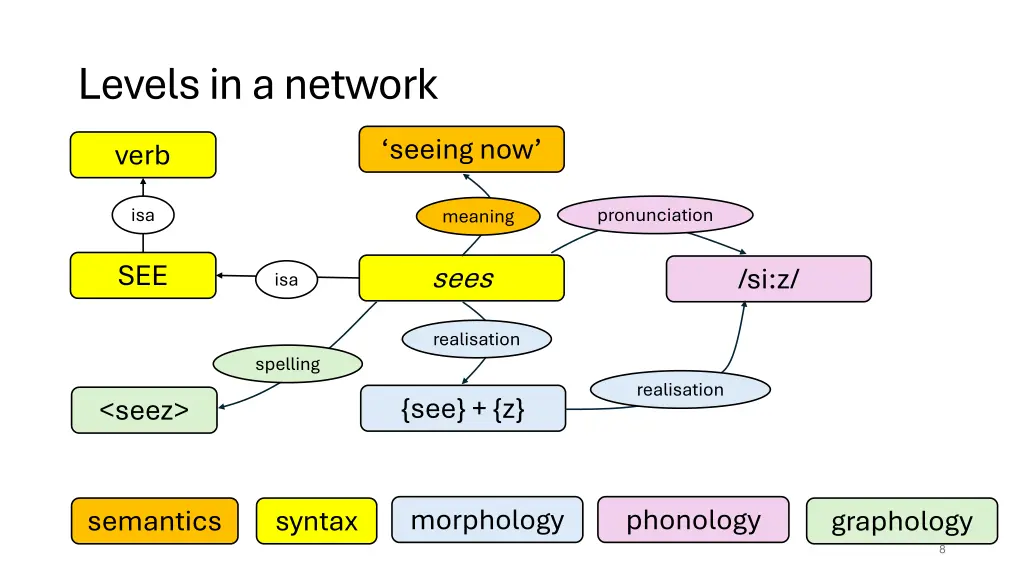
Levels in a network seeing now verb isa pronunciation meaning SEE sees /si:z/ isa realisation spelling realisation {see} + {z} <seez> morphology phonology semantics syntax graphology 8
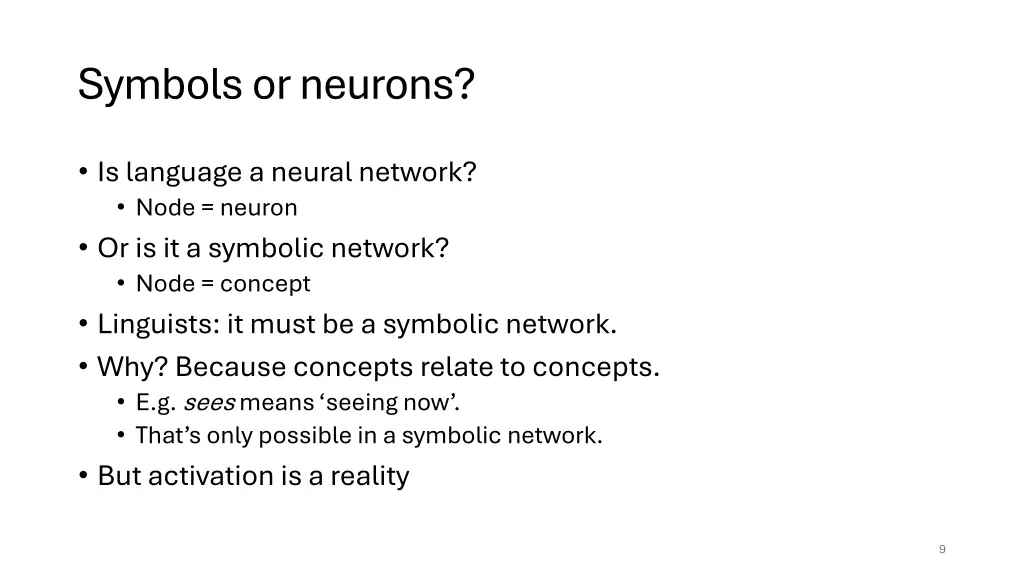
Symbols or neurons? Is language a neural network? Node = neuron Or is it a symbolic network? Node = concept Linguists: it must be a symbolic network. Why? Because concepts relate to concepts. E.g. sees means seeing now . That s only possible in a symbolic network. But activation is a reality 9
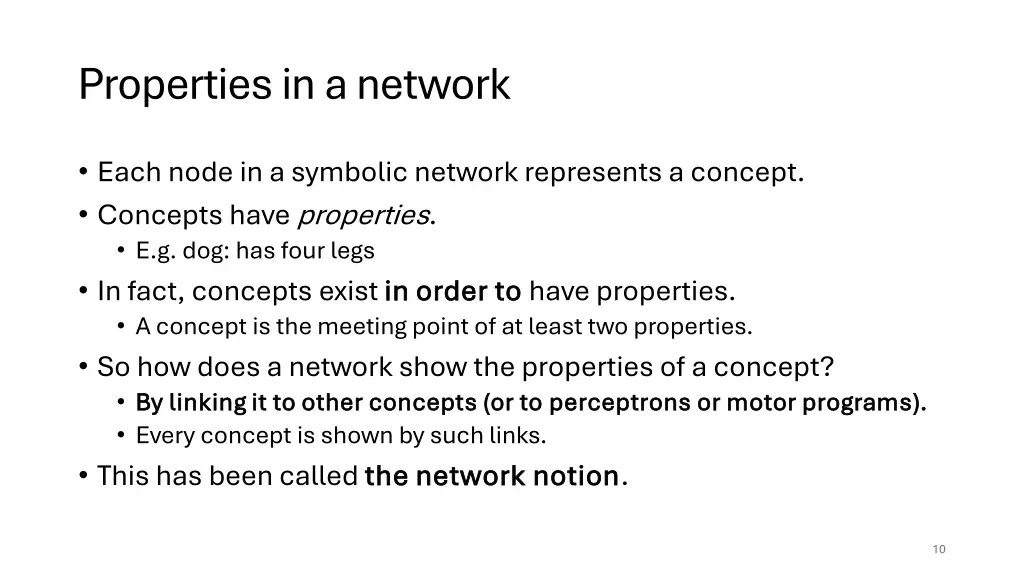
Properties in a network Each node in a symbolic network represents a concept. Concepts have properties. E.g. dog: has four legs In fact, concepts exist in order to in order to have properties. A concept is the meeting point of at least two properties. So how does a network show the properties of a concept? By linking it to other concepts (or to By linking it to other concepts (or to perceptrons Every concept is shown by such links. This has been called the network notion the network notion. perceptrons or motor programs). or motor programs). 10
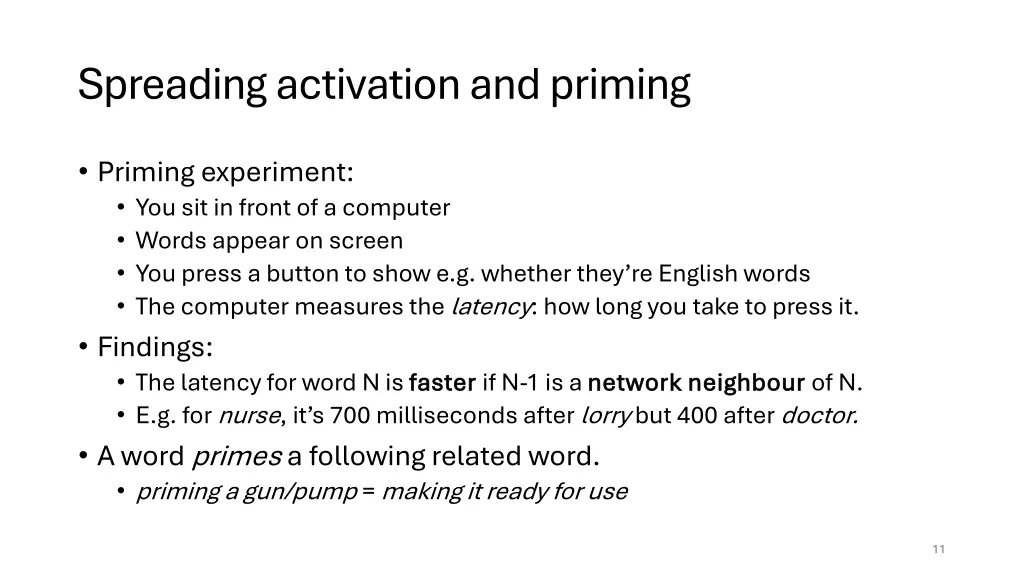
Spreading activation and priming Priming experiment: You sit in front of a computer Words appear on screen You press a button to show e.g. whether they re English words The computer measures the latency: how long you take to press it. Findings: The latency for word N is faster faster if N-1 is a network neighbour E.g. for nurse, it s 700 milliseconds after lorry but 400 after doctor. A word primes a following related word. priming a gun/pump = making it ready for use network neighbour of N. 11
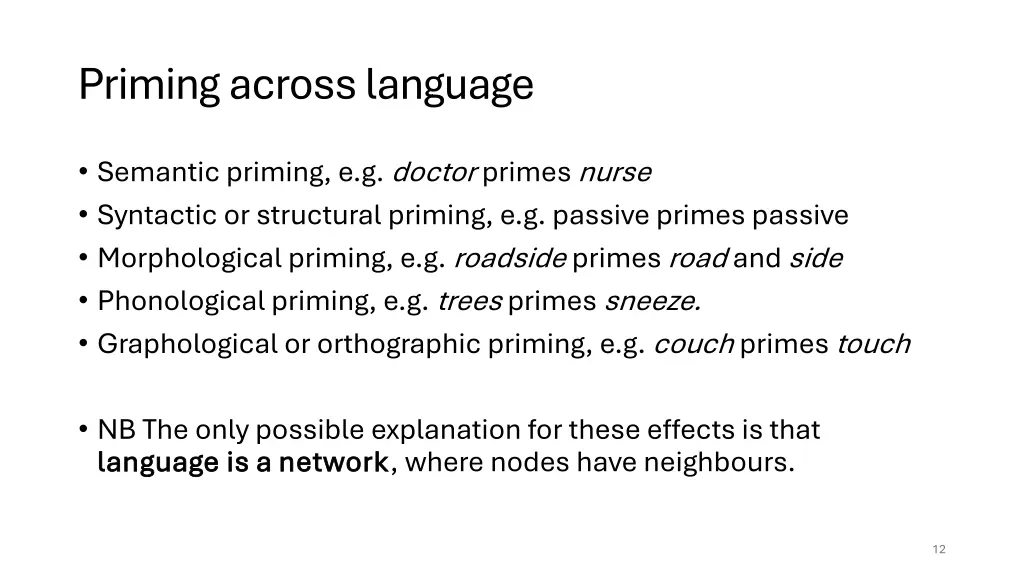
Priming across language Semantic priming, e.g. doctor primes nurse Syntactic or structural priming, e.g. passive primes passive Morphological priming, e.g. roadside primes road and side Phonological priming, e.g. trees primes sneeze. Graphological or orthographic priming, e.g. couch primes touch NB The only possible explanation for these effects is that language is a network language is a network, where nodes have neighbours. 12
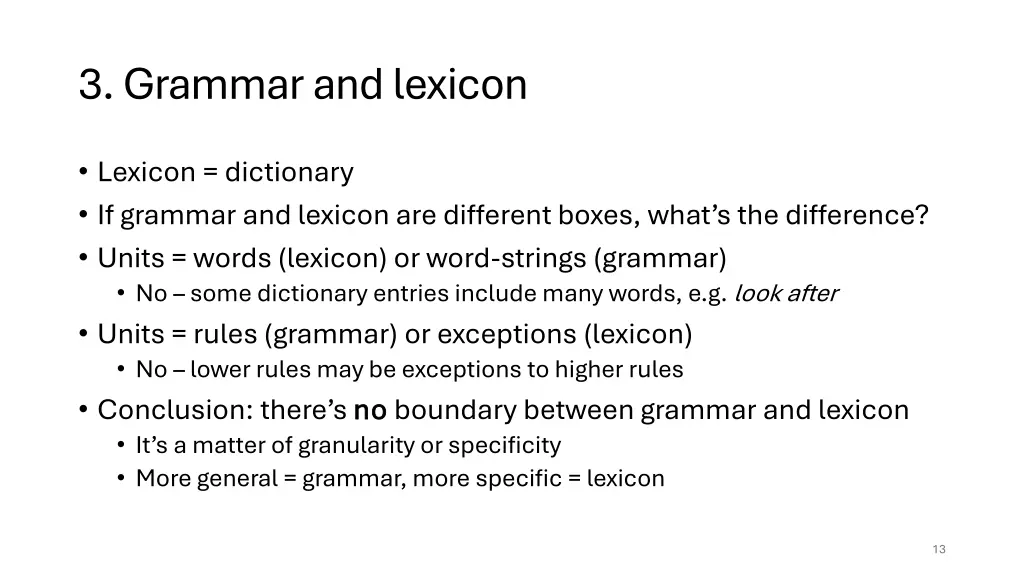
3. Grammar and lexicon Lexicon = dictionary If grammar and lexicon are different boxes, what s the difference? Units = words (lexicon) or word-strings (grammar) No some dictionary entries include many words, e.g. look after Units = rules (grammar) or exceptions (lexicon) No lower rules may be exceptions to higher rules Conclusion: there s no no boundary between grammar and lexicon It s a matter of granularity or specificity More general = grammar, more specific = lexicon 13
So instead of this: meaning semantics? syntax graphology morphosyntax lexicon ? morphology morphophonology phonology phonophonetics? phonetics 14
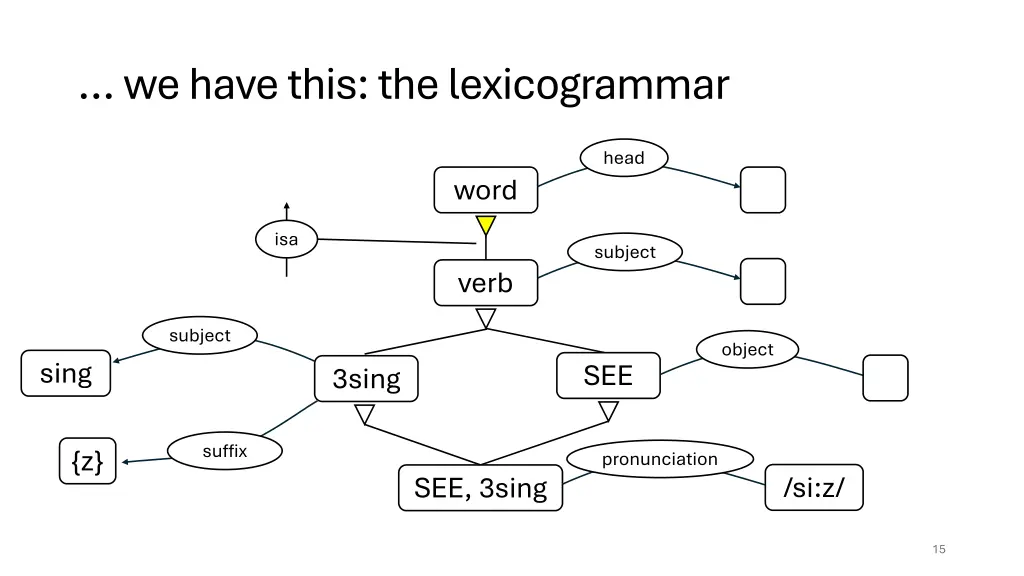
we have this: the lexicogrammar head word isa subject verb subject object sing SEE 3sing suffix {z} pronunciation /si:z/ SEE, 3sing 15
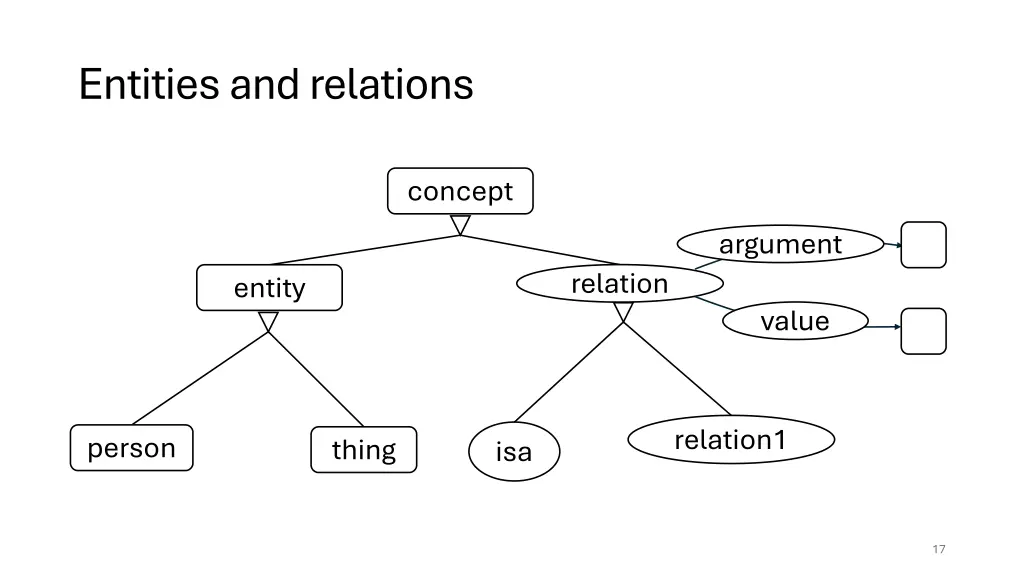
4. Relations The network isn t just a mass of associations , like a neural network. Every link in the symbolic network is classified in a taxonomy, like the taxonomy of entities . Every relation type has a unique consequence for the logic. Just like family relations : mother, brother, cousin, ancestor, 16
Entities and relations concept argument relation entity value relation1 person thing isa 17
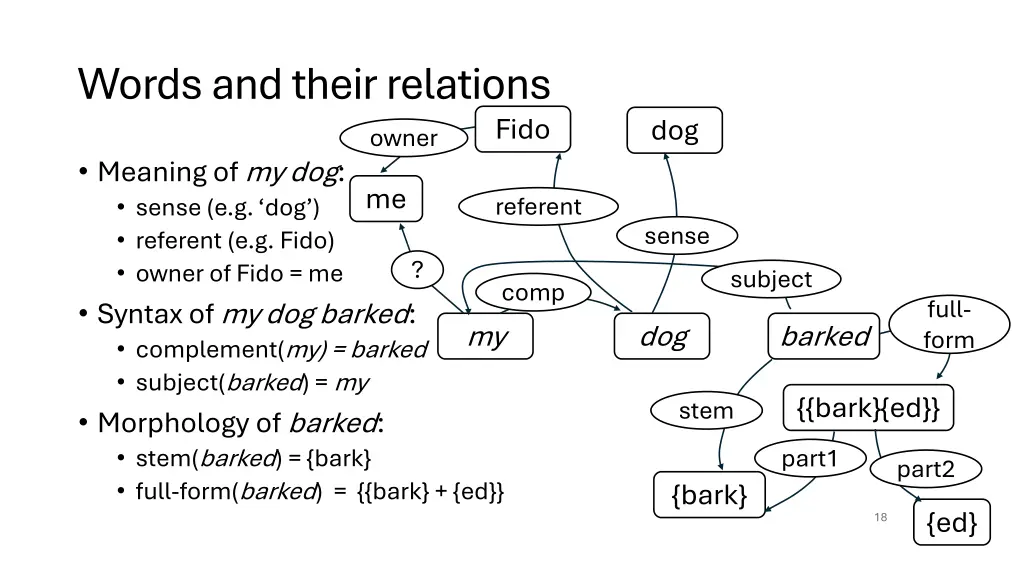
Words and their relations Fido dog owner Meaning of my dog: sense (e.g. dog ) referent (e.g. Fido) owner of Fido = me Syntax of my dog barked: complement(my) = barked subject(barked) = my Morphology of barked: stem(barked) = {bark} full-form(barked) = {{bark} + {ed}} me referent sense ? subject comp full- form barked my dog {{bark}{ed}} stem part1 part2 {bark} {ed} 18
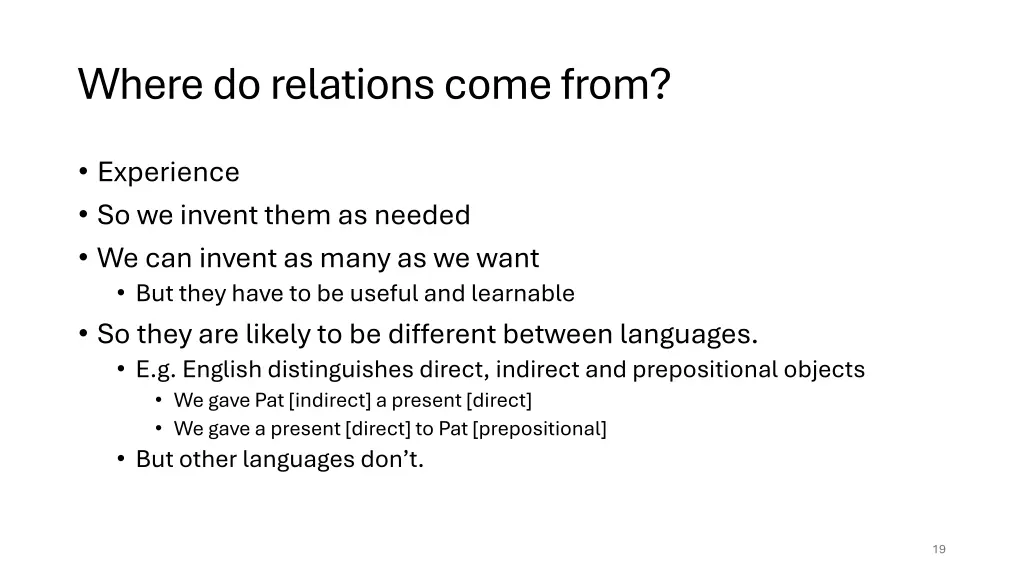
Where do relations come from? Experience So we invent them as needed We can invent as many as we want But they have to be useful and learnable So they are likely to be different between languages. E.g. English distinguishes direct, indirect and prepositional objects We gave Pat [indirect] a present [direct] We gave a present [direct] to Pat [prepositional] But other languages don t. 19
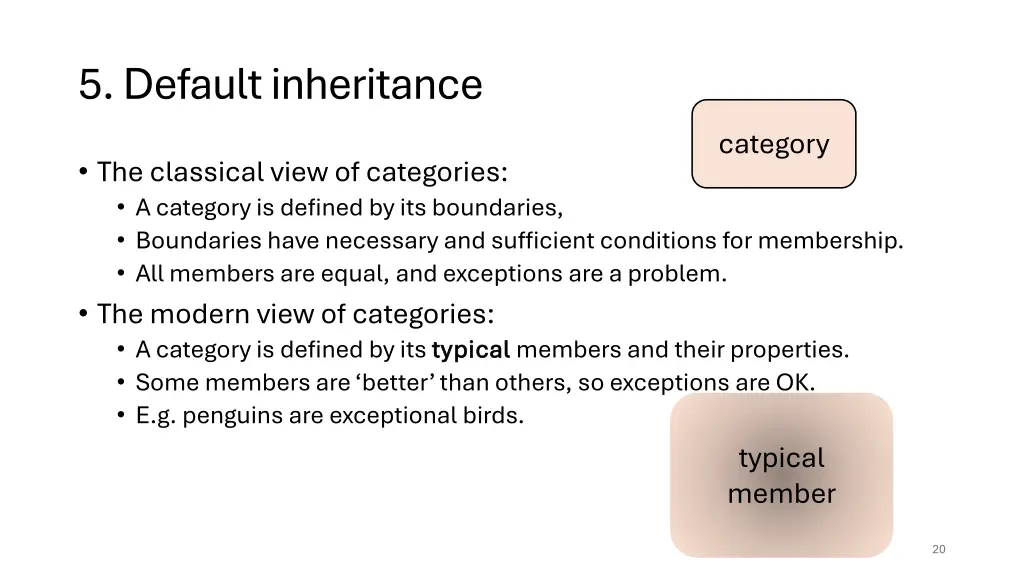
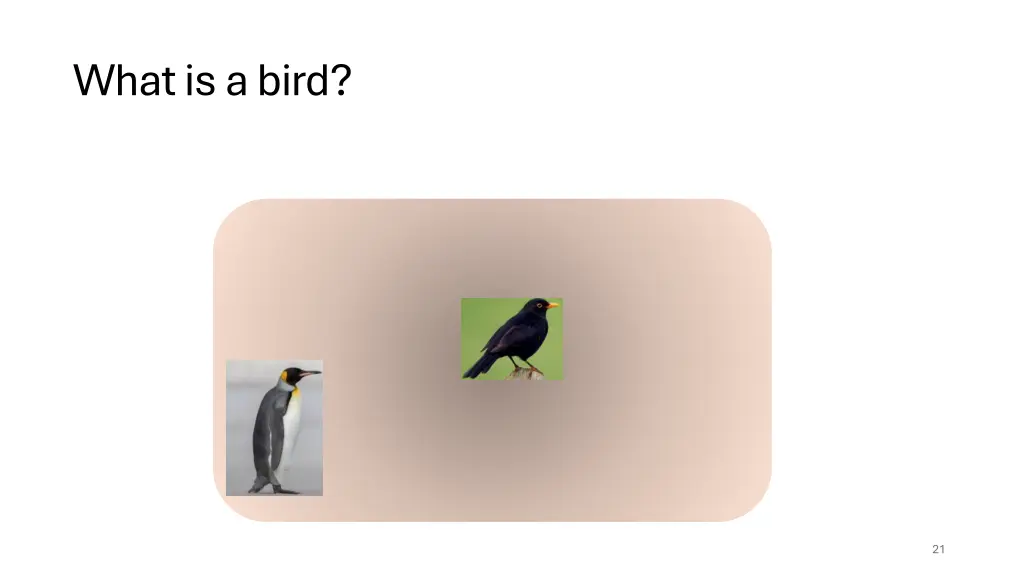
5. Default inheritance category The classical view of categories: A category is defined by its boundaries, Boundaries have necessary and sufficient conditions for membership. All members are equal, and exceptions are a problem. The modern view of categories: A category is defined by its typical typical members and their properties. Some members are better than others, so exceptions are OK. E.g. penguins are exceptional birds. typical member 20
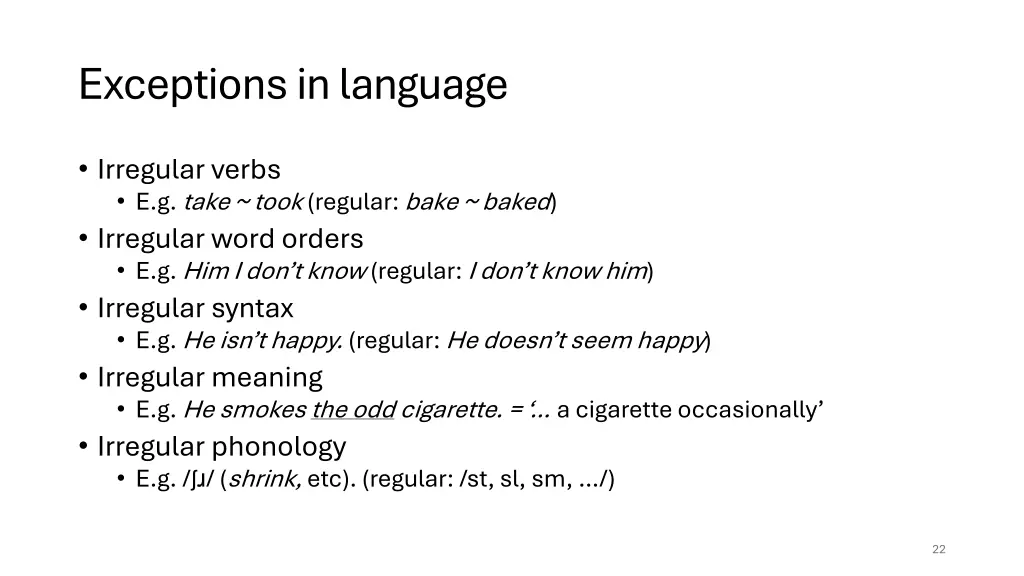
Exceptions in language Irregular verbs E.g. take ~ took (regular: bake ~ baked) Irregular word orders E.g. Him I don t know (regular: I don t know him) Irregular syntax E.g. He isn t happy. (regular: He doesn t seem happy) Irregular meaning E.g. He smokes the odd cigarette. = a cigarette occasionally Irregular phonology E.g. / / (shrink, etc). (regular: /st, sl, sm, /) 22
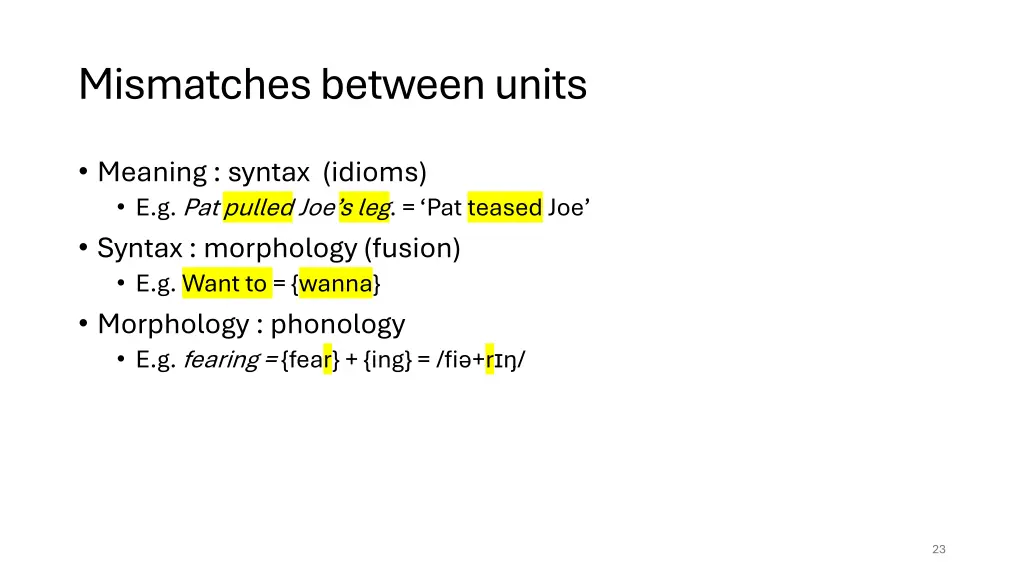
Mismatches between units Meaning : syntax (idioms) E.g. Pat pulled Joe s leg. = Pat teased Joe Syntax : morphology (fusion) E.g. Want to = {wanna} Morphology : phonology E.g. fearing = {fear} + {ing} = /fi +r / 23
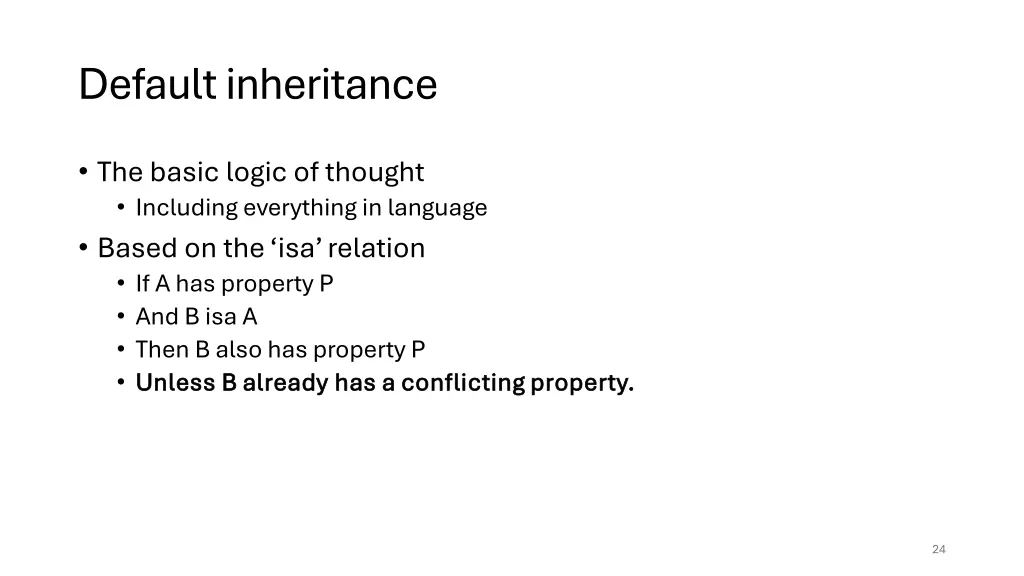
Default inheritance The basic logic of thought Including everything in language Based on the isa relation If A has property P And B isa A Then B also has property P Unless B already has a conflicting property. Unless B already has a conflicting property. 24
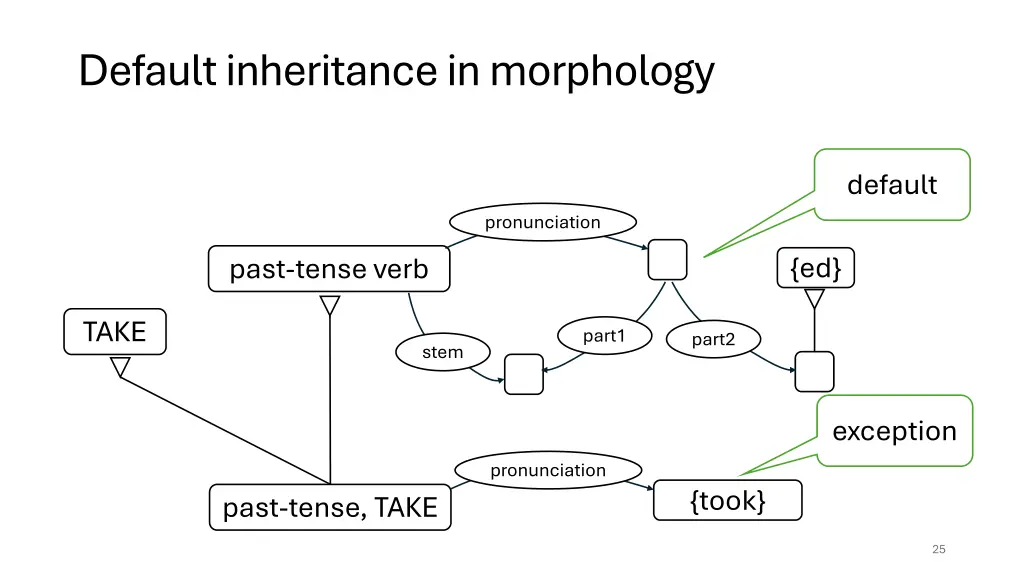
Default inheritance in morphology default pronunciation {ed} past-tense verb TAKE part1 part2 stem exception pronunciation {took} past-tense, TAKE 25
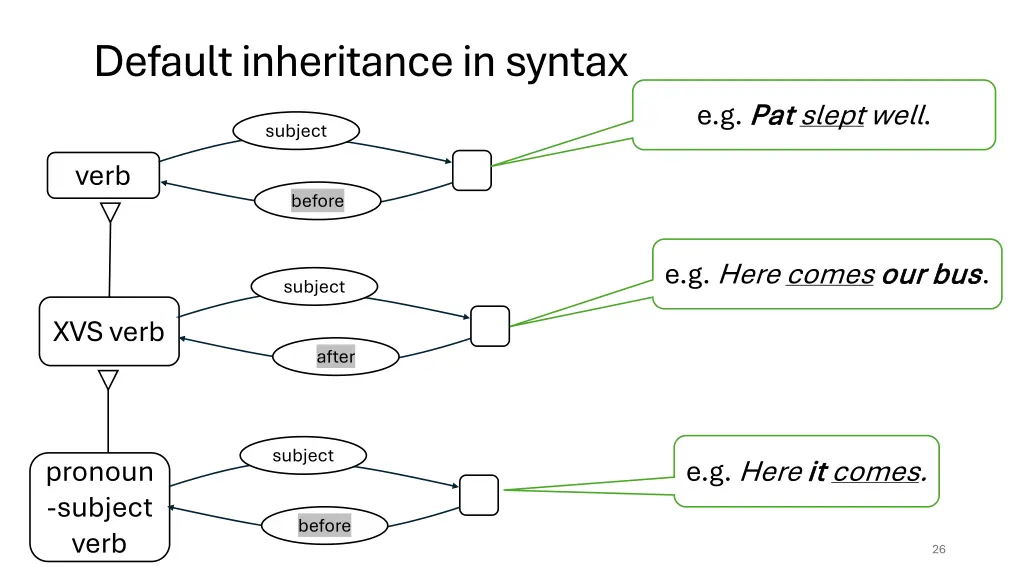
Default inheritance in syntax e.g. Pat Pat slept well. subject verb before e.g. Here comes our bus our bus. subject XVS verb after subject e.g. Here it it comes. pronoun -subject verb before 26
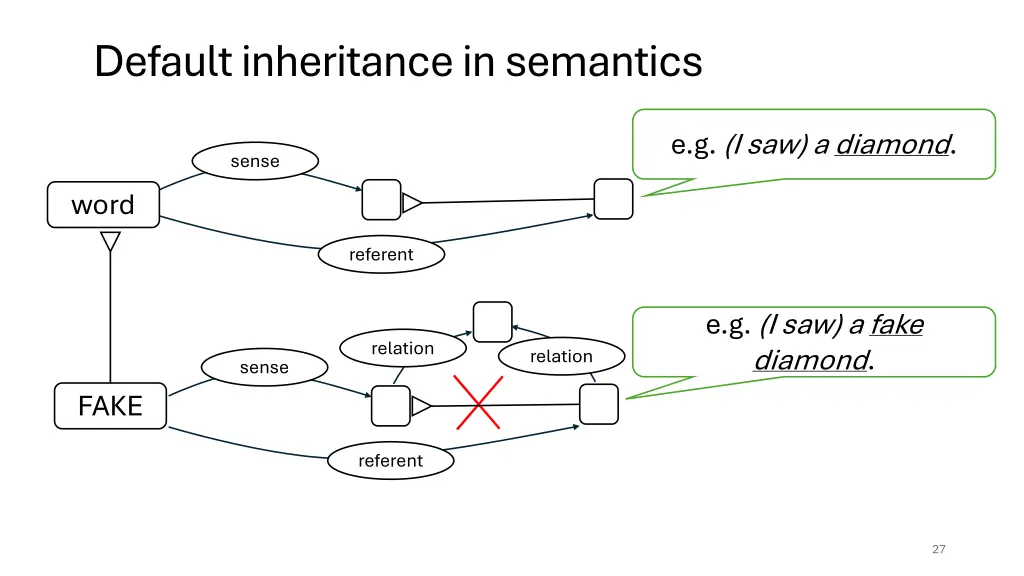
Default inheritance in semantics e.g. (I saw) a diamond. sense word referent e.g. (I saw) a fake diamond. relation relation sense FAKE referent 27
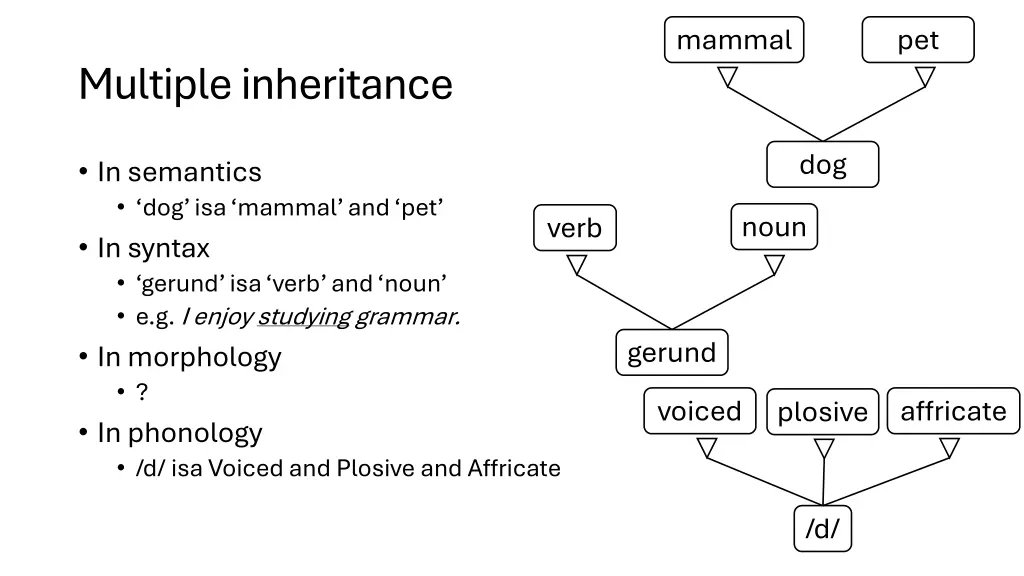
mammal pet Multiple inheritance dog In semantics dog isa mammal and pet In syntax gerund isa verb and noun e.g. I enjoy studying grammar. In morphology ? In phonology /d/ isa Voiced and Plosive and Affricate noun verb gerund voiced affricate plosive /d/
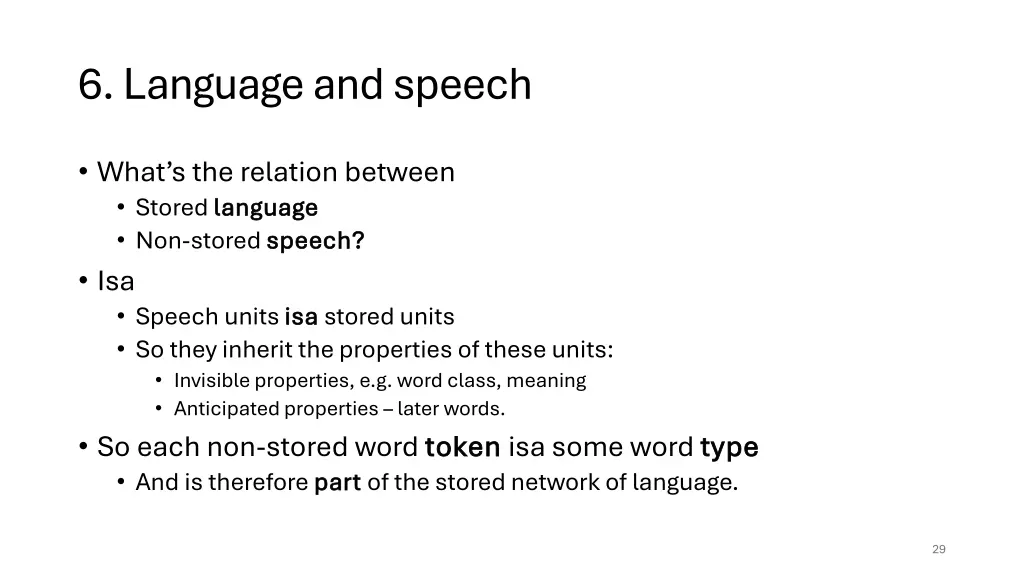
6. Language and speech What s the relation between Stored language language Non-stored speech? speech? Isa Speech units isa So they inherit the properties of these units: Invisible properties, e.g. word class, meaning Anticipated properties later words. So each non-stored word token And is therefore part part of the stored network of language. isa stored units token isa some word type type 29
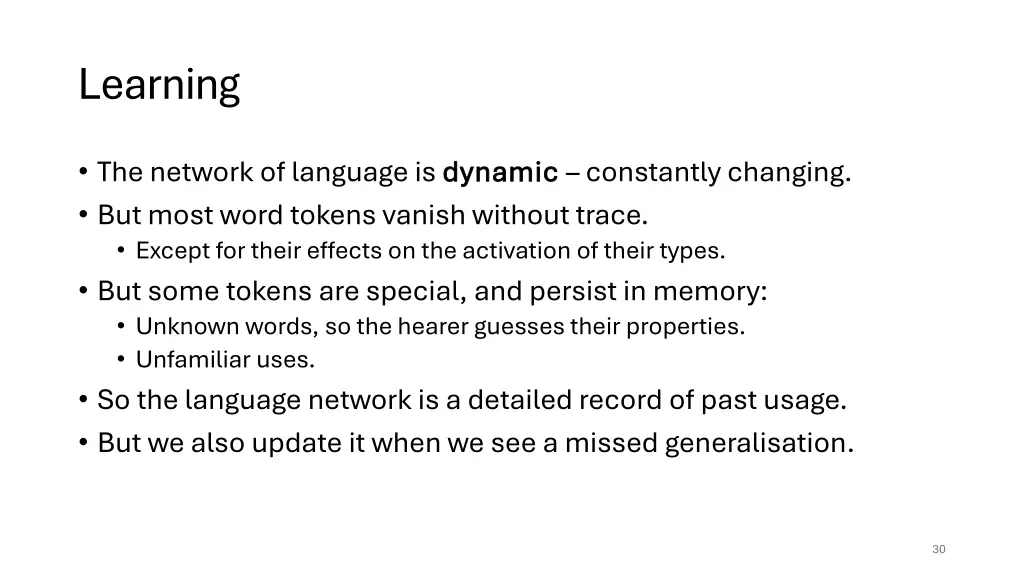
Learning The network of language is dynamic But most word tokens vanish without trace. Except for their effects on the activation of their types. But some tokens are special, and persist in memory: Unknown words, so the hearer guesses their properties. Unfamiliar uses. So the language network is a detailed record of past usage. But we also update it when we see a missed generalisation. dynamic constantly changing. 30
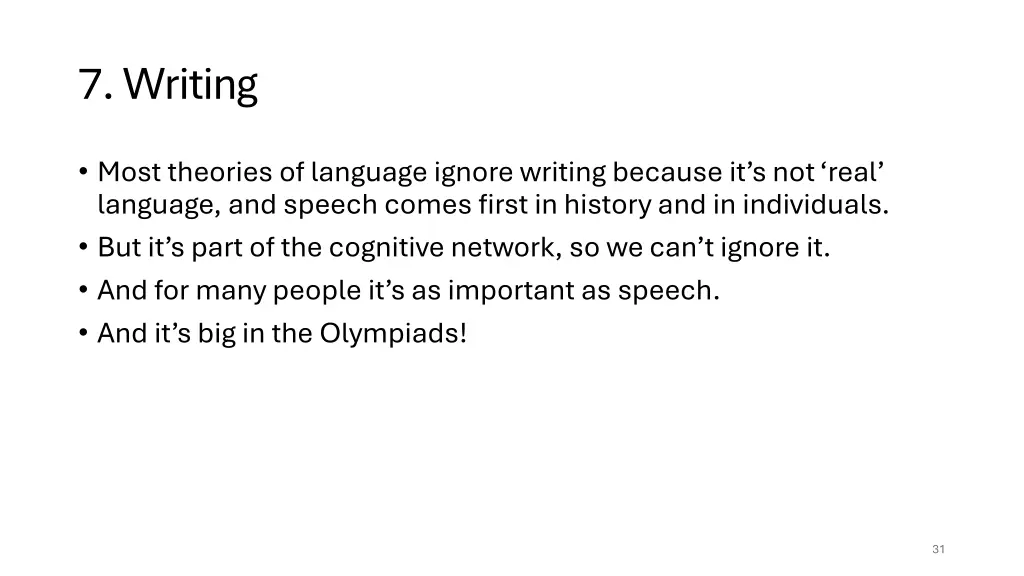
7. Writing Most theories of language ignore writing because it s not real language, and speech comes first in history and in individuals. But it s part of the cognitive network, so we can t ignore it. And for many people it s as important as speech. And it s big in the Olympiads! 31
Remember this? meaning semantics? syntax graphology morphosyntax lexicon ? morphology morphophonology phonology phonophonetics? phonetics 32
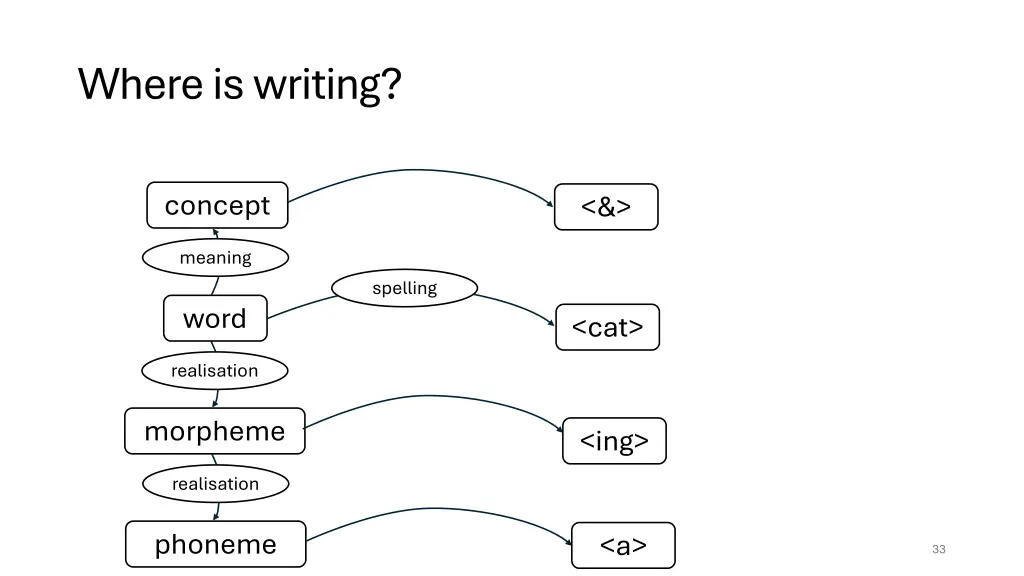
Where is writing? concept <&> meaning spelling word <cat> realisation morpheme <ing> realisation phoneme <a> 33
8. Meaning Meaning structures are just ordinary conceptual structures that we use for ordinary thinking. So in principle any part of conceptual structure is accessible to semantics including parts dealing with feelings and social structures. But semantic structures are only part part of conceptual structure thinking for speaking oriented towards communication. Different languages definitely encourage different communication E.g. English GO versus German GEHEN But thought is influenced by many other things. 34
9. Social constraints Language is the supreme used by member to member using a code built by the ancestors using the code that distinguishes this community from the enemy . So the language reflects the culture of the past language is conservative, e.g. ghost or of the sub-culture, e.g. offside. So you can expect language to be sensitive to social status, age, sex, race, religion, . supreme example of social behaviour social behaviour: 35
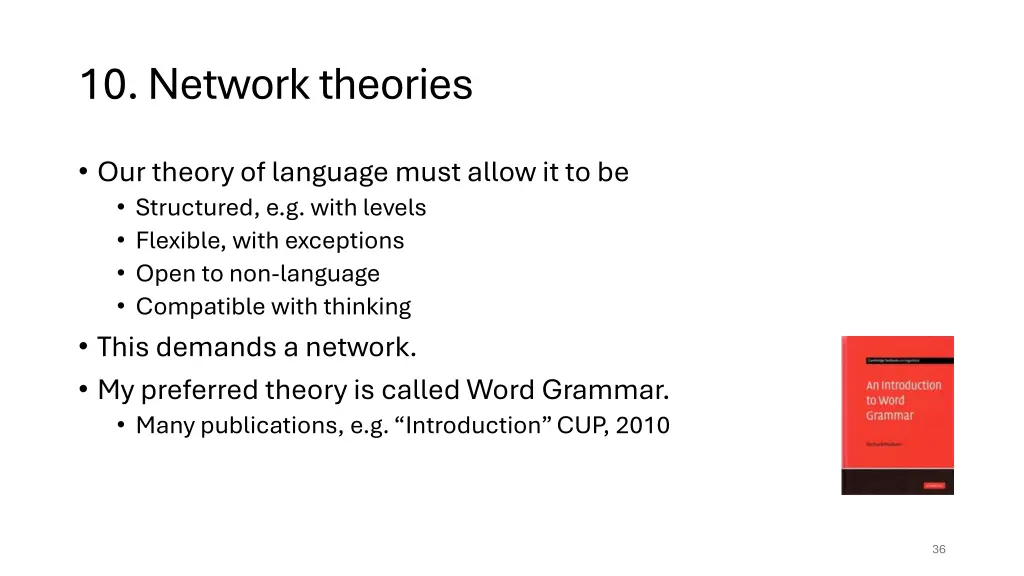
10. Network theories Our theory of language must allow it to be Structured, e.g. with levels Flexible, with exceptions Open to non-language Compatible with thinking This demands a network. My preferred theory is called Word Grammar. Many publications, e.g. Introduction CUP, 2010 36
Thanks for listening This slide show can be downloaded from https://dickhudson.com/talks/ 37