Explore the equivalent circuit and characteristics of the common-emitter configuration in BJT transistor models. Learn about input and output sides, diode representations, controlled sources, impedance considerations, and more for effective circuit analysis and design.
Please find below an Image/Link to download the presentation.
The content on the website is provided AS IS for your information and personal use only. It may not be sold, licensed, or shared on other websites without obtaining consent from the author. If you encounter any issues during the download, it is possible that the publisher has removed the file from their server.
You are allowed to download the files provided on this website for personal or commercial use, subject to the condition that they are used lawfully. All files are the property of their respective owners.
The content on the website is provided AS IS for your information and personal use only. It may not be sold, licensed, or shared on other websites without obtaining consent from the author.
E N D
Presentation Transcript
DIYALA UNIVERSITY COLLEGE OF ENGINEERING DEPARTMENT OF COMMUNICATIONS ENGINEERING Electronic Circuits I Second Year- Lecture 7 Asst. lecturer Wisam Hayder 2020 _ 2021 1
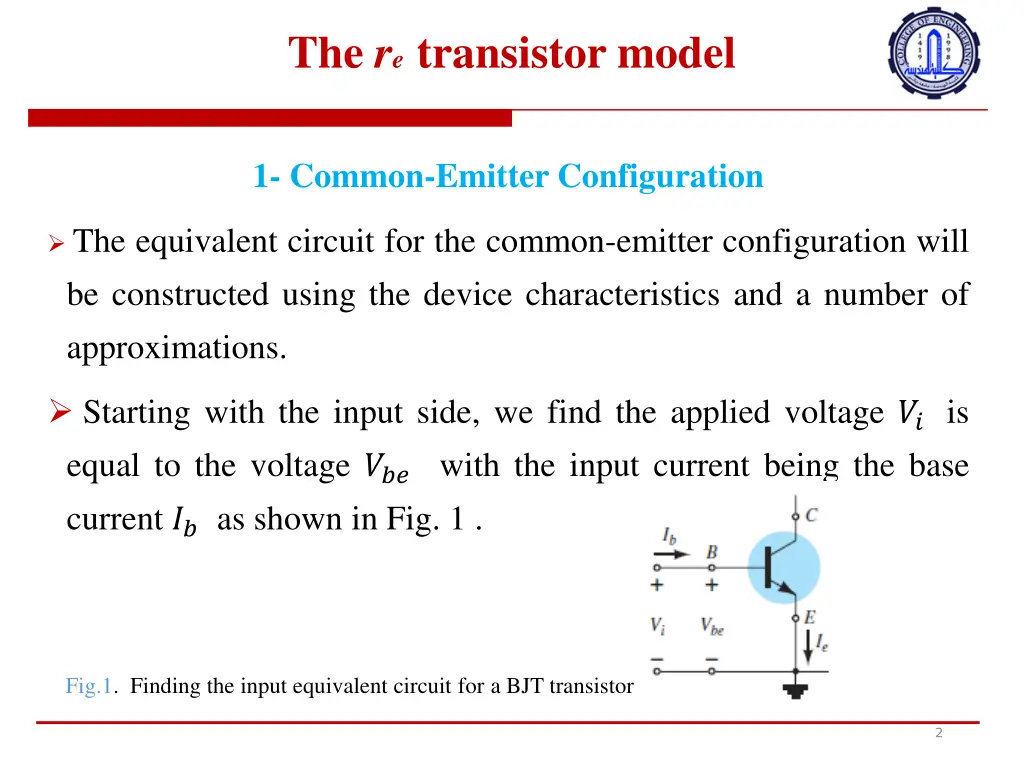
The re transistor model 1- Common-Emitter Configuration The equivalent circuit for the common-emitter configuration will be constructed using the device characteristics and a number of approximations. Starting with the input side, we find the applied voltage ?? is equal to the voltage ??? with the input current being the base current ??as shown in Fig. 1 . Fig.1. Finding the input equivalent circuit for a BJT transistor 2
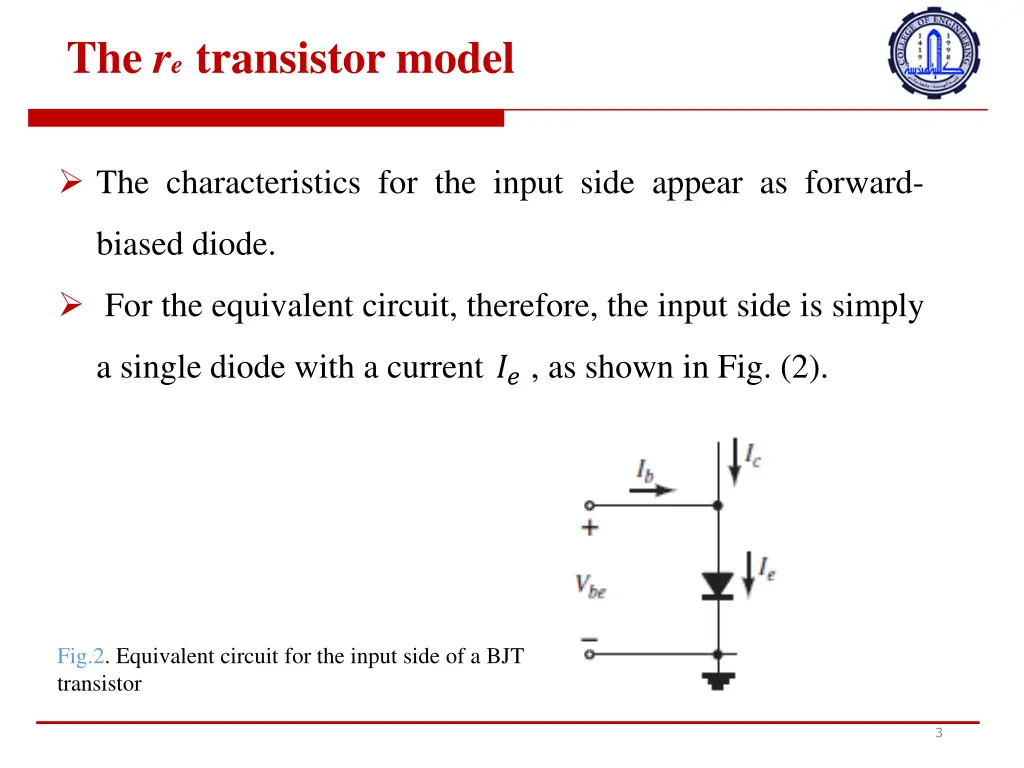
The re transistor model The characteristics for the input side appear as forward- biased diode. For the equivalent circuit, therefore, the input side is simply a single diode with a current ??, as shown in Fig. (2). Fig.2. Equivalent circuit for the input side of a BJT transistor 3
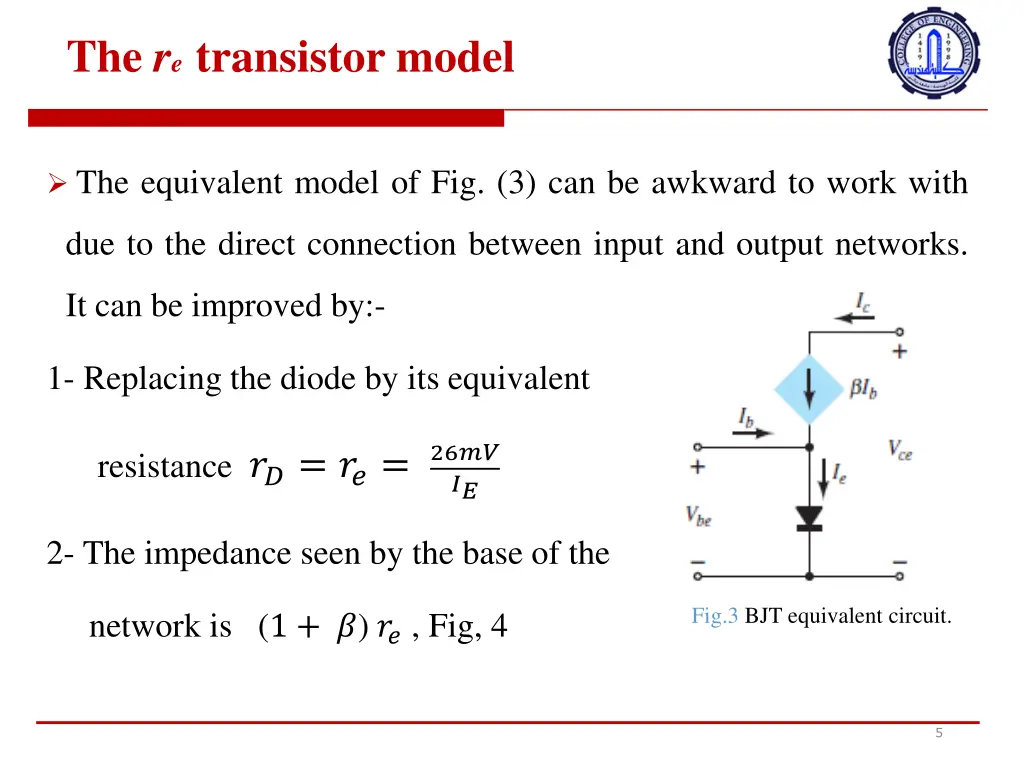
The re transistor model However, we must now add a component to the network that will establish the current ??of Fig. (2) using the output characteristics. If we assume is constant then the entire characteristics at the output section can be replaced by a controlled source whose magnitude is ( ??) and the equivalent network for the common- emitter configuration becomes as shown in figure (3). 4
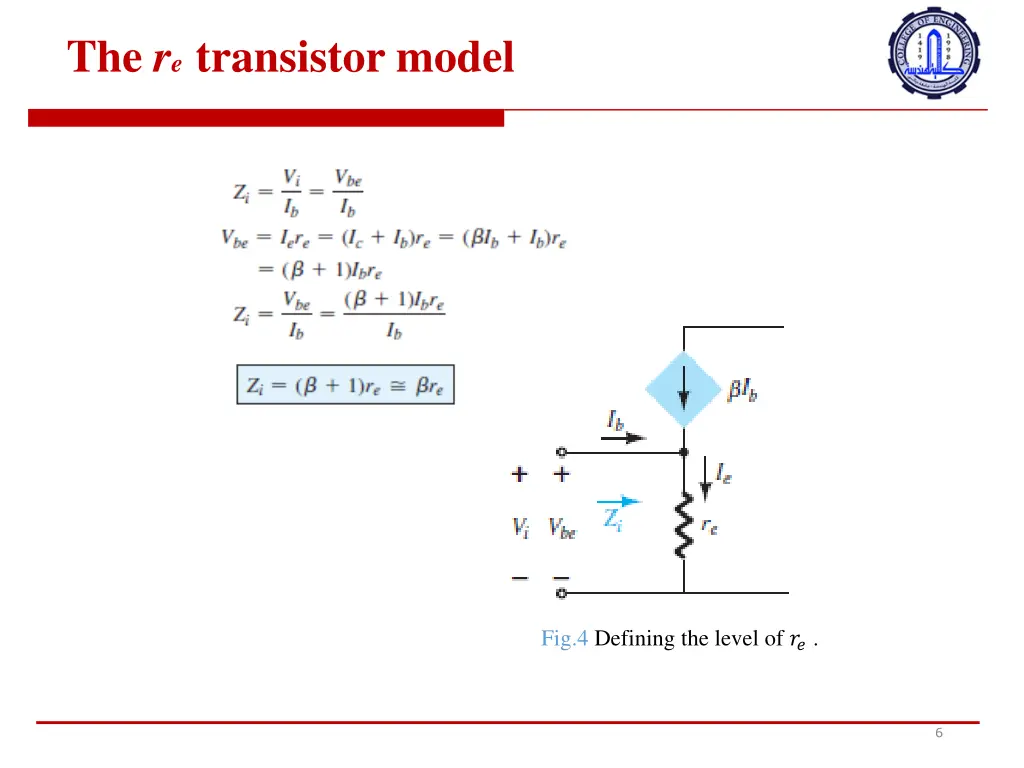
The re transistor model The equivalent model of Fig. (3) can be awkward to work with due to the direct connection between input and output networks. It can be improved by:- 1- Replacing the diode by its equivalent 26?? ?? resistance ??= ??= 2- The impedance seen by the base of the Fig.3 BJT equivalent circuit. network is (1 + ?) ??, Fig, 4 5
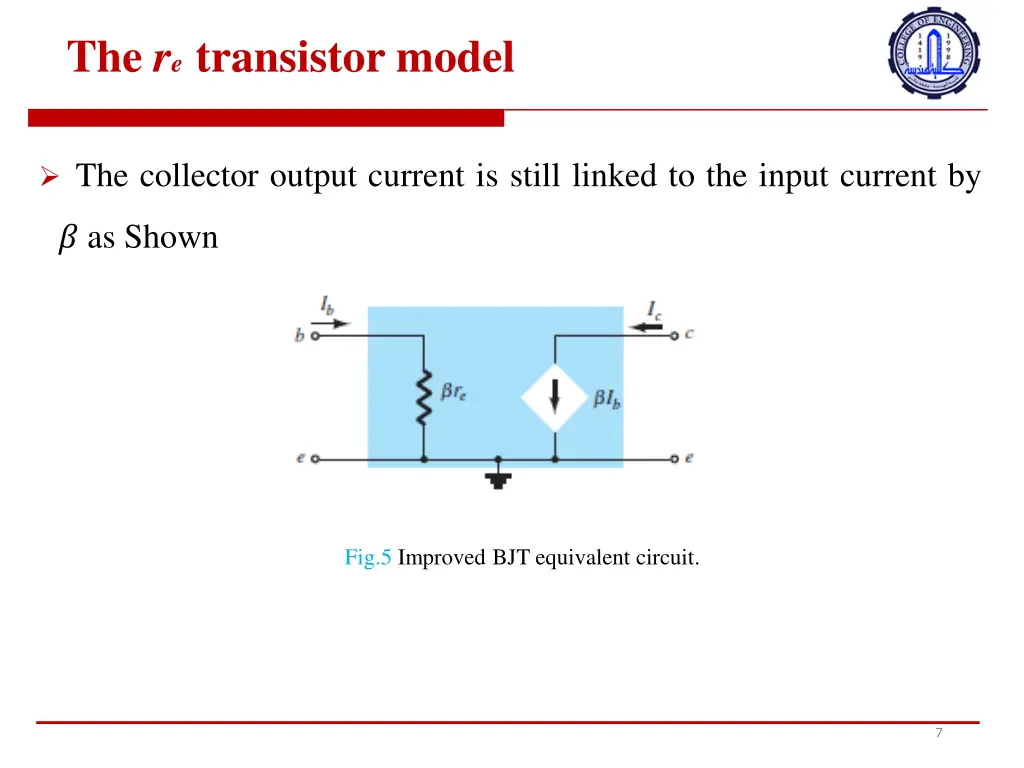
The re transistor model The collector output current is still linked to the input current by ? as Shown Fig.5 Improved BJT equivalent circuit. 7
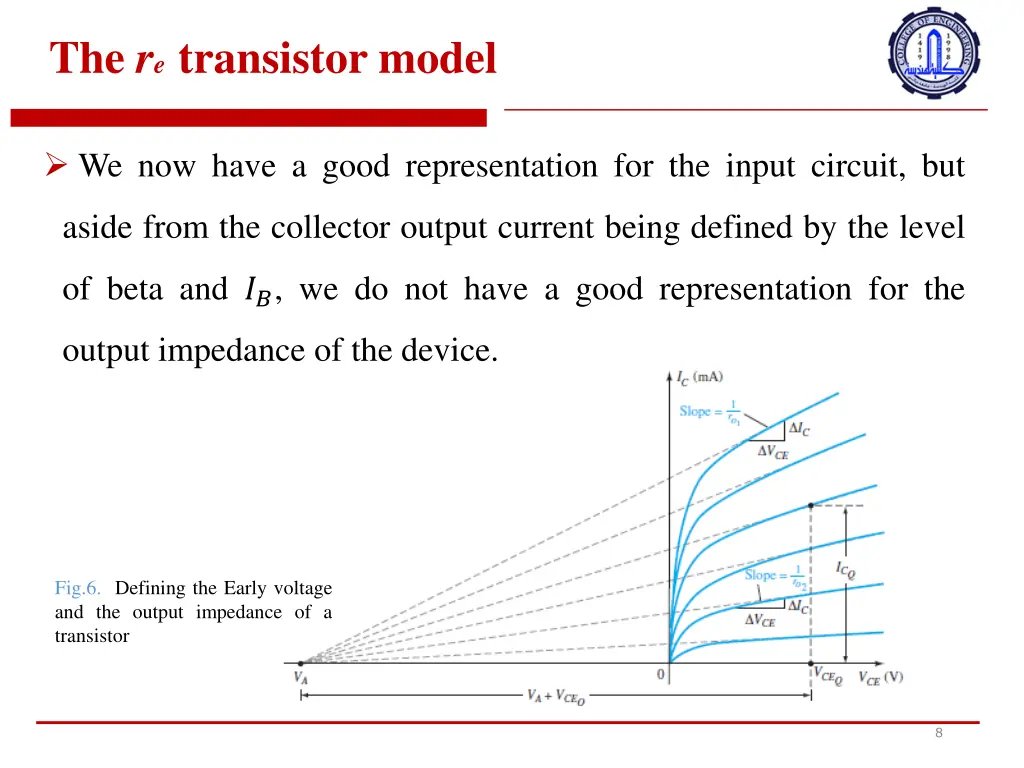
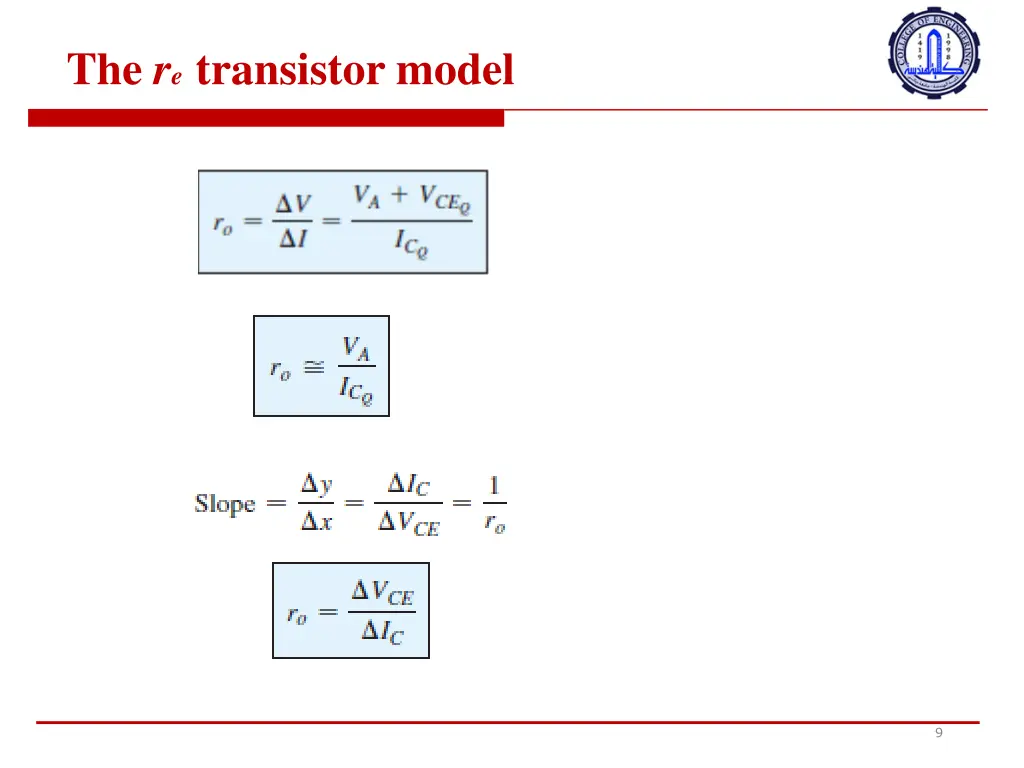
The re transistor model We now have a good representation for the input circuit, but aside from the collector output current being defined by the level of beta and ??, we do not have a good representation for the output impedance of the device. Fig.6. Defining the Early voltage and the output impedance of a transistor 8
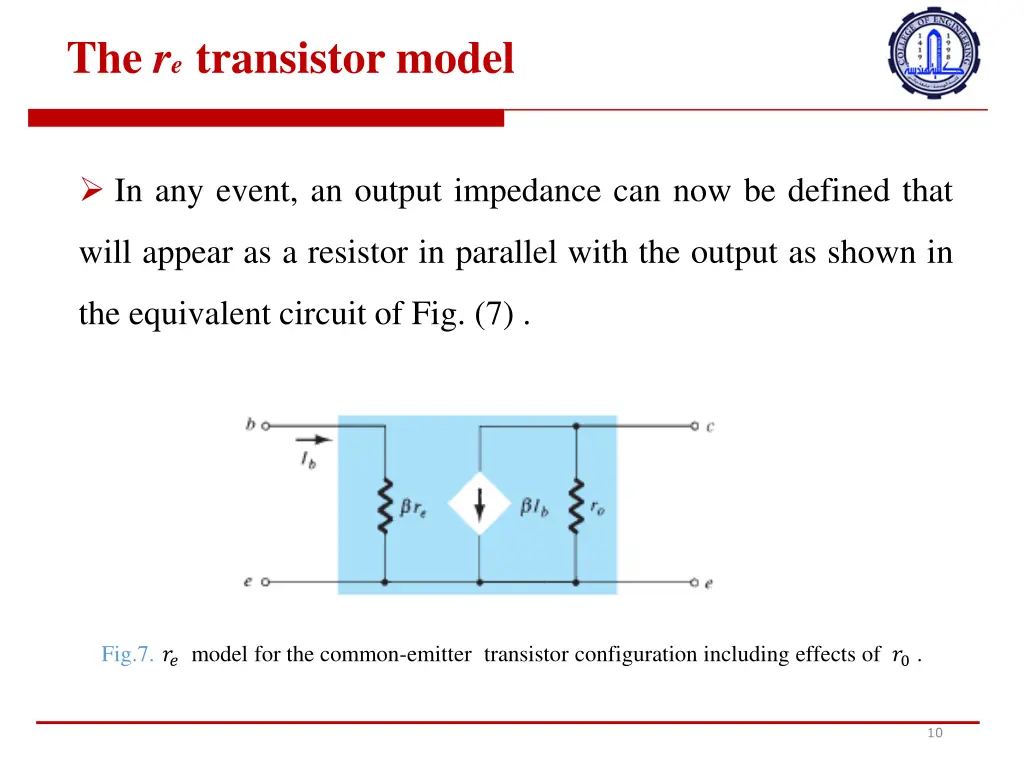
The re transistor model In any event, an output impedance can now be defined that will appear as a resistor in parallel with the output as shown in the equivalent circuit of Fig. (7) . Fig.7. ??model for the common-emitter transistor configuration including effects of ?0. 10
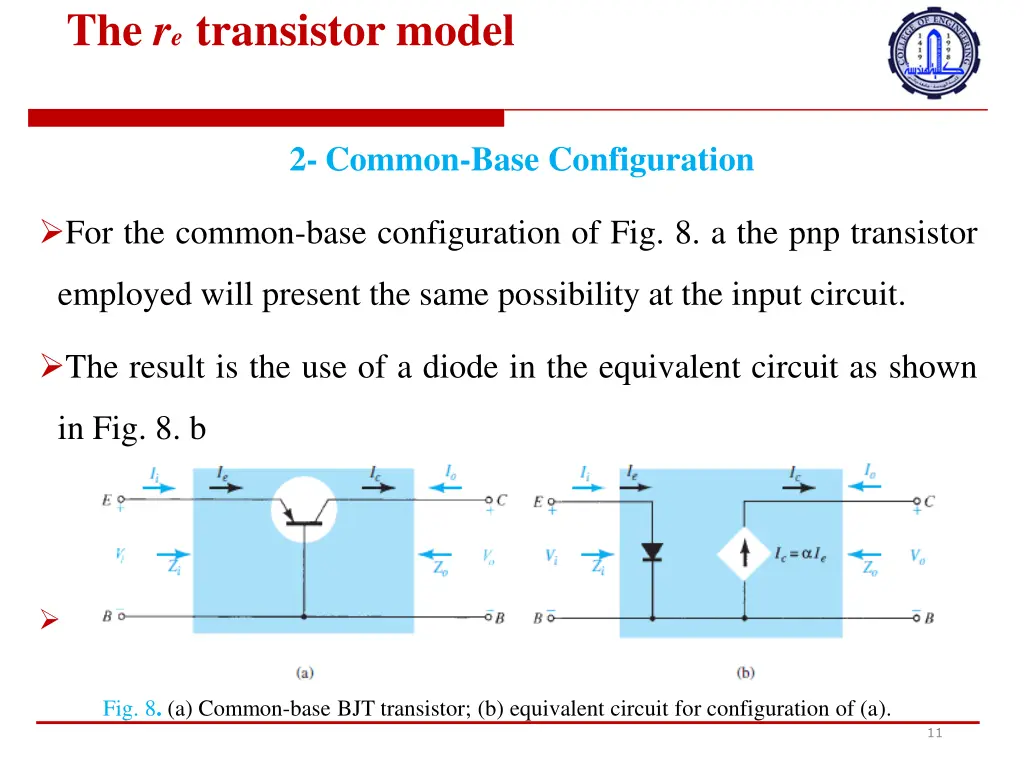
The re transistor model 2- Common-Base Configuration For the common-base configuration of Fig. 8. a the pnp transistor employed will present the same possibility at the input circuit. The result is the use of a diode in the equivalent circuit as shown in Fig. 8. b Fig. 8. (a) Common-base BJT transistor; (b) equivalent circuit for configuration of (a). 11
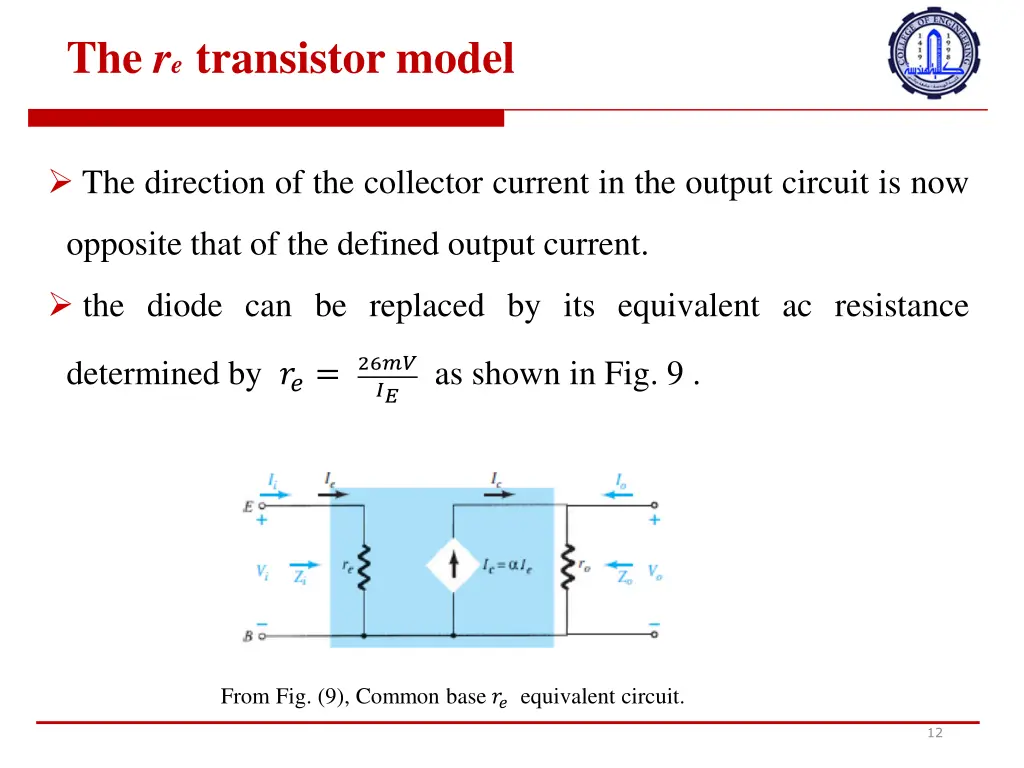
The re transistor model The direction of the collector current in the output circuit is now opposite that of the defined output current. the diode can be replaced by its equivalent ac resistance determined by ??= as shown in Fig. 9 . 26?? ?? From Fig. (9), Common base ??equivalent circuit. 12
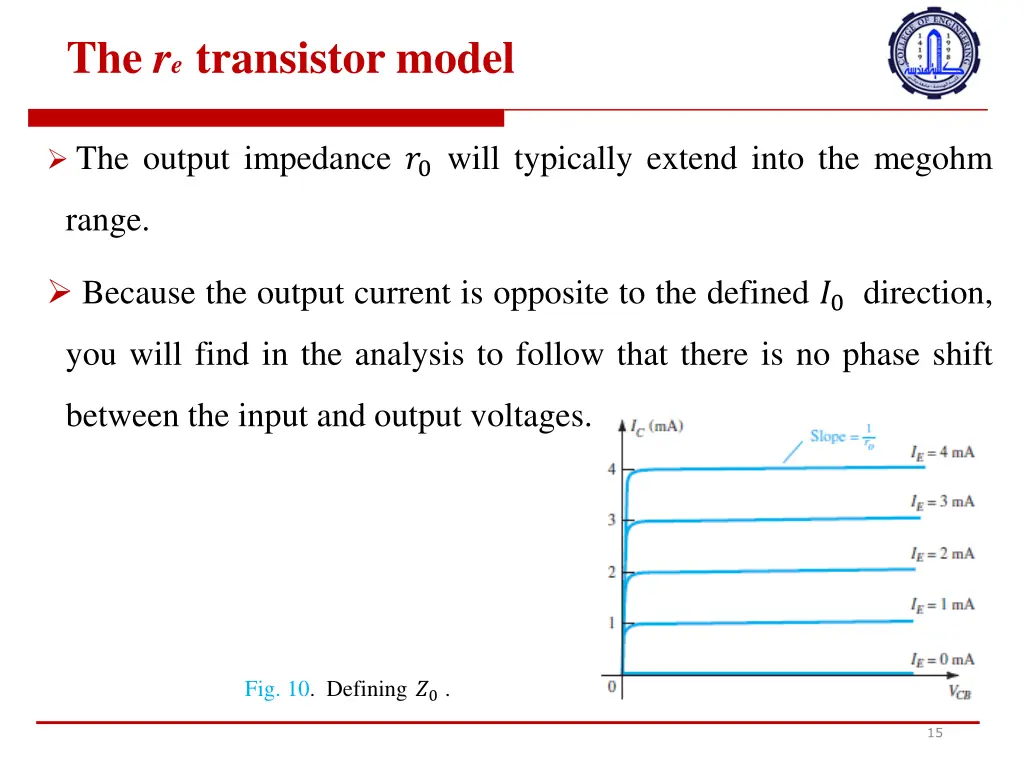
The re transistor model Take note of the fact that the emitter current continues to determine the equivalent resistance. An additional output resistance can be determined from the characteristics of Fig. 10 in much the same manner as applied to the common-emitter configuration. The almost horizontal lines clearly reveal that the output resistance ?0as appearing in Fig. 9 will be quite high and certainly much higher than that for the typical common-emitter configuration. 13
The re transistor model The network of Fig. 9 is therefore an excellent equivalent circuit for the analysis of most common-base configurations. It is similar in many ways to that of the common-emitter configuration. In general, common-base configurations have very low input impedance because it is essentially simply ??. Typical values extend from a few ohms to perhaps 50 14
The re transistor model The output impedance ?0will typically extend into the megohm range. Because the output current is opposite to the defined ?0direction, you will find in the analysis to follow that there is no phase shift between the input and output voltages. Fig. 10. Defining ?0. 15
The re transistor model 3- Common-Collector Configuration For the common-collector configuration, the model defined for the common-emitter configuration of Fig. 7. is normally applied rather than defining a model for the common-collector configuration. In subsequent lectures, a number of common-collector configurations will be investigated, and the effect of using the same model will become quite apparent. 16
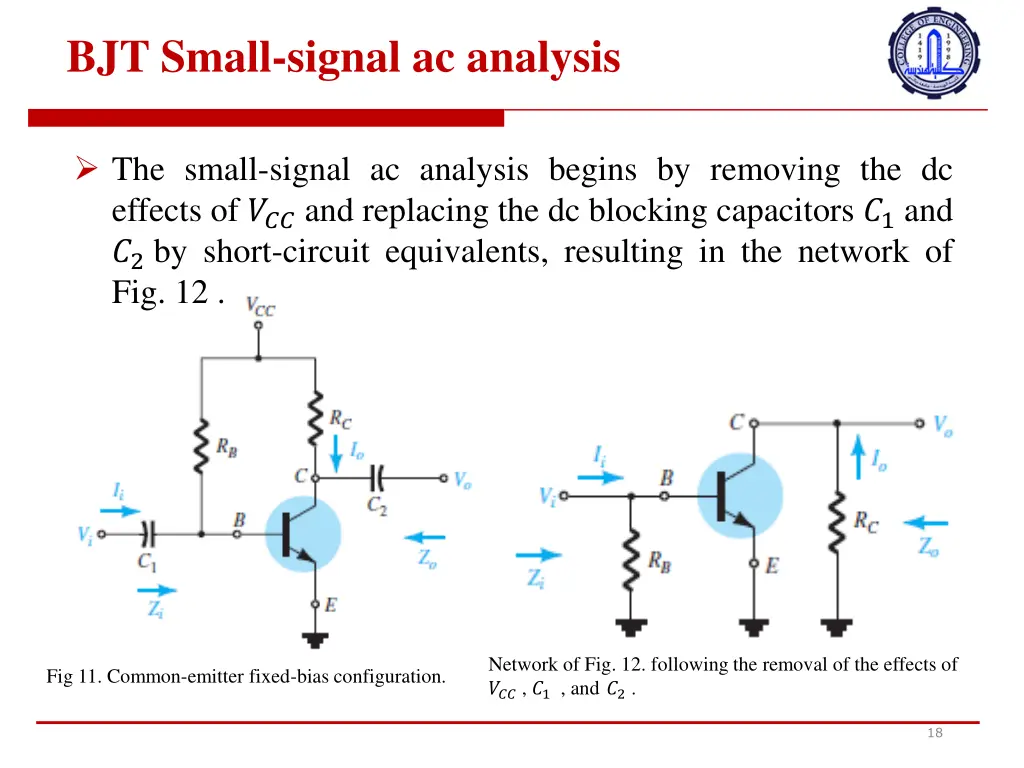
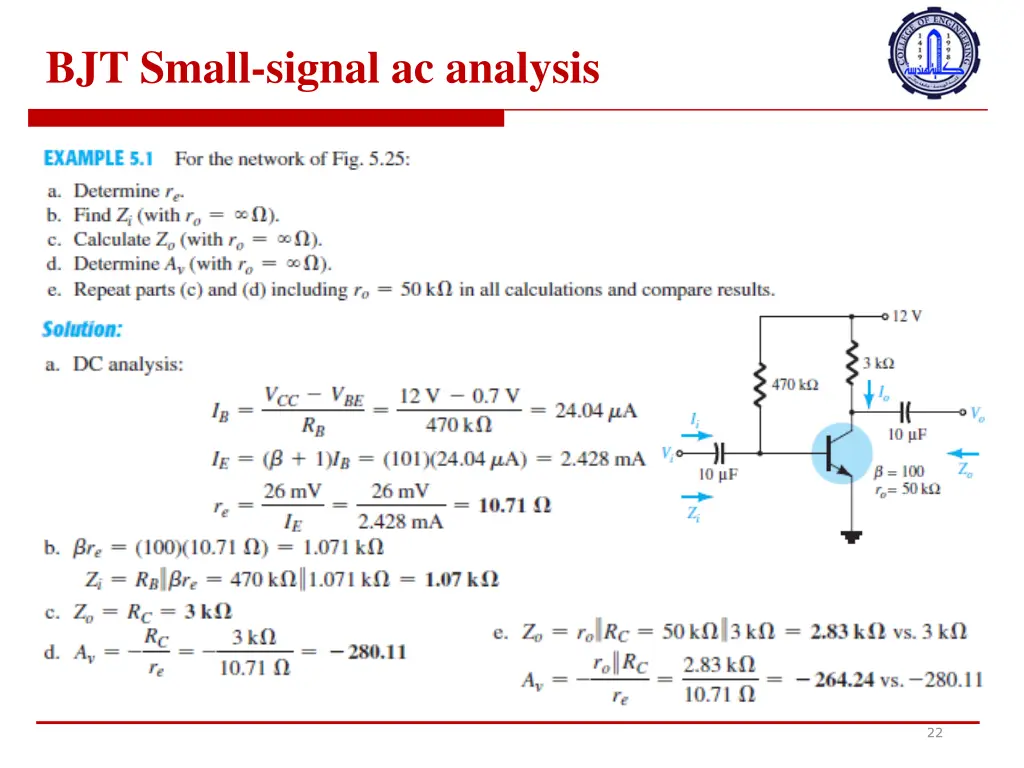
BJT Small-signal ac analysis 1- Common-emitter fixed-bias configuration The first configuration to be analyzed in detail is the common- emitter fixed-bias network of Fig. 11. The input signal ??is applied to the base of the transistor, whereas the output ?0is off the collector. In addition, recognize that the input current ??is not the base current, but the source current, and the output current ?0is the collector current. 17
BJT Small-signal ac analysis The small-signal ac analysis begins by removing the dc effects of ???and replacing the dc blocking capacitors ?1and ?2by short-circuit equivalents, resulting in the network of Fig. 12 . Network of Fig. 12. following the removal of the effects of ???, ?1, and ?2. Fig 11. Common-emitter fixed-bias configuration. 18
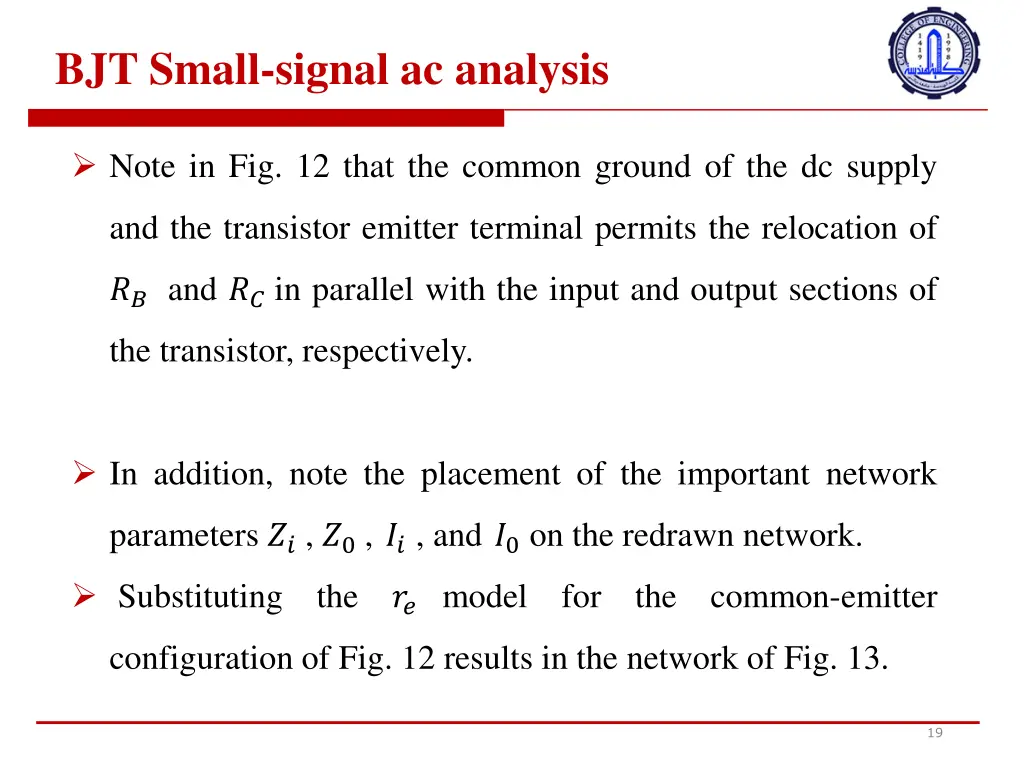
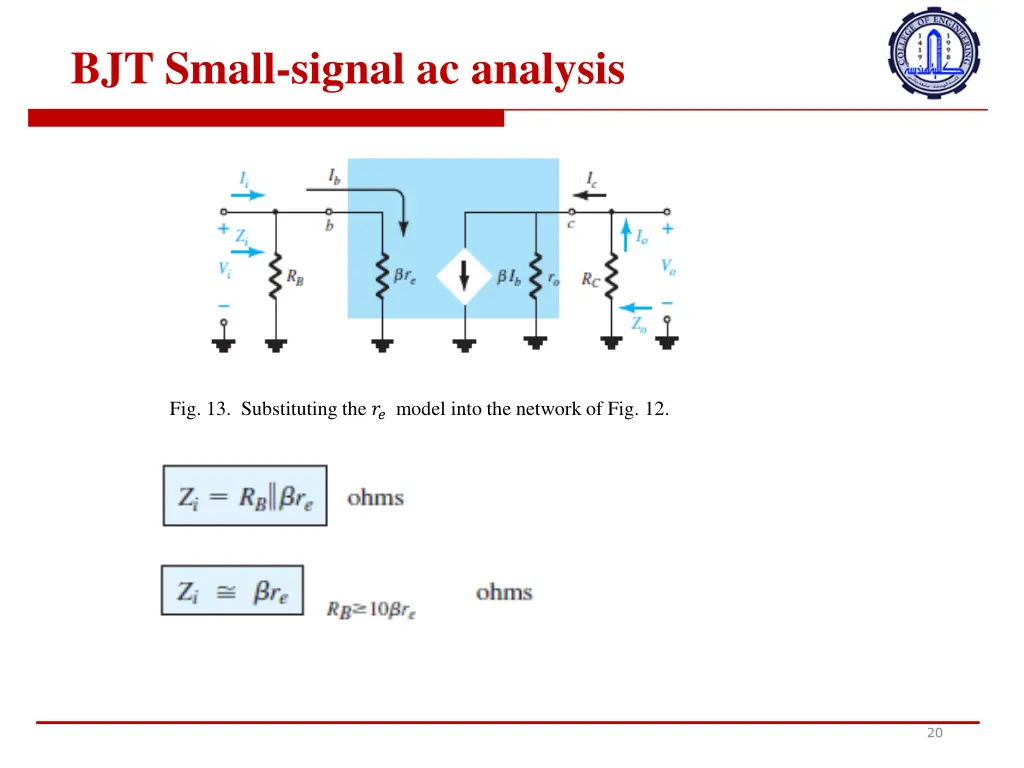
BJT Small-signal ac analysis Note in Fig. 12 that the common ground of the dc supply and the transistor emitter terminal permits the relocation of ??and ??in parallel with the input and output sections of the transistor, respectively. In addition, note the placement of the important network parameters ??, ?0, ??, and ?0on the redrawn network. Substituting the ?? model for the common-emitter configuration of Fig. 12 results in the network of Fig. 13. 19
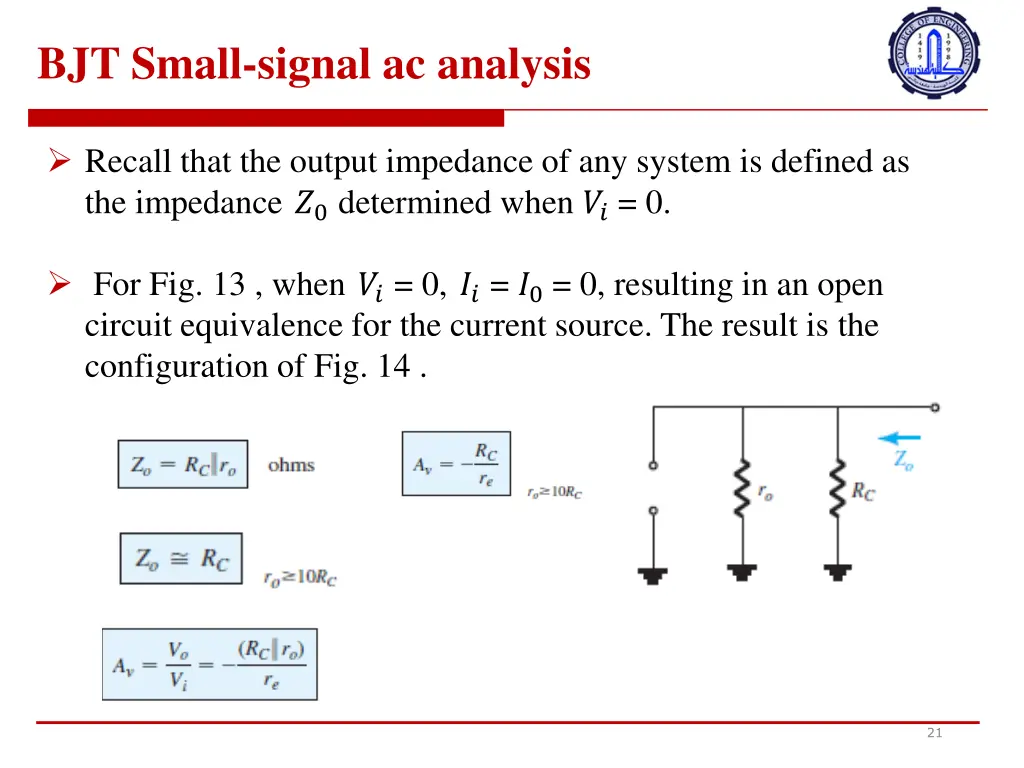
BJT Small-signal ac analysis Recall that the output impedance of any system is defined as the impedance ?0determined when ??= 0. For Fig. 13 , when ??= 0, ??= ?0= 0, resulting in an open circuit equivalence for the current source. The result is the configuration of Fig. 14 . 21
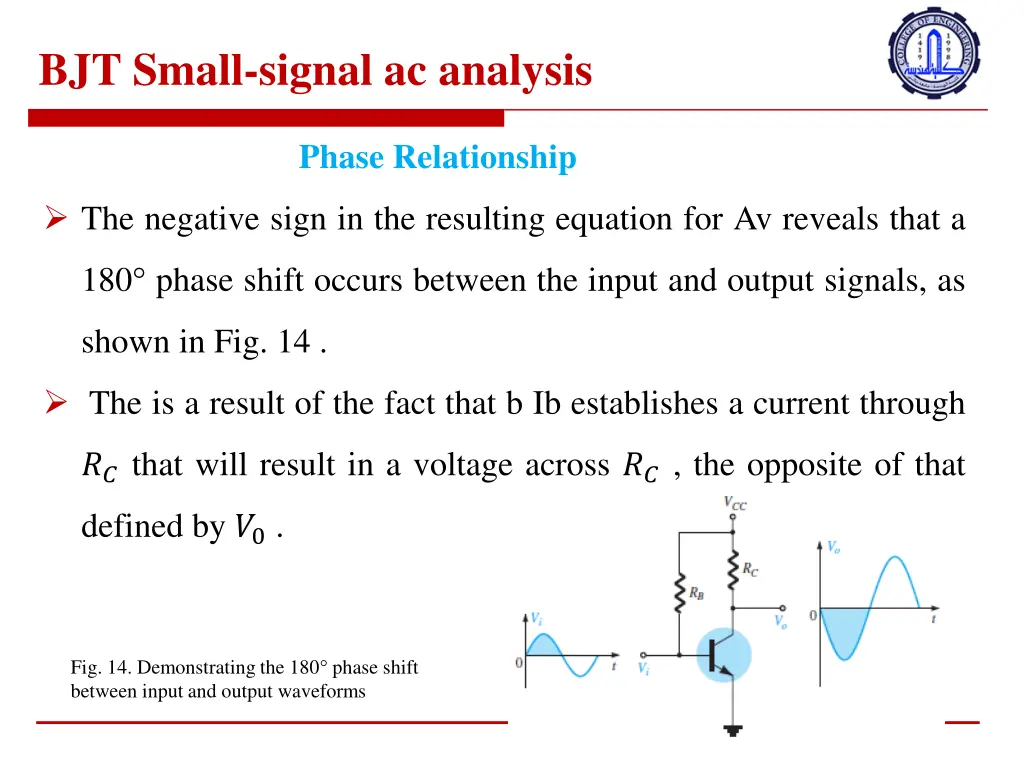
BJT Small-signal ac analysis Phase Relationship The negative sign in the resulting equation for Av reveals that a 180 phase shift occurs between the input and output signals, as shown in Fig. 14 . The is a result of the fact that b Ib establishes a current through ??that will result in a voltage across ??, the opposite of that defined by ?0. Fig. 14. Demonstrating the 180 phase shift between input and output waveforms 23
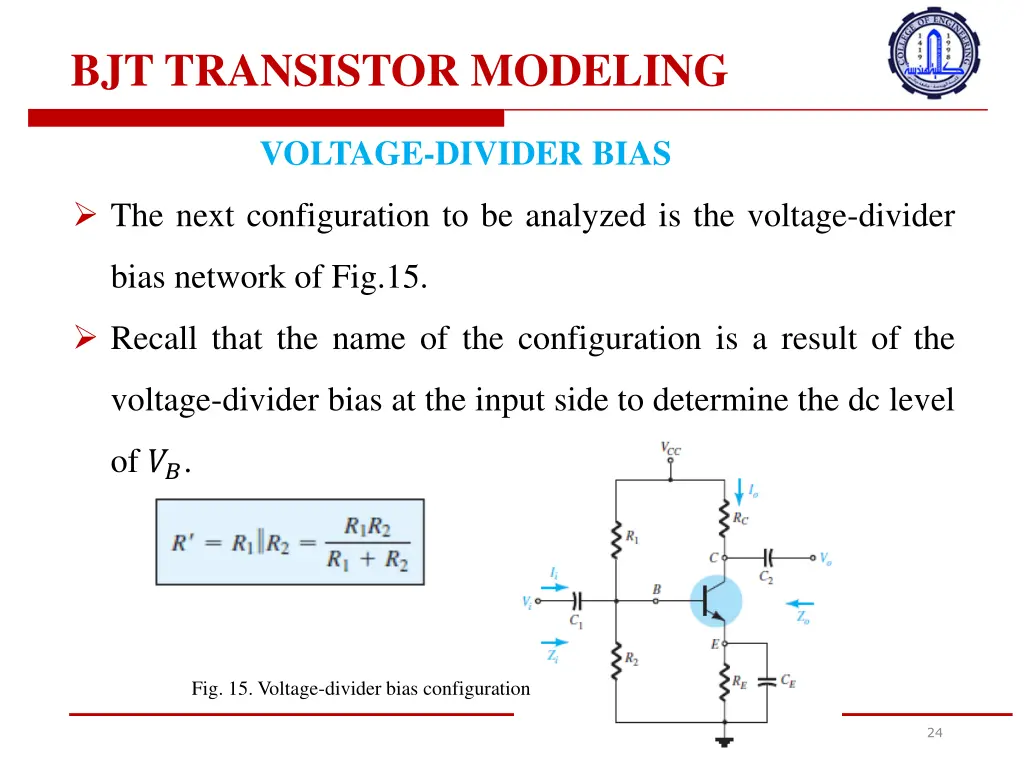
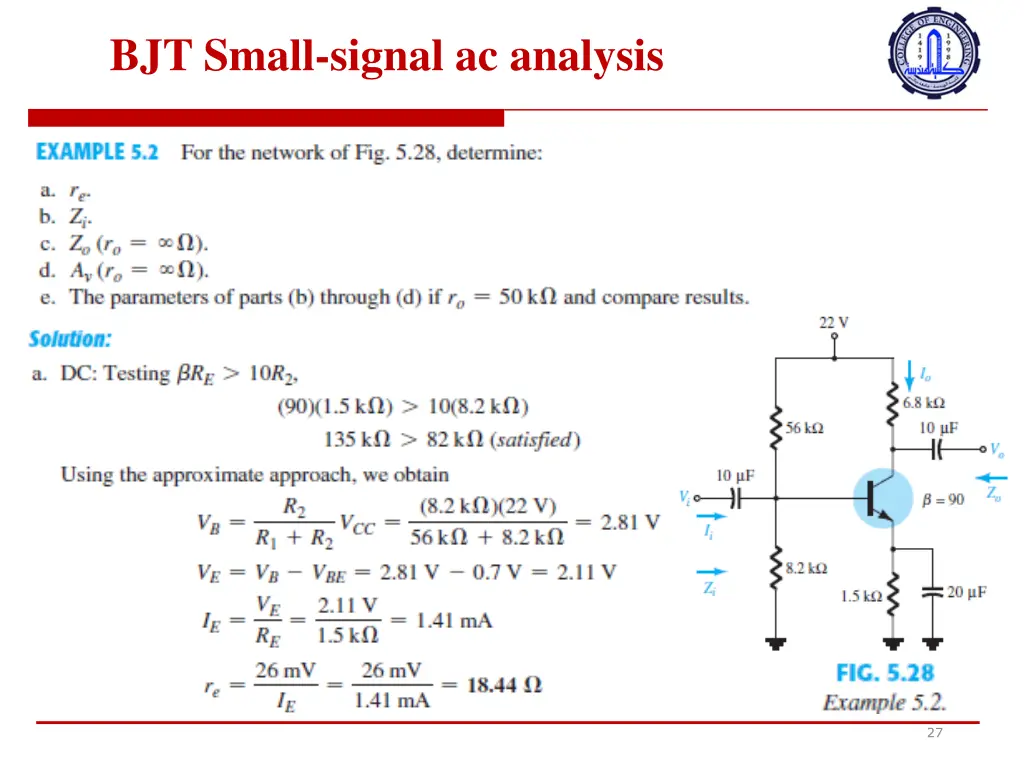
BJT TRANSISTOR MODELING VOLTAGE-DIVIDER BIAS The next configuration to be analyzed is the voltage-divider bias network of Fig.15. Recall that the name of the configuration is a result of the voltage-divider bias at the input side to determine the dc level of ??. Fig. 15. Voltage-divider bias configuration 24
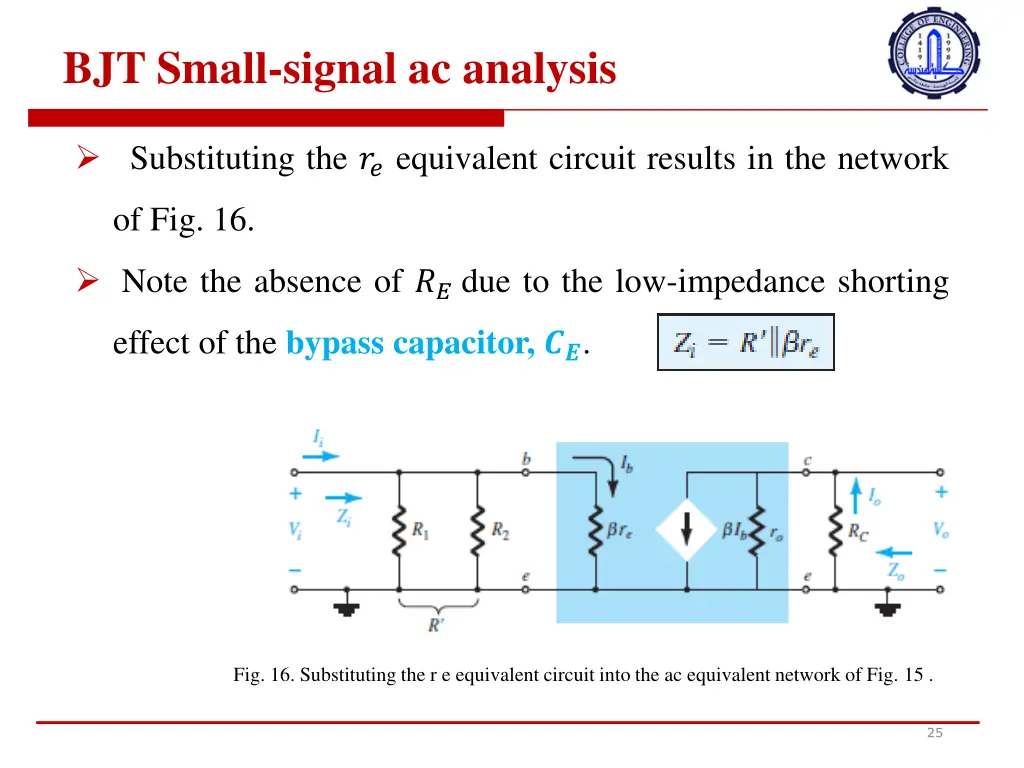
BJT Small-signal ac analysis Substituting the ??equivalent circuit results in the network of Fig. 16. Note the absence of ??due to the low-impedance shorting effect of the bypass capacitor, ??. Fig. 16. Substituting the r e equivalent circuit into the ac equivalent network of Fig. 15 . 25
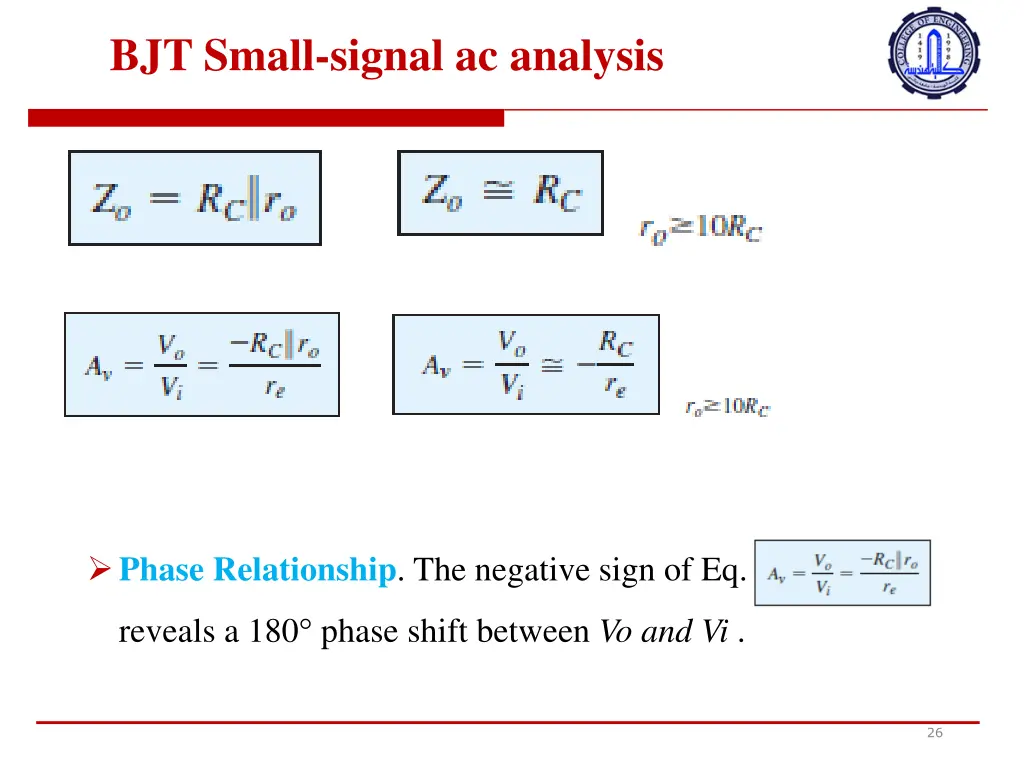
BJT Small-signal ac analysis Phase Relationship. The negative sign of Eq. reveals a 180 phase shift between Vo and Vi . 26