The dreaded maximal random effects UCL Linguistics workshop
This workshop at UCL focuses on mixed-effects modeling in R, emphasizing the specifications of random effects. It discusses the implications of using maximal random effects structures justified by study design, contrasting with traditional tests that allow for varying effects across subjects. The session highlights the importance of including random intercepts and effects to better fit models that account for subject and item variability in response times.

Download Presentation

Please find below an Image/Link to download the presentation.
The content on the website is provided AS IS for your information and personal use only. It may not be sold, licensed, or shared on other websites without obtaining consent from the author.If you encounter any issues during the download, it is possible that the publisher has removed the file from their server.
You are allowed to download the files provided on this website for personal or commercial use, subject to the condition that they are used lawfully. All files are the property of their respective owners.
The content on the website is provided AS IS for your information and personal use only. It may not be sold, licensed, or shared on other websites without obtaining consent from the author.
E N D
Presentation Transcript
3. The dreaded maximal random effects UCL Linguistics workshop on mixed-effects modelling in R 18-20 May 2016
Code at: http://www.mypolyuweb.hk/~sjpolit/UCL_Rworkshop/ 2
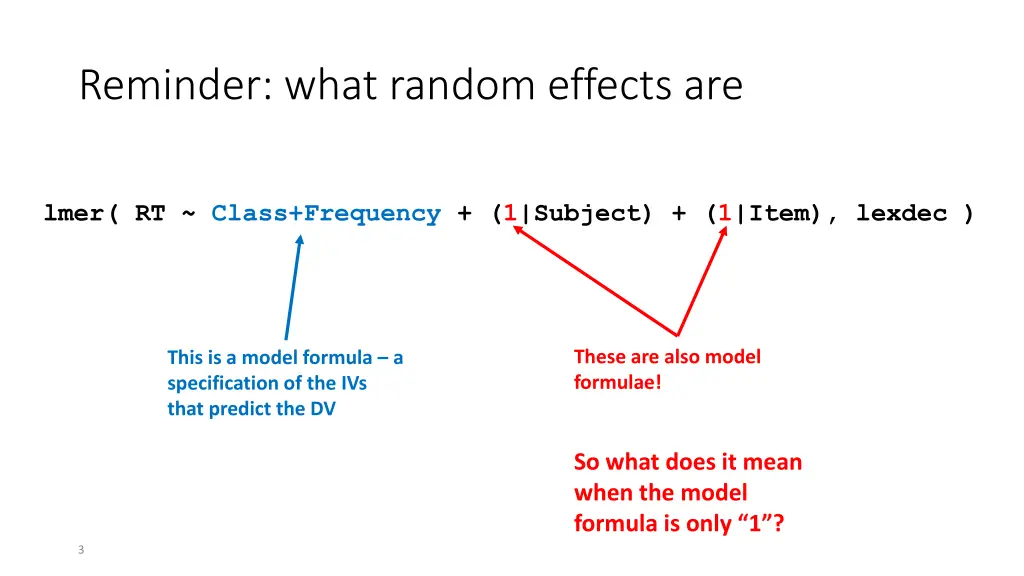
Reminder: what random effects are lmer( RT ~ Class+Frequency + (1|Subject) + (1|Item), lexdec ) These are also model formulae! This is a model formula a specification of the IVs that predict the DV So what does it mean when the model formula is only 1 ? 3
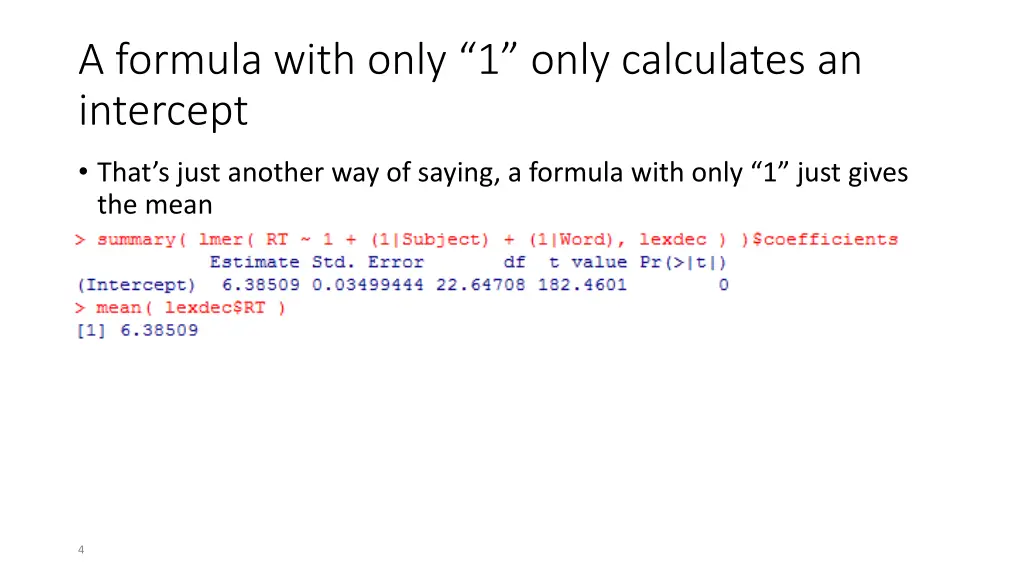
A formula with only 1 only calculates an intercept That s just another way of saying, a formula with only 1 just gives the mean 4
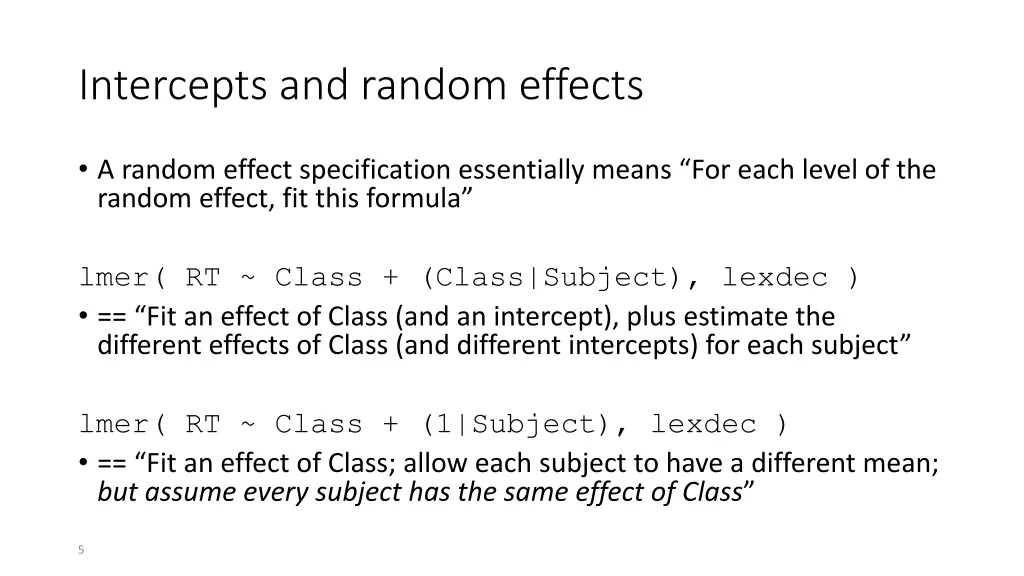
Intercepts and random effects A random effect specification essentially means For each level of the random effect, fit this formula lmer( RT ~ Class + (Class|Subject), lexdec ) == Fit an effect of Class (and an intercept), plus estimate the different effects of Class (and different intercepts) for each subject lmer( RT ~ Class + (1|Subject), lexdec ) == Fit an effect of Class; allow each subject to have a different mean; but assume every subject has the same effect of Class 5
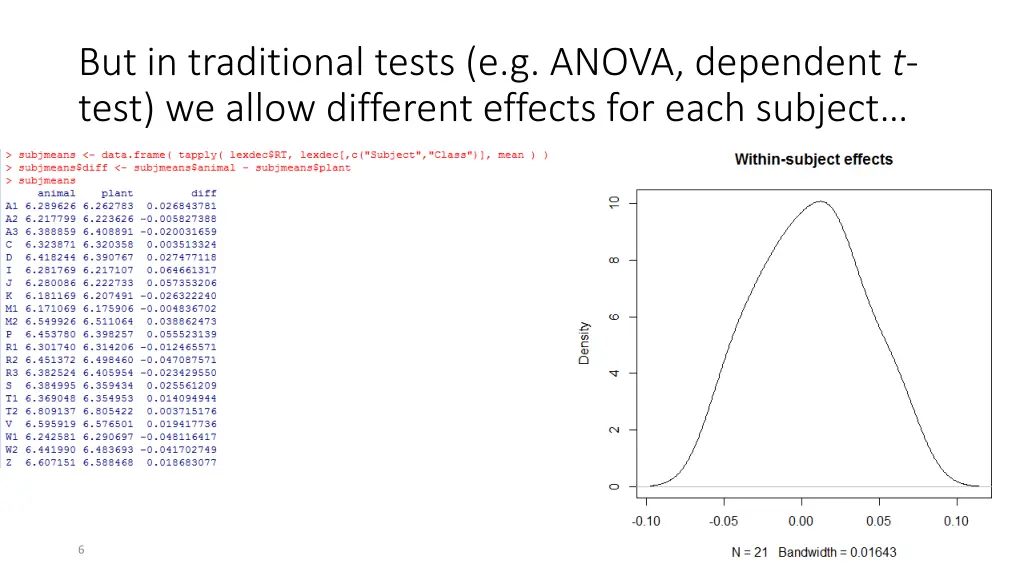
But in traditional tests (e.g. ANOVA, dependent t- test) we allow different effects for each subject 6
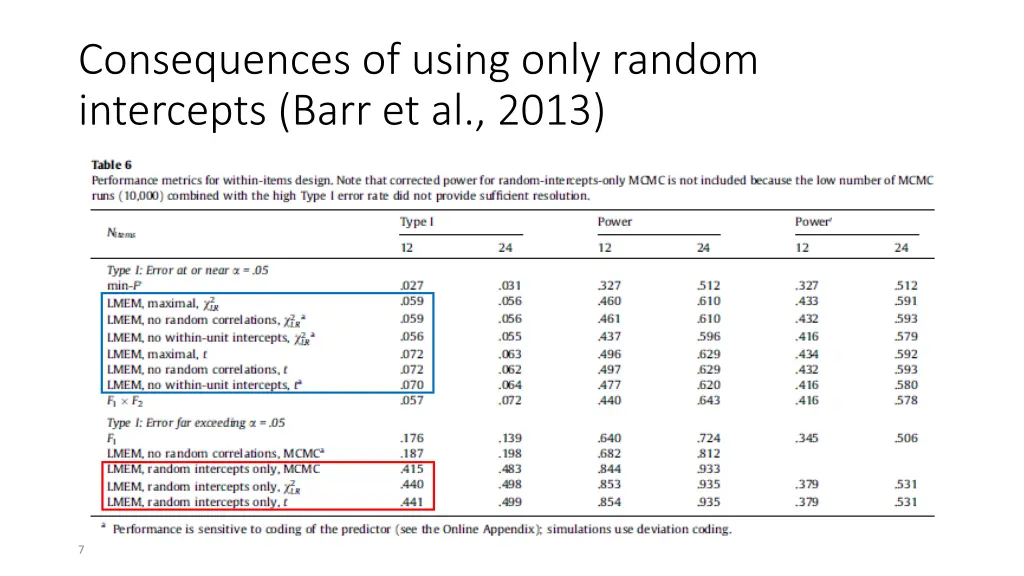
Consequences of using only random intercepts (Barr et al., 2013) 7
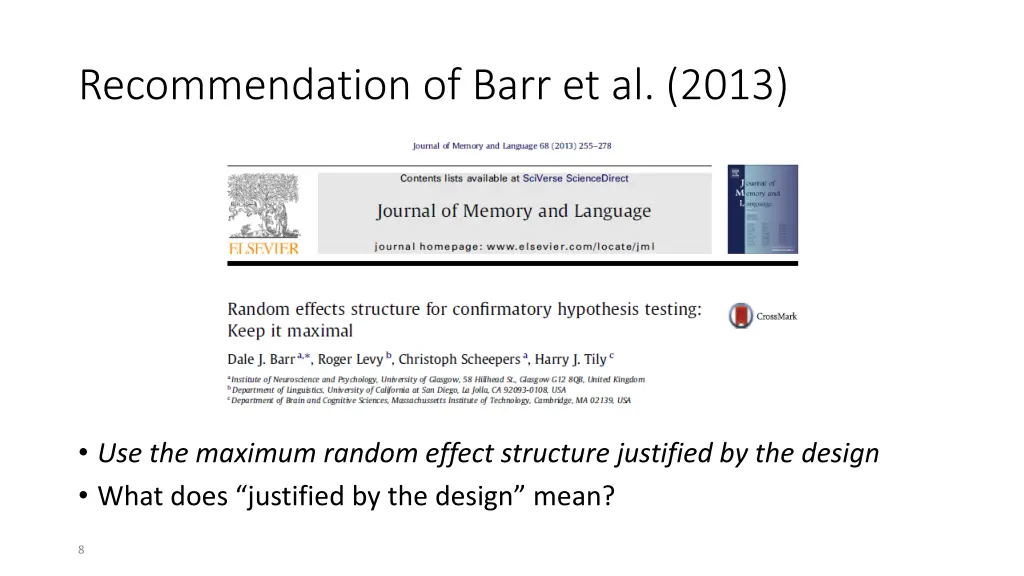
Recommendation of Barr et al. (2013) Use the maximum random effect structure justified by the design What does justified by the design mean? 8
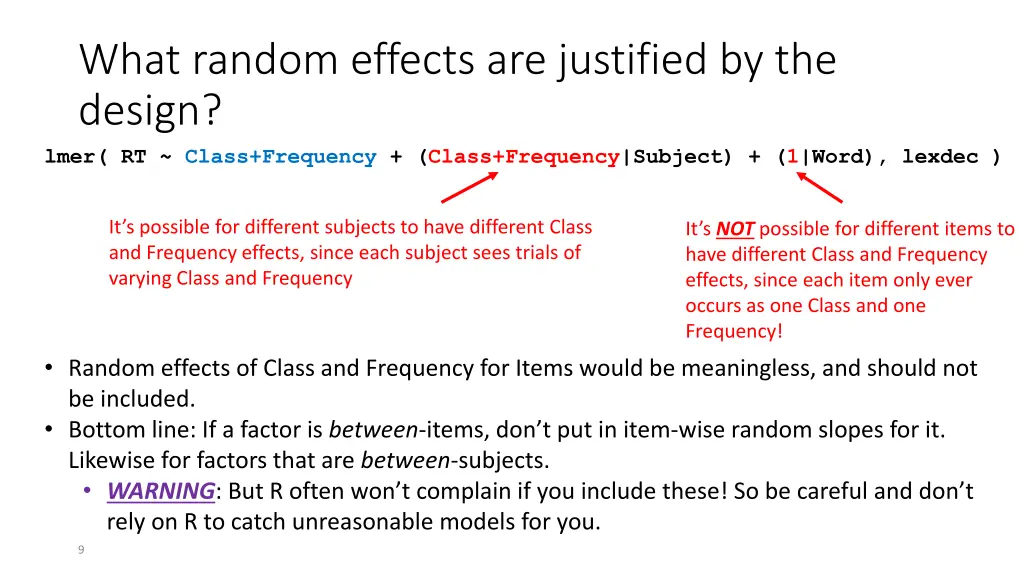
What random effects are justified by the design? lmer( RT ~ Class+Frequency + (Class+Frequency|Subject) + (1|Word), lexdec ) It s possible for different subjects to have different Class and Frequency effects, since each subject sees trials of varying Class and Frequency It s NOT possible for different items to have different Class and Frequency effects, since each item only ever occurs as one Class and one Frequency! Random effects of Class and Frequency for Items would be meaningless, and should not be included. Bottom line: If a factor is between-items, don t put in item-wise random slopes for it. Likewise for factors that are between-subjects. WARNING: But R often won t complain if you include these! So be careful and don t rely on R to catch unreasonable models for you. 9
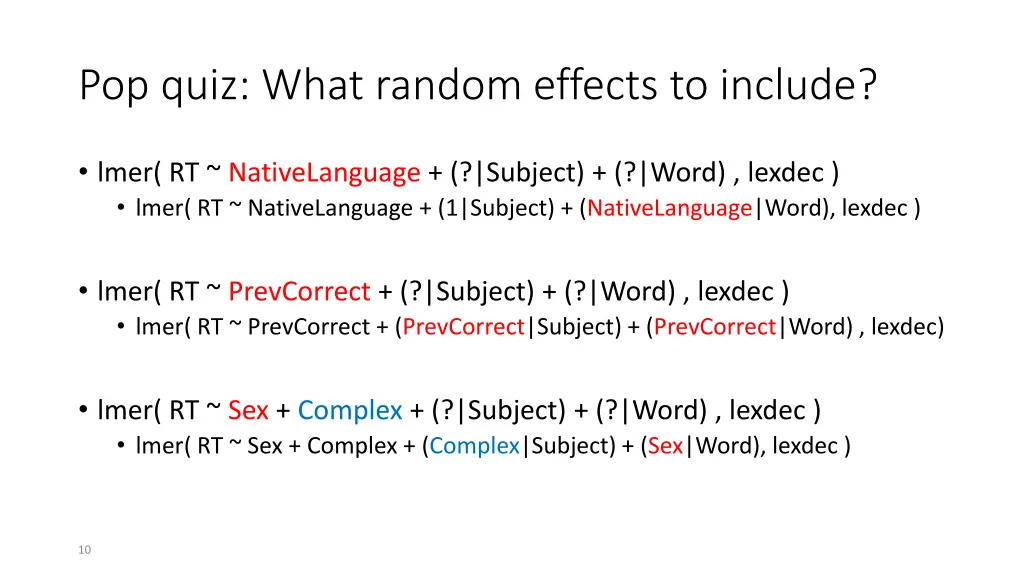
Pop quiz: What random effects to include? lmer( RT ~ NativeLanguage + (?|Subject) + (?|Word) , lexdec ) lmer( RT ~ NativeLanguage + (1|Subject) + (NativeLanguage|Word), lexdec ) lmer( RT ~ PrevCorrect + (?|Subject) + (?|Word) , lexdec ) lmer( RT ~ PrevCorrect + (PrevCorrect|Subject) + (PrevCorrect|Word) , lexdec) lmer( RT ~ Sex + Complex + (?|Subject) + (?|Word) , lexdec ) lmer( RT ~ Sex + Complex + (Complex|Subject) + (Sex|Word), lexdec ) 10
Lets try fitting a maximal random effects model now 11
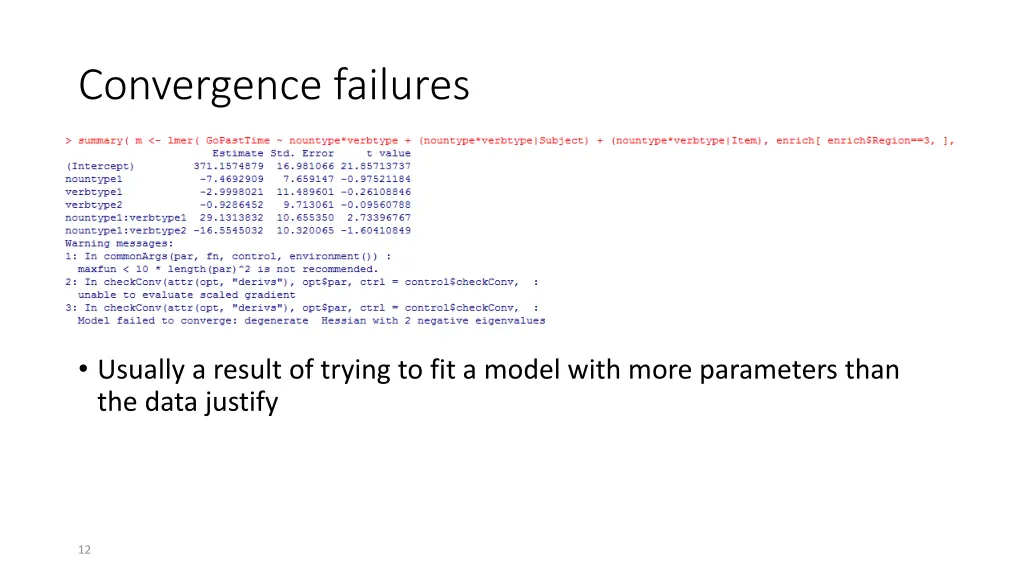
Convergence failures Usually a result of trying to fit a model with more parameters than the data justify 12
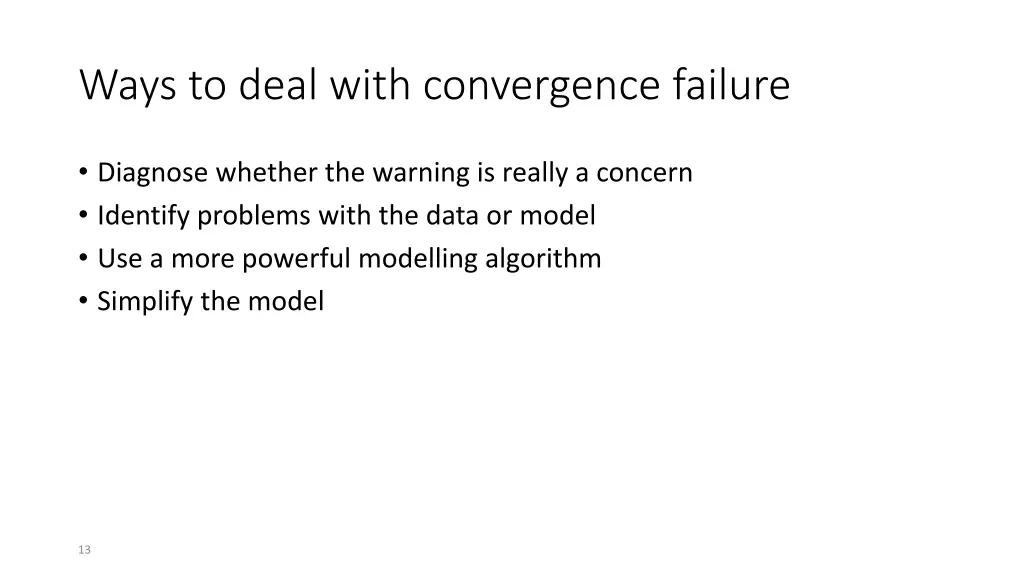
Ways to deal with convergence failure Diagnose whether the warning is really a concern Identify problems with the data or model Use a more powerful modelling algorithm Simplify the model 13
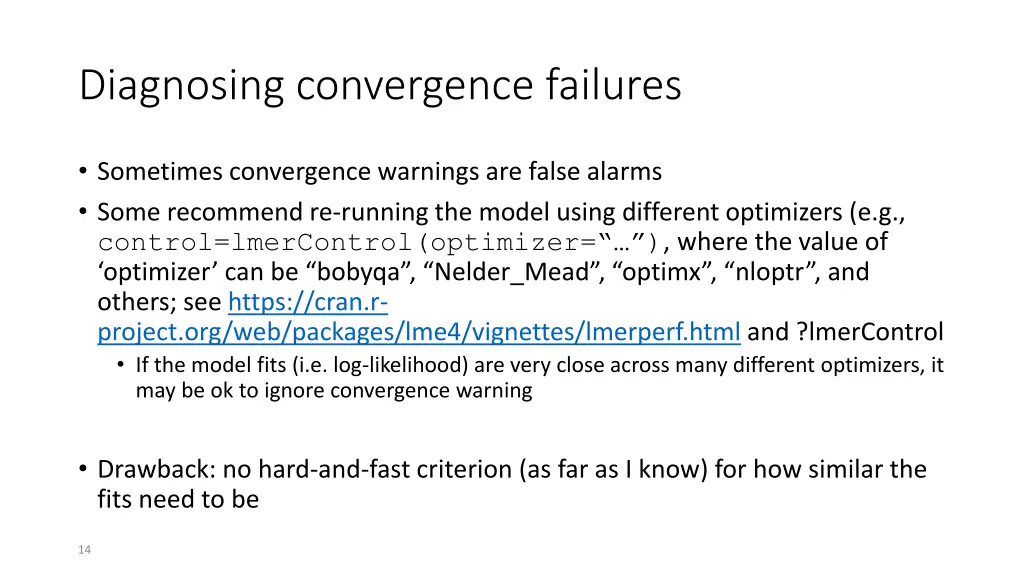
Diagnosing convergence failures Sometimes convergence warnings are false alarms Some recommend re-running the model using different optimizers (e.g., control=lmerControl(optimizer= ), where the value of optimizer can be bobyqa , Nelder_Mead , optimx , nloptr , and others; see https://cran.r- project.org/web/packages/lme4/vignettes/lmerperf.html and ?lmerControl If the model fits (i.e. log-likelihood) are very close across many different optimizers, it may be ok to ignore convergence warning Drawback: no hard-and-fast criterion (as far as I know) for how similar the fits need to be 14
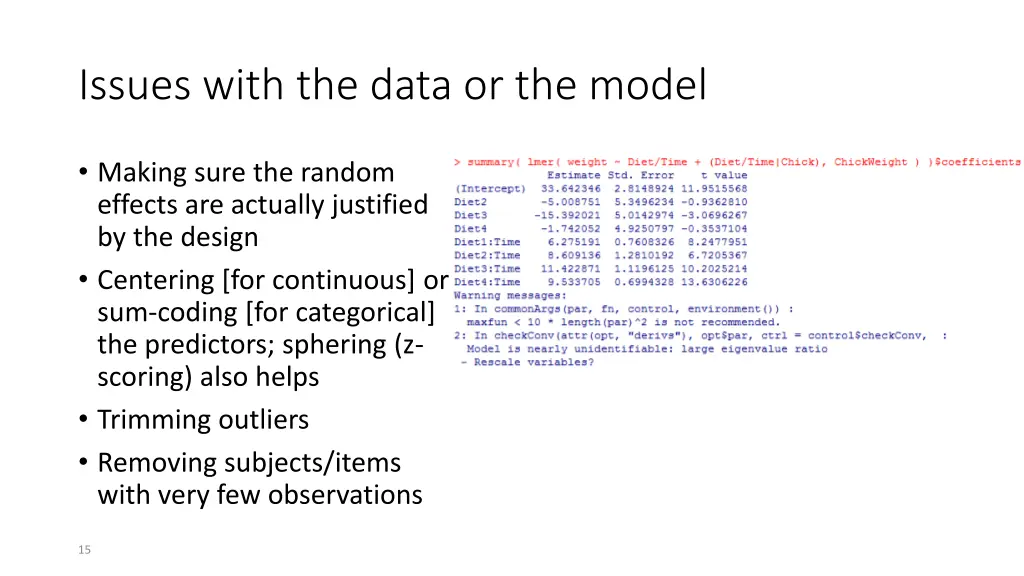
Issues with the data or the model Making sure the random effects are actually justified by the design Centering [for continuous] or sum-coding [for categorical] the predictors; sphering (z- scoring) also helps Trimming outliers Removing subjects/items with very few observations 15
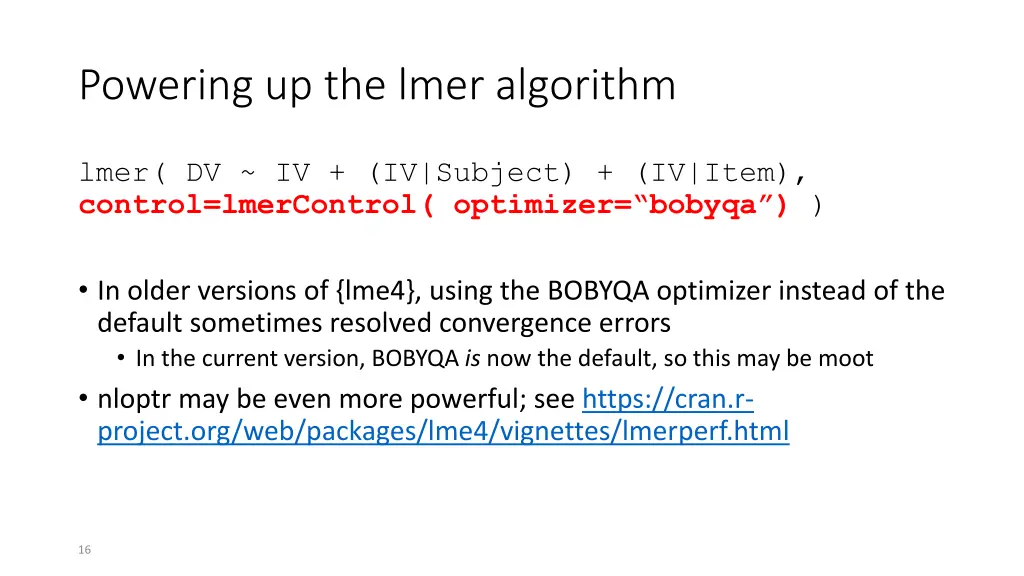
Powering up the lmer algorithm lmer( DV ~ IV + (IV|Subject) + (IV|Item), control=lmerControl( optimizer= bobyqa ) ) In older versions of {lme4}, using the BOBYQA optimizer instead of the default sometimes resolved convergence errors In the current version, BOBYQA is now the default, so this may be moot nloptr may be even more powerful; see https://cran.r- project.org/web/packages/lme4/vignettes/lmerperf.html 16
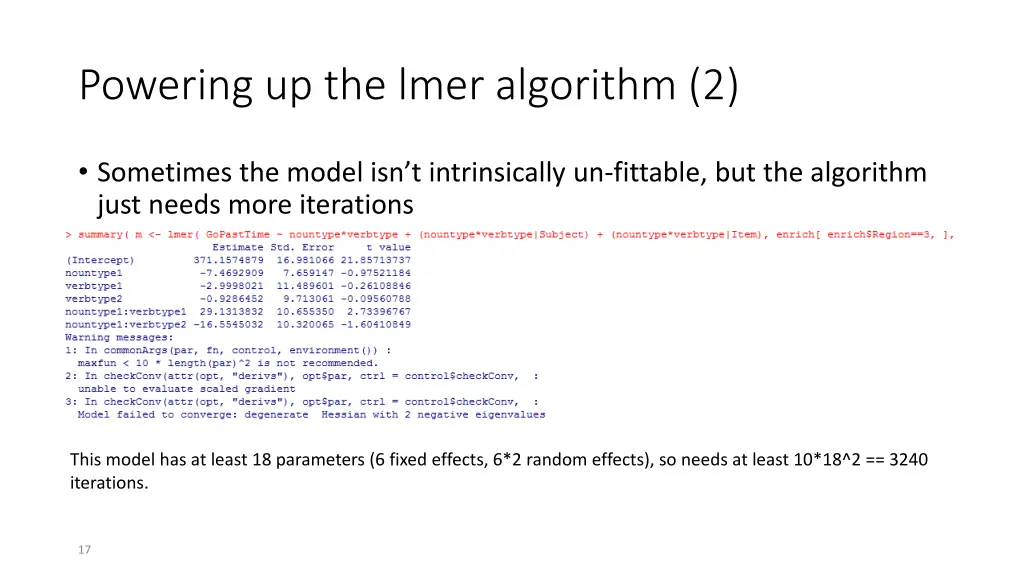
Powering up the lmer algorithm (2) Sometimes the model isn t intrinsically un-fittable, but the algorithm just needs more iterations This model has at least 18 parameters (6 fixed effects, 6*2 random effects), so needs at least 10*18^2 == 3240 iterations. 17
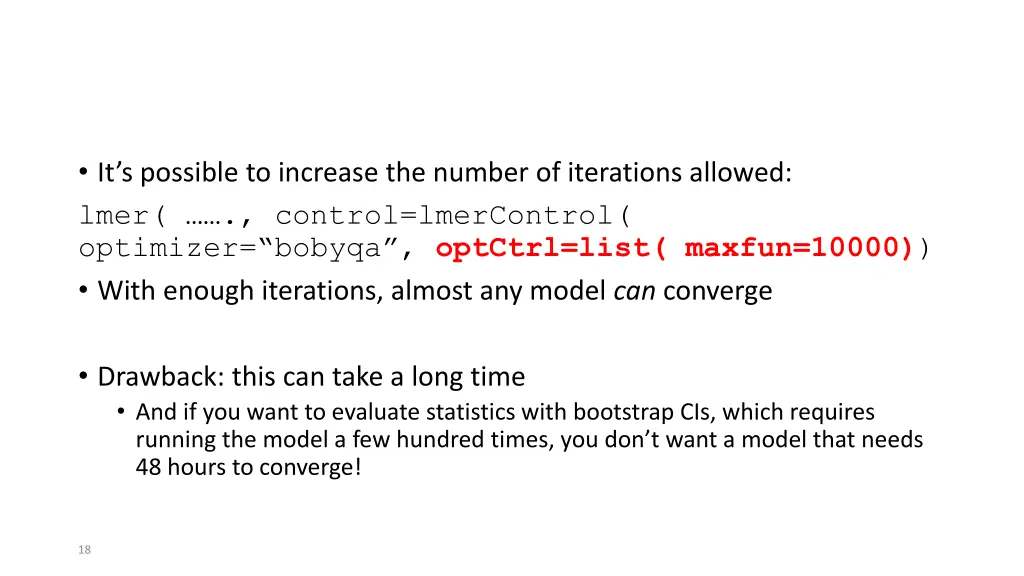
Its possible to increase the number of iterations allowed: lmer( ., control=lmerControl( optimizer= bobyqa , optCtrl=list( maxfun=10000)) With enough iterations, almost any model can converge Drawback: this can take a long time And if you want to evaluate statistics with bootstrap CIs, which requires running the model a few hundred times, you don t want a model that needs 48 hours to converge! 18
Simplifying the random effects structure If the model still doesn t converge, this usually means you are trying to fit more terms than are justified by the amount of data you have It s acceptable to remove terms until the model converges The question is whichterms to remove 19
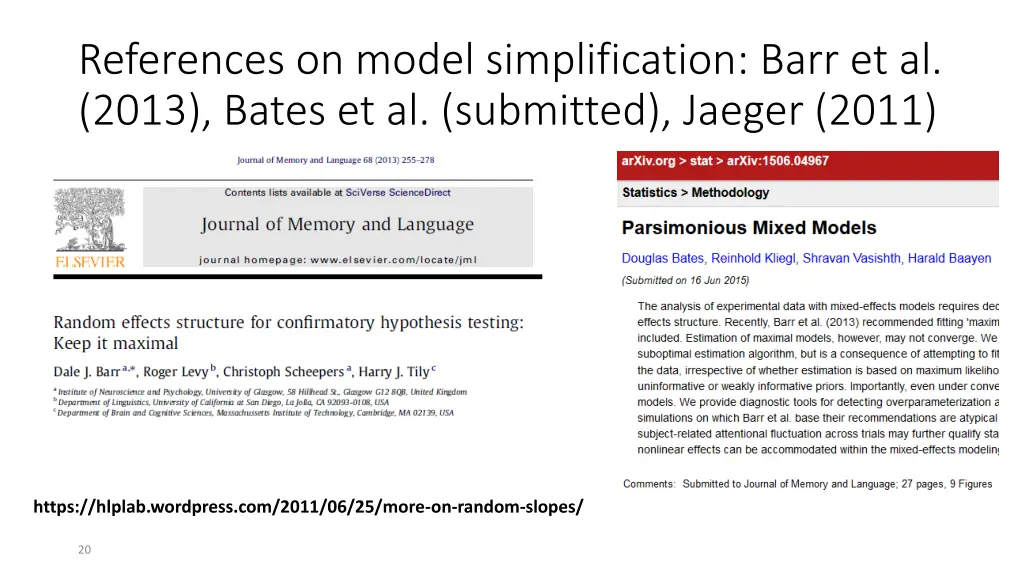
References on model simplification: Barr et al. (2013), Bates et al. (submitted), Jaeger (2011) https://hlplab.wordpress.com/2011/06/25/more-on-random-slopes/ 20
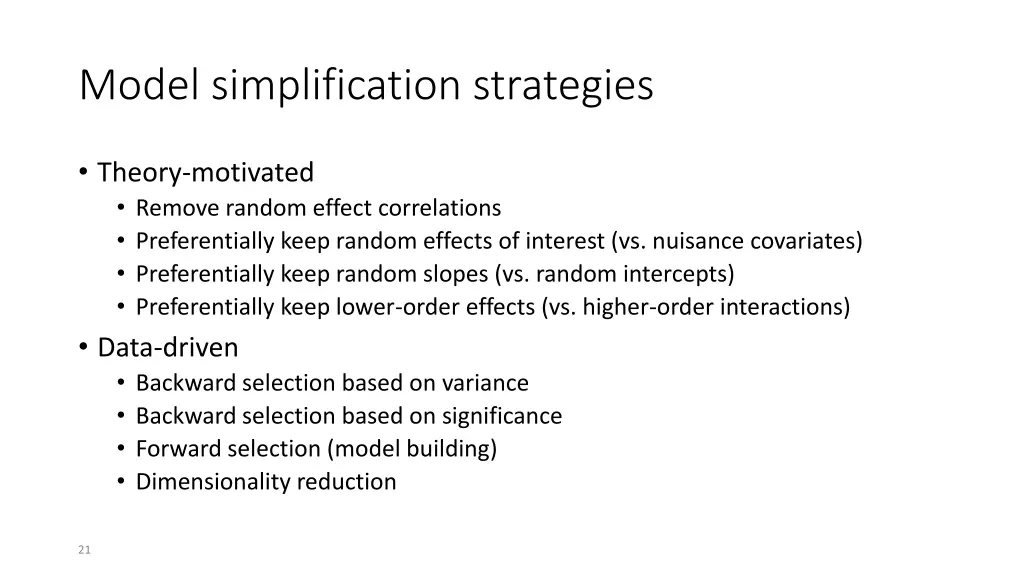
Model simplification strategies Theory-motivated Remove random effect correlations Preferentially keep random effects of interest (vs. nuisance covariates) Preferentially keep random slopes (vs. random intercepts) Preferentially keep lower-order effects (vs. higher-order interactions) Data-driven Backward selection based on variance Backward selection based on significance Forward selection (model building) Dimensionality reduction 21
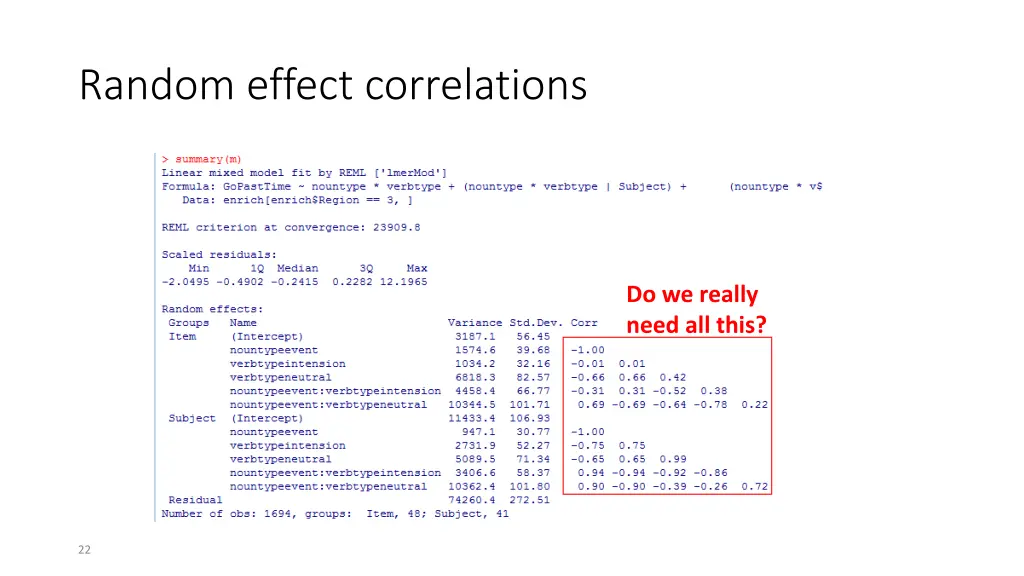
Random effect correlations Do we really need all this? 22
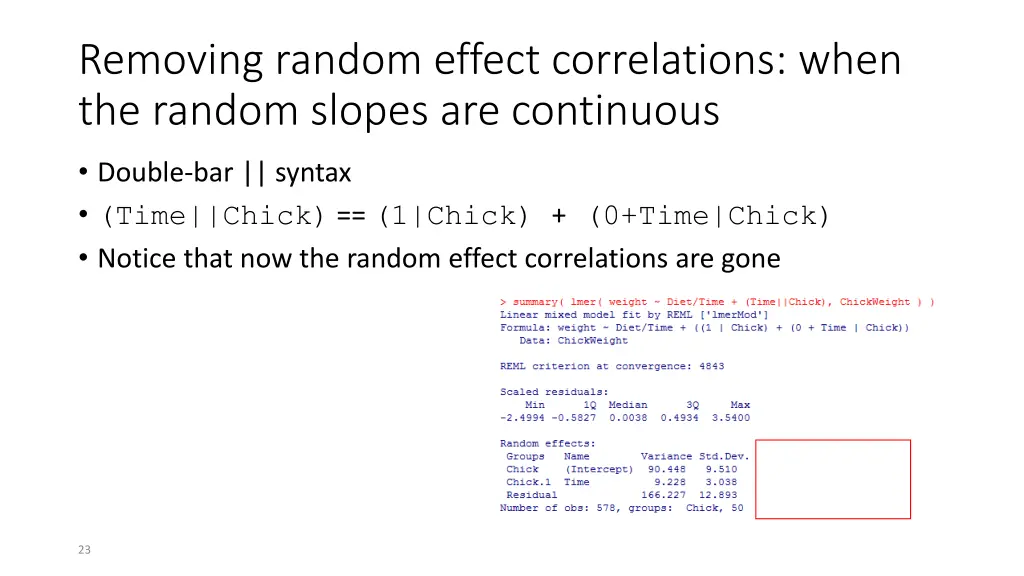
Removing random effect correlations: when the random slopes are continuous Double-bar || syntax (Time||Chick) == (1|Chick) + (0+Time|Chick) Notice that now the random effect correlations are gone 23
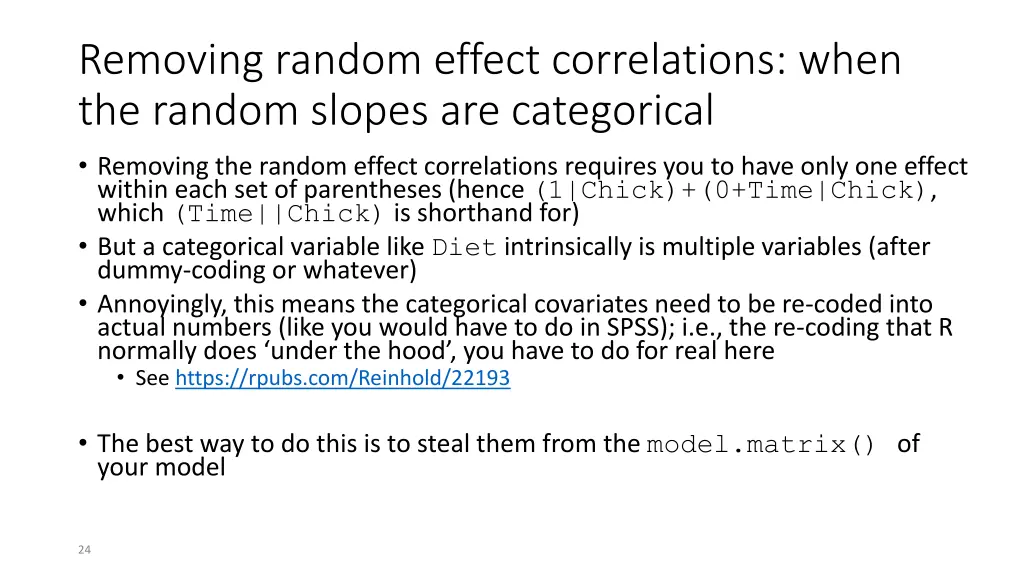
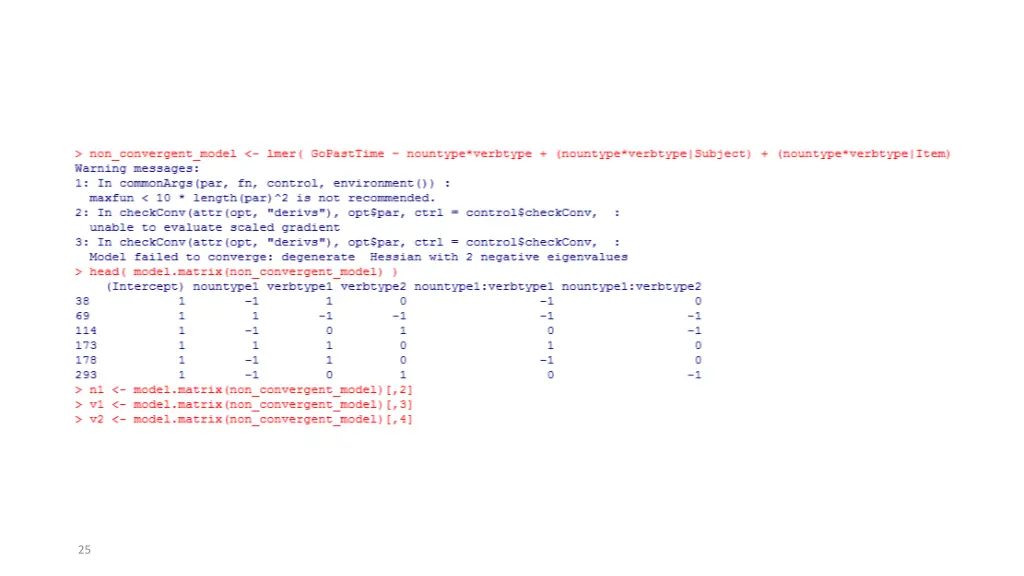
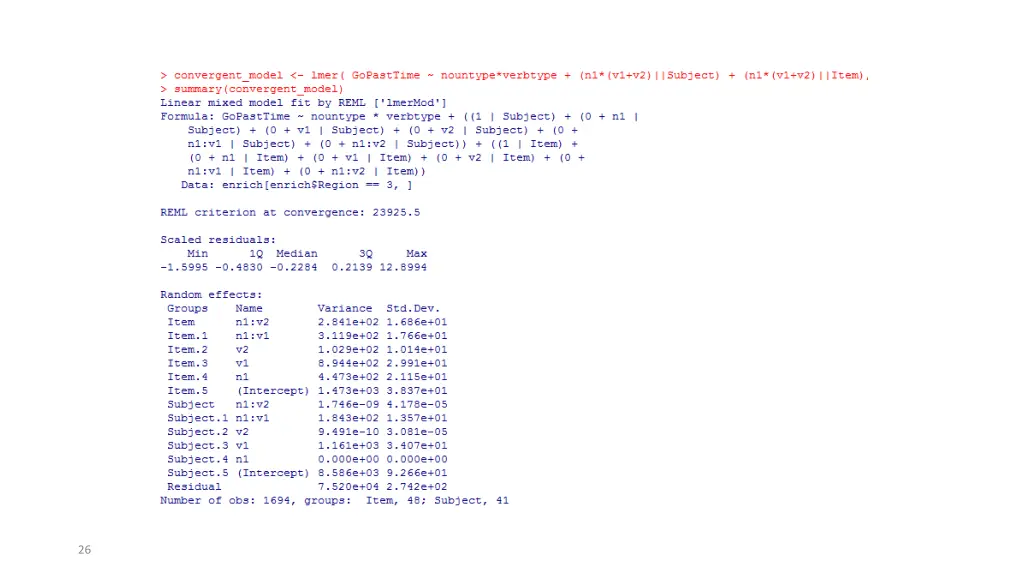
Removing random effect correlations: when the random slopes are categorical Removing the random effect correlations requires you to have only one effect within each set of parentheses (hence (1|Chick)+(0+Time|Chick), which (Time||Chick) is shorthand for) But a categorical variable like Diet intrinsically is multiple variables (after dummy-coding or whatever) Annoyingly, this means the categorical covariates need to be re-coded into actual numbers (like you would have to do in SPSS); i.e., the re-coding that R normally does under the hood , you have to do for real here See https://rpubs.com/Reinhold/22193 The best way to do this is to steal them from the model.matrix() of your model 24
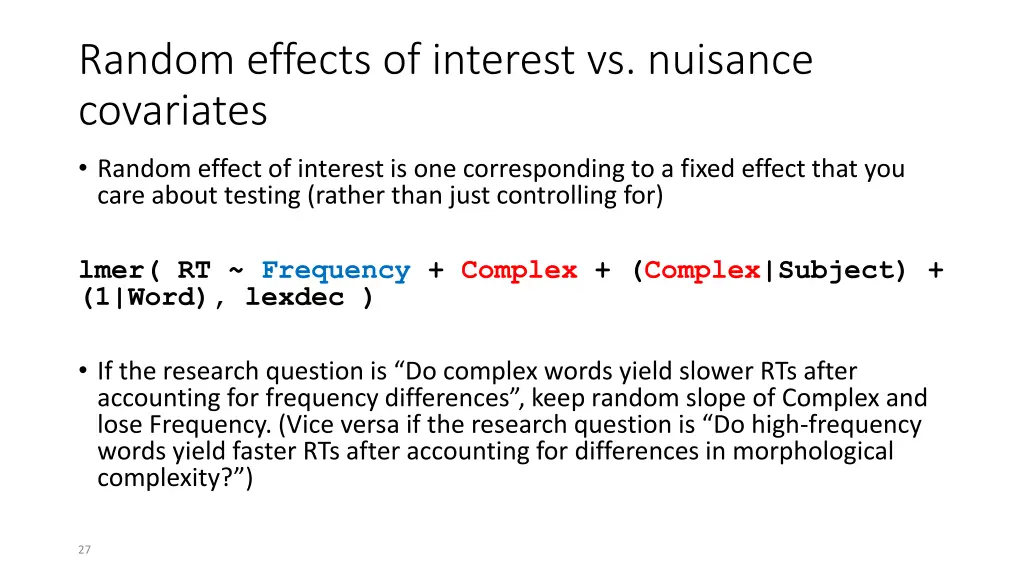
Random effects of interest vs. nuisance covariates Random effect of interest is one corresponding to a fixed effect that you care about testing (rather than just controlling for) lmer( RT ~ Frequency + Complex + (Complex|Subject) + (1|Word), lexdec ) If the research question is Do complex words yield slower RTs after accounting for frequency differences , keep random slope of Complex and lose Frequency. (Vice versa if the research question is Do high-frequency words yield faster RTs after accounting for differences in morphological complexity? ) 27
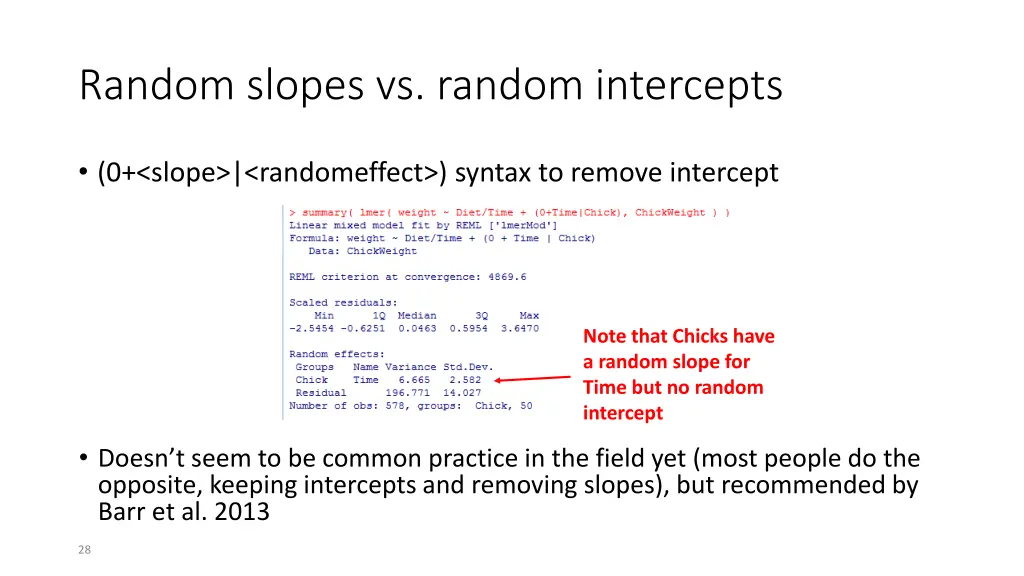
Random slopes vs. random intercepts (0+<slope>|<randomeffect>) syntax to remove intercept Note that Chicks have a random slope for Time but no random intercept Doesn t seem to be common practice in the field yet (most people do the opposite, keeping intercepts and removing slopes), but recommended by Barr et al. 2013 28
Effects of interest If the purpose of the experiment is to test an interaction, the interaction is of more interest than the main effects 29
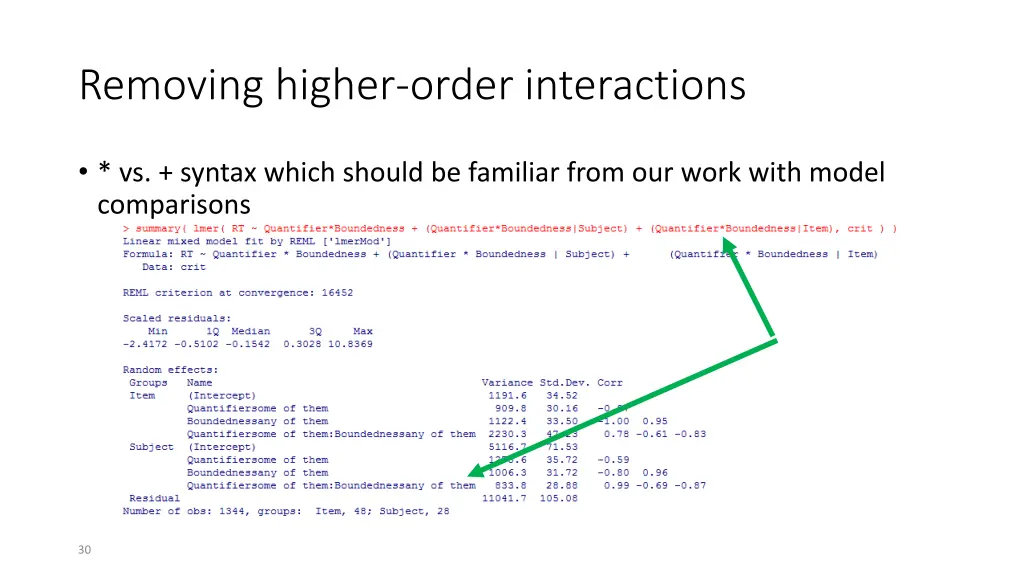
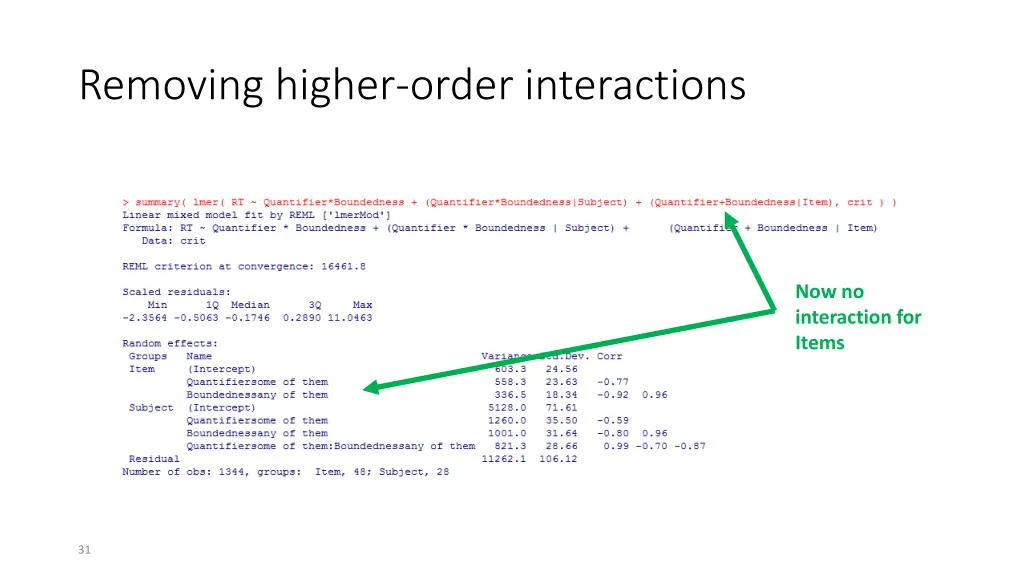
Removing higher-order interactions * vs. + syntax which should be familiar from our work with model comparisons 30
Removing higher-order interactions Now no interaction for Items 31
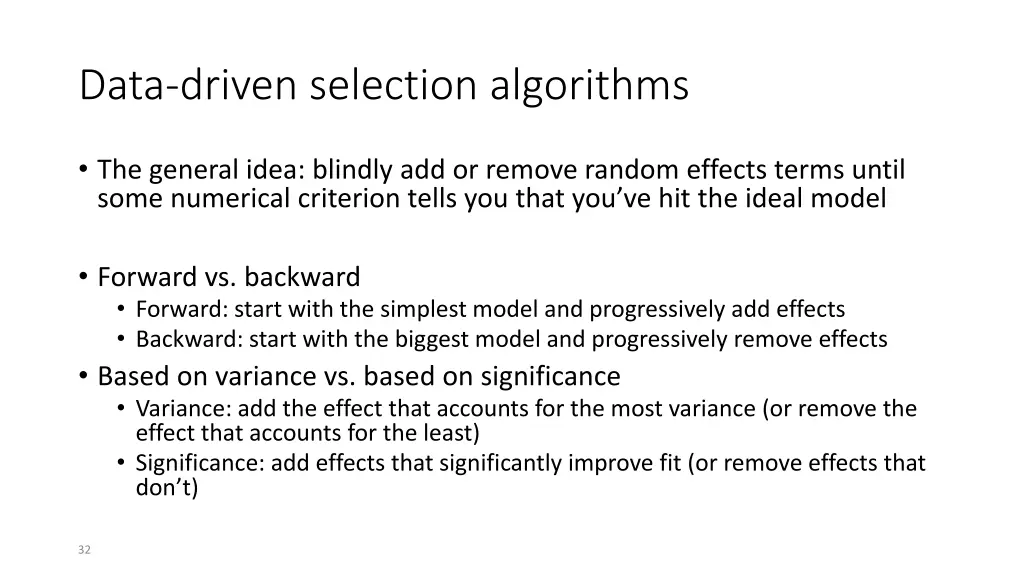
Data-driven selection algorithms The general idea: blindly add or remove random effects terms until some numerical criterion tells you that you ve hit the ideal model Forward vs. backward Forward: start with the simplest model and progressively add effects Backward: start with the biggest model and progressively remove effects Based on variance vs. based on significance Variance: add the effect that accounts for the most variance (or remove the effect that accounts for the least) Significance: add effects that significantly improve fit (or remove effects that don t) 32
Selection: forward vs. backward Forward can be faster than backward, since you might be able to stop before computing complex models with random effects But forward selection biases you towards stopping with fewer random effects Recall that Barr et al. (2013) recommend using the maximum possible random effects structure, not the minimum possible (but see Bates et al., submitted) Thus, backward selection is better 33
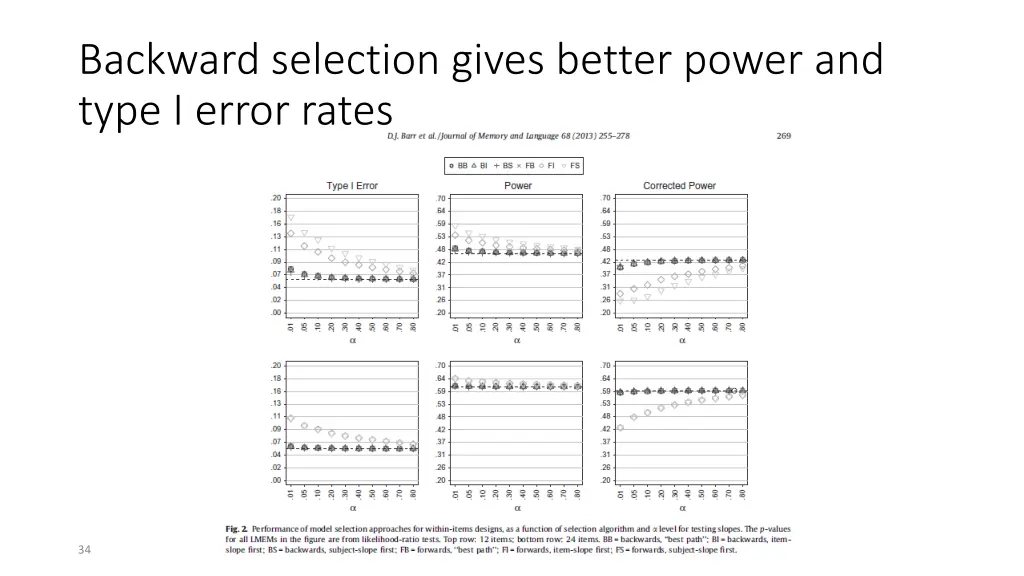
Backward selection gives better power and type I error rates 34
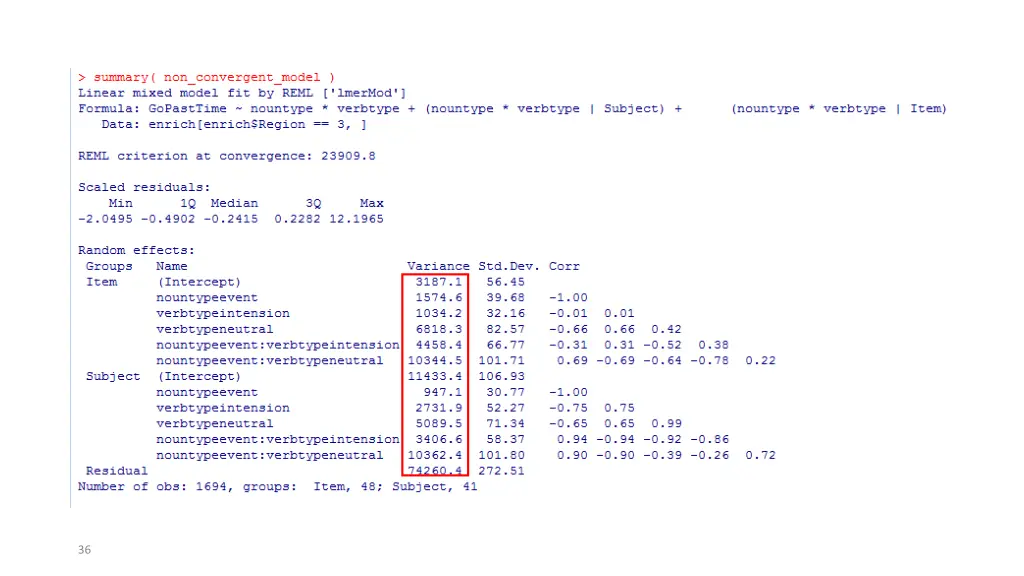
Selection based on significance or variance Selection based on significance requires model comparisons, and thus requires computing a lot of models (which may be prohibitive if each model takes hours) Selection based on variance only requires glancing at the random effects summary 35
One last trick: bootstrapping When one model doesn t converge, it is possible that bootstrap replicates of the model do converge, especially if the model is right at the border of being too complex This can be used to estimate model coefficients based on a bootstrap distribution However, it s also possible that you wait all day for your 500 models to run and actually none of them converges 37
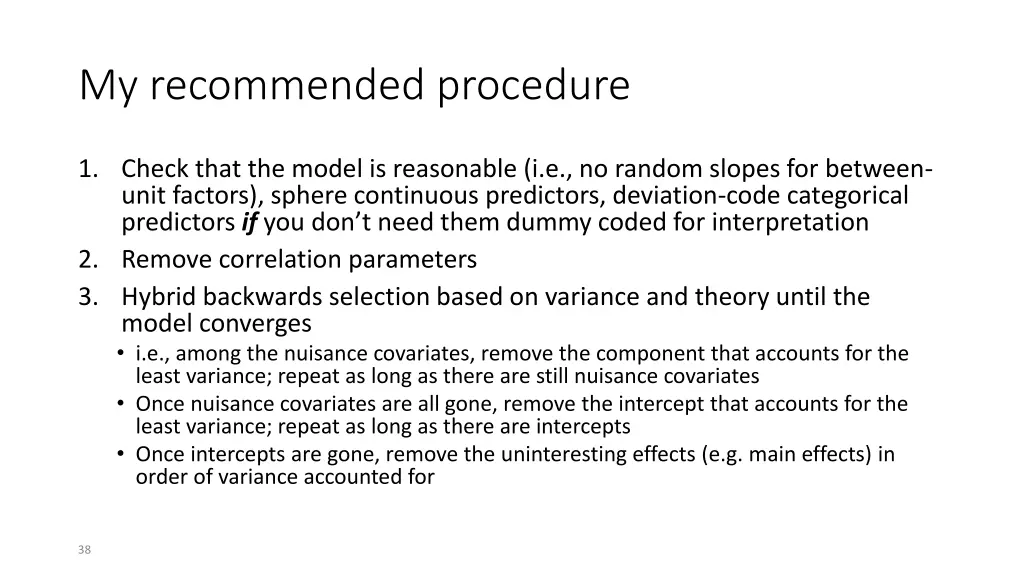
My recommended procedure 1. Check that the model is reasonable (i.e., no random slopes for between- unit factors), sphere continuous predictors, deviation-code categorical predictors ifyou don t need them dummy coded for interpretation 2. Remove correlation parameters 3. Hybrid backwards selection based on variance and theory until the model converges i.e., among the nuisance covariates, remove the component that accounts for the least variance; repeat as long as there are still nuisance covariates Once nuisance covariates are all gone, remove the intercept that accounts for the least variance; repeat as long as there are intercepts Once intercepts are gone, remove the uninteresting effects (e.g. main effects) in order of variance accounted for 38