The Fair Start For Kids Act 2023 Evaluation
The Fair Start for Kids Act (FSKA) is landmark legislation aimed at enhancing early learning and child care access across Washington State. Signed by Governor Inslee on May 7, 2021, it represents a $1.1 billion investment to support affordable, high-quality child care and stabilize the workforce in the sector. The act focuses on advancing racial equity, increasing access to child care, promoting kindergarten readiness, and supporting the workforce in early learning.

Download Presentation

Please find below an Image/Link to download the presentation.
The content on the website is provided AS IS for your information and personal use only. It may not be sold, licensed, or shared on other websites without obtaining consent from the author.If you encounter any issues during the download, it is possible that the publisher has removed the file from their server.
You are allowed to download the files provided on this website for personal or commercial use, subject to the condition that they are used lawfully. All files are the property of their respective owners.
The content on the website is provided AS IS for your information and personal use only. It may not be sold, licensed, or shared on other websites without obtaining consent from the author.
E N D
Presentation Transcript
The Fair Start For Kids Act 2023 Evaluation March 29th, 2024 OIAA Evaluation and Research The Department of Children, Youth & Families Office of Innovation, Alignment, and Accountability (OIAA) builds the agency s capacity to make evidence-informed decisions, continuously learn and improve, and successfully enact system reform www.dcyf.wa.gov 1
Background The Fair Start for Kids Act (FSKA) is historic legislation signed by Governor Inslee on May 7, 2021. Washington State invested $1.1 billion to expand access to affordable, high-quality early learning and child care for Washington families and to stabilize the child care and early learning workforce. Four policy objectives: Advance racial equity Expand access to affordable child care and early learning Promote kindergarten readiness Support the child care and early learning workforce SB 5237 (2021): [DCYF] shall submit a biennial report to the governor and legislature describing how the investments funded by the fair start for kids act have impacted the policy objectives . Section 104 (3) 2
Equity 3
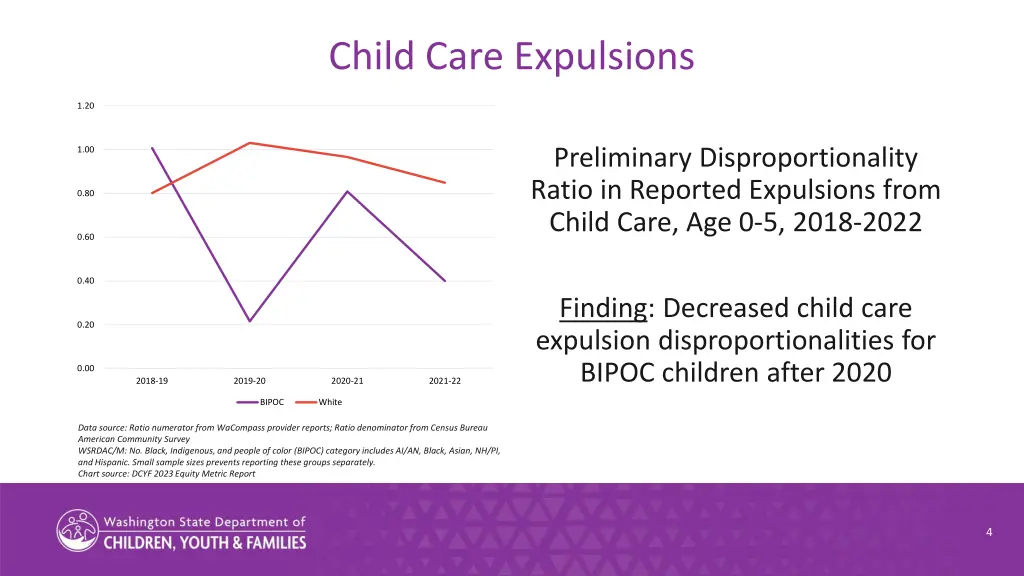
Child Care Expulsions 1.20 Preliminary Disproportionality Ratio in Reported Expulsions from Child Care, Age 0-5, 2018-2022 1.00 0.80 0.60 0.40 Finding: Decreased child care expulsion disproportionalities for BIPOC children after 2020 0.20 0.00 2018-19 2019-20 2020-21 2021-22 BIPOC White Data source: Ratio numerator from WaCompass provider reports; Ratio denominator from Census Bureau American Community Survey WSRDAC/M: No. Black, Indigenous, and people of color (BIPOC) category includes AI/AN, Black, Asian, NH/PI, and Hispanic. Small sample sizes prevents reporting these groups separately. Chart source: DCYF 2023 Equity Metric Report 4
Access 5
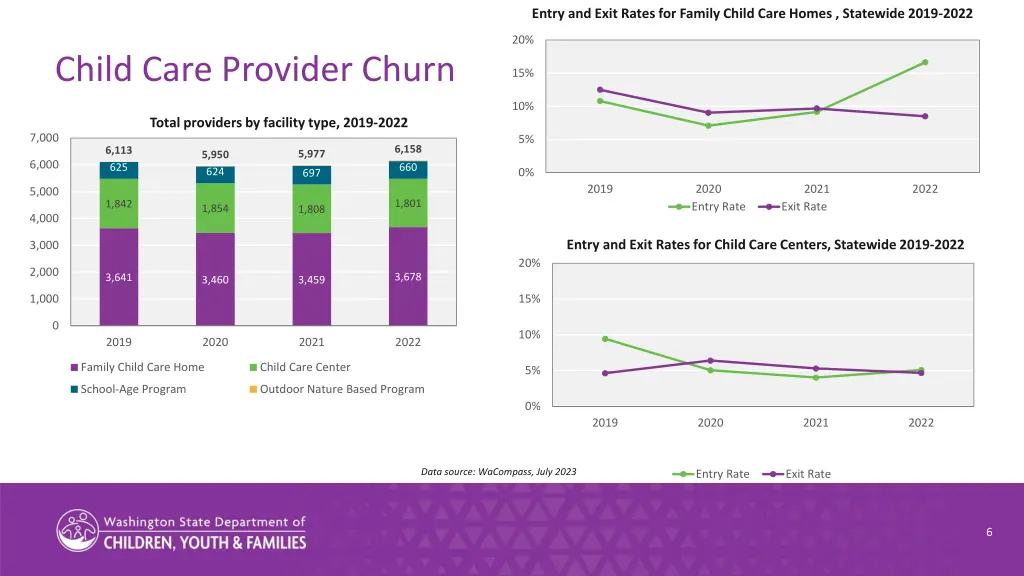
Entry and Exit Rates for Family Child Care Homes , Statewide 2019-2022 20% Child Care Provider Churn 15% 10% Total providers by facility type, 2019-2022 7,000 5% 6,158 6,113 5,977 5,950 6,000 625 660 624 0% 697 2019 2020 Entry Rate 2021 2022 5,000 1,801 1,842 Exit Rate 1,854 1,808 4,000 Entry and Exit Rates for Child Care Centers, Statewide 2019-2022 3,000 20% 2,000 3,678 3,641 3,460 3,459 1,000 15% 0 10% 2019 2020 2021 2022 Family Child Care Home Child Care Center 5% School-Age Program Outdoor Nature Based Program 0% 2019 2020 2021 2022 Data source: WaCompass, July 2023 Entry Rate Exit Rate 6 6
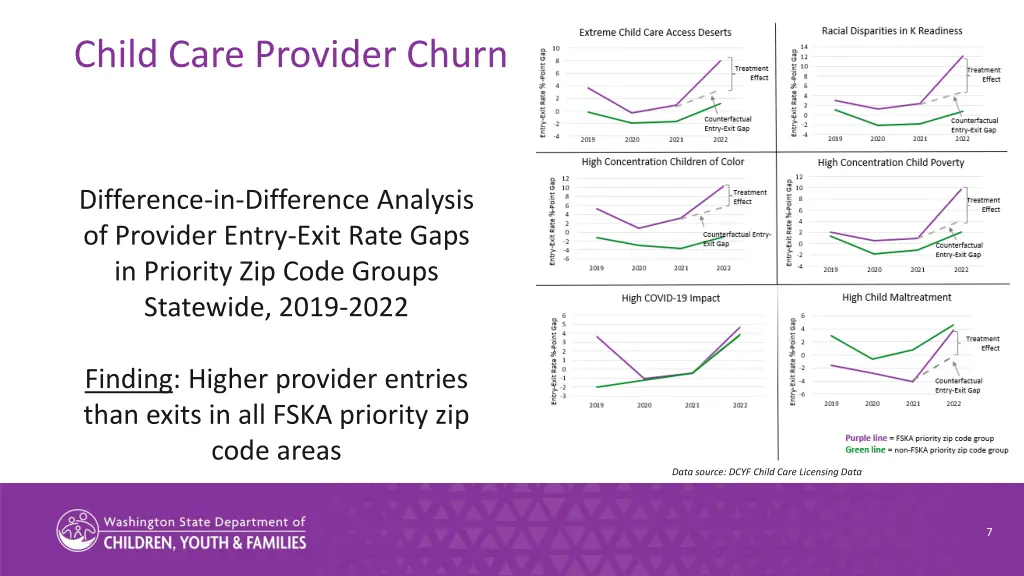
Child Care Provider Churn Difference-in-Difference Analysis of Provider Entry-Exit Rate Gaps in Priority Zip Code Groups Statewide, 2019-2022 Finding: Higher provider entries than exits in all FSKA priority zip code areas Data source: DCYF Child Care Licensing Data 7 7
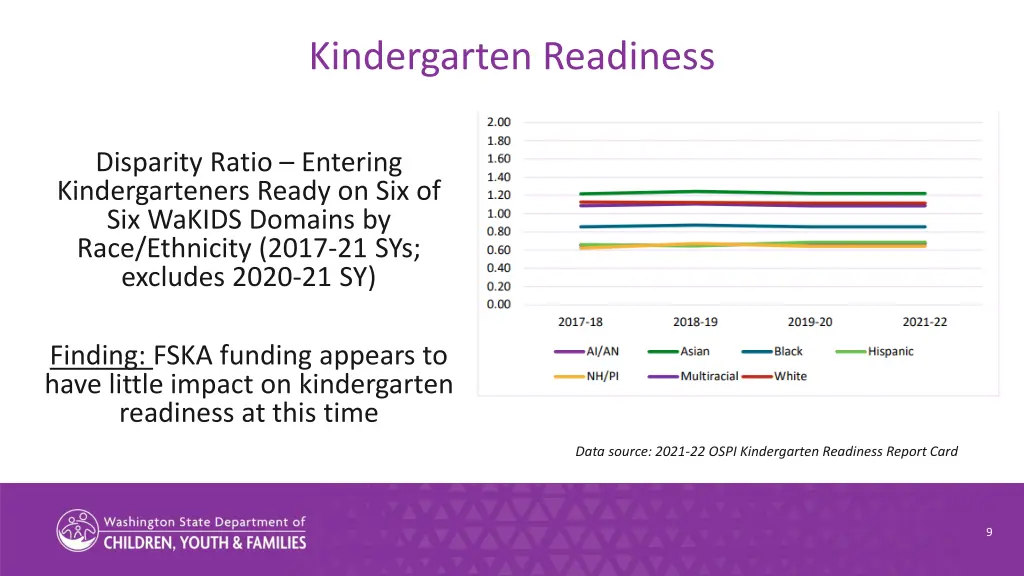
Kindergarten Readiness Disparity Ratio Entering Kindergarteners Ready on Six of Six WaKIDS Domains by Race/Ethnicity (2017-21 SYs; excludes 2020-21 SY) Finding: FSKA funding appears to have little impact on kindergarten readiness at this time Data source: 2021-22 OSPI Kindergarten Readiness Report Card 9
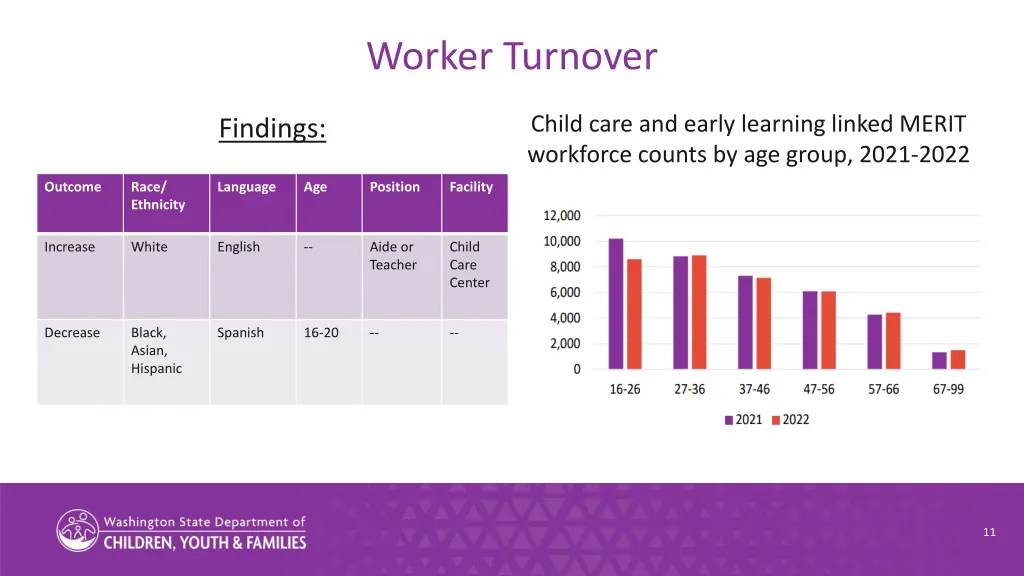
Worker Turnover Child care and early learning linked MERIT workforce counts by age group, 2021-2022 Findings: Outcome Race/ Ethnicity Language Age Position Facility Increase White English -- Aide or Teacher Child Care Center Decrease Black, Asian, Hispanic Spanish 16-20 -- -- 11
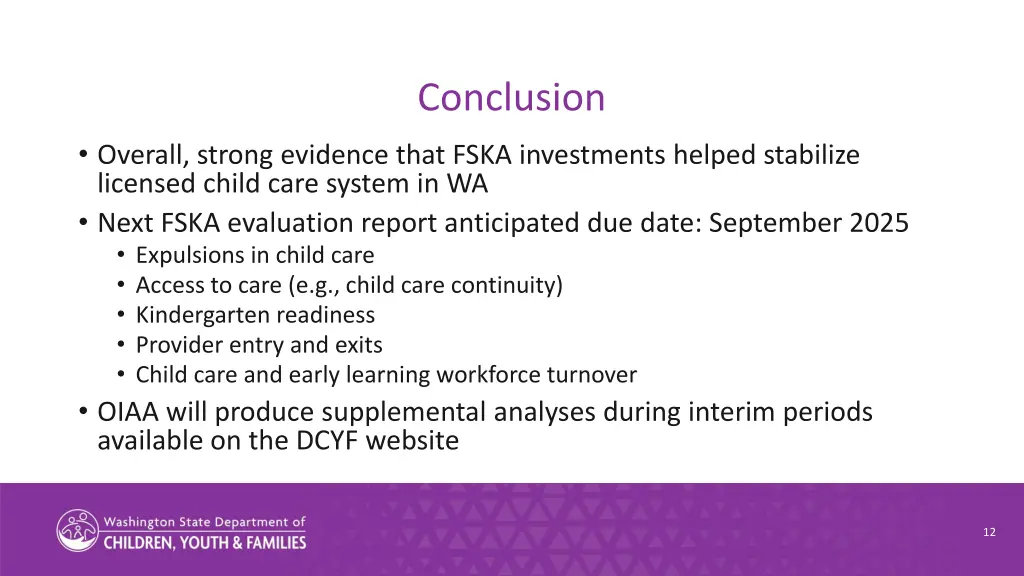
Conclusion Overall, strong evidence that FSKA investments helped stabilize licensed child care system in WA Next FSKA evaluation report anticipated due date: September 2025 Expulsions in child care Access to care (e.g., child care continuity) Kindergarten readiness Provider entry and exits Child care and early learning workforce turnover OIAA will produce supplemental analyses during interim periods available on the DCYF website 12
Thank you! Contact: OIAA@dcyf.wa.gov https://www.dcyf.wa.gov/sites/default/files/pdf/reports/FSKA- EvalReport-2023.pdf Suggested citation: Budrevich-Ryan, A., Ybarra, V., Seppi, J., Lothian, K., J. and Feldman, S. (2023). The Fair Start for Kids Act 2023 Evaluation Report. Washington State Department of Children, Youth, and Families Office of Innovation, Alignment, and Accountability. 13