The Million Bucks Concept - Transformative Technologies for Elite Genetics Distribution
Overall aim is to distribute elite genetics through modern reproductive technologies and surrogate sires, overcoming existing challenges in small ruminant breeding programs. Advantages include indigenous germ line ablated bucks and criteria for selection indices informed by Classic Breeders pyramid. Potential barriers like inbreeding depression and solutions are also discussed.

Download Presentation

Please find below an Image/Link to download the presentation.
The content on the website is provided AS IS for your information and personal use only. It may not be sold, licensed, or shared on other websites without obtaining consent from the author. If you encounter any issues during the download, it is possible that the publisher has removed the file from their server.
You are allowed to download the files provided on this website for personal or commercial use, subject to the condition that they are used lawfully. All files are the property of their respective owners.
The content on the website is provided AS IS for your information and personal use only. It may not be sold, licensed, or shared on other websites without obtaining consent from the author.
E N D
Presentation Transcript
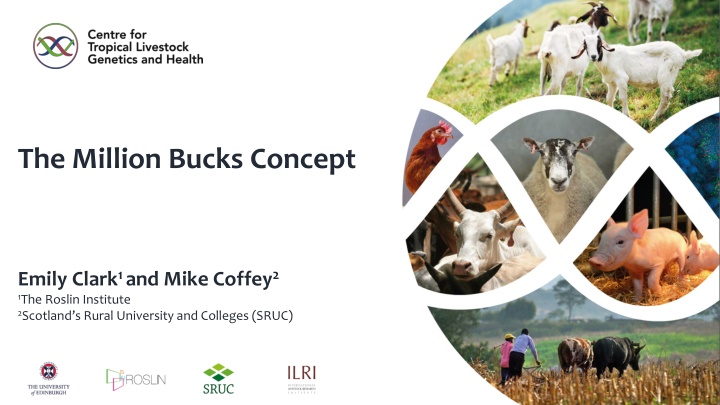
The Million Bucks Concept Emily Clark1 and Mike Coffey2 1The Roslin Institute 2Scotland s Rural University and Colleges (SRUC)
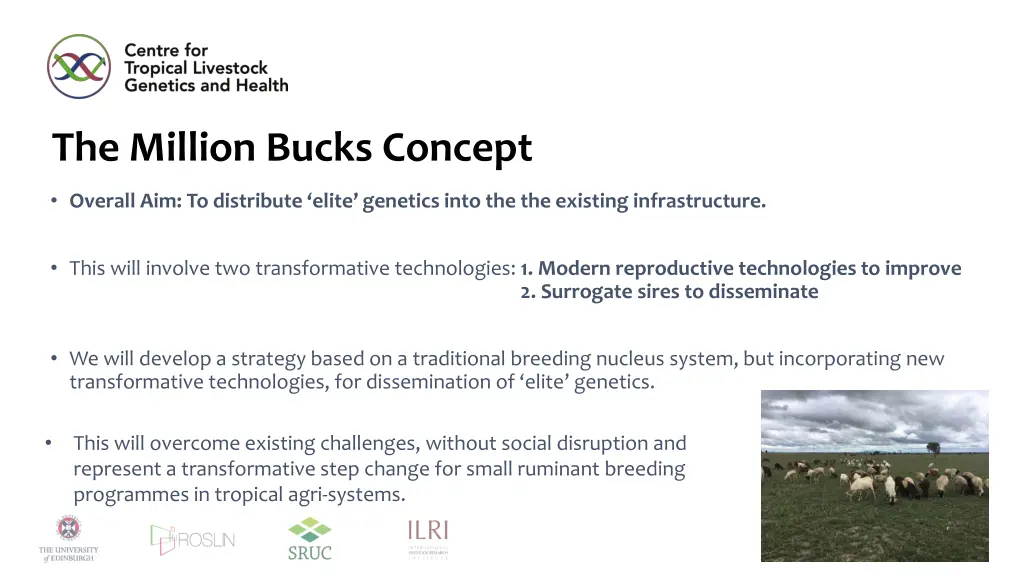
The Million Bucks Concept Overall Aim: To distribute elite genetics into the the existing infrastructure. This will involve two transformative technologies: 1. Modern reproductive technologies to improve 2. Surrogate sires to disseminate We will develop a strategy based on a traditional breeding nucleus system, but incorporating new transformative technologies, for dissemination of elite genetics. This will overcome existing challenges, without social disruption and represent a transformative step change for small ruminant breeding programmes in tropical agri-systems.
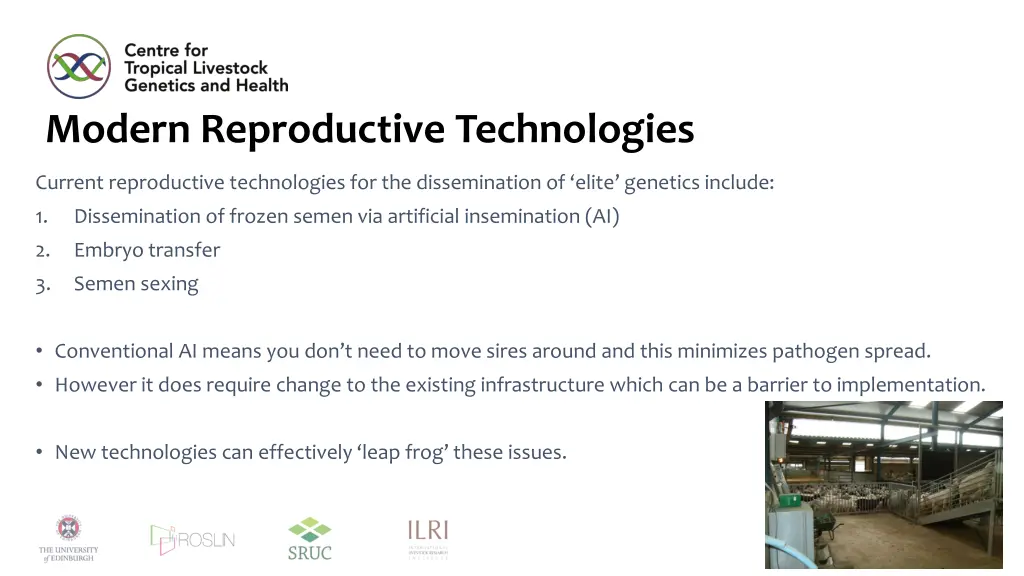
Modern Reproductive Technologies Current reproductive technologies for the dissemination of elite genetics include: 1. Dissemination of frozen semen via artificial insemination (AI) 2. Embryo transfer 3. Semen sexing Conventional AI means you don t need to move sires around and this minimizes pathogen spread. However it does require change to the existing infrastructure which can be a barrier to implementation. New technologies can effectively leap frog these issues.
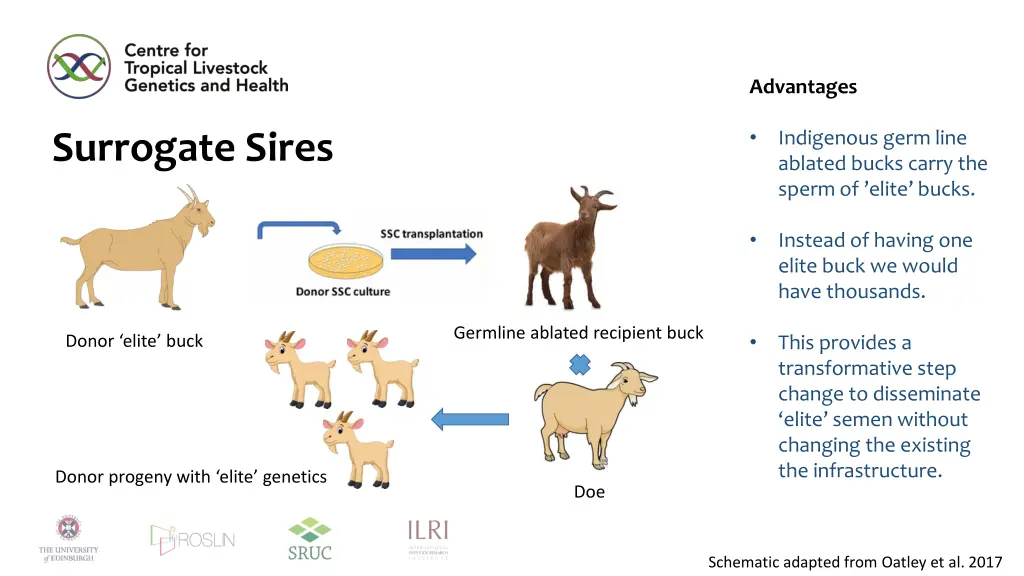
Advantages Indigenous germ line ablated bucks carry the sperm of elite bucks. Surrogate Sires Instead of having one elite buck we would have thousands. Germline ablated recipient buck Donor elite buck This provides a transformative step change to disseminate elite semen without changing the existing the infrastructure. Donor progeny with elite genetics Doe Schematic adapted from Oatley et al. 2017
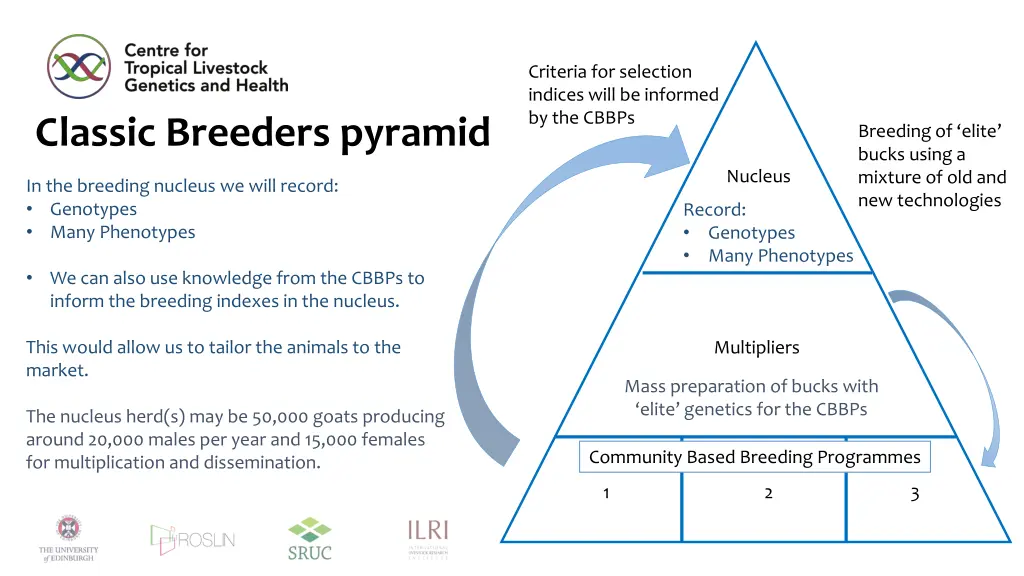
Criteria for selection indices will be informed by the CBBPs Classic Breeders pyramid Breeding of elite bucks using a mixture of old and new technologies Nucleus In the breeding nucleus we will record: Genotypes Many Phenotypes Record: Genotypes Many Phenotypes We can also use knowledge from the CBBPs to inform the breeding indexes in the nucleus. This would allow us to tailor the animals to the market. Multipliers Mass preparation of bucks with elite genetics for the CBBPs The nucleus herd(s) may be 50,000 goats producing around 20,000 males per year and 15,000 females for multiplication and dissemination. Community Based Breeding Programmes 3 1 2
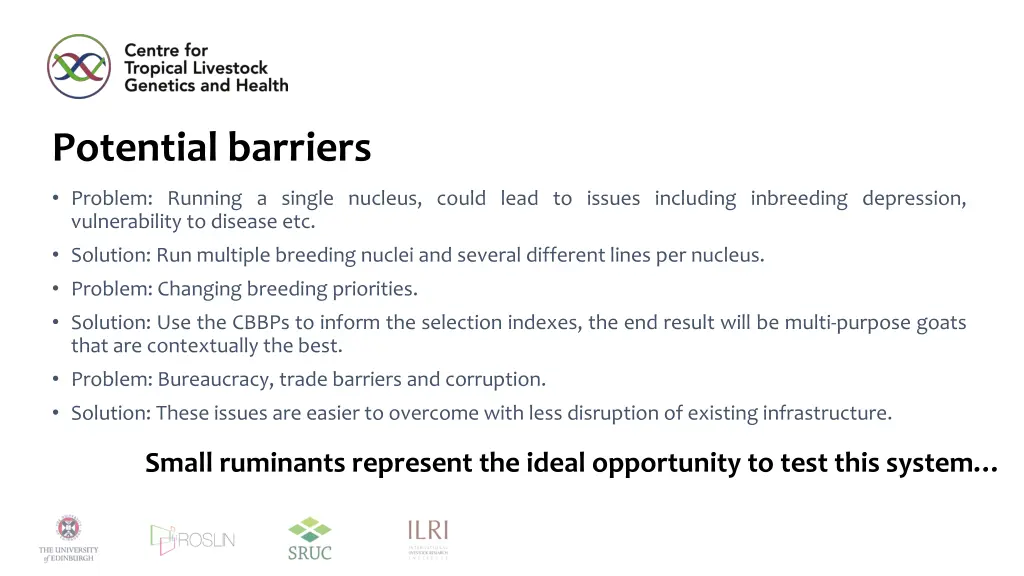
Potential barriers Problem: Running a single nucleus, could lead to issues including inbreeding depression, vulnerability to disease etc. Solution: Run multiple breeding nuclei and several different lines per nucleus. Problem: Changing breeding priorities. Solution: Use the CBBPs to inform the selection indexes, the end result will be multi-purpose goats that are contextually the best. Problem: Bureaucracy, trade barriers and corruption. Solution: These issues are easier to overcome with less disruption of existing infrastructure. Small ruminants represent the ideal opportunity to test this system