The Ontological Connection Between Image Schemas and Affordances
Discover the ontological analysis of image schemas and affordances, exploring their relationship and significance in cognition. Dive into the definition, examples, and implications of these cognitive elements.

Download Presentation

Please find below an Image/Link to download the presentation.
The content on the website is provided AS IS for your information and personal use only. It may not be sold, licensed, or shared on other websites without obtaining consent from the author. If you encounter any issues during the download, it is possible that the publisher has removed the file from their server.
You are allowed to download the files provided on this website for personal or commercial use, subject to the condition that they are used lawfully. All files are the property of their respective owners.
The content on the website is provided AS IS for your information and personal use only. It may not be sold, licensed, or shared on other websites without obtaining consent from the author.
E N D
Presentation Transcript
Linking Image Schemas with Affordances: An Ontological Approach Fumiaki Toyoshima and Adrien Barton JOWO 2019 @ Graz, Austria September 23, 2019
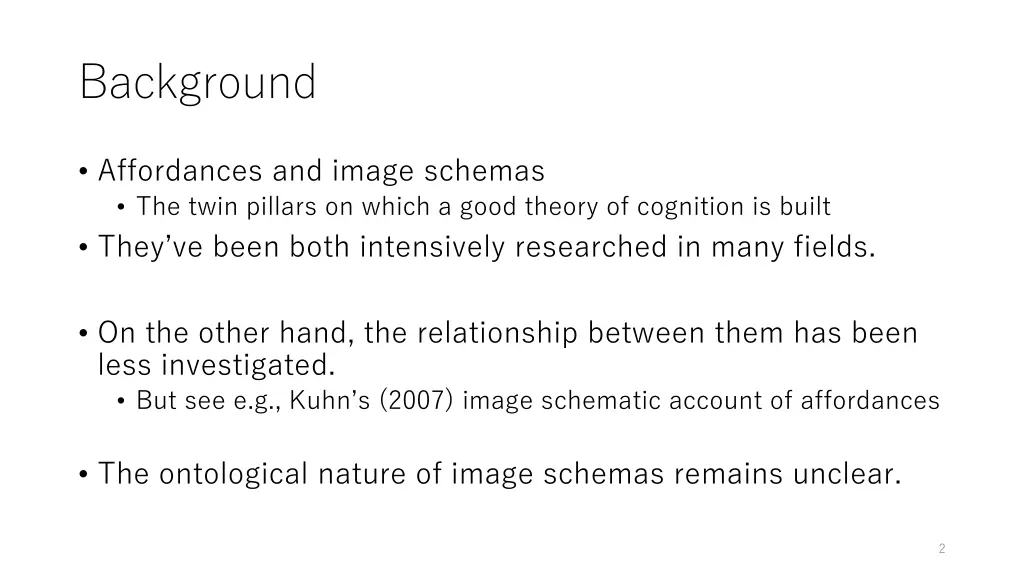
Background Affordances and image schemas The twin pillars on which a good theory of cognition is built They ve been both intensively researched in many fields. On the other hand, the relationship between them has been less investigated. But see e.g., Kuhn s (2007) image schematic account of affordances The ontological nature of image schemas remains unclear. 2
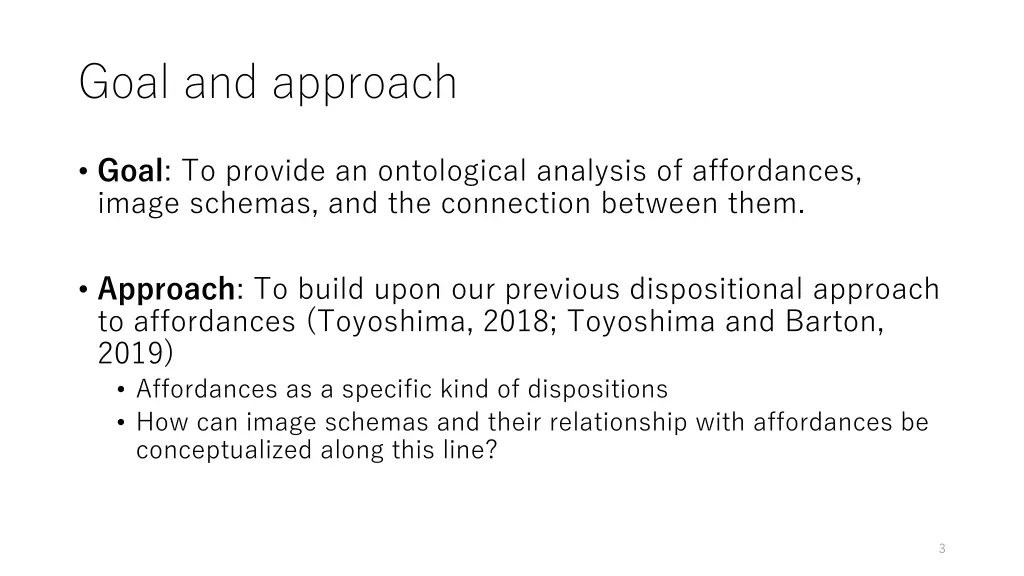
Goal and approach Goal: To provide an ontological analysis of affordances, image schemas, and the connection between them. Approach: To build upon our previous dispositional approach to affordances (Toyoshima, 2018; Toyoshima and Barton, 2019) Affordances as a specific kind of dispositions How can image schemas and their relationship with affordances be conceptualized along this line? 3
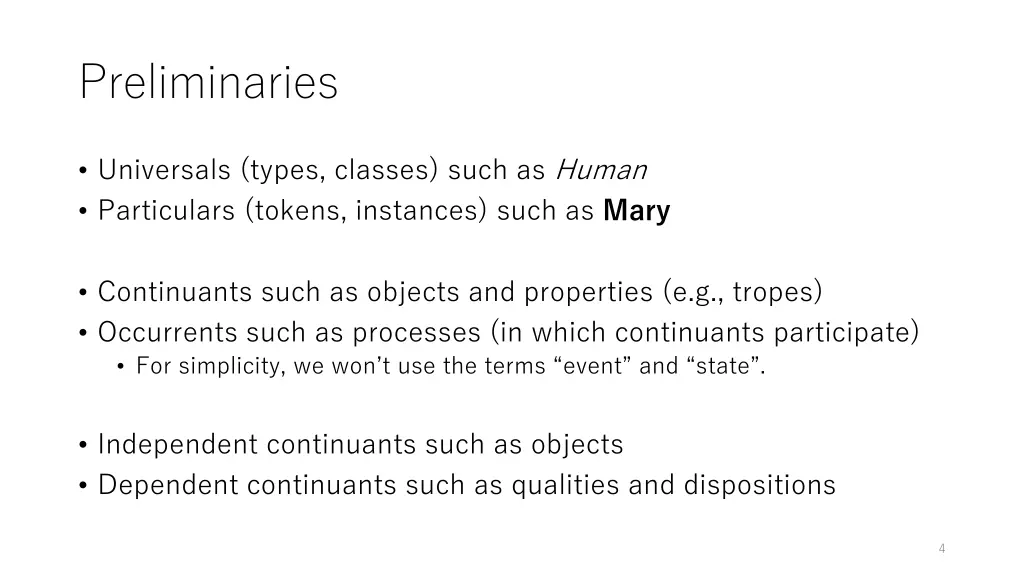
Preliminaries Universals (types, classes) such as Human Particulars (tokens, instances) such as Mary Continuants such as objects and properties (e.g., tropes) Occurrents such as processes (in which continuants participate) For simplicity, we won t use the terms event and state . Independent continuants such as objects Dependent continuants such as qualities and dispositions 4
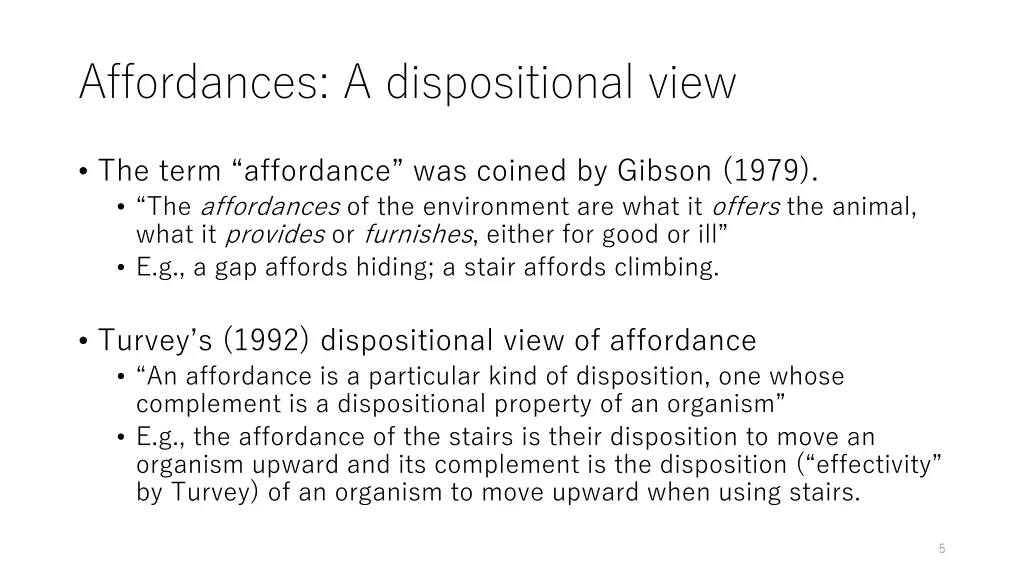
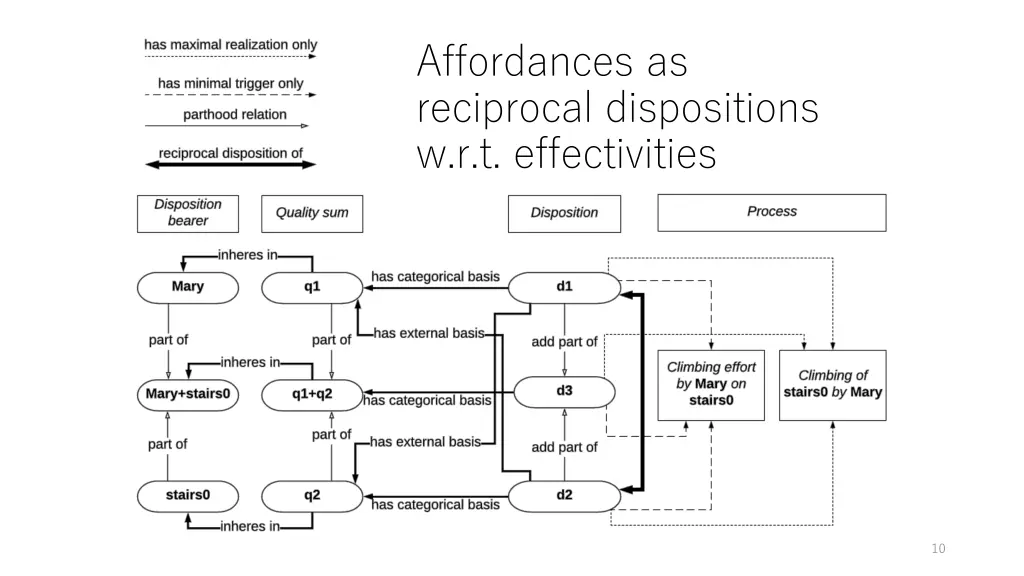
Affordances: A dispositional view The term affordance was coined by Gibson (1979). The affordances of the environment are what it offers the animal, what it provides or furnishes, either for good or ill E.g., a gap affords hiding; a stair affords climbing. Turvey s (1992) dispositional view of affordance An affordance is a particular kind of disposition, one whose complement is a dispositional property of an organism E.g., the affordance of the stairs is their disposition to move an organism upward and its complement is the disposition ( effectivity by Turvey) of an organism to move upward when using stairs. 5
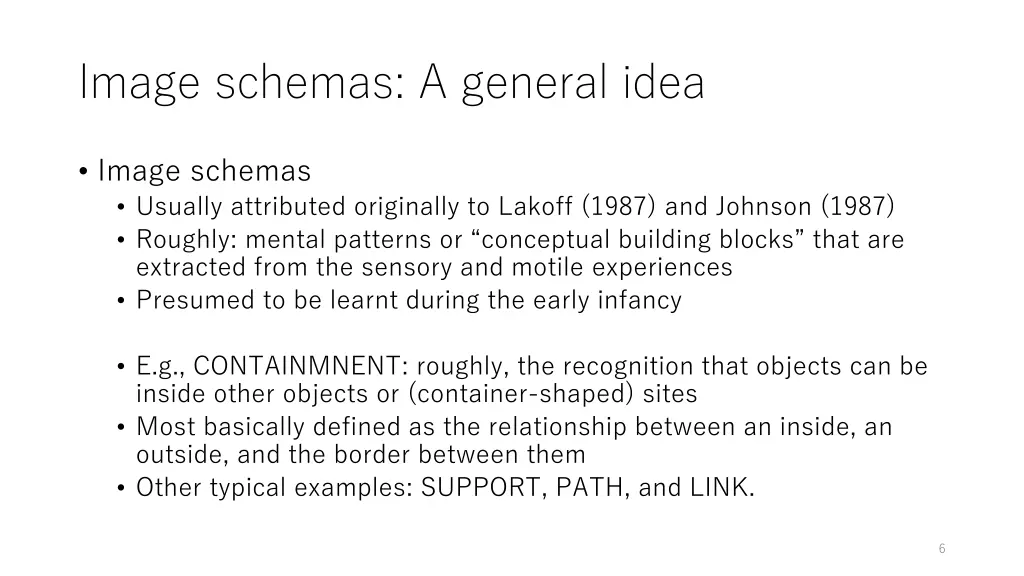
Image schemas: A general idea Image schemas Usually attributed originally to Lakoff (1987) and Johnson (1987) Roughly: mental patterns or conceptual building blocks that are extracted from the sensory and motile experiences Presumed to be learnt during the early infancy E.g., CONTAINMNENT: roughly, the recognition that objects can be inside other objects or (container-shaped) sites Most basically defined as the relationship between an inside, an outside, and the border between them Other typical examples: SUPPORT, PATH, and LINK. 6
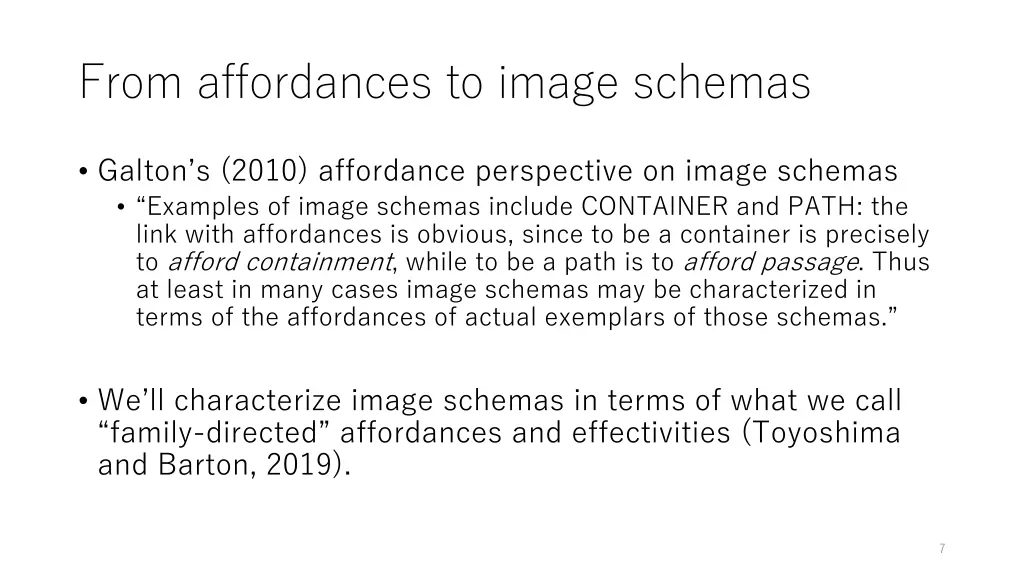
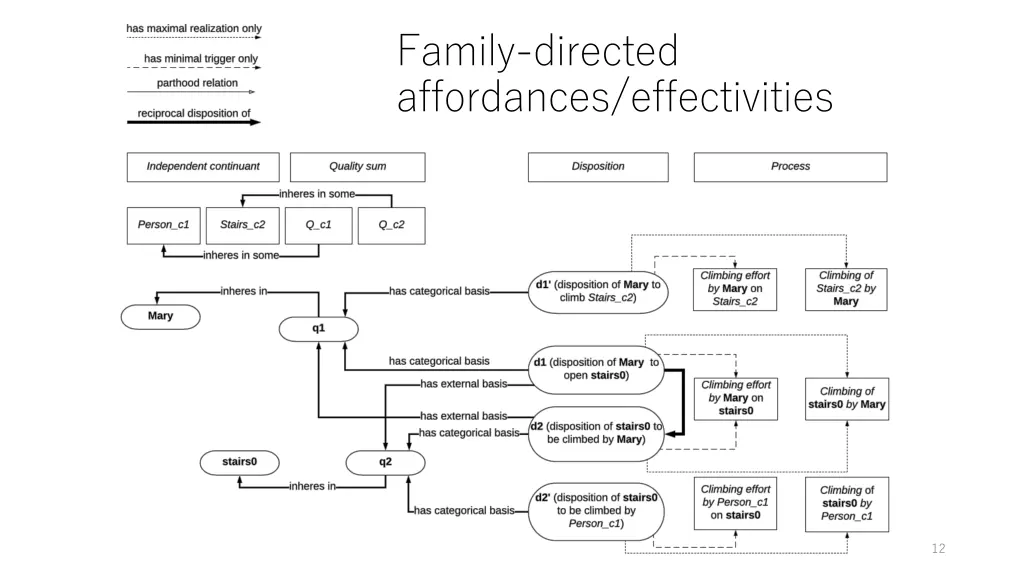
From affordances to image schemas Galton s (2010) affordance perspective on image schemas Examples of image schemas include CONTAINER and PATH: the link with affordances is obvious, since to be a container is precisely to afford containment, while to be a path is to afford passage. Thus at least in many cases image schemas may be characterized in terms of the affordances of actual exemplars of those schemas. We ll characterize image schemas in terms of what we call family-directed affordances and effectivities (Toyoshima and Barton, 2019). 7
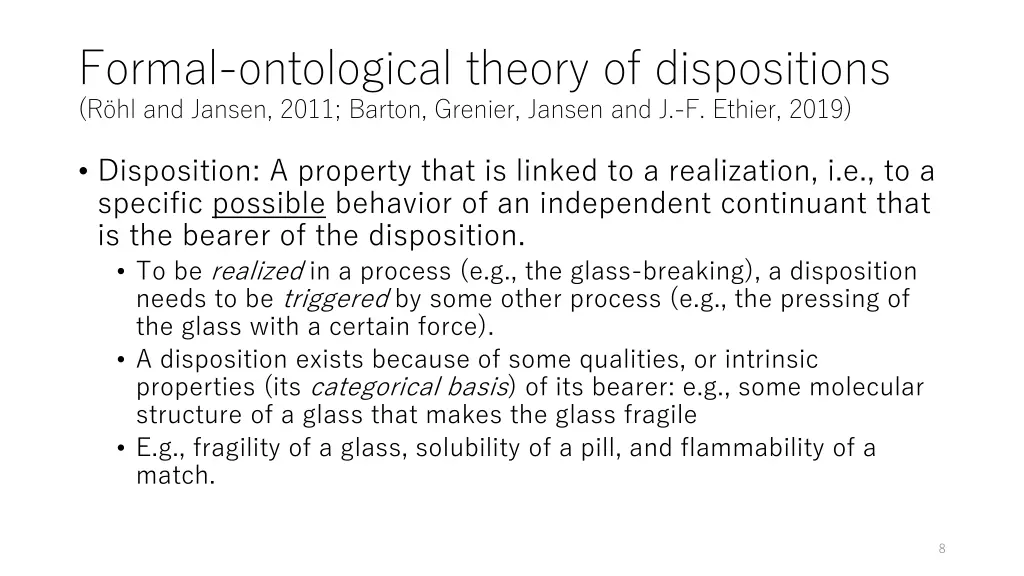
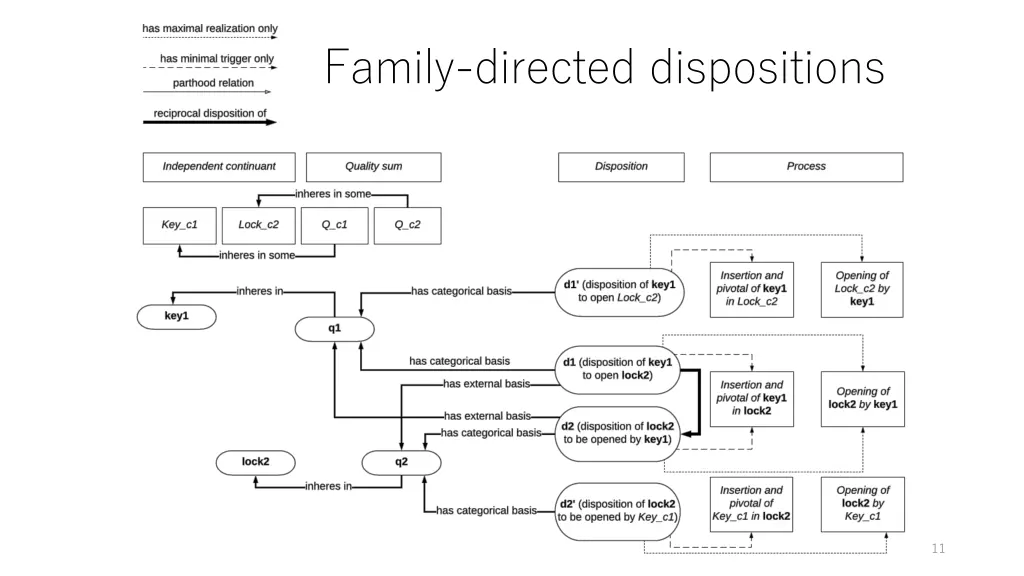
Formal-ontological theory of dispositions (R hl and Jansen, 2011; Barton, Grenier, Jansen and J.-F. Ethier, 2019) Disposition: A property that is linked to a realization, i.e., to a specific possible behavior of an independent continuant that is the bearer of the disposition. To be realized in a process (e.g., the glass-breaking), a disposition needs to be triggered by some other process (e.g., the pressing of the glass with a certain force). A disposition exists because of some qualities, or intrinsic properties (its categorical basis) of its bearer: e.g., some molecular structure of a glass that makes the glass fragile E.g., fragility of a glass, solubility of a pill, and flammability of a match. 8
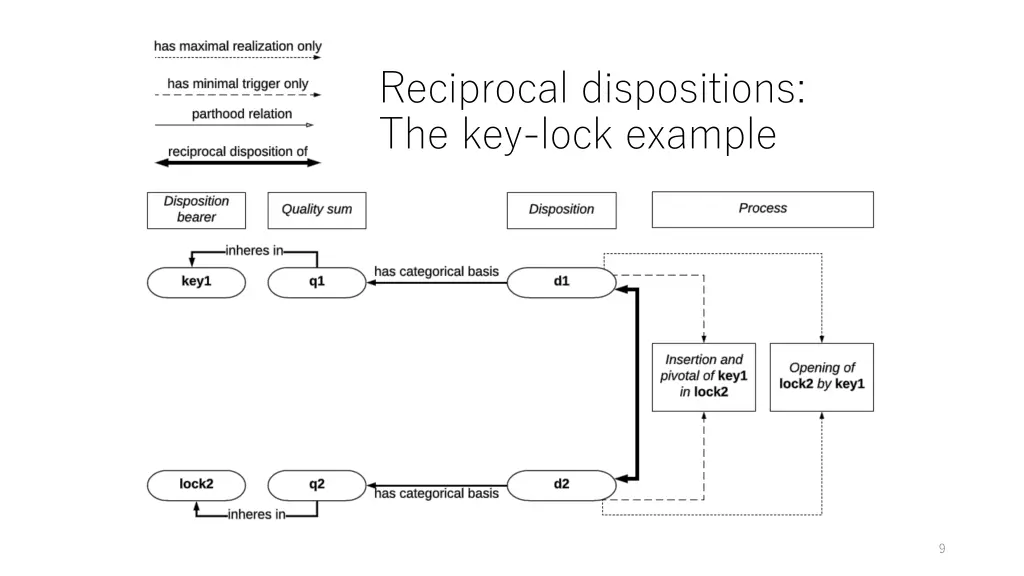
Reciprocal dispositions: The key-lock example 9
Affordances as reciprocal dispositions w.r.t. effectivities 10
Family-directed affordances/effectivities 12
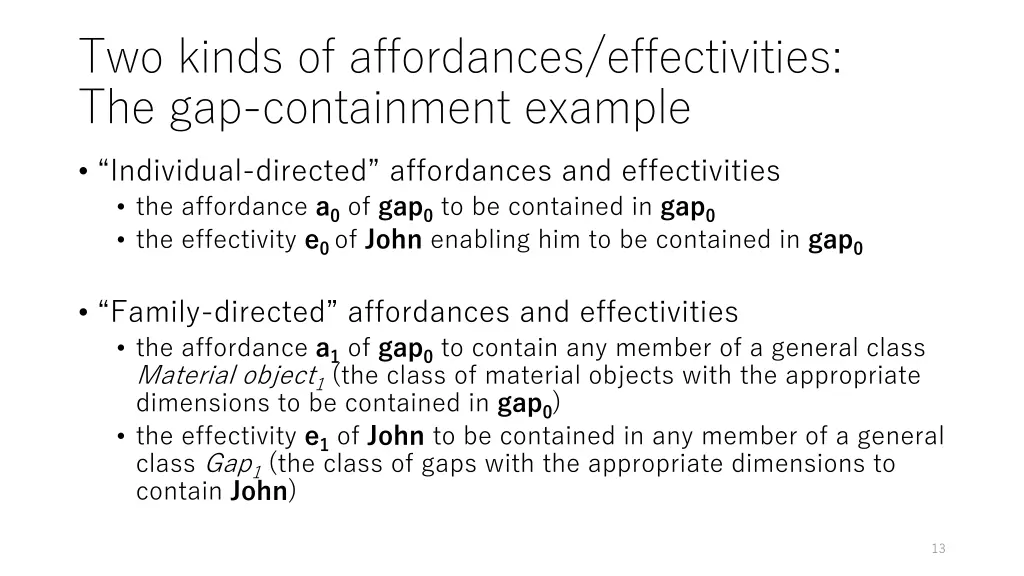
Two kinds of affordances/effectivities: The gap-containment example Individual-directed affordances and effectivities the affordance a0of gap0to be contained in gap0 the effectivity e0 of John enabling him to be contained in gap0 Family-directed affordances and effectivities the affordance a1of gap0to contain any member of a general class Material object1(the class of material objects with the appropriate dimensions to be contained in gap0) the effectivity e1of John to be contained in any member of a general class Gap1(the class of gaps with the appropriate dimensions to contain John) 13
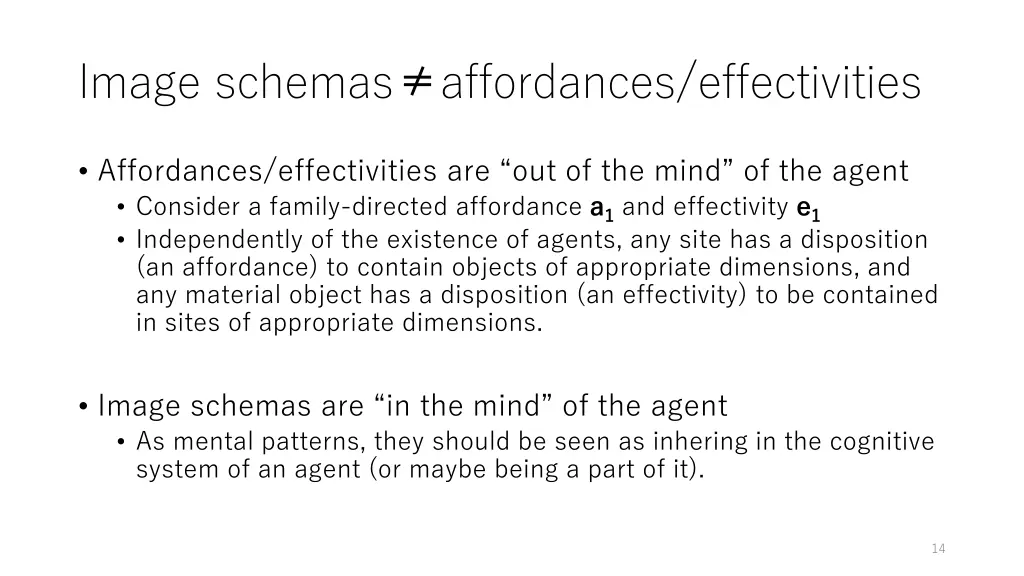
Image schemas affordances/effectivities Affordances/effectivities are out of the mind of the agent Consider a family-directed affordance a1and effectivity e1 Independently of the existence of agents, any site has a disposition (an affordance) to contain objects of appropriate dimensions, and any material object has a disposition (an effectivity) to be contained in sites of appropriate dimensions. Image schemas are in the mind of the agent As mental patterns, they should be seen as inhering in the cognitive system of an agent (or maybe being a part of it). 14
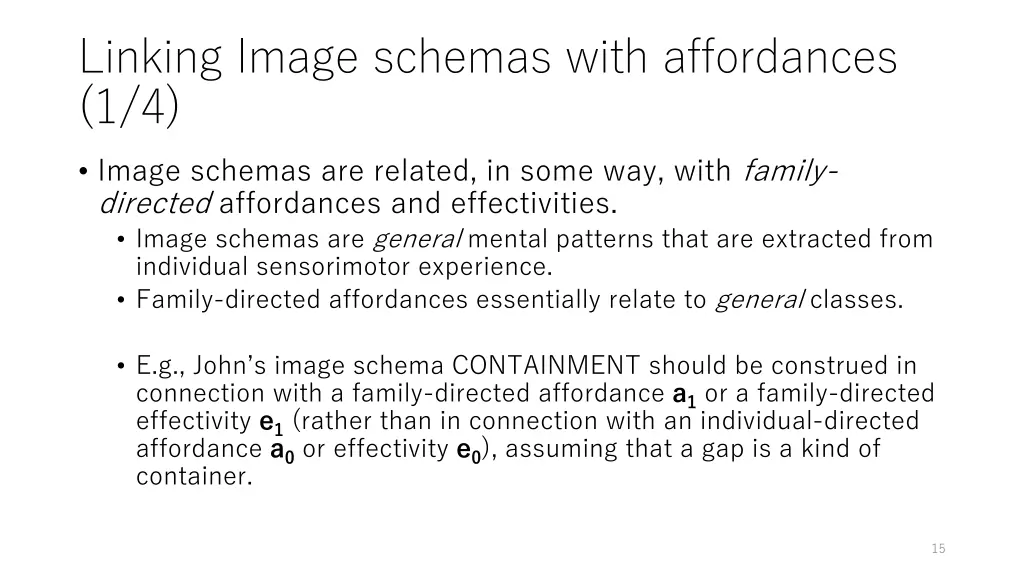
Linking Image schemas with affordances (1/4) Image schemas are related, in some way, with family- directed affordances and effectivities. Image schemas are general mental patterns that are extracted from individual sensorimotor experience. Family-directed affordances essentially relate to general classes. E.g., John s image schema CONTAINMENT should be construed in connection with a family-directed affordance a1or a family-directed effectivity e1(rather than in connection with an individual-directed affordance a0or effectivity e0), assuming that a gap is a kind of container. 15
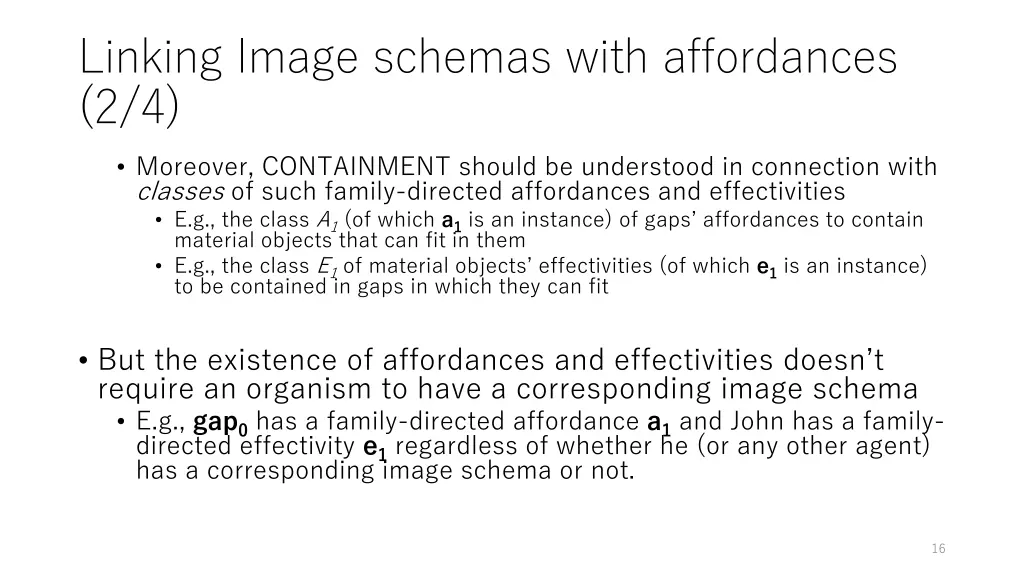
Linking Image schemas with affordances (2/4) Moreover, CONTAINMENT should be understood in connection with classes of such family-directed affordances and effectivities E.g., the class A1(of which a1is an instance) of gaps affordances to contain material objects that can fit in them E.g., the class E1of material objects effectivities (of which e1is an instance) to be contained in gaps in which they can fit But the existence of affordances and effectivities doesn t require an organism to have a corresponding image schema E.g., gap0has a family-directed affordance a1and John has a family- directed effectivity e1regardless of whether he (or any other agent) has a corresponding image schema or not. 16
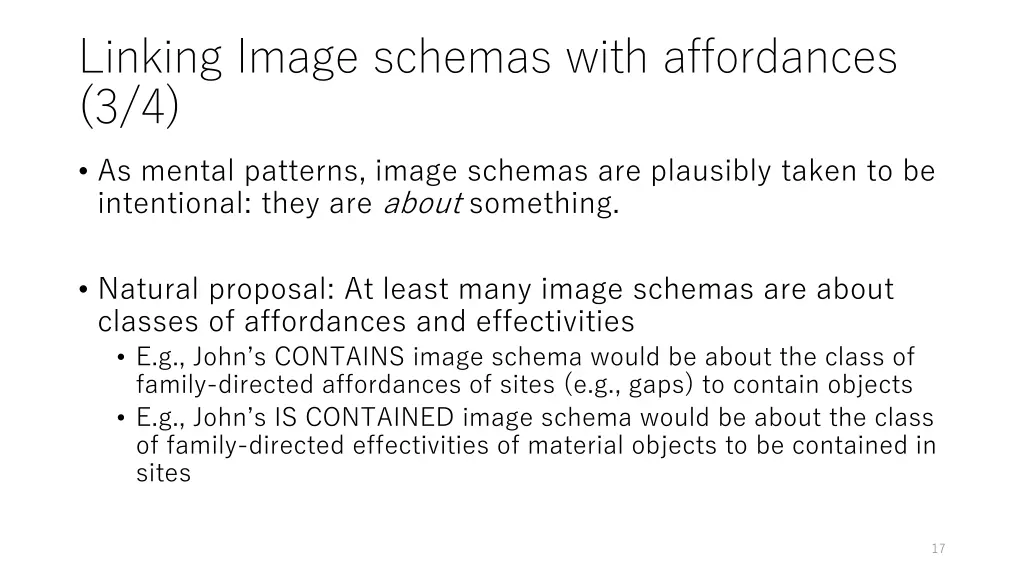
Linking Image schemas with affordances (3/4) As mental patterns, image schemas are plausibly taken to be intentional: they are about something. Natural proposal: At least many image schemas are about classes of affordances and effectivities E.g., John s CONTAINS image schema would be about the class of family-directed affordances of sites (e.g., gaps) to contain objects E.g., John s IS CONTAINED image schema would be about the class of family-directed effectivities of material objects to be contained in sites 17
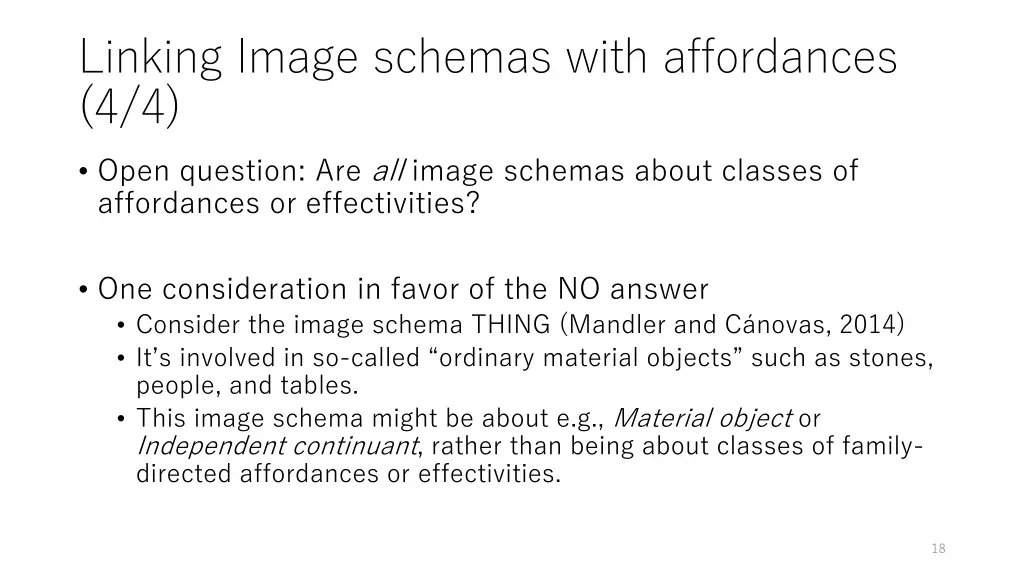
Linking Image schemas with affordances (4/4) Open question: Are all image schemas about classes of affordances or effectivities? One consideration in favor of the NO answer Consider the image schema THING (Mandler and C novas, 2014) It s involved in so-called ordinary material objects such as stones, people, and tables. This image schema might be about e.g., Material object or Independent continuant, rather than being about classes of family- directed affordances or effectivities. 18
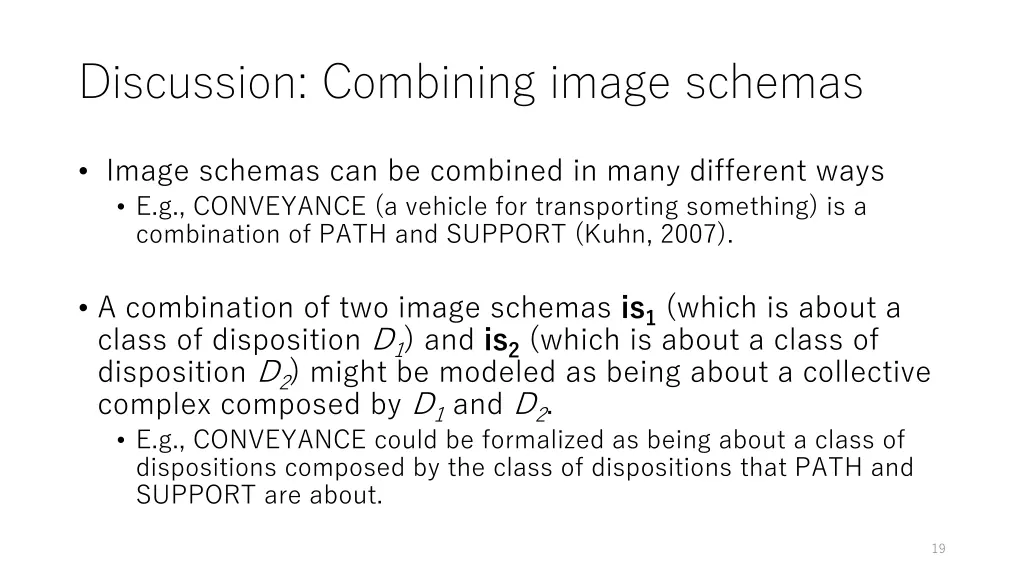
Discussion: Combining image schemas Image schemas can be combined in many different ways E.g., CONVEYANCE (a vehicle for transporting something) is a combination of PATH and SUPPORT (Kuhn, 2007). A combination of two image schemas is1(which is about a class of disposition D1) and is2(which is about a class of disposition D2) might be modeled as being about a collective complex composed by D1and D2. E.g., CONVEYANCE could be formalized as being about a class of dispositions composed by the class of dispositions that PATH and SUPPORT are about. 19
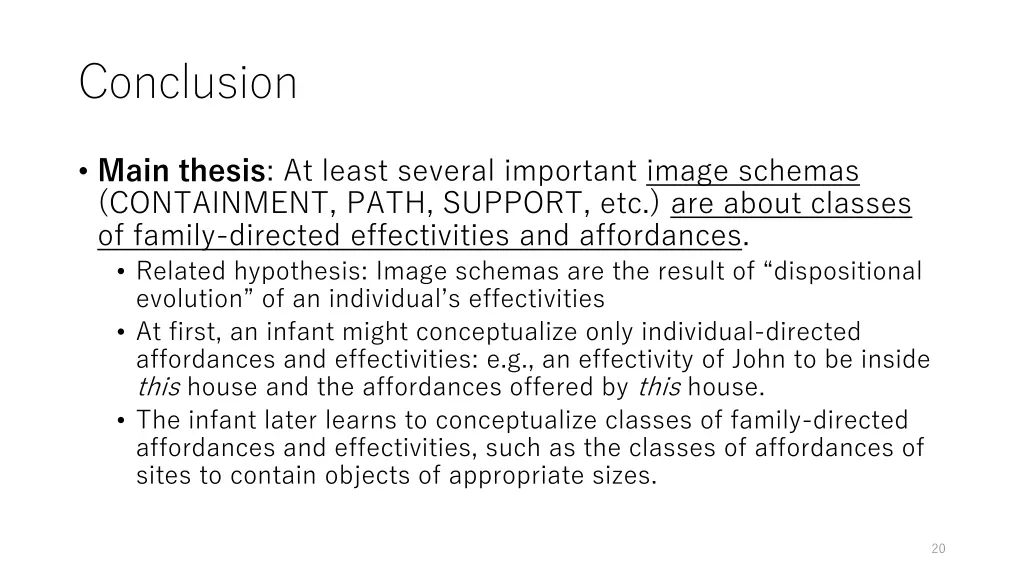
Conclusion Main thesis: At least several important image schemas (CONTAINMENT, PATH, SUPPORT, etc.) are about classes of family-directed effectivities and affordances. Related hypothesis: Image schemas are the result of dispositional evolution of an individual s effectivities At first, an infant might conceptualize only individual-directed affordances and effectivities: e.g., an effectivity of John to be inside this house and the affordances offered by this house. The infant later learns to conceptualize classes of family-directed affordances and effectivities, such as the classes of affordances of sites to contain objects of appropriate sizes. 20
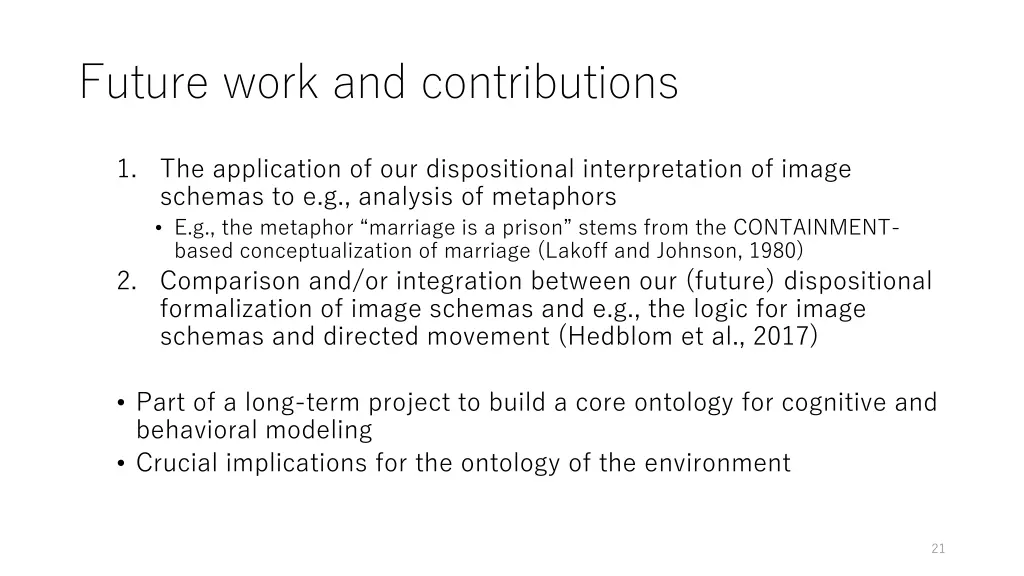
Future work and contributions 1. The application of our dispositional interpretation of image schemas to e.g., analysis of metaphors E.g., the metaphor marriage is a prison stems from the CONTAINMENT- based conceptualization of marriage (Lakoff and Johnson, 1980) 2. Comparison and/or integration between our (future) dispositional formalization of image schemas and e.g., the logic for image schemas and directed movement (Hedblom et al., 2017) Part of a long-term project to build a core ontology for cognitive and behavioral modeling Crucial implications for the ontology of the environment 21
Thank you for your attention! Fumiaki Toyoshima: toyo.fumming@gmail.com Adrien Barton: adrien.barton@irit.fr (Note: All the abbreviated references in this presentation can be found in our paper.) 22