The Urinary System: Functions and Structures

The urinary system plays a crucial role in filtering blood, producing urine, and maintaining fluid balance in the body. This system consists of various organs such as the kidneys, ureters, bladder, and urethra. Learn about the anatomy, functions, and coverings of the kidneys, along with the role of nephrons and the suprarenal glands in maintaining overall health.

Download Presentation

Please find below an Image/Link to download the presentation.
The content on the website is provided AS IS for your information and personal use only. It may not be sold, licensed, or shared on other websites without obtaining consent from the author.If you encounter any issues during the download, it is possible that the publisher has removed the file from their server.
You are allowed to download the files provided on this website for personal or commercial use, subject to the condition that they are used lawfully. All files are the property of their respective owners.
The content on the website is provided AS IS for your information and personal use only. It may not be sold, licensed, or shared on other websites without obtaining consent from the author.
E N D
Presentation Transcript
Dr. Dr. Muna Muna Hameed Hameed Al Al- -Saeed Saeed The Urinary System 1
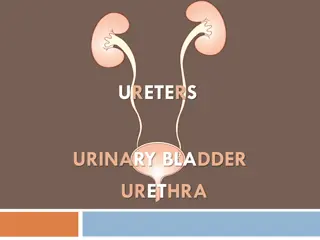
The urinary system's function is to filter blood and create urine as a waste by-product. The urinary system organs ureters, include the two kidneys, renal pelvis, two bladder, and urethra. The Kidneys: The kidneys a The Kidneys: The kidneys are solid, bean-shaped organs. Located below the ribs toward the middle of the back. The right kidney is positioned slightly lower than the left. Each of which is about 11 cm long, 6 cm wide, 3 cm thick. The average weight is 150 gm in male & 135 gm in female Each kidney has a lateral convex & medial concave border. 2
The function of the kidney Remove waste products and drugs from the body. Balance the body's fluids. Release hormones to regulate blood pressure. Control production of red blood cells 3
Coverings of kidneys: The kidneys have the following coverings: 1-Fibrous capsule: This surrounds the kidney and is closely applied to its outer surface. 2. Perirenal fat: This covers the fibrous capsule. 3. Renal fascia: This is a connective tissue that lies outside the perirenal fat and encloses the kidneys and suprarenal glands. 4. Pararenal fat: This lies external to the ities renal fascia and is often in large quantitities. .1 .2 .3 .4 4
When a kidney is cut lengthwise, 2- regions become apparent. 1. Cortex: The outer region, which is light in color. 2. Medulla: It is a darker reddish-brown area, deep to the cortex. The parenchyma of the kidney consists of renal tubules. These renal tubules are consisting of 1. Secretory (Nephron): its function is the formation of urine. 2. Excretory tubules: These are ducts that collect urine and carry it to the pelvis tubules 5
Each nephron consists of: 1. The renal corpuscle consists of two parts (Glomerulus, Bowman's capsule) 2. Proximal convoluted tubule. 3. Loop of Henle. 4. distal convoluted tubule The Suprarenal glands (Adrenal glands): The adrenal glands are small glands located on top of each kidney. They produce essential hormones, including sex hormones and cortisol . 6