Theoretical Studies on Astatine Isotopes Alpha-Decay Half-Lives

Theoretical studies on alpha-decay half-lives for astatine isotopes, exploring quantum tunneling predictions and recent works in nuclear physics. Astatine, a highly radioactive element with various isotopes, presents challenges in understanding its decay mechanisms and energies.

Download Presentation

Please find below an Image/Link to download the presentation.
The content on the website is provided AS IS for your information and personal use only. It may not be sold, licensed, or shared on other websites without obtaining consent from the author.If you encounter any issues during the download, it is possible that the publisher has removed the file from their server.
You are allowed to download the files provided on this website for personal or commercial use, subject to the condition that they are used lawfully. All files are the property of their respective owners.
The content on the website is provided AS IS for your information and personal use only. It may not be sold, licensed, or shared on other websites without obtaining consent from the author.
E N D
Presentation Transcript
Theoretical Studies on alpha-decay half-lives for Astatine Isotopes Ali Hassan Ahmed Dashty T. Jamel S.S. Hosseini H. Hassanabadi Faculty of Physics, Shahrood Univ. of Technology Salahaddin Univ. - Erbil Ministry of Education Sept. 18 2019
Outlines * Introduction (Scientific Background) * Theoretical Predictions * Recent Works * Our approach
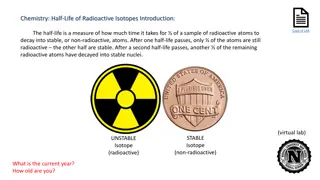
Introduction The chemical element Astatine is classed as a halogen and a nonmetal. It was discovered in 1940 by Dale R. Coson, Kenneth Ross Mackenzie and Emilio Segr . Astatine (85At) has 39 known isotopes, all of which are radioactive; the range of their mass numbers is from 191 to 229. There also exist 23 metastable excited states. The longest-lived isotope is210At, which has a half-life of 8.1 hours; the longest-lived isotope existing in naturally occurring decay chains is219At with a half-life of 56 seconds. Abundance earth s crust: About 25 grams exists in Earth s crust at any given time. Abundance solar system: negligible
Alpha decay energy follows the same trend as for other heavy elements. Lighter astatine isotopes have quite high energies of alpha decay, which become lower as the nuclei become heavier. Astatine is highly radioactive (harmful), and Astatine-211 is sometimes used as a radioactive tracer and in cancer treatment. Like iodine, it is known to accumulate in the thyroid gland. Yet, thousands of short-lived isotopes are continually created in the cosmos. The properties of most isotopes are unknown and can be only inferred, with considerable uncertainty, from theoretical calculations.
Theoretical Predictions Quantum Tunneling WKB Approximation T is transmission coefficient, R is radius of nucleus. derived in Yung-Kuo Lim (originally by Gammow) image from hyperphysics.phy-astr.gsu.edu
After some algebra and simplifying for the nuclear case ( ) 2 = 2 2 2 ~ 60 120 G Z Z e D 2 2 Q h 55 27 ~ 10 10 T then t1/2=ln2 =ln2 ln2 )/ 2R fT= 2 V0+Q ( 1/2 e 2G This is called the one-body theory of alpha decay
Recent Works and our approach PHYSICAL REVIEW C 85, 027306 (2012) REVIEW C 94, 024320 (2016) Nuclear Physics A 971 (2018) International Journal of Modern Physics E (Nuclear) vol. 27 no.8 (2018)
The Coulomb and proximity potential model (CPPM) ? ? + ? ?? ???? is the universal function proximity potential which is given as = / z b Where is the overlap distance in units of b between the colliding surfaces, b 1 (fm) is the width of the nuclear surface and z is the distance between the near surfaces of the fragments
A. I. Budaca, R. Budaca, I. Silisteanu, Nuclear Physics A, 951, 6074, (2016). Where a=10.8238, b=0.5966, c=-56.9785 for e-e nuclei, a=14.7747, b=0.5021, c=-49.97080 for e-o nuclei, a=11.1462, b=0.5110, c=-39.0096 for o-e nuclei and a=14.7405, b=0.4666, c=-41.72227 for o-o nuclei.
Empirical Formula for Calculating (n, ) Reaction Cross Sections at 14.5 MeV Neutrons Ali Hassan Ahmed Salahaddin University - Erbil Dashty T. Jamel Ministry of Education Rozhan Dilshad Haidar Salahaddin University - Erbil Sept. 18 2019
Outlines * Introduction * Theory and Empirical Predictions * Recent Works and our approach
Introduction The cross sections of neutron induced charged particle reactions have much importance in nuclear structure investigations and applications of nuclear energy. cross section data for the neutron reactions are often needed for the reactor design and in understanding the nuclear phenomena The studies of (n, ) reaction cross sections are required for estimating radiation damage caused by proton production, nuclear heating in the components, and structural transmutations in the materials of fusion and fission reactors. When experimental data are rare or not available and theoretical calculations sounds incorrect, systematics are used for estimating neutron induced reaction cross-section.
Empirical Formulae Different empirical and semi-empirical formulae were proposed by several authors to study the systematic dependence of (n, p), (n, ) and (n, 2n) reaction cross-sections for neutron energy around 14 - 15 MeV. Also in many cases neutron generators is being used in the measurement of (n, p), (n, a) reaction cross sections within this neutron energy range, hence it is important to have empirical formulae for the reaction cross sections under study at the specified neutron energy. As a rule, in empirical approaches, the cross-section is expressed by an exponential function with its argument depending on the number of nucleons in the target nucleus.
? ?,? = ? ??? ??(??)/? where ??? is the non-elastic cross section and C and ? are parameters determined from the least square fitting for different reactions, and ???= ??2 (?1/3+ 1)2 with ro = 1.2 x 10⁻¹³ cm.
Konobeyev AY, Fischer U, and Broeders CH. Published in Applied Radiation and Isotopes 2009.
Thus, in our approach for the (n, ) reaction cross section formalism, the term ? ???will be replaced with other physical parameters as: ? ?, = ? (?) ??(? ?)/? The comparison of predicted cross sections with the experimental data and the previous suggested formulae will be done through chi-square x2 and R2 values.
The importance of these studies: 1. -decay has been a powerful tool to study the properties of unstable nuclei and identify new elements and their isotopes. 2. By these analytic formulas and empirical relationships, the -decay half-lives can be estimated easily. Especially, they are usually used to predict the -decay half-lives to serve the experimental design. 3. A reliable model for the long -decay half-lives is helpful for searching for the island of stability of 200-219At nuclei.
fleeting promethium extant Recent Works and our Intent argument island of stability
3. The spontaneous emission of a charged particle heavier than an particle but lighter than a fission fragment is known as cluster radioactivity. There is a whole family of such a disintegration mode: 14C radioactivity, 24Ne radioactivity, 28Mg radioactivity, and so on. Wentzel Kramers Brillouin An exotic atom is an otherwise normal atom in which one or more sub-atomic particles have been replaced by other particles of the same charge. For example, electrons may be replaced by other negatively charged particles such as muons (muonic atoms) or pions (pionic atoms).[1][2]Because these substitute particles are usually unstable, exotic atoms typically have very short lifetimes.