Theories of Evolution
Explore the different theories of evolution discussed on February 25th, 2019. Dive into the fascinating world of evolutionary biology and learn about the mechanisms driving the diversity of life on Earth.

Download Presentation

Please find below an Image/Link to download the presentation.
The content on the website is provided AS IS for your information and personal use only. It may not be sold, licensed, or shared on other websites without obtaining consent from the author.If you encounter any issues during the download, it is possible that the publisher has removed the file from their server.
You are allowed to download the files provided on this website for personal or commercial use, subject to the condition that they are used lawfully. All files are the property of their respective owners.
The content on the website is provided AS IS for your information and personal use only. It may not be sold, licensed, or shared on other websites without obtaining consent from the author.
E N D
Presentation Transcript
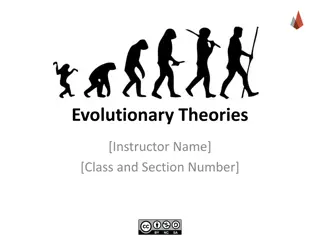
Theories of Evolution FEBRUARY 25TH, 2019
Up to now Generally speaking, Church thinking dominated talks about origins Ideas of evolution present from early Greek thinkers For example, Empedocles Medieval period accepted Aristotle s immutable/hierarchical order Provided order for origins Provided structure to civil society (rulers could refer to God for power) 19thcentury evolution developed explanations of species change Undermined the Great Chain of Being order of the previous 1500 years
Roadmap Early Evolutionary Theories Herbert Spencer Charles Darwin Francis Galton Comparative Psychology
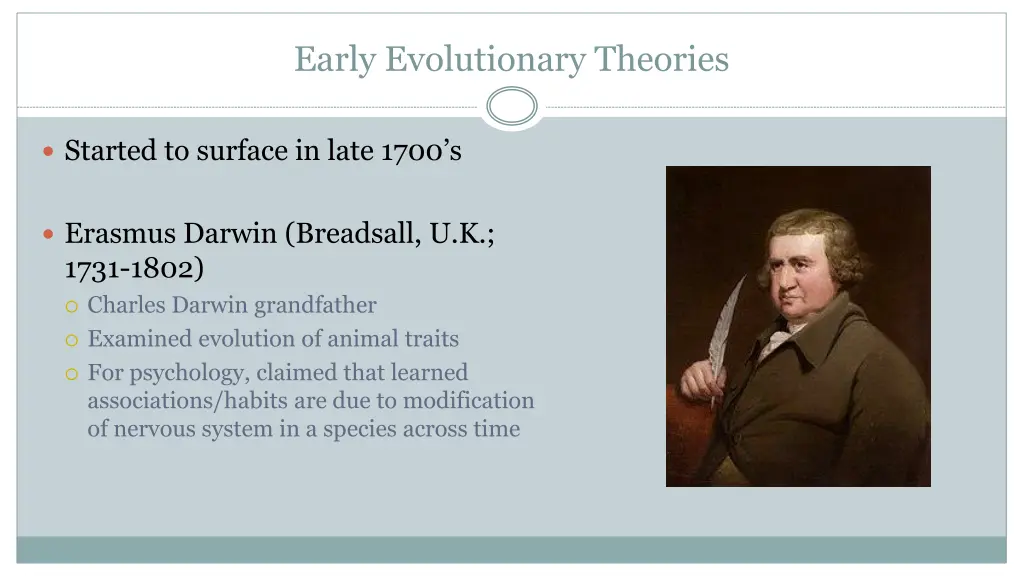
Early Evolutionary Theories Started to surface in late 1700 s Erasmus Darwin (Breadsall, U.K.; 1731-1802) Charles Darwin grandfather Examined evolution of animal traits For psychology, claimed that learned associations/habits are due to modification of nervous system in a species across time
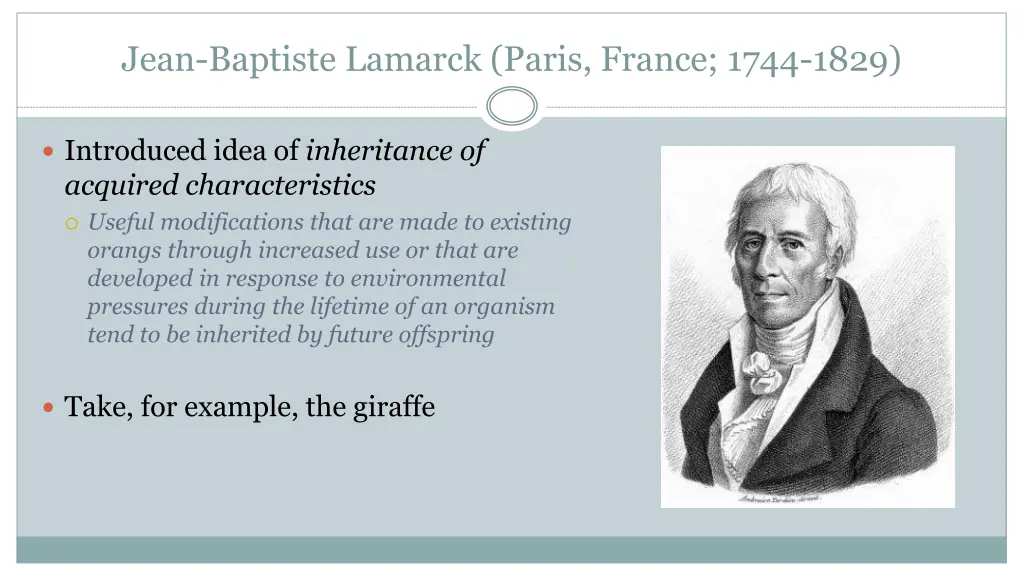
Jean-Baptiste Lamarck (Paris, France; 1744-1829) Introduced idea of inheritance of acquired characteristics Useful modifications that are made to existing orangs through increased use or that are developed in response to environmental pressures during the lifetime of an organism tend to be inherited by future offspring Take, for example, the giraffe
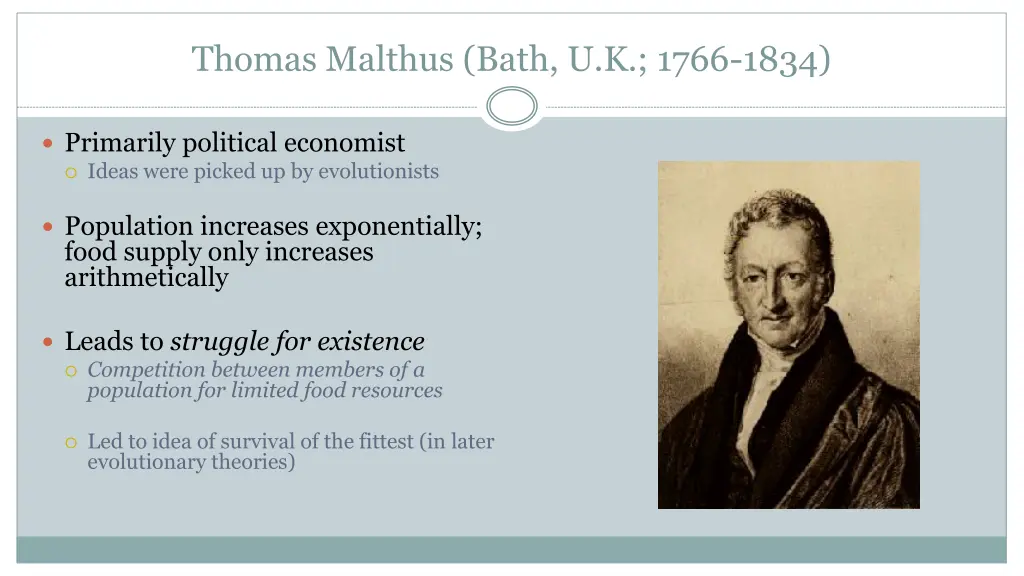
Thomas Malthus (Bath, U.K.; 1766-1834) Primarily political economist Ideas were picked up by evolutionists Population increases exponentially; food supply only increases arithmetically Leads to struggle for existence Competition between members of a population for limited food resources Led to idea of survival of the fittest (in later evolutionary theories)
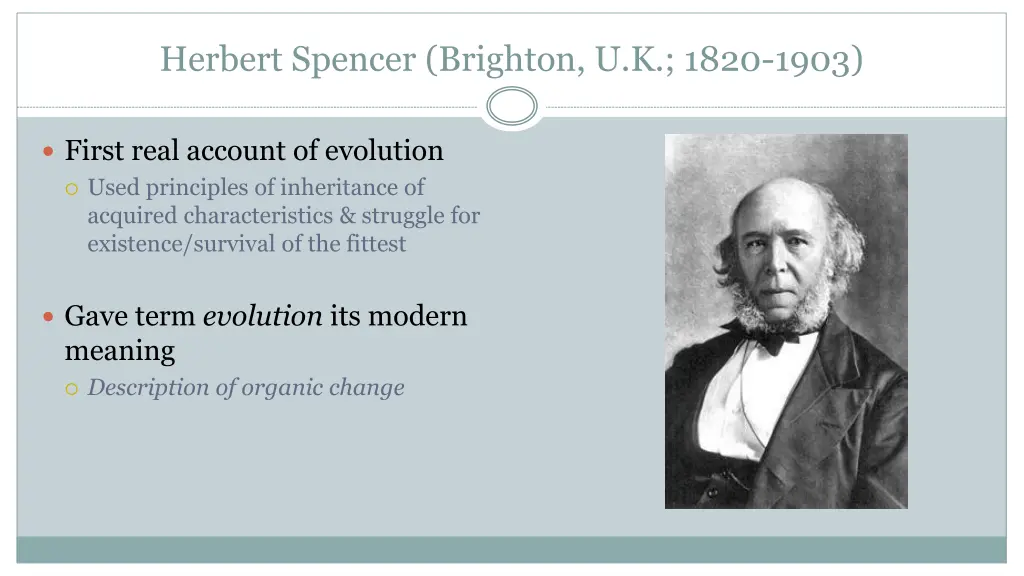
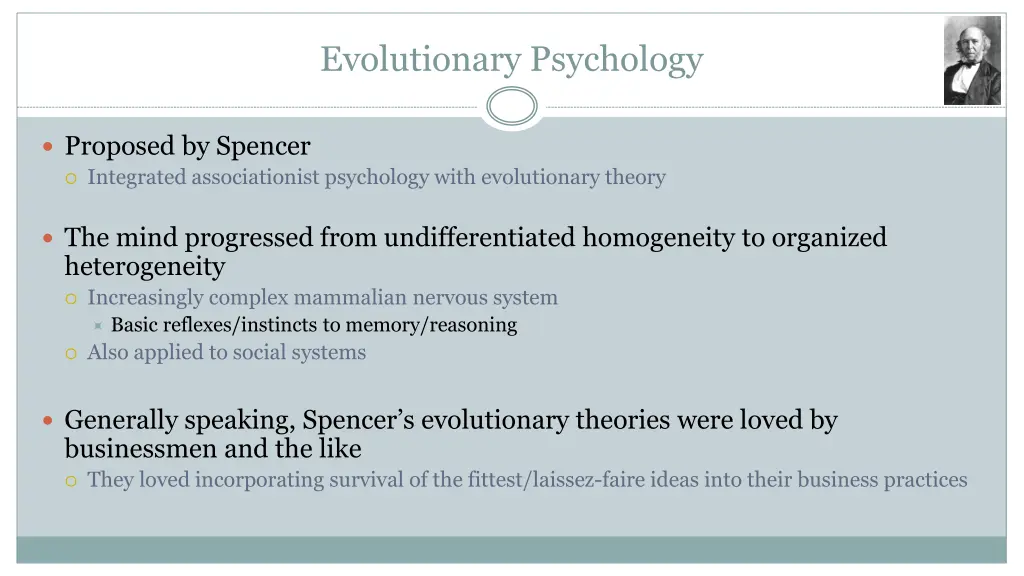
Herbert Spencer (Brighton, U.K.; 1820-1903) First real account of evolution Used principles of inheritance of acquired characteristics & struggle for existence/survival of the fittest Gave term evolution its modern meaning Description of organic change
Herbert Spencer Conceived of evolution as a cosmic force governed by the principle of the conservation of energy Application of persistent force to material bodies leads to progressive individuation Only organisms that are well-endowed through successful adaptation survive & propagate Advocated for soft heredity Mechanism of inheritance through biological reproduction can be influenced by the life history of organisms Basically, offspring can remember the experience of its ancestors
Social Darwinism Application of theories of evolution based upon survival of the fittest theories of social change and political practice Spencer s own theory most influential advocated for laissez-faire evolution Social progress is best assured by leaving biological, psychological, & social evolution to its natural course I m sure you can figure out how that can go wrong/be immoral Advocated that government should not intervene in economic, educational, or health matters No social support programs in place whatsoever Tough on poor, sick, unemployed, and elderly
Evolutionary Psychology Proposed by Spencer Integrated associationist psychology with evolutionary theory The mind progressed from undifferentiated homogeneity to organized heterogeneity Increasingly complex mammalian nervous system Basic reflexes/instincts to memory/reasoning Also applied to social systems Generally speaking, Spencer s evolutionary theories were loved by businessmen and the like They loved incorporating survival of the fittest/laissez-faire ideas into their business practices
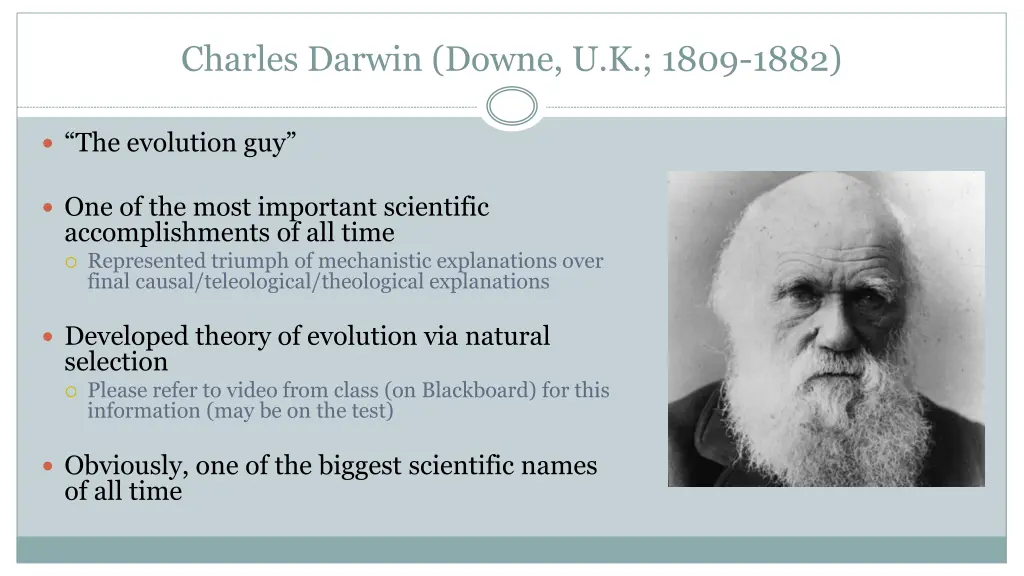
Charles Darwin (Downe, U.K.; 1809-1882) The evolution guy One of the most important scientific accomplishments of all time Represented triumph of mechanistic explanations over final causal/teleological/theological explanations Developed theory of evolution via natural selection Please refer to video from class (on Blackboard) for this information (may be on the test) Obviously, one of the biggest scientific names of all time
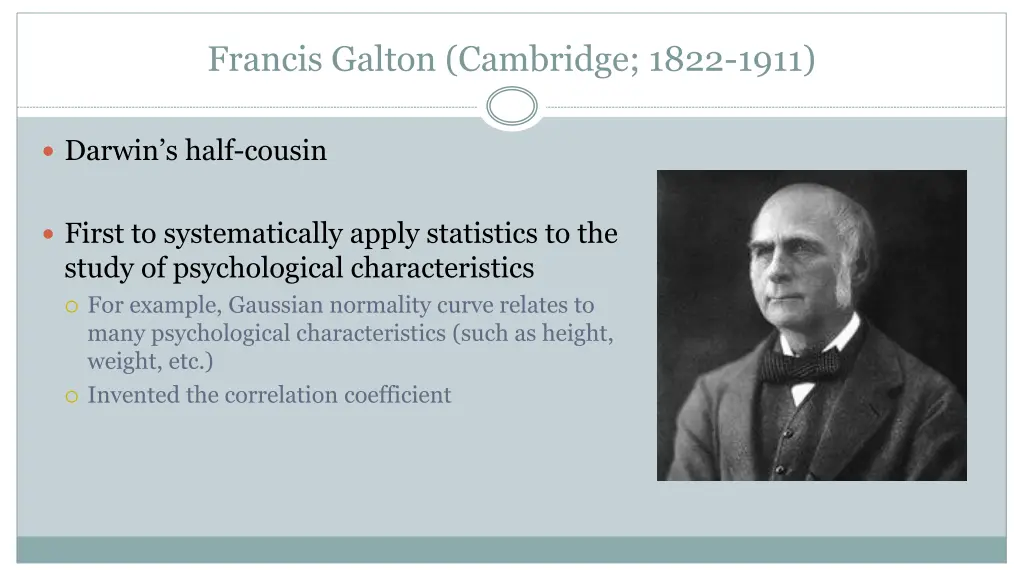
Francis Galton (Cambridge; 1822-1911) Darwin s half-cousin First to systematically apply statistics to the study of psychological characteristics For example, Gaussian normality curve relates to many psychological characteristics (such as height, weight, etc.) Invented the correlation coefficient
Francis Galton Main contribution to psychology the study of individual differences Tested 1000s of individuals on head size, physical strength, reaction time, visual/auditory acuity, etc. Led to combining study of individual differences with evolution to develop eugenics Programs of artificial selection that encourage/promote the breeding of the highly gifted and discourage/prevent the breeding of idiots and imbeciles Led to things such as the Holocaust, sterilization of individuals with mental disorders, and further racism
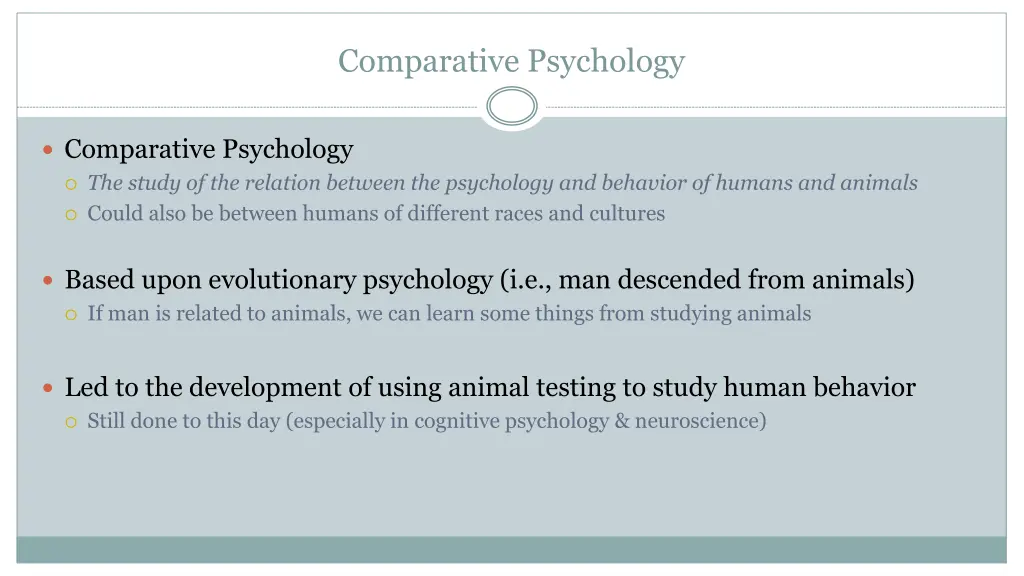
Comparative Psychology Comparative Psychology The study of the relation between the psychology and behavior of humans and animals Could also be between humans of different races and cultures Based upon evolutionary psychology (i.e., man descended from animals) If man is related to animals, we can learn some things from studying animals Led to the development of using animal testing to study human behavior Still done to this day (especially in cognitive psychology & neuroscience)