Theory of Light and Atomic Structure in Chemistry
Explore the fascinating world of light and its significance in chemistry. Learn about the electromagnetic spectrum, properties of light as a wave and particle, and the essential concepts of wavelength, frequency, and photon behavior. Understand the applications of light in various spectroscopic techniques and imaging technologies. Discover how light influences atomic behavior and why studying it is crucial in the field of chemistry.

Uploaded on | 0 Views
Download Presentation

Please find below an Image/Link to download the presentation.
The content on the website is provided AS IS for your information and personal use only. It may not be sold, licensed, or shared on other websites without obtaining consent from the author. If you encounter any issues during the download, it is possible that the publisher has removed the file from their server.
You are allowed to download the files provided on this website for personal or commercial use, subject to the condition that they are used lawfully. All files are the property of their respective owners.
The content on the website is provided AS IS for your information and personal use only. It may not be sold, licensed, or shared on other websites without obtaining consent from the author.
E N D
Presentation Transcript
Module 6: Theory of light and atomic structure General Chemistry Chem2331
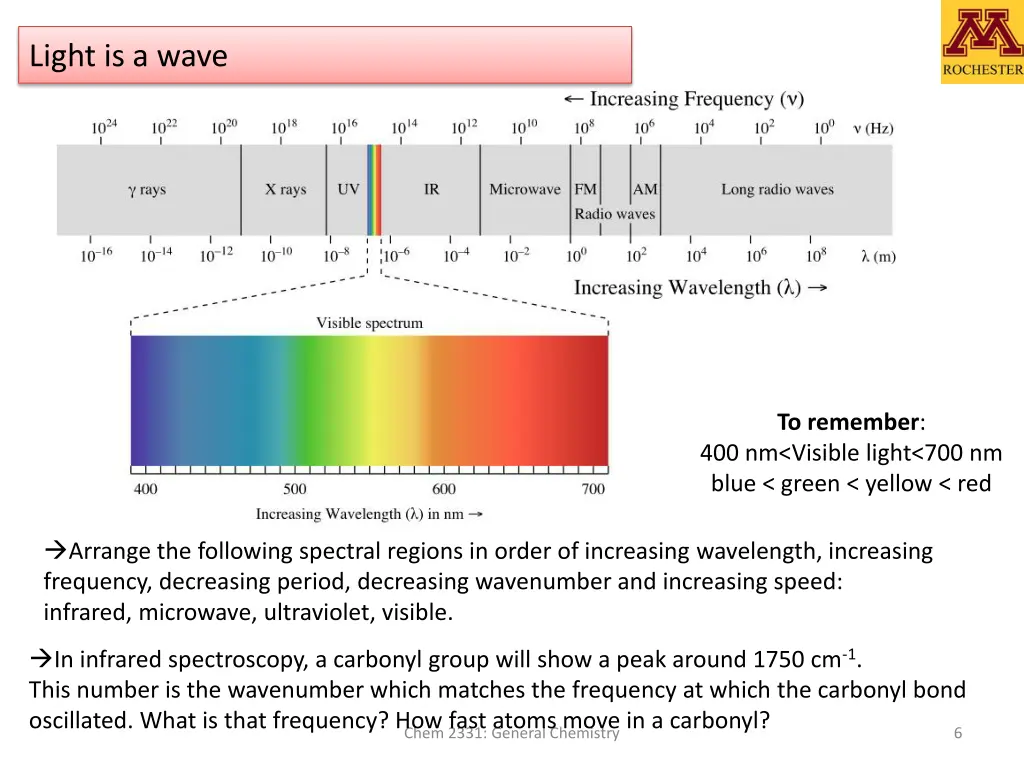
Module 6 Outline Module 6. Session 1. 1. Light: the electromagnetic spectrum 1. Range and applications 2. Light as a wave that moves in space and time 1. Space properties: wavelength and wavenumber 2. Time properties: frequency and period 3. The speed of light is a constant 3. Light as a particle: the photon 1. The photoelectric effect or why cell phones are not dangerous Chem 2331: General Chemistry 2
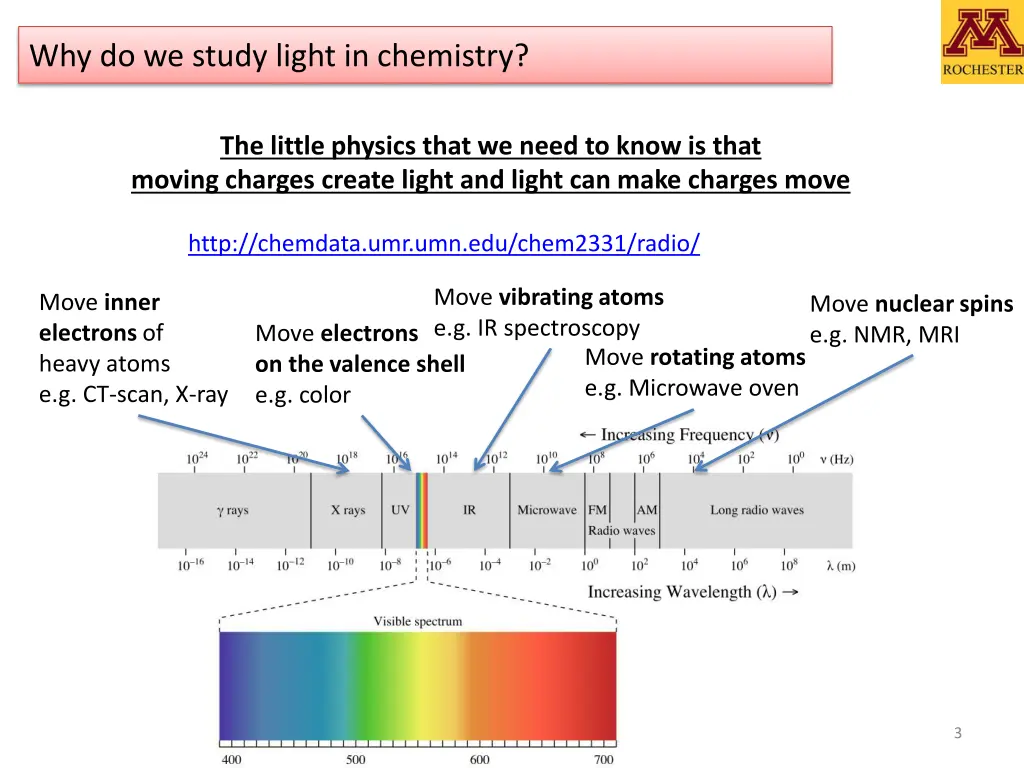
Why do we study light in chemistry? The little physics that we need to know is that moving charges create light and light can make charges move http://chemdata.umr.umn.edu/chem2331/radio/ Move vibrating atoms e.g. IR spectroscopy Move inner electrons of heavy atoms e.g. CT-scan, X-ray Move nuclear spins e.g. NMR, MRI Move electrons on the valence shell e.g. color Move rotating atoms e.g. Microwave oven Chem 2331: General Chemistry 3
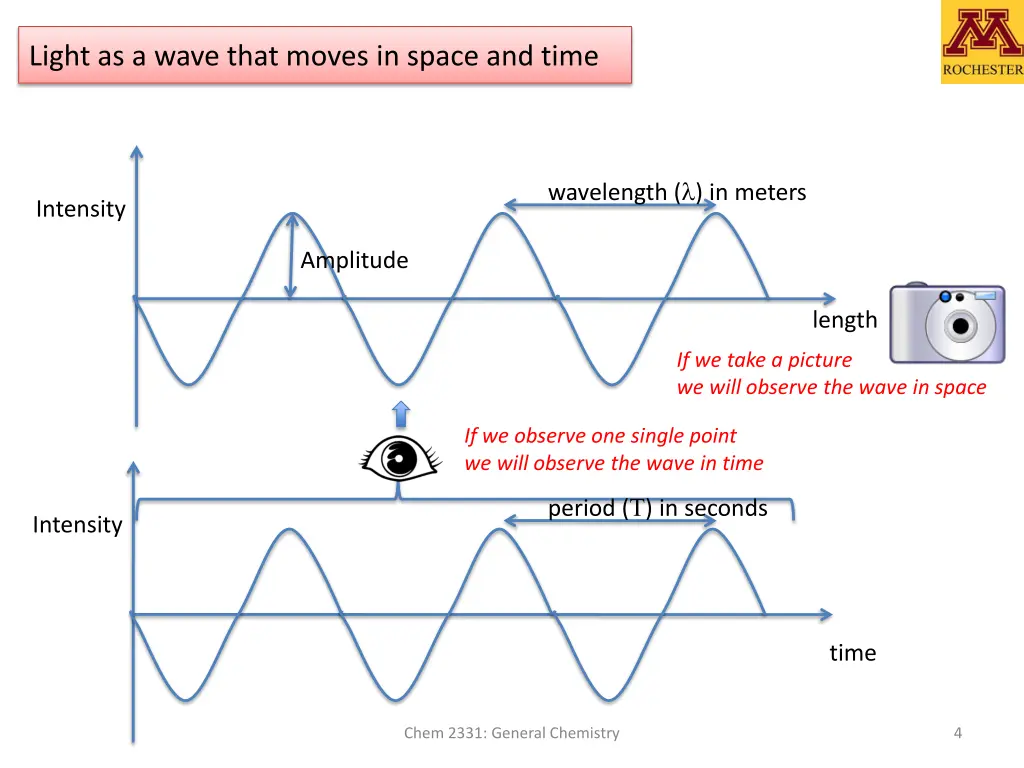
Light as a wave that moves in space and time wavelength ( ) in meters Intensity Amplitude length If we take a picture we will observe the wave in space If we observe one single point we will observe the wave in time period ( ) in seconds Intensity time Chem 2331: General Chemistry 4
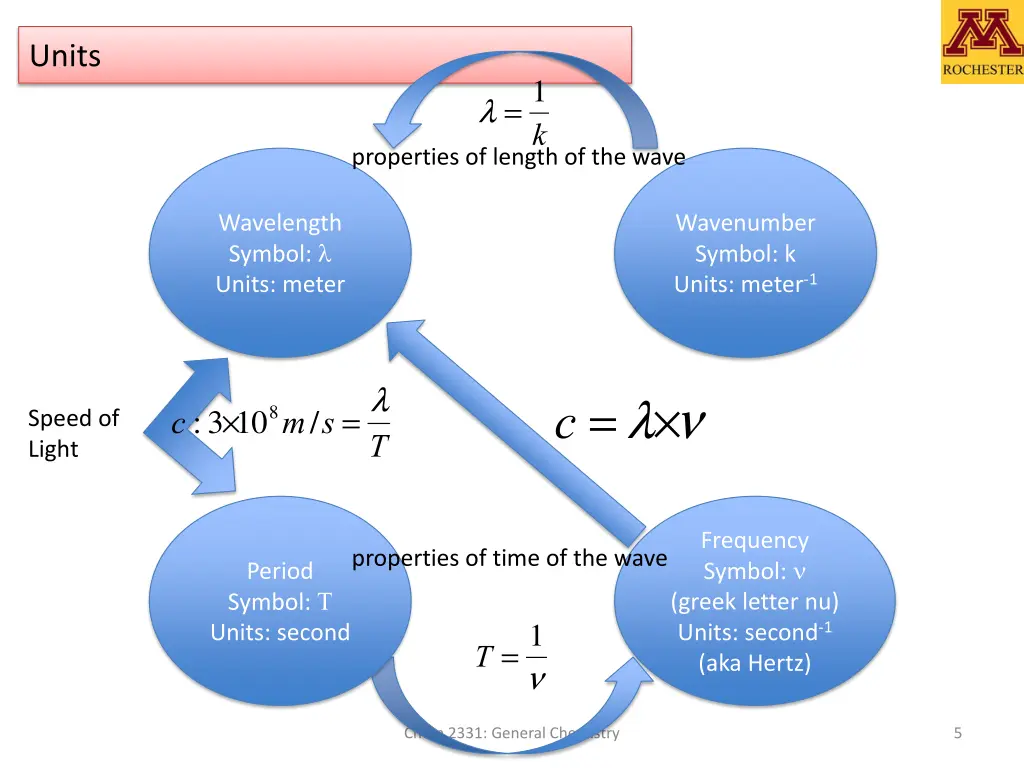
Units l =1 k properties of length of the wave Wavelength Symbol: Units: meter Wavenumber Symbol: k Units: meter-1 c :3 108m/s =l c =l n Speed of Light T Frequency Symbol: (greek letter nu) Units: second-1 (aka Hertz) properties of time of the wave Period Symbol: Units: second T =1 n Chem 2331: General Chemistry 5
Light is a wave To remember: 400 nm<Visible light<700 nm blue < green < yellow < red Arrange the following spectral regions in order of increasing wavelength, increasing frequency, decreasing period, decreasing wavenumber and increasing speed: infrared, microwave, ultraviolet, visible. In infrared spectroscopy, a carbonyl group will show a peak around 1750 cm-1. This number is the wavenumber which matches the frequency at which the carbonyl bond oscillated. What is that frequency? How fast atoms move in a carbonyl? Chem 2331: General Chemistry 6
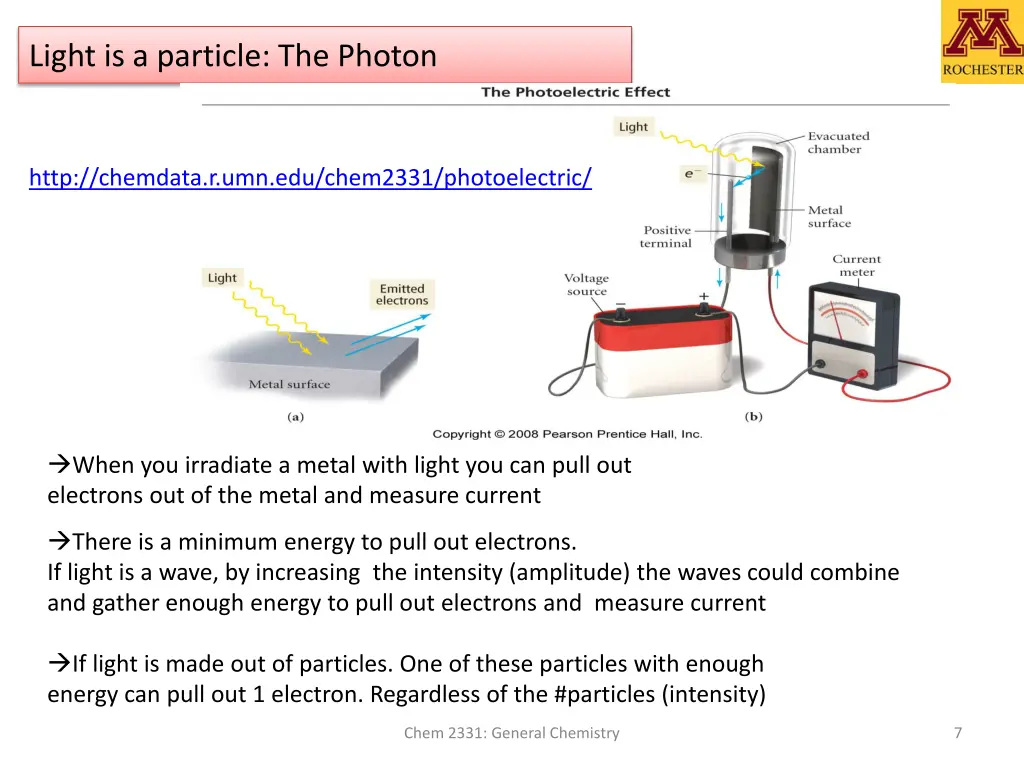
Light is a particle: The Photon http://chemdata.r.umn.edu/chem2331/photoelectric/ When you irradiate a metal with light you can pull out electrons out of the metal and measure current There is a minimum energy to pull out electrons. If light is a wave, by increasing the intensity (amplitude) the waves could combine and gather enough energy to pull out electrons and measure current If light is made out of particles. One of these particles with enough energy can pull out 1 electron. Regardless of the #particles (intensity) Chem 2331: General Chemistry 7
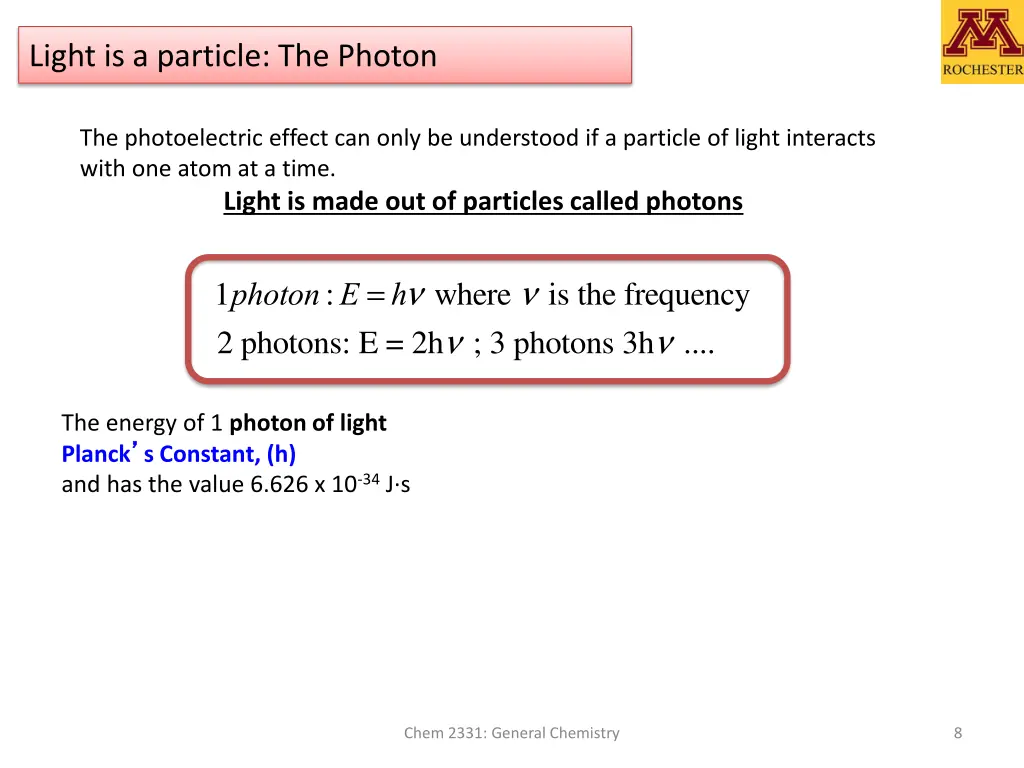
Light is a particle: The Photon The photoelectric effect can only be understood if a particle of light interacts with one atom at a time. Light is made out of particles called photons 1photon:E =hn where n is the frequency 2 photons: E = 2hn ; 3 photons 3hn .... The energy of 1 photon of light Planck s Constant, (h) and has the value 6.626 x 10⁻³⁴J s Chem 2331: General Chemistry 8
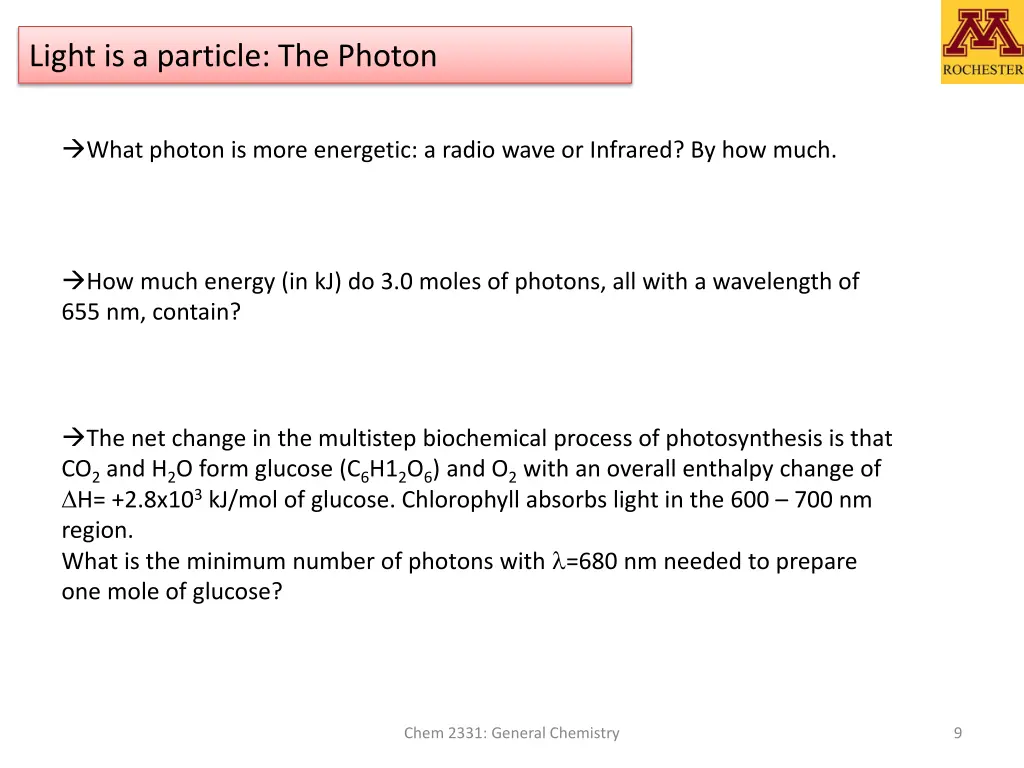
Light is a particle: The Photon What photon is more energetic: a radio wave or Infrared? By how much. How much energy (in kJ) do 3.0 moles of photons, all with a wavelength of 655 nm, contain? The net change in the multistep biochemical process of photosynthesis is that CO2 and H2O form glucose (C6H12O6) and O2 with an overall enthalpy change of H= +2.8x10³ kJ/mol of glucose. Chlorophyll absorbs light in the 600 700 nm region. What is the minimum number of photons with =680 nm needed to prepare one mole of glucose? Chem 2331: General Chemistry 9
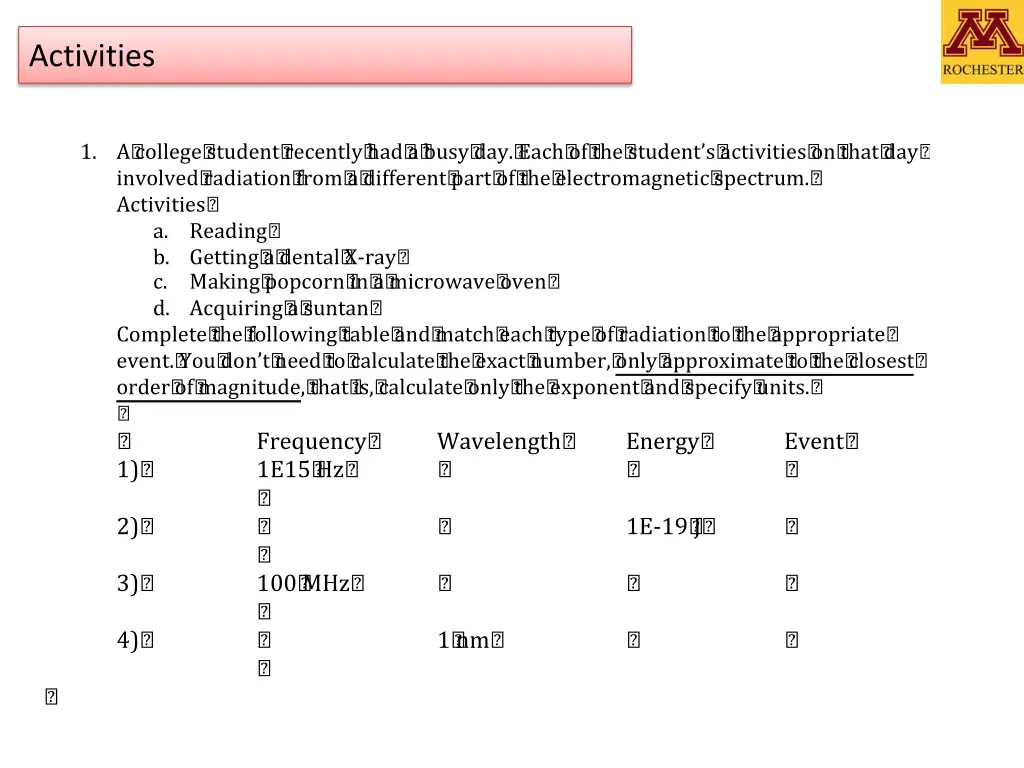
Activities 1.A? college? student? recently? had? a? busy? day.? Each? of? the? student s? activities? on? that? day? involved? radiation? from? a? different? part? of? the? electromagnetic? spectrum.? Activities? a.Reading? b.Getting? a? dental? X-ray? c.Making? popcorn? in? a? microwave? oven? d.Acquiring? a? suntan? Complete? the? following? table? and? match? each? type? of? radiation? to? the? appropriate? event.? You? don t? need? to? calculate? the? exact? number,? only? approximate? to? the? closest? order? of? magnitude,? that? is,? calculate? only? the? exponent? and? specify? units.? ? ? Frequency? Wavelength? 1)? 1E15? Hz? ? 2)? ? ? 3)? 100? MHz? ? 4)? ? ? Energy? ? Event? ? ? ? 1E-19? J? ? ? ? ? 1? nm? ? ? ?