Thermal Characterization of Au-Si Multilayers Using 3-Omega Method by Sunmi Shin
Explore the thermal conductivity measurement techniques, including the 3-Omega method, for Au-Si multilayers. Learn about the weaknesses of conventional steady-state systems, principles of extracting thermal conductivity, and applications in ultralow thermal conductivity materials. Discover how temperature gradients are analyzed within specimens.

Download Presentation

Please find below an Image/Link to download the presentation.
The content on the website is provided AS IS for your information and personal use only. It may not be sold, licensed, or shared on other websites without obtaining consent from the author. If you encounter any issues during the download, it is possible that the publisher has removed the file from their server.
You are allowed to download the files provided on this website for personal or commercial use, subject to the condition that they are used lawfully. All files are the property of their respective owners.
The content on the website is provided AS IS for your information and personal use only. It may not be sold, licensed, or shared on other websites without obtaining consent from the author.
E N D
Presentation Transcript
PHYS 211A Thermal characterization of Au-Si multilayers using 3-omega method Sunmi Shin Materials Science and Engineering Program 1
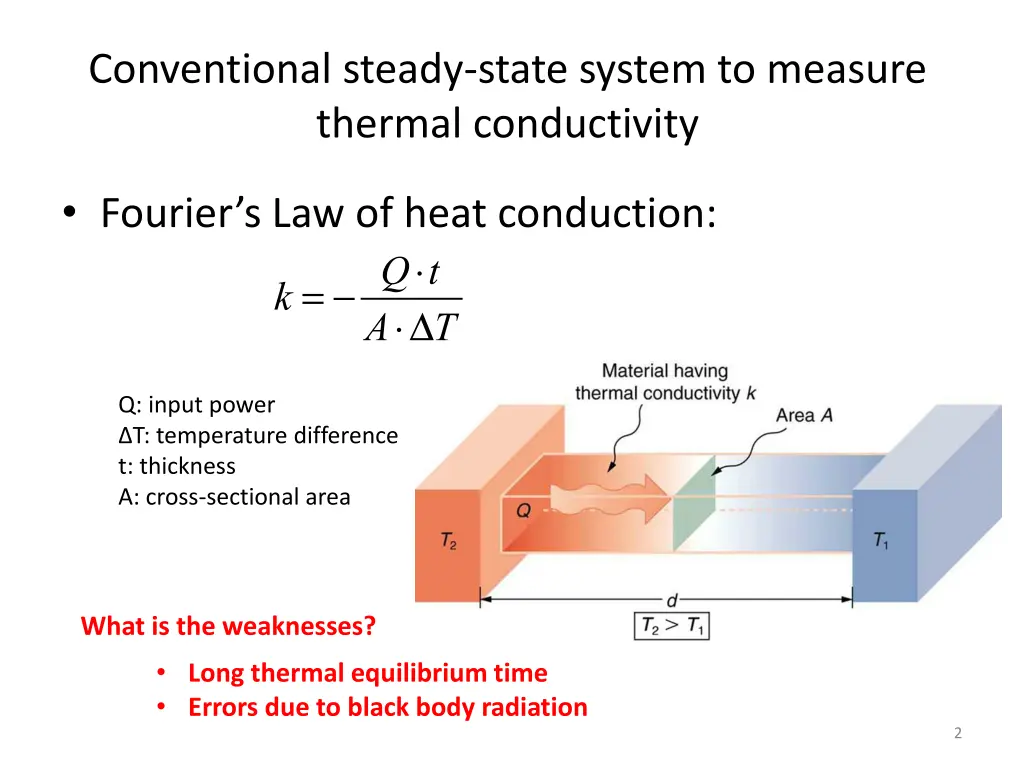
Conventional steady-state system to measure thermal conductivity Fourier s Law of heat conduction: k = -Q t A DT Q: input power T: temperature difference t: thickness A: cross-sectional area What is the weaknesses? Long thermal equilibrium time Errors due to black body radiation 2
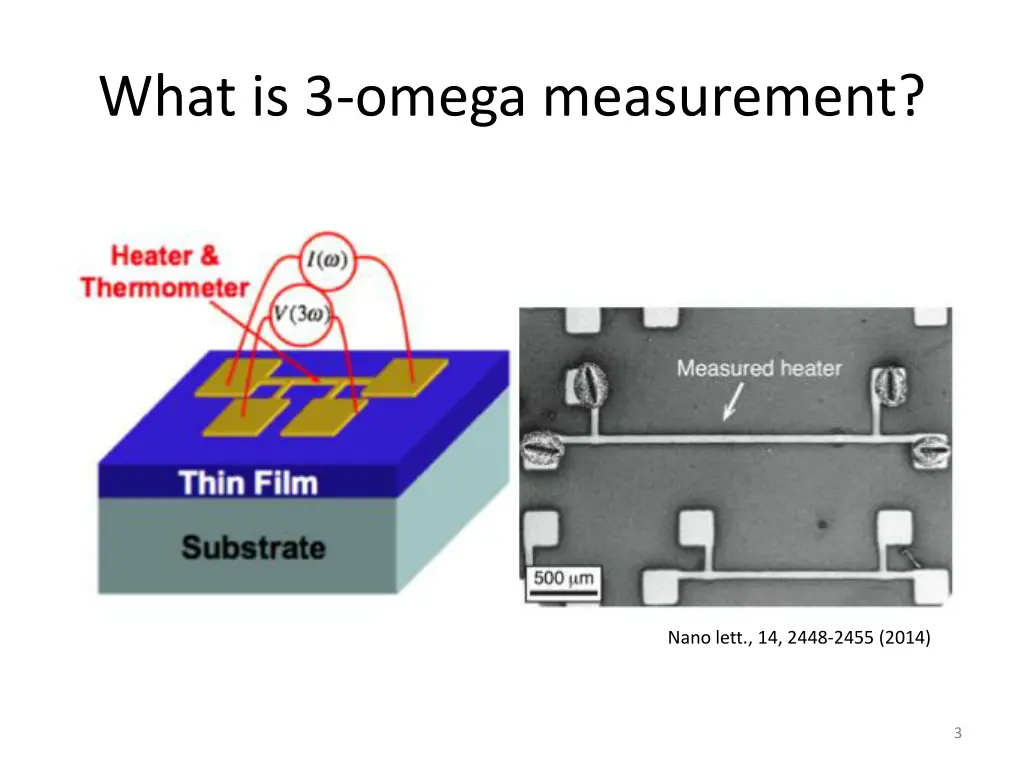
What is 3-omega measurement? Nano lett., 14, 2448-2455 (2014) 3
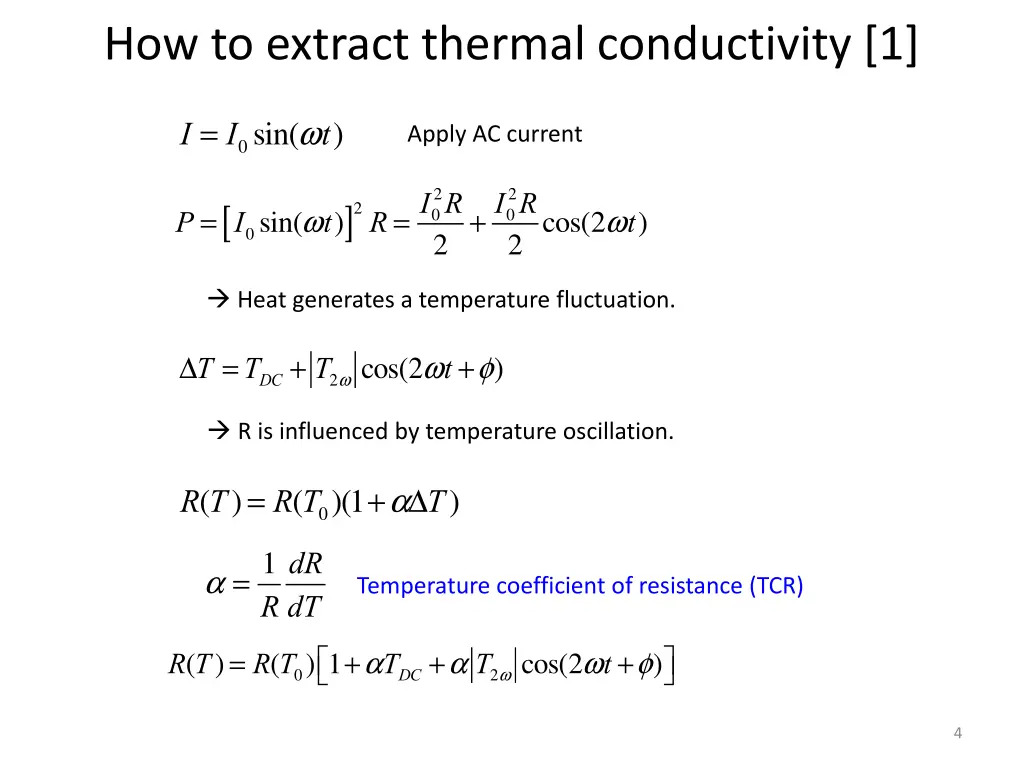
How to extract thermal conductivity [1] I = I0sin(wt) Apply AC current 2R 2 2R 2 2R=I0 +I0 P = I0sin(wt) [ ] cos(2wt) Heat generates a temperature fluctuation. DT =TDC+ T2wcos(2wt +f) R is influenced by temperature oscillation. R(T)= R(T0)(1+aDT) a =1 dR dT Temperature coefficient of resistance (TCR) R R(T)= R(T0) 1+aTDC+a T2wcos(2wt +f) 4
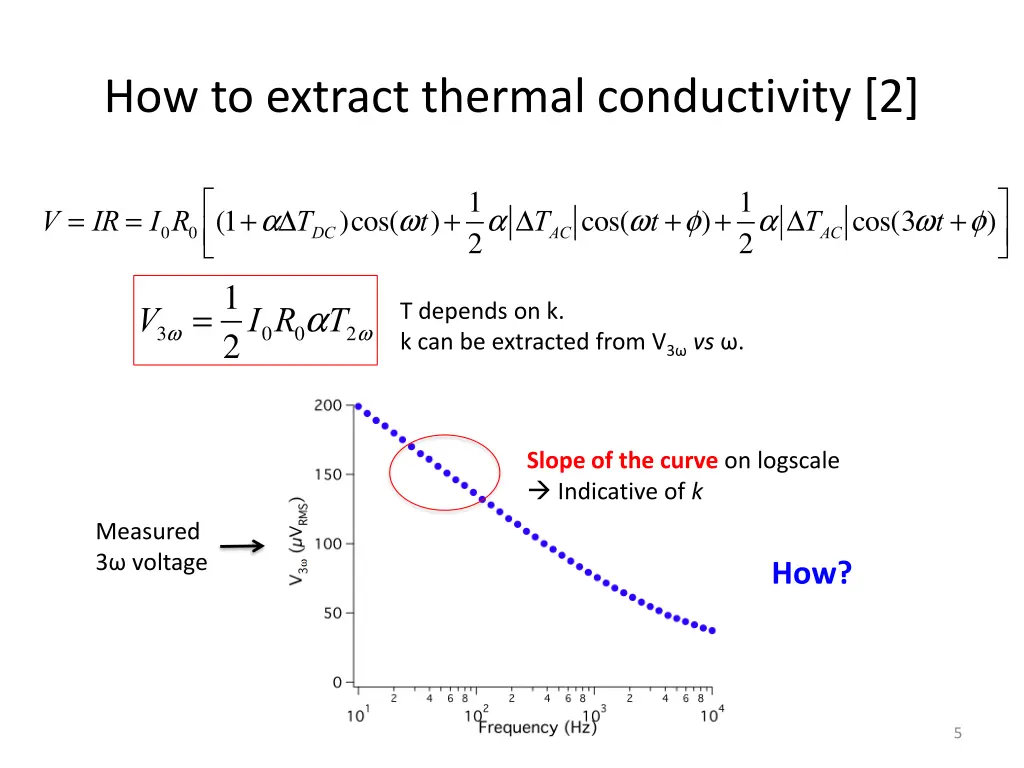
How to extract thermal conductivity [2] V = IR = I0R0(1+aDTDC)cos(wt)+1 2a DTACcos(wt +f)+1 2a DTACcos(3wt +f) V3w=1 2I0R0aT2w T depends on k. k can be extracted from V3 vs . Slope of the curve on logscale Indicative of k Measured 3 voltage How? 5
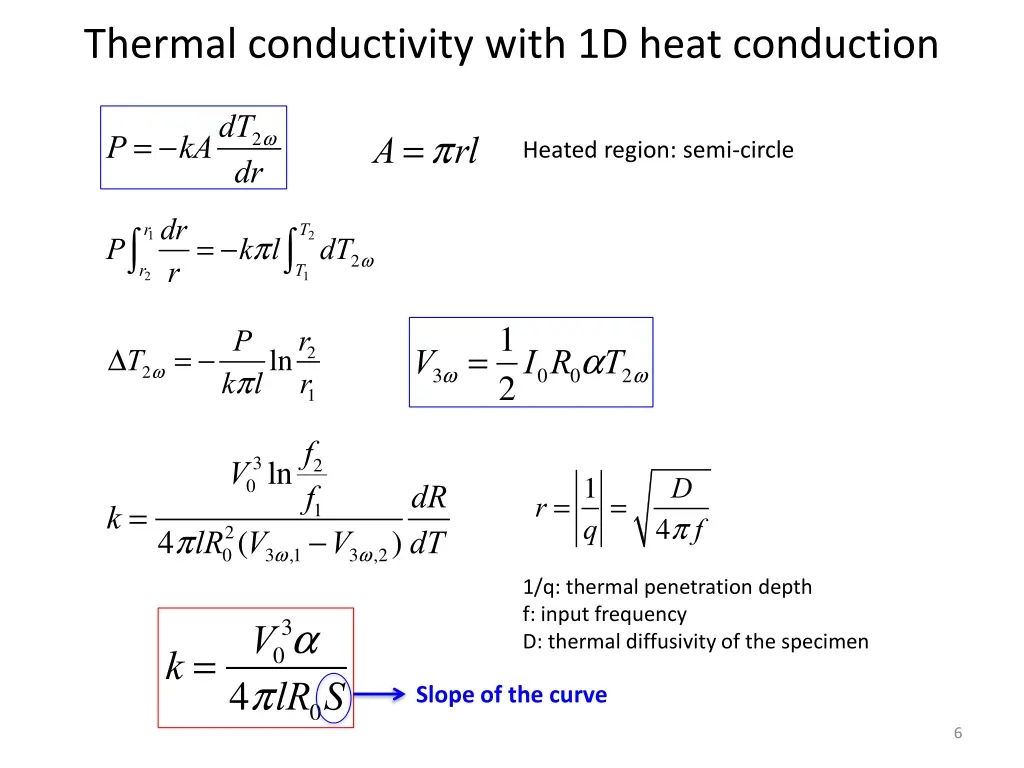
Thermal conductivity with 1D heat conduction P = -kAdT2w A=prl Heated region: semi-circle dr dr r r1 T2 = -kpl P dT2w r2 T1 V3w=1 DT2w= -P kpllnr2 2I0R0aT2w r1 3lnf2 V0 r =1 D dR dT f1 q= k = 4p f 4plR0 2(V3w,1-V3w,2) 1/q: thermal penetration depth f: input frequency D: thermal diffusivity of the specimen 3a V0 k = 4plR0S Slope of the curve 6
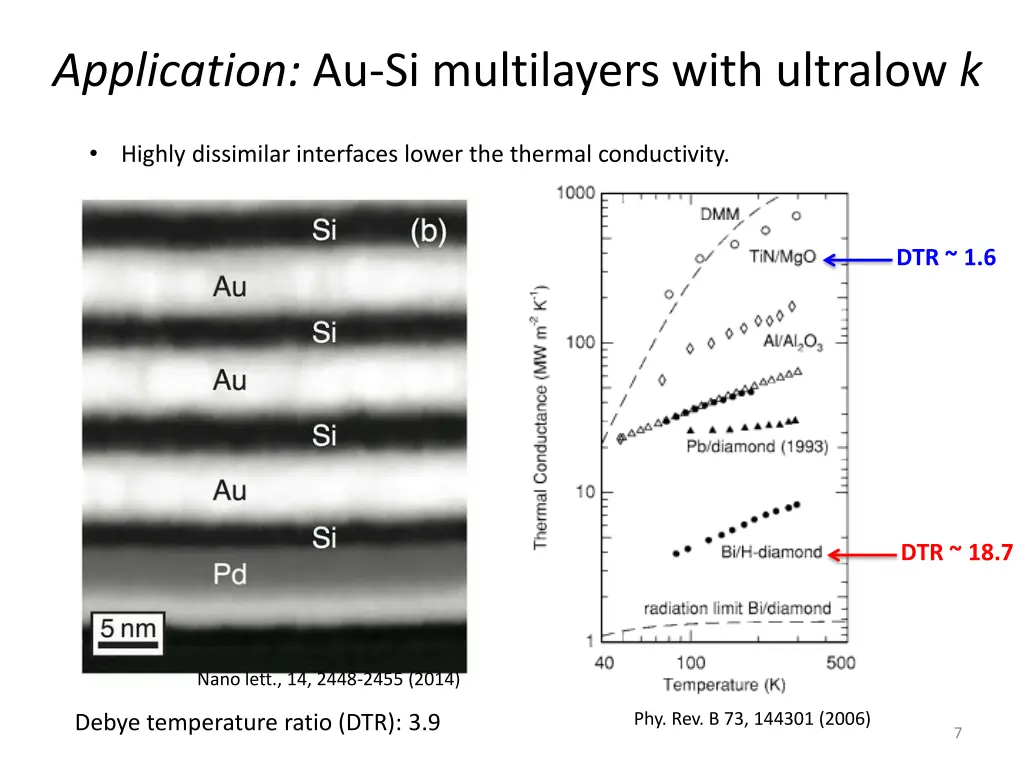
Application: Au-Si multilayers with ultralow k Highly dissimilar interfaces lower the thermal conductivity. DTR ~ 1.6 DTR ~ 18.7 Nano lett., 14, 2448-2455 (2014) Phy. Rev. B 73, 144301 (2006) Debye temperature ratio (DTR): 3.9 7
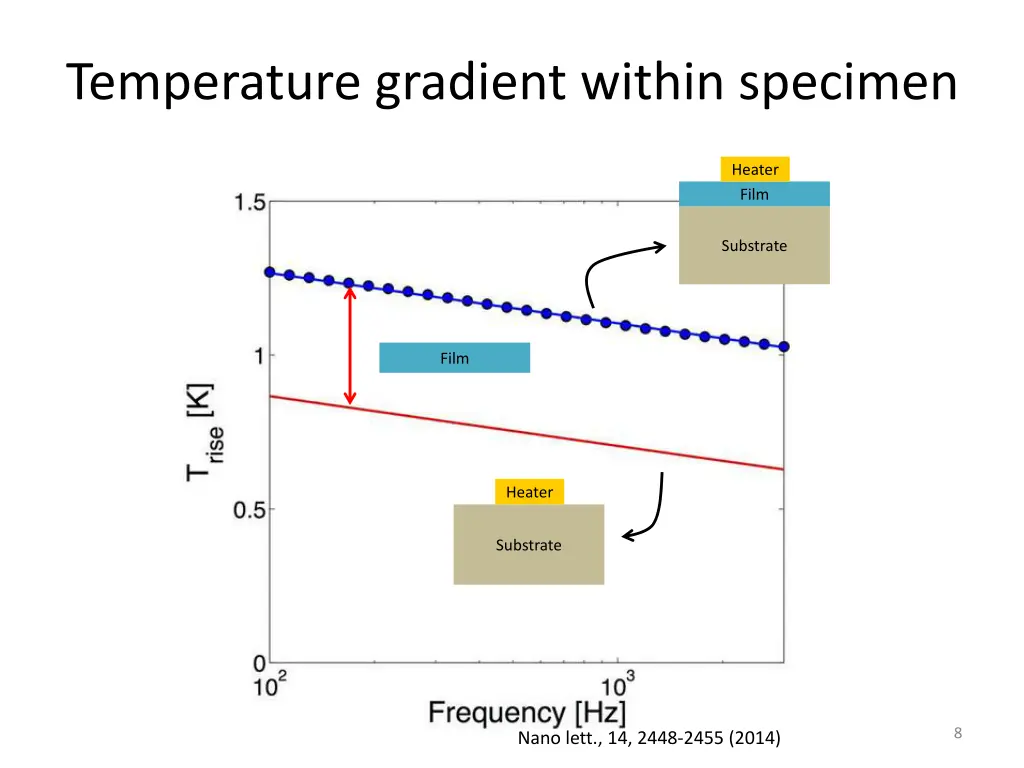
Temperature gradient within specimen Heater Film Substrate Film Heater Substrate 8 Nano lett., 14, 2448-2455 (2014)
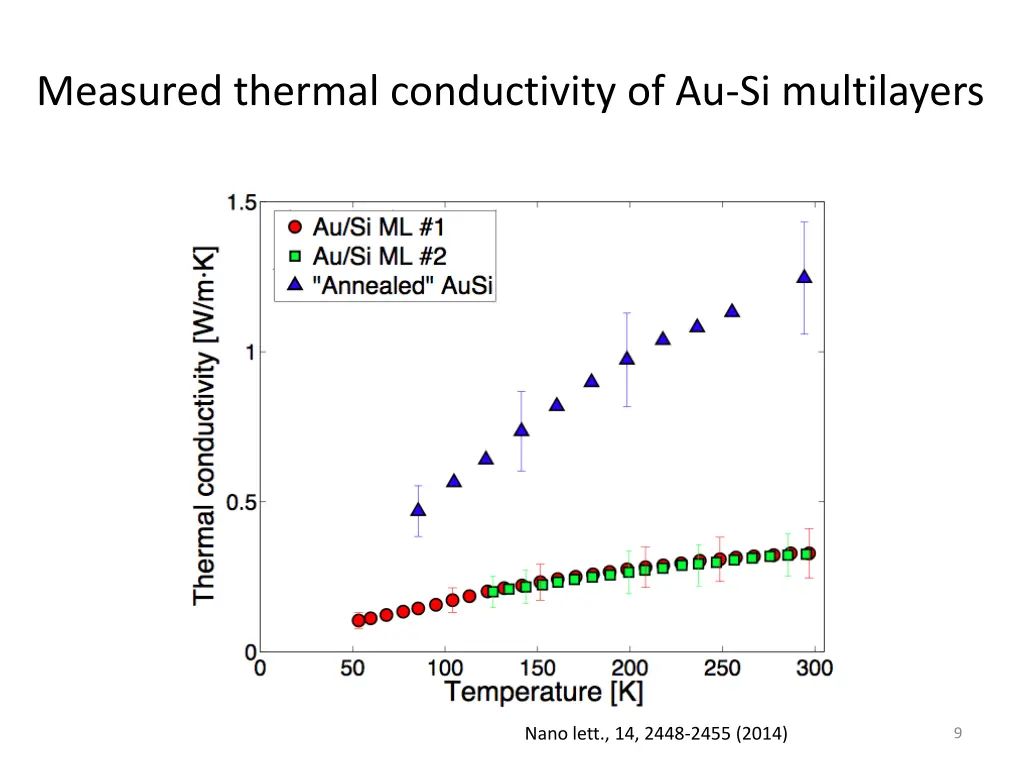
Measured thermal conductivity of Au-Si multilayers Nano lett., 14, 2448-2455 (2014) 9
Thank you! 10