Delve into the world of thermoforming and thermosetting polymers, exploring their production, properties, applications, and differences. Learn about synthetic polymers, thermoforming polymers, thermosetting polymers, key terms, and the structure and properties of polymers.
Please find below an Image/Link to download the presentation.
The content on the website is provided AS IS for your information and personal use only. It may not be sold, licensed, or shared on other websites without obtaining consent from the author. If you encounter any issues during the download, it is possible that the publisher has removed the file from their server.
You are allowed to download the files provided on this website for personal or commercial use, subject to the condition that they are used lawfully. All files are the property of their respective owners.
The content on the website is provided AS IS for your information and personal use only. It may not be sold, licensed, or shared on other websites without obtaining consent from the author.
E N D
Presentation Transcript
Core Knowledge 1.10 Thermoforming and Thermosetting polymers Name: Group: Teacher:
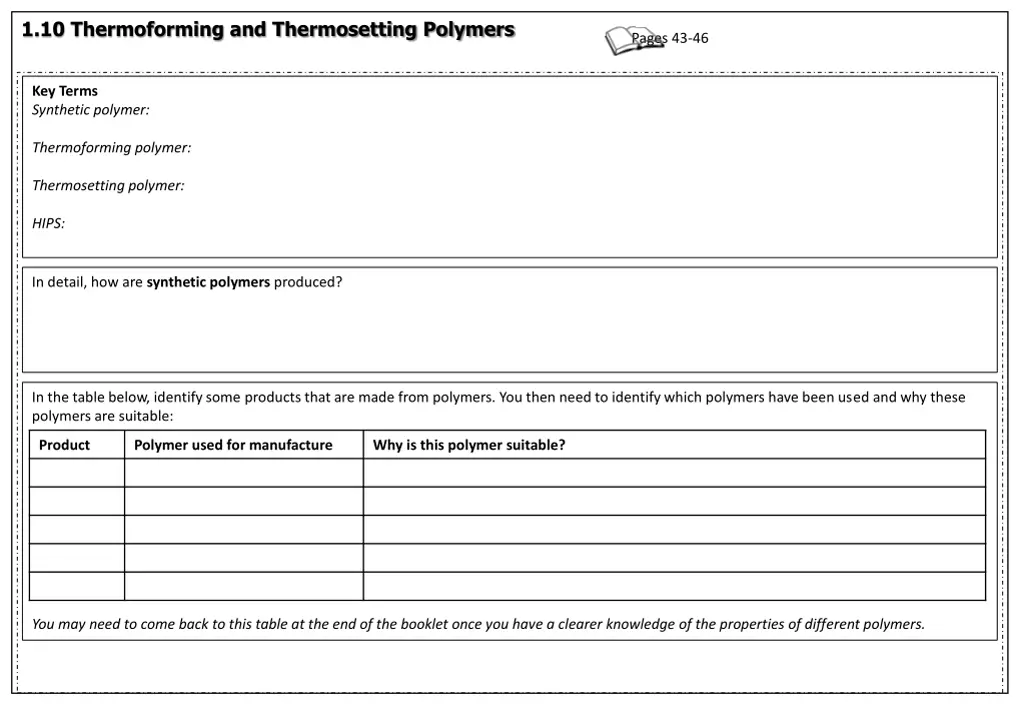
1.10 Thermoforming and Thermosetting Polymers Pages 43-46 Key Terms Synthetic polymer: Thermoforming polymer: Thermosetting polymer: HIPS: In detail, how are synthetic polymers produced? In the table below, identify some products that are made from polymers. You then need to identify which polymers have been used and why these polymers are suitable: Product Polymer used for manufacture Why is this polymer suitable? You may need to come back to this table at the end of the booklet once you have a clearer knowledge of the properties of different polymers.
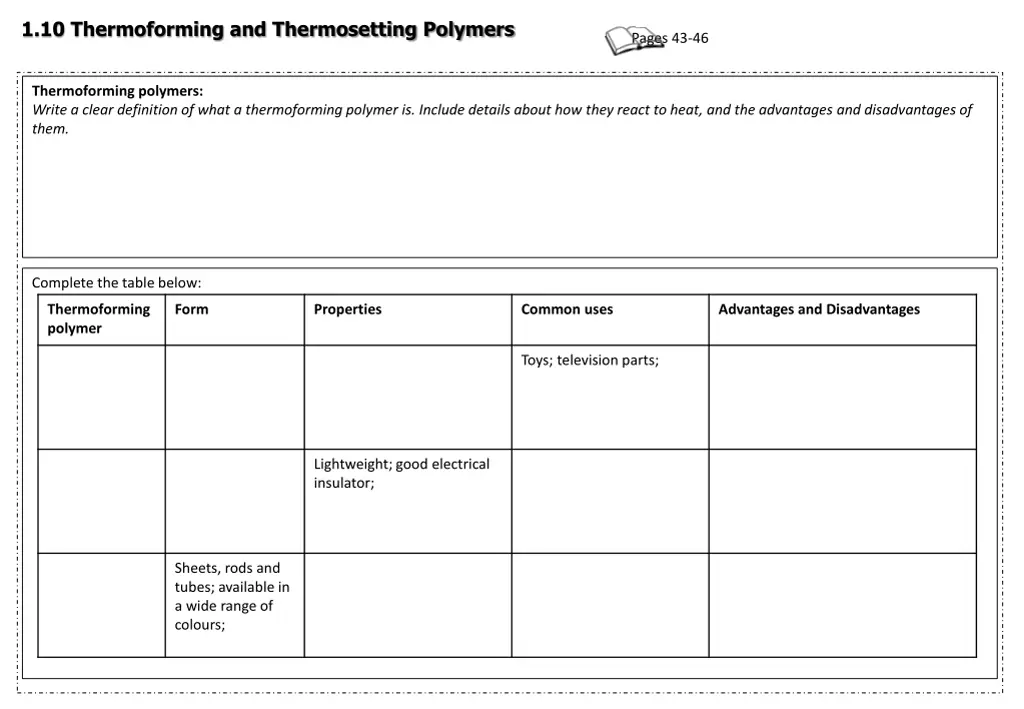
1.10 Thermoforming and Thermosetting Polymers Pages 43-46 Thermoforming polymers: Write a clear definition of what a thermoforming polymer is. Include details about how they react to heat, and the advantages and disadvantages of them. Complete the table below: Thermoforming polymer Form Properties Common uses Advantages and Disadvantages Toys; television parts; Lightweight; good electrical insulator; Sheets, rods and tubes; available in a wide range of colours;
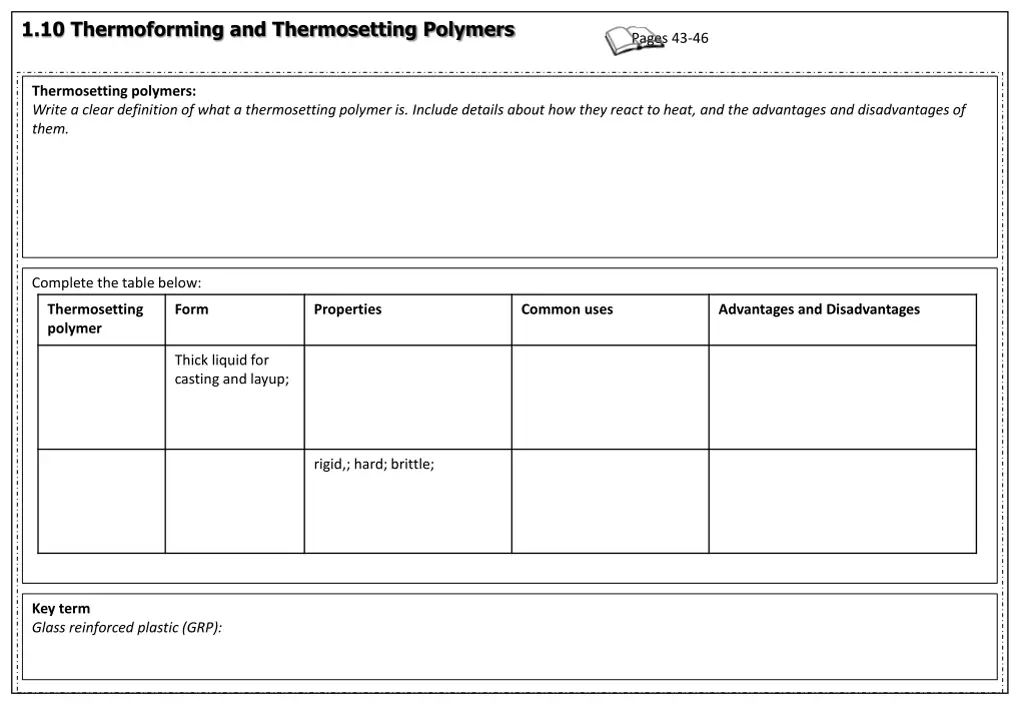
1.10 Thermoforming and Thermosetting Polymers Pages 43-46 Thermosetting polymers: Write a clear definition of what a thermosetting polymer is. Include details about how they react to heat, and the advantages and disadvantages of them. Complete the table below: Thermosetting polymer Form Properties Common uses Advantages and Disadvantages Thick liquid for casting and layup; rigid,; hard; brittle; Key term Glass reinforced plastic (GRP):
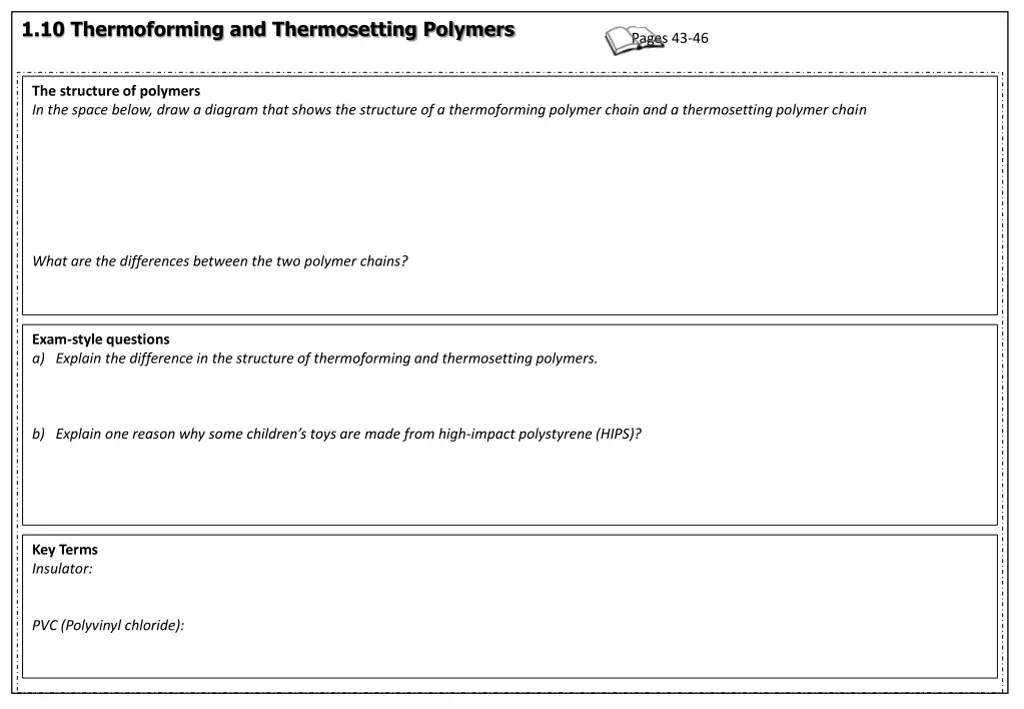
1.10 Thermoforming and Thermosetting Polymers Pages 43-46 The structure of polymers In the space below, draw a diagram that shows the structure of a thermoforming polymer chain and a thermosetting polymer chain What are the differences between the two polymer chains? Exam-style questions a) Explain the difference in the structure of thermoforming and thermosetting polymers. b) Explain one reason why some children s toys are made from high-impact polystyrene (HIPS)? Key Terms Insulator: PVC (Polyvinyl chloride):
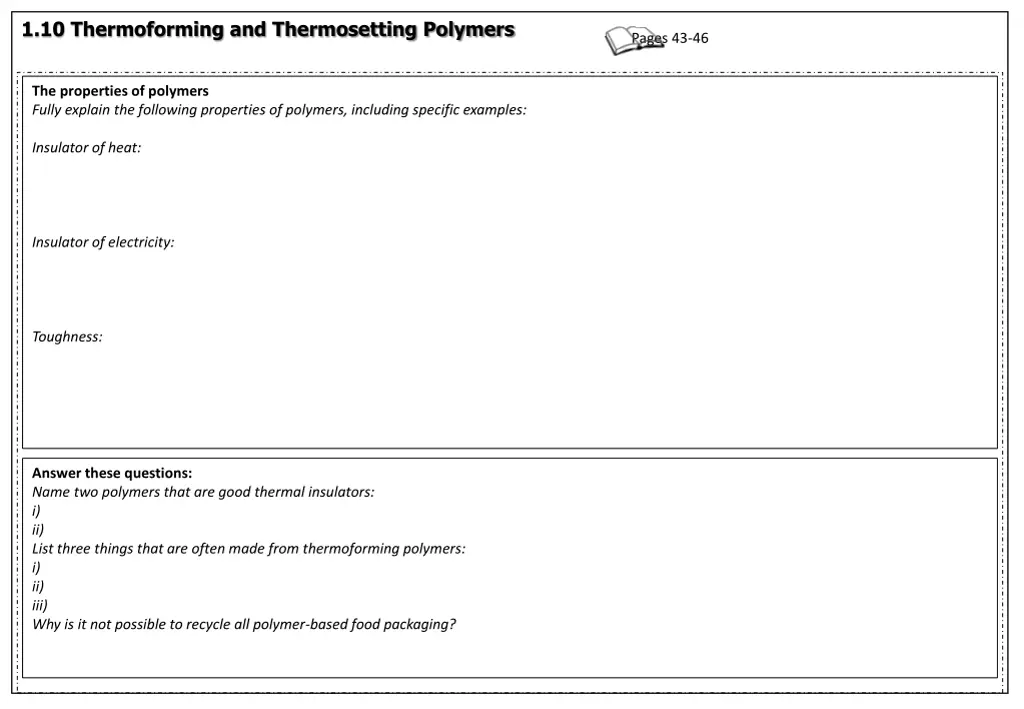
1.10 Thermoforming and Thermosetting Polymers Pages 43-46 The properties of polymers Fully explain the following properties of polymers, including specific examples: Insulator of heat: Insulator of electricity: Toughness: Answer these questions: Name two polymers that are good thermal insulators: i) ii) List three things that are often made from thermoforming polymers: i) ii) iii) Why is it not possible to recycle all polymer-based food packaging?