This week in the physics course
Electric charge is an intrinsic property of matter, consisting of positive and negative charges found in protons and electrons. Charges are measured in Coulombs, and they interact through electrostatic forces. This content delves into the fundamental concepts of electric charge and how it manifests in the world around us.

Download Presentation

Please find below an Image/Link to download the presentation.
The content on the website is provided AS IS for your information and personal use only. It may not be sold, licensed, or shared on other websites without obtaining consent from the author.If you encounter any issues during the download, it is possible that the publisher has removed the file from their server.
You are allowed to download the files provided on this website for personal or commercial use, subject to the condition that they are used lawfully. All files are the property of their respective owners.
The content on the website is provided AS IS for your information and personal use only. It may not be sold, licensed, or shared on other websites without obtaining consent from the author.
E N D
Presentation Transcript
This week in the physics course Lectures will cover Chapter 20 (Electric Charge) and start Chapter 22 (Electric Potential) Please note: lecture slides and scans of the textbook chapters are available on Blackboard Tutorial class will practise problems from last week s lectures on Chapter 16 (Temperature and Heat) Physics help available in MASH centre (Chris Blake, Tues 10.30-12.30 and Wayne Rowlands Thurs 2.30-4.30) Don t hesitate to get in touch with any questions cblake@swin.edu.au
Chapter 20 : Electric charge, force, field What is electric charge and how do we measure it? Coulomb s Force Law between charges How an electric field can be used to describe electrostatic forces Some simple applications of these principles
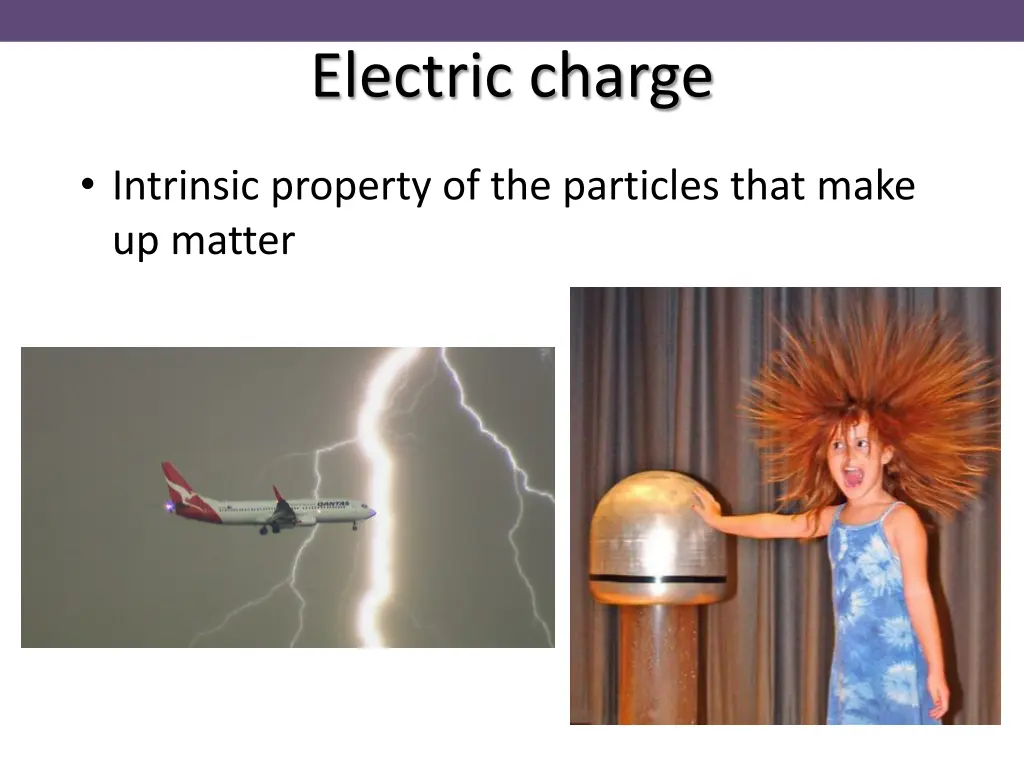
Electric charge Intrinsic property of the particles that make up matter
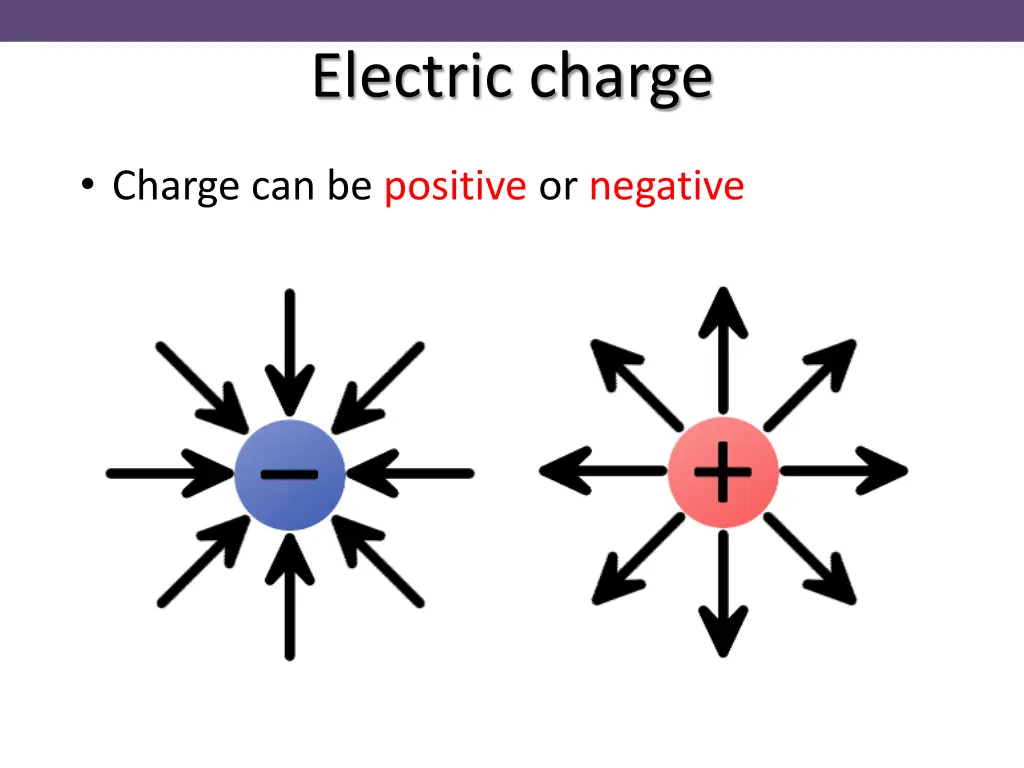
Electric charge Charge can be positive or negative
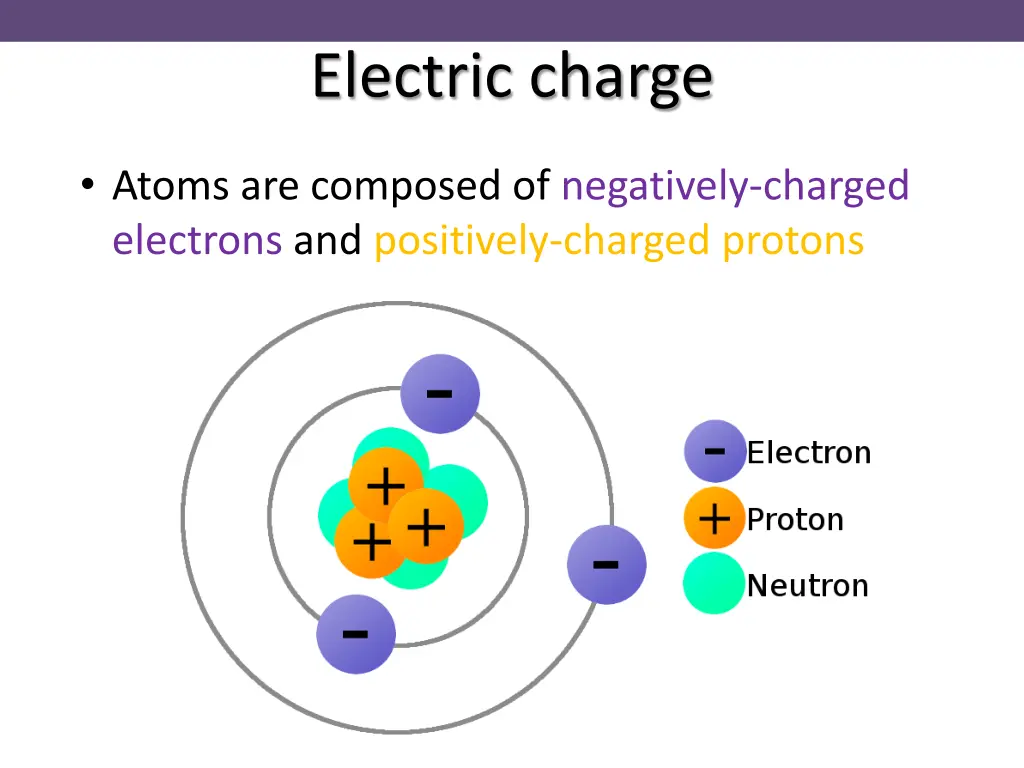
Electric charge Atoms are composed of negatively-charged electrons and positively-charged protons
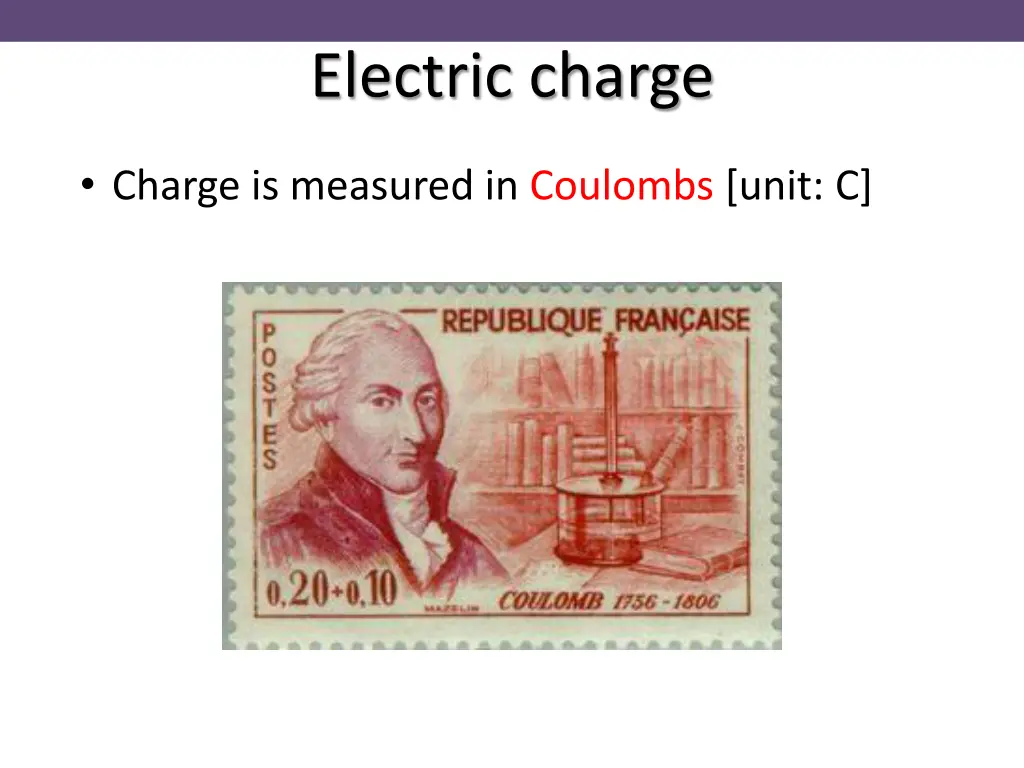
Electric charge Charge is measured in Coulombs [unit: C]
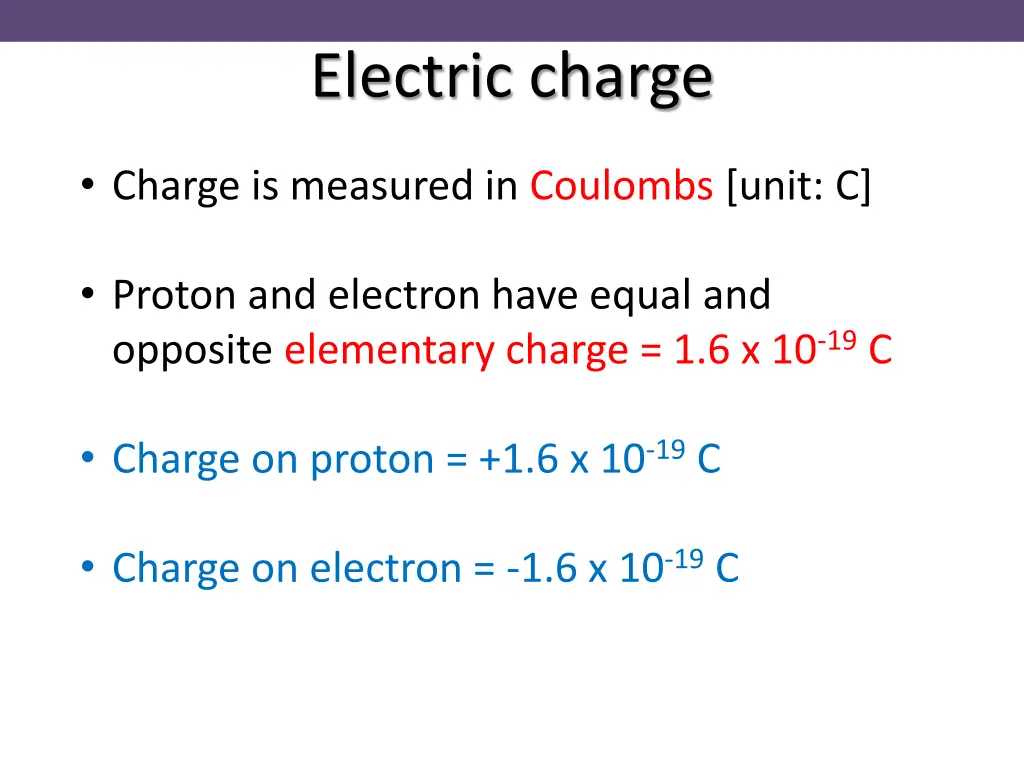
Electric charge Charge is measured in Coulombs [unit: C] Proton and electron have equal and opposite elementary charge = 1.6 x 10⁻¹⁹ C Charge on proton = +1.6 x 10⁻¹⁹ C Charge on electron = -1.6 x 10⁻¹⁹ C
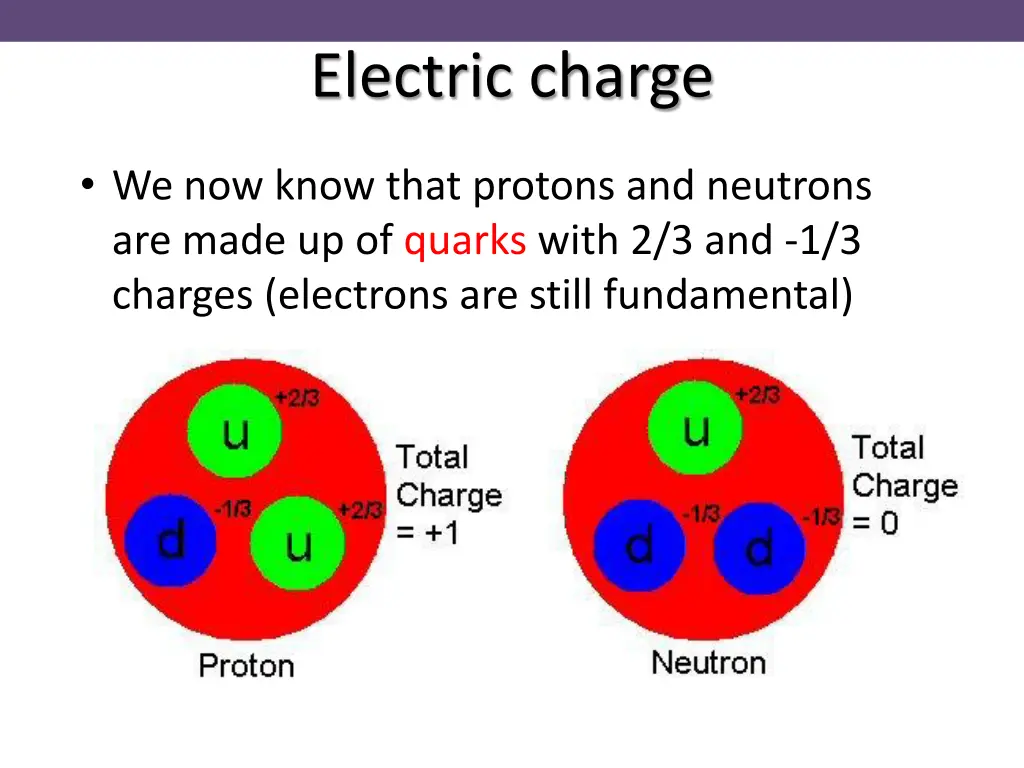
Electric charge We now know that protons and neutrons are made up of quarks with 2/3 and -1/3 charges (electrons are still fundamental)
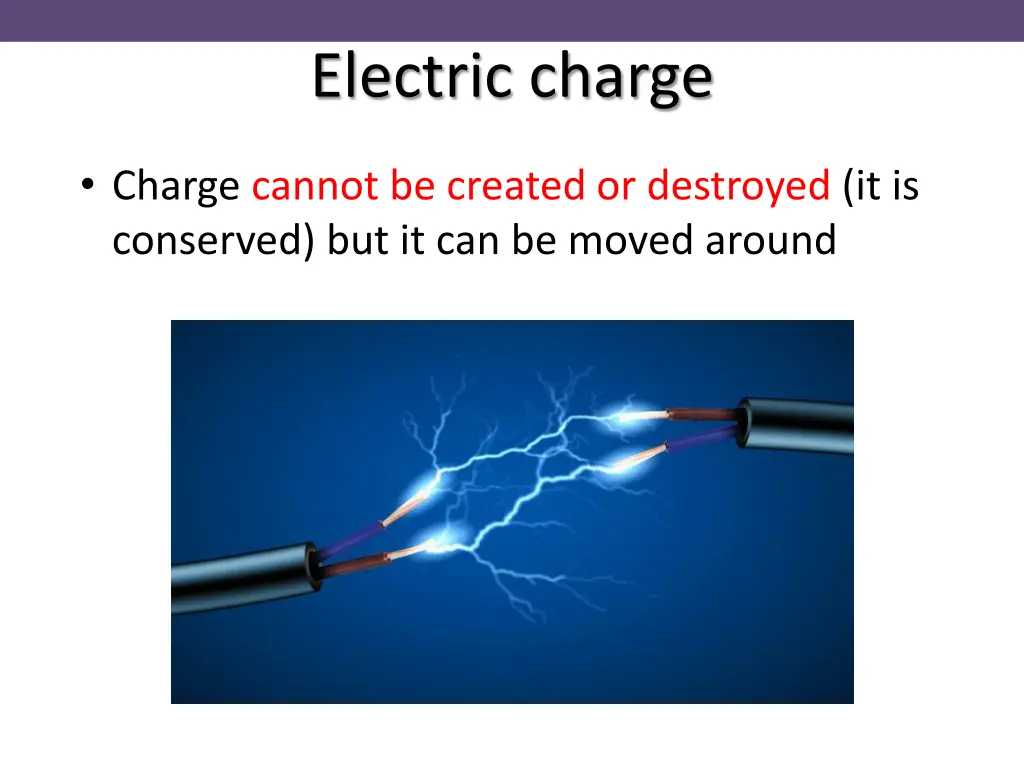
Electric charge Charge cannot be created or destroyed (it is conserved) but it can be moved around
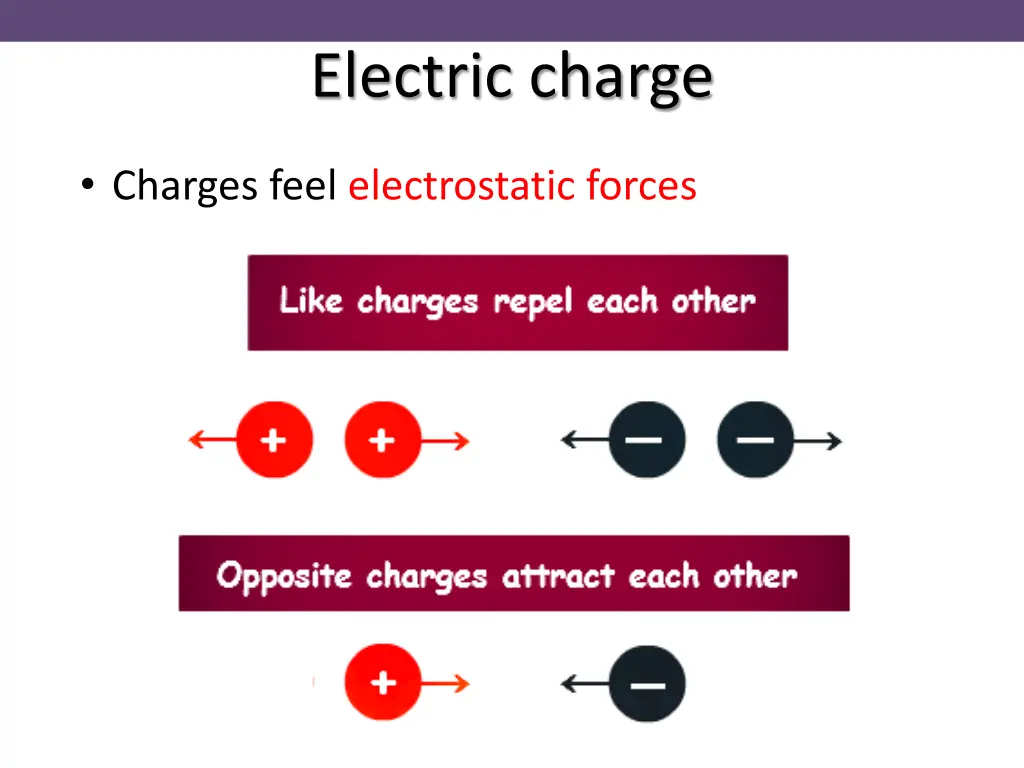
Electric charge Charges feel electrostatic forces
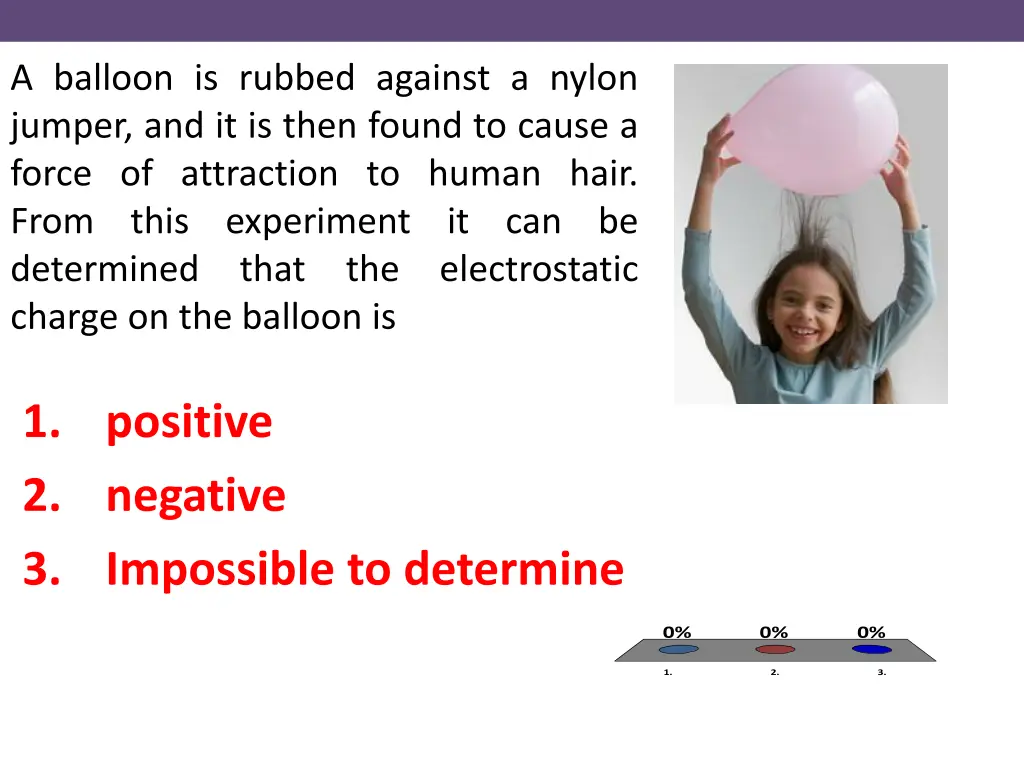
A balloon is rubbed against a nylon jumper, and it is then found to cause a force of attraction to human hair. From this experiment it can be determined that the electrostatic charge on the balloon is 1. positive 2. negative 3. Impossible to determine 0% 0% 0% 1. 2. 3.
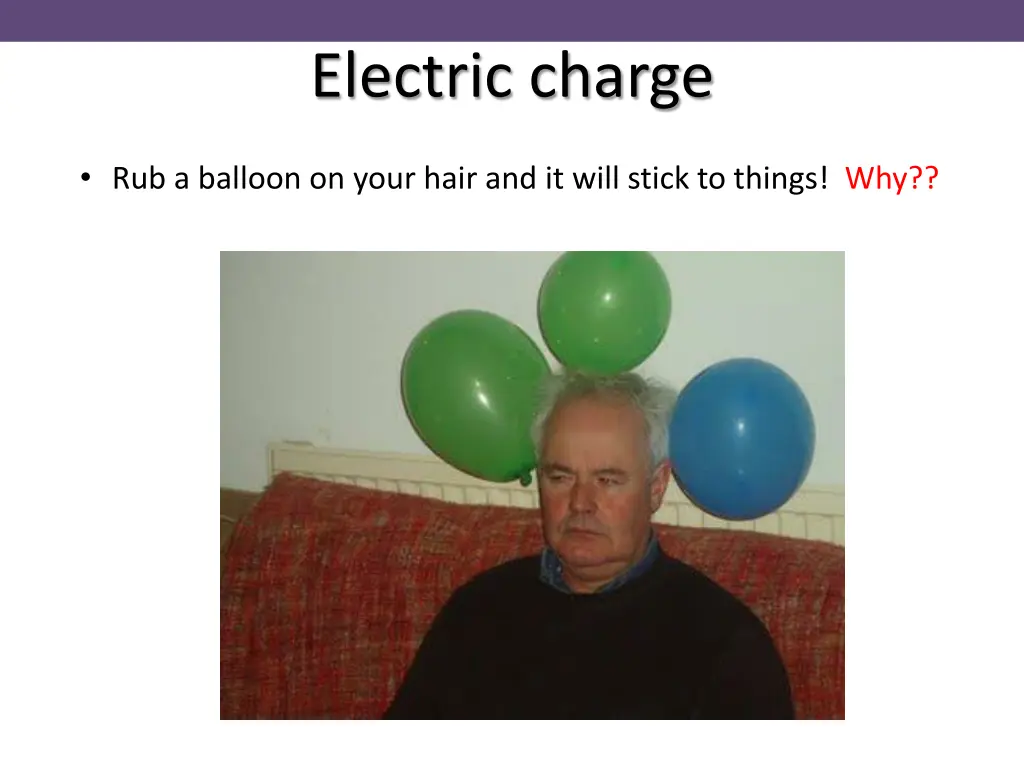
Electric charge Rub a balloon on your hair and it will stick to things! Why??
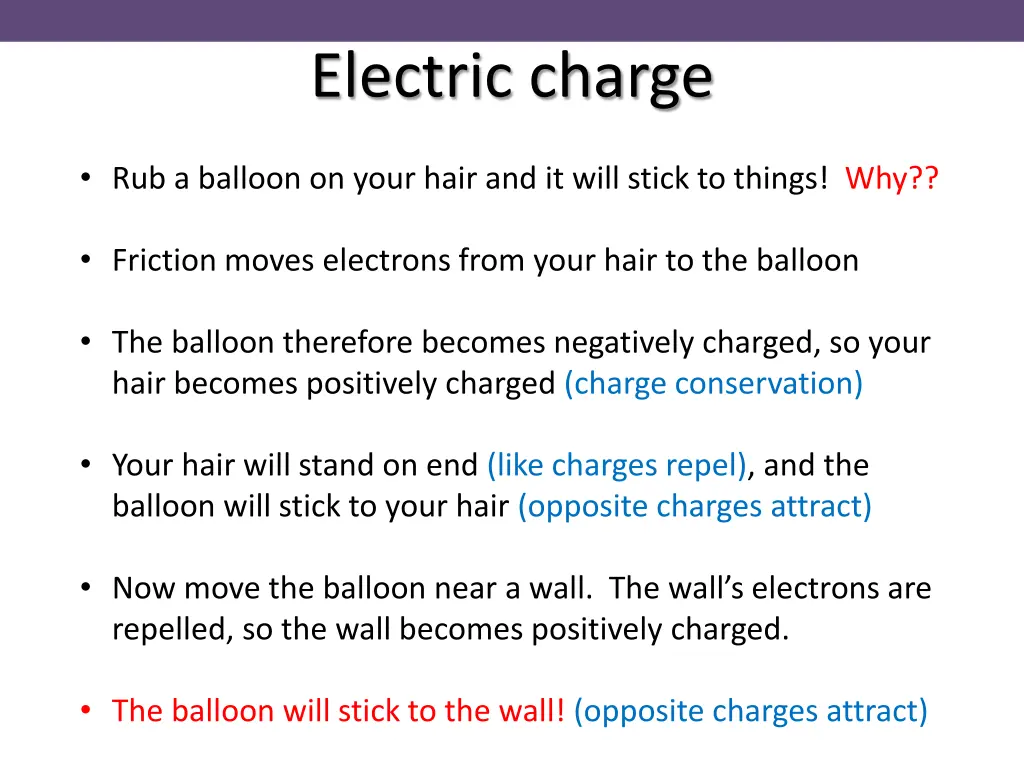
Electric charge Rub a balloon on your hair and it will stick to things! Why?? Friction moves electrons from your hair to the balloon The balloon therefore becomes negatively charged, so your hair becomes positively charged (charge conservation) Your hair will stand on end (like charges repel), and the balloon will stick to your hair (opposite charges attract) Now move the balloon near a wall. The wall s electrons are repelled, so the wall becomes positively charged. The balloon will stick to the wall! (opposite charges attract)
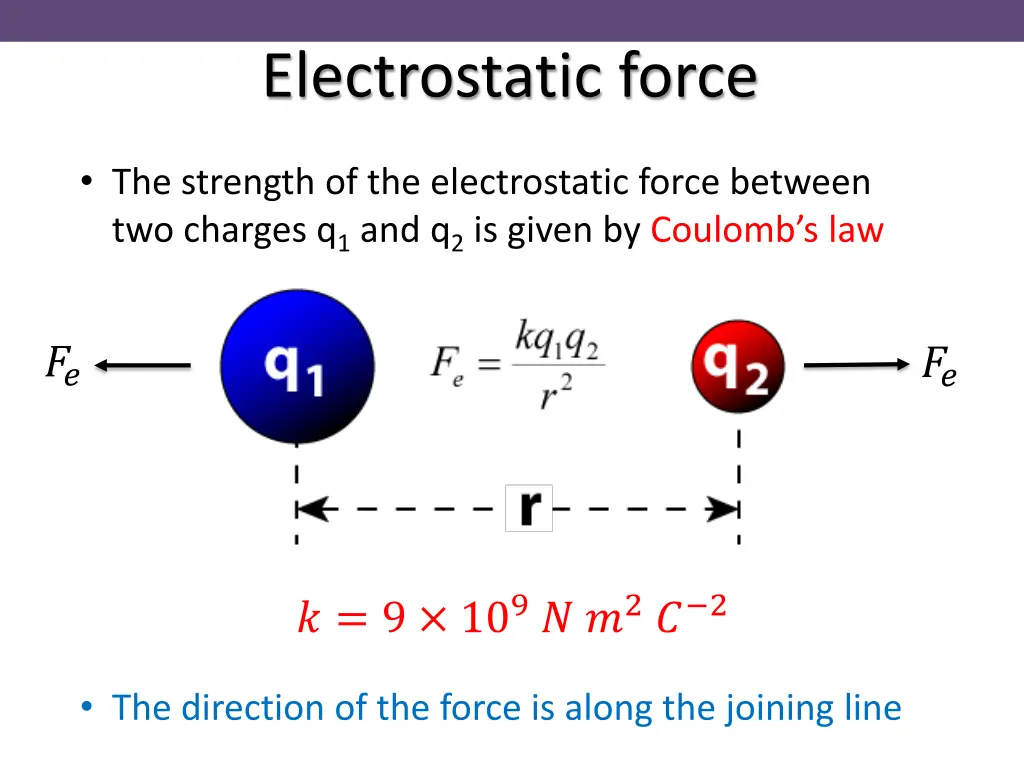
Electrostatic force The strength of the electrostatic force between two charges q1 and q2 is given by Coulomb s law ?? ?? ? = 9 109 ? ?2 ? 2 The direction of the force is along the joining line
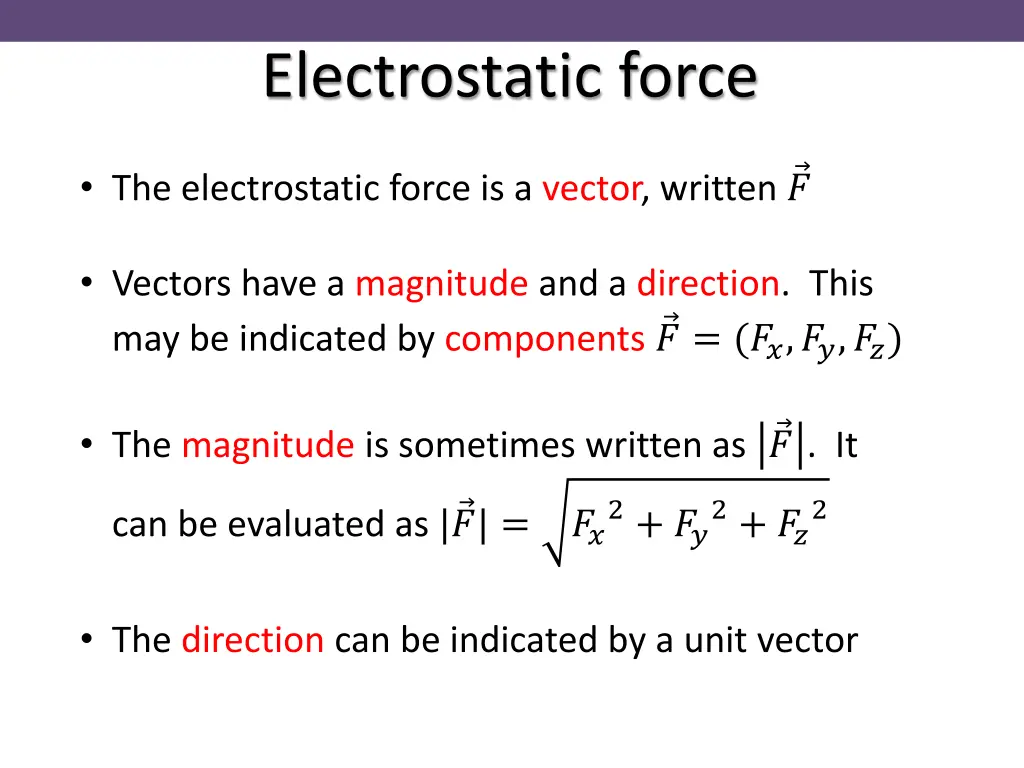
Electrostatic force The electrostatic force is a vector, written ? Vectors have a magnitude and a direction. This may be indicated by components ? = (??,??,??) The magnitude is sometimes written as ? . It ??2+ ??2+ ??2 can be evaluated as | ?| = The direction can be indicated by a unit vector
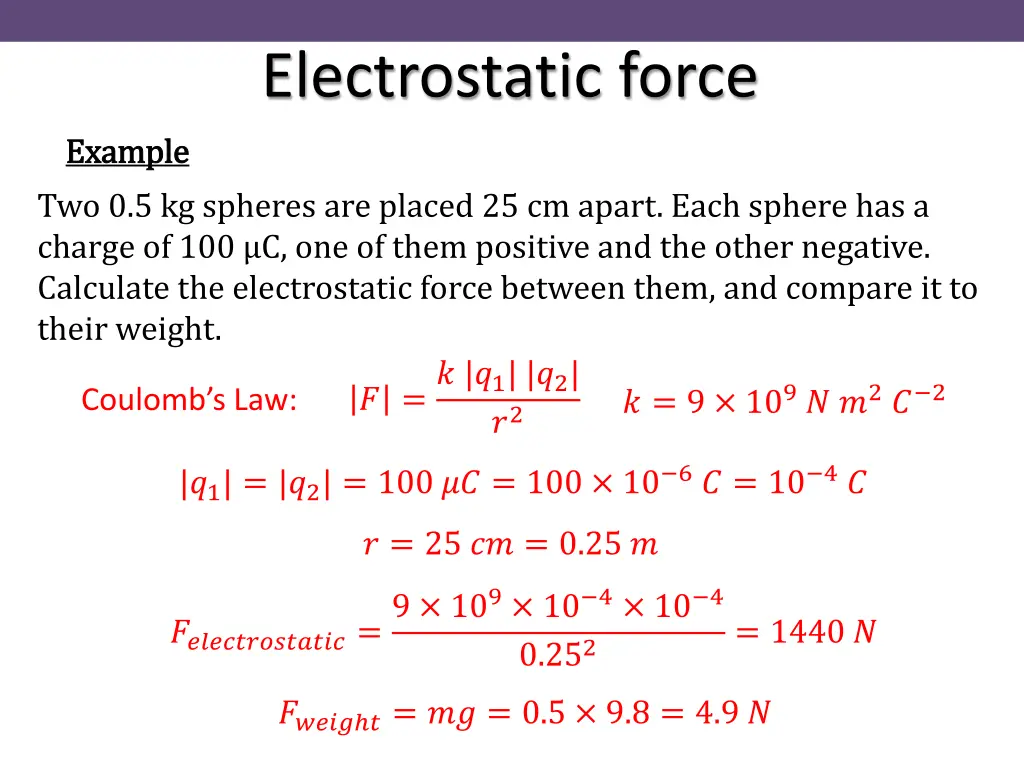
Electrostatic force Example Example Two 0.5 kg spheres are placed 25 cm apart. Each sphere has a charge of 100 C, one of them positive and the other negative. Calculate the electrostatic force between them, and compare it to their weight. ? =? |?1| |?2| ?2 ? = 9 109 ? ?2 ? 2 Coulomb s Law: |?1| = |?2| = 100 ?? = 100 10 6 ? = 10 4 ? ? = 25 ?? = 0.25 ? ??????????????=9 109 10 4 10 4 = 1440 ? 0.252 ????? ?= ?? = 0.5 9.8 = 4.9 ?
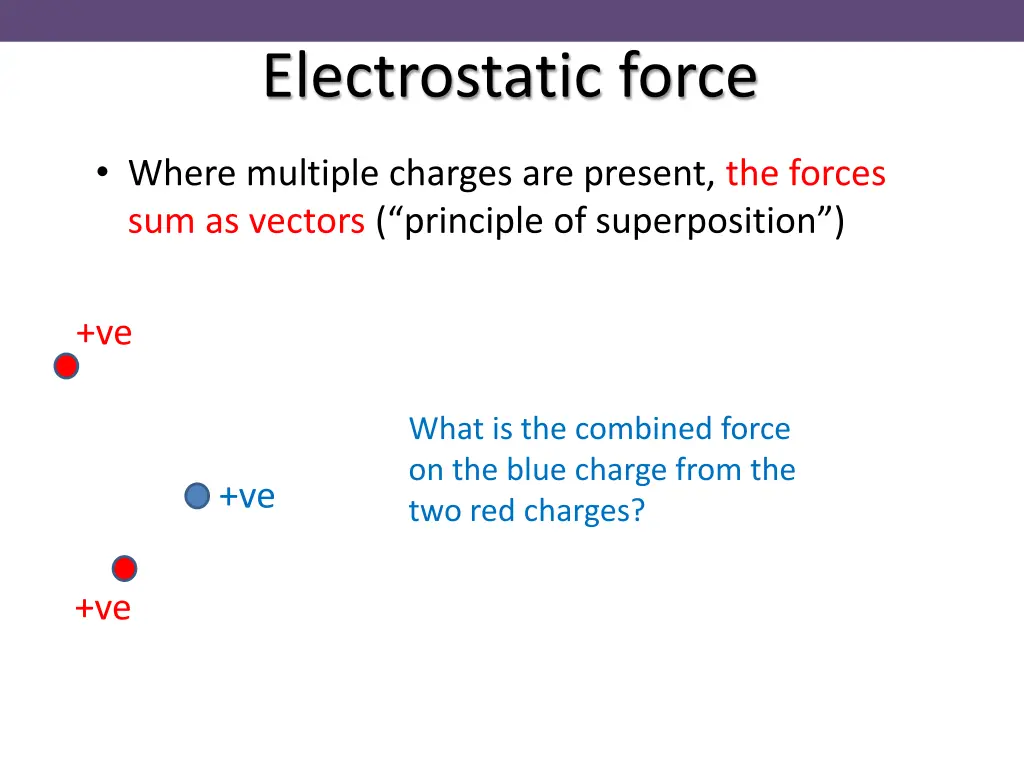
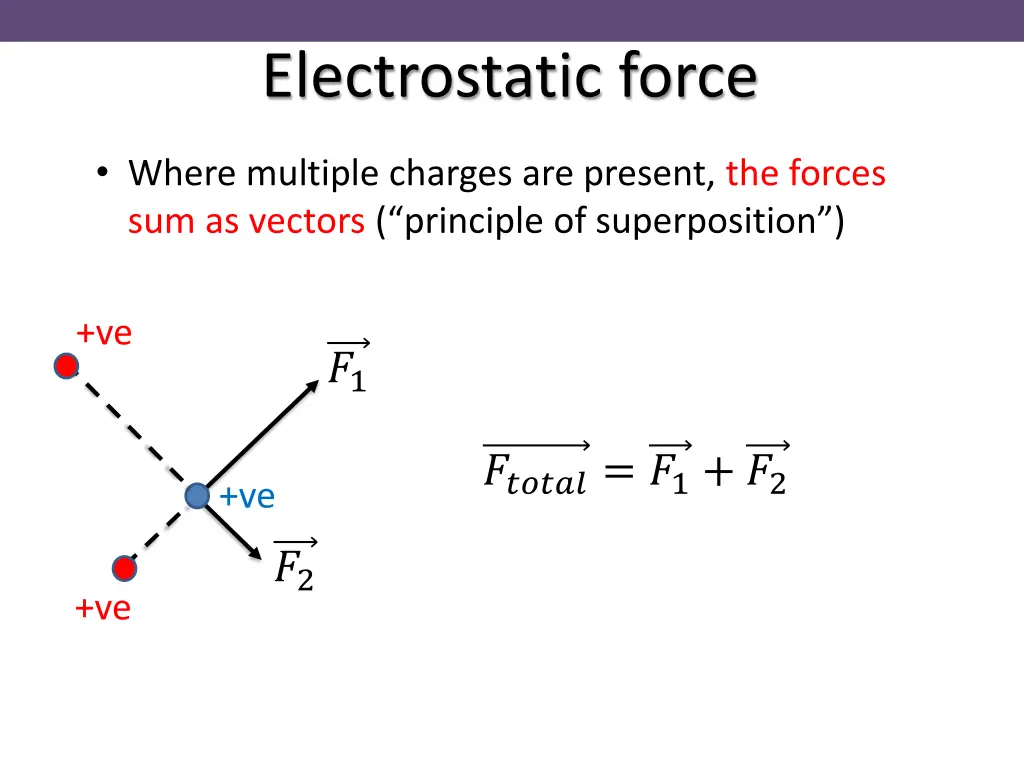
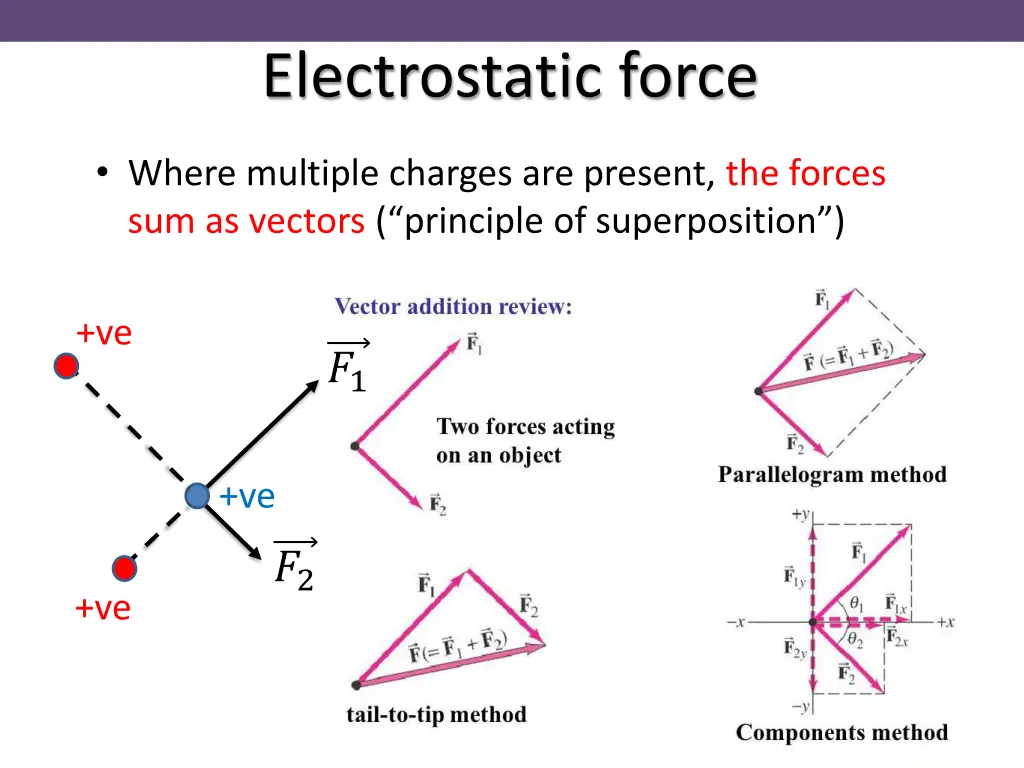
Electrostatic force Where multiple charges are present, the forces sum as vectors ( principle of superposition ) +ve What is the combined force on the blue charge from the two red charges? +ve +ve
Electrostatic force Where multiple charges are present, the forces sum as vectors ( principle of superposition ) +ve ?1 ??????= ?1+ ?2 +ve ?2 +ve
Electrostatic force Where multiple charges are present, the forces sum as vectors ( principle of superposition ) +ve ?1 +ve ?2 +ve
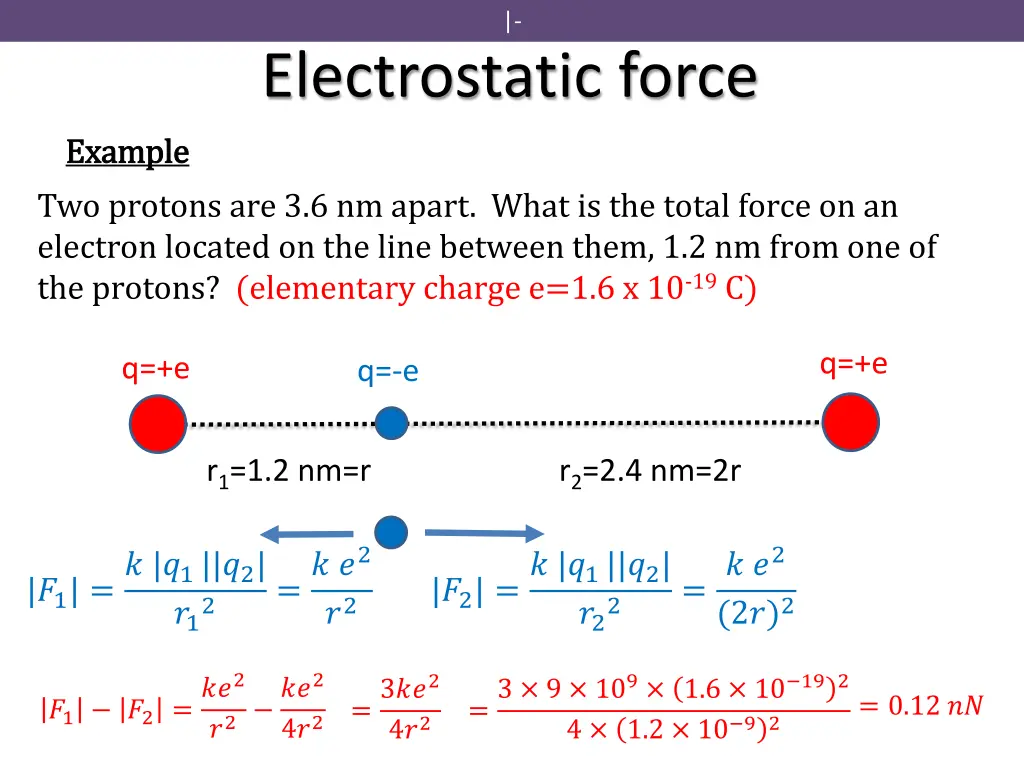
|- Electrostatic force Example Example Two protons are 3.6 nm apart. What is the total force on an electron located on the line between them, 1.2 nm from one of the protons? (elementary charge e=1.6 x 10⁻¹⁹ C) q=+e q=+e q=-e r1=1.2 nm=r r2=2.4 nm=2r =? ?2 ? ?2 (2?)2 |?1| =? |?1 ||?2| |?2| =? |?1 ||?2| = ?12 ?2 ?22 ?1 ?2 =??2 ?2 ??2 =3??2 4?2 =3 9 109 1.6 10 19 2 4 1.2 10 9 2 = 0.12 ?? 4?2
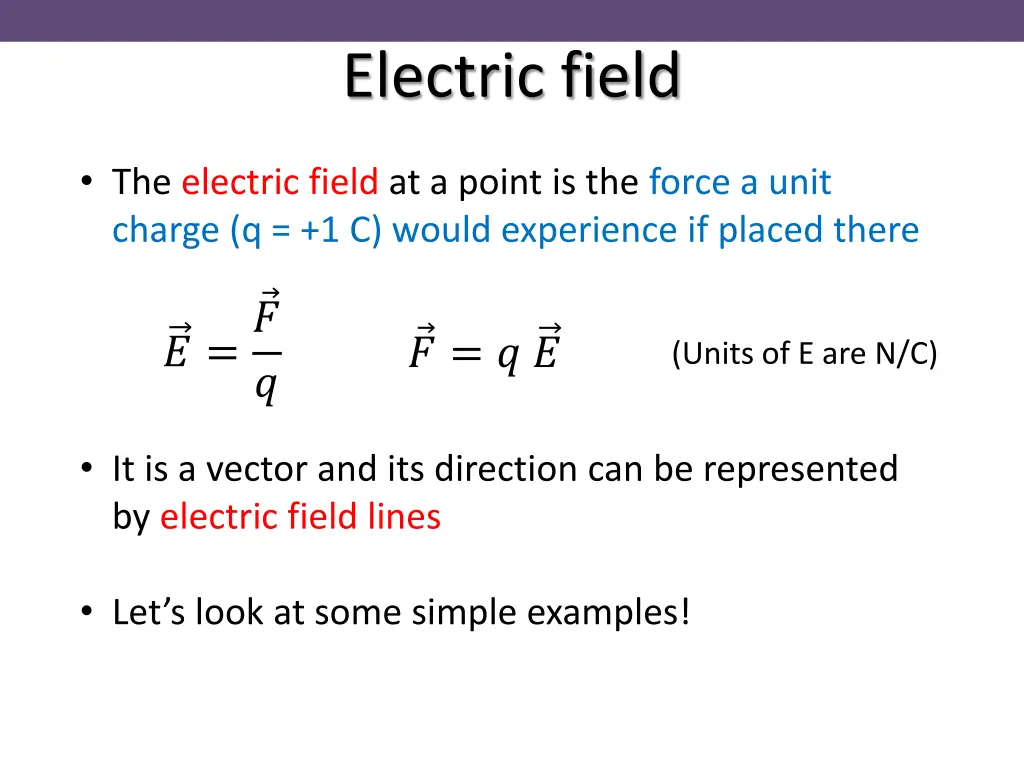
Electric field The electric field at a point is the force a unit charge (q = +1 C) would experience if placed there ? ? ? = ? ? ? = (Units of E are N/C) It is a vector and its direction can be represented by electric field lines Let s look at some simple examples!
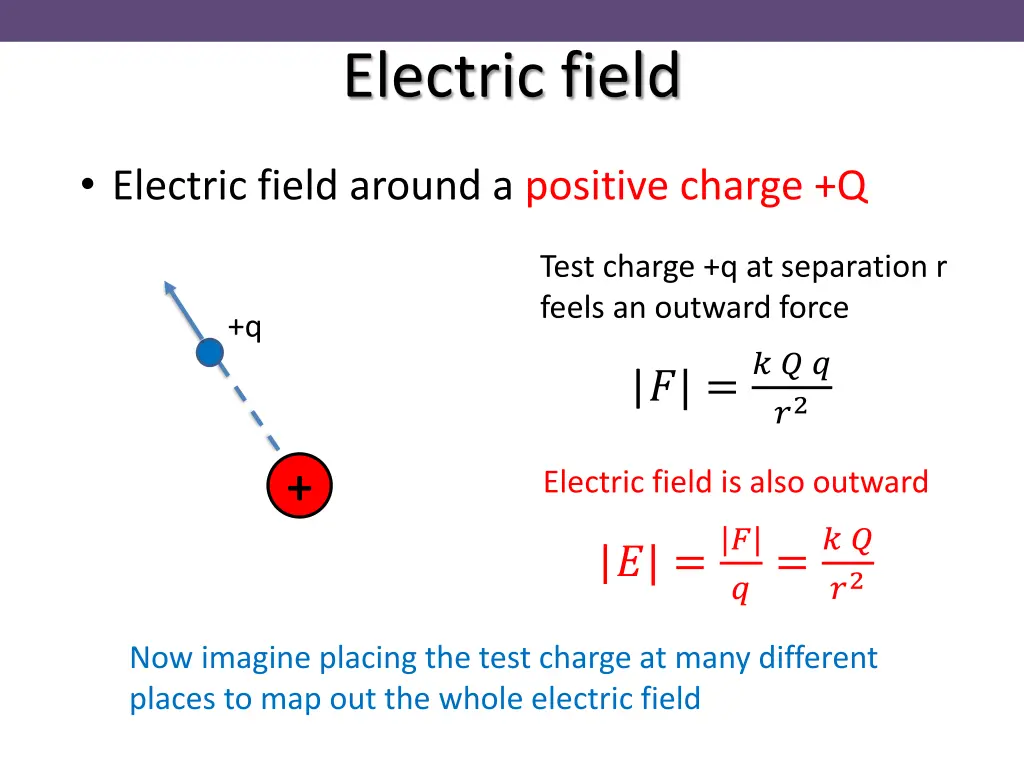
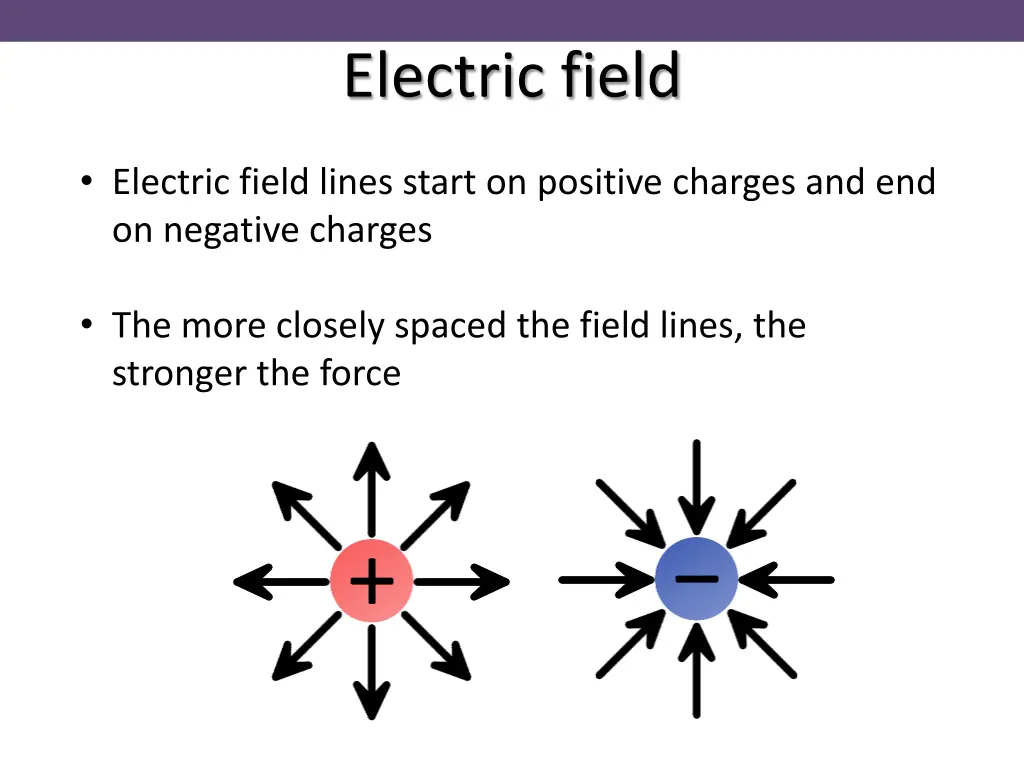
Electric field Electric field around a positive charge +Q Test charge +q at separation r feels an outward force |?| =? ? ? +q ?2 + Electric field is also outward |?| =|?| ?=? ? ?2 Now imagine placing the test charge at many different places to map out the whole electric field
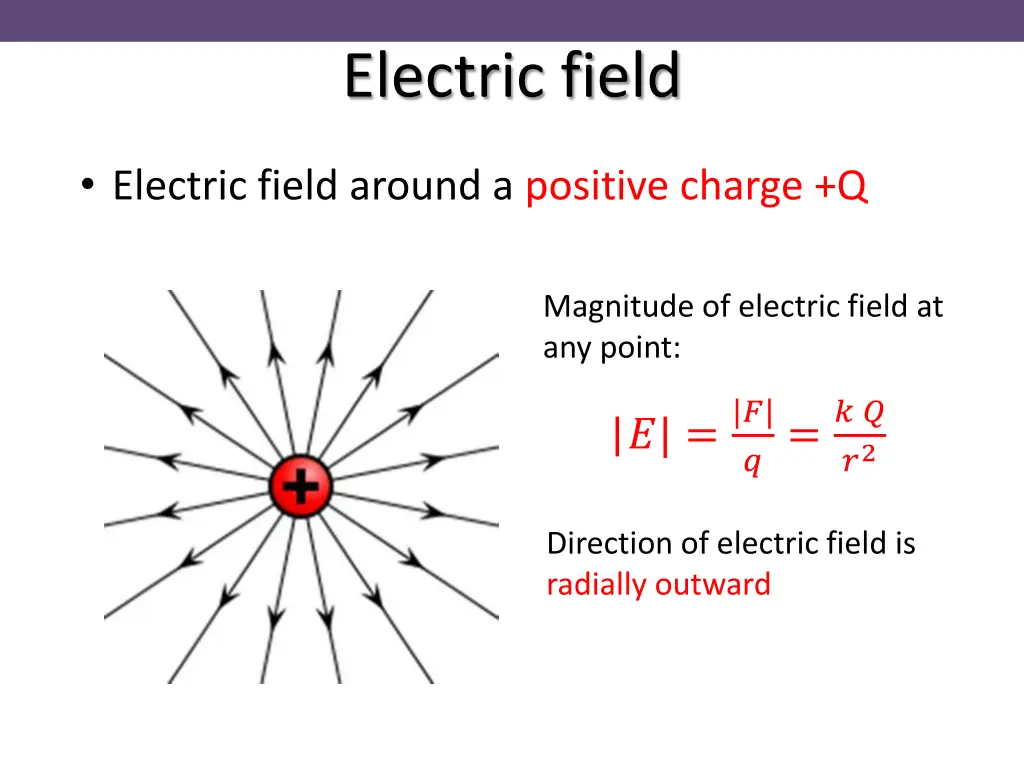
Electric field Electric field around a positive charge +Q Magnitude of electric field at any point: |?| =|?| ?=? ? ?2 Direction of electric field is radially outward
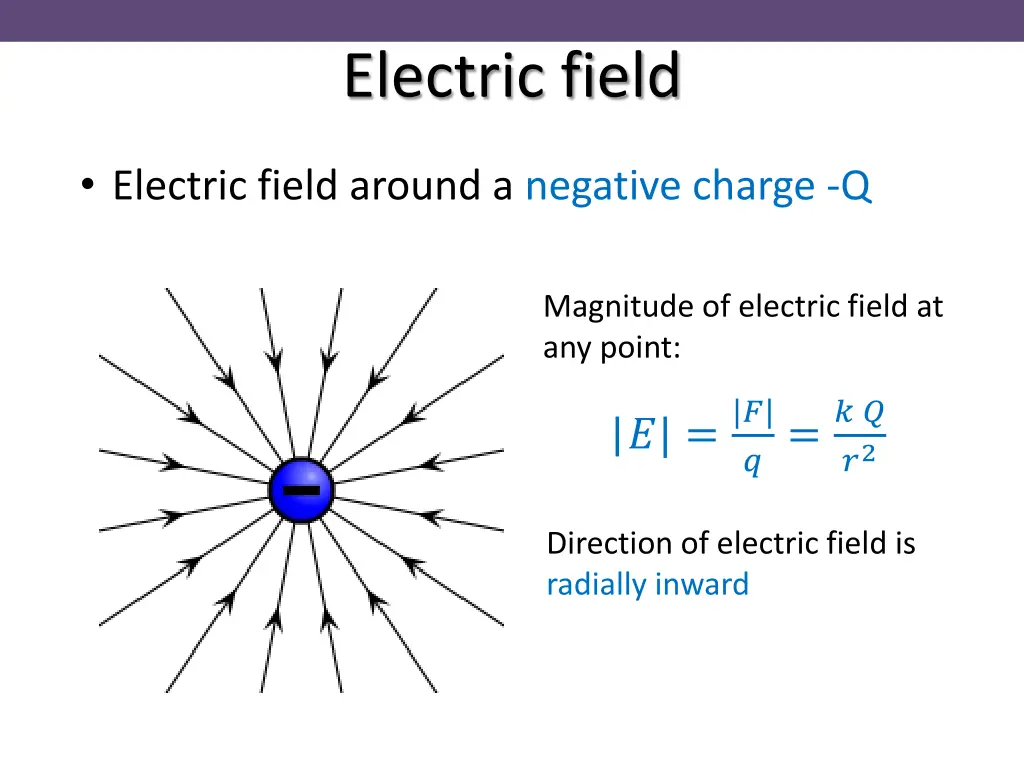
Electric field Electric field around a negative charge -Q Magnitude of electric field at any point: |?| =|?| ?=? ? ?2 Direction of electric field is radially inward
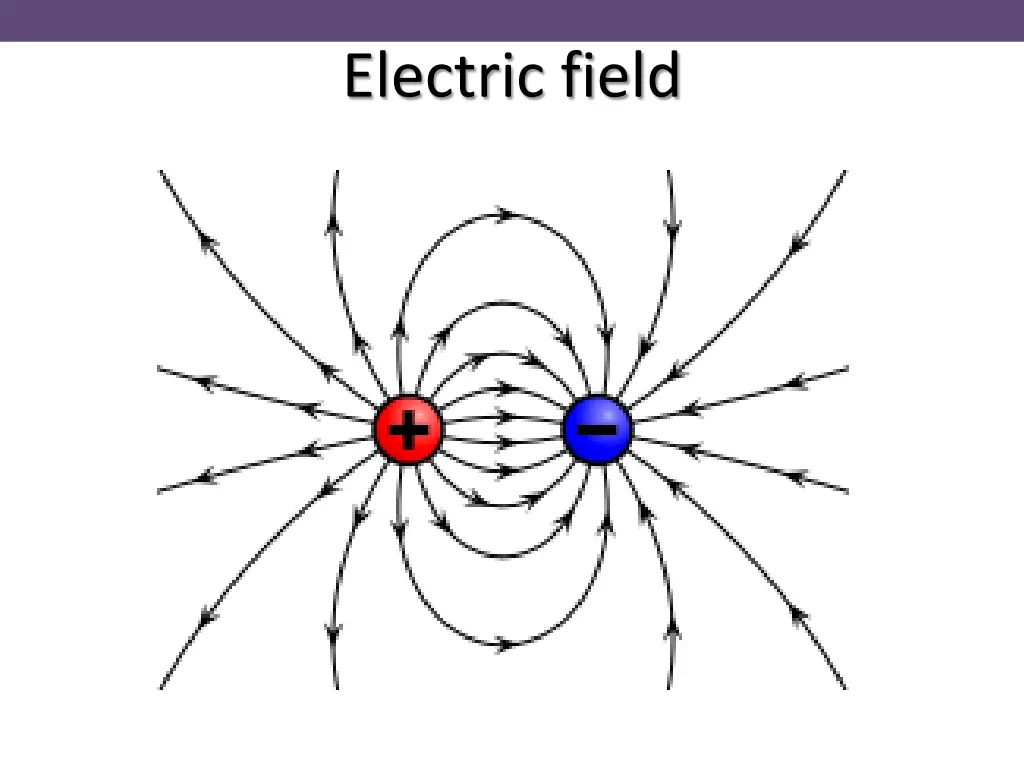
Electric field Electric field lines start on positive charges and end on negative charges The more closely spaced the field lines, the stronger the force
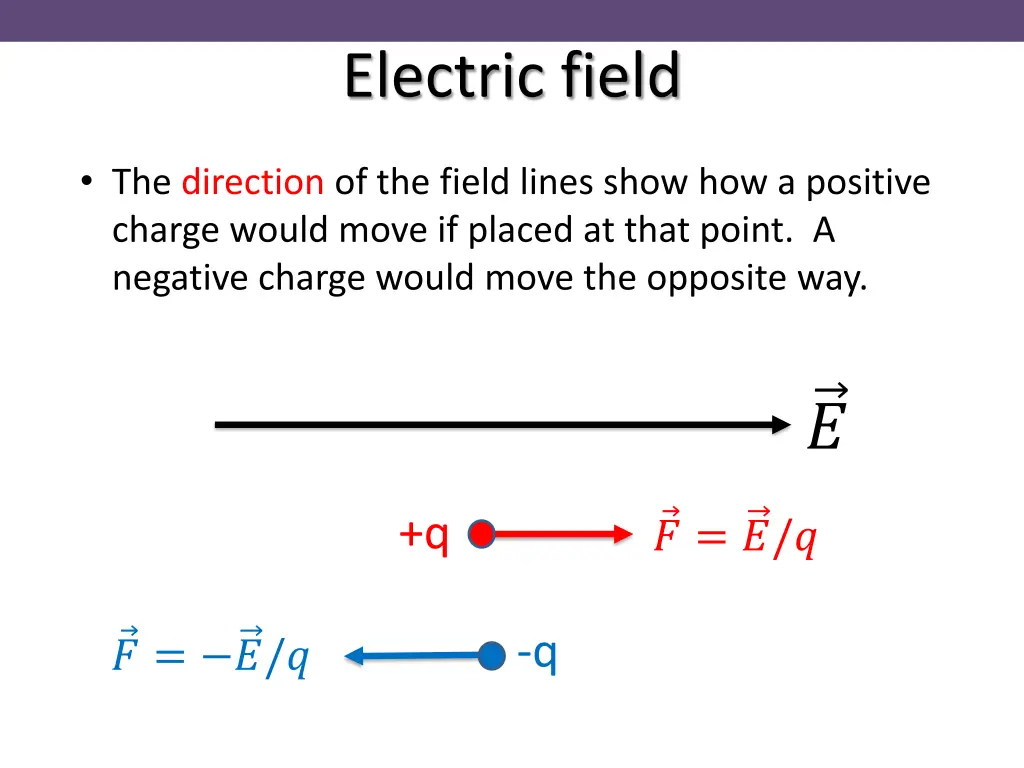
Electric field The direction of the field lines show how a positive charge would move if placed at that point. A negative charge would move the opposite way. ? ? = ?/? +q ? = ?/? -q
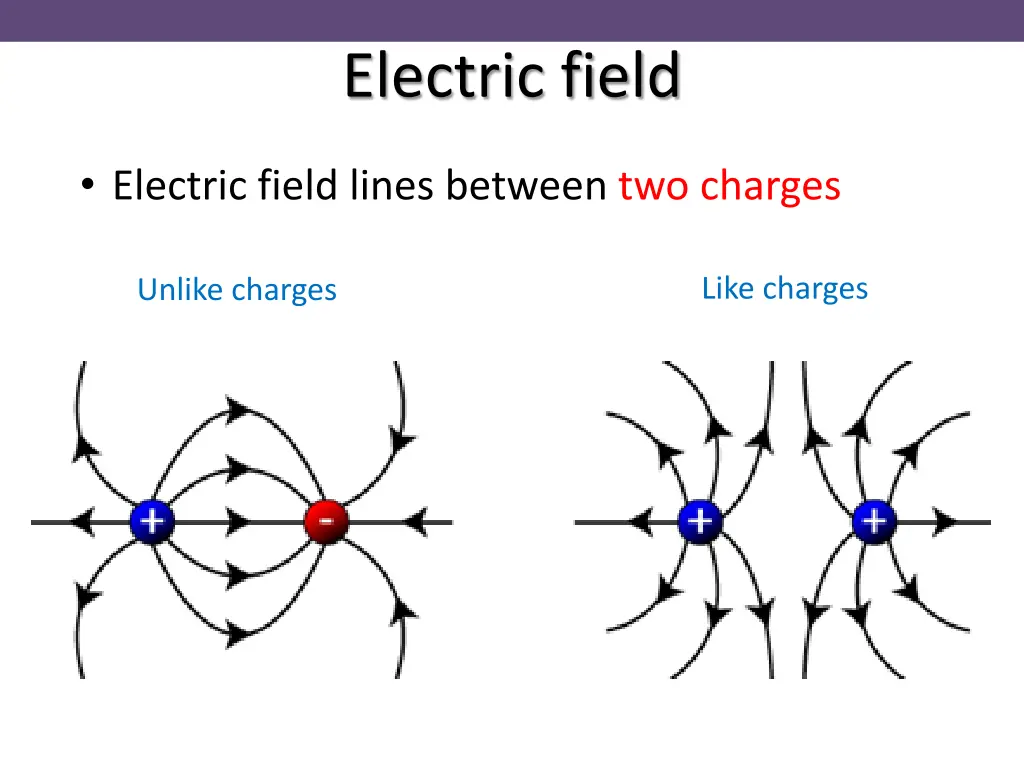
Electric field Electric field lines between two charges Like charges Unlike charges
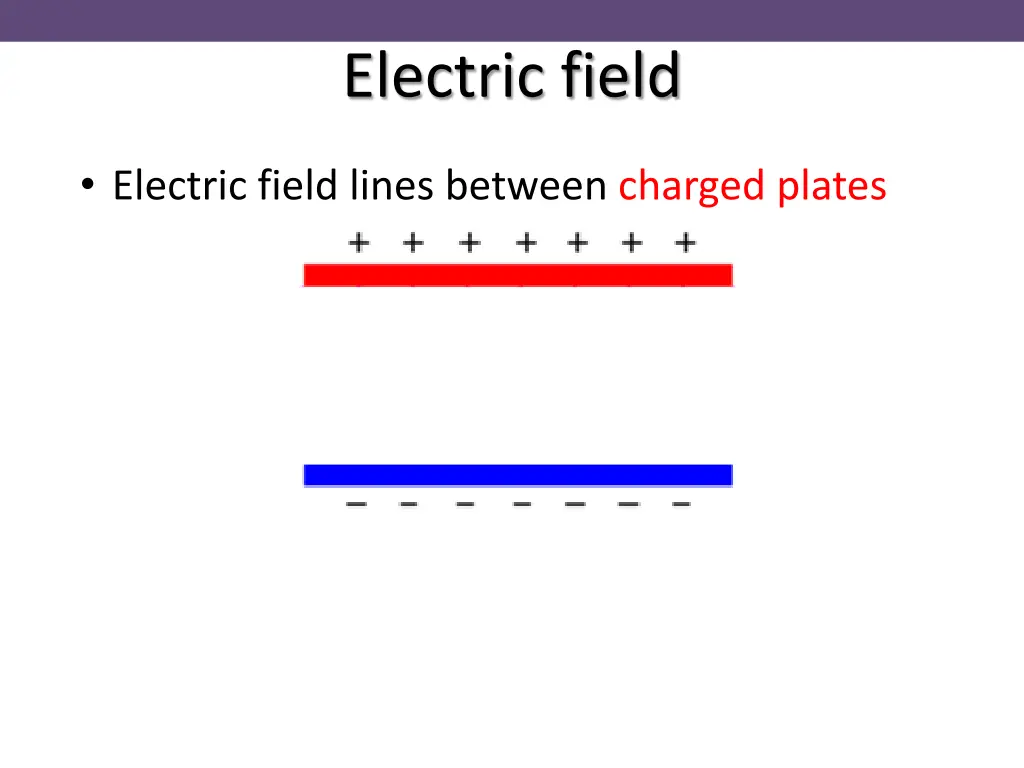
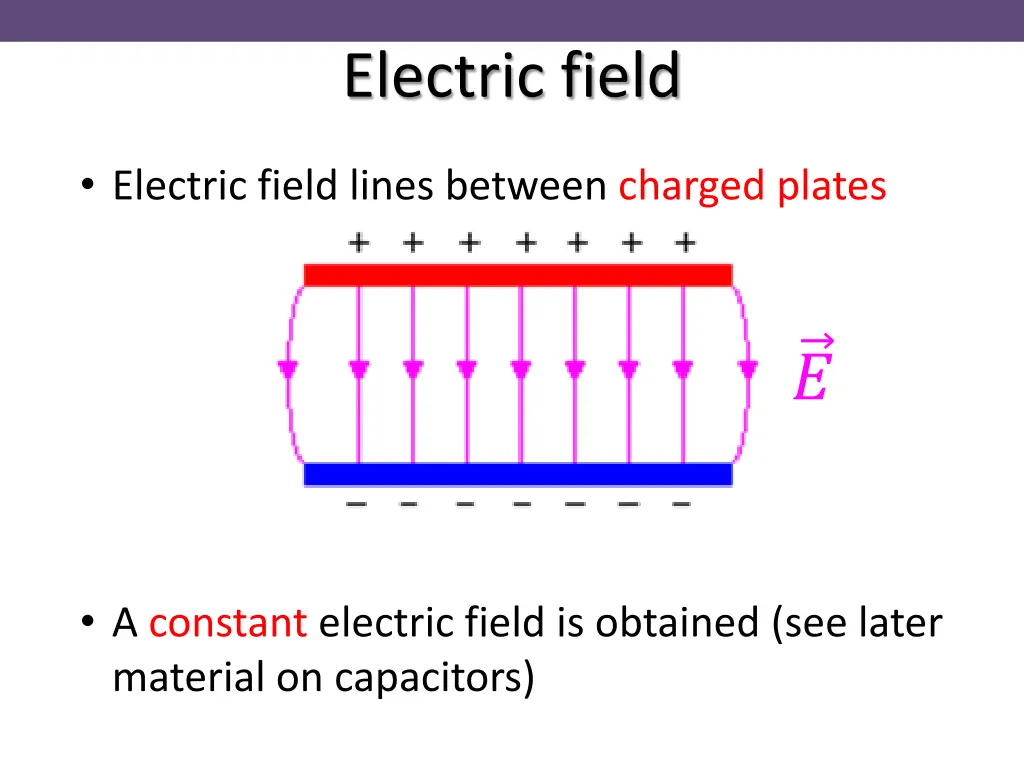
Electric field Electric field lines between charged plates
Electric field Electric field lines between charged plates ? A constant electric field is obtained (see later material on capacitors)
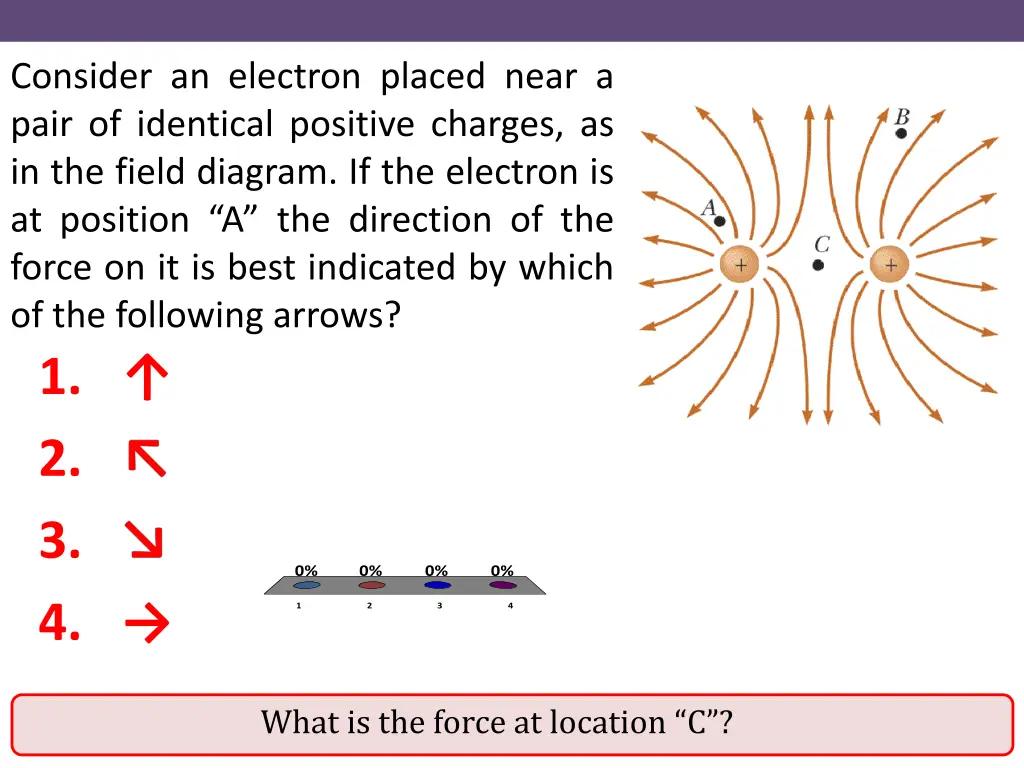
Consider an electron placed near a pair of identical positive charges, as in the field diagram. If the electron is at position A the direction of the force on it is best indicated by which of the following arrows? 1. 2. 3. 4. 0% 0% 0% 0% 1 2 3 4 What is the force at location C ?
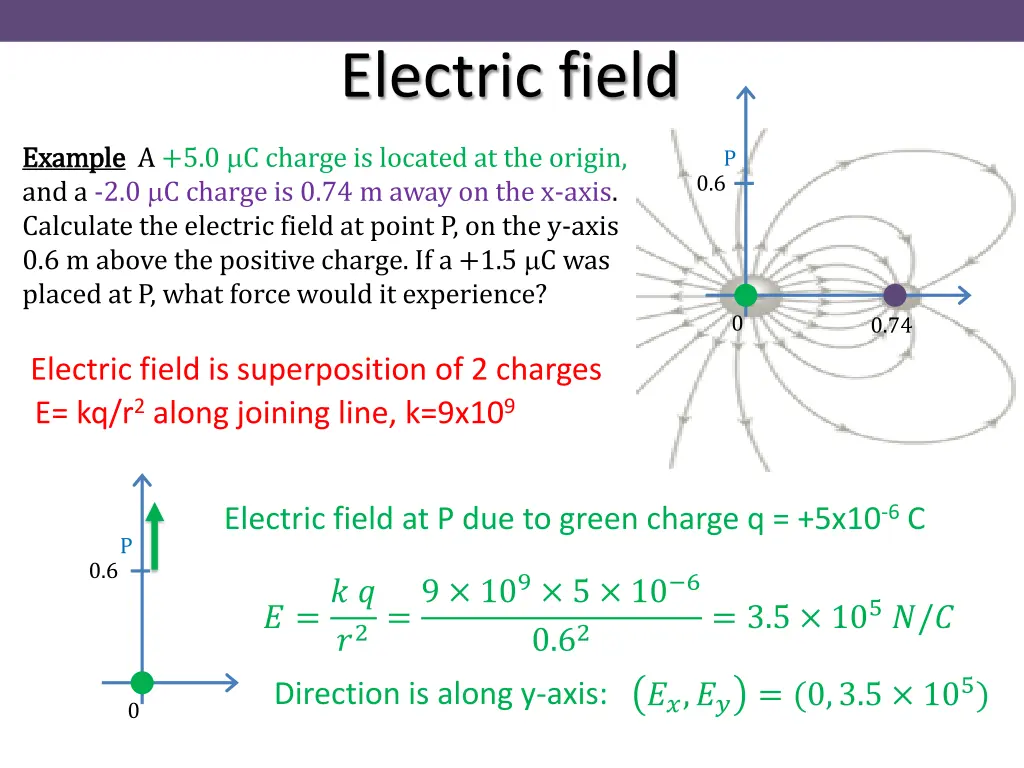
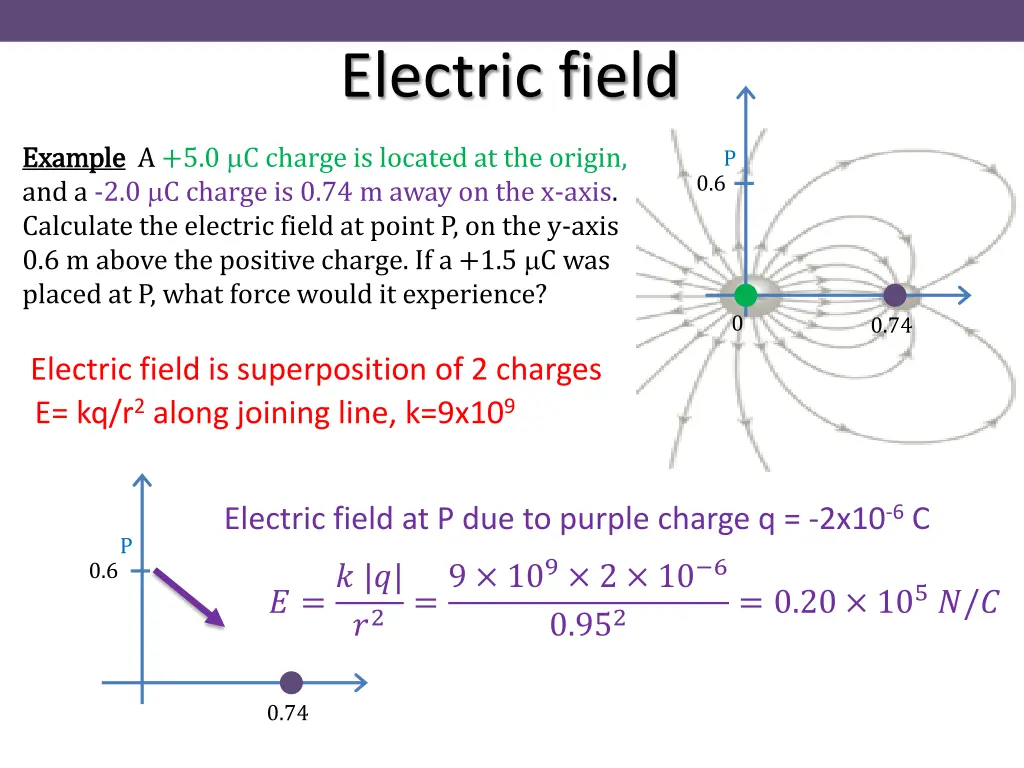
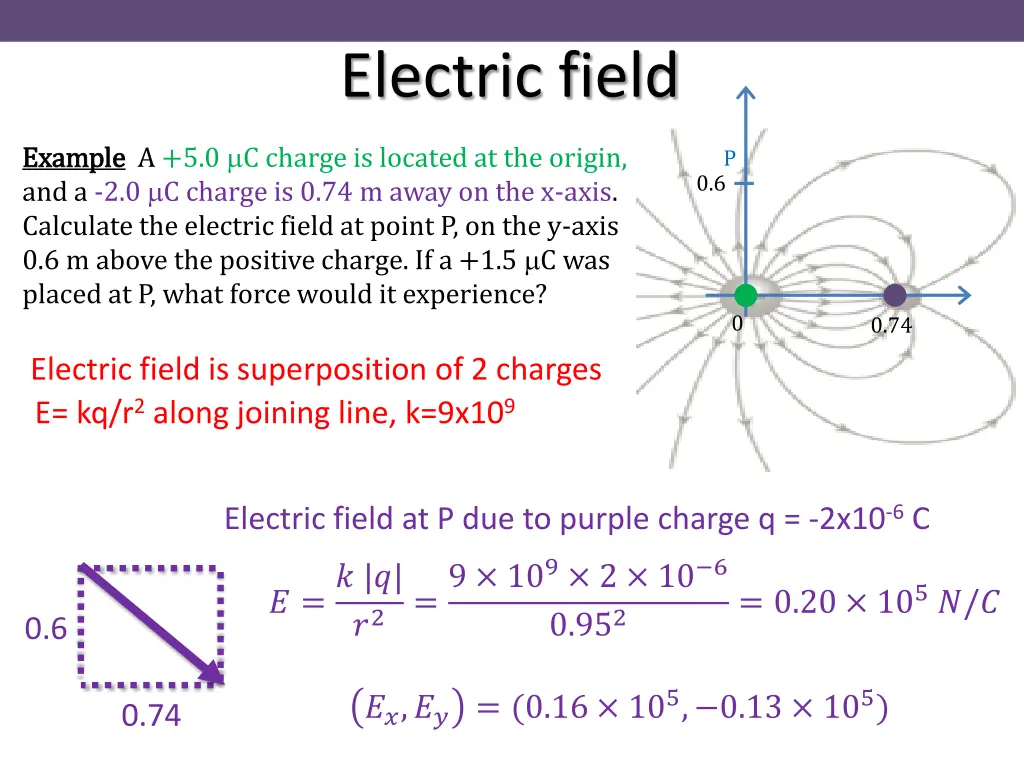
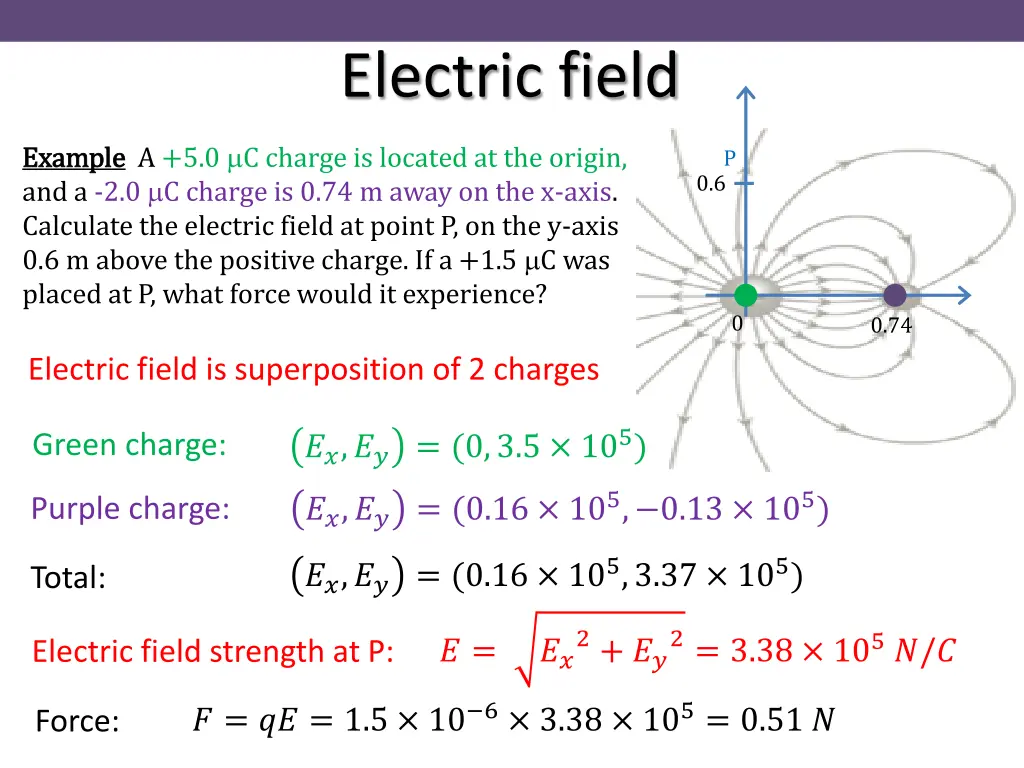
Electric field Example Example A +5.0 C charge is located at the origin, and a -2.0 C charge is 0.74 m away on the x-axis. Calculate the electric field at point P, on the y-axis 0.6 m above the positive charge. If a +1.5 C was placed at P, what force would it experience? P 0.6 0 0.74 Electric field is superposition of 2 charges E= kq/r2 along joining line, k=9x10⁹ Electric field at P due to green charge q = +5x10⁻⁶ C P 0.6 ?2=9 109 5 10 6 Direction is along y-axis: ??,?? = (0,3.5 105) ? =? ? = 3.5 105 ?/? 0.62 0
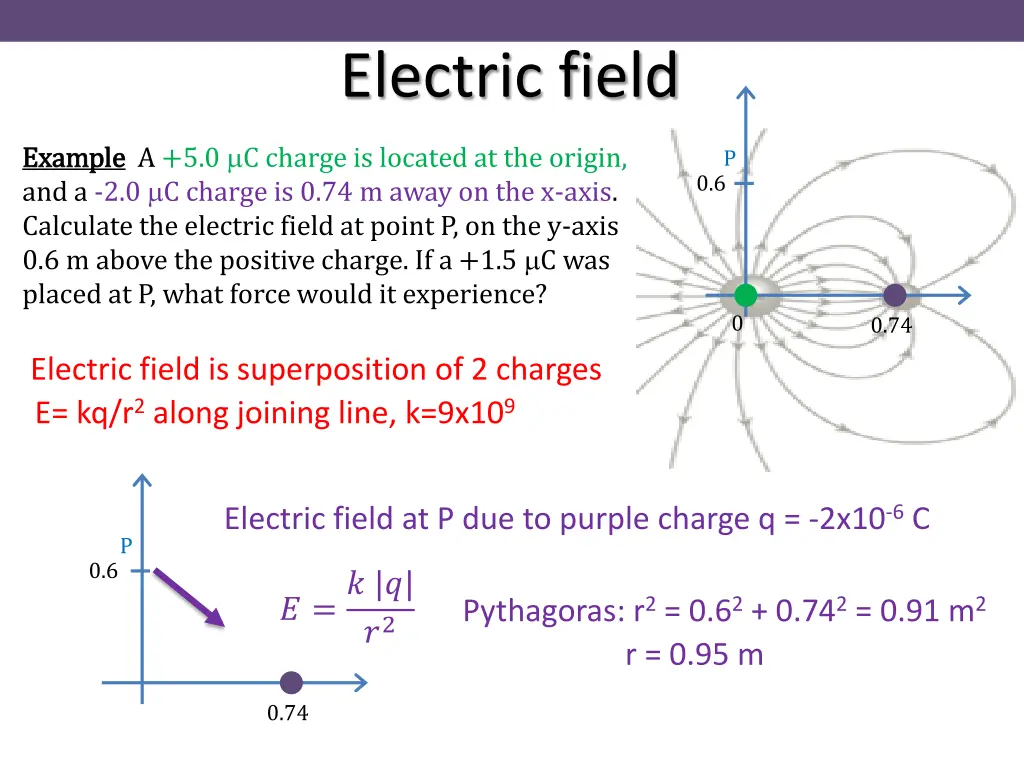
Electric field Example Example A +5.0 C charge is located at the origin, and a -2.0 C charge is 0.74 m away on the x-axis. Calculate the electric field at point P, on the y-axis 0.6 m above the positive charge. If a +1.5 C was placed at P, what force would it experience? P 0.6 0 0.74 Electric field is superposition of 2 charges E= kq/r2 along joining line, k=9x10⁹ Electric field at P due to purple charge q = -2x10⁻⁶ C P 0.6 ? =? |?| Pythagoras: r2 = 0.62 + 0.742 = 0.91 m2 r = 0.95 m ?2 0.74
Electric field Example Example A +5.0 C charge is located at the origin, and a -2.0 C charge is 0.74 m away on the x-axis. Calculate the electric field at point P, on the y-axis 0.6 m above the positive charge. If a +1.5 C was placed at P, what force would it experience? P 0.6 0 0.74 Electric field is superposition of 2 charges E= kq/r2 along joining line, k=9x10⁹ Electric field at P due to purple charge q = -2x10⁻⁶ C P =9 109 2 10 6 0.952 0.6 ? =? |?| = 0.20 105 ?/? ?2 0.74
Electric field Example Example A +5.0 C charge is located at the origin, and a -2.0 C charge is 0.74 m away on the x-axis. Calculate the electric field at point P, on the y-axis 0.6 m above the positive charge. If a +1.5 C was placed at P, what force would it experience? P 0.6 0 0.74 Electric field is superposition of 2 charges E= kq/r2 along joining line, k=9x10⁹ Electric field at P due to purple charge q = -2x10⁻⁶ C =9 109 2 10 6 0.952 ? =? |?| = 0.20 105 ?/? ?2 0.6 ??,?? = (0.16 105, 0.13 105) 0.74
Electric field Example Example A +5.0 C charge is located at the origin, and a -2.0 C charge is 0.74 m away on the x-axis. Calculate the electric field at point P, on the y-axis 0.6 m above the positive charge. If a +1.5 C was placed at P, what force would it experience? P 0.6 0 0.74 Electric field is superposition of 2 charges ??,?? = (0,3.5 105) Green charge: ??,?? = (0.16 105, 0.13 105) Purple charge: ??,?? = (0.16 105,3.37 105) Total: ??2+ ??2= 3.38 105 ?/? ? = Electric field strength at P: ? = ?? = 1.5 10 6 3.38 105= 0.51 ? Force:
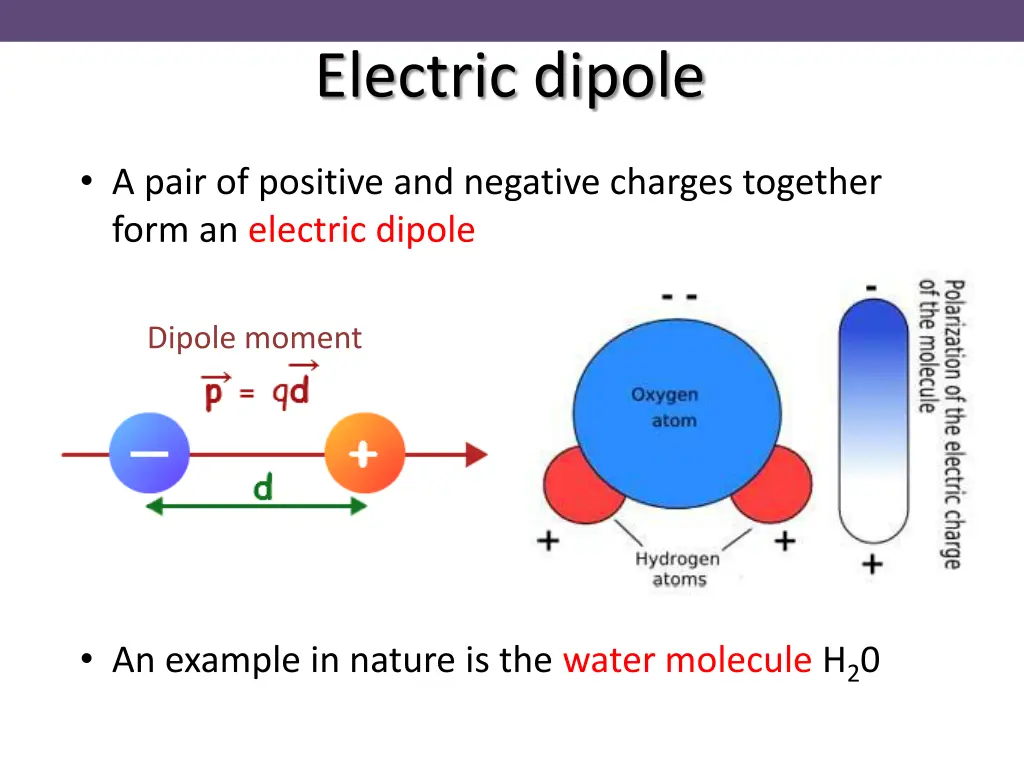
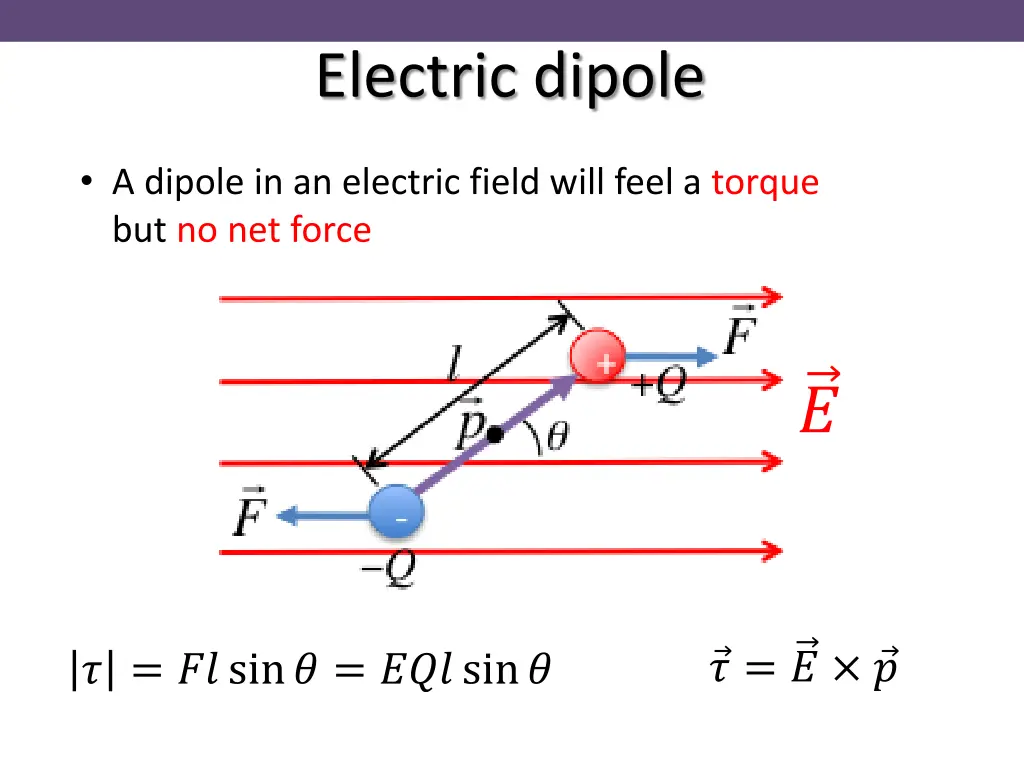
Electric dipole A pair of positive and negative charges together form an electric dipole Dipole moment An example in nature is the water molecule H20
Electric dipole A dipole in an electric field will feel a torque but no net force ? ? = ? ? ? = ??sin? = ???sin?
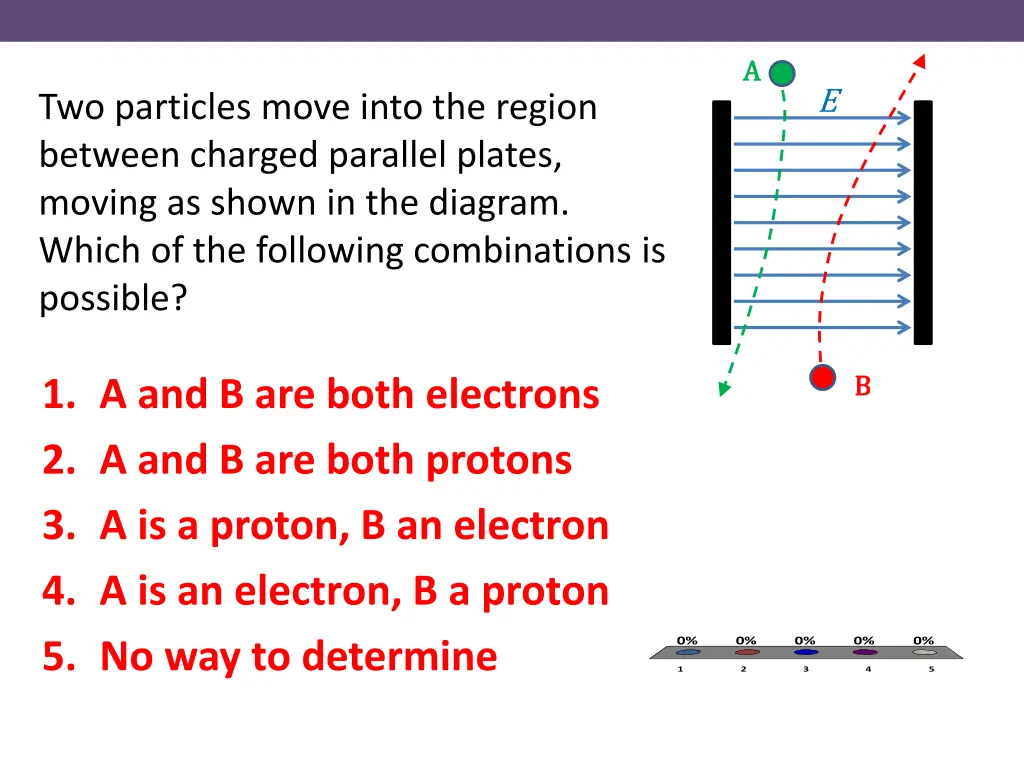
A A E Two particles move into the region between charged parallel plates, moving as shown in the diagram. Which of the following combinations is possible? B B 1. A and B are both electrons 2. A and B are both protons 3. A is a proton, B an electron 4. A is an electron, B a proton 5. No way to determine 0% 0% 0% 0% 0% 1 2 3 4 5
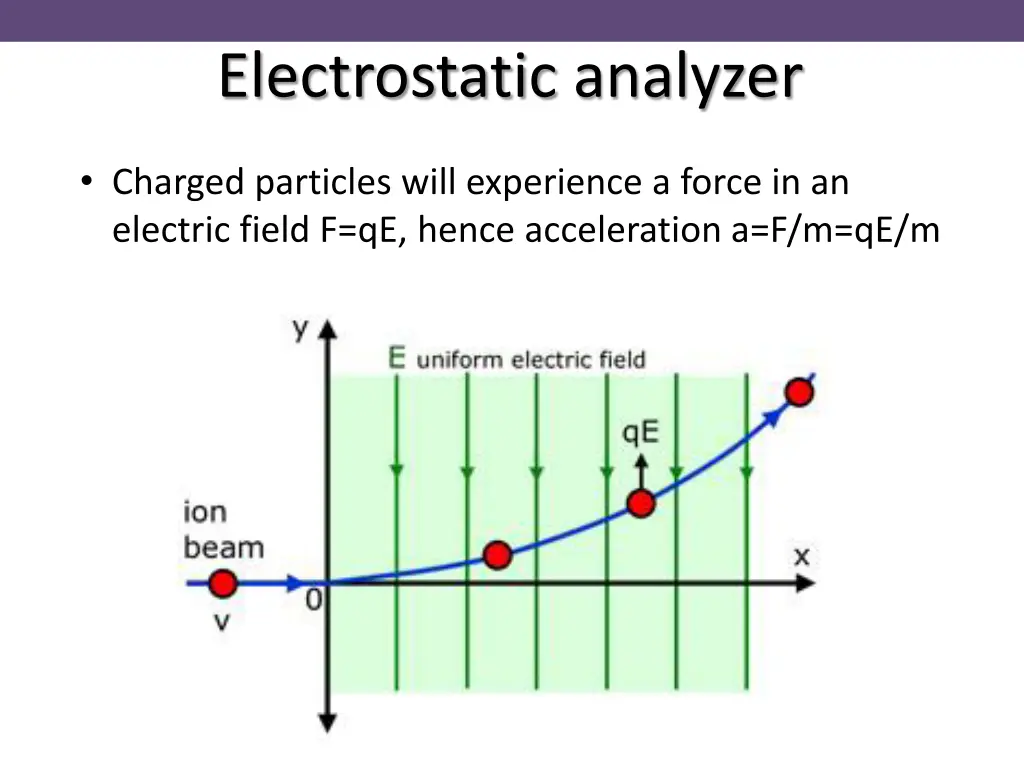
Electrostatic analyzer Charged particles will experience a force in an electric field F=qE, hence acceleration a=F/m=qE/m
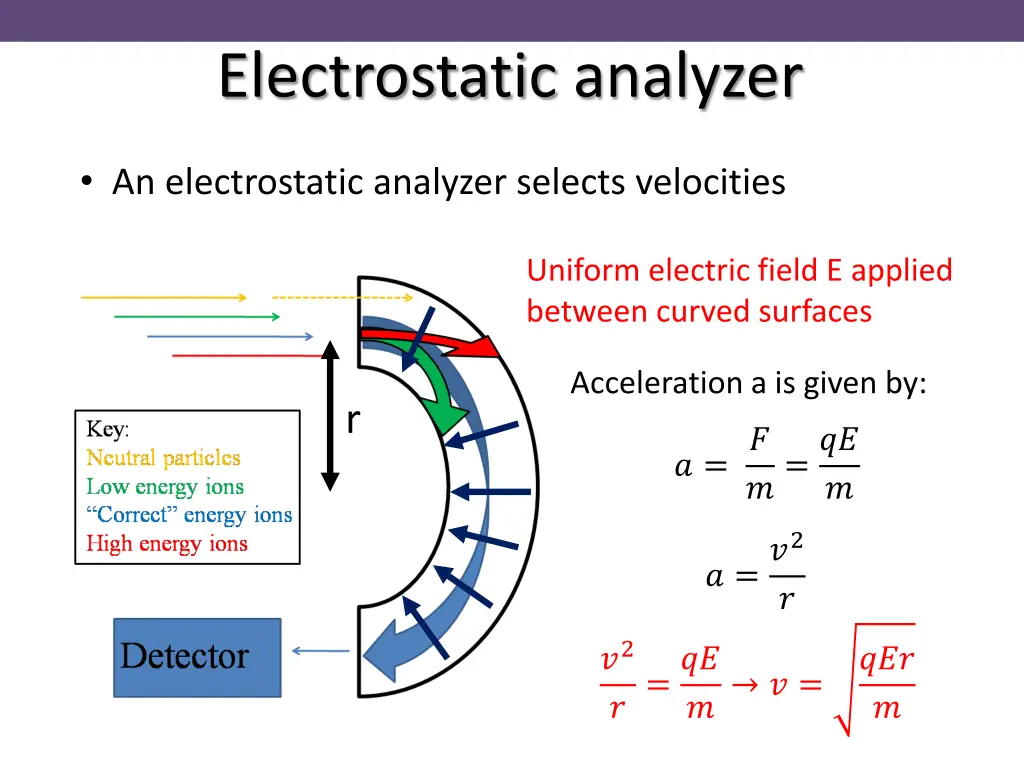
Electrostatic analyzer An electrostatic analyzer selects velocities Uniform electric field E applied between curved surfaces Acceleration a is given by: r ? ?=?? ? = ? ? =?2 ? ?2 ?=?? ??? ? ? ? =
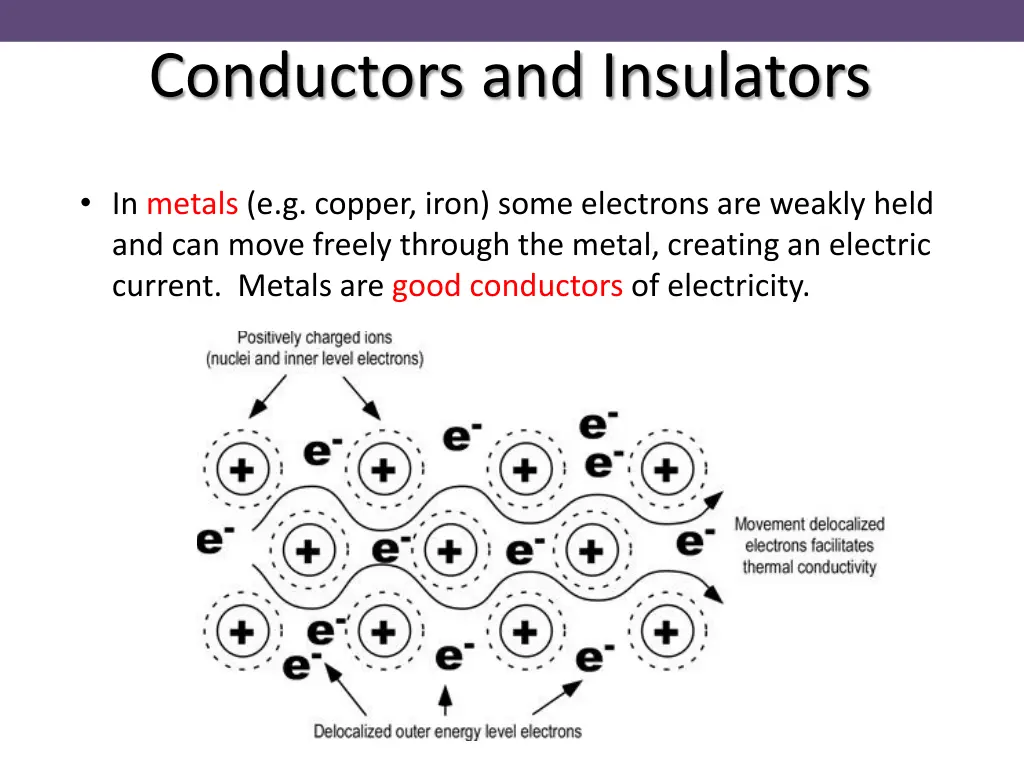
Conductors and Insulators In metals (e.g. copper, iron) some electrons are weakly held and can move freely through the metal, creating an electric current. Metals are good conductors of electricity.
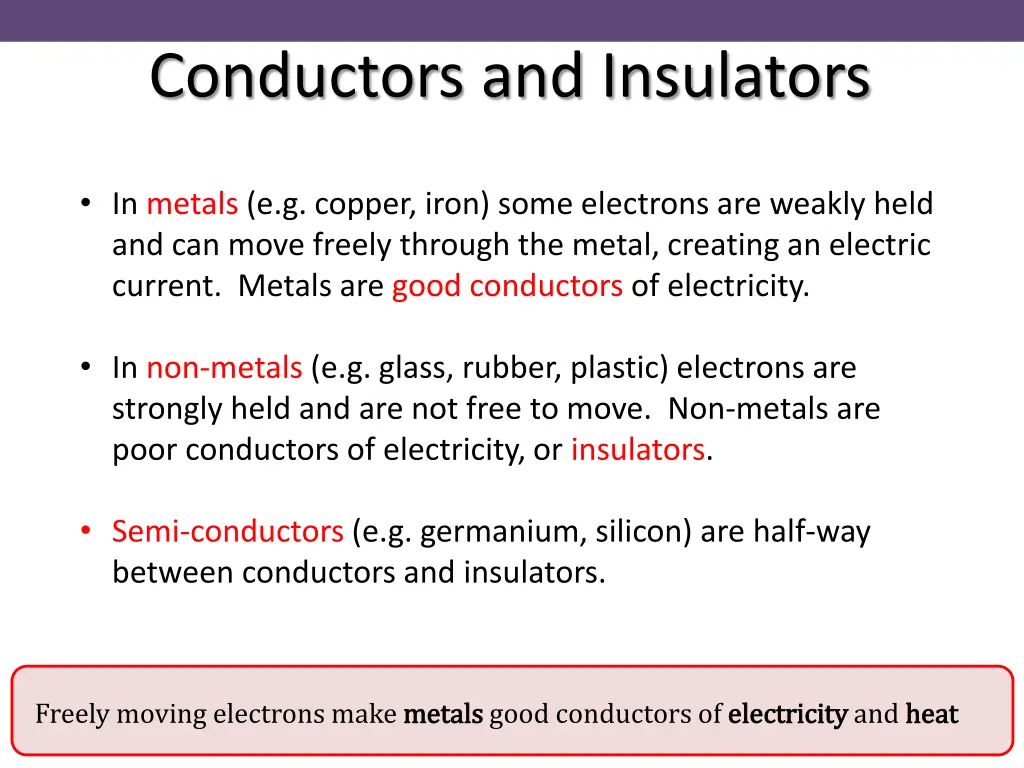
Conductors and Insulators In metals (e.g. copper, iron) some electrons are weakly held and can move freely through the metal, creating an electric current. Metals are good conductors of electricity. In non-metals (e.g. glass, rubber, plastic) electrons are strongly held and are not free to move. Non-metals are poor conductors of electricity, or insulators. Semi-conductors (e.g. germanium, silicon) are half-way between conductors and insulators. Freely moving electrons make metals metals good conductors of electricity electricity and heat heat
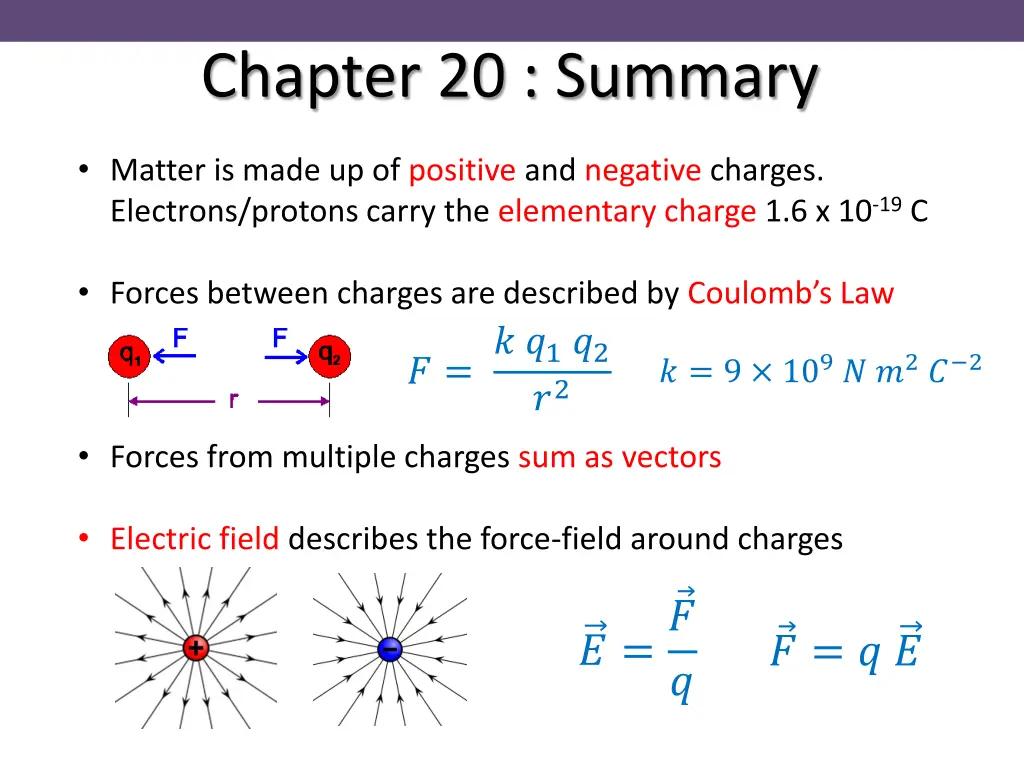
Chapter 20 : Summary Matter is made up of positive and negative charges. Electrons/protons carry the elementary charge 1.6 x 10⁻¹⁹ C Forces between charges are described by Coulomb s Law ? ?1 ?2 ?2 ? = 9 109 ? ?2 ? 2 ? = Forces from multiple charges sum as vectors Electric field describes the force-field around charges ? ? ? = ? ? ? =