Uncover the intricacies of transforming vectors in three dimensions, exploring rotation matrices, orientation principles, and smooth motion challenges with a focus on coordinate systems. Understand the linear transformations between Earth and Platform coordinates, the importance of orthogonal matrices, and the utilization of sines and cosines in rotation computations. Delve into the concept of rotating about an axis, the impact of successive rotations, and the search for an invariant axis for smooth rotations. Discover the proposed representation involving unit vectors and scalar angles for rotation.
Please find below an Image/Link to download the presentation.
The content on the website is provided AS IS for your information and personal use only. It may not be sold, licensed, or shared on other websites without obtaining consent from the author. If you encounter any issues during the download, it is possible that the publisher has removed the file from their server.
You are allowed to download the files provided on this website for personal or commercial use, subject to the condition that they are used lawfully. All files are the property of their respective owners.
The content on the website is provided AS IS for your information and personal use only. It may not be sold, licensed, or shared on other websites without obtaining consent from the author.
E N D
Presentation Transcript
Coordinate Transformations in Three Dimensions Robert P. Goddard Northwest C++ Users Group Presented 18 October 2017 Additional material added 23 October 2017
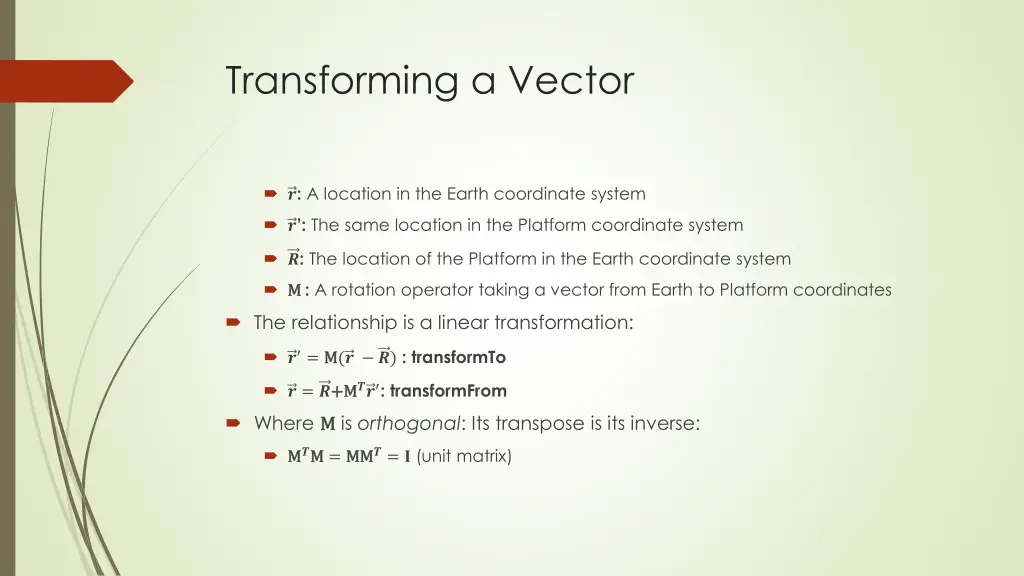
Transforming a Vector ?: A location in the Earth coordinate system ? : The same location in the Platform coordinate system ?: The location of the Platform in the Earth coordinate system M M: A rotation operator taking a vector from Earth to Platform coordinates The relationship is a linear transformation: ? = M M(? ?) : transformTo ? = ?+ +M M?? : transformFrom Where M M is orthogonal: Its transpose is its inverse: M M?M M = M MM M?= ? (unit matrix)
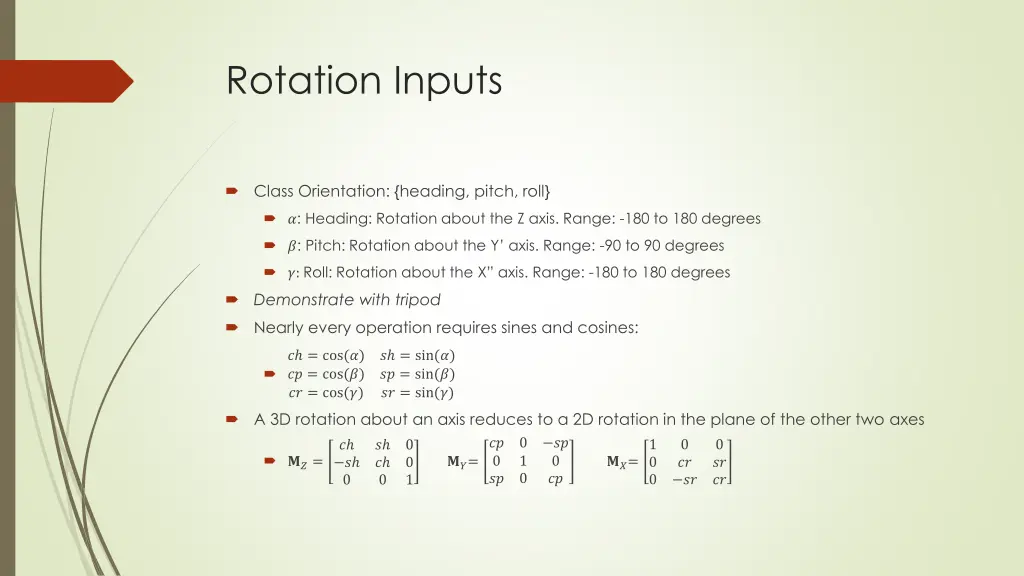
Rotation Inputs Class Orientation: {heading, pitch, roll} ?: Heading: Rotation about the Z axis. Range: -180 to 180 degrees ?: Pitch: Rotation about the Y axis. Range: -90 to 90 degrees ?: Roll: Rotation about the X axis. Range: -180 to 180 degrees Demonstrate with tripod Nearly every operation requires sines and cosines: ? = cos(?) ?? = cos(?) ?? = cos(?) ? = sin(?) ?? = sin(?) ?? = sin(?) A 3D rotation about an axis reduces to a 2D rotation in the plane of the other two axes ?? 0 ?? 0 1 0 ?? 0 ?? 1 0 0 0 ?? ?? 0 ?? ?? ? ? 0 ? ? 0 0 0 1 ??= ??= ??=
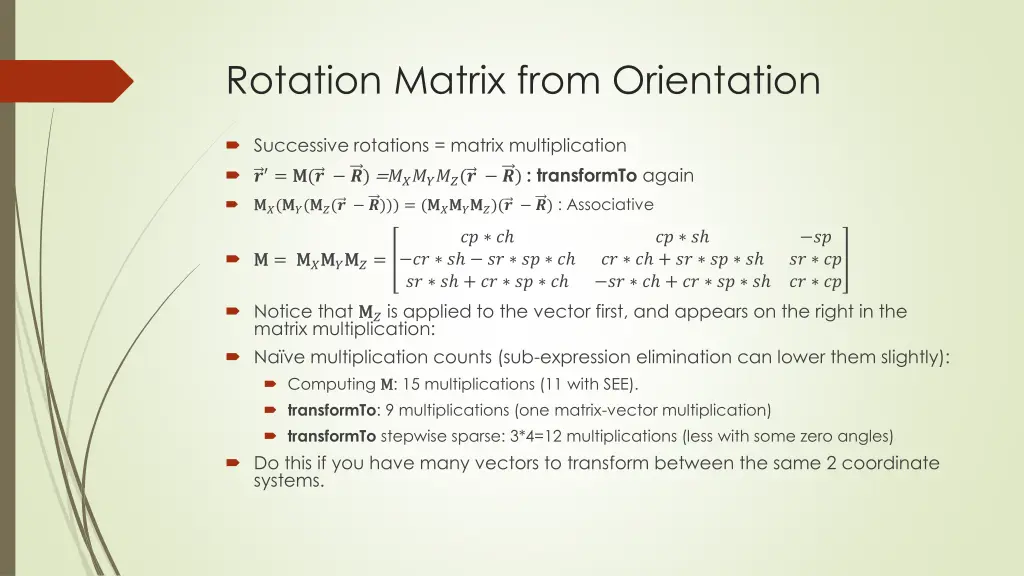
Rotation Matrix from Orientation Successive rotations = matrix multiplication ? = M M(? ?) =??????(? ?) : transformTo again M M?(M M?(M M?(? ?))) = (M M?M M?M M?)(? ?) : Associative ?? ? ?? ? ?? ?? ?? ?? ?? M M = M M?M M?M M?= ?? ? ?? ?? ? ?? ? + ?? ?? ? ?? ? + ?? ?? ? ?? ? + ?? ?? ? Notice that M M?is applied to the vector first, and appears on the right in the matrix multiplication: Na ve multiplication counts (sub-expression elimination can lower them slightly): Computing M M: 15 multiplications (11 with SEE). transformTo: 9 multiplications (one matrix-vector multiplication) transformTo stepwise sparse: 3*4=12 multiplications (less with some zero angles) Do this if you have many vectors to transform between the same 2 coordinate systems.
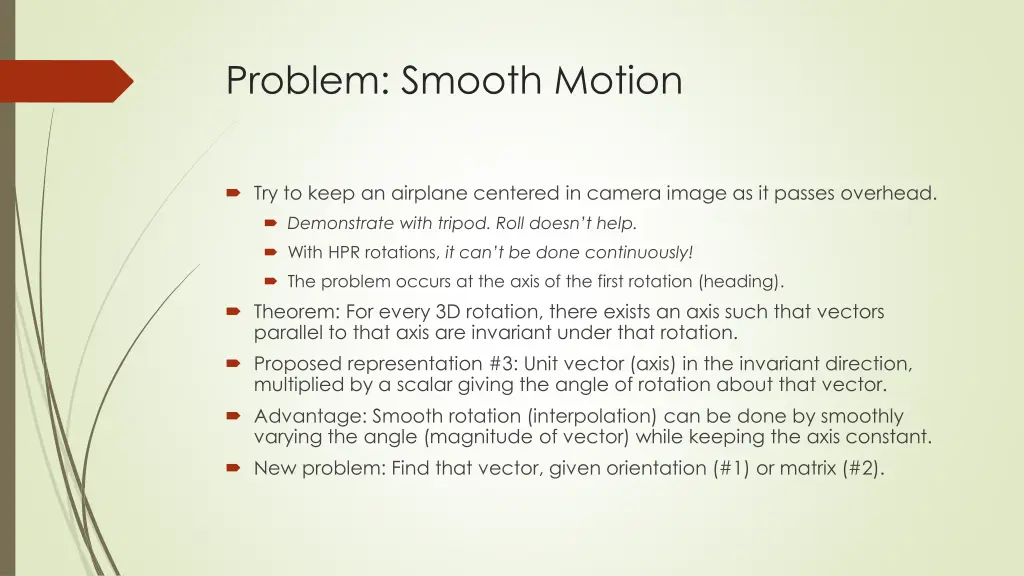
Problem: Smooth Motion Try to keep an airplane centered in camera image as it passes overhead. Demonstrate with tripod. Roll doesn t help. With HPR rotations, it can t be done continuously! The problem occurs at the axis of the first rotation (heading). Theorem: For every 3D rotation, there exists an axis such that vectors parallel to that axis are invariant under that rotation. Proposed representation #3: Unit vector (axis) in the invariant direction, multiplied by a scalar giving the angle of rotation about that vector. Advantage: Smooth rotation (interpolation) can be done by smoothly varying the angle (magnitude of vector) while keeping the axis constant. New problem: Find that vector, given orientation (#1) or matrix (#2).
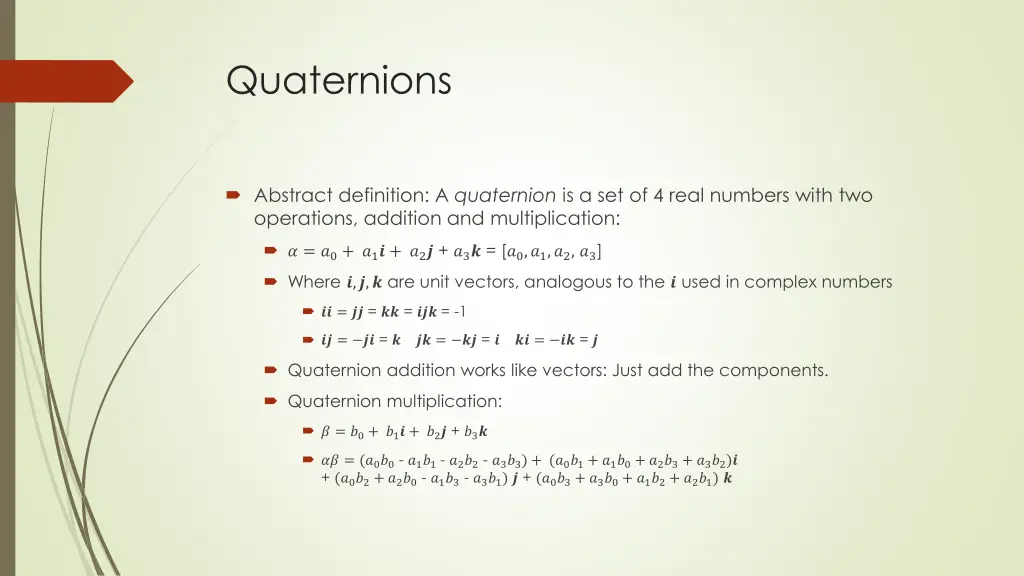
Quaternions Abstract definition: A quaternion is a set of 4 real numbers with two operations, addition and multiplication: ? = ?0+ ?1? + ?2? + ?3? = [?0,?1,?2, ?3] Where ?,?,? are unit vectors, analogous to the ? used in complex numbers ?? = ?? = ?? = ??? = -1 ?? = ?? = ? ?? = ?? = ? ?? = ?? = ? Quaternion addition works like vectors: Just add the components. Quaternion multiplication: ? = ?0+ ?1? + ?2? + ?3? ?? = (?0?0- ?1?1- ?2?2- ?3?3) + (?0?1+ ?1?0+ ?2?3+ ?3?2)? + (?0?2+ ?2?0- ?1?3- ?3?1) ? + (?0?3+ ?3?0+ ?1?2+ ?2?1) ?
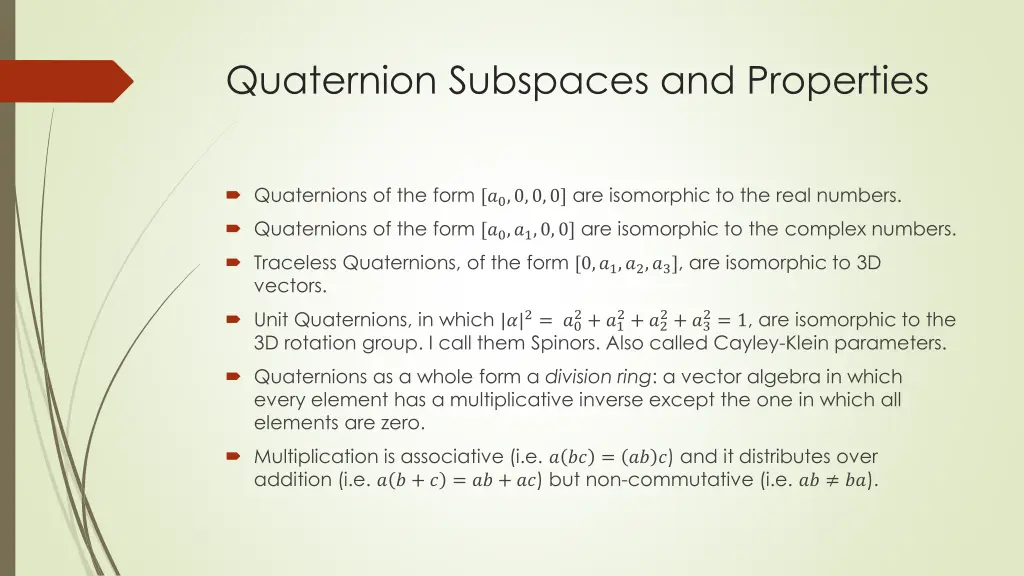
Quaternion Subspaces and Properties Quaternions of the form [?0,0,0,0] are isomorphic to the real numbers. Quaternions of the form [?0,?1,0,0] are isomorphic to the complex numbers. Traceless Quaternions, of the form [0,?1,?2,?3], are isomorphic to 3D vectors. Unit Quaternions, in which |?|2= ?0 3D rotation group. I call them Spinors. Also called Cayley-Klein parameters. 2= 1, are isomorphic to the 2+ ?1 2+ ?2 2+ ?3 Quaternions as a whole form a division ring: a vector algebra in which every element has a multiplicative inverse except the one in which all elements are zero. Multiplication is associative (i.e. ? ?? = ?? ?) and it distributes over addition (i.e. ? ? + ? = ?? + ??) but non-commutative (i.e. ?? ??).
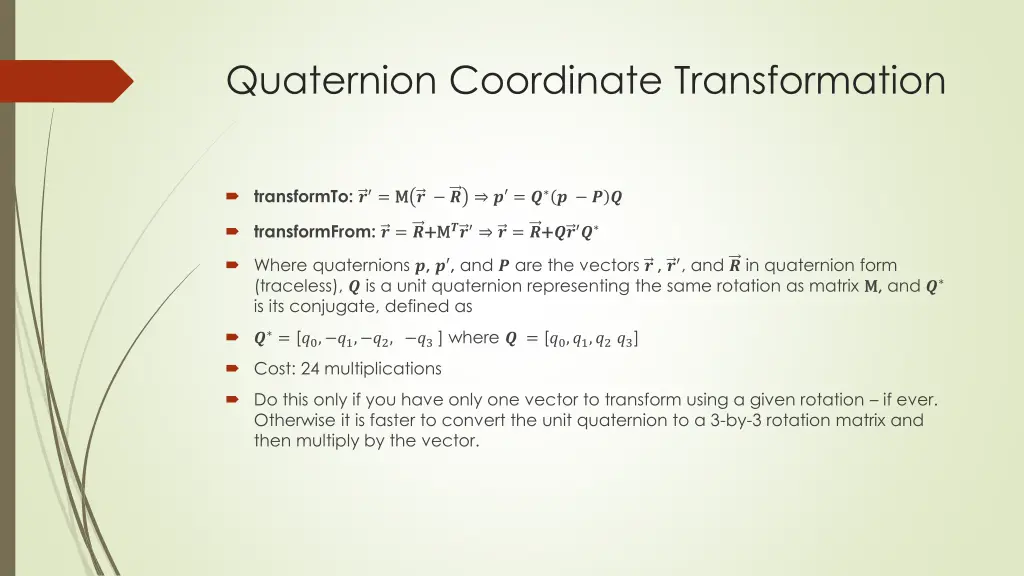
Quaternion Coordinate Transformation transformTo: ? = M M ? ? ? = ? ? ? ? transformFrom: ? = ?+ +M M?? ? = ?+ +?? ? Where quaternions ?, ? , and ? are the vectors ? , ? , and ? in quaternion form (traceless), ? is a unit quaternion representing the same rotation as matrix M M, and ? is its conjugate, defined as ? = [?0, ?1, ?2, ?3] where ? = [?0,?1,?2?3] Cost: 24 multiplications Do this only if you have only one vector to transform using a given rotation if ever. Otherwise it is faster to convert the unit quaternion to a 3-by-3 rotation matrix and then multiply by the vector.
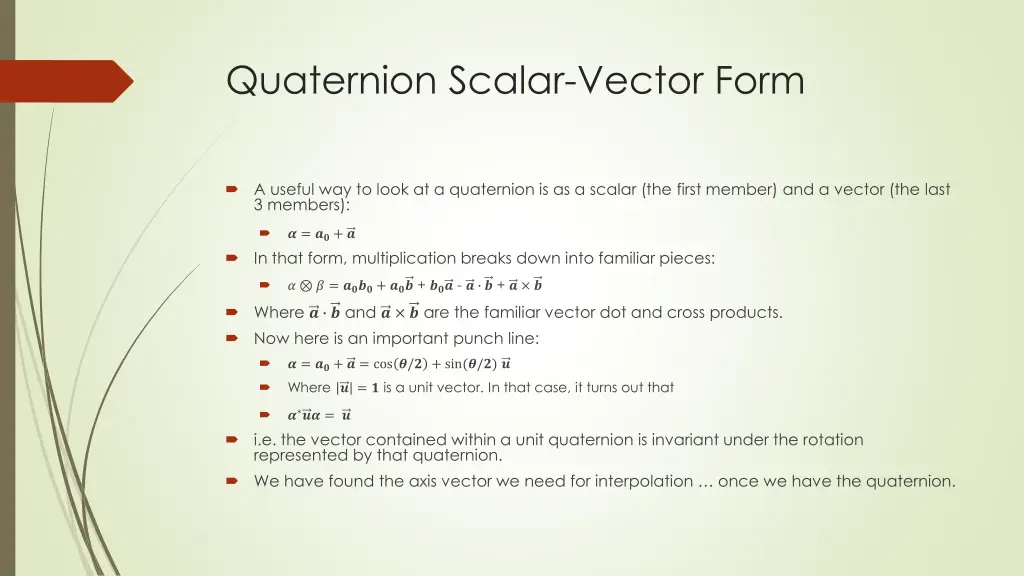
Quaternion Scalar-Vector Form A useful way to look at a quaternion is as a scalar (the first member) and a vector (the last 3 members): In that form, multiplication breaks down into familiar pieces: ? = ??+ ? ? ? = ????+ ??? + ??? - ? ? + ? ? Where ? ? and ? ? are the familiar vector dot and cross products. Now here is an important punch line: ? = ??+ ? = cos ?/? + sin(?/?) ? Where ? = ? is a unit vector. In that case, it turns out that ? ?? = ? i.e. the vector contained within a unit quaternion is invariant under the rotation represented by that quaternion. We have found the axis vector we need for interpolation once we have the quaternion.
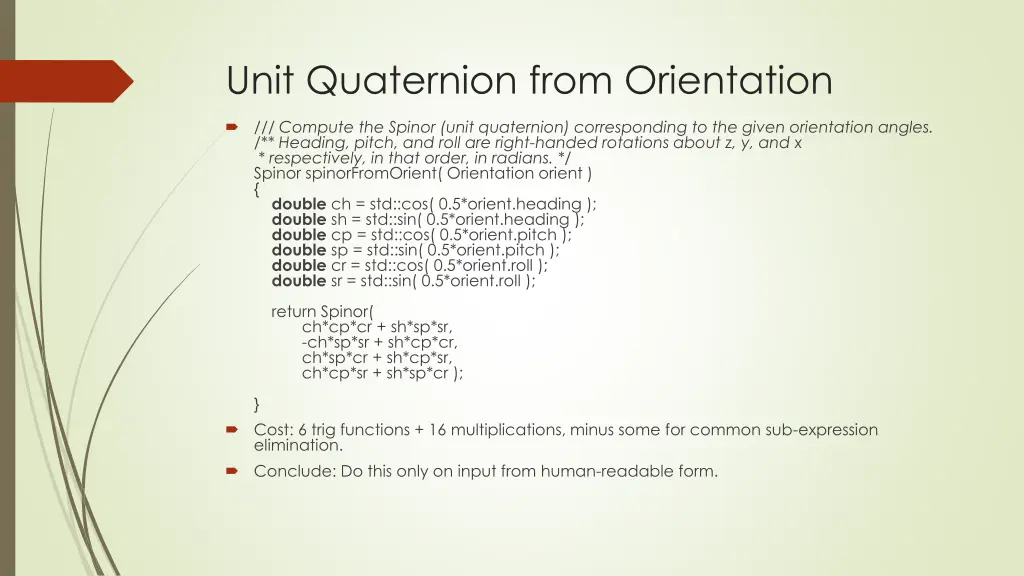
Unit Quaternion from Orientation /// Compute the Spinor (unit quaternion) corresponding to the given orientation angles. /** Heading, pitch, and roll are right-handed rotations about z, y, and x * respectively, in that order, in radians. */ Spinor spinorFromOrient( Orientation orient ) { double ch = std::cos( 0.5*orient.heading ); double sh = std::sin( 0.5*orient.heading ); double cp = std::cos( 0.5*orient.pitch ); double sp = std::sin( 0.5*orient.pitch ); double cr = std::cos( 0.5*orient.roll ); double sr = std::sin( 0.5*orient.roll ); return Spinor( ch*cp*cr + sh*sp*sr, -ch*sp*sr + sh*cp*cr, ch*sp*cr + sh*cp*sr, ch*cp*sr + sh*sp*cr ); } Cost: 6 trig functions + 16 multiplications, minus some for common sub-expression elimination. Conclude: Do this only on input from human-readable form.
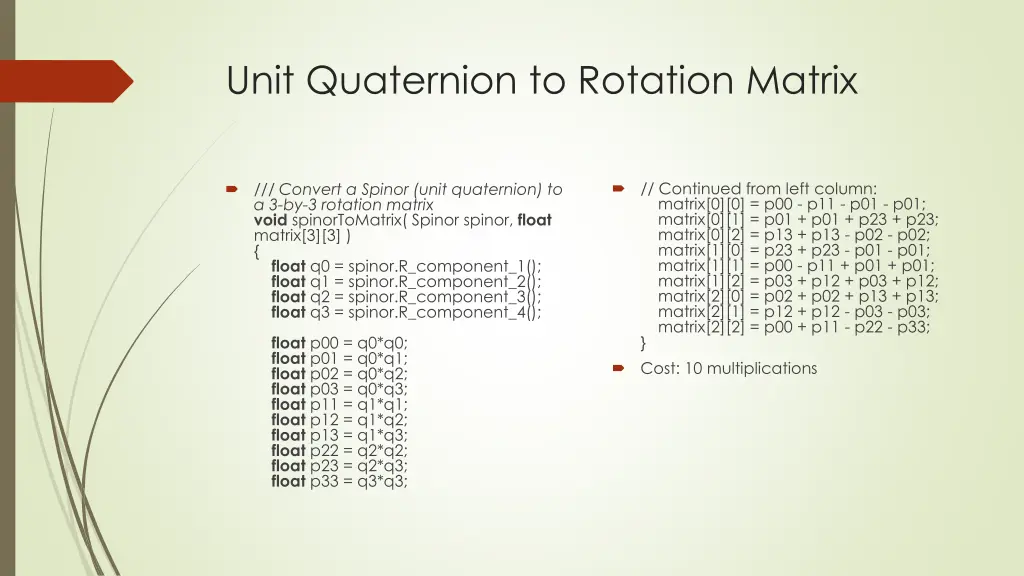
Added Material Slides after this one were added after the talk. Caveat: All code shown in this presentation is based on well-tested SST code, but it was heavily edited for this presentation and not subsequently tested. Don t blindly depend on it.
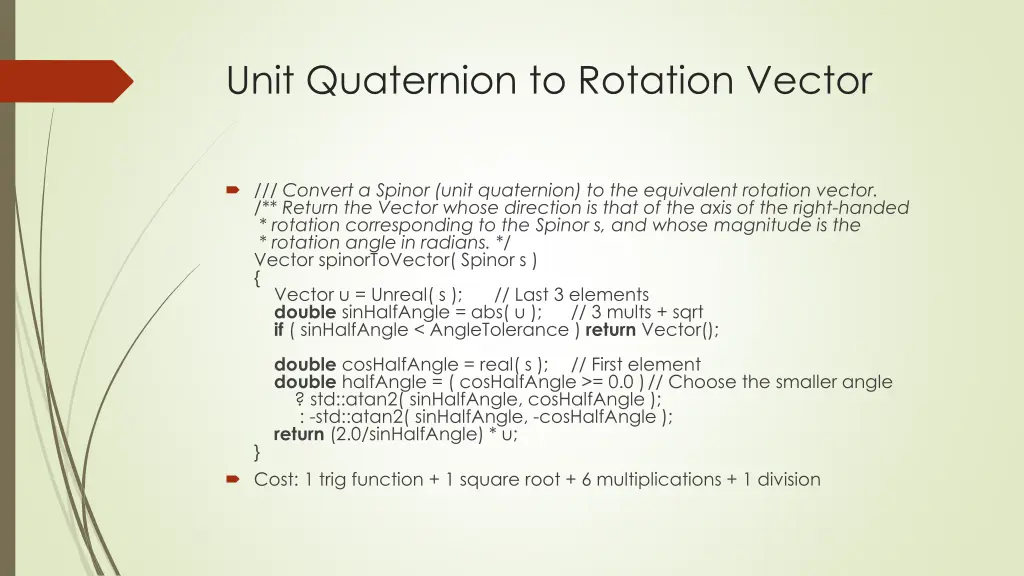
Unit Quaternion to Rotation Vector /// Convert a Spinor (unit quaternion) to the equivalent rotation vector. /** Return the Vector whose direction is that of the axis of the right-handed * rotation corresponding to the Spinor s, and whose magnitude is the * rotation angle in radians. */ Vector spinorToVector( Spinor s ) { Vector u = Unreal( s ); // Last 3 elements double sinHalfAngle = abs( u ); if ( sinHalfAngle < AngleTolerance ) return Vector(); // 3 mults + sqrt double cosHalfAngle = real( s ); double halfAngle = ( cosHalfAngle >= 0.0 )// Choose the smaller angle ? std::atan2( sinHalfAngle, cosHalfAngle ); : -std::atan2( sinHalfAngle, -cosHalfAngle ); return (2.0/sinHalfAngle) * u; // First element } Cost: 1 trig function + 1 square root + 6 multiplications + 1 division
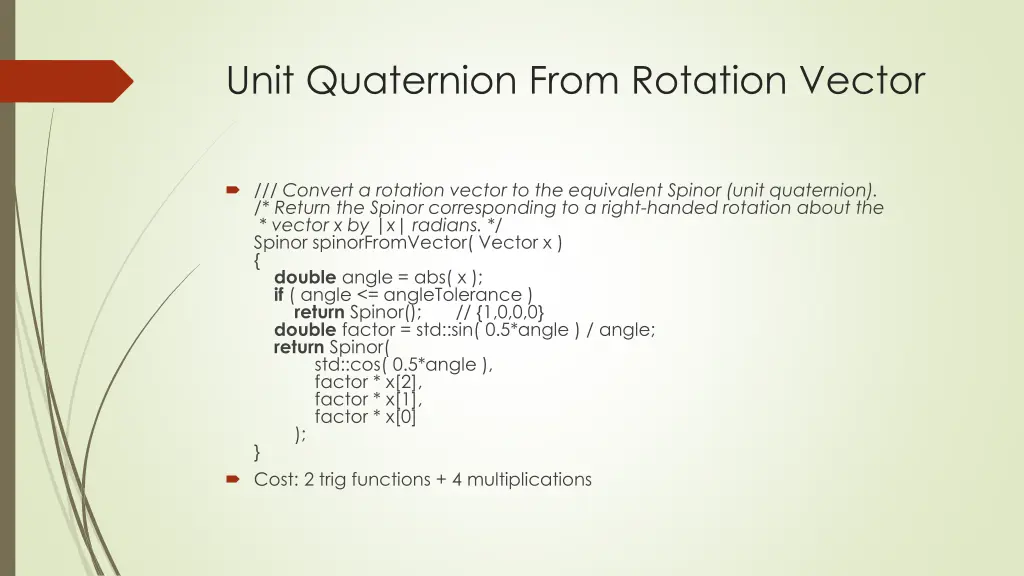
Unit Quaternion From Rotation Vector /// Convert a rotation vector to the equivalent Spinor (unit quaternion). /* Return the Spinor corresponding to a right-handed rotation about the * vector x by |x| radians. */ Spinor spinorFromVector( Vector x ) { double angle = abs( x ); if ( angle <= angleTolerance ) return Spinor(); // {1,0,0,0} double factor = std::sin( 0.5*angle ) / angle; return Spinor( std::cos( 0.5*angle ), factor * x[2], factor * x[1], factor * x[0] ); } Cost: 2 trig functions + 4 multiplications
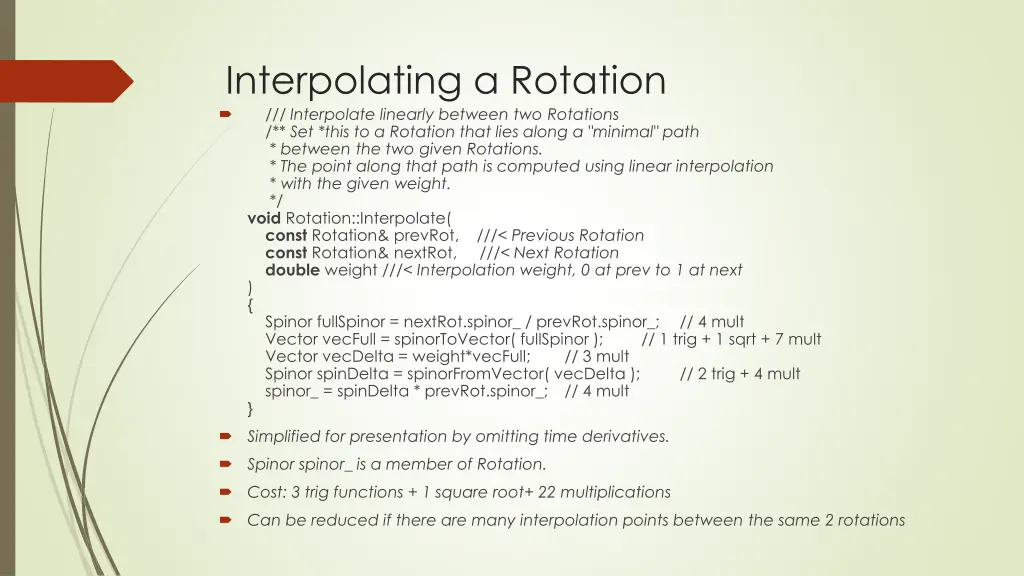
Interpolating a Rotation /// Interpolate linearly between two Rotations /** Set *this to a Rotation that lies along a "minimal" path * between the two given Rotations. * The point along that path is computed using linear interpolation * with the given weight. */ void Rotation::Interpolate( const Rotation& prevRot, ///< Previous Rotation const Rotation& nextRot, ///< Next Rotation double weight ///< Interpolation weight, 0 at prev to 1 at next ) { Spinor fullSpinor = nextRot.spinor_ / prevRot.spinor_; Vector vecFull = spinorToVector( fullSpinor ); Vector vecDelta = weight*vecFull; Spinor spinDelta = spinorFromVector( vecDelta ); spinor_ = spinDelta * prevRot.spinor_; } // 4 mult // 1 trig + 1 sqrt + 7 mult // 3 mult // 2 trig + 4 mult // 4 mult Simplified for presentation by omitting time derivatives. Spinor spinor_ is a member of Rotation. Cost: 3 trig functions + 1 square root+ 22 multiplications Can be reduced if there are many interpolation points between the same 2 rotations
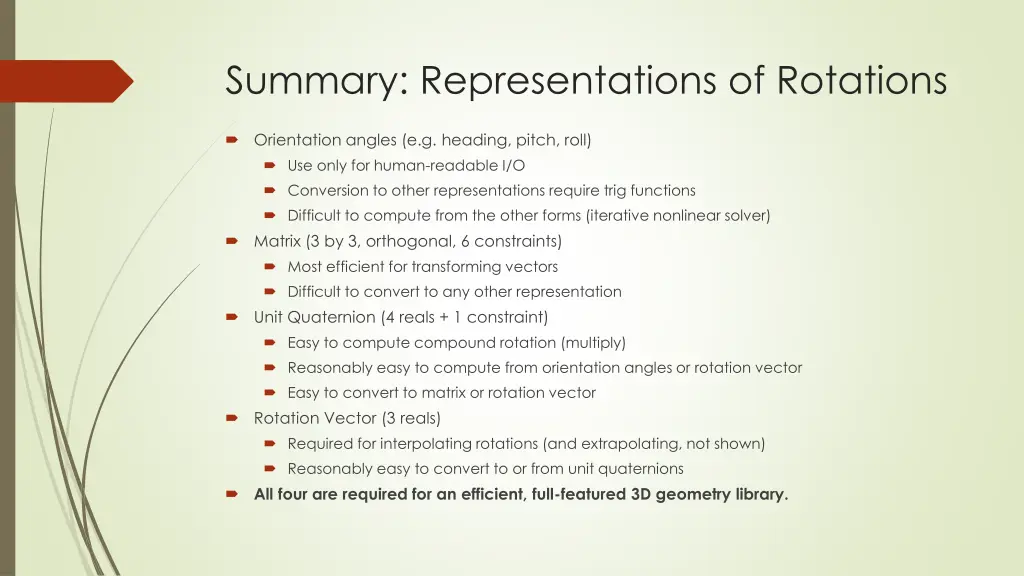
Summary: Representations of Rotations Orientation angles (e.g. heading, pitch, roll) Use only for human-readable I/O Conversion to other representations require trig functions Difficult to compute from the other forms (iterative nonlinear solver) Matrix (3 by 3, orthogonal, 6 constraints) Most efficient for transforming vectors Difficult to convert to any other representation Unit Quaternion (4 reals + 1 constraint) Easy to compute compound rotation (multiply) Reasonably easy to compute from orientation angles or rotation vector Easy to convert to matrix or rotation vector Rotation Vector (3 reals) Required for interpolating rotations (and extrapolating, not shown) Reasonably easy to convert to or from unit quaternions All four are required for an efficient, full-featured 3D geometry library.