Learn how to differentiate between malignant hypertension-induced thrombotic microangiopathy and thrombotic thrombocytopenic purpura (TTP) in patients, crucial for early diagnosis and treatment. Discover key clinical features, diagnostic challenges, and the importance of distinguishing between these conditions. Find out about the role of plasmapheresis and the significance of severe thrombocytopenia in the diagnostic process.
Please find below an Image/Link to download the presentation.
The content on the website is provided AS IS for your information and personal use only. It may not be sold, licensed, or shared on other websites without obtaining consent from the author. If you encounter any issues during the download, it is possible that the publisher has removed the file from their server.
You are allowed to download the files provided on this website for personal or commercial use, subject to the condition that they are used lawfully. All files are the property of their respective owners.
The content on the website is provided AS IS for your information and personal use only. It may not be sold, licensed, or shared on other websites without obtaining consent from the author.
The clinical definition of thrombotic thrombocytopenic purpura (TTP) is the presence of unexplained microangiopathic hemolytic anemia and thrombocytopenia with or without renal dysfunction, fever, neurological deficit or variable pattern of systemic tissue injury from microvascular thrombosis.
Patients with malignant hypertension sometimes exhibit microangiopathic hemolytic anemia/thrombocytopenia known as thrombotic microangiopathy (TMA). On the other hand, severe hypertension is sometimes associated with hemolytic uremic syndrome (HUS)/thrombotic thrombocytopenic purpura (TTP).
Because the clinical features of the two entities overlap significantly, it is sometimes difficult to distinguish one from the other. However, such differentiation is indispensable, since early performance of plasmapheresis is critical in HUS/TTP.
Recently, the plasma level of ADAMTS13 (a metalloprotease domain), which is a von Willebrand Factor cleavingprotease, has been shown to be very low in familial or some of the sporadic cases of TTP, and a low level of ADAMTS13 is very specific to TTP.
Some reports have shown that patients with a very low plasma level of ADAMTS13 respond very well to plasmapheresis. Thus, patients with a low level of ADAMTS13 activity might respond well to plasmapheresis or plasma infusion.
TTP is a disorder of von Willebrand factor (VWF) proteolysis, caused by either a congenital deficiency or an autoimmune antibody- mediated destruction of ADAMTS-13. Documenting severe ADAMTS- 13 deficiency .
In malignant hypertension, the autoregulatory mechanism fails, resulting in damage to the vascular wall. Disruption of the vascular endothelium causes plasma constituents (including fibrinoid material) to enter the vascular wall and obliterate the vascular lumen.
In most patients with renal failure related to malignant hypertension, renal biopsy demonstrates an obliterative vasculopathy with fibrinoid necrosis as well as fibrin and platelet clots . This luminal narrowing is believed to fragment erythrocytes and consume platelets leading to TMA.
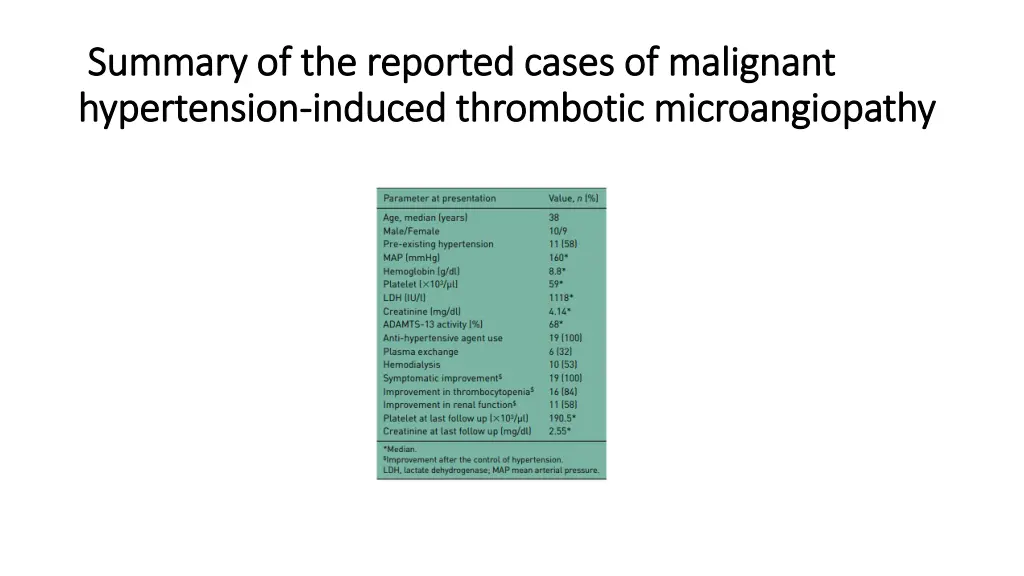
Summary of the reported cases of malignant Summary of the reported cases of malignant hypertension hypertension- -induced thrombotic induced thrombotic microangiopathy microangiopathy
Many experts believe that plasma exchange should be considered in TTP after the exclusion of alternate causes such severe malignant hypertension, implying that the presence of a severe malignant hypertension excludes TTP.
Importantly, one-third of reported cases of malignant hypertension- induced TMA have undergone plasma exchange, thus highlighting the clinical dilemma in reliably differentiating the two conditions and foregoing plasma exchange based on initial clinical suspicion.
Prior history of hypertension and higher mean arterial pressure at presentation are possible clues to a diagnosis of malignant hypertension. The greater degree of renal impairment at diagnosis, relatively modest thrombocytopenia and lack of severe ADAMTS-13 deficiency (activity <10%) can further differentiate malignant hypertension from TTP.
A higher serum creatinine level and urinary protein excretion at admission among malignant hypertension patients with versus without microangiopathic hemolyic anemia. However, the difference was not statistically significan likely because of small number of patients in different studies.
Compared with TTP, cases with malignant hypertension-induced TMA are shown to have higher blood pressure at presentation , signs of hypertensive heart disease or a retinopathy, higher platelet count, and higher ADAMTS-13 activity.
Patients with malignant hypertension, compared with healthy controls, can have lower levels of ADAMTS-13; the levels negatively correlated with LDH levels, platelet count and the presence of schistocytes. However, the deficiency of ADAMTS-13 is always mild (activity >50%).
Although high creatinine levels and systolic hypertension at presentation are associated with a lower chance of renal recovery , malignant hypertension patients ultimately may have more favorable nonrenal prognosis than other thrombotic microangiopathies.
Conclusion In conclusion, prior history of hypertension, high mean arterial pressure, significant renal impairment but relatively modest thrombocytopenia and lack of severe ADAMTS-13 deficiency (activity <10%) at diagnosis are clues to diagnose malignant hypertension- induced TMA.