Timeline of Moroccan politics
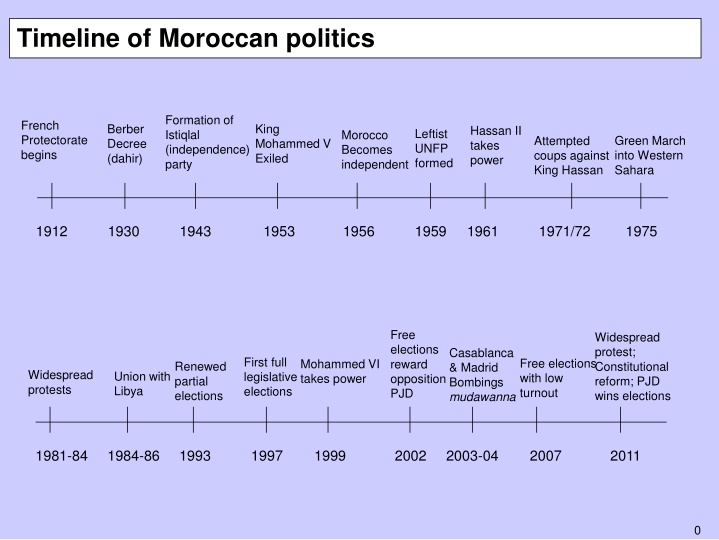
The timeline chronicles significant events in Moroccan politics, from the establishment of the Istiqlal party and the French Protectorate to the independence of Morocco and the rise of King Mohammed VI. It highlights key historical moments such as the Green March into Western Sahara, attempted coups, and significant electoral changes. The evolution of political dynamics, including identity politics and the role of the monarchy, illustrates Morocco's complex political landscape over the years.

Uploaded on Feb 17, 2025 | 0 Views
Download Presentation

Please find below an Image/Link to download the presentation.
The content on the website is provided AS IS for your information and personal use only. It may not be sold, licensed, or shared on other websites without obtaining consent from the author.If you encounter any issues during the download, it is possible that the publisher has removed the file from their server.
You are allowed to download the files provided on this website for personal or commercial use, subject to the condition that they are used lawfully. All files are the property of their respective owners.
The content on the website is provided AS IS for your information and personal use only. It may not be sold, licensed, or shared on other websites without obtaining consent from the author.
E N D
Presentation Transcript
Timeline of Moroccan politics Formation of Istiqlal (independence) party French Protectorate begins Berber Decree (dahir) King Mohammed V Exiled Hassan II takes power Leftist UNFP formed Morocco Becomes independent Green March into Western Sahara Attempted coups against King Hassan 1912 1930 1943 1953 1956 1959 1961 1971/72 1975 Free elections reward opposition PJD Widespread protest; Constitutional reform; PJD wins elections Casablanca & Madrid Bombings mudawanna First full legislative elections Free elections with low turnout Mohammed VI takes power Renewed partial elections Widespread protests Union with Libya 1981-84 1984-86 1993 1997 1999 2002 2003-04 2007 2011 0
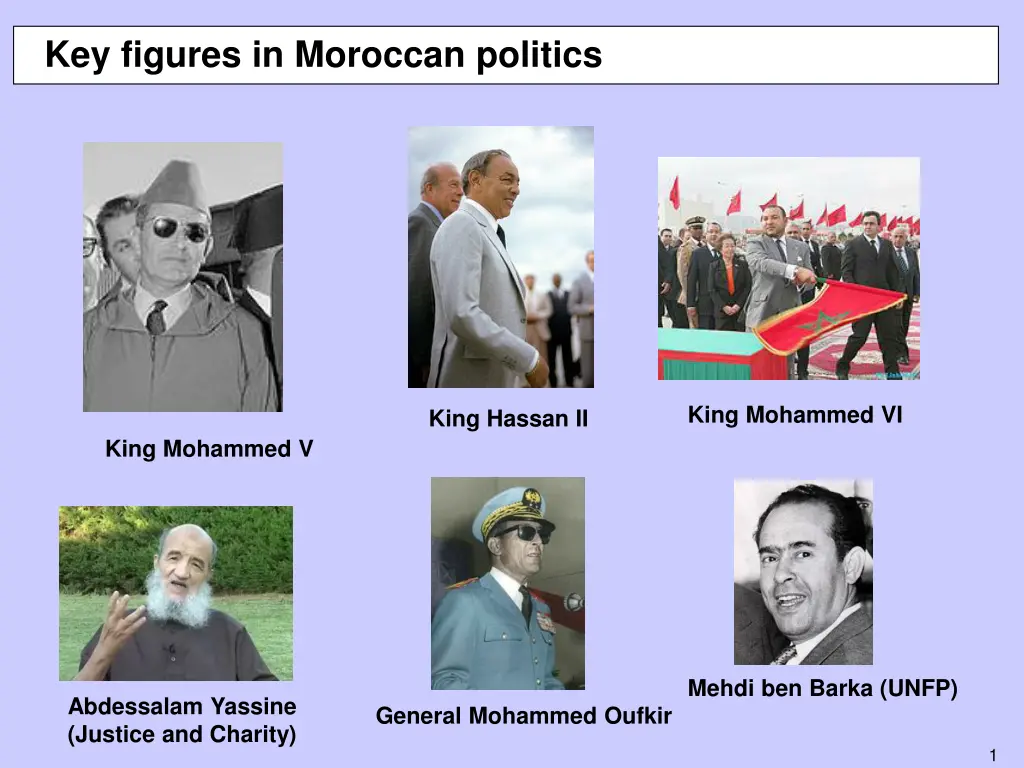
Key figures in Moroccan politics King Mohammed VI King Hassan II King Mohammed V Mehdi ben Barka (UNFP) Abdessalam Yassine (Justice and Charity) General Mohammed Oufkir 1
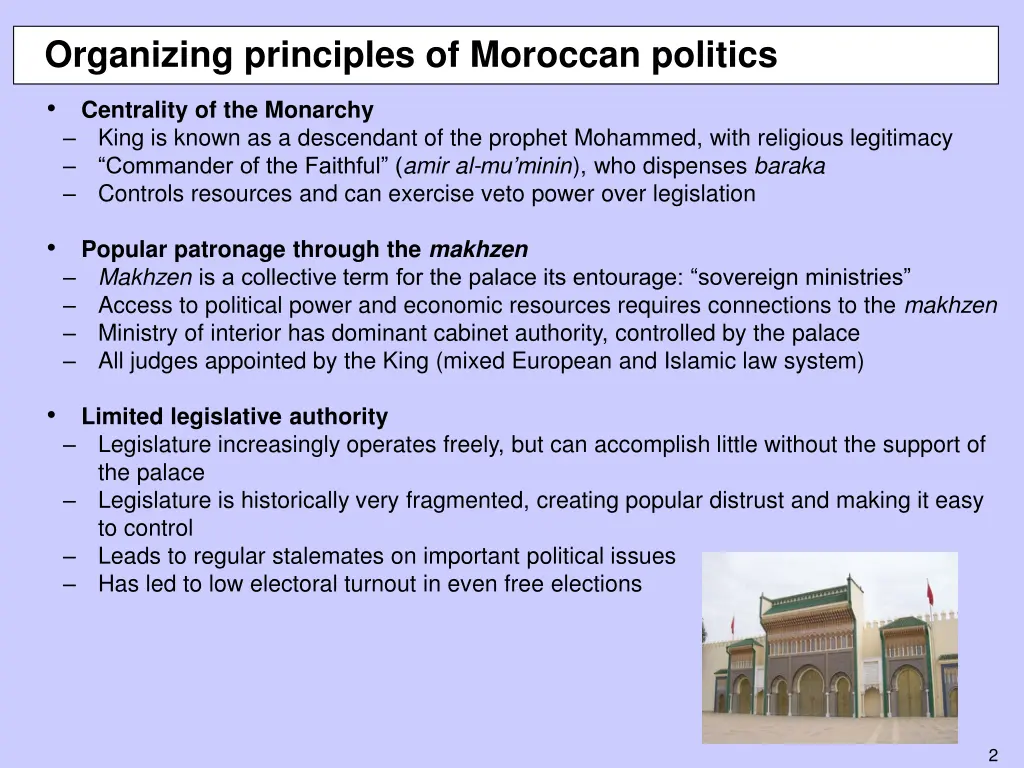
Organizing principles of Moroccan politics Centrality of the Monarchy King is known as a descendant of the prophet Mohammed, with religious legitimacy Commander of the Faithful (amir al-mu minin), who dispenses baraka Controls resources and can exercise veto power over legislation Popular patronage through the makhzen Makhzenis a collective term for the palace its entourage: sovereign ministries Access to political power and economic resources requires connections to the makhzen Ministry of interior has dominant cabinet authority, controlled by the palace All judges appointed by the King (mixed European and Islamic law system) Limited legislative authority Legislature increasingly operates freely, but can accomplish little without the support of the palace Legislature is historically very fragmented, creating popular distrust and making it easy to control Leads to regular stalemates on important political issues Has led to low electoral turnout in even free elections 2
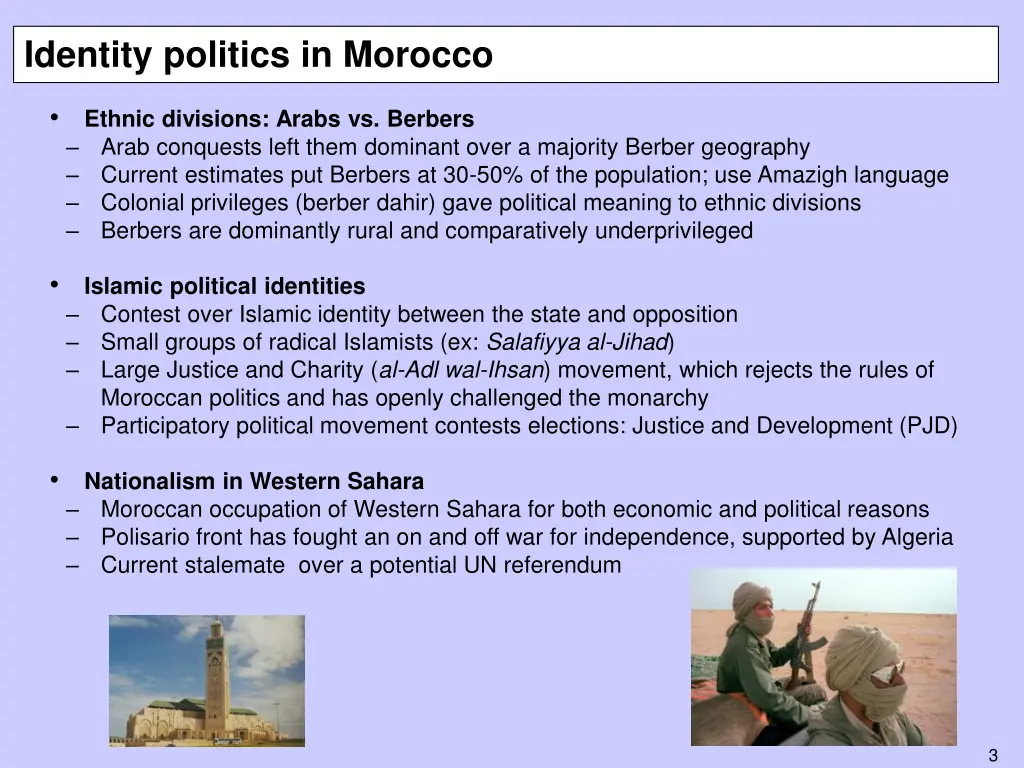
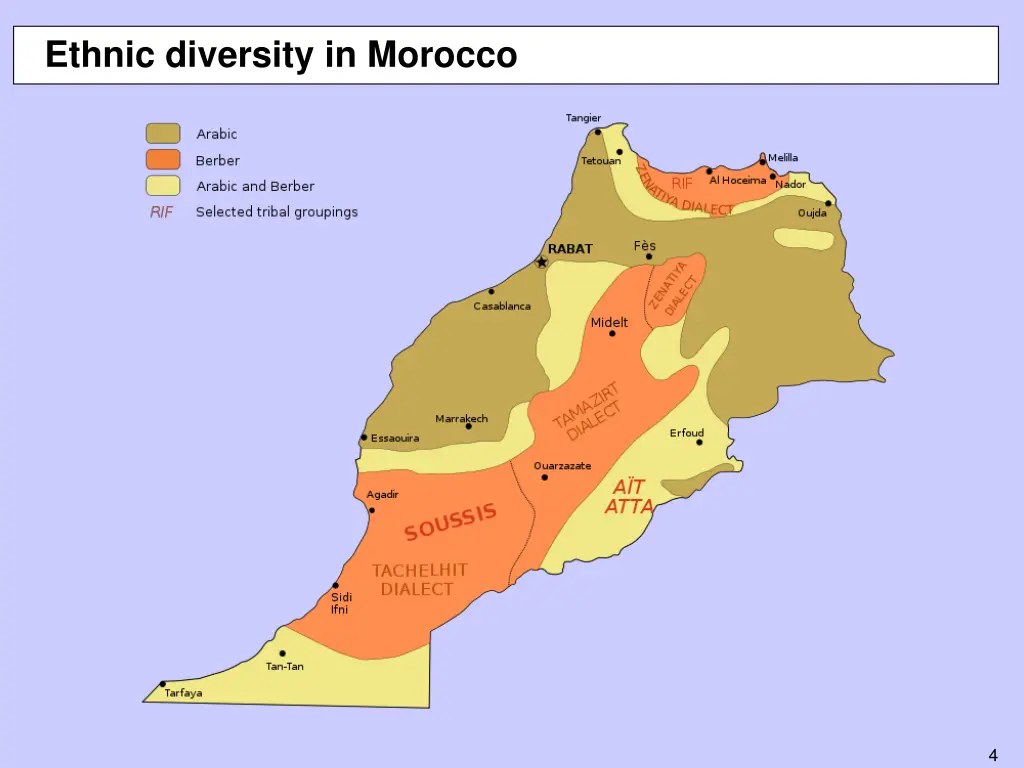
Identity politics in Morocco Ethnic divisions: Arabs vs. Berbers Arab conquests left them dominant over a majority Berber geography Current estimates put Berbers at 30-50% of the population; use Amazigh language Colonial privileges (berber dahir) gave political meaning to ethnic divisions Berbers are dominantly rural and comparatively underprivileged Islamic political identities Contest over Islamic identity between the state and opposition Small groups of radical Islamists (ex: Salafiyya al-Jihad) Large Justice and Charity (al-Adl wal-Ihsan) movement, which rejects the rules of Moroccan politics and has openly challenged the monarchy Participatory political movement contests elections: Justice and Development (PJD) Nationalism in Western Sahara Moroccan occupation of Western Sahara for both economic and political reasons Polisario front has fought an on and off war for independence, supported by Algeria Current stalemate over a potential UN referendum 3
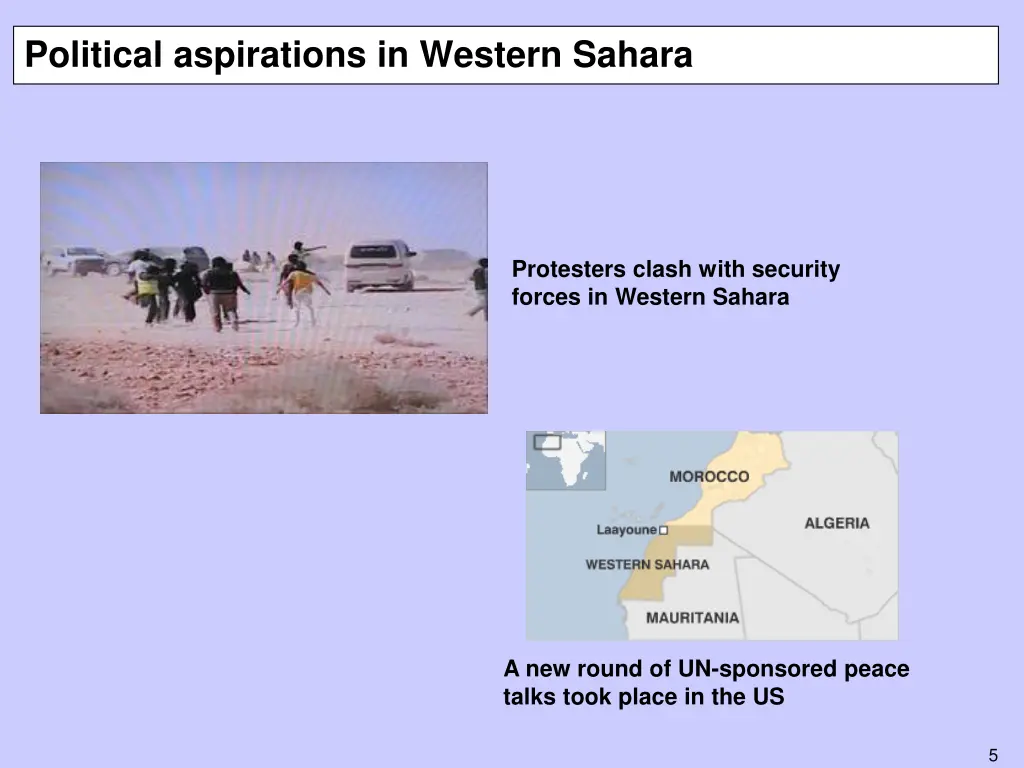
Political aspirations in Western Sahara Protesters clash with security forces in Western Sahara A new round of UN-sponsored peace talks took place in the US 5
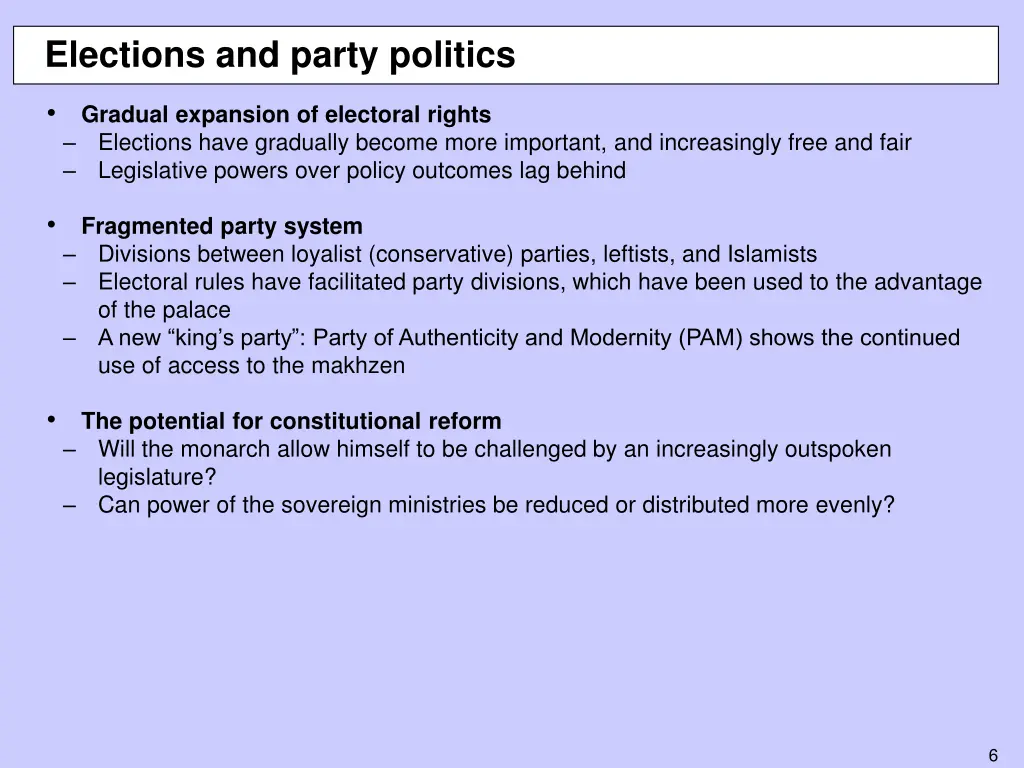
Elections and party politics Gradual expansion of electoral rights Elections have gradually become more important, and increasingly free and fair Legislative powers over policy outcomes lag behind Fragmented party system Divisions between loyalist (conservative) parties, leftists, and Islamists Electoral rules have facilitated party divisions, which have been used to the advantage of the palace A new king s party : Party of Authenticity and Modernity (PAM) shows the continued use of access to the makhzen The potential for constitutional reform Will the monarch allow himself to be challenged by an increasingly outspoken legislature? Can power of the sovereign ministries be reduced or distributed more evenly? 6
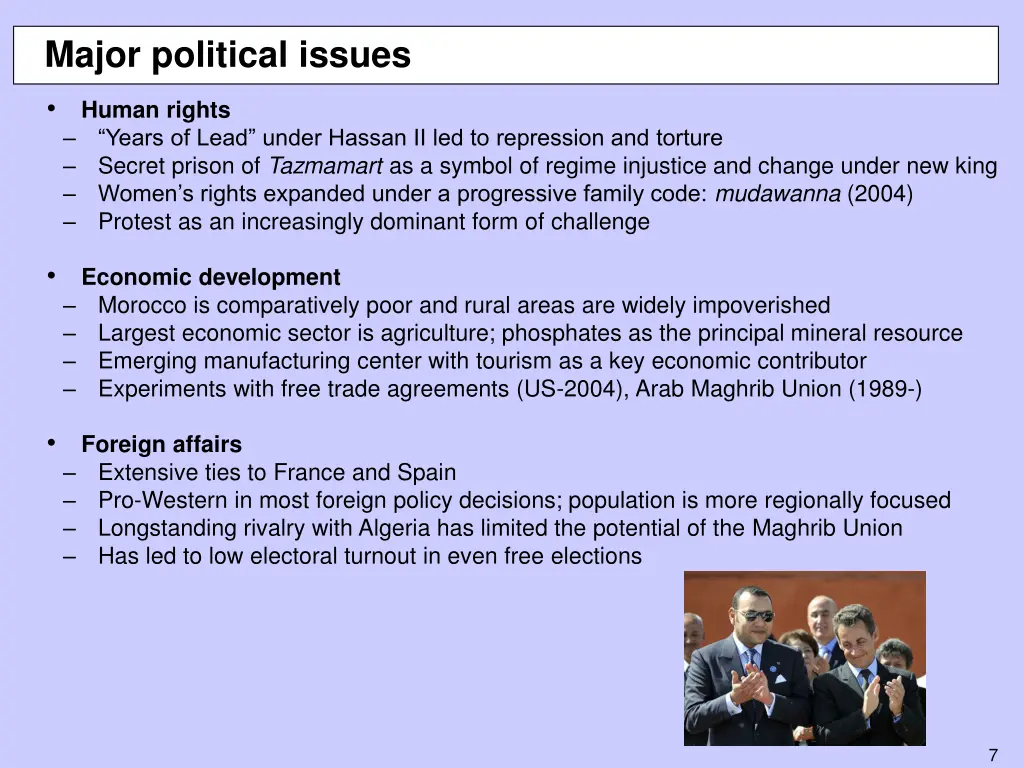
Major political issues Human rights Years of Lead under Hassan II led to repression and torture Secret prison of Tazmamart as a symbol of regime injustice and change under new king Women s rights expanded under a progressive family code: mudawanna (2004) Protest as an increasingly dominant form of challenge Economic development Morocco is comparatively poor and rural areas are widely impoverished Largest economic sector is agriculture; phosphates as the principal mineral resource Emerging manufacturing center with tourism as a key economic contributor Experiments with free trade agreements (US-2004), Arab Maghrib Union (1989-) Foreign affairs Extensive ties to France and Spain Pro-Western in most foreign policy decisions; population is more regionally focused Longstanding rivalry with Algeria has limited the potential of the Maghrib Union Has led to low electoral turnout in even free elections 7
Lecture termsNovember 28-Dec 2 Tansu Ciller Mohammed V Necmettin Erbakan Makhzen Welfare Party Commander of the Faithful Tayyip Erdogan Hassan II Justice and Development Party (AKP) Green March Republic of Fear Berbers Saddam Hussein Polisario UNSCOM Mohammed VI Moqtada al-Sadr Istiqlal Sunni triangle Justice and Development Party (PJD) United Iraqi Alliance 1980 Turkish coup Nuri al-Maliki Abdullah Ocalan 8