Explore the history, scope, and enforcement of Title IX, including the role of a Title IX Coordinator and key objectives. Learn about the obligations and enforcement of Title IX in educational settings receiving federal financial assistance.
Please find below an Image/Link to download the presentation.
The content on the website is provided AS IS for your information and personal use only. It may not be sold, licensed, or shared on other websites without obtaining consent from the author. If you encounter any issues during the download, it is possible that the publisher has removed the file from their server.
You are allowed to download the files provided on this website for personal or commercial use, subject to the condition that they are used lawfully. All files are the property of their respective owners.
The content on the website is provided AS IS for your information and personal use only. It may not be sold, licensed, or shared on other websites without obtaining consent from the author.
E N D
Presentation Transcript
Title IX Coordinator: Roles and Responsibilities Laura Castille, esq. Hatch Valley Schools Certification Training August 2024
Todays Objectives: Understand the history, scope and enforcement of Title IX. Understand the sweeping changes to Title IX: 2020 and 2024, including important definitions and procedural changes. Understand how to determine Title IX jurisdiction and procedural steps when a complaint is received. Understand the role of an institution s Title IX Coordinator.
Title IX Title IX is a Federal Civil Rights law stating: No person in the United States shall, on the basis of sex, be excluded from participation in, be denied the benefits of, or be subjected to discrimination under any education program or activity receiving financial assistance. 37 small words: huge impact.
History and purpose of TIX Congress recognized that, in spite of the Civil Rights Act of 1964, women continued to received unequal treatment in schools. How it started: to remedy a long and unfortunate history of sex discrimination . United States v. Virginia. 518 U.S. 515, 531 (1996) quoting Frontiero v. Richardson, 411 U.S. 677, 684 (1973). How it is going: improved access to educational opportunities and providing equal opportunity to aspire, achieve, participate in and contribute to society based on their individual talents and capacities. Virginia. 518 U.S. 515, 531 (1996) United States v.
Scope of Title IX Applies to institutions receiving federal financial assistance from the Department of Education, including state and local educational agencies. Approximately 16,500 local school districts, 7,000 postsecondary institutions, as well as charter schools, for-profit schools, libraries, and museums. Also included are vocational rehabilitation agencies and education agencies of 50 Columbia, and territories and possessions of the United States. states, the District of
Scope of Title IX cont. Title IX obligations apply to: recruitment, admissions, and counseling; financial assistance; athletics; sex-based harassment; treatment of pregnant and parenting students; discipline; single-sex education; retaliation; and employment.
Who enforces Title IX? Title IX is a civil rights law and falls under the jurisdiction of the U.S. Department of Justice. DOJ enforces laws to ensure equal access to education, as well as the Equal Protection Clause of the 14thAmendment. DOJ coordinates enforcement of Title IX across agencies to include the Department of Education and Office of Civil Rights (OCR).
The 2020 Title IX Regulation Related to Sexual Harassment Regulations - effective beginning August 14, 2020. Changes include: New terminology, policy and notice requirements Limitations on jurisdiction Optional burdens of proof; must choose. Revised Title IX Coordinator responsibilities Revised investigation procedures Expanded hearing rights options for K-12 hearings New Requirements for Decision makers New rules for appeals Expanded training requirements and record keeping 8
The 2024 Title IX Regulation Changes Related to Sexual Harassment: Highlights Removal of Geographic limitations 34 CFR 106.11 Title IX recipient should not focus on whether the alleged misconduct happened on or off campus, but rather on whether the recipient has disciplinary authority over the respondent s conduct in the context in which it occurred. There is no distinction between discrimination that occurs in person and that which occurs online, and the final regulations permit schools to exercise their authority under the law to consider some conduct that occurs outside an institution s educational boundaries.
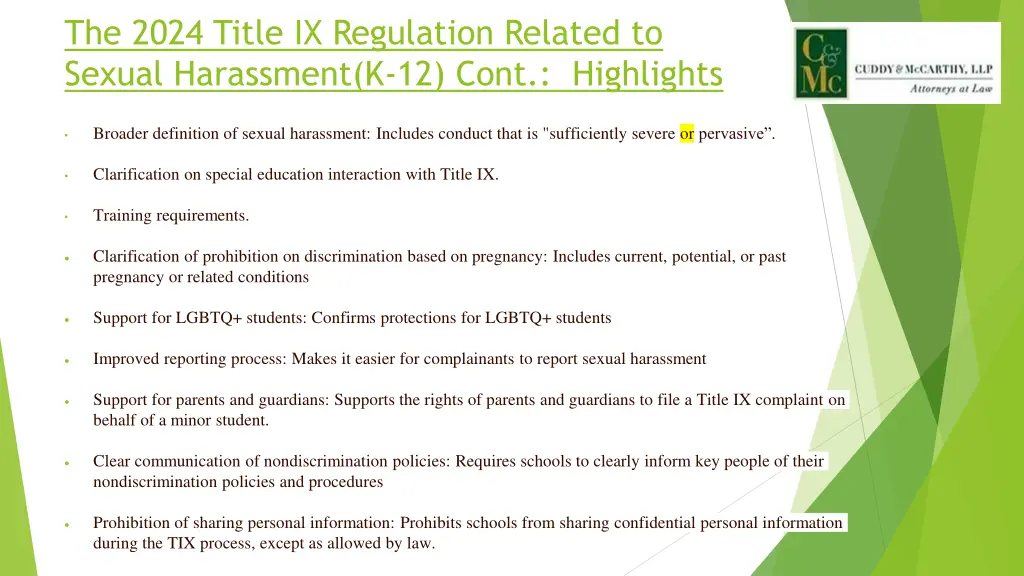
The 2024 Title IX Regulation Related to Sexual Harassment(K-12) Cont.: Highlights Broader definition of sexual harassment: Includes conduct that is "sufficiently severe or pervasive . Clarification on special education interaction with Title IX. Training requirements. Clarification of prohibition on discrimination based on pregnancy: Includes current, potential, or past pregnancy or related conditions Support for LGBTQ+ students: Confirms protections for LGBTQ+ students Improved reporting process: Makes it easier for complainants to report sexual harassment Support for parents and guardians: Supports the rights of parents and guardians to file a Title IX complaint on behalf of a minor student. Clear communication of nondiscrimination policies: Requires schools to clearly inform key people of their nondiscrimination policies and procedures Prohibition of sharing personal information: Prohibits schools from sharing confidential personal information during the TIX process, except as allowed by law.
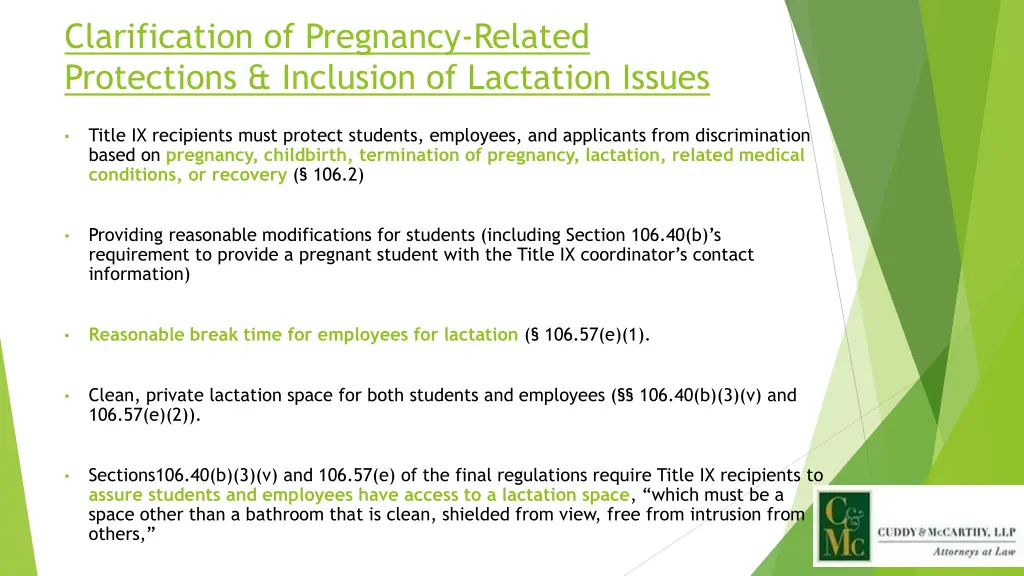
Clarification of Pregnancy-Related Protections & Inclusion of Lactation Issues Title IX recipients must protect students, employees, and applicants from discrimination based on pregnancy, childbirth, termination of pregnancy, lactation, related medical conditions, or recovery ( 106.2) Providing reasonable modifications for students (including Section 106.40(b) s requirement to provide a pregnant student with the Title IX coordinator s contact information) Reasonable break time for employees for lactation ( 106.57(e)(1). Clean, private lactation space for both students and employees ( 106.40(b)(3)(v) and 106.57(e)(2)). Sections106.40(b)(3)(v) and 106.57(e) of the final regulations require Title IX recipients to assure students and employees have access to a lactation space, which must be a space other than a bathroom that is clean, shielded from view, free from intrusion from others,
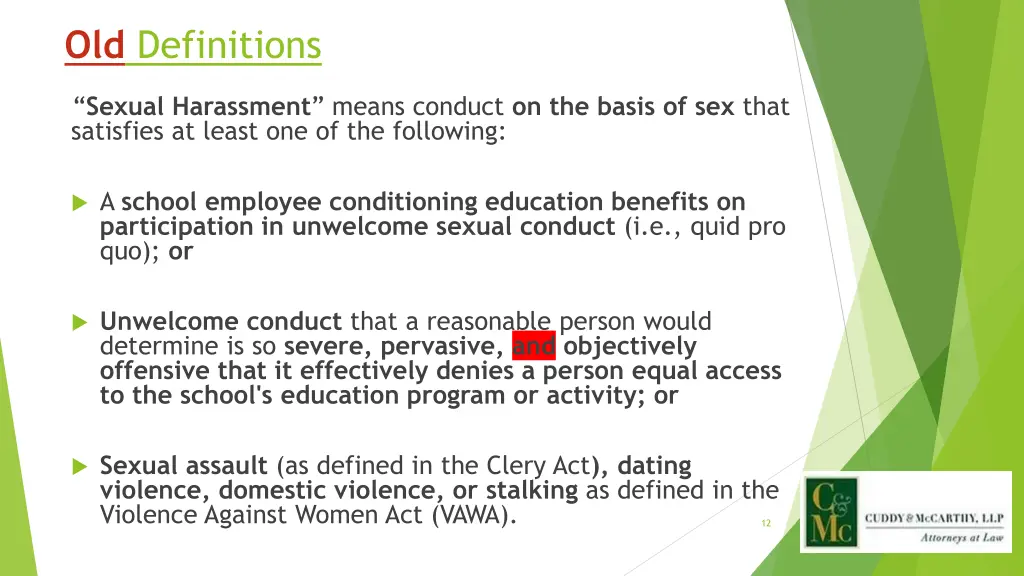
Old Definitions Sexual Harassment means conduct on the basis of sex that satisfies at least one of the following: A school employee conditioning education benefits on participation in unwelcome sexual conduct (i.e., quid pro quo); or Unwelcome conduct that a reasonable person would determine is so severe, pervasive, and objectively offensive that it effectively denies a person equal access to the school's education program or activity; or Sexual assault (as defined in the Clery Act), dating violence, domestic violence, or stalking as defined in the Violence Against Women Act (VAWA). 12
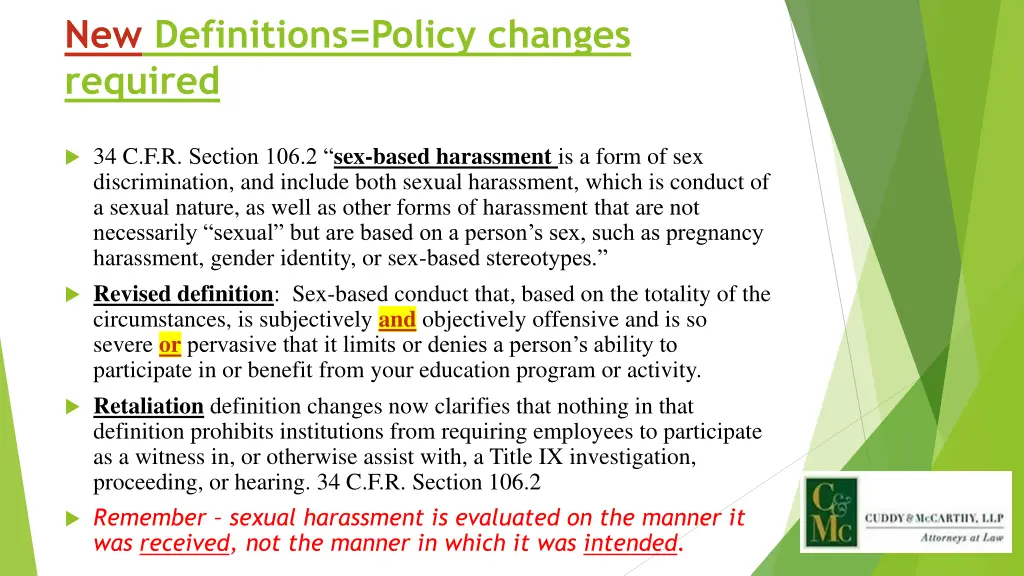
New Definitions=Policy changes required 34 C.F.R. Section 106.2 sex-based harassment is a form of sex discrimination, and include both sexual harassment, which is conduct of a sexual nature, as well as other forms of harassment that are not necessarily sexual but are based on a person s sex, such as pregnancy harassment, gender identity, or sex-based stereotypes. Revised definition: Sex-based conduct that, based on the totality of the circumstances, is subjectively and objectively offensive and is so severe orpervasive that it limits or denies a person s ability to participate in or benefit from your education program or activity. Retaliation definition changes now clarifies that nothing in that definition prohibits institutions from requiring employees to participate as a witness in, or otherwise assist with, a Title IX investigation, proceeding, or hearing. 34 C.F.R. Section 106.2 Remember sexual harassment is evaluated on the manner it was received, not the manner in which it was intended.
Elements of Sexual/gender-based Harassment A form of sex discrimination involving conduct of a sexual nature. Unwelcome sexual advance or conduct that creates an intimidating, hostile or offensive workplace. May occur when submission to such conduct is made either explicitly or implicitly a term or condition of an individual s employment or academic progress. Sexual harassment does not have to be of a sexual nature it can include offensive remarks about a person s sex. i.e. dumb ho, stupid bitch Includes any retaliatory conduct in response to reporting such conduct.
Examples of verbal sexual harassment Threats or suggestions of loss of job, academic credit or privileges or withholding of a benefit unless sexual favors are given Threats or suggestions that a person will get ahead if sexual favors are given Repeated requests to have lunch, dinner, a drink or to just hang out or hook up Calling someone doll, babe, or honey Making sexual innuendoes Telling sexually-oriented jokes or stories Making sexually-oriented comments about a person s appearance, clothing, or body. Turning innocent discussions to sexual topics Cat-calling
Examples of non-verbal sexual harassment Elevator eyes Staring (at someone or particular body parts) Displaying sexual and/or derogatory materials about men or women, including sharing pictures and videos on social media or on your phone Invading an individual s personal space Making sexual gestures with hands and/or body movements
Examples of Physical sexual harassment Massaging a person s neck, shoulders, etc. Brushing up against another person Hugging, kissing, patting, or stroking someone Pinning someone into a corner Touching oneself in front of another Adjusting a person s clothing Non-consensual sexual contact If the conduct interferes with a person s ability to access educational or work opportunities it may be sexual harassment.
Hostile Environment Analysis under TIX Unwelcome conduct determined by a reasonable person, placed in a substantially similar situation, to be so severe or pervasive, and objectively offensive that it effectively denies a person equal access to the recipient s education program or activity.
Prohibitions on Retaliation No school or person may intimidate, threaten, coerce, or discriminate against any individual for the purpose of interfering with any right or privilege secured by Title IX, or because the individual has made a report or complaint, testified, assisted, or participated or refused to participate in any manner in a Title IX investigation, proceeding, or hearing. 19
What Does Not Constitute Retaliation? The exercise of rights protected by the First Amendment does not constitute retaliation. (No party can be prohibited from discussing the allegations or gathering evidence). Charging an individual with a code of conduct violation for making a materially false statement in bad faith in the course of a grievance proceeding under this part does not constitute retaliation; provided, however, that a determination regarding responsibility, alone, is not sufficient to conclude that any party made a bad faith materially false statement. 20
TIX Notice and Response When a Responsible Employee is made aware of conduct which may constitute sexual harassment, school/district must take specific action. Conduct must be immediately reported to TIXC. Promptly contact Complainant to discuss available supportive measures. Supportive Measures: individualized services to restore or preserve equal access to education, protect student and employee safety, or deter sexual harassment. Supportive measures must be offered even if a complainant does not wish to initiate or participate in a grievance process. Explain to Complainant the process of filing a complaint and the TIX investigation process.
Mandatory Response to Reports of Sexual Harassment A District MUST respond promptly in a manner that is not deliberately indifferent, i.e., in a way that is not clearly unreasonable in light of the known circumstances; Offer supportive measures to the complainant 22
Protection for LGBTQ+ Now Codified Codification of protection against discrimination on the basis of sexual orientation and gender identity. The final regulations: Protection against all sex- based harassment and discrimination. The final rule protects all students and employees from all sex discrimination prohibited under Title IX, including by restoring and strengthening full protection from sexual violence and other sex- based harassment.
Social Media and AI Included in Harassment A recipient s obligation is to address all forms of sex discrimination, including sex-based harassment that occurs within the recipient s education program or activity, whether the conduct takes place online, in person, or both. Online harassment can include, but is not limited to, unwelcome conduct on social media platforms such as sex-based derogatory name- calling, the nonconsensual distribution of intimate images (including authentic images and images that have been altered or generated by artificial intelligence (AI) technologies), cyberstalking, sending sex- based pictures or cartoons, and other sex-based conduct that, based on the totality of the circumstances, is subjectively and objectively offensive and so severe or pervasive that it limits or denies a person s ability to participate in or benefit from the recipient s education program or activity. A recipient must evaluate online conduct with the same factors that are used to determine whether in-person conduct creates a hostile environment.
Special Education & Title IX Section 106.8(e) clarifies that the Title IX Coordinator is not required to consult with a student s full IEP team or Section 504 team. However, Section 106.8(e) does provide the recipient must require that the Title IX Coordinator consult with one or more members of a student s IEP team or Section 504 team, as appropriate. The purpose of the consultation is to determine how the recipient can comply with relevant special education laws while carrying out the recipient s obligation under Title IX
Title IX and Confidentiality Schools must keep confidential the identity of complainants, respondents, and witnesses, except as may be permitted by FERPA, or as required by law, or as necessary to carry out a Title IX proceeding. 26
Training Requirements Section 106.8(d)(2) requires all investigators, decisionmakers, and other persons responsible for implementing the recipient s grievance procedures or who have the authority to modify or terminate supportive measures to also be trained on the recipient s obligations; the recipient s grievance procedures, and if applicable, how to serve impartially, including by avoiding prejudgment of the facts at issue, conflicts of interest, and bias
Title IX Required Training Title IX Coordinators, investigators, decision-makers and people who facilitate any informal resolution process, must be free from conflicts of interest or bias for or against complainants or respondents. Training of Title IX personnel must include: the new rule s definition of sexual harassment and the scope of the school s education program or activity; how to conduct an investigation and grievance process including hearings, appeals, and informal resolution processes, as applicable; and how to serve impartially, including by avoiding prejudgment of the facts at issue, conflicts of interest, and bias; training on any technology to be used at a live hearing; decision-makers and investigators must receive training on issues of relevance, including how to apply the rape shield protections provided only for complainants. 28
Deadline for Implementation - August 1, 2024 All policies MUST be updated All staff trained on new Title IX regulations - annually. Update student, staff and parent handbooks, websites, etc. before school starts.
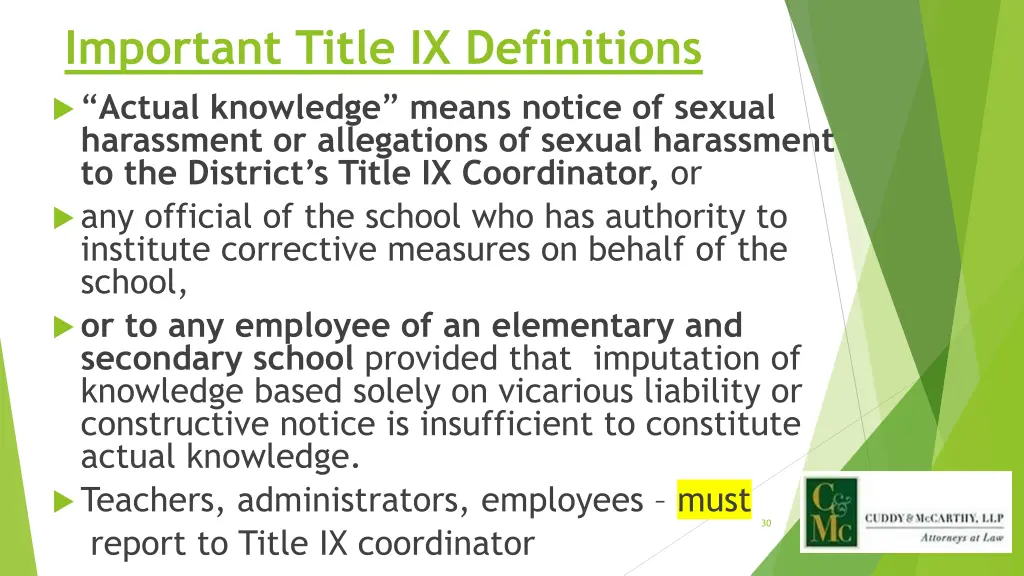
Important Title IX Definitions Actual knowledge means notice of sexual harassment or allegations of sexual harassment to the District s Title IX Coordinator, or any official of the school who has authority to institute corrective measures on behalf of the school, or to any employee of an elementary and secondary school provided that imputation of knowledge based solely on vicarious liability or constructive notice is insufficient to constitute actual knowledge. Teachers, administrators, employees must report to Title IX coordinator 30
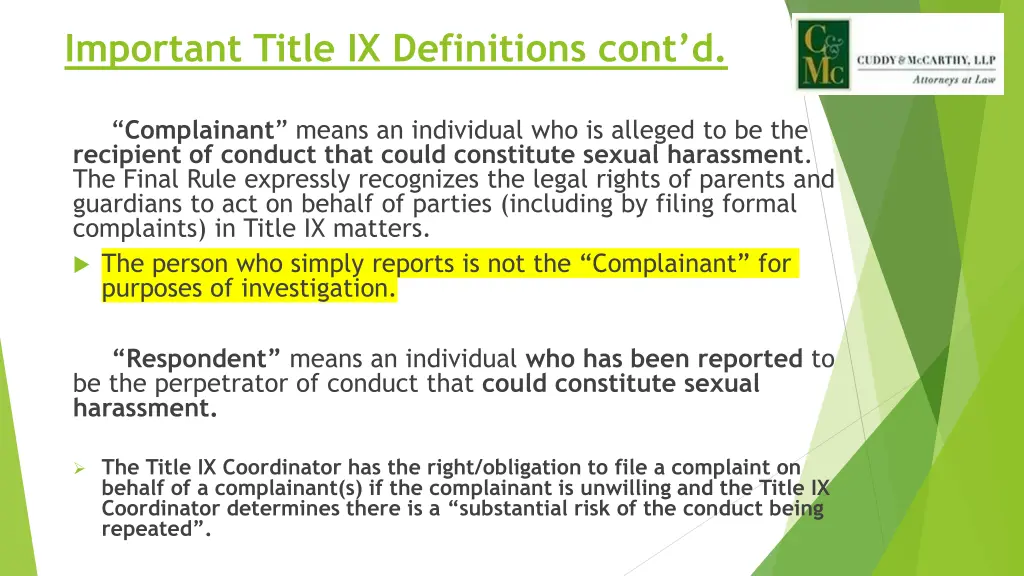
Important Title IX Definitions contd. Complainant means an individual who is alleged to be the recipient of conduct that could constitute sexual harassment. The Final Rule expressly recognizes the legal rights of parents and guardians to act on behalf of parties (including by filing formal complaints) in Title IX matters. The person who simply reports is not the Complainant for purposes of investigation. be the perpetrator of conduct that could constitute sexual harassment. The Title IX Coordinator has the right/obligation to file a complaint on behalf of a complainant(s) if the complainant is unwilling and the Title IX Coordinator determines there is a substantial risk of the conduct being repeated . Respondent means an individual who has been reported to
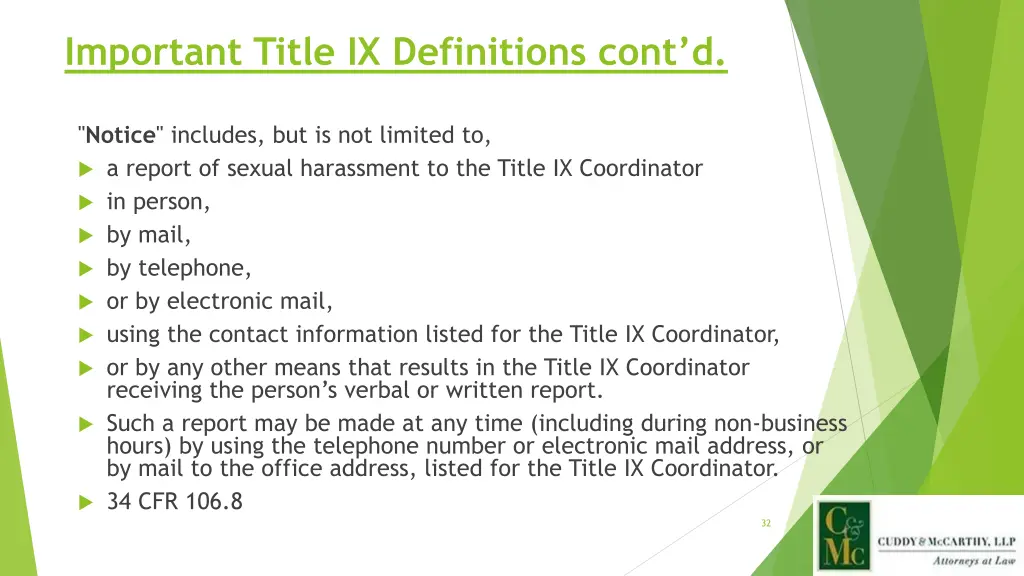
Important Title IX Definitions contd. "Notice" includes, but is not limited to, a report of sexual harassment to the Title IX Coordinator in person, by mail, by telephone, or by electronic mail, using the contact information listed for the Title IX Coordinator, or by any other means that results in the Title IX Coordinator receiving the person s verbal or written report. Such a report may be made at any time (including during non-business hours) by using the telephone number or electronic mail address, or by mail to the office address, listed for the Title IX Coordinator. 34 CFR 106.8 32
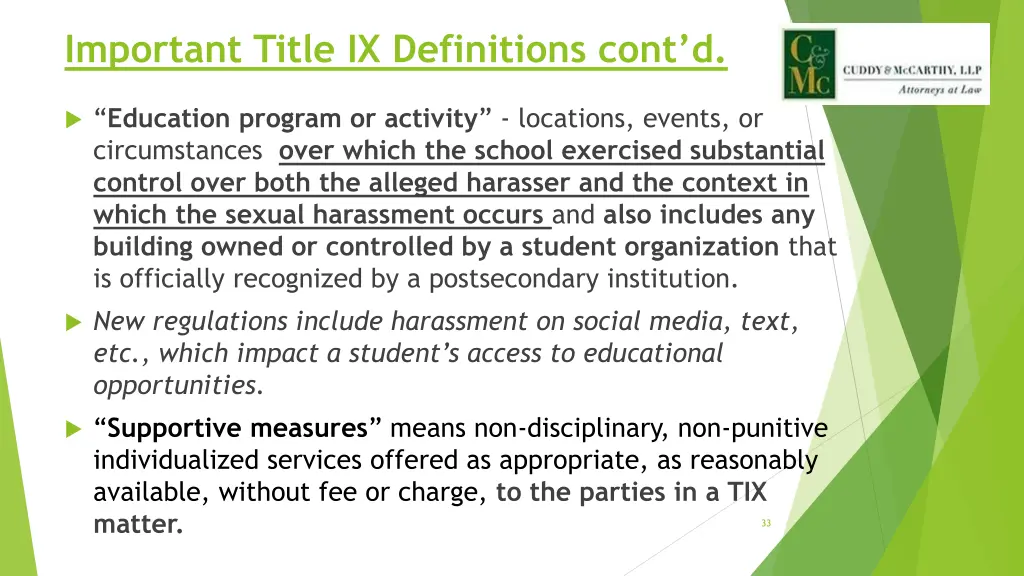
Important Title IX Definitions contd. Education program or activity - locations, events, or circumstances over which the school exercised substantial control over both the alleged harasser and the context in which the sexual harassment occurs and also includes any building owned or controlled by a student organization that is officially recognized by a postsecondary institution. New regulations include harassment on social media, text, etc., which impact a student s access to educational opportunities. Supportive measures means non-disciplinary, non-punitive individualized services offered as appropriate, as reasonably available, without fee or charge, to the parties in a TIX matter. 33
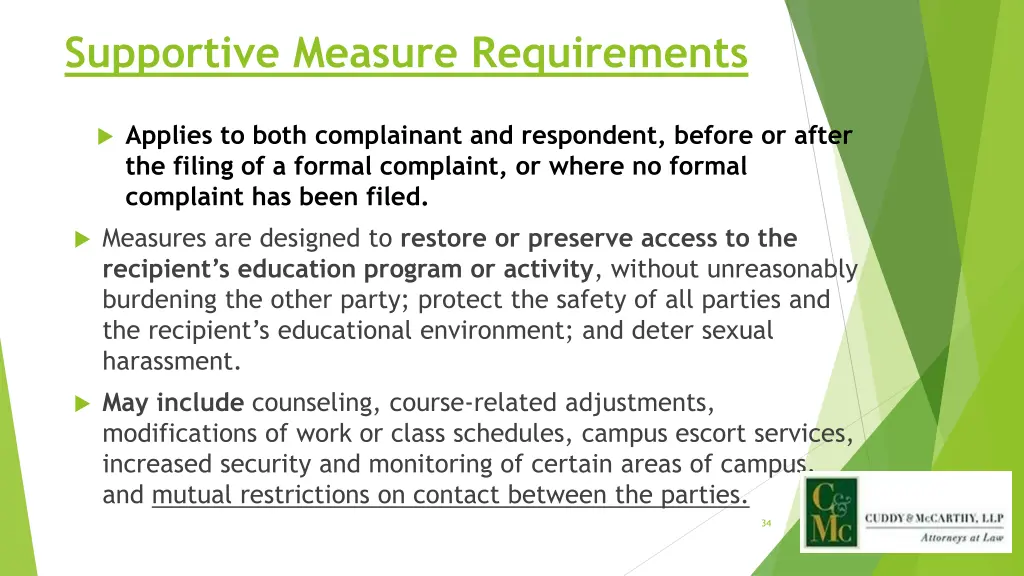
Supportive Measure Requirements Applies to both complainant and respondent, before or after the filing of a formal complaint, or where no formal complaint has been filed. Measures are designed to restore or preserve access to the recipient s education program or activity, without unreasonably burdening the other party; protect the safety of all parties and the recipient s educational environment; and deter sexual harassment. May include counseling, course-related adjustments, modifications of work or class schedules, campus escort services, increased security and monitoring of certain areas of campus, and mutual restrictions on contact between the parties. 34
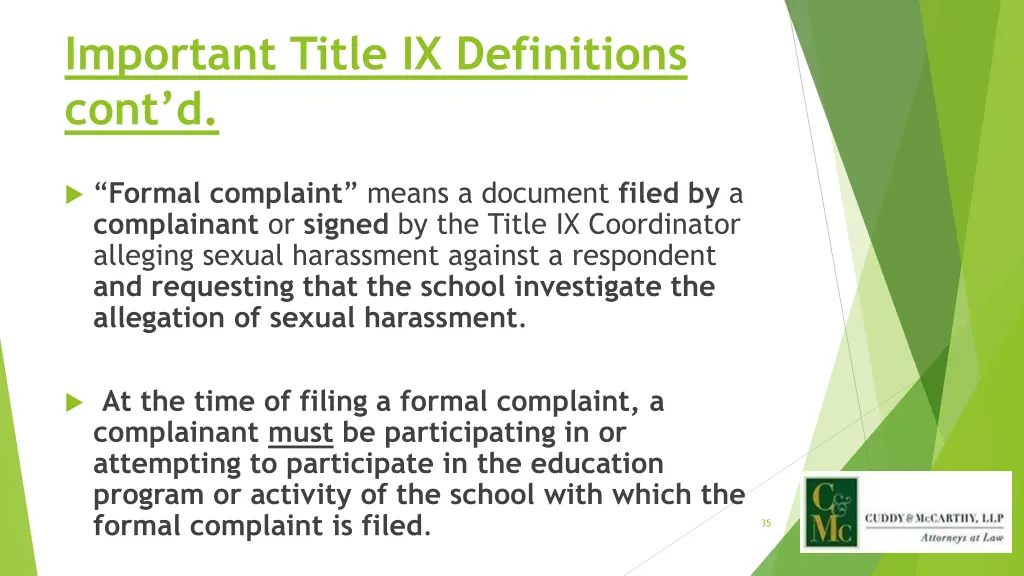
Important Title IX Definitions cont d. Formal complaint means a document filed by a complainant or signed by the Title IX Coordinator alleging sexual harassment against a respondent and requesting that the school investigate the allegation of sexual harassment. At the time of filing a formal complaint, a complainant must be participating in or attempting to participate in the education program or activity of the school with which the formal complaint is filed. 35
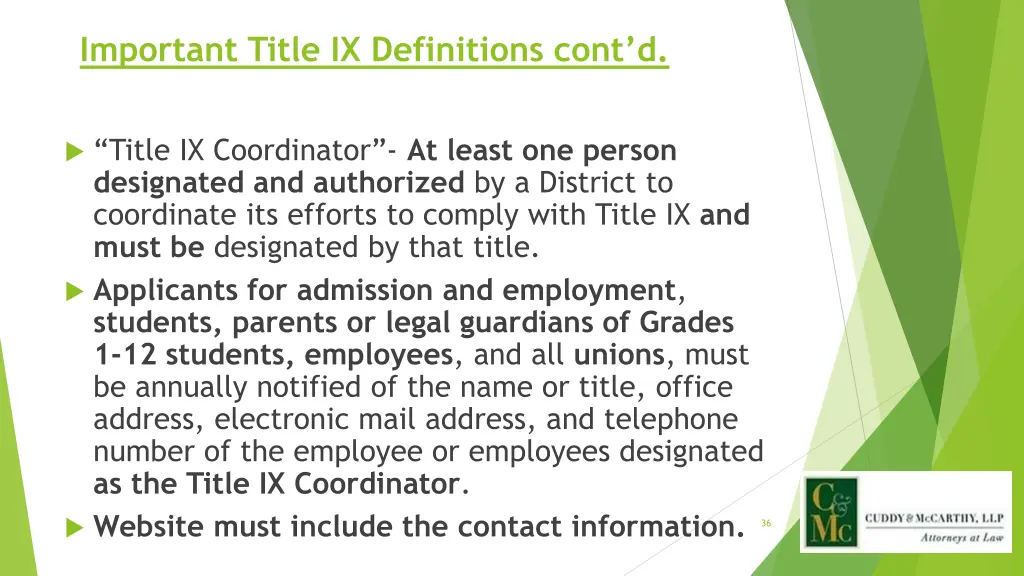
Important Title IX Definitions contd. Title IX Coordinator - At least one person designated and authorized by a District to coordinate its efforts to comply with Title IX and must be designated by that title. Applicants for admission and employment, students, parents or legal guardians of Grades 1-12 students, employees, and all unions, must be annually notified of the name or title, office address, electronic mail address, and telephone number of the employee or employees designated as the Title IX Coordinator. Website must include the contact information. 36
Break Time (Grab the document from your email entitled Standard Operating Procedures for when we return.)
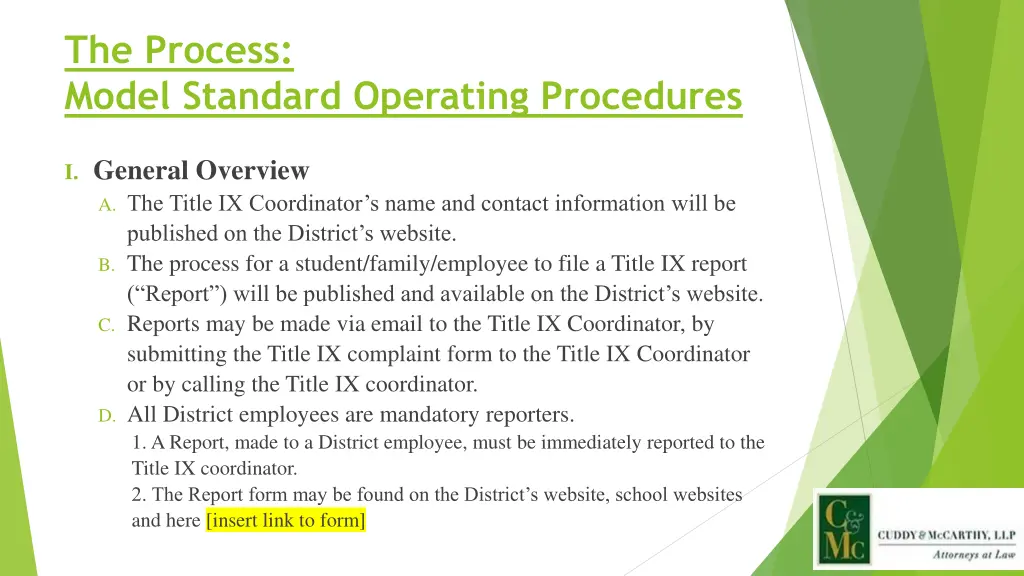
The Process: Model Standard Operating Procedures I. General Overview A. The Title IX Coordinator s name and contact information will be published on the District s website. B. The process for a student/family/employee to file a Title IX report ( Report ) will be published and available on the District s website. C. Reports may be made via email to the Title IX Coordinator, by submitting the Title IX complaint form to the Title IX Coordinator or by calling the Title IX coordinator. D. All District employees are mandatory reporters. 1. A Report, made to a District employee, must be immediately reported to the Title IX coordinator. 2. The Report form may be found on the District s website, school websites and here [insert link to form]
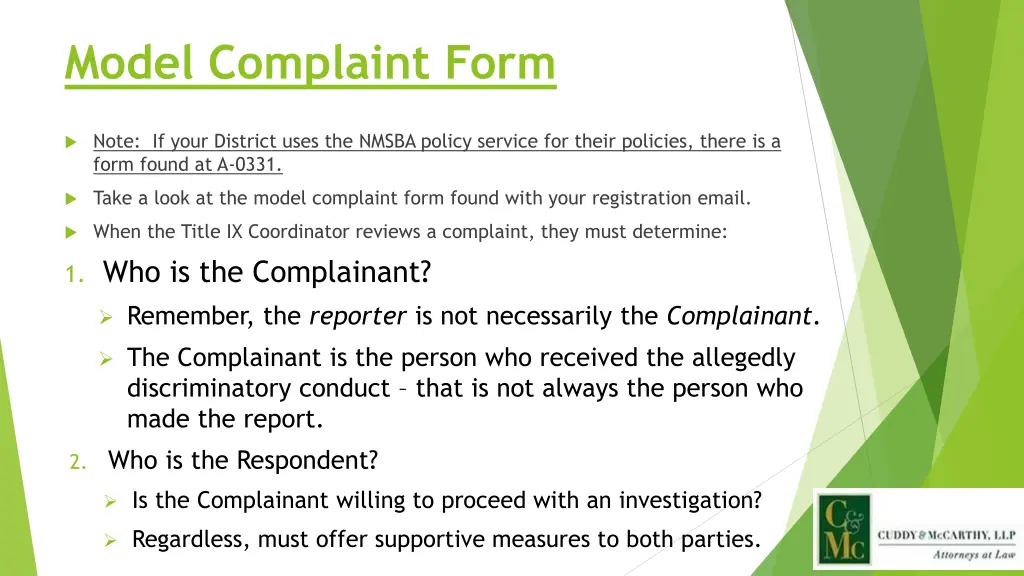
Model Complaint Form Note: If your District uses the NMSBA policy service for their policies, there is a form found at A-0331. Take a look at the model complaint form found with your registration email. When the Title IX Coordinator reviews a complaint, they must determine: 1. Who is the Complainant? Remember, the reporter is not necessarily the Complainant. The Complainant is the person who received the allegedly discriminatory conduct that is not always the person who made the report. 2. Who is the Respondent? Is the Complainant willing to proceed with an investigation? Regardless, must offer supportive measures to both parties.
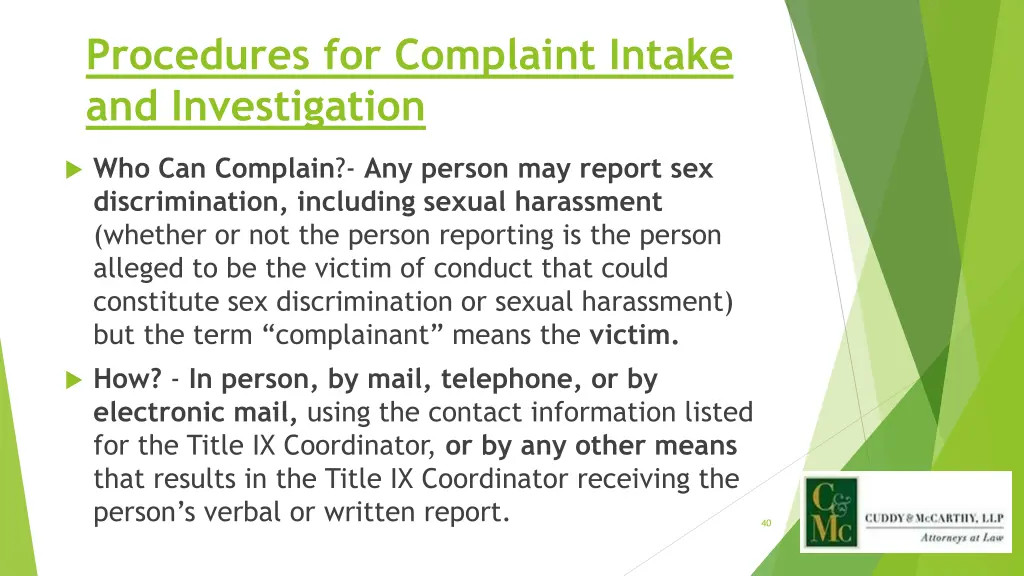
Procedures for Complaint Intake and Investigation Who Can Complain?- Any person may report sex discrimination, including sexual harassment (whether or not the person reporting is the person alleged to be the victim of conduct that could constitute sex discrimination or sexual harassment) but the term complainant means the victim. How? - In person, by mail, telephone, or by electronic mail, using the contact information listed for the Title IX Coordinator, or by any other means that results in the Title IX Coordinator receiving the person s verbal or written report. 40
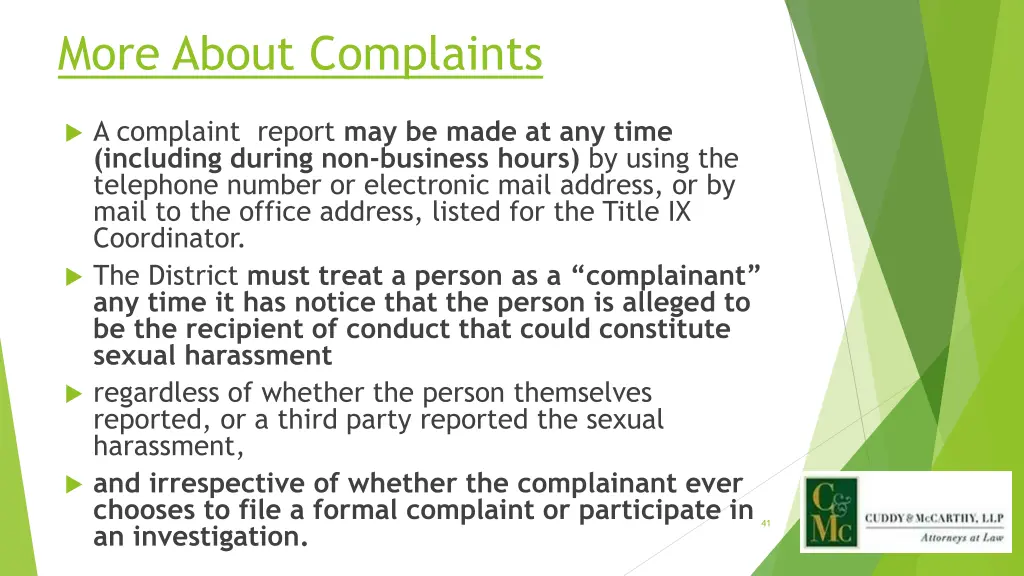
More About Complaints A complaint report may be made at any time (including during non-business hours) by using the telephone number or electronic mail address, or by mail to the office address, listed for the Title IX Coordinator. The District must treat a person as a complainant any time it has notice that the person is alleged to be the recipient of conduct that could constitute sexual harassment regardless of whether the person themselves reported, or a third party reported the sexual harassment, and irrespective of whether the complainant ever chooses to file a formal complaint or participate in an investigation. 41
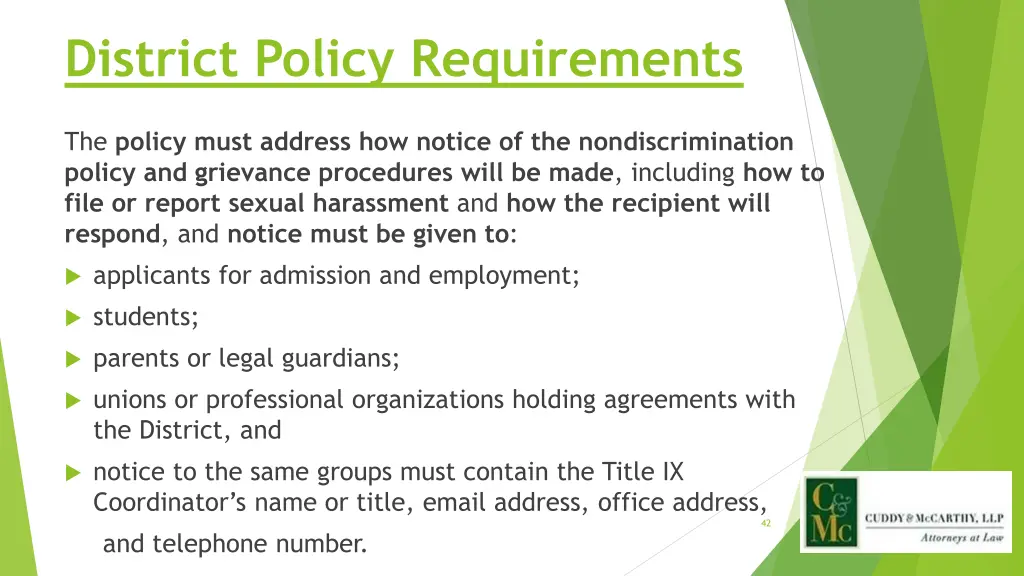
District Policy Requirements The policy must address how notice of the nondiscrimination policy and grievance procedures will be made, including how to file or report sexual harassment and how the recipient will respond, and notice must be given to: applicants for admission and employment; students; parents or legal guardians; unions or professional organizations holding agreements with the District, and notice to the same groups must contain the Title IX Coordinator s name or title, email address, office address, and telephone number. 42
Policy Requirements, contd. Notice of a District s non-discrimination policy must include, statement that the recipient does not discriminate on the basis of sex in the education program or activity that it operates, and that it is required by Title IX and its regulations not to discriminate in such a manner; the requirement that prohibition on discrimination in the education program or activity applies to employment; Statement that inquiries about the application of Title IX and its regulations to the District may be referred to the designated Title IX Coordinator, to the Assistant Secretary of the Federal Department of Education, or both; and both the notice of nondiscrimination and the Title IX Coordinator s contact information must be published on District/School websites and in any handbook provided students, parents/guardians, applicants, unions and professional organizations have agreements with a District. 43
3. Must determine Jurisdiction Does TIX jurisdiction attach? Was the complainant attempting to participate in a District- sanctioned program or activity when the conduct occurred? Was the respondent engaging in a District-sanctioned program or activity when the conduct occurred? Did the District have control over the respondent when the conduct occurred? Did the alleged conduct occur within the jurisdiction of the School/District? Remember: The new regulations, effective August 1, 2024, require the district to consider conduct that did not occur within the geographical boundaries of the district, but impacted a student s access to their educational opportunities. i.e. social media, texting, snapchat, pictures, etc.
4. Must Determine SPOO Does the conduct alleged, if true, rise to the level of a Title IX investigation: Severe or Pervasive and Objectively Offensive So as to effectively limit or deny a person s ability to participate in or benefit from your education program or activity. If yes, must meet with Complainant to review the investigation process.
Complainant Considerations Questions 1. Has the Complainant been offered supportive measures? 2. Has the Complainant been informed of her right to contact law enforcement? 3. Has the Complainant had the Title IX investigation process explained to her? 4. Does the Complainant want an investigation into this matter? 5. If yes, what are the next steps? 6. If no, what are the next steps? 7. Should the TIX coordinator consider filing a complaint on behalf of complainant if she is unwilling to move forward? Why or why not?
Respondent Considerations 1. Has Respondent been offered supportive measures? 2. Has Respondent been provided with written notice of allegations and advisement of rights? 3. Has Respondent been notified of the presumption that they are not responsible for the alleged conduct? 4. Has Respondent been notified of their right to provide witnesses and evidence to support their position? 5. Has Respondent been notified of their right to respond in writing to the allegations?
Standard Operating Procedures cont. I. Handling a Report A. When a Report is received, the Title IX Coordinator, or Designee, i.e. Deputy Title IX Coordinators, will conduct a preliminary inquiry, when necessary to gather more information to determine Title IX jurisdiction. B. Based on the allegations, or preliminary inquiry, the Title IX Coordinator will determine if the allegations in the Report fall within Title IX jurisdiction, or if the Report will be referred to another department. C. When a formal Report is received from a Complainant, and the allegations do not meet the criteria for Title IX jurisdiction, a Notice of Dismissal ( Dismissal ) will be sent to the Complainant. 1. If Respondent is aware of the Report, Respondent will also receive the Dismissal.
Mandatory Dismissal of Formal Complaint If the conduct alleged in the formal complaint would not constitute sexual harassment as defined in 106.30 even if proved, did not occur in the district's education program or activity, or did not occur against a person in the United States, Don t forget about social media considerations... then the district must dismiss the formal complaint with regard to that conduct for purposes of sexual harassment under title IX or this part; such a dismissal does not preclude action under another provision of the district's code of conduct.
Permissive Dismissal of Formal Complaint The district may dismiss the formal complaint or any allegations therein, if at any time during the investigation or hearing: A complainant notifies the Title IX Coordinator in writing that the complainant would like to withdraw the formal complaint or any allegations therein; the respondent is no longer enrolled or employed by the recipient; or specific circumstances prevent the recipient from gathering evidence sufficient to reach a determination as to the formal complaint or allegations therein.