Explore transaction management in DBMS, including concurrency issues, locking protocols, and schedules. Learn about shared database usage, transaction units, commit and abort actions, and scheduling rules for actions within transactions.
Please find below an Image/Link to download the presentation.
The content on the website is provided AS IS for your information and personal use only. It may not be sold, licensed, or shared on other websites without obtaining consent from the author. If you encounter any issues during the download, it is possible that the publisher has removed the file from their server.
You are allowed to download the files provided on this website for personal or commercial use, subject to the condition that they are used lawfully. All files are the property of their respective owners.
The content on the website is provided AS IS for your information and personal use only. It may not be sold, licensed, or shared on other websites without obtaining consent from the author.
Today Last Session: Quiz II and a very brief introduction on transaction management Today s Session: DBMS Internals- Part XI Transaction Management Announcement: P3 is due on April 18
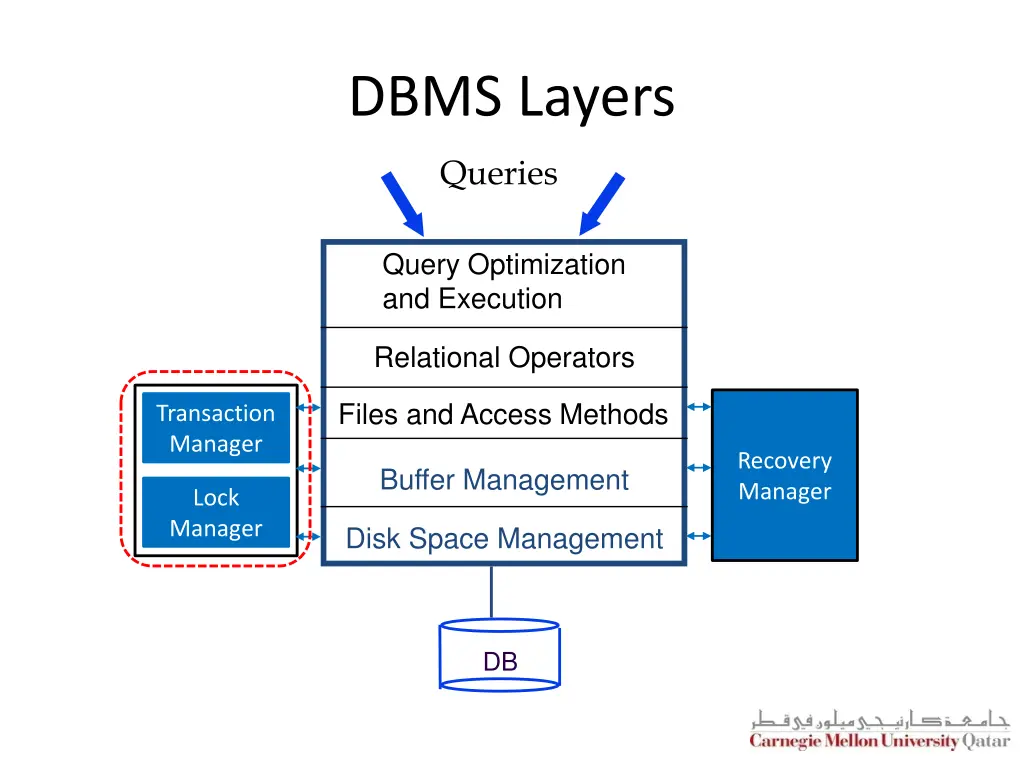
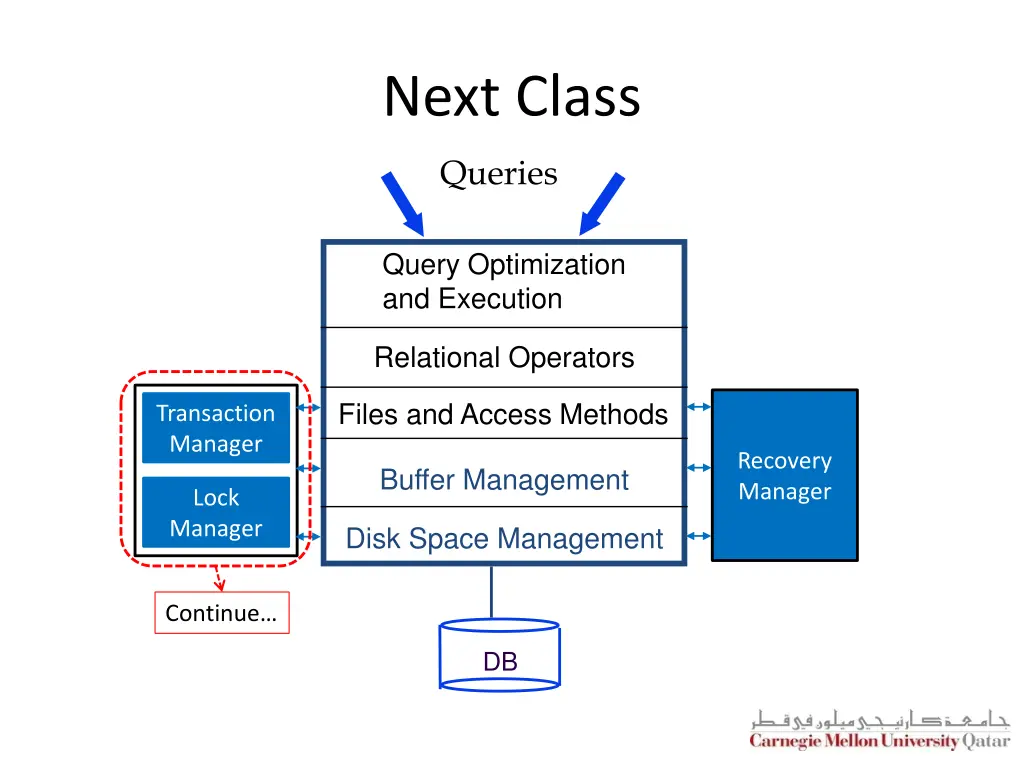
DBMS Layers Queries Query Optimization and Execution Relational Operators Files and Access Methods Transaction Manager Recovery Manager Buffer Management Lock Manager Disk Space Management DB
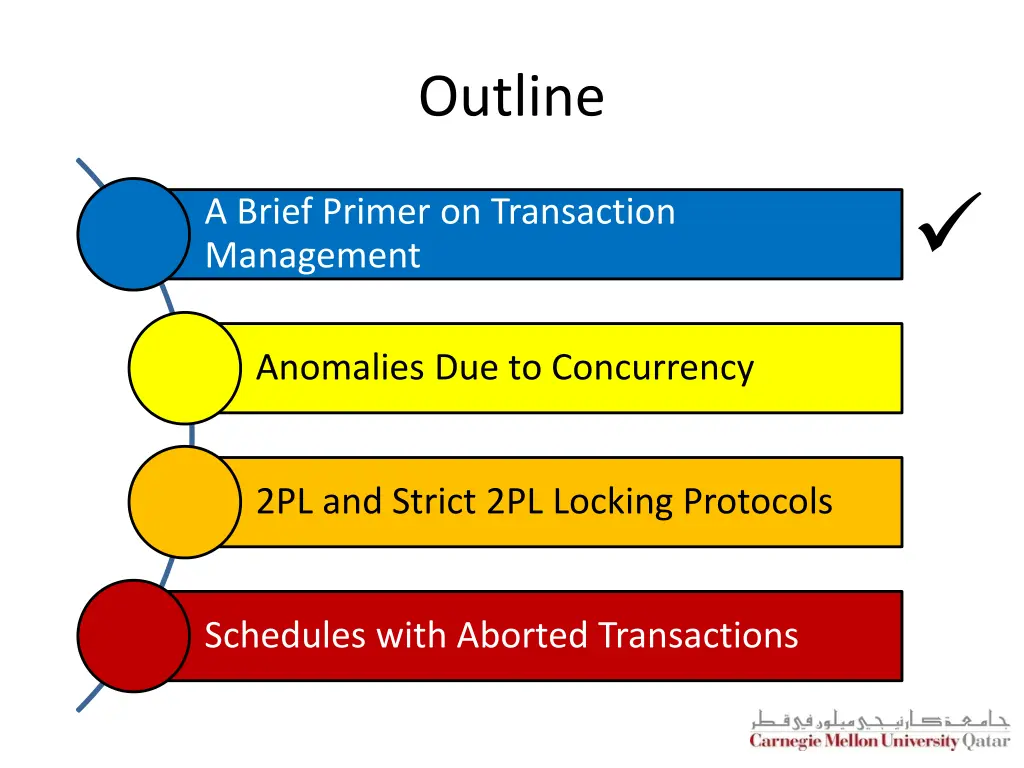
Outline A Brief Primer on Transaction Management Anomalies Due to Concurrency 2PL and Strict 2PL Locking Protocols Schedules with Aborted Transactions
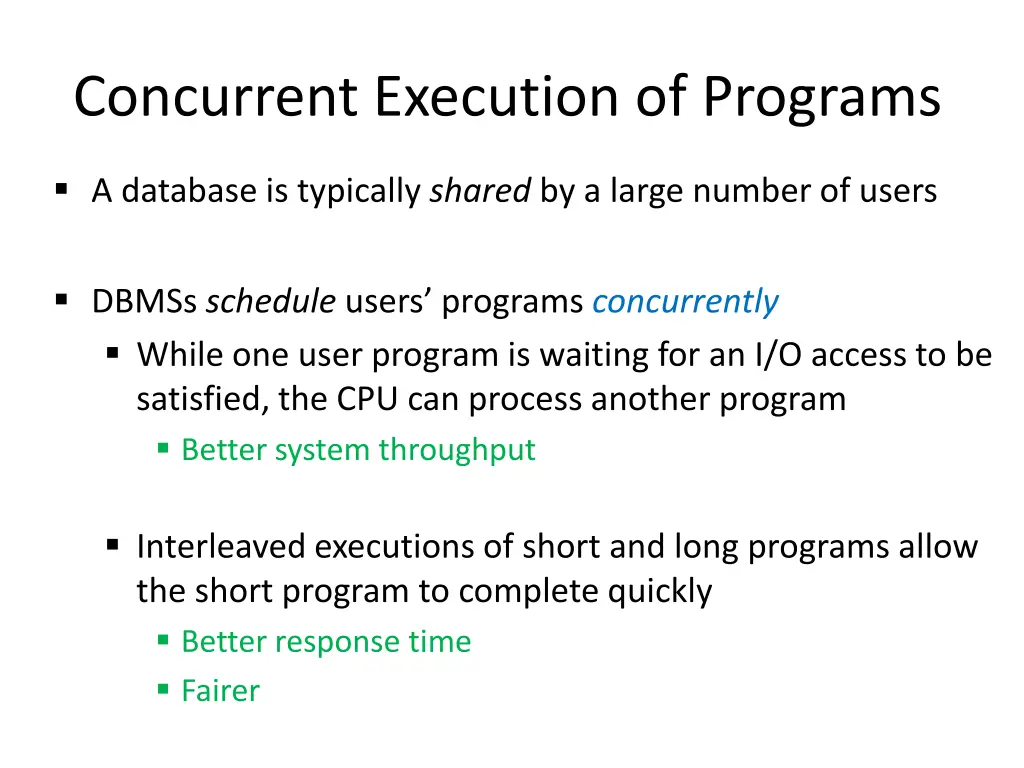
Concurrent Execution of Programs A database is typically shared by a large number of users DBMSs scheduleusers programs concurrently While one user program is waiting for an I/O access to be satisfied, the CPU can process another program Better system throughput Interleaved executions of short and long programs allow the short program to complete quickly Better response time Fairer
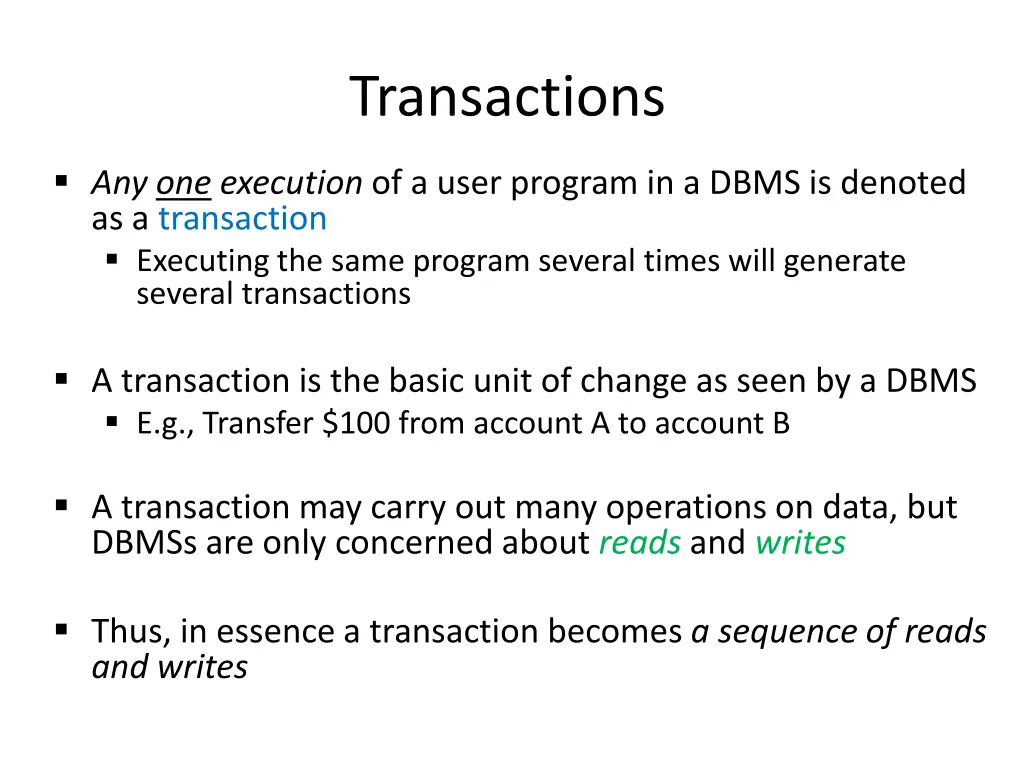
Transactions Any one execution of a user program in a DBMS is denoted as a transaction Executing the same program several times will generate several transactions A transaction is the basic unit of change as seen by a DBMS E.g., Transfer $100 from account A to account B A transaction may carry out many operations on data, but DBMSs are only concerned about reads and writes Thus, in essence a transaction becomes a sequence of reads and writes
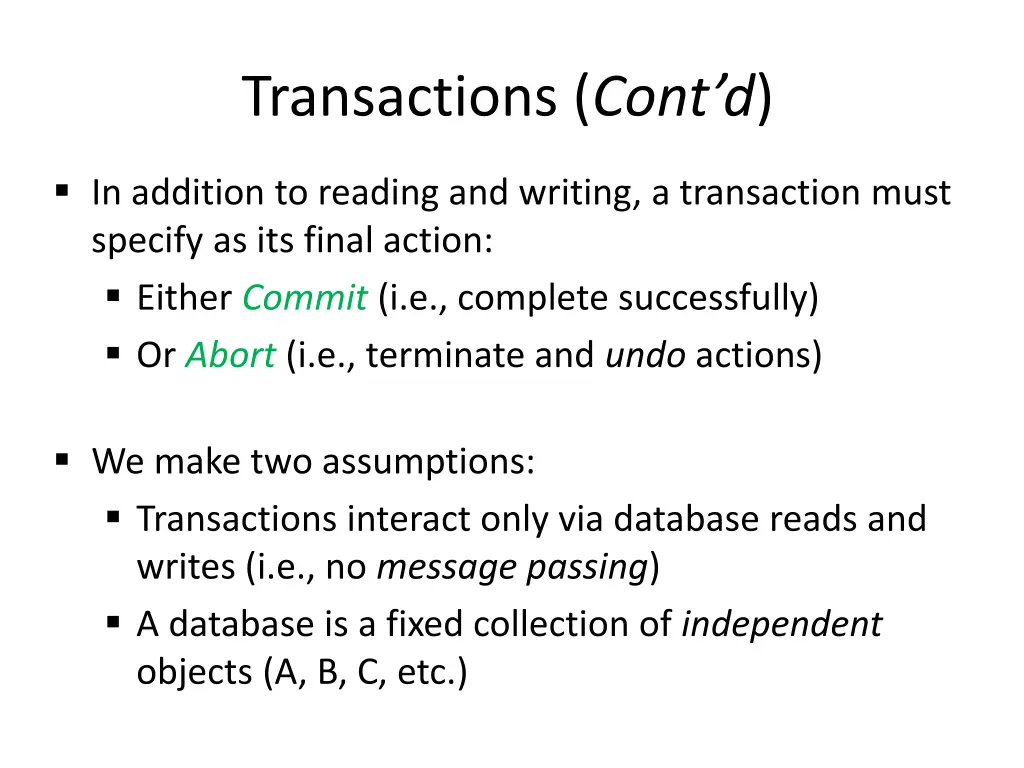
Transactions (Contd) In addition to reading and writing, a transaction must specify as its final action: Either Commit (i.e., complete successfully) Or Abort (i.e., terminate and undo actions) We make two assumptions: Transactions interact only via database reads and writes (i.e., no message passing) A database is a fixed collection of independent objects (A, B, C, etc.)
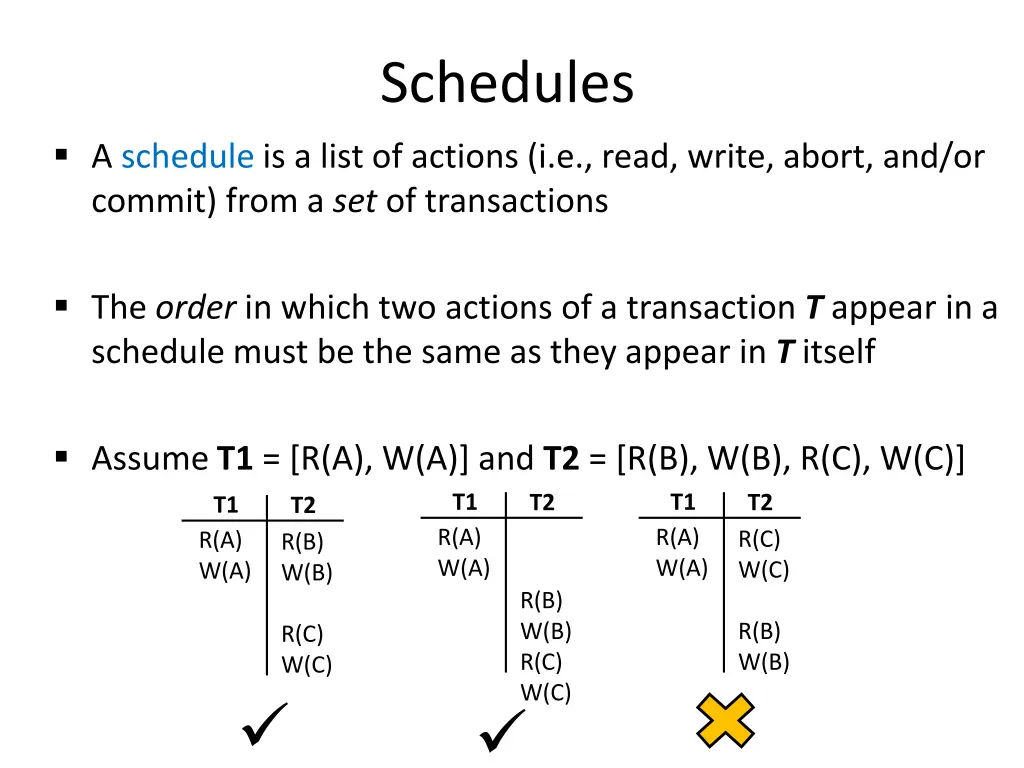
Schedules A schedule is a list of actions (i.e., read, write, abort, and/or commit) from a set of transactions The order in which two actions of a transaction T appear in a schedule must be the same as they appear in T itself Assume T1 = [R(A), W(A)] and T2 = [R(B), W(B), R(C), W(C)] T1 R(A) W(A) T1 T2 T2 R(C) W(C) T1 T2 R(B) W(B) R(A) W(A) R(A) W(A) R(B) W(B) R(C) W(C) R(B) W(B) R(C) W(C)
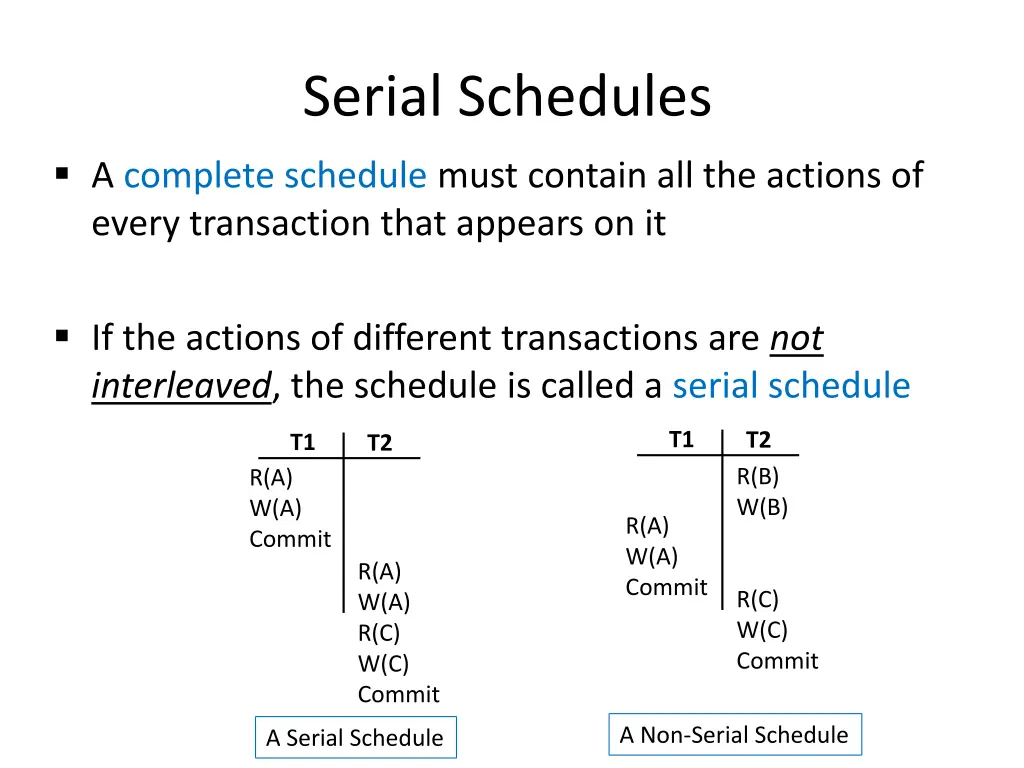
Serial Schedules A complete schedule must contain all the actions of every transaction that appears on it If the actions of different transactions are not interleaved, the schedule is called a serial schedule T1 T2 R(B) W(B) T1 T2 R(A) W(A) Commit R(A) W(A) Commit R(A) W(A) R(C) W(C) Commit R(C) W(C) Commit A Non-Serial Schedule A Serial Schedule
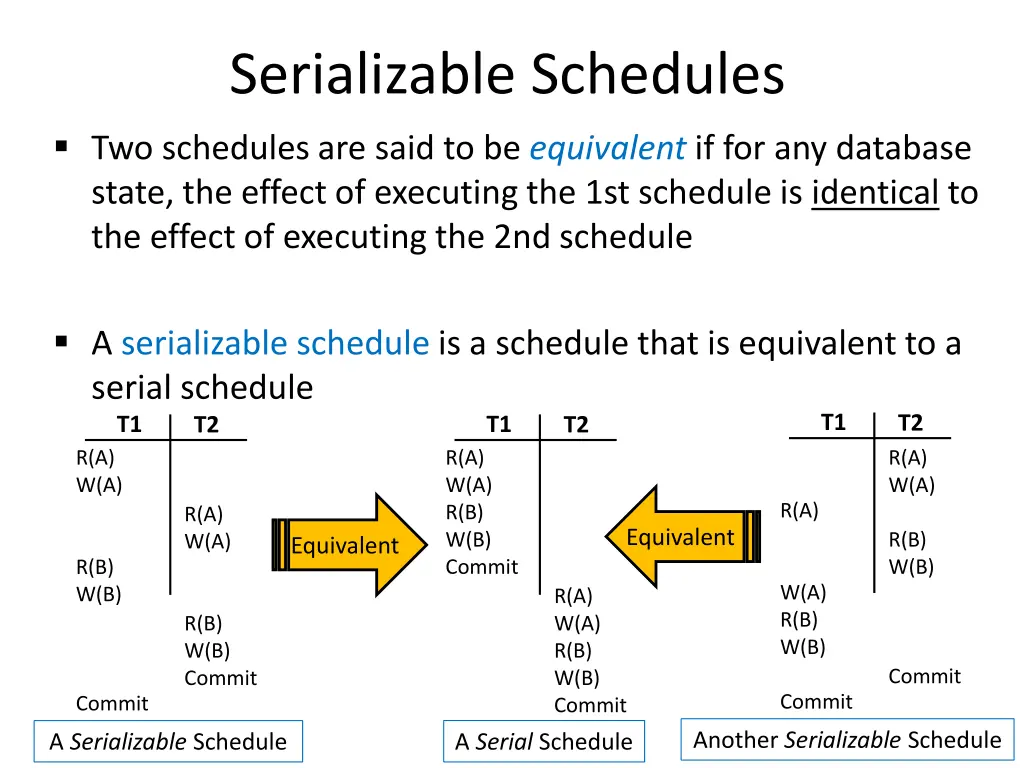
Serializable Schedules Two schedules are said to be equivalent if for any database state, the effect of executing the 1st schedule is identical to the effect of executing the 2nd schedule A serializable schedule is a schedule that is equivalent to a serial schedule T1 T2 R(A) W(A) R(A) W(A) W(B) Commit T1 T2 R(A) W(A) T1 T2 R(A) W(A) R(B) R(A) Equivalent R(B) W(B) Equivalent R(B) W(B) W(A) R(B) W(B) R(A) W(A) R(B) W(B) Commit R(B) W(B) Commit Commit Commit Commit Another Serializable Schedule A Serial Schedule A Serializable Schedule
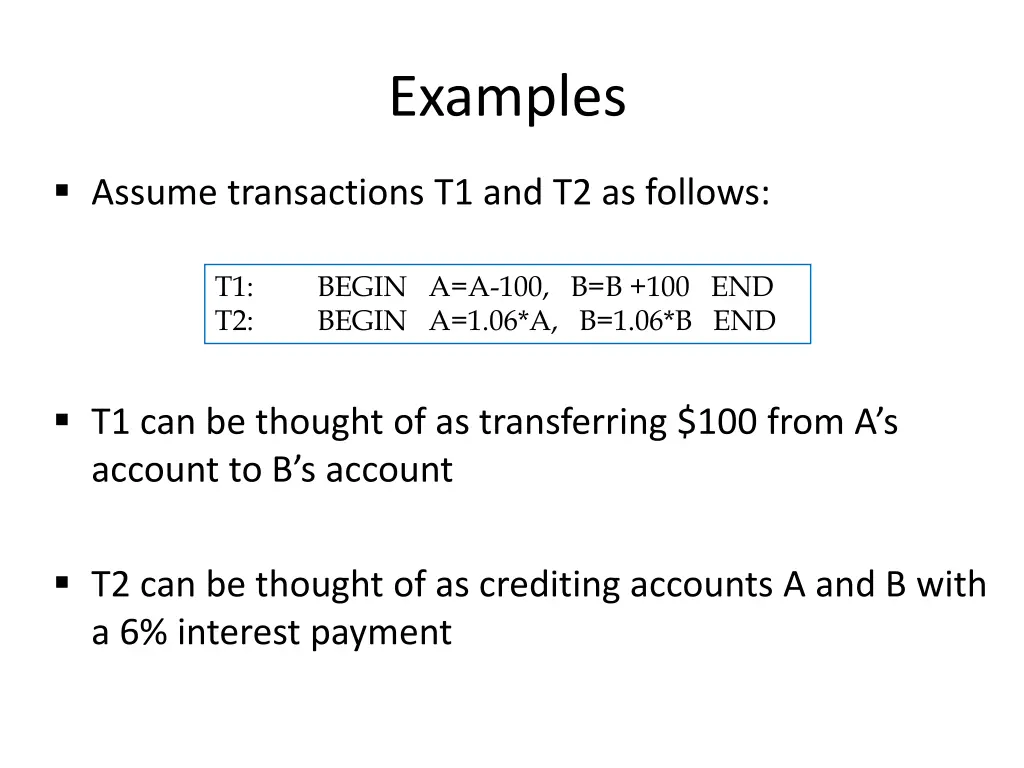
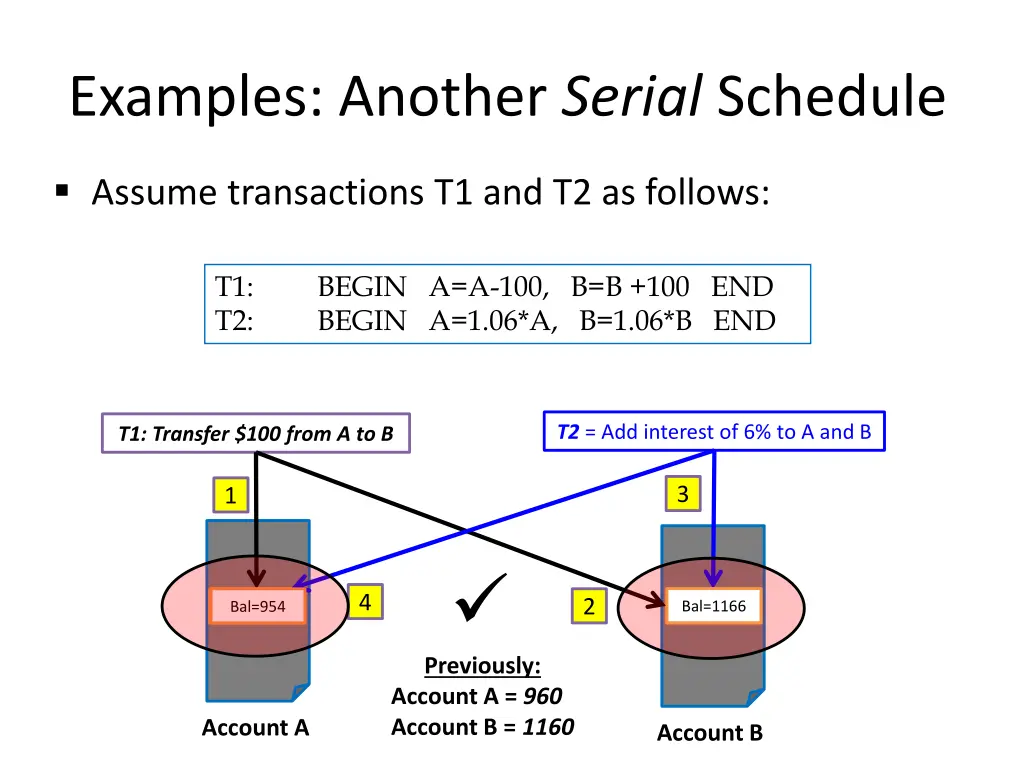
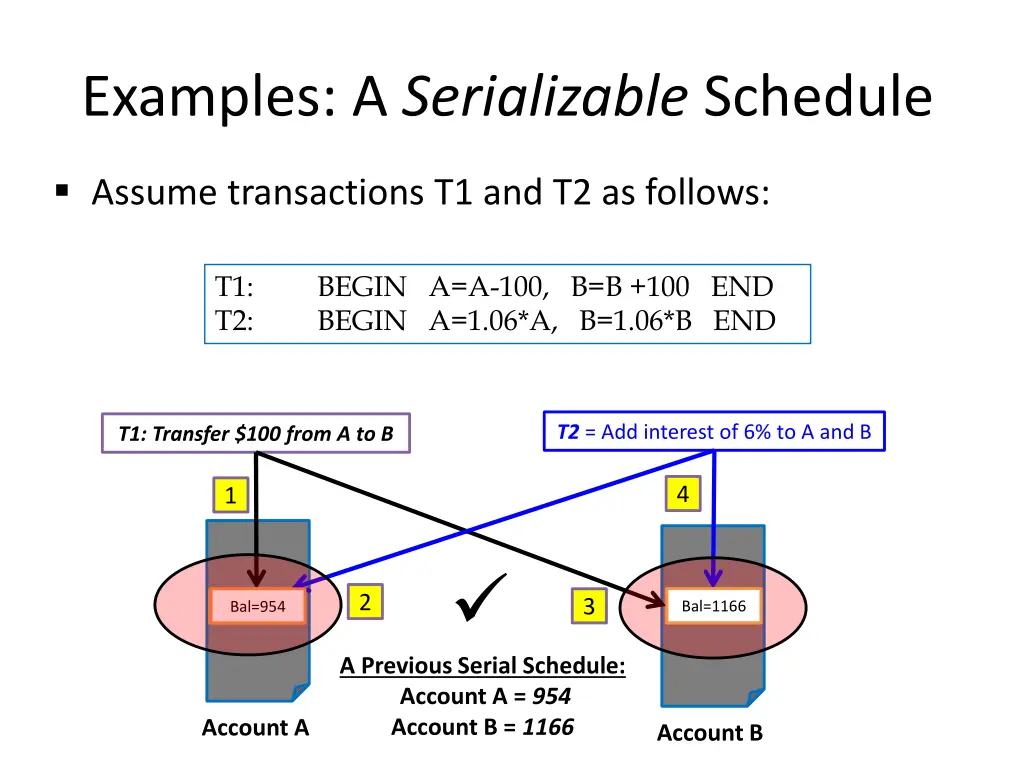
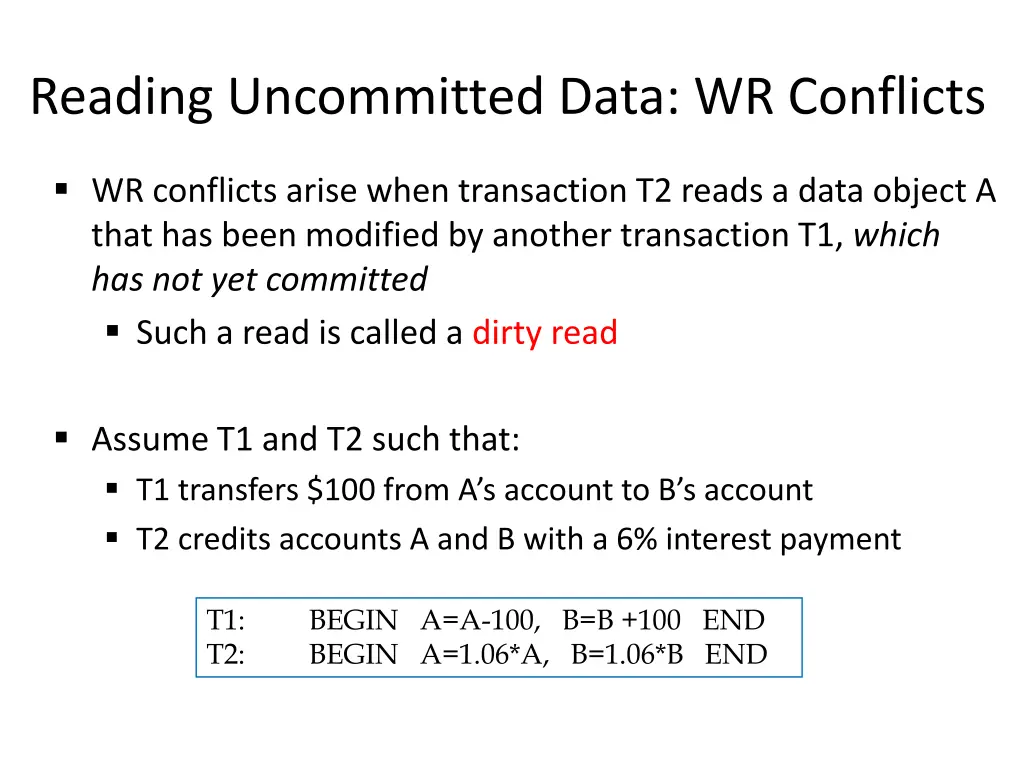
Examples Assume transactions T1 and T2 as follows: T1: T2: BEGIN A=A-100, B=B +100 END BEGIN A=1.06*A, B=1.06*B END T1 can be thought of as transferring $100 from A s account to B s account T2 can be thought of as crediting accounts A and B with a 6% interest payment
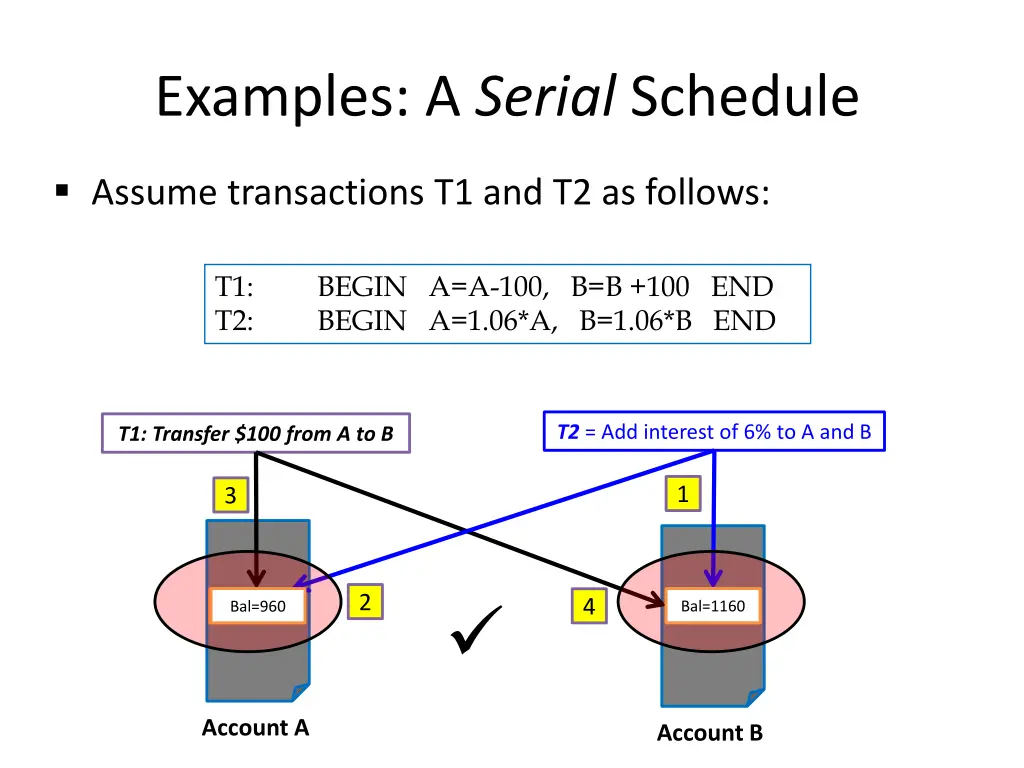
Examples: A Serial Schedule Assume transactions T1 and T2 as follows: T1: T2: BEGIN A=A-100, B=B +100 END BEGIN A=1.06*A, B=1.06*B END T2 = Add interest of 6% to A and B T1: Transfer $100 from A to B 1 3 2 4 Bal=1000 Bal=1060 Bal=1160 Bal=1000 Bal=1060 Bal=960 Account A Account B
Examples: Another Serial Schedule Assume transactions T1 and T2 as follows: T1: T2: BEGIN A=A-100, B=B +100 END BEGIN A=1.06*A, B=1.06*B END T2 = Add interest of 6% to A and B T1: Transfer $100 from A to B 3 1 4 2 Bal=1000 Bal=1100 Bal=1166 Bal=1000 Bal=900 Bal=954 Previously: Account A = 960 Account B = 1160 Account A Account B
Examples: A Serializable Schedule Assume transactions T1 and T2 as follows: T1: T2: BEGIN A=A-100, B=B +100 END BEGIN A=1.06*A, B=1.06*B END T2 = Add interest of 6% to A and B T1: Transfer $100 from A to B 4 1 2 3 Bal=1000 Bal=1100 Bal=1166 Bal=1000 Bal=900 Bal=954 A Previous Serial Schedule: Account A = 954 Account B = 1166 Account A Account B
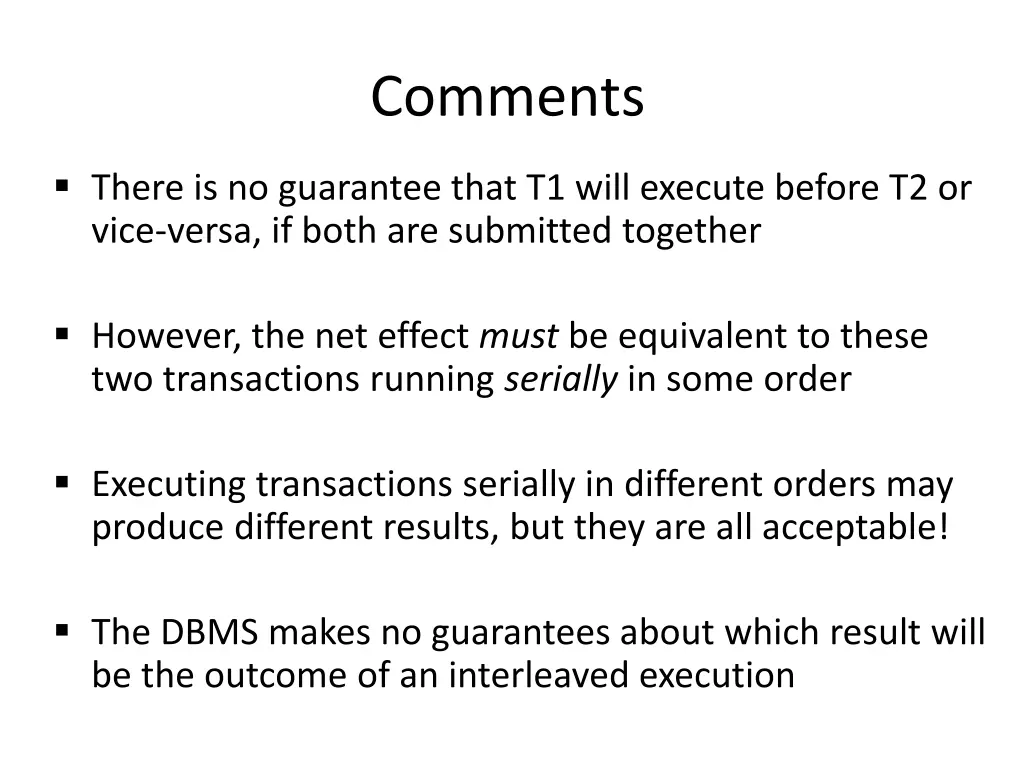
Comments There is no guarantee that T1 will execute before T2 or vice-versa, if both are submitted together However, the net effect must be equivalent to these two transactions running serially in some order Executing transactions serially in different orders may produce different results, but they are all acceptable! The DBMS makes no guarantees about which result will be the outcome of an interleaved execution
Outline A Brief Primer on Transaction Management Anomalies Due to Concurrency 2PL and Strict 2PL Locking Protocols Schedules with Aborted Transactions
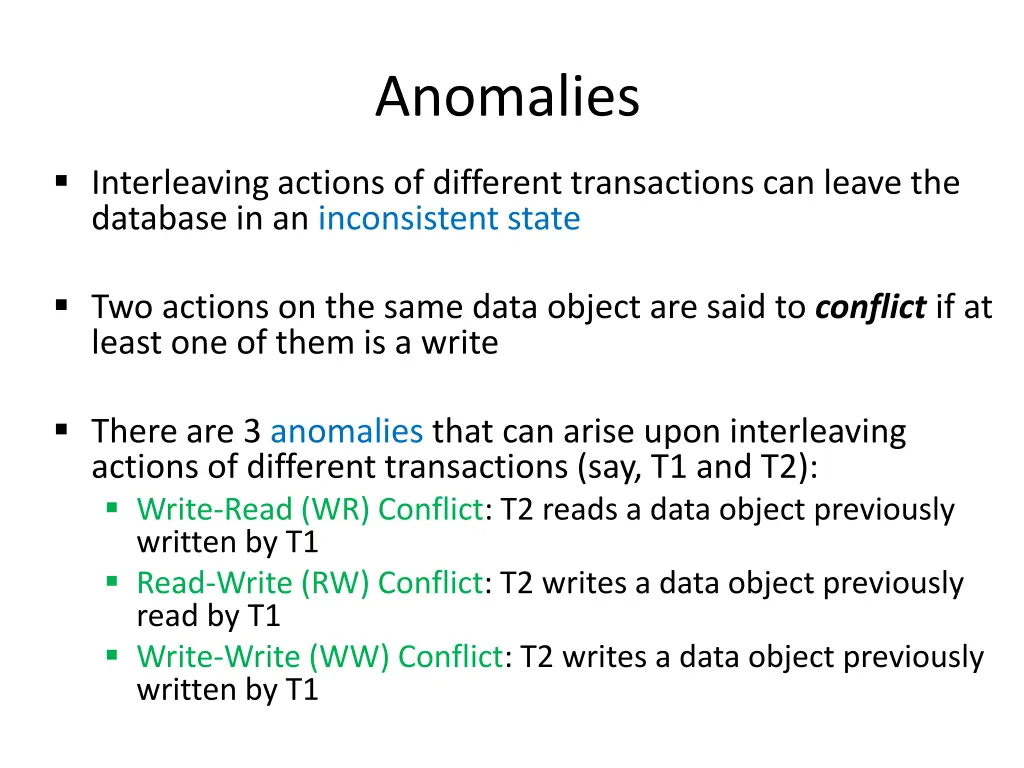
Anomalies Interleaving actions of different transactions can leave the database in an inconsistent state Two actions on the same data object are said to conflict if at least one of them is a write There are 3 anomalies that can arise upon interleaving actions of different transactions (say, T1 and T2): Write-Read (WR) Conflict: T2 reads a data object previously written by T1 Read-Write (RW) Conflict: T2 writes a data object previously read by T1 Write-Write (WW) Conflict: T2 writes a data object previously written by T1
Reading Uncommitted Data: WR Conflicts WR conflicts arise when transaction T2 reads a data object A that has been modified by another transaction T1, which has not yet committed Such a read is called a dirty read Assume T1 and T2 such that: T1 transfers $100 from A s account to B s account T2 credits accounts A and B with a 6% interest payment T1: T2: BEGIN A=A-100, B=B +100 END BEGIN A=1.06*A, B=1.06*B END
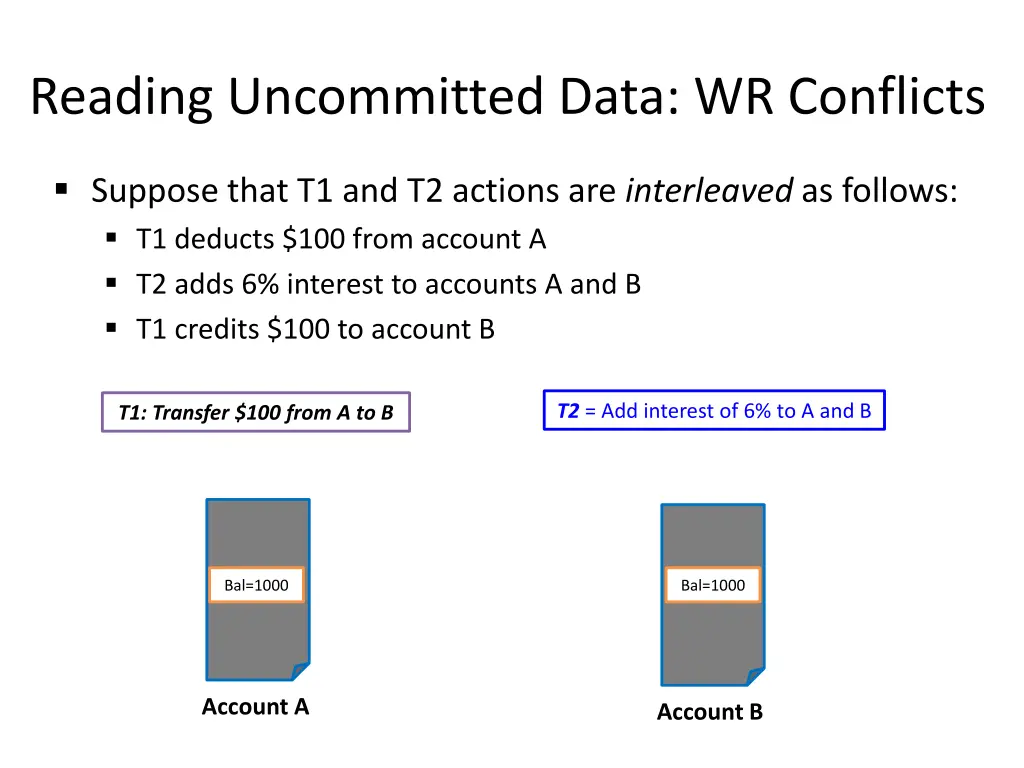
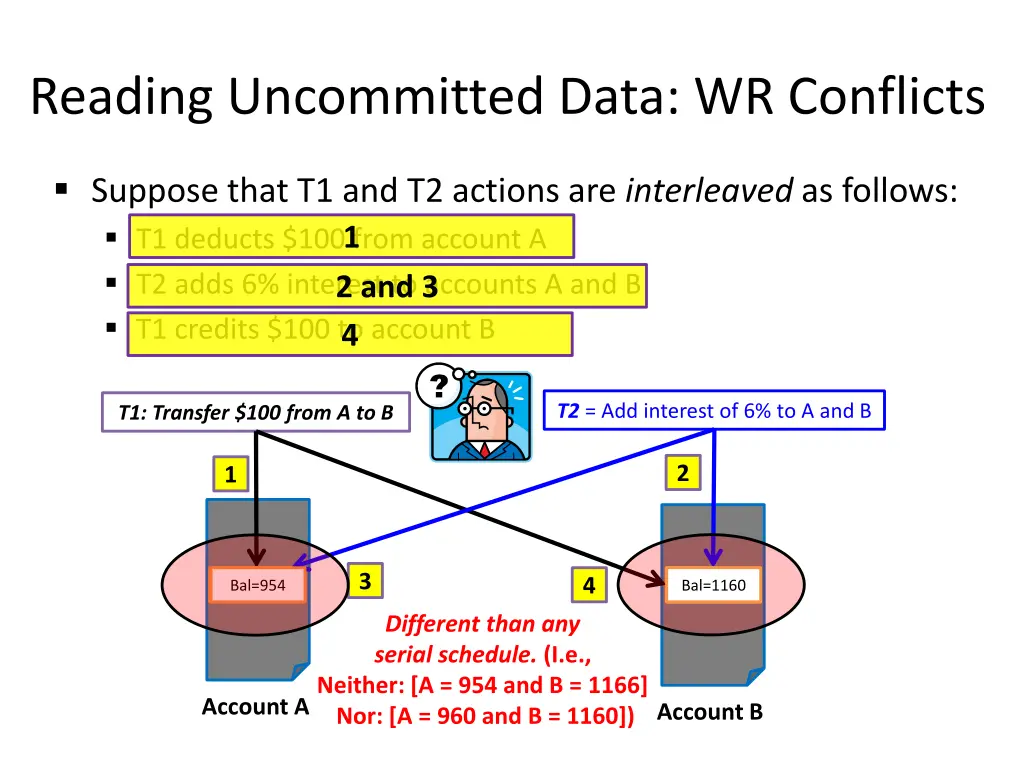
Reading Uncommitted Data: WR Conflicts Suppose that T1 and T2 actions are interleaved as follows: T1 deducts $100 from account A T2 adds 6% interest to accounts A and B T1 credits $100 to account B T2 = Add interest of 6% to A and B T1: Transfer $100 from A to B Bal=1000 Bal=1000 Account A Account B
Reading Uncommitted Data: WR Conflicts Suppose that T1 and T2 actions are interleaved as follows: T1 deducts $100 from account A T2 adds 6% interest to accounts A and B T1 credits $100 to account B 4 1 2 and 3 T2 = Add interest of 6% to A and B T1: Transfer $100 from A to B 2 1 3 4 Bal=1000 Bal=900 Bal=954 Bal=1000 Bal=1060 Bal=1160 Different than any serial schedule. (I.e., Neither: [A = 954 and B = 1166] Nor: [A = 960 and B = 1160]) Account A Account B
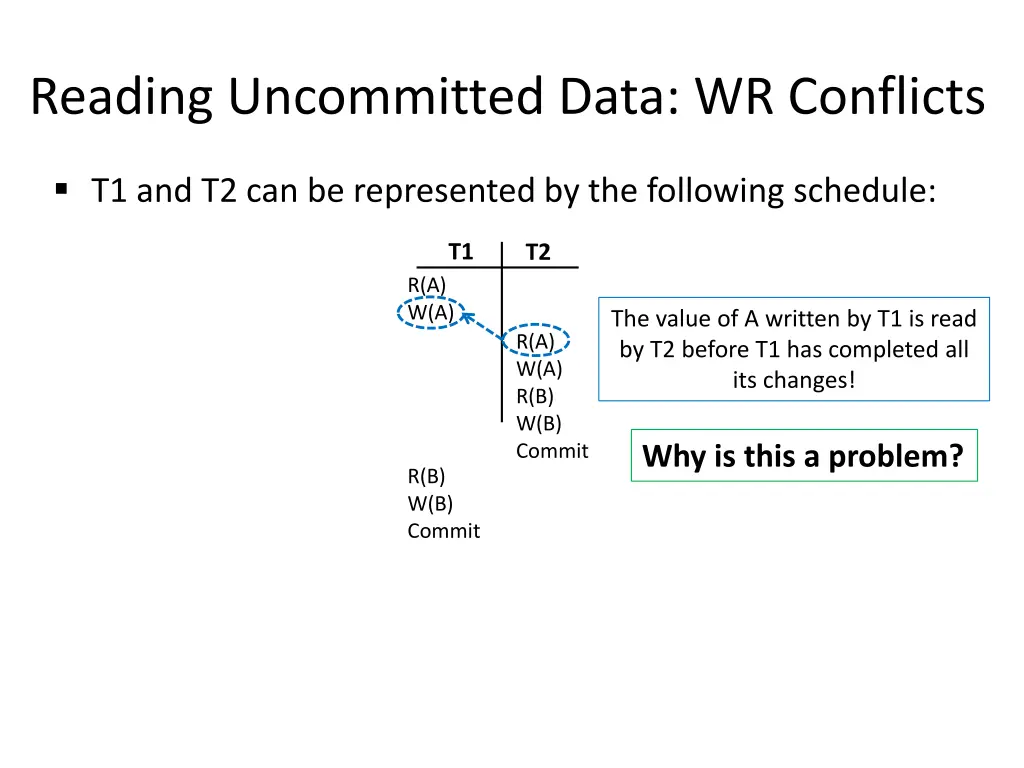
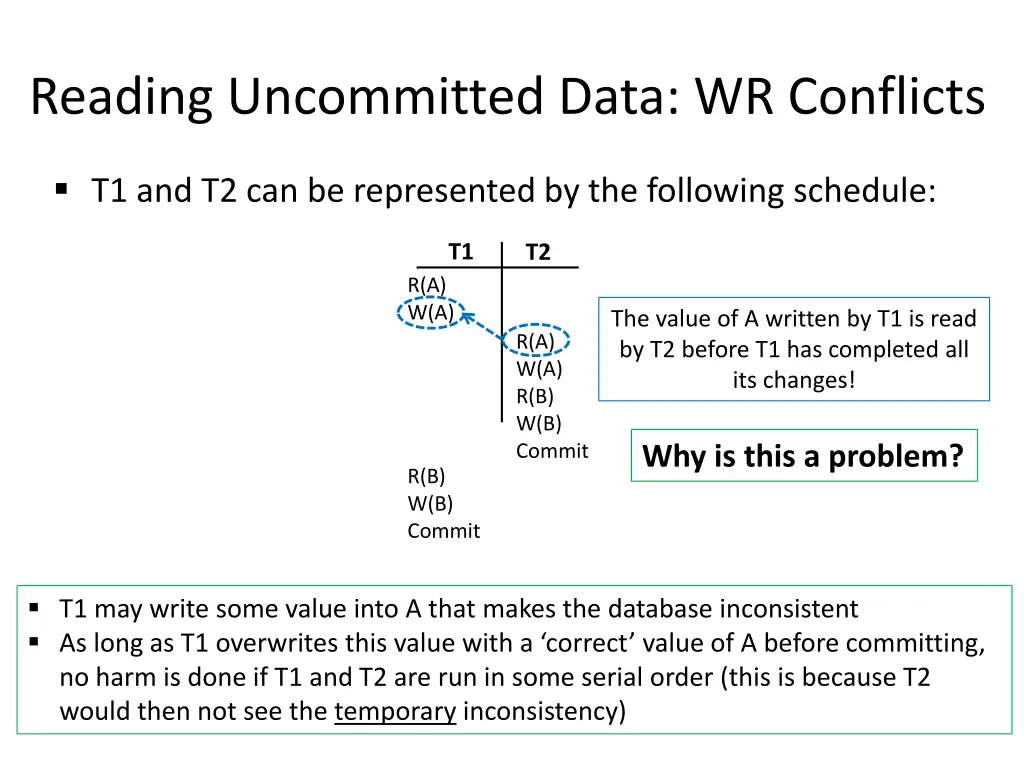
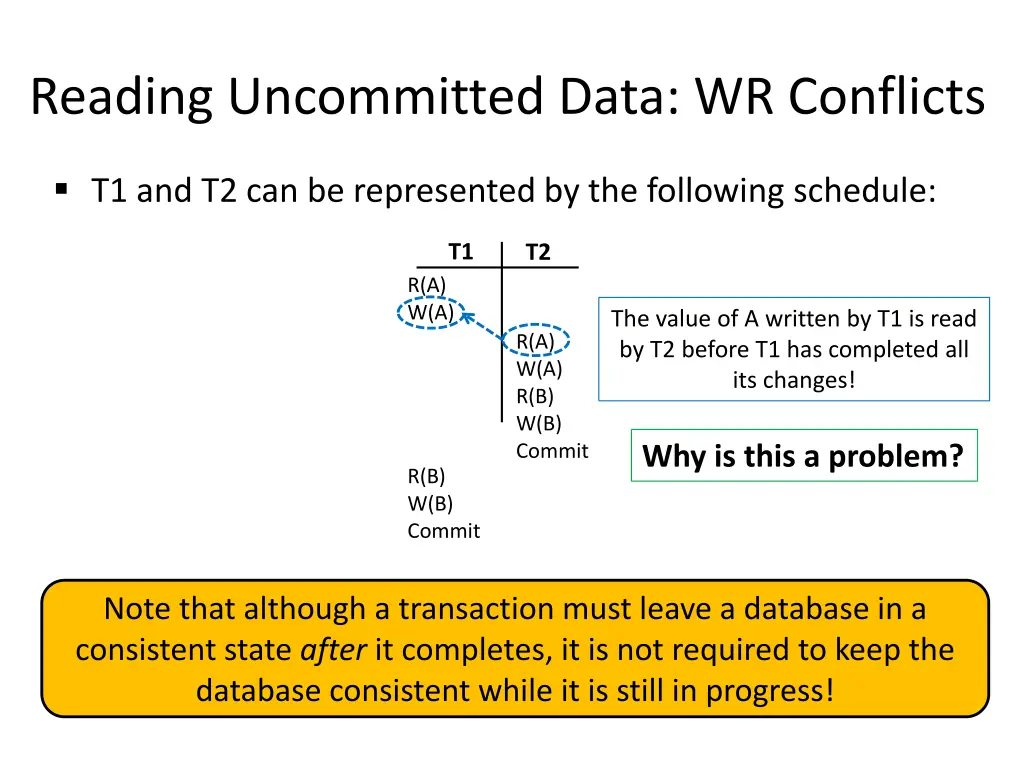
Reading Uncommitted Data: WR Conflicts T1 and T2 can be represented by the following schedule: T1 T2 R(A) W(A) The value of A written by T1 is read by T2 before T1 has completed all its changes! R(A) W(A) R(B) W(B) Commit Why is this a problem? R(B) W(B) Commit
Reading Uncommitted Data: WR Conflicts T1 and T2 can be represented by the following schedule: T1 T2 R(A) W(A) The value of A written by T1 is read by T2 before T1 has completed all its changes! R(A) W(A) R(B) W(B) Commit Why is this a problem? R(B) W(B) Commit T1 may write some value into A that makes the database inconsistent As long as T1 overwrites this value with a correct value of A before committing, no harm is done if T1 and T2 are run in some serial order (this is because T2 would then not see the temporary inconsistency)
Reading Uncommitted Data: WR Conflicts T1 and T2 can be represented by the following schedule: T1 T2 R(A) W(A) The value of A written by T1 is read by T2 before T1 has completed all its changes! R(A) W(A) R(B) W(B) Commit Why is this a problem? R(B) W(B) Commit Note that although a transaction must leave a database in a consistent state after it completes, it is not required to keep the database consistent while it is still in progress!
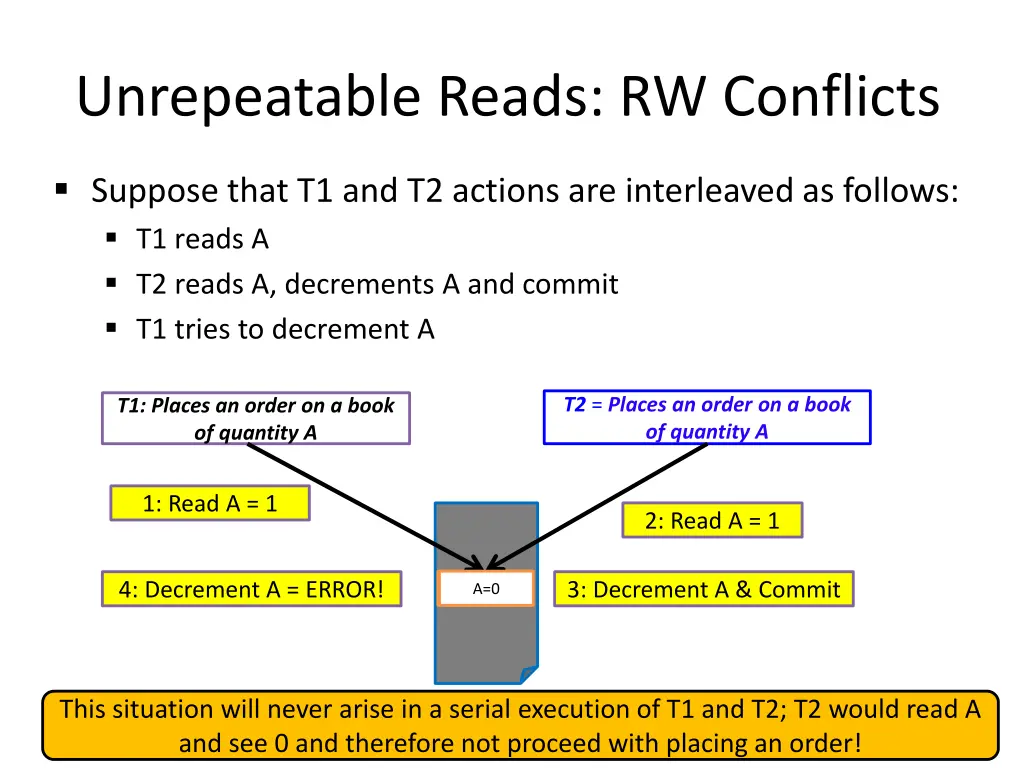
Unrepeatable Reads: RW Conflicts RW conflicts arise when transaction T2 writes a data object A that has been read by another transaction T1, while T1 is still in progress If T1 tries to read A again, it will get a different result! Such a read is called an unrepeatable read Assume A is the number of available copies for a book A transaction that places an order on the book reads A, checks that A > 0 and decrements A Assume two transactions, T1 and T2
Unrepeatable Reads: RW Conflicts Suppose that T1 and T2 actions are interleaved as follows: T1 reads A T2 reads A, decrements A and commit T1 tries to decrement A T2 = Places an order on a book of quantity A T1: Places an order on a book of quantity A 1: Read A = 1 2: Read A = 1 4: Decrement A = ERROR! 3: Decrement A & Commit A=1 A=0 This situation will never arise in a serial execution of T1 and T2; T2 would read A and see 0 and therefore not proceed with placing an order!
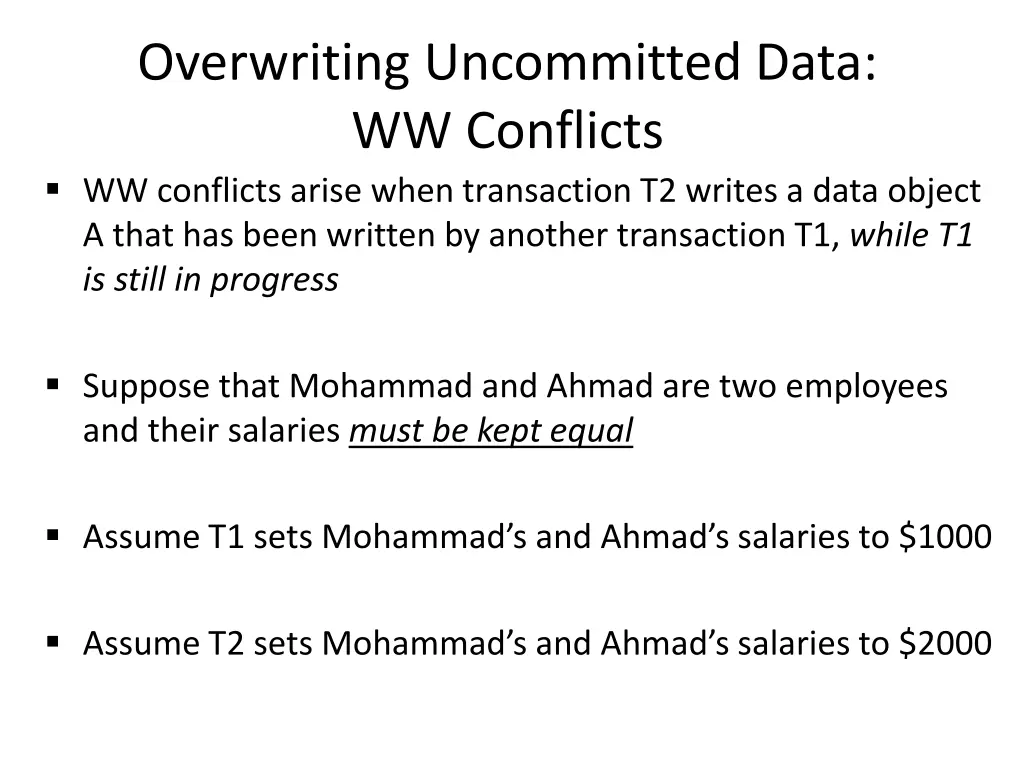
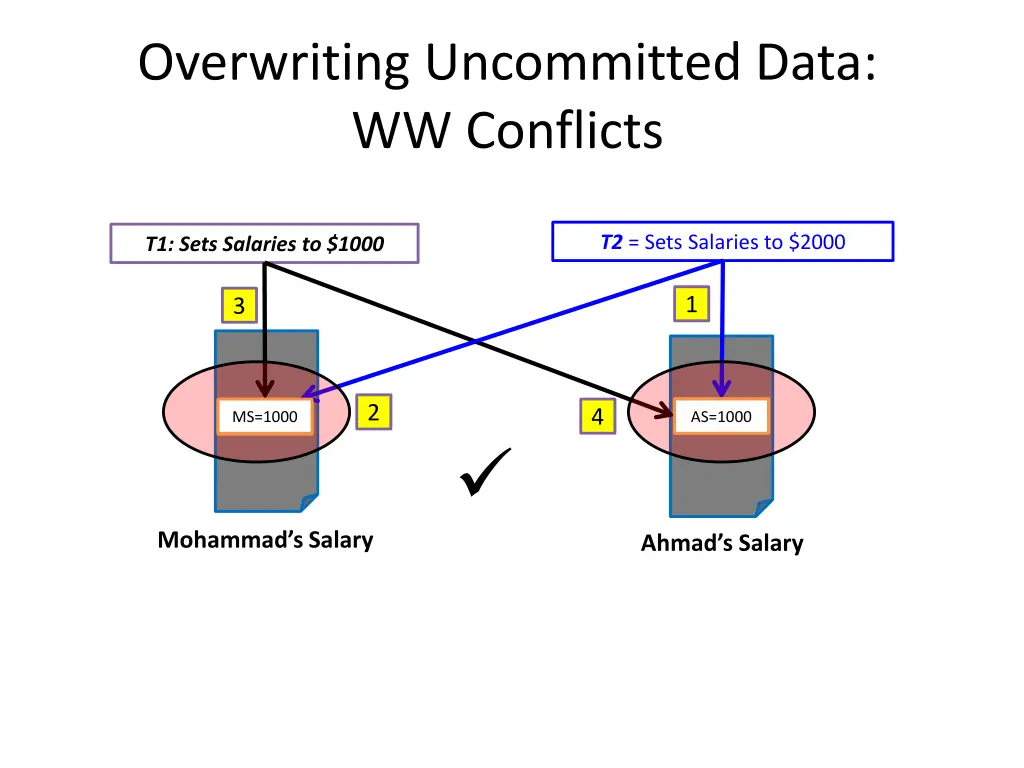
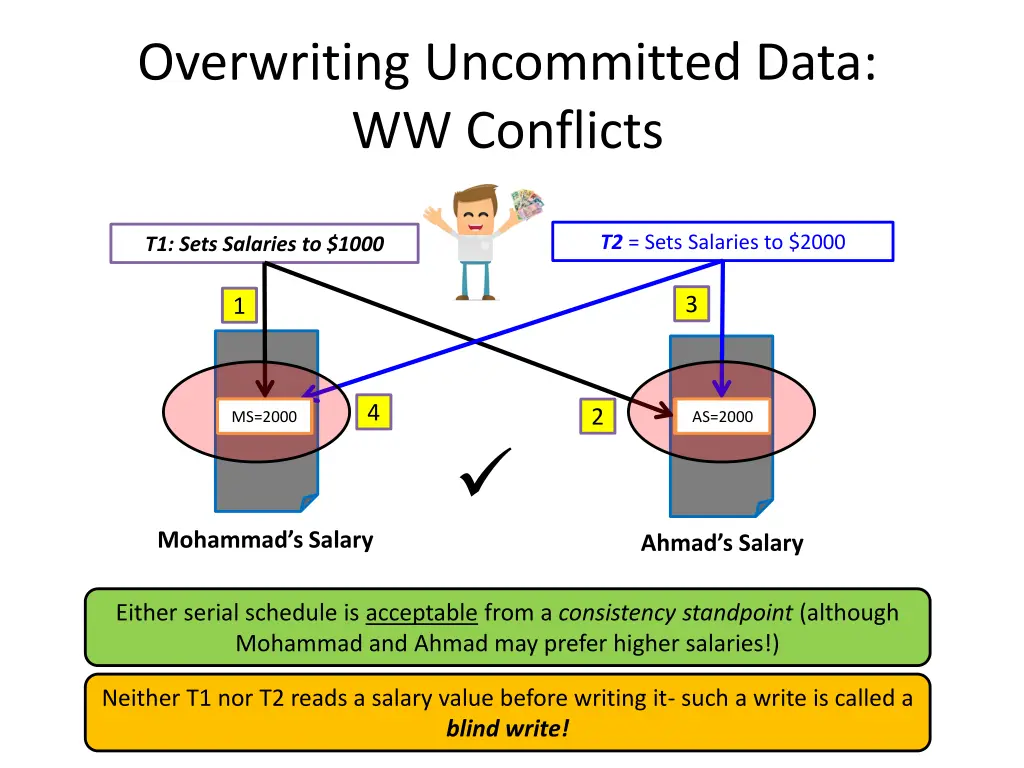
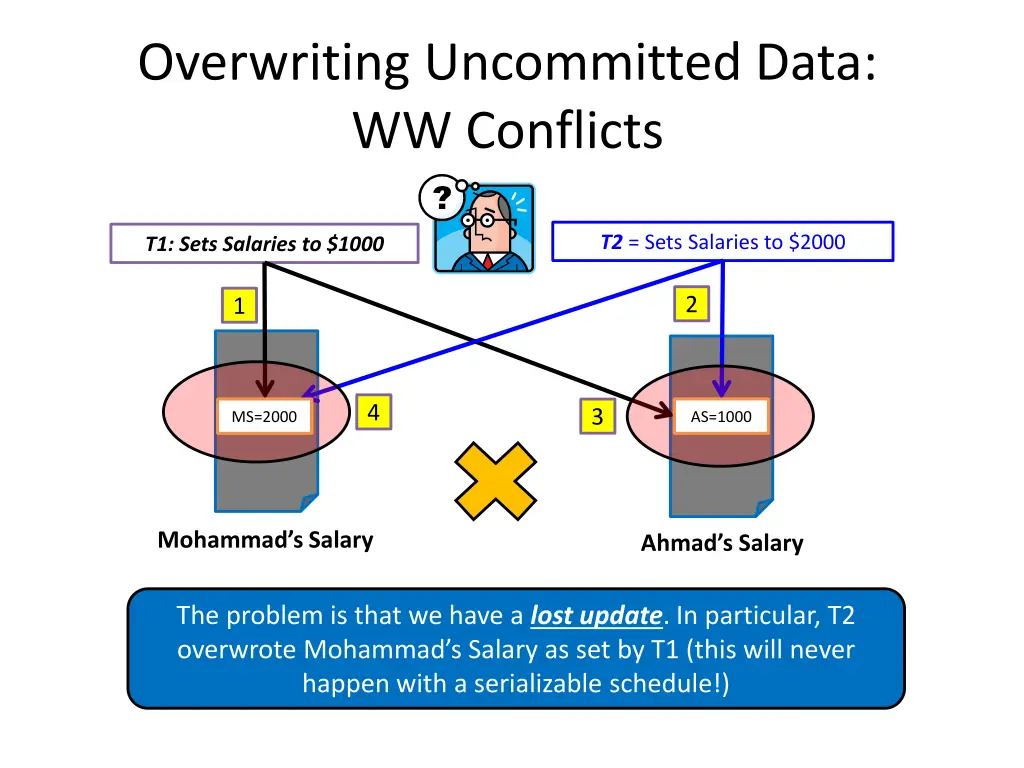
Overwriting Uncommitted Data: WW Conflicts WW conflicts arise when transaction T2 writes a data object A that has been written by another transaction T1, while T1 is still in progress Suppose that Mohammad and Ahmad are two employees and their salaries must be kept equal Assume T1 sets Mohammad s and Ahmad s salaries to $1000 Assume T2 sets Mohammad s and Ahmad s salaries to $2000
Overwriting Uncommitted Data: WW Conflicts T2 = Sets Salaries to $2000 T1: Sets Salaries to $1000 1 3 2 4 AS=0 AS=2000 AS=1000 MS=0 MS=2000 MS=1000 Mohammad s Salary Ahmad s Salary
Overwriting Uncommitted Data: WW Conflicts T2 = Sets Salaries to $2000 T1: Sets Salaries to $1000 3 1 4 2 MS=0 MS=1000 MS=2000 AS=0 AS=1000 AS=2000 Mohammad s Salary Ahmad s Salary Either serial schedule is acceptable from a consistency standpoint (although Mohammad and Ahmad may prefer higher salaries!) Neither T1 nor T2 reads a salary value before writing it- such a write is called a blind write!
Overwriting Uncommitted Data: WW Conflicts T2 = Sets Salaries to $2000 T1: Sets Salaries to $1000 2 1 4 3 MS=0 MS=1000 MS=2000 AS=0 AS=2000 AS=1000 Mohammad s Salary Ahmad s Salary The problem is that we have a lost update. In particular, T2 overwrote Mohammad s Salary as set by T1 (this will never happen with a serializable schedule!)
Next Class Queries Query Optimization and Execution Relational Operators Files and Access Methods Transaction Manager Recovery Manager Buffer Management Lock Manager Disk Space Management Continue DB