Discover the comprehensive folder contents on your table, showcasing documents related to membership lists, transfer tickets, general education courses, and more for the Transfer and Articulation Program at Connecticut Community Colleges. Gain insights into competencies, outcomes, and majors for AY 2016-2017. Explore the Transfer Navigator, advising sheets, and TAP-compliant degrees available, aiding students in their academic journey. Stay updated on the latest data and essential information for student success and seamless articulation within the academic framework. (375 characters)
Please find below an Image/Link to download the presentation.
The content on the website is provided AS IS for your information and personal use only. It may not be sold, licensed, or shared on other websites without obtaining consent from the author. If you encounter any issues during the download, it is possible that the publisher has removed the file from their server.
You are allowed to download the files provided on this website for personal or commercial use, subject to the condition that they are used lawfully. All files are the property of their respective owners.
The content on the website is provided AS IS for your information and personal use only. It may not be sold, licensed, or shared on other websites without obtaining consent from the author.
E N D
Presentation Transcript
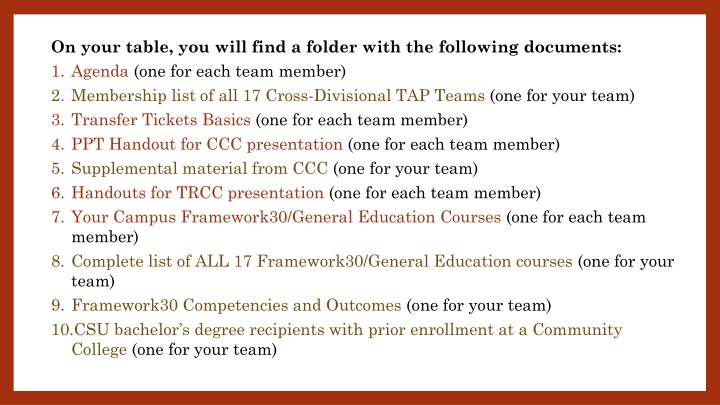
On your table, you will find a folder with the following documents: 1. Agenda (one for each team member) 2. Membership list of all 17 Cross-Divisional TAP Teams (one for your team) 3. Transfer Tickets Basics (one for each team member) 4. PPT Handout for CCC presentation (one for each team member) 5. Supplemental material from CCC (one for your team) 6. Handouts for TRCC presentation (one for each team member) 7. Your Campus Framework30/General Education Courses (one for each team member) 8. Complete list of ALL 17 Framework30/General Education courses (one for your team) 9. Framework30 Competencies and Outcomes (one for your team) 10.CSU bachelor s degree recipients with prior enrollment at a Community College (one for your team)
Outcomes, Assessment and Vetting Courses for the Framework30: Best Practices Transfer and Articulation Program (TAP) + Student Success Gateway Community College 16 September 2016, 10am-2pm
AY 2016-2017 As of Fall 2016, 11 Transfer Tickets are available at all 12 Connecticut Community Colleges: Biology Chemistry Communication Criminal Justice English History Mathematics Political Science Psychology Social Work Sociology Each degree is common to all 12 Community Colleges. ONLY these degrees are considered TAP compliant.
AY 2016-2017 A common portal Transfer Navigator houses each Community College Transfer Ticket + the requirements for completing the degree at each CSU or COSC.
AY 2016-2017 This fall, students are finding 11 Transfer Ticket degrees Advising sheets that spell out degree requirements + suggest a course of study Single document lists of General Education courses (vetted by each campus) that fulfill the 11 competencies
Fall 2016 Declared TAP Majors ACC CCC GCC HCC MCC MxCC NVCC NCCC NCC QVCC TRCC* TxCC* Totals 173 Biology Chemistry Communication Criminal Justice English History Mathematics Political Science Psychology Social Work 24 Sociology Campus Totals **Need to seek Federal approval before enrolling students in new programs so they will have students listed in liberal arts or general studies as a primary program.
AY 2016-2017 Across the system, 197 students have chosen to begin their college degree with a Transfer Ticket: Biology Chemistry Communication Criminal Justice English History Mathematics Political Science Psychology Social Work Sociology 173 24
AY 2017-2018 As of Fall 2017, we expect another 12 Transfer Tickets to be available to Community College students: Accounting Art Studio Business Management Computer Science Early Childhood Teaching Credential Exercise Science Finance Foreign Languages (Spanish, French, German, & Italian) Marketing Music Physics Theater
Framework30: the General Education Core Principles of vetting (taken from BOR policy): Balance among the arts and humanities, the sciences, mathematics, and the social sciences Focus on subject matter, disciplinary methodologies, and relationships among domains of knowledge Excellent preparation for all students in their first 30 hours of General Education Competency based Include outcome assessment for continuing review
Framework30: Vetting Observations 1. Some common courses have not been vetted by all campuses. 2. Some vetted courses have pre-requisites that already fulfill that competency. 3. Some courses have been vetted outside traditional disciplinary. 4. Some seem to have been vetted for assessment rather than teaching outcomes.
Transfer Ticket (TAP) A.A. Degree Transfer Ticket (60-61 credits) = Framework30 (30-31 credits of general education meeting 11 competencies*) + Pathway30 (30 credits of major courses, additional general education, and unrestricted electives) *10 competencies are designated by course at each Community College; the others are embedded.
Transfer Ticket (TAP) A.A. Degree Transfer Ticket (60-61 credits) = Framework30 (30-31 credits of general education meeting 11 competencies*) + Pathway30 (30 credits of major courses, additional general education, and unrestricted electives) *10 competencies are designated by course at each Community College; the others are embedded.
Framework30: Which Courses Count? 1. Each Community College vets courses for each of 10 designated competencies. 2. Each Community College vets courses to decide which meet the competencies. 3. Each course approved for a designated competency must meet all outcomes for that competency. 4. The Framework30 transfers to the CSUs and CO as a package of competencies (the Common Package), not course-by-course.
Framework30: Which Courses Count? What does it mean for a course to fulfill all of the outcomes of a designated competency? 1. Are the outcomes learning goals? 2. Will the course assess for the outcomes? 3. Will the course teach to the outcomes? 4. What are the expectations for coverage of each outcome? 5. How many competencies can be covered in a single course?
Historical Knowledge and Understanding Competency: Defines the Field Students will study the interrelatedness of various realms of human experience from multiple historical perspectives.
Historical Knowledge and Understanding Outcomes: Define the Tasks 1. Interpret and differentiate types of historical sources including popular, academic, primary, and secondary. 2. Recognize ever-changing interpretations of history. 3. Examine the development of societies in national and/or international contexts. 4. Explain the influence and agency of race, class, gender, and other perspectives on historical events. 5. Describe the impact of the past on subsequent events, including the present. 6. Examine the complex, dynamic, and interrelated nature of change. [This] . . . list could be for a high school course, or an undergraduate course, or even a graduate school course. --Robert Shireman, The Real Value of What Students Do in College
Historical Knowledge and Understanding Rubric: Can Help Define Level of Coverage/Achievement 5. Describe the impact of the past on subsequent events, including the present. 4 3 2 1 Highly Competent Competent Minimally Competent Describes the impact of the past on subsequent historical events. Description is imprecise or lacks depth. Not Competent Describes the impact of the past on subsequent historical events. Explains the causes in detail. Describes the impact of the past on subsequent historical events. Attempts to explain the causes. Does not recognize the impact of the past on subsequent historical events.
So What are the best practices for vetting courses for our students?