Transistor Tuned Amplifiers in Electronic Circuits
Explore the distinctions between Tuned Amplifiers and other types of amplifiers, focusing on the specific bandwidth design of Tuned Amplifiers. Learn about the analysis of Parallel Tuned Circuits and the concept of electrical resonance in LC circuits. Discover the significance of parallel resonance in reactive circuits and how frequency affects circuit power factors.

Download Presentation

Please find below an Image/Link to download the presentation.
The content on the website is provided AS IS for your information and personal use only. It may not be sold, licensed, or shared on other websites without obtaining consent from the author. If you encounter any issues during the download, it is possible that the publisher has removed the file from their server.
You are allowed to download the files provided on this website for personal or commercial use, subject to the condition that they are used lawfully. All files are the property of their respective owners.
The content on the website is provided AS IS for your information and personal use only. It may not be sold, licensed, or shared on other websites without obtaining consent from the author.
E N D
Presentation Transcript
DIYALA UNIVERSITY COLLEGE OF ENGINEERING DEPARTMENT OF COMMUNICATION ENGINEERING Electronic Circuits II Second Year. Lecture 6 lecturer Wisam Hayder 2021 1
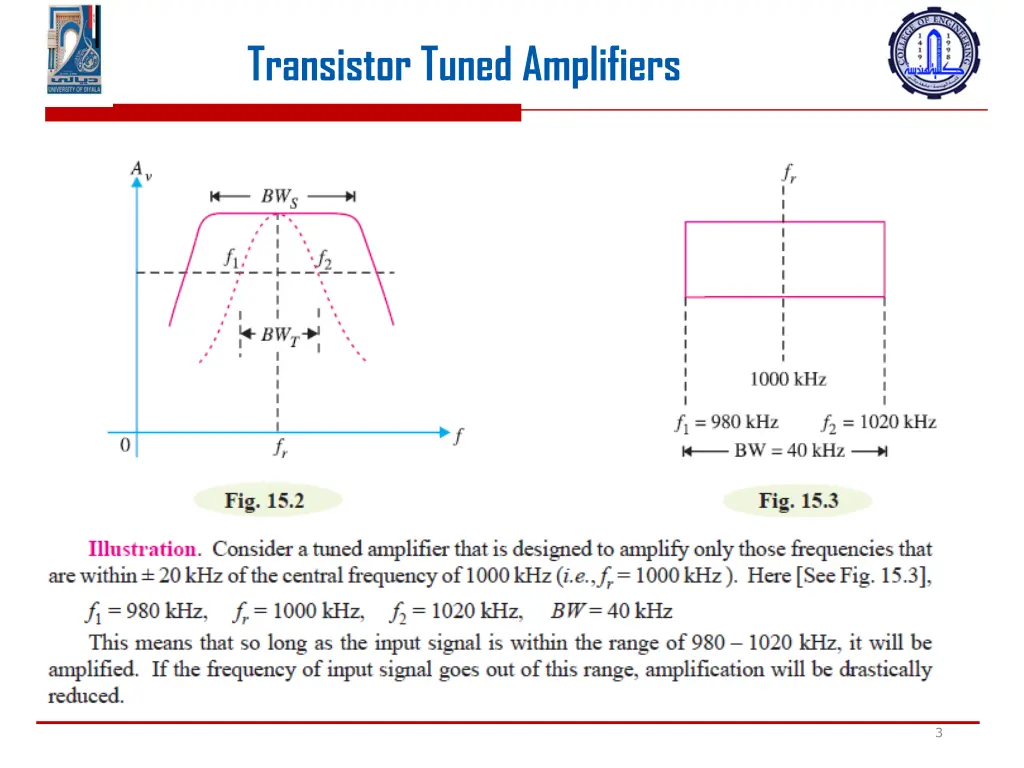
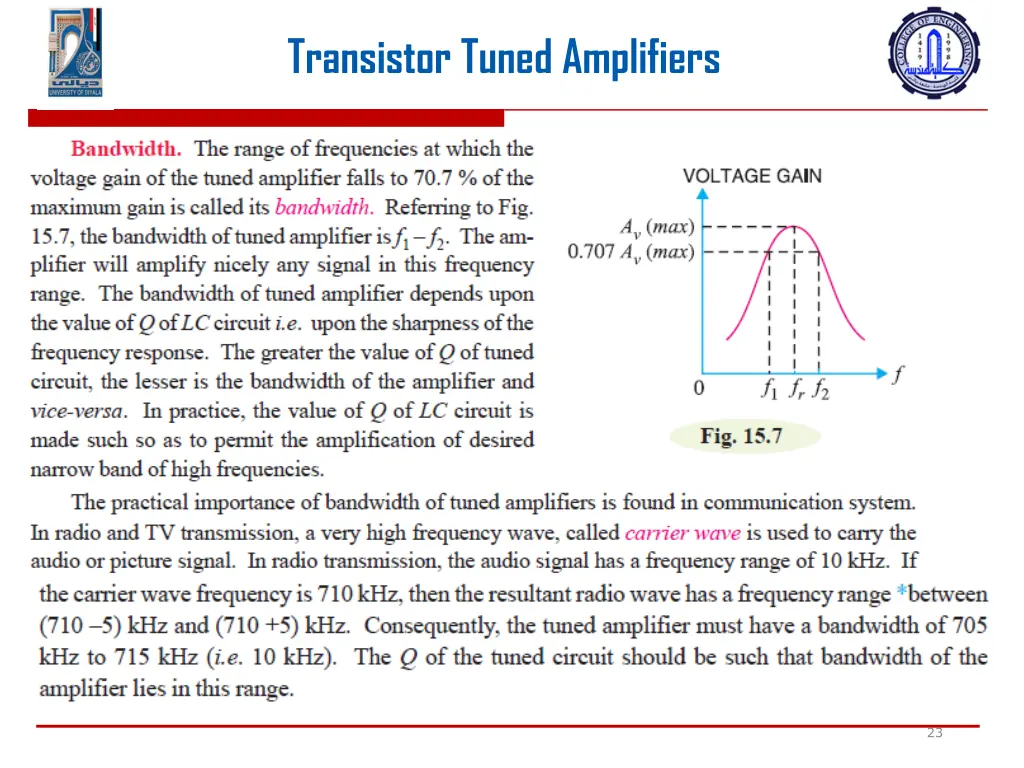
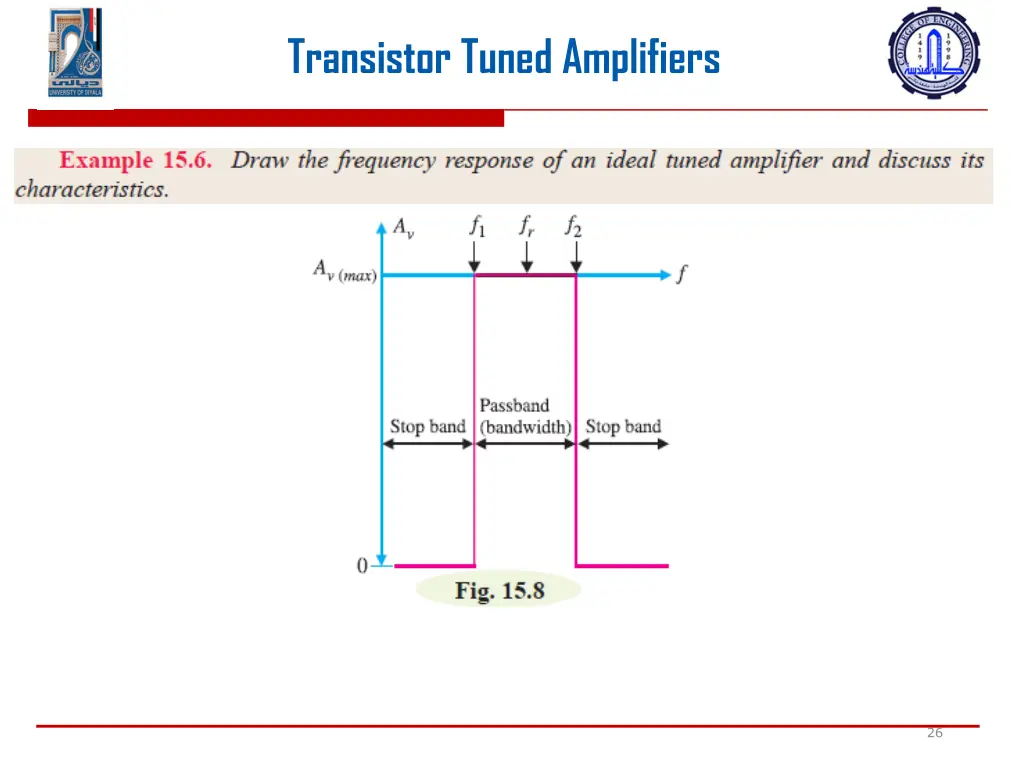
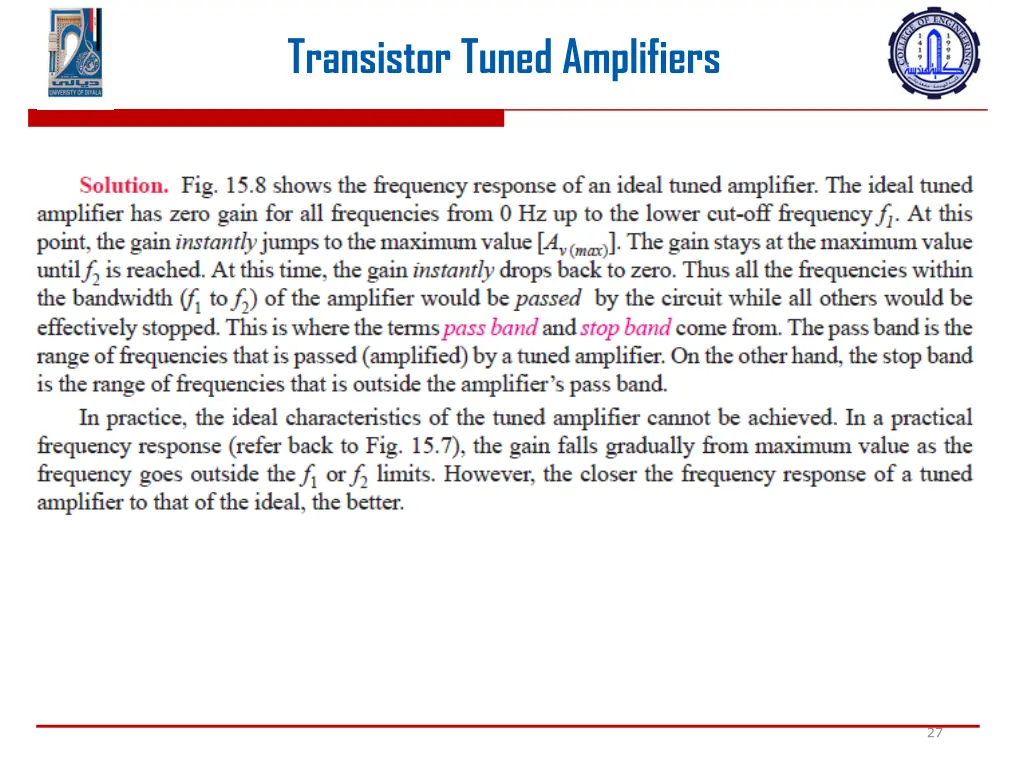
Transistor Tuned Amplifiers Distinction between Tuned Amplifiers and other Amplifiers We have seen that amplifiers (e.g., voltage amplifier, power amplifier etc.) provide the constant gain over a limited band of frequencies i.e., from lower cut-off frequency ?1to upper cut-off frequency ?2. Now bandwidth of the amplifier, BW = f2 f1. The difference, that tuned amplifiers are designed to have specific, usually narrow bandwidth. See Fig. 15.2. Note that ???is the bandwidth of standard frequency response while ???is the bandwidth of the tuned amplifier. In many applications, the narrower the bandwidth of a tuned amplifier, the better it is. 2
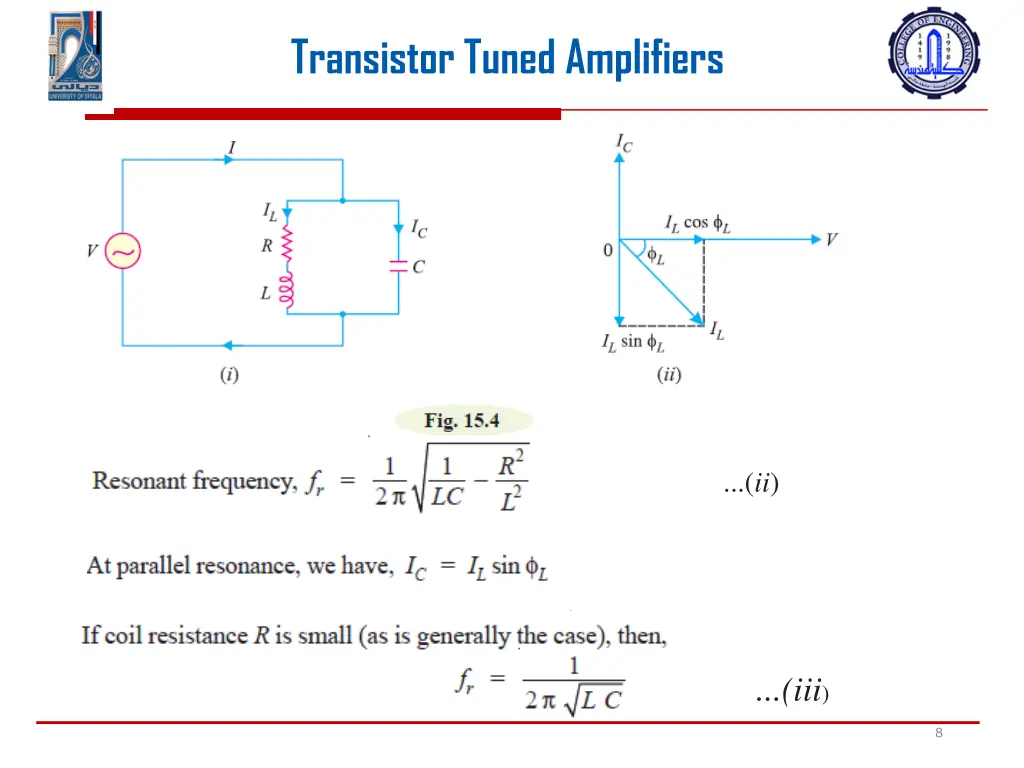
Transistor Tuned Amplifiers Analysis of Parallel Tuned Circuit Aparallel tuned circuit consists of a capacitor C and inductor L in parallel as shown in Fig. 15.4 (i). In practice, some resistance R is always present with the coil. If an alternating voltage is applied across this parallel circuit, the frequency of oscillations will be that of the applied voltage. 4
Transistor Tuned Amplifiers However, if the frequency of applied voltage is equal to the natural or resonant frequency of LC circuit, then electrical resonance will occur. Under such conditions, the impedance of the tuned circuit becomes maximum and the line current is minimum. The circuit then draws just enough energy from a.c. supply necessary to overcome the losses in the resistance R. 5
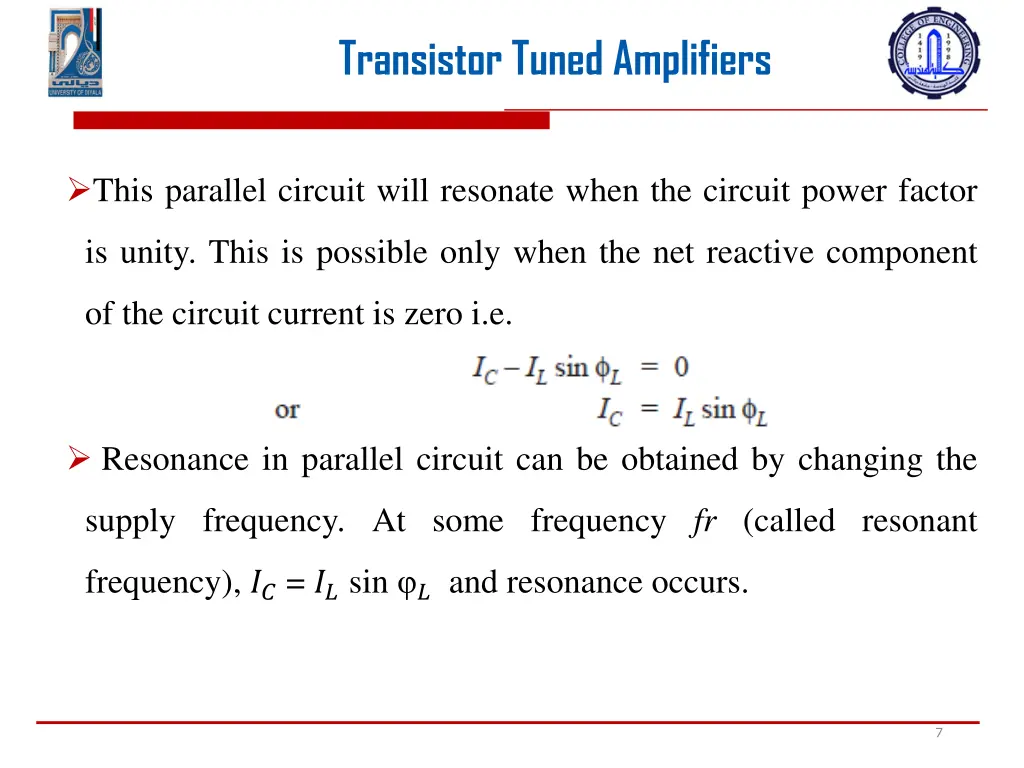
Transistor Tuned Amplifiers Parallel resonance A parallel circuit containing reactive elements (L and C ) is resonant when the circuit power factor is unity i.e. applied voltage and the supply current are in phase. The phasor diagram of the parallel circuit is shown in Fig. 15. 4 (ii). The coil current ??has two rectangular components viz active component ????? ?and reactive component ????? ?. 6
Transistor Tuned Amplifiers This parallel circuit will resonate when the circuit power factor is unity. This is possible only when the net reactive component of the circuit current is zero i.e. Resonance in parallel circuit can be obtained by changing the supply frequency. At some frequency fr (called resonant frequency), ??= ??sin ?and resonance occurs. 7
Transistor Tuned Amplifiers ...(ii) ...(iii) 8
Transistor Tuned Amplifiers The resonant frequency will be in Hz if R, L and C are in ohms, henry and farad respectively. Note. If in the problem, the value of R is given, then eq. (ii) should be used to find fr. However, if R is not given, then eq. (iii) may be used to find fr. 9
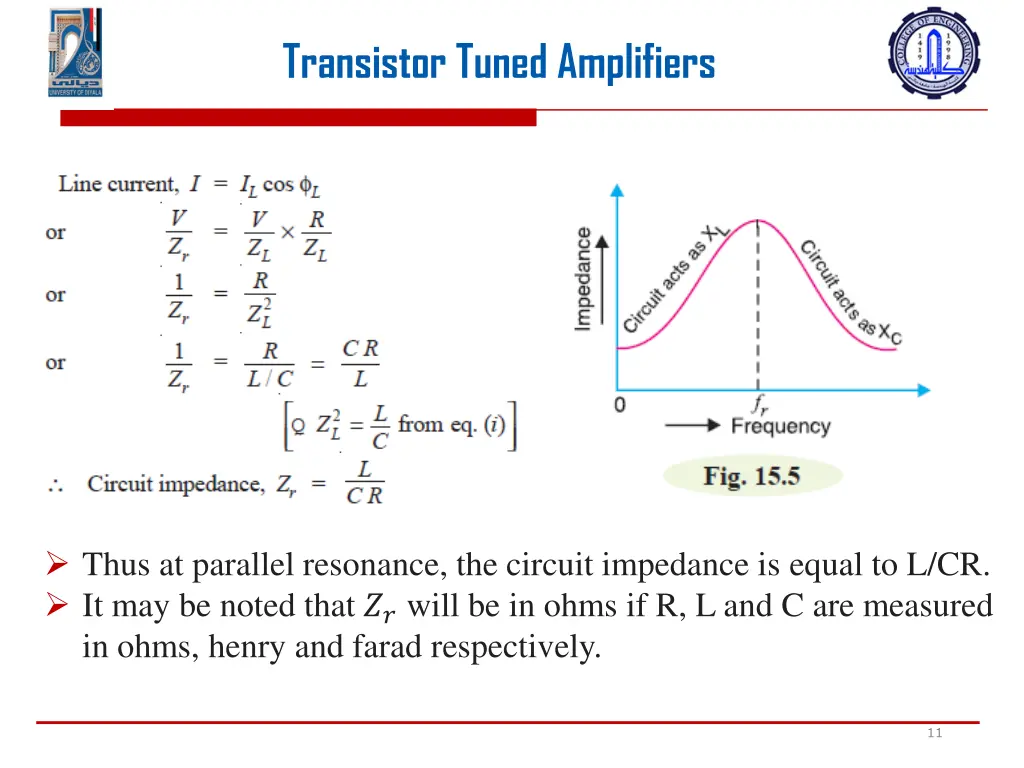
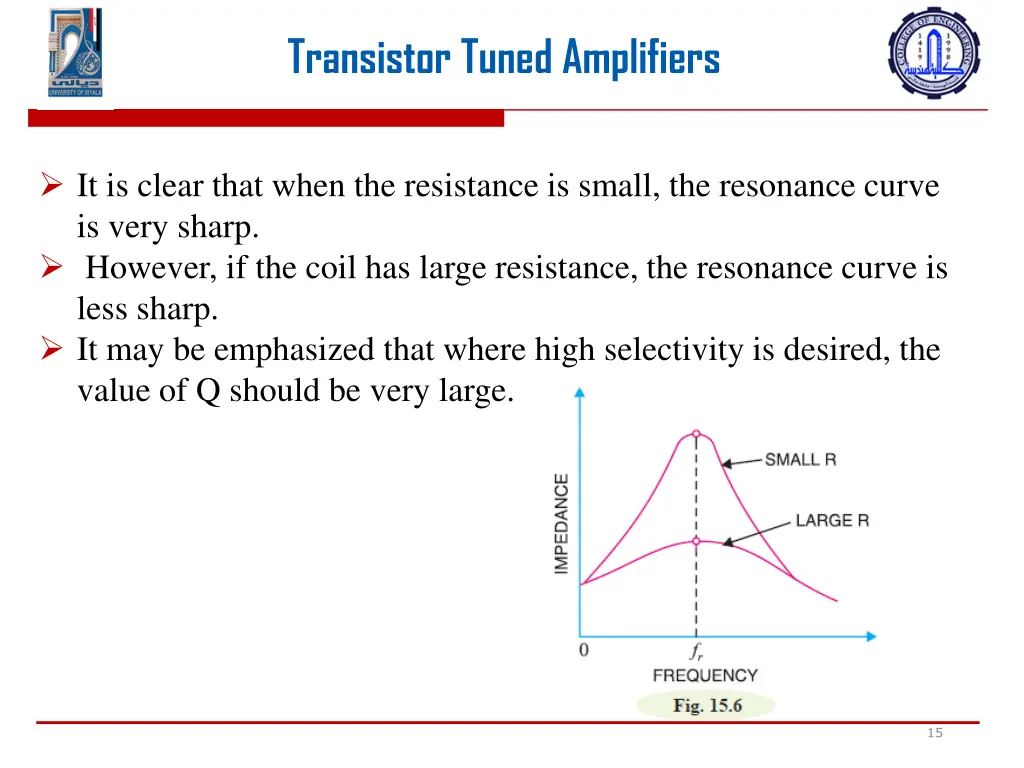
Transistor Tuned Amplifiers Characteristics of Parallel Resonant Circuit (i) Impedance of tuned circuit. The impedance offered by the parallel LC circuit is given by the supply voltage divided by the line current i.e., V/I. Since at resonance, line current is minimum, therefore, impedance is maximum at resonant frequency. This fact is shown by the impedance-frequency curve of Fig 15.5. It is clear from impedance-frequency curve that impedance rises to a steep peak at resonant frequency fr. However, the impedance of the circuit decreases rapidly when the frequency is changed above or below the resonant frequency. 10
Transistor Tuned Amplifiers Thus at parallel resonance, the circuit impedance is equal to L/CR. It may be noted that ??will be in ohms if R, L and C are measured in ohms, henry and farad respectively. 11
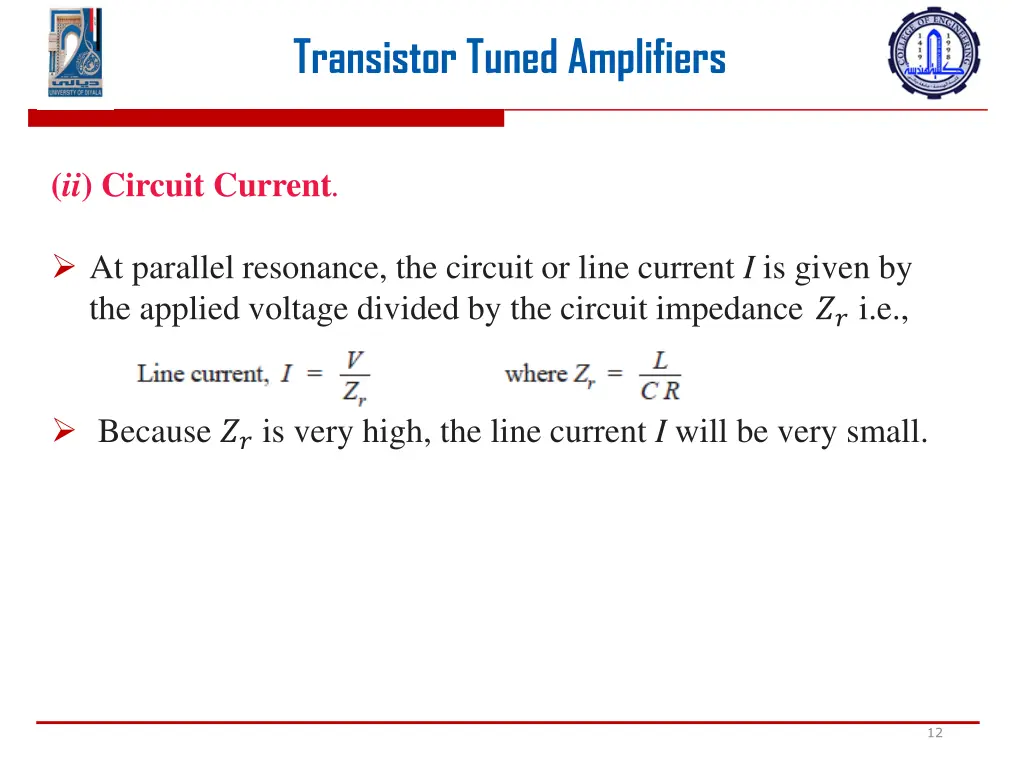
Transistor Tuned Amplifiers (ii) Circuit Current. At parallel resonance, the circuit or line current I is given by the applied voltage divided by the circuit impedance ??i.e., Because ??is very high, the line current I will be very small. 12
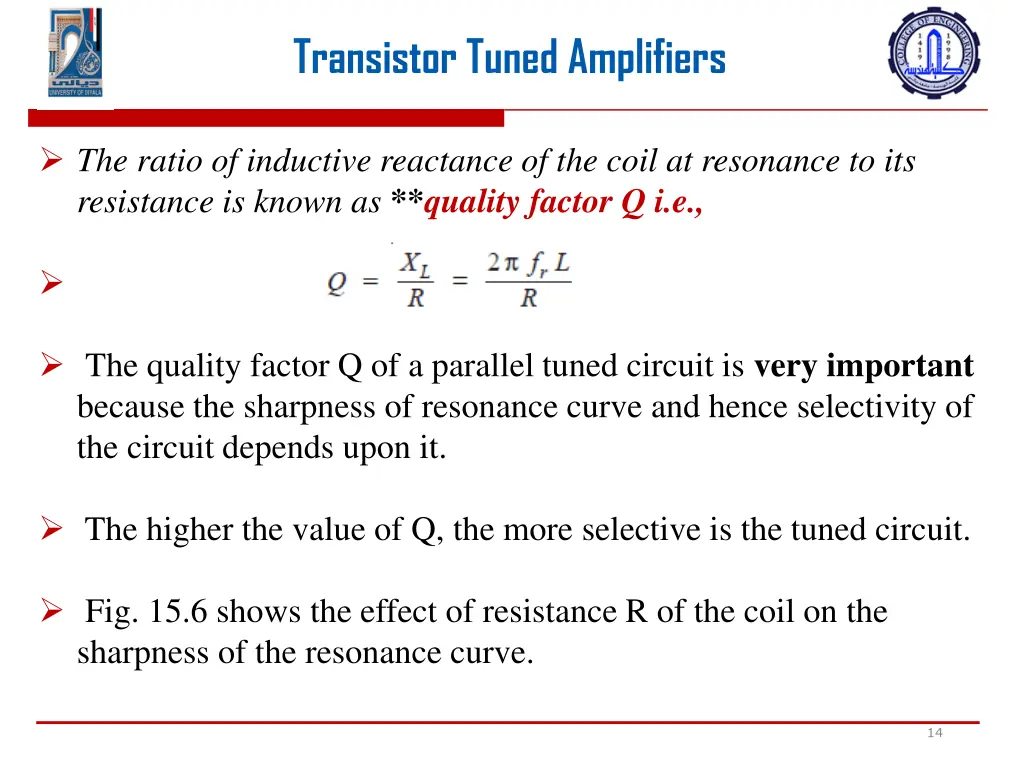
Transistor Tuned Amplifiers (iii) Quality factor Q. It is desired that resonance curve of a parallel tuned circuit should be as sharp as possible in order to provide selectivity. The sharp resonance curve means that impedance falls rapidly as the frequency is varied from the resonant frequency. The smaller the resistance of coil, the more sharp is the resonance curve. This is due to the fact that a small resistance consumes less power and draws a relatively small line current. The ratio of inductive reactance and resistance of the coil at resonance, therefore, becomes a measure of the quality of the tuned circuit. This is called quality factor and may be defined as under : 13
Transistor Tuned Amplifiers The ratio of inductive reactance of the coil at resonance to its resistance is known as **quality factor Q i.e., The quality factor Q of a parallel tuned circuit is very important because the sharpness of resonance curve and hence selectivity of the circuit depends upon it. The higher the value of Q, the more selective is the tuned circuit. Fig. 15.6 shows the effect of resistance R of the coil on the sharpness of the resonance curve. 14
Transistor Tuned Amplifiers It is clear that when the resistance is small, the resonance curve is very sharp. However, if the coil has large resistance, the resonance curve is less sharp. It may be emphasized that where high selectivity is desired, the value of Q should be very large. 15
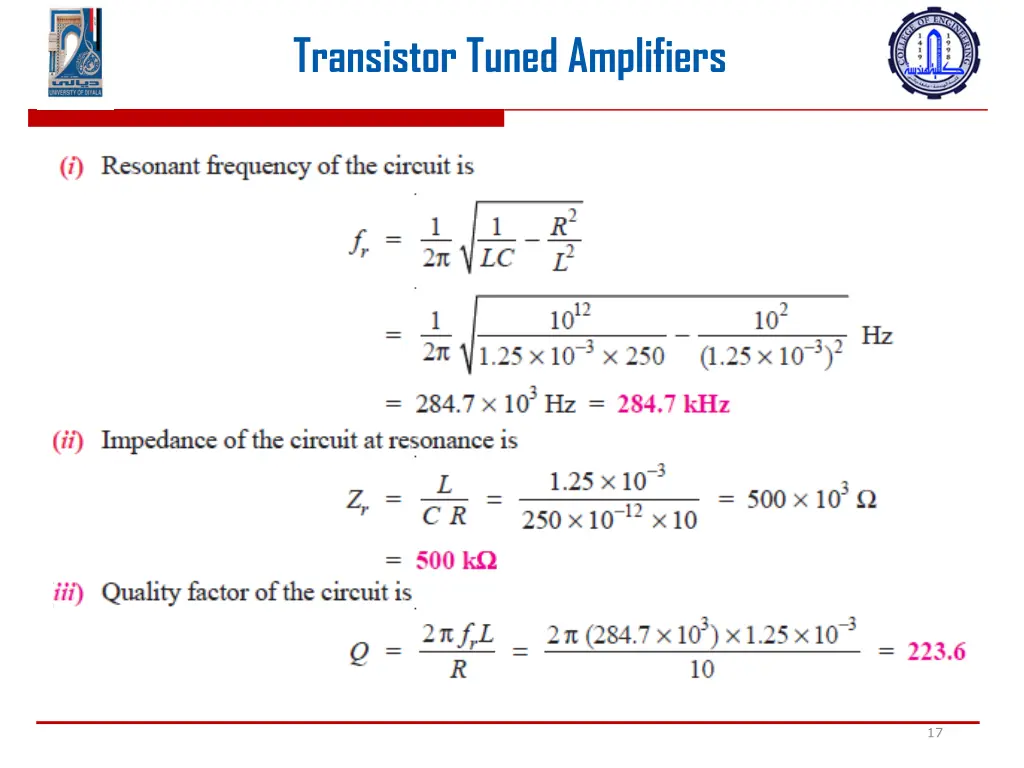
Transistor Tuned Amplifiers Example 15.1. A parallel resonant circuit has a capacitor of 250pF in one branch and inductance of 1.25mH plus a resistance of 10 in the parallel branch. Find (i) resonant frequency (ii) impedance of the circuit at resonance (iii) Q-factor of the circuit. Solution. R = 10 ; L = 1.25 10 3H; C = 250 10 12F 16
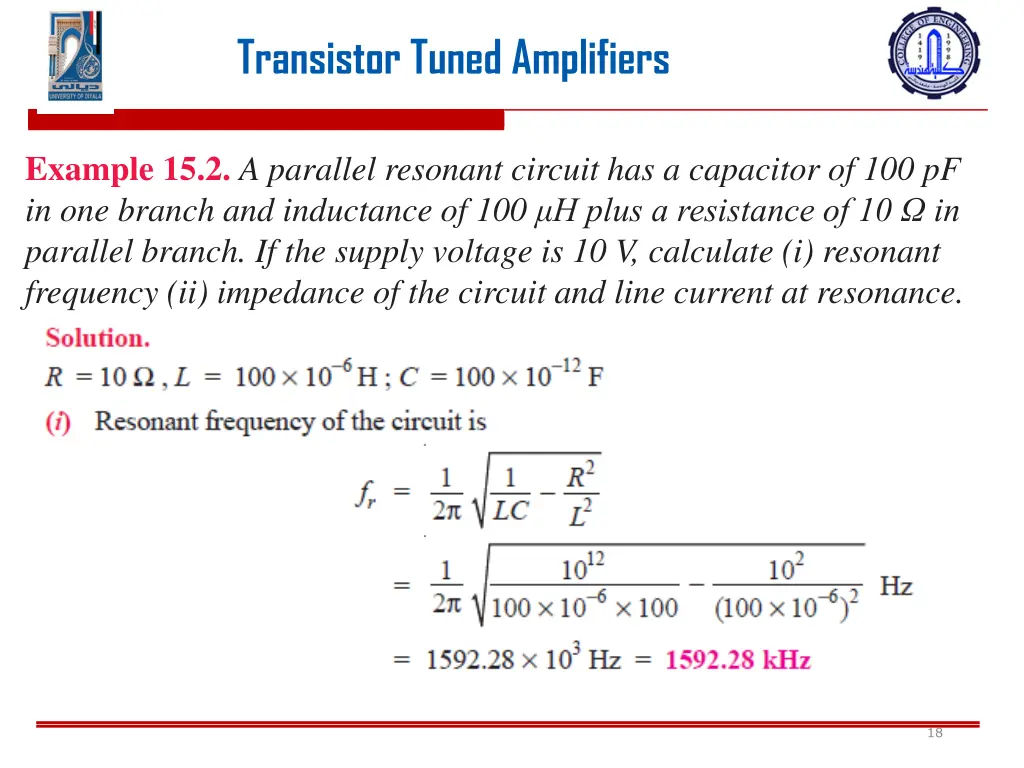
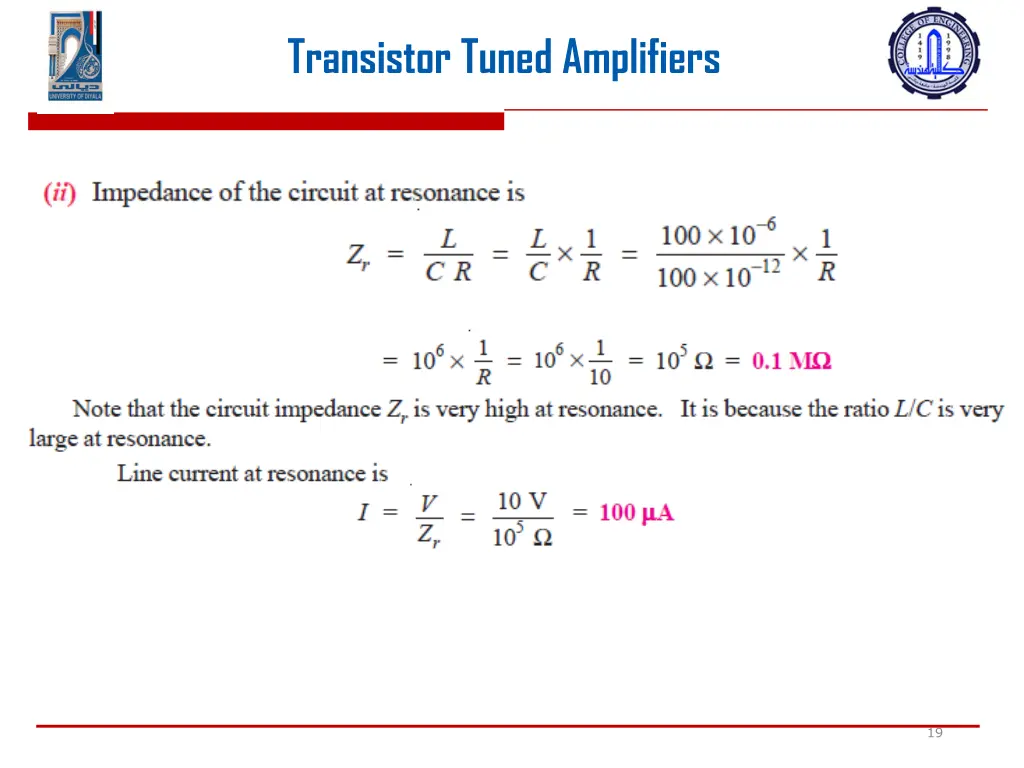
Transistor Tuned Amplifiers Example 15.2. A parallel resonant circuit has a capacitor of 100 pF in one branch and inductance of 100 H plus a resistance of 10 in parallel branch. If the supply voltage is 10 V, calculate (i) resonant frequency (ii) impedance of the circuit and line current at resonance. 18
Transistor Tuned Amplifiers Advantages Advantages of Tuned Amplifiers of Tuned Amplifiers (i) Small power loss. A tuned parallel circuit employs reactive components L and C. Consequently, the power loss in such a circuit is quite low. On the other hand, if a resistive load is used in the collector circuit, there will be considerable loss of power. Here fore, tuned amplifiers are highly efficient. (ii) High selectivity. A tuned circuit has the property of selectivity i.e. it can select the desired frequency for amplification out of a large number of frequencies simultaneously impressed upon it. For instance, if a mixture of frequencies including fr is fed to the input of a tuned amplifier, then maximum amplification occurs for fr. 20 20
Transistor Tuned Amplifiers For all other frequencies, the tuned circuit offers very low impedance and hence these are amplified to a little extent and may be thought as rejected by the circuit. On the other hand, if we use resistive load in the collector, all the frequencies will be amplified equally well i.e. the circuit will not have the ability to select the desired frequency. (iii) Smaller collector supply voltage. Because of little resistance in the parallel tuned circuit, it requires small collector supply voltage VCC. On the other hand, if a high load resistance is used in the collector for amplifying even one frequency, it would mean large voltage drop across it due to zero signal collector current. Consequently, a higher collector supply will be needed. 21
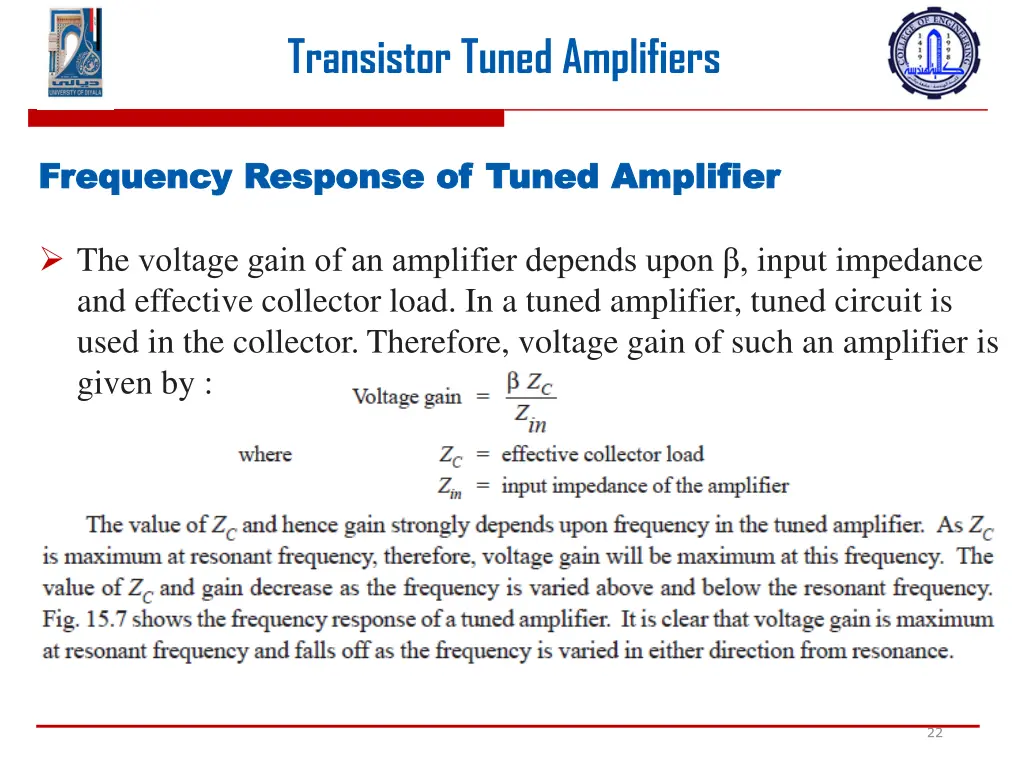
Transistor Tuned Amplifiers Frequency Frequency Response of Tuned Response of Tuned Amplifier Amplifier The voltage gain of an amplifier depends upon , input impedance and effective collector load. In a tuned amplifier, tuned circuit is used in the collector. Therefore, voltage gain of such an amplifier is given by : 22
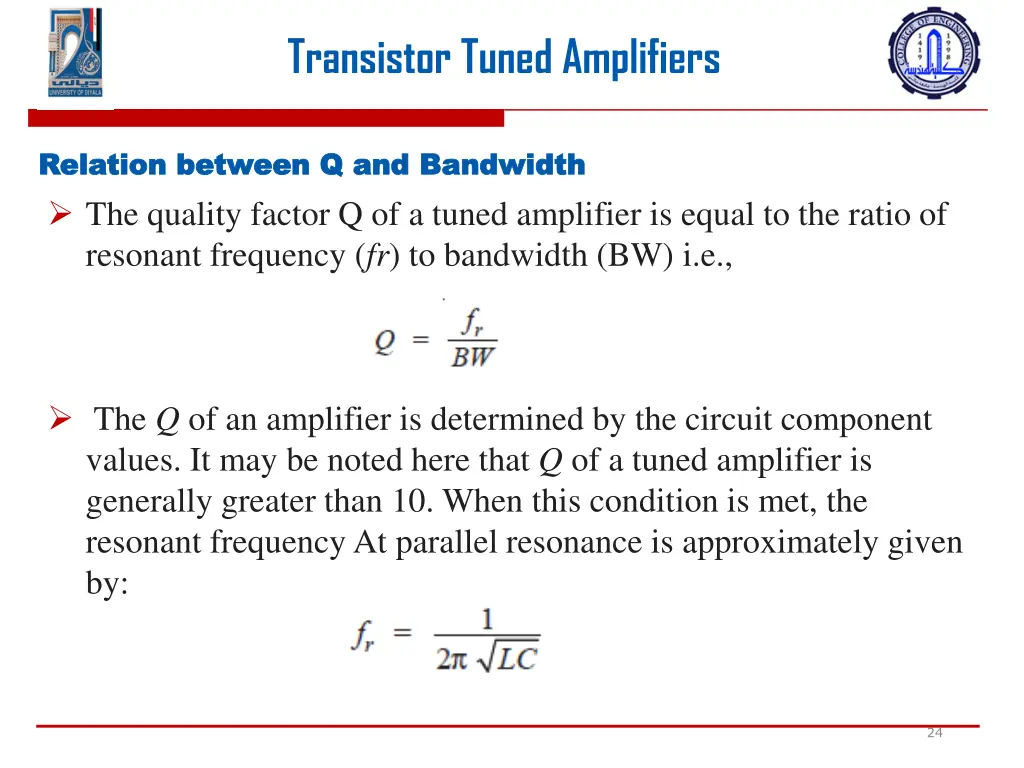
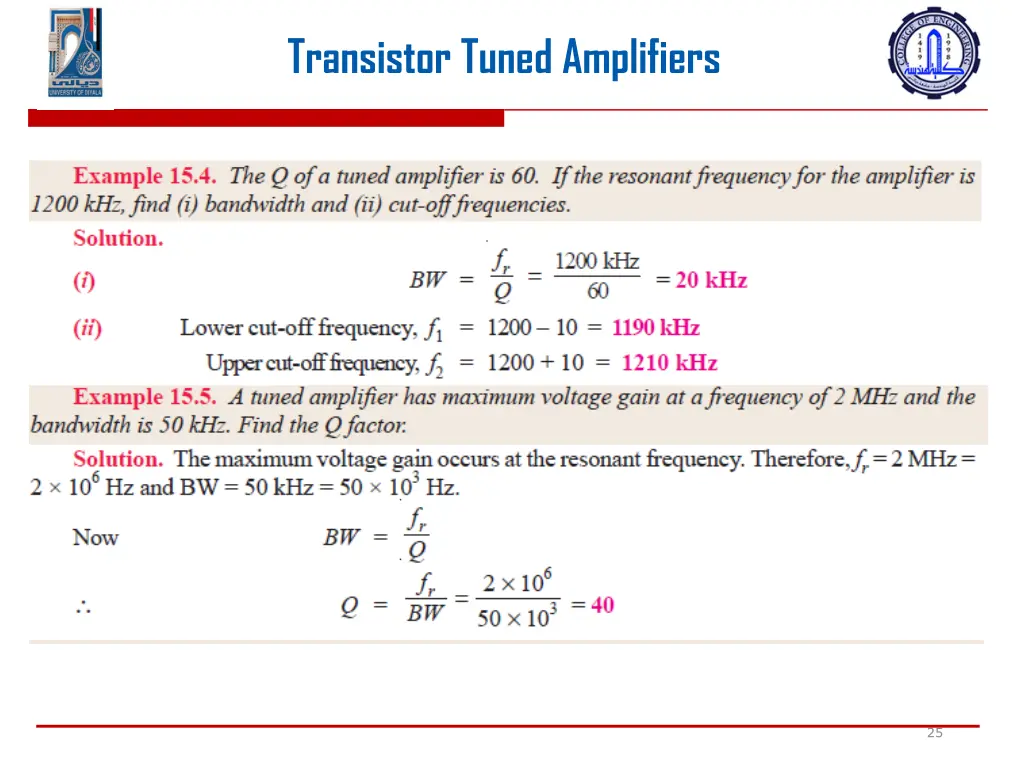
Transistor Tuned Amplifiers Relation between Q and Bandwidth Relation between Q and Bandwidth The quality factor Q of a tuned amplifier is equal to the ratio of resonant frequency (fr) to bandwidth (BW) i.e., The Q of an amplifier is determined by the circuit component values. It may be noted here that Q of a tuned amplifier is generally greater than 10. When this condition is met, the resonant frequency At parallel resonance is approximately given by: 24
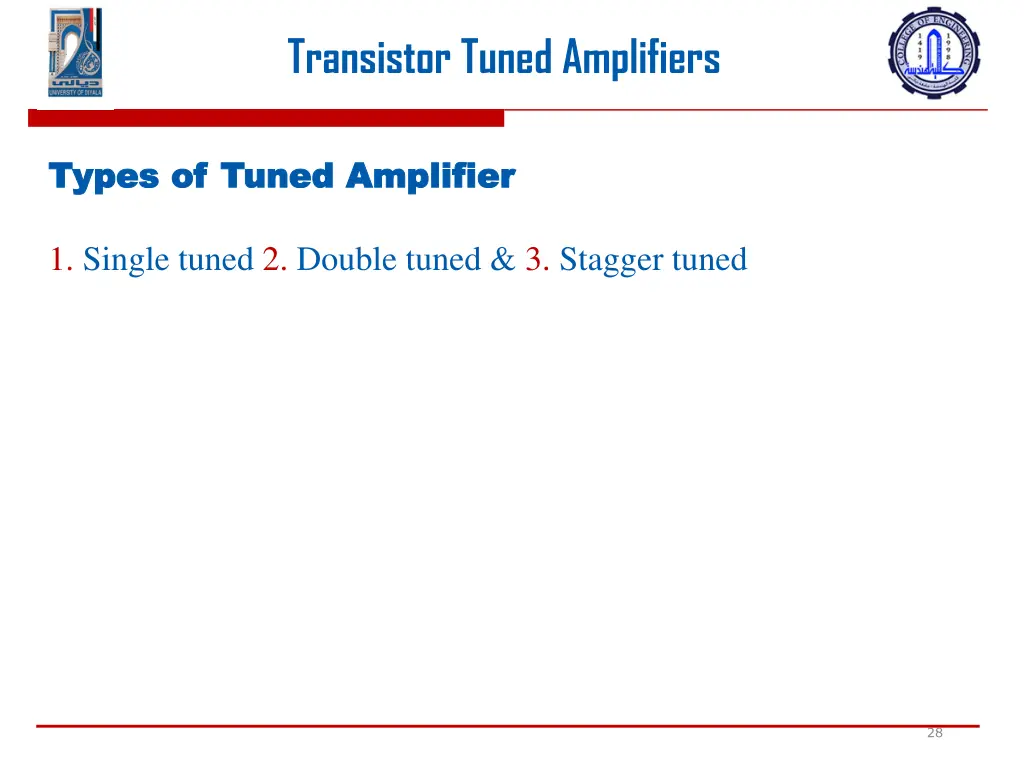
Transistor Tuned Amplifiers Types of Tuned Amplifier Types of Tuned Amplifier 1. Single tuned 2. Double tuned & 3. Stagger tuned 28