Trigonometry & Right Triangle Ratios
Trigonometry is the study of ratios of sides in a right triangle, involving functions like sine, cosine, and tangent. Explore interactive simulations, examples, and inverse trigonometric functions to enhance your understanding.

Download Presentation

Please find below an Image/Link to download the presentation.
The content on the website is provided AS IS for your information and personal use only. It may not be sold, licensed, or shared on other websites without obtaining consent from the author.If you encounter any issues during the download, it is possible that the publisher has removed the file from their server.
You are allowed to download the files provided on this website for personal or commercial use, subject to the condition that they are used lawfully. All files are the property of their respective owners.
The content on the website is provided AS IS for your information and personal use only. It may not be sold, licensed, or shared on other websites without obtaining consent from the author.
E N D
Presentation Transcript
Trigonometry ID1050 Quantitative & Qualitative Reasoning
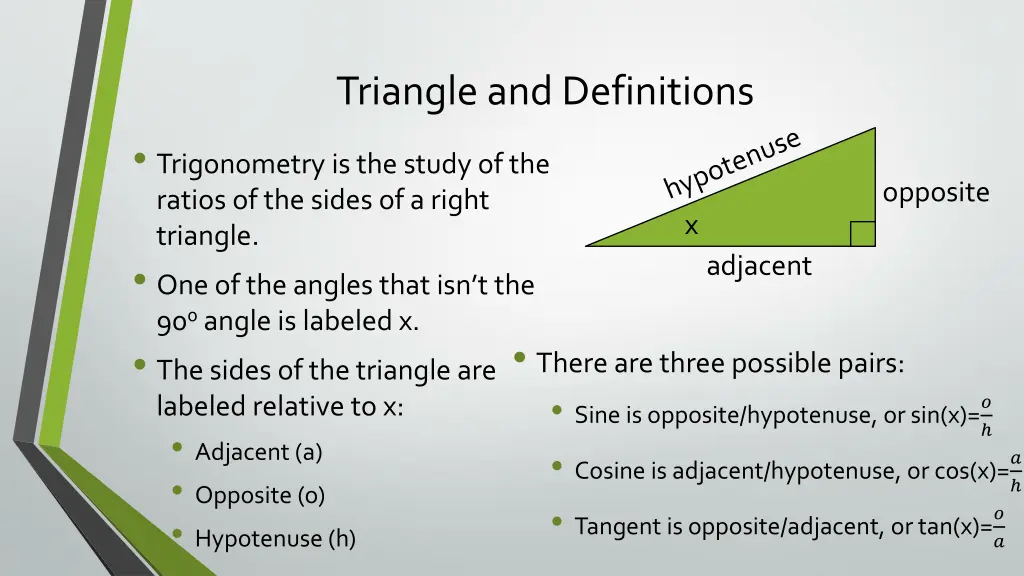
Triangle and Definitions Trigonometry is the study of the ratios of the sides of a right triangle. One of the angles that isn t the 900angle is labeled x. The sides of the triangle are labeled relative to x: Adjacent (a) Opposite (o) Hypotenuse (h) o pposite x djacent a There are three possible pairs: Sine is opposite/hypotenuse, or sin(x)=? Cosine is adjacent/hypotenuse, or cos(x)=? Tangent is opposite/adjacent, or tan(x)=? ?
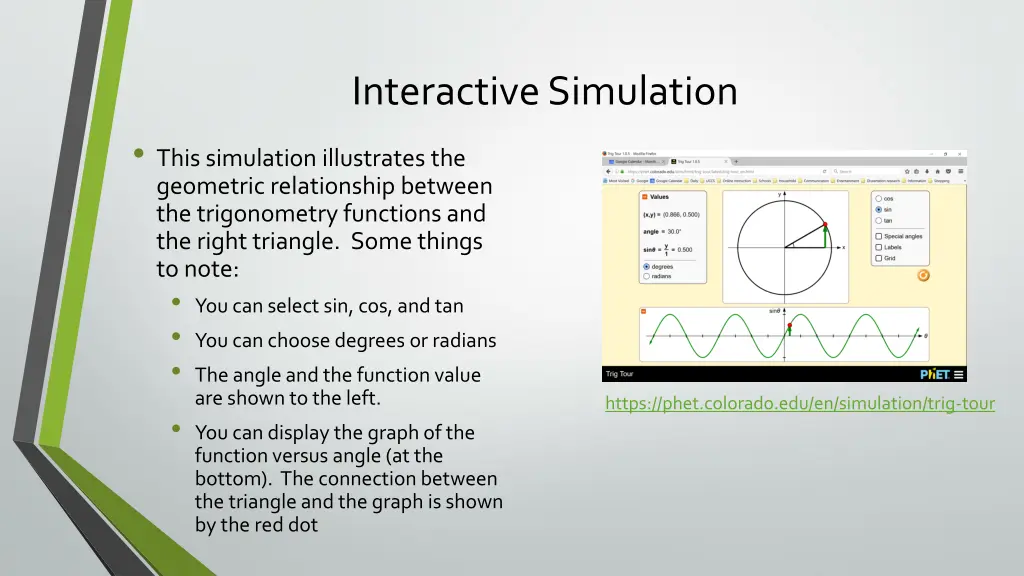
Interactive Simulation This simulation illustrates the geometric relationship between the trigonometry functions and the right triangle. Some things to note: You can select sin, cos, and tan You can choose degrees or radians The angle and the function value are shown to the left. You can display the graph of the function versus angle (at the bottom). The connection between the triangle and the graph is shown by the red dot https://phet.colorado.edu/en/simulation/trig-tour
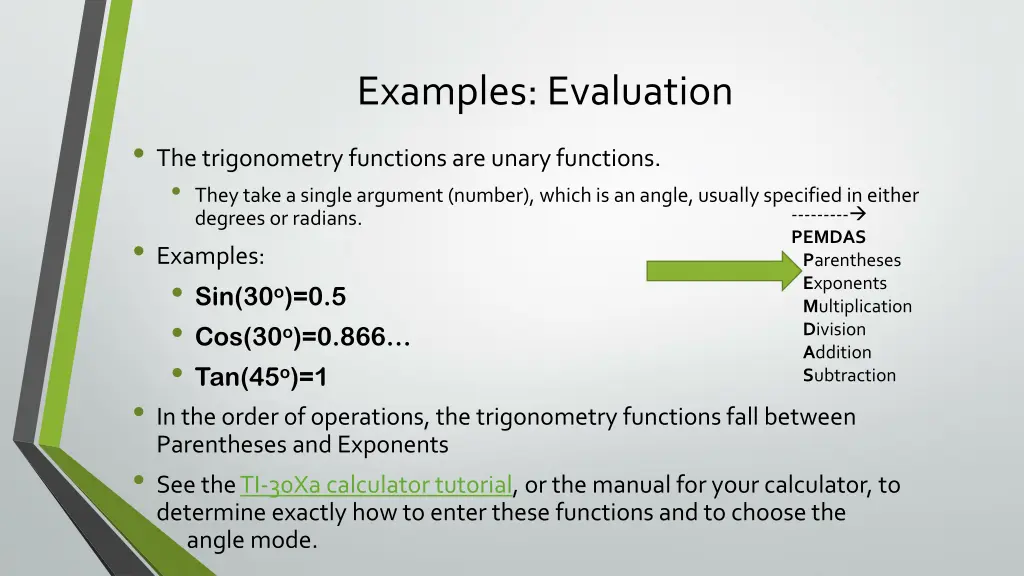
Examples: Evaluation The trigonometry functions are unary functions. They take a single argument (number), which is an angle, usually specified in either degrees or radians. Examples: Sin(30o)=0.5 Cos(30o)=0.866 Tan(45o)=1 In the order of operations, the trigonometry functions fall between Parentheses and Exponents See the TI-30Xa calculator tutorial, or the manual for your calculator, to determine exactly how to enter these functions and to choose the angle mode. --------- PEMDAS Parentheses Exponents Multiplication Division Addition Subtraction
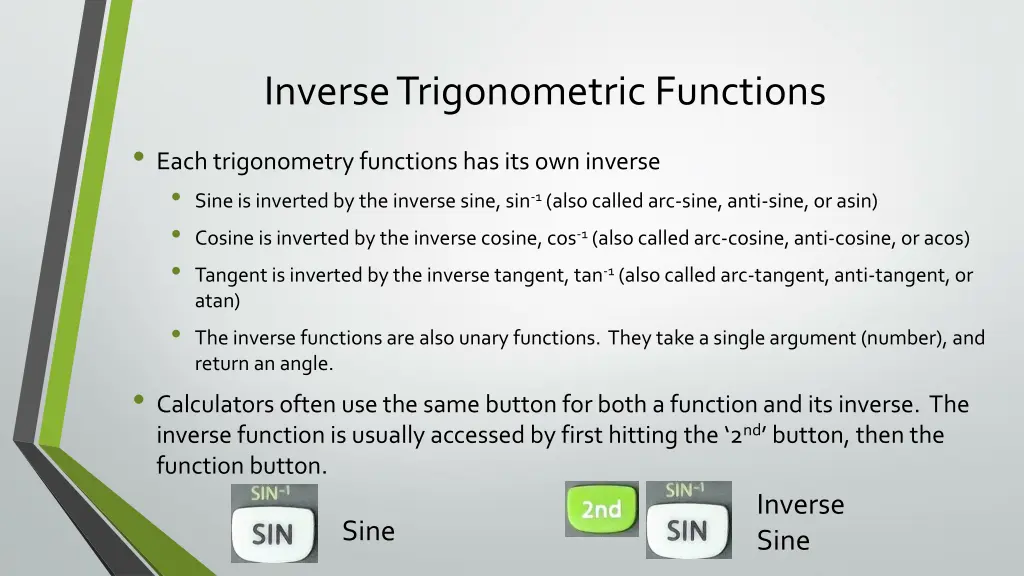
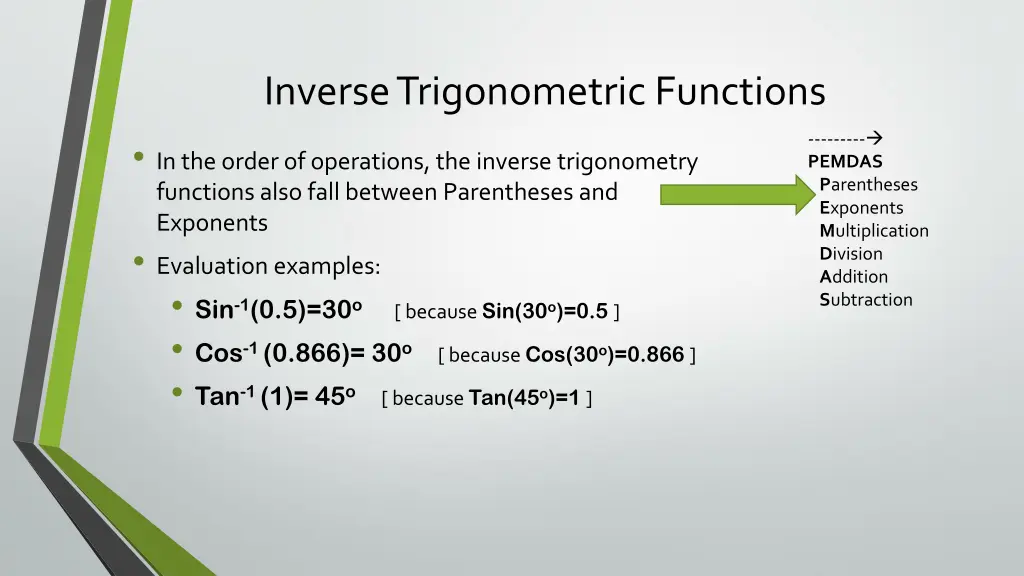
Inverse Trigonometric Functions Each trigonometry functions has its own inverse Sine is inverted by the inverse sine, sin-1 (also called arc-sine, anti-sine, or asin) Cosine is inverted by the inverse cosine, cos-1 (also called arc-cosine, anti-cosine, or acos) Tangent is inverted by the inverse tangent, tan-1 (also called arc-tangent, anti-tangent, or atan) The inverse functions are also unary functions. They take a single argument (number), and return an angle. Calculators often use the same button for both a function and its inverse. The inverse function is usually accessed by first hitting the 2nd button, then the function button. Inverse Sine Sine
Inverse Trigonometric Functions --------- PEMDAS Parentheses Exponents Multiplication Division Addition Subtraction In the order of operations, the inverse trigonometry functions also fall between Parentheses and Exponents Evaluation examples: Sin-1(0.5)=30o[ because Sin(30o)=0.5 ] Cos-1 (0.866)= 30o[ because Cos(30o)=0.866 ] Tan-1 (1)= 45o[ because Tan(45o)=1 ]
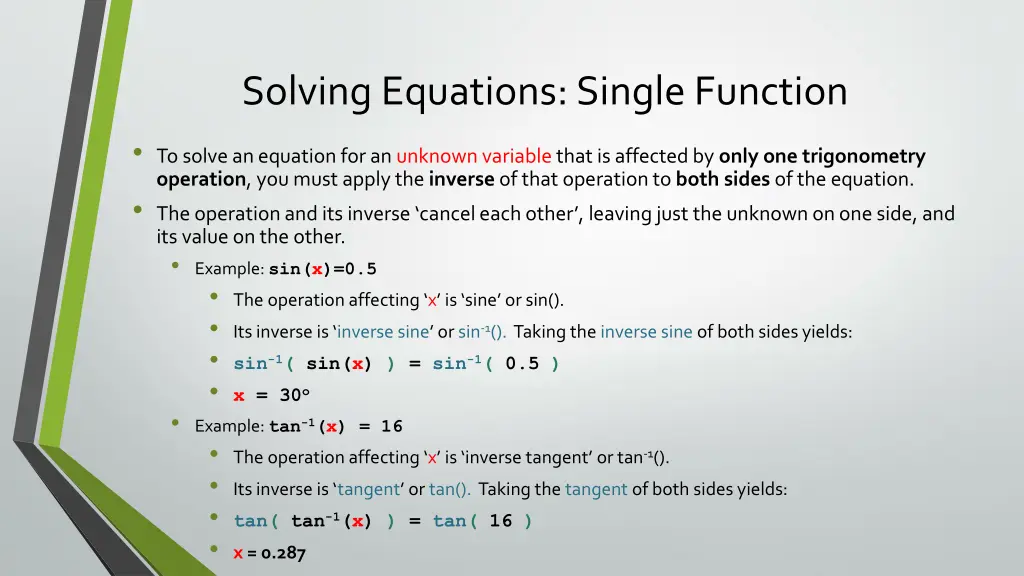
Solving Equations: Single Function To solve an equation for an unknown variable that is affected by only one trigonometry operation, you must apply the inverse of that operation to both sides of the equation. The operation and its inverse cancel each other , leaving just the unknown on one side, and its value on the other. Example: sin(x)=0.5 The operation affecting x is sine or sin(). Its inverse is inverse sine or sin-1(). Taking the inverse sine of both sides yields: sin-1( sin(x) ) = sin-1( 0.5 ) x = 30o Example: tan-1(x) = 16 The operation affecting x is inverse tangent or tan-1(). Its inverse is tangent or tan(). Taking the tangent of both sides yields: tan( tan-1(x) ) = tan( 16 ) x = 0.287
Conclusion Trigonometry is the study of the relationship between angles and sides of a right triangle. There are three important functions: sine, cosine, and tangent. Each function has an inverse.