Delve into the discussion on TXOP bandwidth expansion related to secondary channel access in IEEE 802.11-24, addressing scenarios like AP regaining TXOP and different TXOP sharings. Explore cases and solutions for channel access with EDCA, CCA requirements, and synchronization challenges in primary and secondary channels.
Please find below an Image/Link to download the presentation.
The content on the website is provided AS IS for your information and personal use only. It may not be sold, licensed, or shared on other websites without obtaining consent from the author. If you encounter any issues during the download, it is possible that the publisher has removed the file from their server.
You are allowed to download the files provided on this website for personal or commercial use, subject to the condition that they are used lawfully. All files are the property of their respective owners.
The content on the website is provided AS IS for your information and personal use only. It may not be sold, licensed, or shared on other websites without obtaining consent from the author.
E N D
Presentation Transcript
May 2024 doc.: IEEE 802.11-24/0850r0 TXOP Bandwidth Expansion Related to Secondary Channel Access Date: 2024-5-9 Authors: Name Jerome Gu Shirley Yin Jason Sheng Affiliations Clourney Semiconductor Address Phone email jeg150@clourneysemi.com Submission Slide 1 Jerome Gu, Clourney Semiconductor
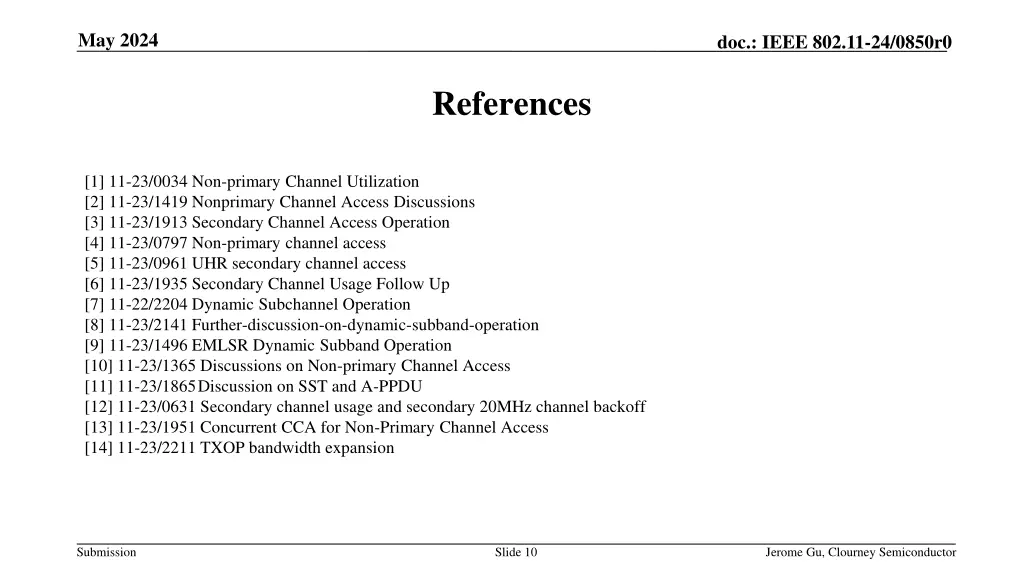
May 2024 doc.: IEEE 802.11-24/0850r0 Introduction The secondary channel access of 11bn has been discussed in several contributions. Non-Primary Channel Access [1, 12, 13] Secondary channel access and media sychronization. [2, 3] (MU-RTS)RTS/CTS, NAV [4, 5] RU allocation [6] Dynamic Subchannel Operation [7-9] Extend the Non-Primary Channel Access to MLO [10] TXOP bandwidth expansion [14] In this contribution, we would further discuss the TXOP bandwidth expansion problem. Submission Slide 2 Jerome Gu, Clourney Semiconductor
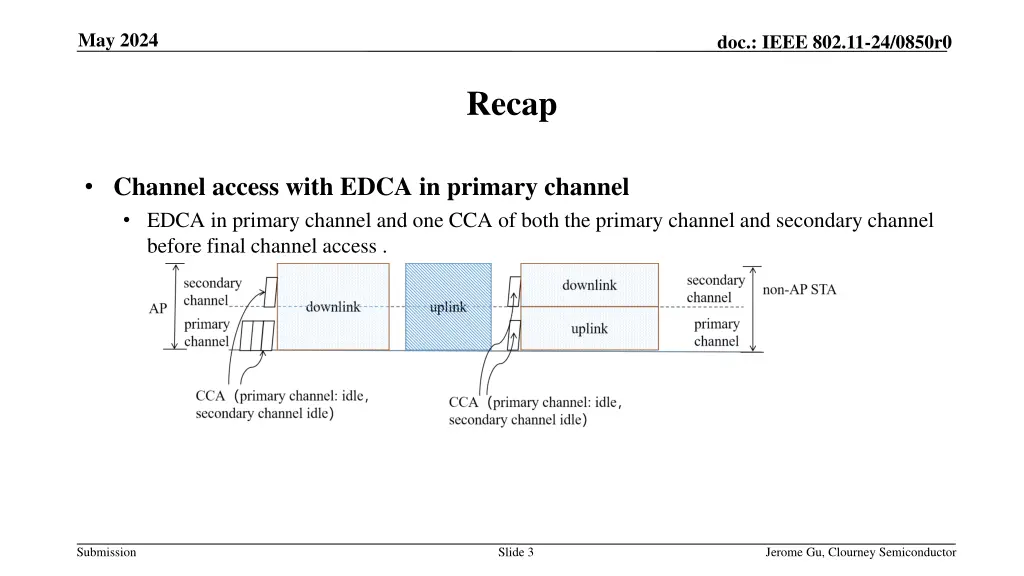
May 2024 doc.: IEEE 802.11-24/0850r0 Recap Channel access with EDCA in primary channel EDCA in primary channel and one CCA of both the primary channel and secondary channel before final channel access . Submission Slide 3 Jerome Gu, Clourney Semiconductor
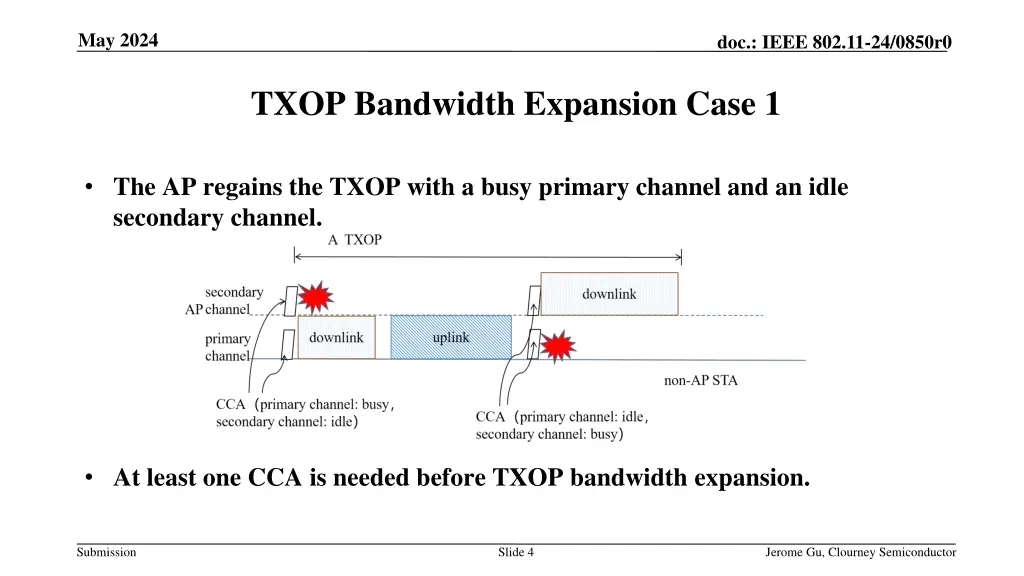
May 2024 doc.: IEEE 802.11-24/0850r0 TXOP Bandwidth Expansion Case 1 The AP regains the TXOP with a busy primary channel and an idle secondary channel. At least one CCA is needed before TXOP bandwidth expansion. Submission Slide 4 Jerome Gu, Clourney Semiconductor
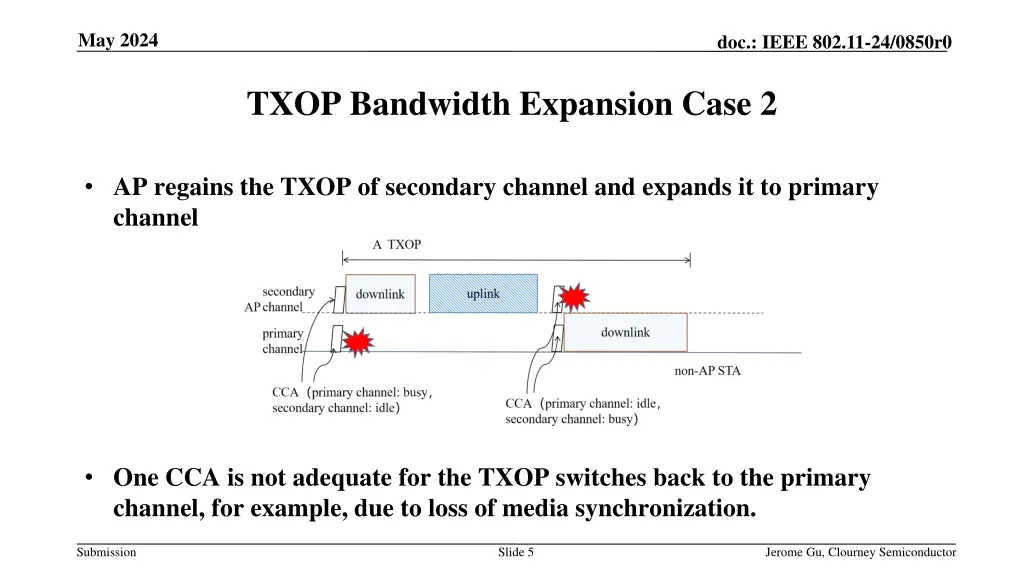
May 2024 doc.: IEEE 802.11-24/0850r0 TXOP Bandwidth Expansion Case 2 AP regains the TXOP of secondary channel and expands it to primary channel One CCA is not adequate for the TXOP switches back to the primary channel, for example, due to loss of media synchronization. Submission Slide 5 Jerome Gu, Clourney Semiconductor
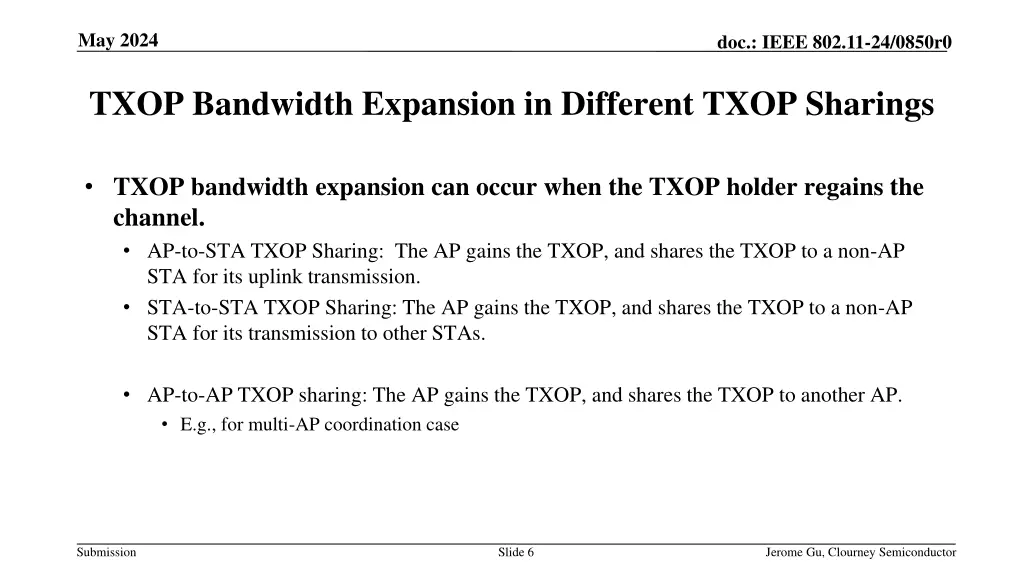
May 2024 doc.: IEEE 802.11-24/0850r0 TXOP Bandwidth Expansion in Different TXOP Sharings TXOP bandwidth expansion can occur when the TXOP holder regains the channel. AP-to-STA TXOP Sharing: The AP gains the TXOP, and shares the TXOP to a non-AP STA for its uplink transmission. STA-to-STA TXOP Sharing: The AP gains the TXOP, and shares the TXOP to a non-AP STA for its transmission to other STAs. AP-to-AP TXOP sharing: The AP gains the TXOP, and shares the TXOP to another AP. E.g., for multi-AP coordination case Submission Slide 6 Jerome Gu, Clourney Semiconductor
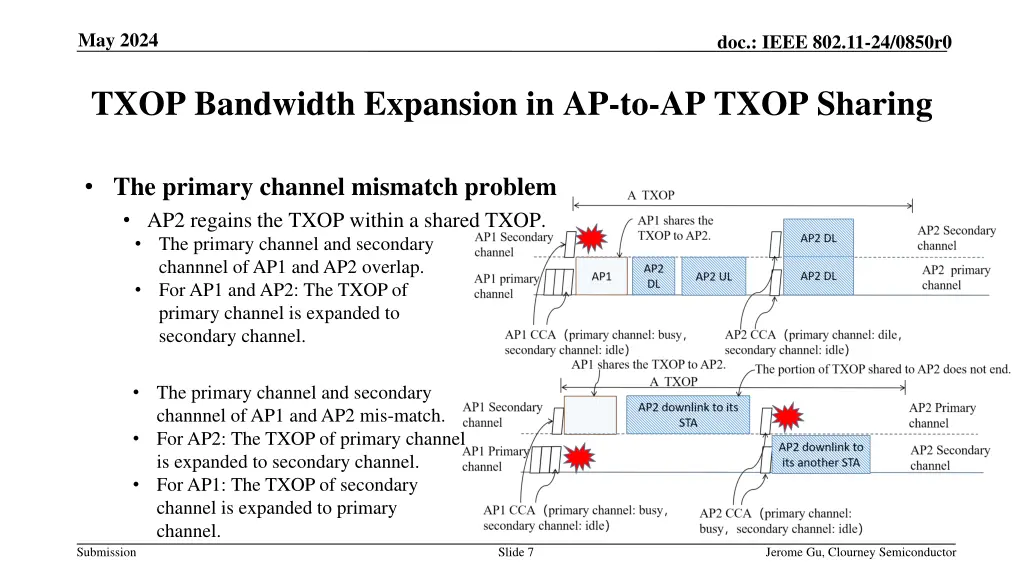
May 2024 doc.: IEEE 802.11-24/0850r0 TXOP Bandwidth Expansion in AP-to-AP TXOP Sharing The primary channel mismatch problem AP2 regains the TXOP within a shared TXOP. The primary channel and secondary channnel of AP1 and AP2 overlap. For AP1 and AP2: The TXOP of primary channel is expanded to secondary channel. The primary channel and secondary channnel of AP1 and AP2 mis-match. For AP2: The TXOP of primary channel is expanded to secondary channel. For AP1: The TXOP of secondary channel is expanded to primary channel. Submission Slide 7 Jerome Gu, Clourney Semiconductor
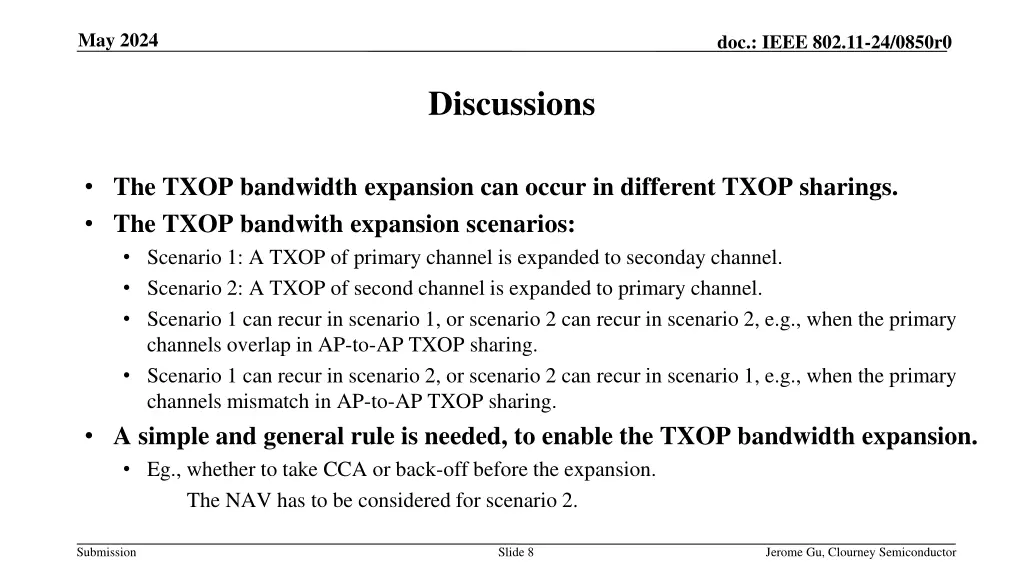
May 2024 doc.: IEEE 802.11-24/0850r0 Discussions The TXOP bandwidth expansion can occur in different TXOP sharings. The TXOP bandwith expansion scenarios: Scenario 1: A TXOP of primary channel is expanded to seconday channel. Scenario 2: A TXOP of second channel is expanded to primary channel. Scenario 1 can recur in scenario 1, or scenario 2 can recur in scenario 2, e.g., when the primary channels overlap in AP-to-AP TXOP sharing. Scenario 1 can recur in scenario 2, or scenario 2 can recur in scenario 1, e.g., when the primary channels mismatch in AP-to-AP TXOP sharing. A simple and general rule is needed, to enable the TXOP bandwidth expansion. Eg., whether to take CCA or back-off before the expansion. The NAV has to be considered for scenario 2. Submission Slide 8 Jerome Gu, Clourney Semiconductor
May 2024 doc.: IEEE 802.11-24/0850r0 Summary The TXOP bandwidth expansion is discussed for the secondary channel acesss problem. A simple and general rule for TXOP expansion is to be studied. Submission Slide 9 Jerome Gu, Clourney Semiconductor