UCA Core Program Assessment and Review Findings
Explore the evaluation and outcomes of the UCA Core Annual Brief, focusing on critical inquiry and the four-year program review. Discover key insights, assessment results, and lessons learned from the comprehensive academic program emphasizing critical inquiry and effective communication skills.

Download Presentation

Please find below an Image/Link to download the presentation.
The content on the website is provided AS IS for your information and personal use only. It may not be sold, licensed, or shared on other websites without obtaining consent from the author. If you encounter any issues during the download, it is possible that the publisher has removed the file from their server.
You are allowed to download the files provided on this website for personal or commercial use, subject to the condition that they are used lawfully. All files are the property of their respective owners.
The content on the website is provided AS IS for your information and personal use only. It may not be sold, licensed, or shared on other websites without obtaining consent from the author.
E N D
Presentation Transcript
Assessment of the UCA Core Annual Brief (AY 20-21) Critical Inquiry and Four Year Program Review
Todays Presentation Report on Critical Inquiry Assessment Assessment Results Conclusions Four Year UCA Core Program Summary/Review Lessons learned from first, four year cycle
The UCA Core The UCA Core is a comprehensive academic program of study designed to develop and reinforce students knowledge and skills of critical inquiry and effective communication, as well as the knowledge and skills necessary for living responsible, ethical lives in a diverse and changing world. The overarching goal of the program is to facilitate the development of thoughtful, knowledgeable, articulate, and ethical citizens.
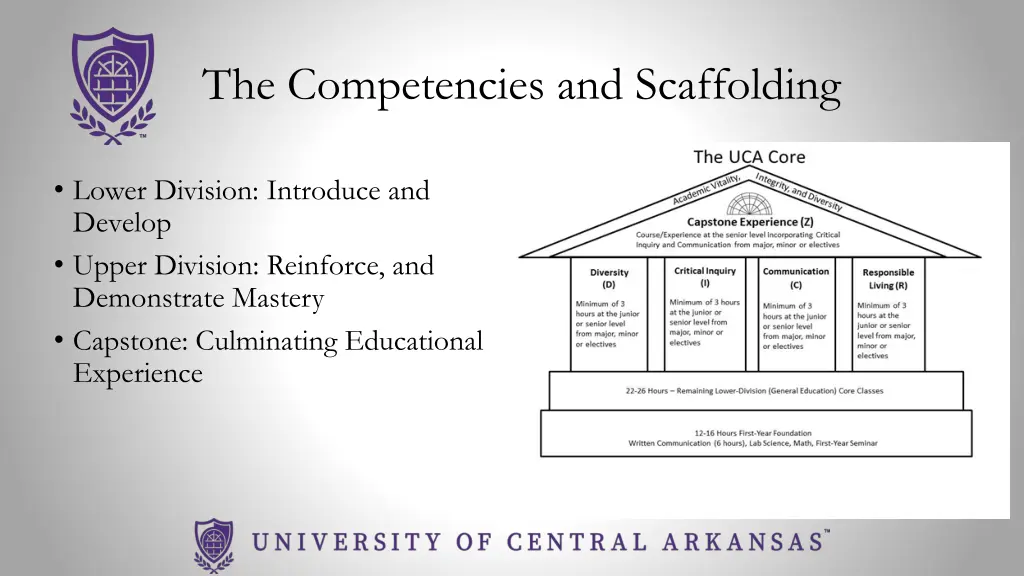
The Competencies and Scaffolding Lower Division: Introduce and Develop Upper Division: Reinforce, and Demonstrate Mastery Capstone: Culminating Educational Experience
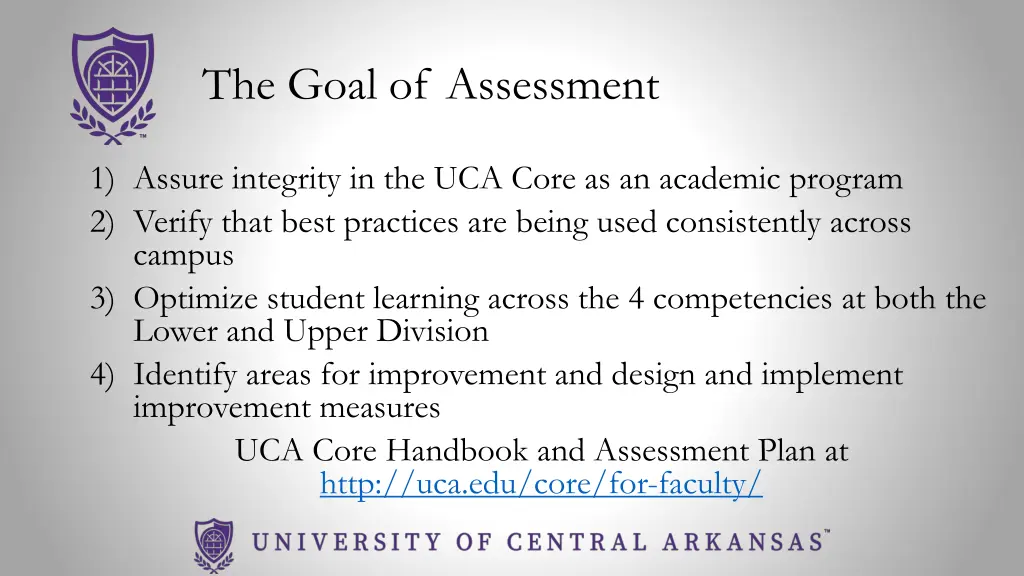
The Goal of Assessment 1) Assure integrity in the UCA Core as an academic program 2) Verify that best practices are being used consistently across campus 3) Optimize student learning across the 4 competencies at both the Lower and Upper Division 4) Identify areas for improvement and design and implement improvement measures UCA Core Handbook and Assessment Plan at http://uca.edu/core/for-faculty/
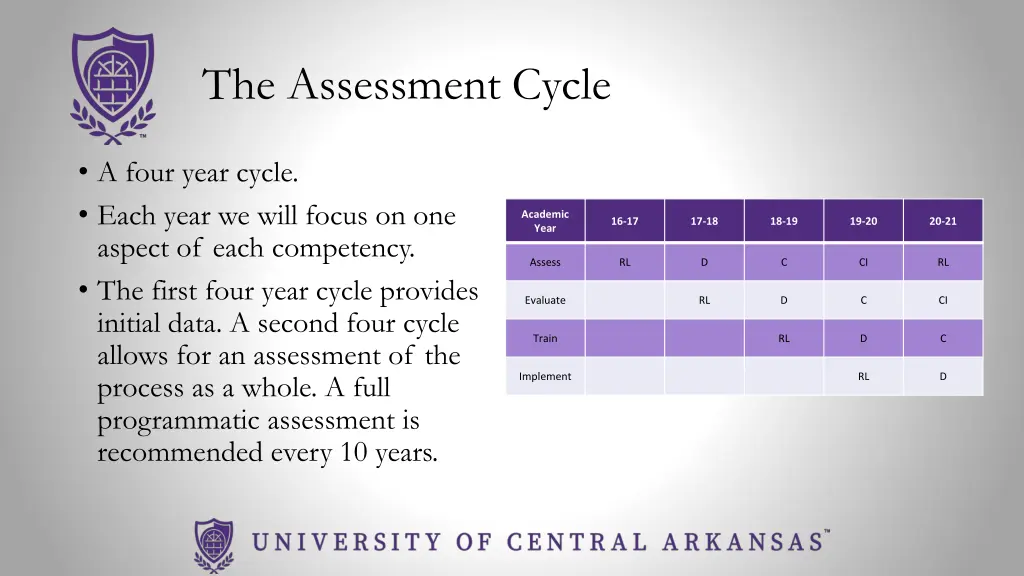
The Assessment Cycle A four year cycle. Each year we will focus on one aspect of each competency. The first four year cycle provides initial data. A second four cycle allows for an assessment of the process as a whole. A full programmatic assessment is recommended every 10 years. Academic Year 16-17 17-18 18-19 19-20 20-21 Assess RL D C CI RL Evaluate RL D C CI Train RL D C Implement RL D
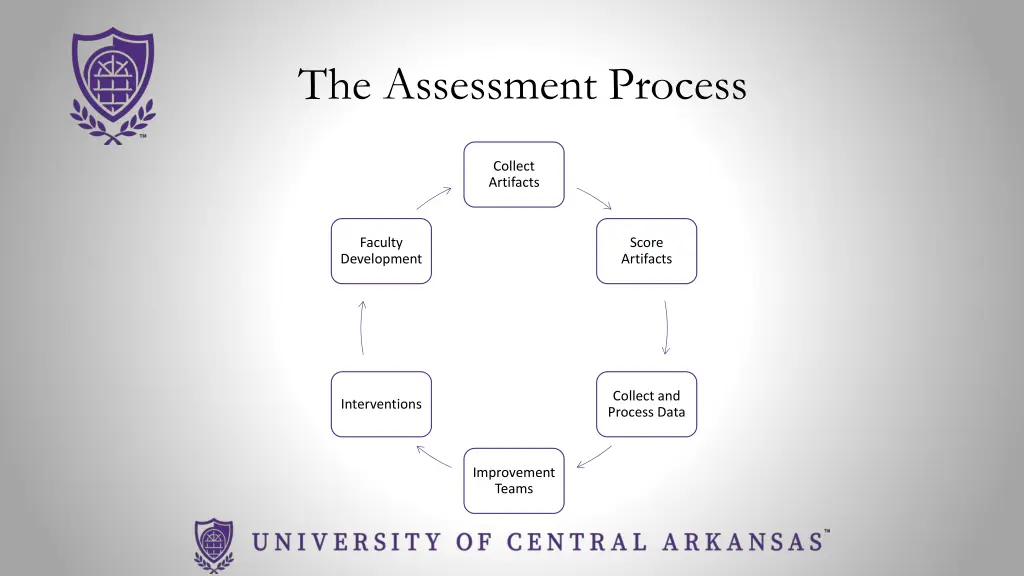
The Assessment Process Collect Artifacts Faculty Development Score Artifacts Collect and Process Data Interventions Improvement Teams
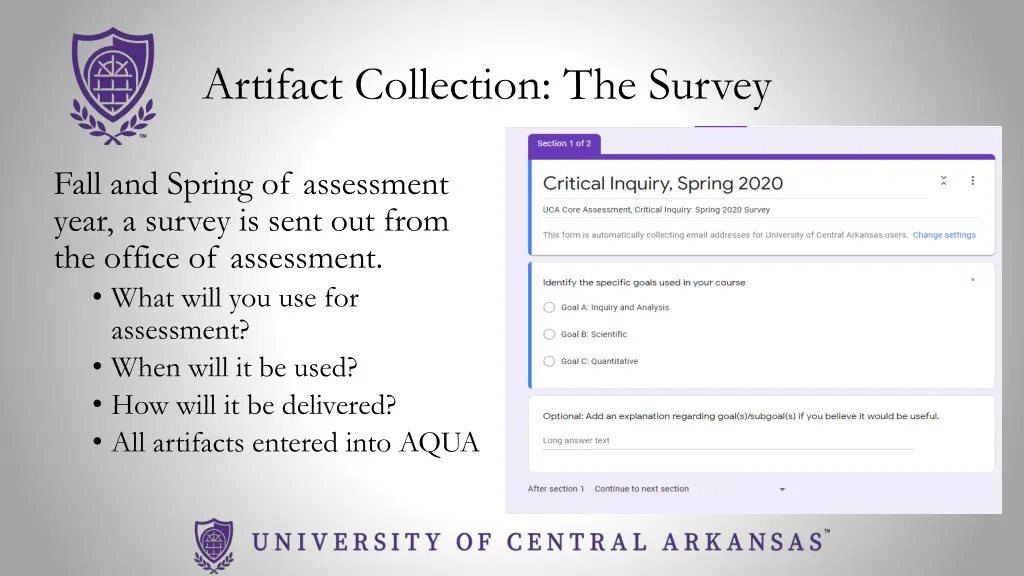
Artifact Collection: The Survey Fall and Spring of assessment year, a survey is sent out from the office of assessment. What will you use for assessment? When will it be used? How will it be delivered? All artifacts entered into AQUA
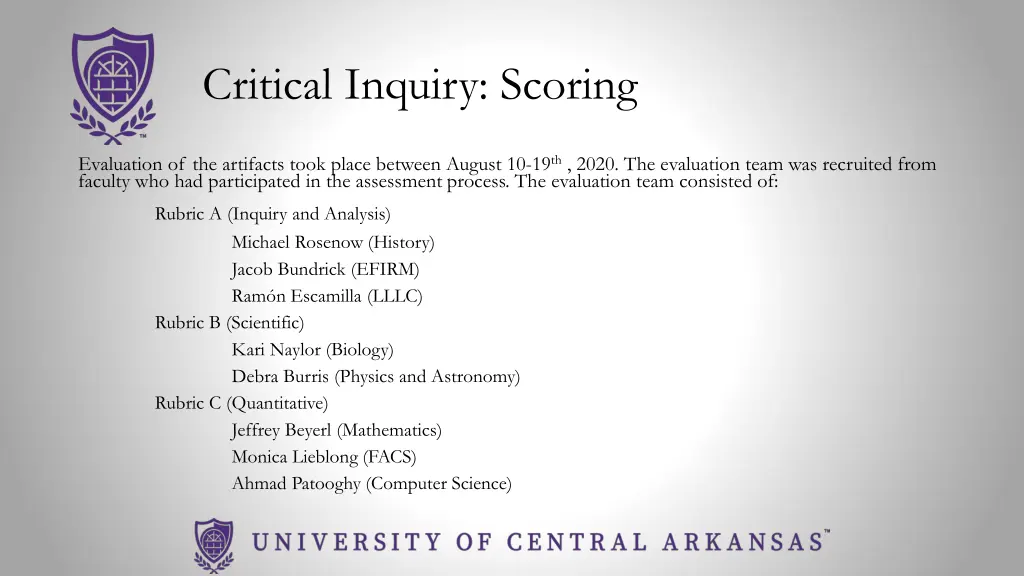
Critical Inquiry: Scoring Evaluation of the artifacts took place between August 10-19th , 2020. The evaluation team was recruited from faculty who had participated in the assessment process. The evaluation team consisted of: Rubric A (Inquiry and Analysis) Michael Rosenow (History) Jacob Bundrick (EFIRM) Ram n Escamilla (LLLC) Rubric B (Scientific) Kari Naylor (Biology) Debra Burris (Physics and Astronomy) Rubric C (Quantitative) Jeffrey Beyerl (Mathematics) Monica Lieblong (FACS) Ahmad Patooghy (Computer Science)
Scoring Results The teams for Goals B and C were able to score the entire population of artifacts. This is due to two factors. First, we had a smaller pool of artifacts due to poor survey response. There should have been significantly more artifacts to score under Goals B and C. For example, we received only one course worth of artifacts for all Upper Division Core Critical Inquiry (Goal B: Scientific) courses. Secondly, given the nature of the rubrics and the artifacts received scoring was often formulaic allowing scorers to process artifacts significantly quicker than Goal A, where lengthy papers are the norm. In the future, it may be prudent to enlist more scorers for Goal A in order to process a greater number of artifacts while holding Goals B and C to two scorers each.
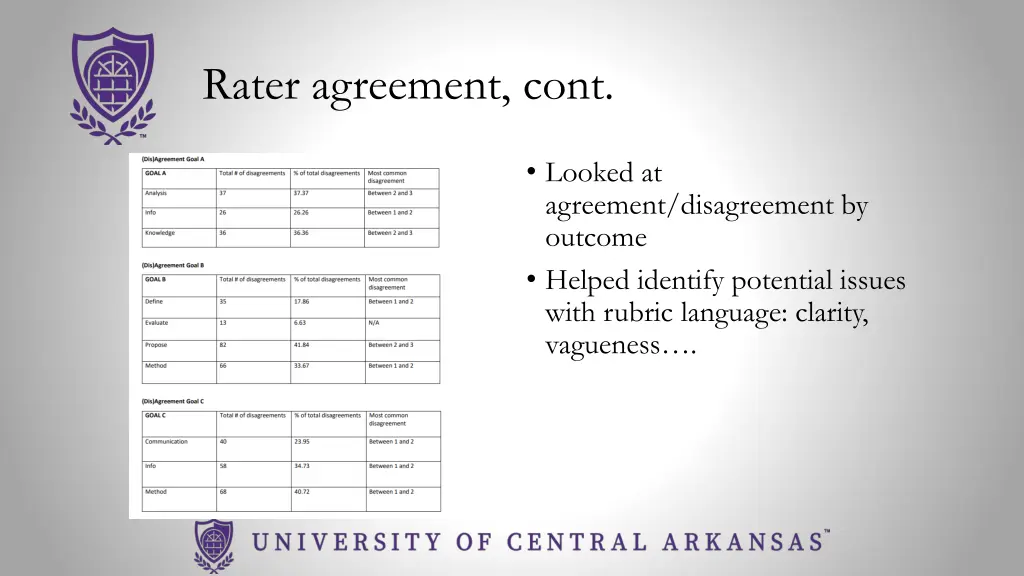
Rater agreement, cont. Looked at agreement/disagreement by outcome Helped identify potential issues with rubric language: clarity, vagueness .
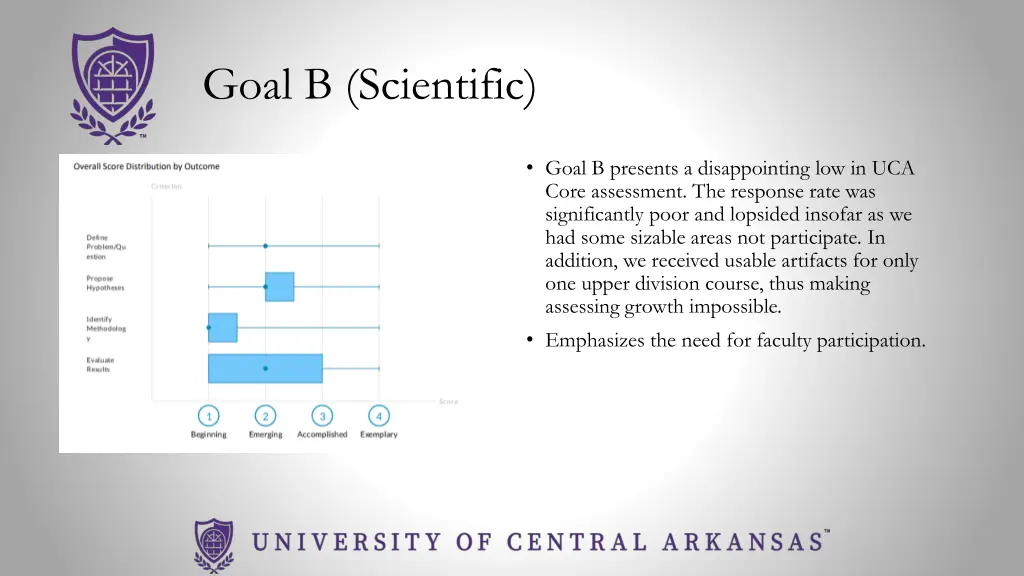
Goal B (Scientific) Goal B presents a disappointing low in UCA Core assessment. The response rate was significantly poor and lopsided insofar as we had some sizable areas not participate. In addition, we received usable artifacts for only one upper division course, thus making assessing growth impossible. Emphasizes the need for faculty participation.
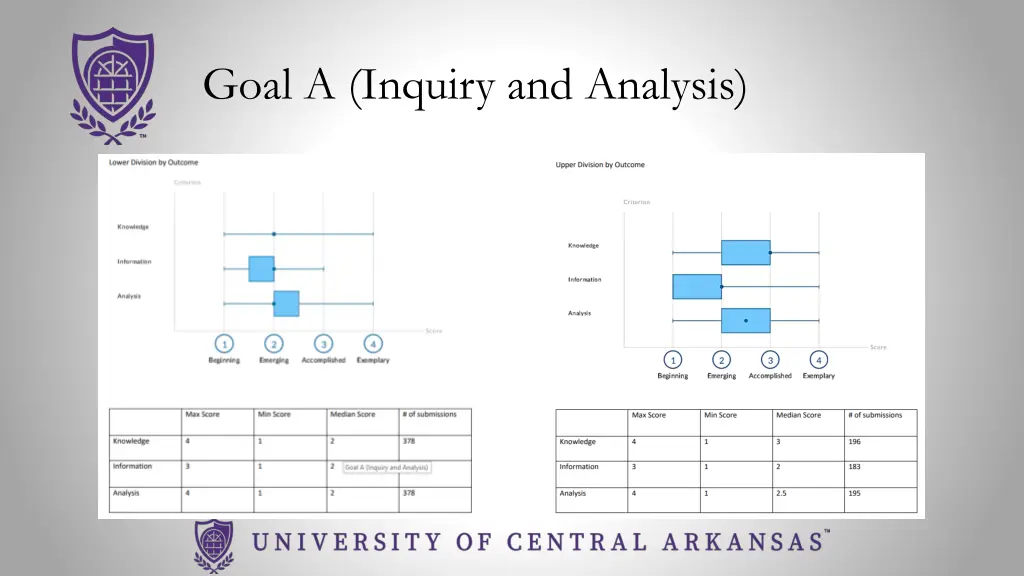
Observations from the Report Faculty participation continues to be an issue. AY 19-20 survey response rate = 46.45% Poorly chosen or designed assignments was a problem frequently noted by score teams. Pre-cycle training needs to focus on assignment design. With respect to student learning: significant growth was noted in some areas. Only 50-60% of students at the upper division scored accomplished or higher, with markedly less than 20% of students scoring exemplary . The rubrics ought to be revisited in order to clarify language and allow scorers to develop and impose a standard set of expectations.
Four Year Program Review of the UCA Core Review provides an archival document/history of our assessment processes during the first full cycle of Core assessment. Provides an opportunity to reflect on and catalog past failures and current successes. The review is both a summary of previous assessment reports, as well as an evaluation of the FYS program and overall evaluation of Core assessment to date. The full report is located here: https://uca.edu/core/assessment/
Key Takeaways Our assessment processes for general education at UCA are fully implemented, productive, and tenable long-term. There are places where improvements are needed including rubric development/revision and improved faculty involvement. The First Year Seminar program needs to be revisited, as does the Capstone requirement.
Assessment of General Education at UCA The process developed and implemented at UCA is sound, it is well fitted to the structure of the UCA Core and the needs of the University. We collect the population of artifacts for each competency area from which we derive a stratified, random sample. A team of trained faculty score these artifacts over the course of three days. In theory, a well-calibrated team with a high degree of interrater reliability generates the data. Data is processed and interpreted using AQUA and reported out to the university. Development opportunities are developed based on the assessment data. As designed, the process provides reliable, relevant data on student learning as well as informs developmental opportunities tailored to the assessment results.
Room for Improvement To date we have had dwindling faculty participation, routinely receiving artifacts from fewer than 50% of faculty who ought to be submitting artifacts. In addition, even those faculty that participate by submitting student work are not always submitting well-designed artifacts. The rubrics in use can be at times unclear leading to difficulties in assessing student work consistently and communicating clear expectations to faculty. None of the obstacles are insurmountable, nor do they invalidate the fundamental design of the assessment process.
FYS needs to be revisited Having recognized early on the deficiencies of the First Year Seminar program as defined by the initial taskforce and as implemented at the adoption of the UCA Core, we have worked diligently to improve the FYS program in an attempt to assure that first year students are getting a valuable experience. Specific efforts are documented in the full report. The FYS sub-committee of the UCA Core Council reviewed FYSes as a high impact practice. Their full report contains several substantive recommendations, which are currently under review by a working group of the Council on Student Success dedicated to evaluating the FYS program.
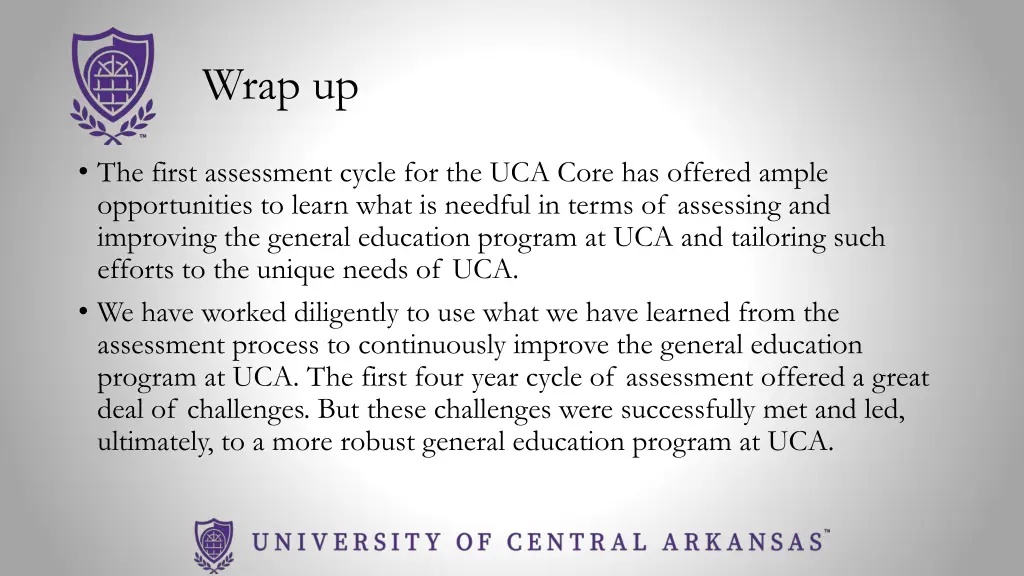
Wrap up The first assessment cycle for the UCA Core has offered ample opportunities to learn what is needful in terms of assessing and improving the general education program at UCA and tailoring such efforts to the unique needs of UCA. We have worked diligently to use what we have learned from the assessment process to continuously improve the general education program at UCA. The first four year cycle of assessment offered a great deal of challenges. But these challenges were successfully met and led, ultimately, to a more robust general education program at UCA.
Jake Held, PhD Assistant Provost for Academic Assessment and General Education Professor of Philosophy Wingo Hall 215 501-450-5307 jmheld@uca.edu All reports and documents including this presentation can be located at: https://uca.edu/core/for-faculty/