Ukraine Conflict Dynamics and Prospects
The conflict in Ukraine is analyzed at bilateral, regional, and global levels, highlighting the structural dynamics and background of the ongoing war. The criticality of the situation, potential implications on European and global security orders, and the opposing approaches rooted in post-Cold War dynamics are explored with insights from Dr. Muhammad Riaz Shad, a professor specializing in International Relations.

Uploaded on Mar 10, 2025 | 2 Views
Download Presentation

Please find below an Image/Link to download the presentation.
The content on the website is provided AS IS for your information and personal use only. It may not be sold, licensed, or shared on other websites without obtaining consent from the author.If you encounter any issues during the download, it is possible that the publisher has removed the file from their server.
You are allowed to download the files provided on this website for personal or commercial use, subject to the condition that they are used lawfully. All files are the property of their respective owners.
The content on the website is provided AS IS for your information and personal use only. It may not be sold, licensed, or shared on other websites without obtaining consent from the author.
E N D
Presentation Transcript
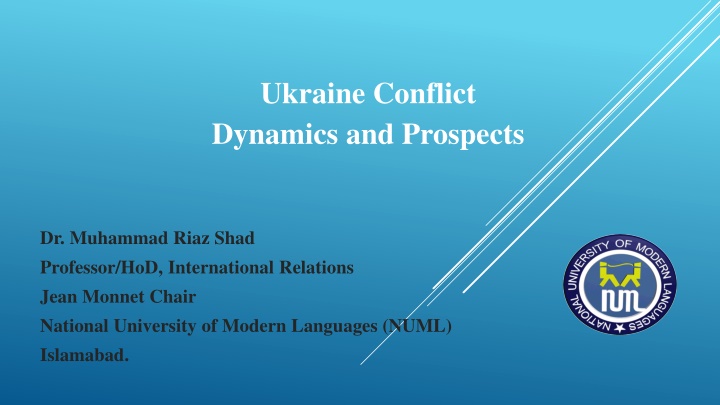
Ukraine Conflict Dynamics and Prospects Dr. Muhammad Riaz Shad Professor/HoD, International Relations Jean Monnet Chair National University of Modern Languages (NUML) Islamabad.
Criticality of the Ukraine Conflict Happening in a core region of the world Transforming the European Security Order (Europe s biggest security crisis since WWII) Potentially may lead to WWIII involving nuclear weapons Consequential for the world order; may reshape the global order Has deeper consequences for the wider world, particularly the developing world
Dynamics of Ukraine Conflict- Level of Analysis Bilateral level (bilateral dynamics of Russia-Ukraine relations) Regional level (post-cold war European Security Order) Global level (post-cold war World Order) The dynamics/factors operating at the three levels are interlinked; however, they are also characterized by independent features. Regional level offers the most plausible explanation of the Ukraine Conflict.
Background of the Current Ukraine War Current Ukraine war is an escalation of the crisis that started in Ukraine in late 2013. President Viktor Yanukovych refused to sign Association Agreement with EU in Nov 2013 Annexation of Crimea by Russia in March 2014 Russian support to separatists in Eastern Ukraine Russia started military build-up at Ukraine borders in Dec 2021 On 21 February 2022, Russia recognized Donetsk People's Republic and Luhansk People's Republic in Eastern Ukraine (Donbas region) as independent states. On 24 Feb 2022, Russia launched military invasion of Ukraine
Structural Dynamics of the Ukraine Conflict (Regional Level of Analysis) Opposite approaches over Ukraine (European liberal vs. Russian realist approach), rooted in post- cold war European Security Order (ESO) Post-cold war ESO was based on the centrality of Euro-Atlantic organizations, viz. NATO & EU. Three concentric circles of the ESO: Core Circle (Western Europe) Intermediate Circle (Eastern/Central European states) Outer Circle (Russia/Post-Soviet states)
Structural Dynamics of the Ukraine Conflict (Regional Level of Analysis) NATO and the EU were remarkably successful in transforming the politico-economic and security structures and stabilizing the post-Communist Central and Eastern European states. Nevertheless, they failed in integrating Russia into the institutional edifice. Russia did not join the Western organizations due to two interrelated reasons .Russian perception & Non-negotiable rules for EU-NATO membership Divergent paths EU-NATO eastward expansion and the initial Russian reaction EU-NATO plans for expansion to the post-Soviet states (ENP 2004 ; EaP 2009 ; NATO summit 2008) Russian Response .. OSCE (wider Europe vs. Greater Europe) EEU Coercive measures
Russian Military Objectives in Ukraine Russia annexed Crimea and supported Russian ethnic separatists in Donbas in 2014 to keep Ukraine destabilized In current war, extended military objectives may range from occupation of strategic locations/installations to imperial control of the whole country. It has so far failed to occupy Kyiv and Kharkiv, Ukraine s two largest cities. It has made significant gains in Donbas though slowly and costily. Has established the long-sought strategic land corridor between Russia and Crimea. Denying Ukraine the access to the Black sea. Moscow s ultimate aim seems to extend Russian territorial control along the entire northern coast of the Black Sea, reducing Ukraine into a land-locked country.
Western Response Economic sanctions on Russia [Several rounds of sanctions targeting Russian officials, organizations, energy and financial sectors] Political, Economic and Military support to Ukraine Political/diplomatic isolation of Russia NATO Mobilization Four multinational battle groups stationed in the Baltic states (Estonia, Latvia, and Lithuania) and Poland Recent NATO summit: i. declared Russia as most significant and direct threat while deeming China as a security challenge ii. Sweden and Finland formally invited to join NATO iii.Plan to increase deployment of military personnel (rapid reaction force) and equipment in eastern Ukraine
Limitations of Western Sanctions Russian economy mainly depends on energy and arms exports Europe remains the major and most important market for the Russian energy exports. In 2021, the EU imported more than 40% of its total gas consumption, 27% of oil imports and 46% of coal from Russia. Energy represented 62% of EU total imports from Russia, and cost 99 billion Europe does not have easy alternatives for meeting its energy needs; thus energy sector is mainly exempted from the EU sanctions. EU cuts oil imports by sea ( 2/3rd); plans to cut by 90% by the end of this year; Asian markets European Union imports of Russian fossil fuels accounted for 44 billion euros ($46.3 billion) from February 24, the day Russia launched its invasion, to April 24. Ruble best performing currency (Bloomberg)
Implications for Pakistan Economic Repercussions Neither Russia nor Ukraine is a significant trade partner of Pakistan (they together accounted for $1/68 billion trade in 2020) Economic sanctions on Russia and supply disruptions from Ukraine are seriously impacting global energy and food prices including Pakistan, particularly petroleum, wheat and palm oil. This is coupled with Pakistan s domestic economic stress due to current account deficit, shrinking forex reserves and huge inflation (rupee devaluation, IMF program & international prices).
Implications for Pakistan Political Repercussions The US-EU have been seeking political/diplomatic isolation of Russia following the Russian military intervention in Ukraine. Pakistan had/has to confront more western pressure because of three factors: Pakistani PM visit to Moscow was a bad timing; the optics were interpreted as endorsement of the Russian action. Pakistan along with another 34 nations (including India, Sri Lanka & Bangladesh) abstained from voting on a UNSC resolution on the condemnation of Russian aggression. Pakistan s economic dependence on the West EU s GSP+ status, FATF grey listing, IMF loan
Implications for Pakistan Strategic Challenge Pakistan has been pursuing Neutrality in its relations with major powers in view of three factors: Closer Partnership with China following the its enhanced engagement in Pakistan under CPEC. US distancing from Pakistan and deepening strategic partnership with India The growing strategic rivalry between the US and China If former PM s Moscow visit was not planned overnight, all the above factors would have accounted for his visit to Moscow. The Ukraine conflict brought fore not only the debate over Pakistan s Balancing Policy and strategy but also challenges in its pursuit.
Implications for Pakistan Strategic Challenge An effective pursuit of any challenging policy such as Balancing demands certain prerequisites: Political will (all stakeholders including political & security circles; unitary decision; national policy) System-level Capacity (The key to understanding international politics is the concept of interest defined in terms of power) Unit-level Factors (such as state society relations, the nature of their domestic political regimes, strategic culture, and leader perceptions) Strategy (geo-politics or geo-economics)
Thank You Thank You