Explore the social impact of community food businesses through research findings on LEAP Loan funding, agroecology, and the challenges and rewards of good jobs within this sector. Discover how these businesses connect with people and shape the local community.
Please find below an Image/Link to download the presentation.
The content on the website is provided AS IS for your information and personal use only. It may not be sold, licensed, or shared on other websites without obtaining consent from the author. If you encounter any issues during the download, it is possible that the publisher has removed the file from their server.
You are allowed to download the files provided on this website for personal or commercial use, subject to the condition that they are used lawfully. All files are the property of their respective owners.
The content on the website is provided AS IS for your information and personal use only. It may not be sold, licensed, or shared on other websites without obtaining consent from the author.
E N D
Presentation Transcript
Food for Thought Exploring the Social Impact of Community Food Businesses Rob Wannerton/Clare Horrell January 2023
Overview About LEAP Loan funding for established community food businesses 18pct grant focussed on social impact Followed 8 businesses; 600 customer surveys; 51 people interviewed
Rather than tweaking the practices of unsustainable agricultural systems, agroecology seeks to transform food and agricultural systems, addressing the root causes of problems in an integrated way and providing holistic and long-term solutions. This includes an explicit focus on social and economic dimensions of food systems. The 10 Elements of Agroecology: Guiding the transition to sustainable agriculture and food systems FAO, 2018
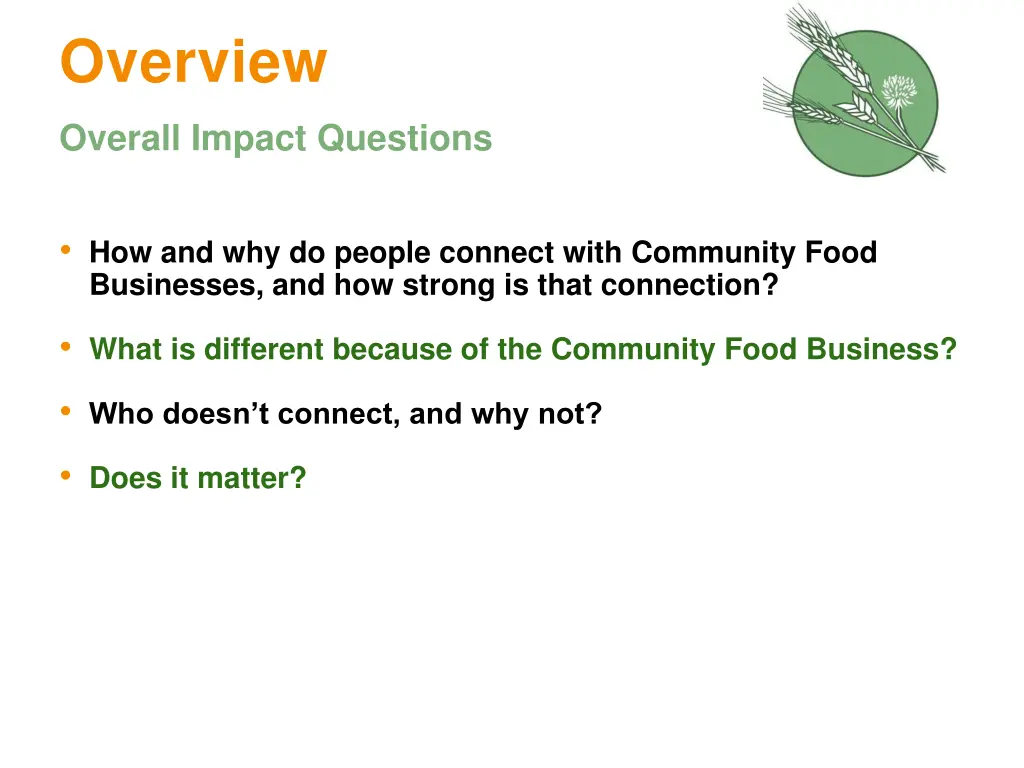
Overview Overall Impact Questions How and why do people connect with Community Food Businesses, and how strong is that connection? What is different because of the Community Food Business? Who doesn t connect, and why not? Does it matter?
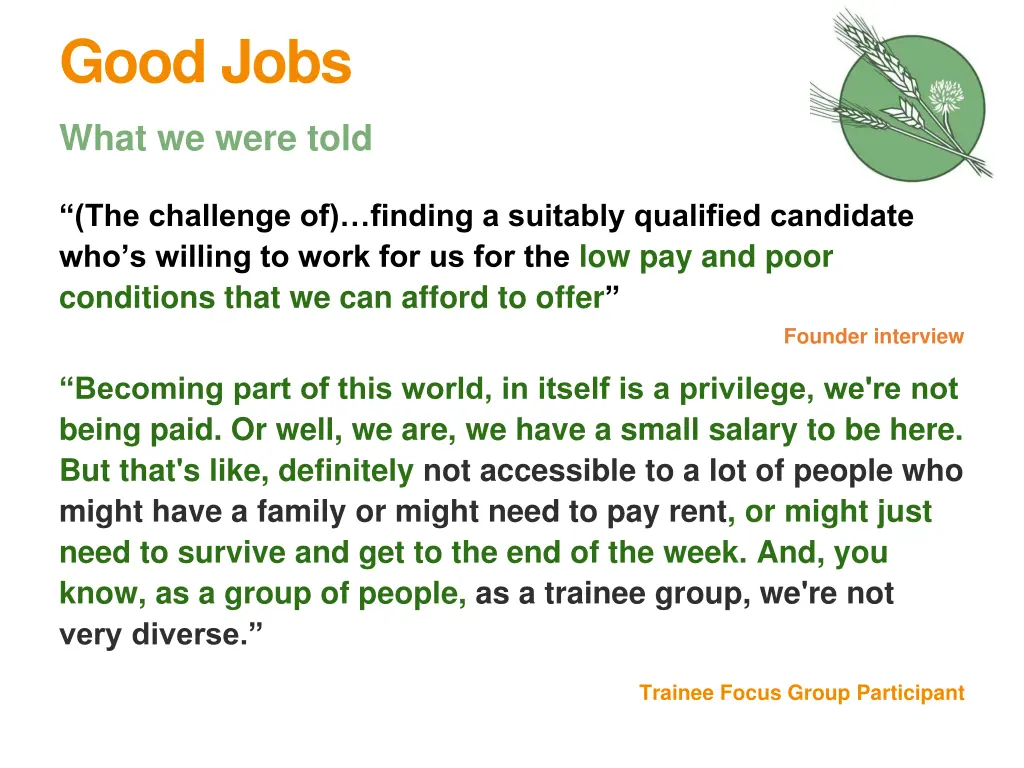
Good Jobs What we were told (The challenge of) finding a suitably qualified candidate who s willing to work for us for the low pay and poor conditions that we can afford to offer Founder interview Becoming part of this world, in itself is a privilege, we're not being paid. Or well, we are, we have a small salary to be here. But that's like, definitely not accessible to a lot of people who might have a family or might need to pay rent, or might just need to survive and get to the end of the week. And, you know, as a group of people, as a trainee group, we're not very diverse. Trainee Focus Group Participant
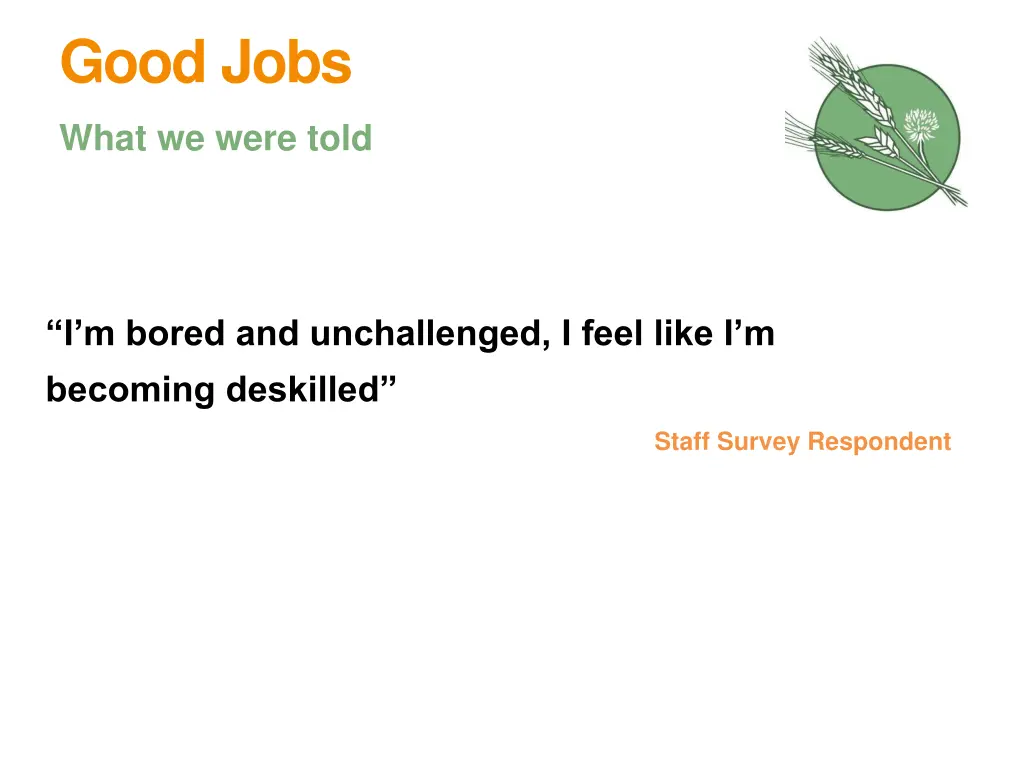
Good Jobs What we were told I m bored and unchallenged, I feel like I m becoming deskilled Staff Survey Respondent
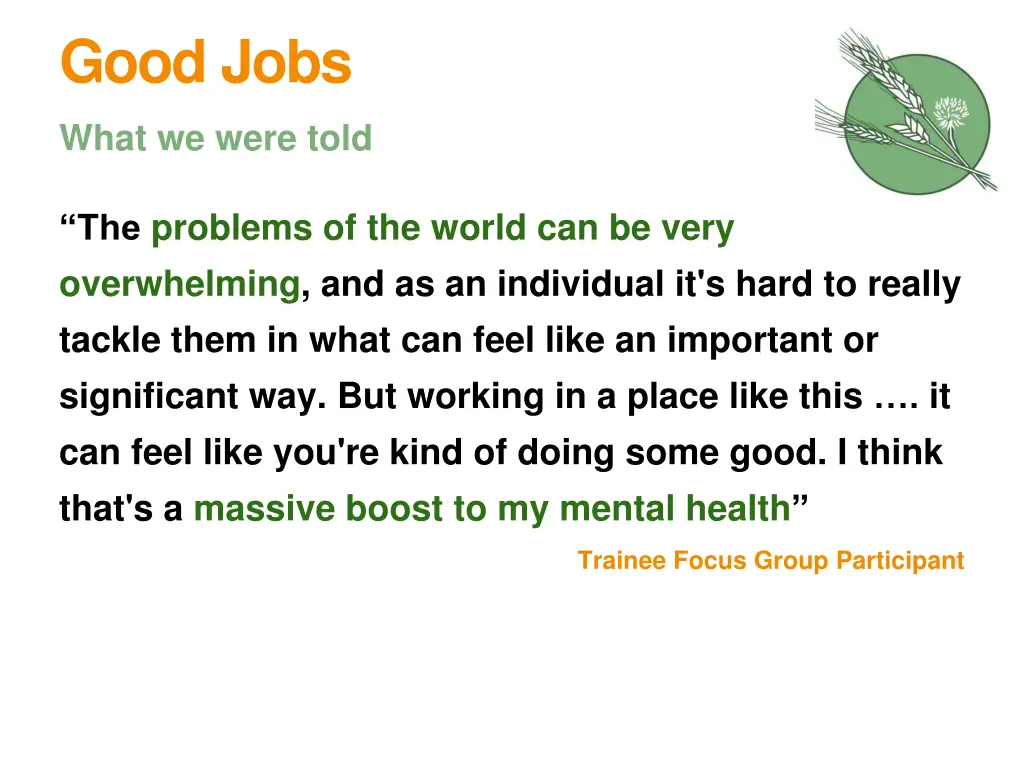
Good Jobs What we were told The problems of the world can be very overwhelming, and as an individual it's hard to really tackle them in what can feel like an important or significant way. But working in a place like this . it can feel like you're kind of doing some good. I think that's a massive boost to my mental health Trainee Focus Group Participant
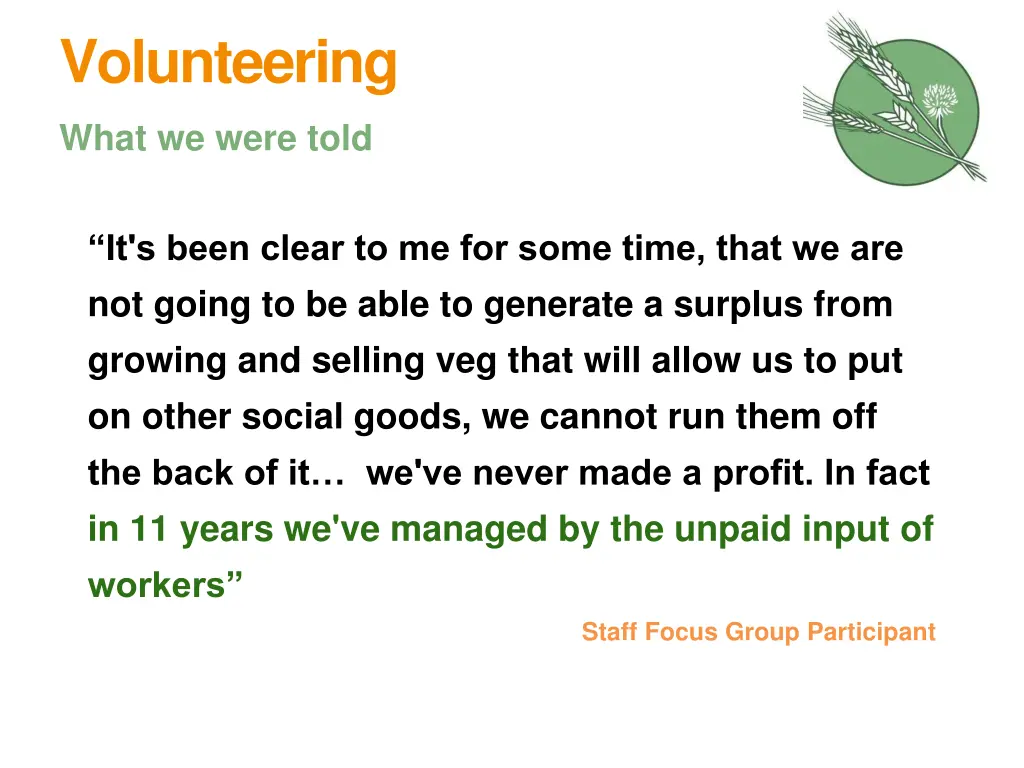
Volunteering What we were told It's been clear to me for some time, that we are not going to be able to generate a surplus from growing and selling veg that will allow us to put on other social goods, we cannot run them off the back of it we've never made a profit. In fact in 11 years we've managed by the unpaid input of workers Staff Focus Group Participant
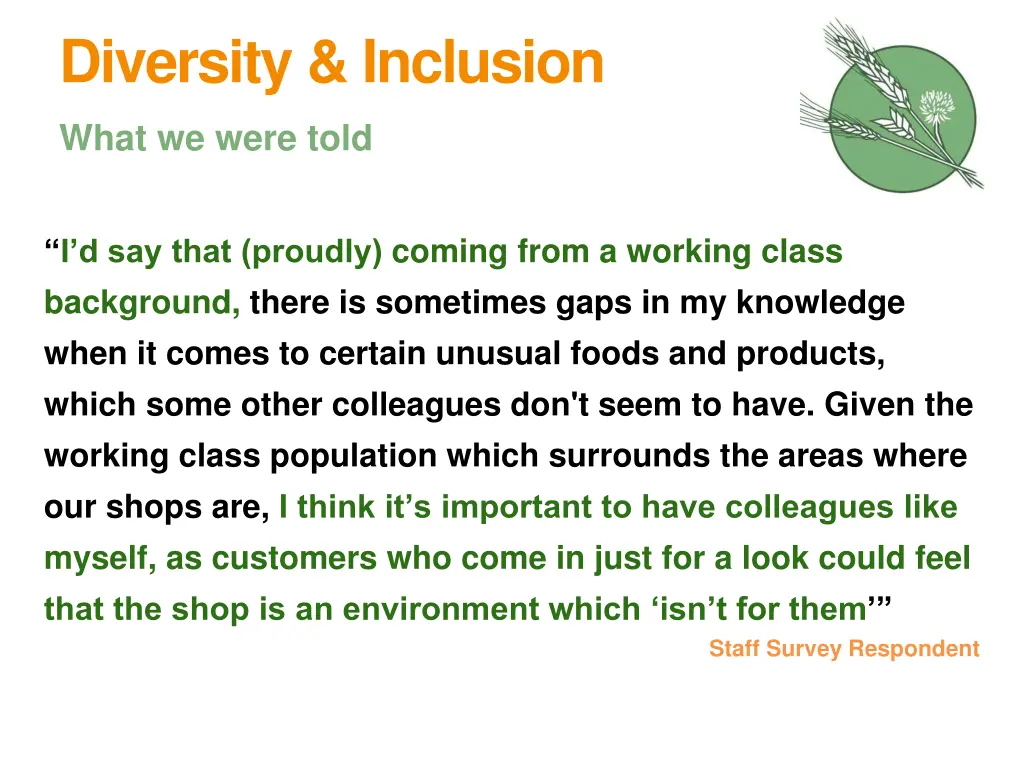
Diversity & Inclusion What we were told I d say that (proudly) coming from a working class background, there is sometimes gaps in my knowledge when it comes to certain unusual foods and products, which some other colleagues don't seem to have. Given the working class population which surrounds the areas where our shops are, I think it s important to have colleagues like myself, as customers who come in just for a look could feel that the shop is an environment which isn t for them Staff Survey Respondent
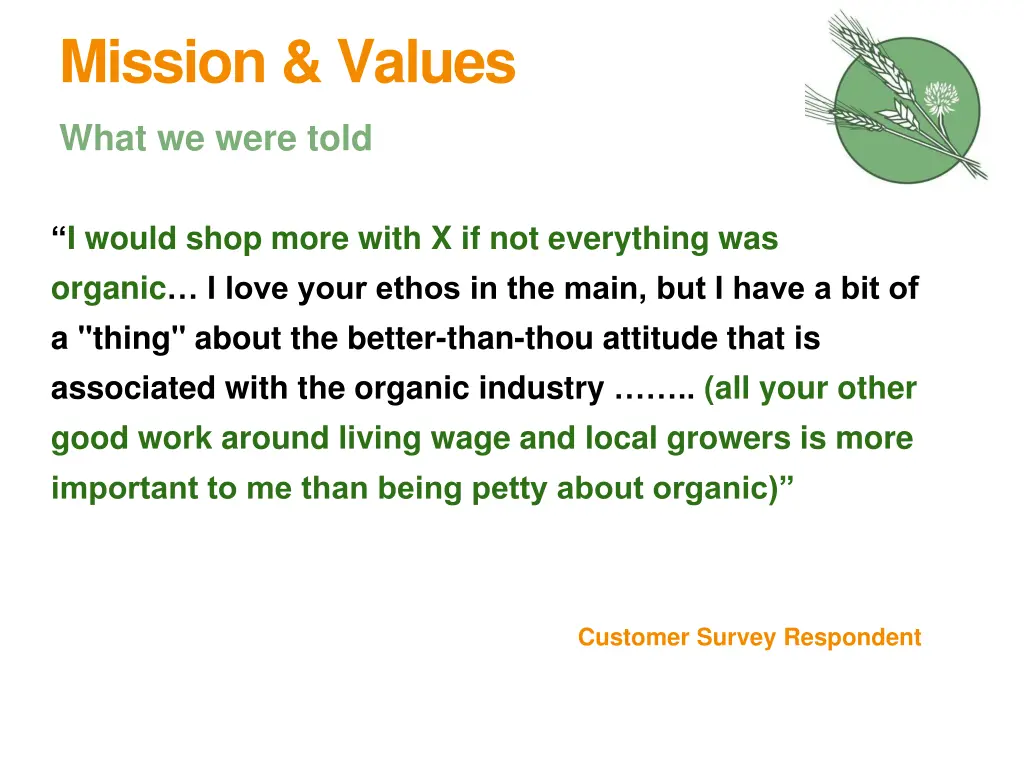
Mission & Values What we were told I would shop more with X if not everything was organic I love your ethos in the main, but I have a bit of a "thing" about the better-than-thou attitude that is associated with the organic industry .. (all your other good work around living wage and local growers is more important to me than being petty about organic) Customer Survey Respondent
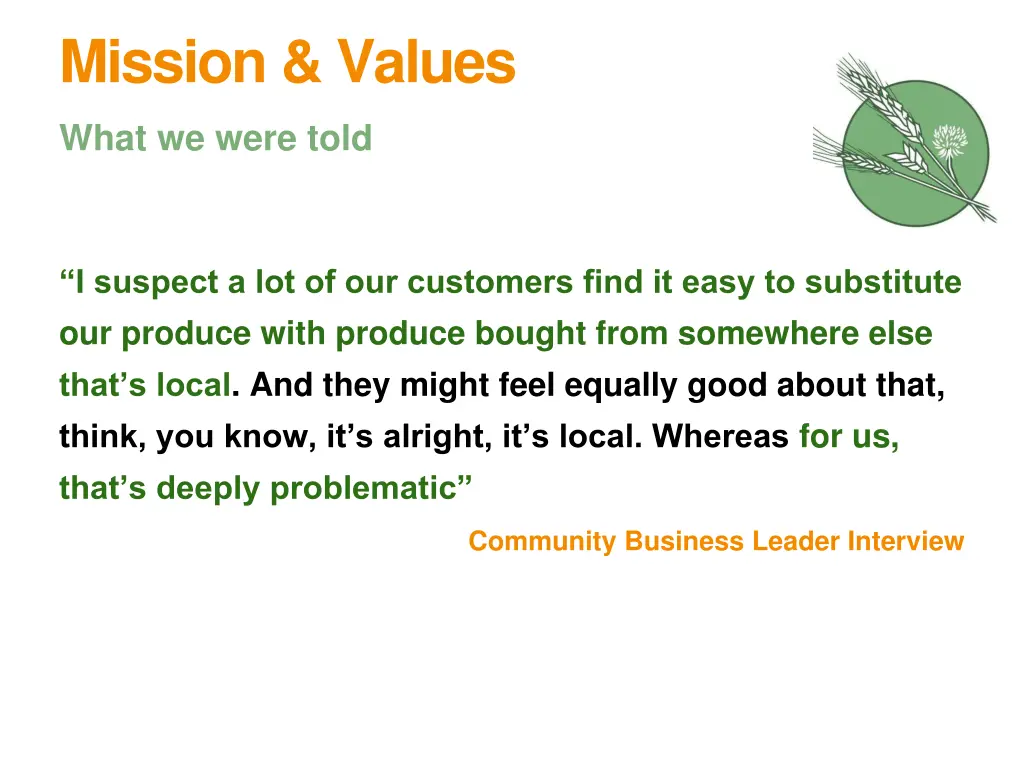
Mission & Values What we were told I suspect a lot of our customers find it easy to substitute our produce with produce bought from somewhere else that s local. And they might feel equally good about that, think, you know, it s alright, it s local. Whereas for us, that s deeply problematic Community Business Leader Interview
Breaking Out What we were told If I'm going to be honest here, I think, eating seasonally after being spoiled by a supermarket, if you're going to go back to a seasonal approach, which is the sensible approach, you are going to get bored out of your brain. I mean, at the moment, if I'm being honest, I'm sick to death of carrots in my veg box . Customer Focus Group Participant
Breaking Out What we were told You've got this conflict all the time between trying to attract customers who are going to give up their hard earned cash, in order to do this work, that is really not cash driven. It's more ethos driven....(we want to) attract people because of the ethos of the organisation because they want to be part of something. And I think what's been happening is we've been attracting people because they want nice veggies and treat us like a shop CFB Founder, Staff Focus Group
What Next Questions we want to explore further What constitutes a good job and a good traineeship? What support do CFBs need to make this possible? What is the role of volunteering and how can it be best managed and supported for the best benefit for CFBs and the volunteers? What does or should community mean in the context of the CFB and how do CFBs relate to the place and people in which they are situated? What are the barriers beyond price and access that exclude or prevent people from engaging with CFBs? Who drives the mission of CFBs? What is the role of CFBs in addressing social inequalities? Who pays for the social good that CFBs can have?
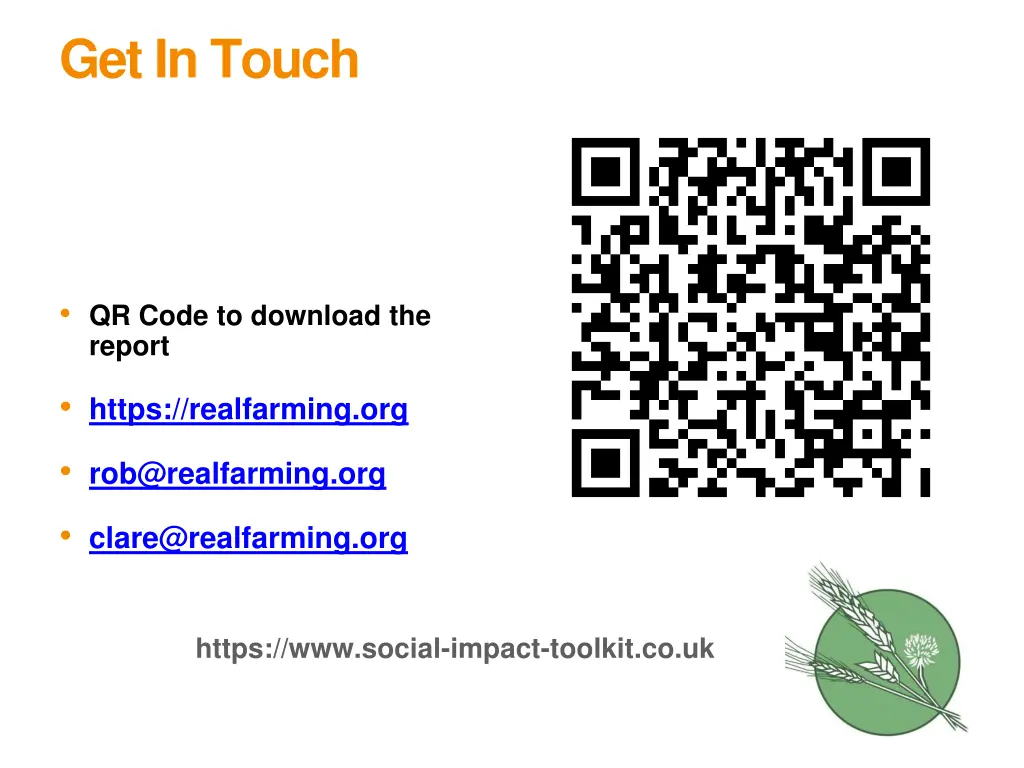
Get In Touch QR Code to download the report https://realfarming.org rob@realfarming.org clare@realfarming.org https://www.social-impact-toolkit.co.uk