Understanding Adoption Rates for Irrigation Practices in the Mid-South Region
Explore the adoption rates for irrigation practices in the Mid-South region through a detailed survey including insights on water shortage perceptions, groundwater issues, and usage of Controlled-Heating Systems (CHS). Discover the primary reasons behind the adoption of CHS and the overall response distribution from states like Mississippi, Arkansas, Louisiana, and Missouri.

Uploaded on | 3 Views
Download Presentation

Please find below an Image/Link to download the presentation.
The content on the website is provided AS IS for your information and personal use only. It may not be sold, licensed, or shared on other websites without obtaining consent from the author. If you encounter any issues during the download, it is possible that the publisher has removed the file from their server.
You are allowed to download the files provided on this website for personal or commercial use, subject to the condition that they are used lawfully. All files are the property of their respective owners.
The content on the website is provided AS IS for your information and personal use only. It may not be sold, licensed, or shared on other websites without obtaining consent from the author.
E N D
Presentation Transcript
Adoption Rates for Irrigation Practices in the Mid-south C.G. Henry, L.J. Krutz, J. Henggeler, R. Levy RISER RISER
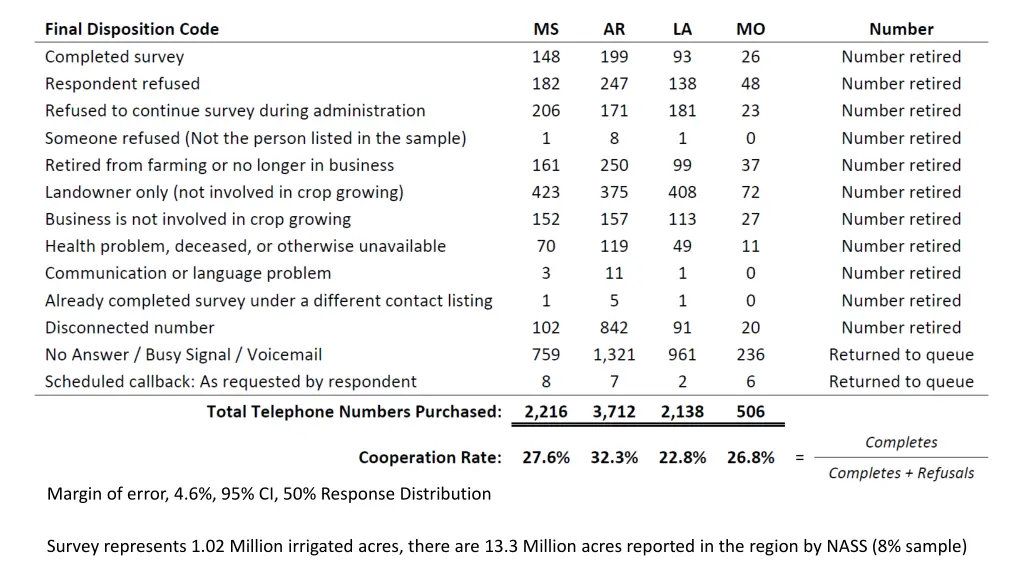
Margin of error, 4.6%, 95% CI, 50% Response Distribution Survey represents 1.02 Million irrigated acres, there are 13.3 Million acres reported in the region by NASS (8% sample)
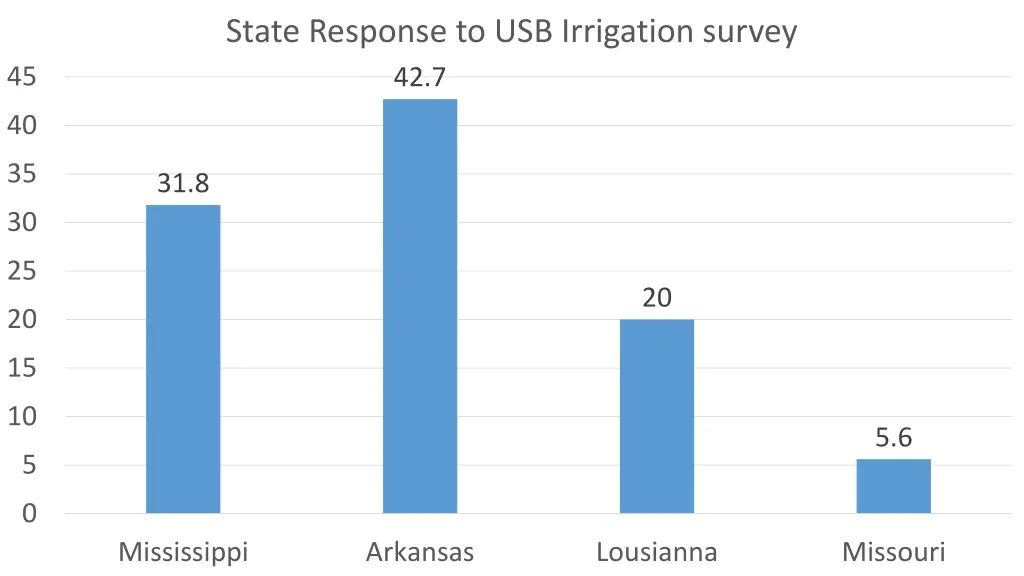
State Response to USB Irrigation survey 45 42.7 40 35 31.8 30 25 20 20 15 10 5.6 5 0 Mississippi Arkansas Lousianna Missouri
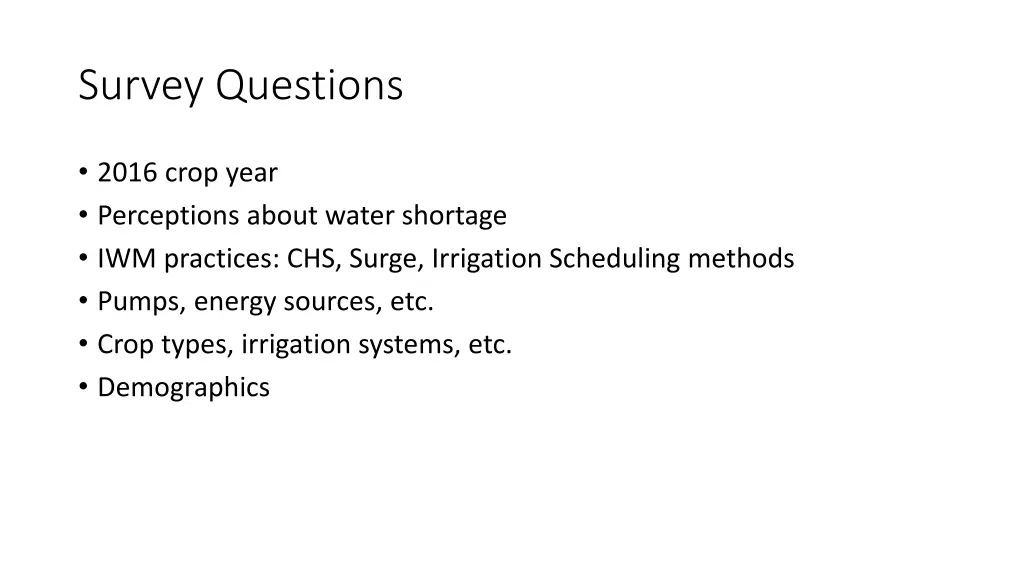
Survey Questions 2016 crop year Perceptions about water shortage IWM practices: CHS, Surge, Irrigation Scheduling methods Pumps, energy sources, etc. Crop types, irrigation systems, etc. Demographics
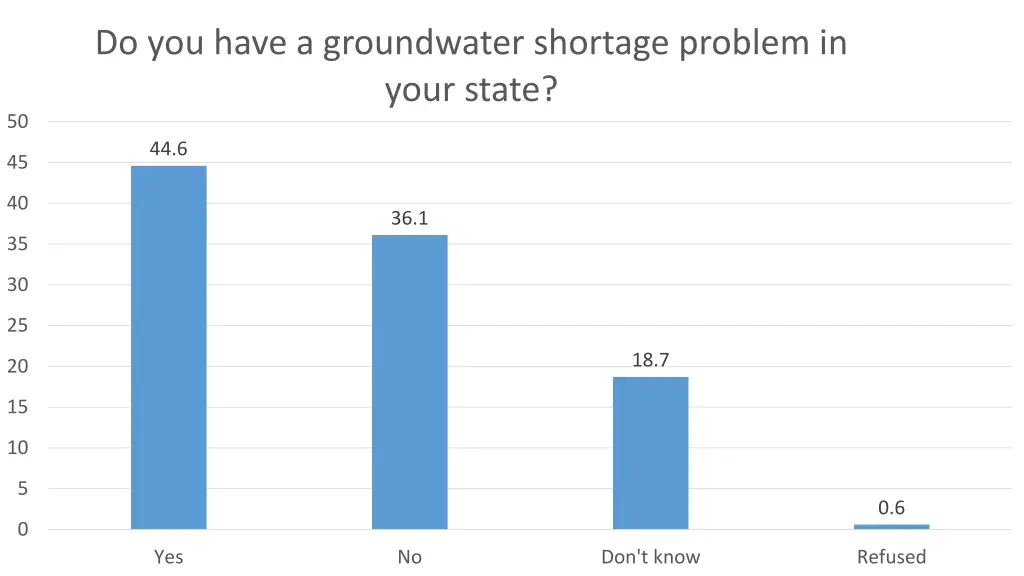
Do you have a groundwater shortage problem in your state? 50 44.6 45 40 36.1 35 30 25 18.7 20 15 10 5 0.6 0 Yes No Don't know Refused
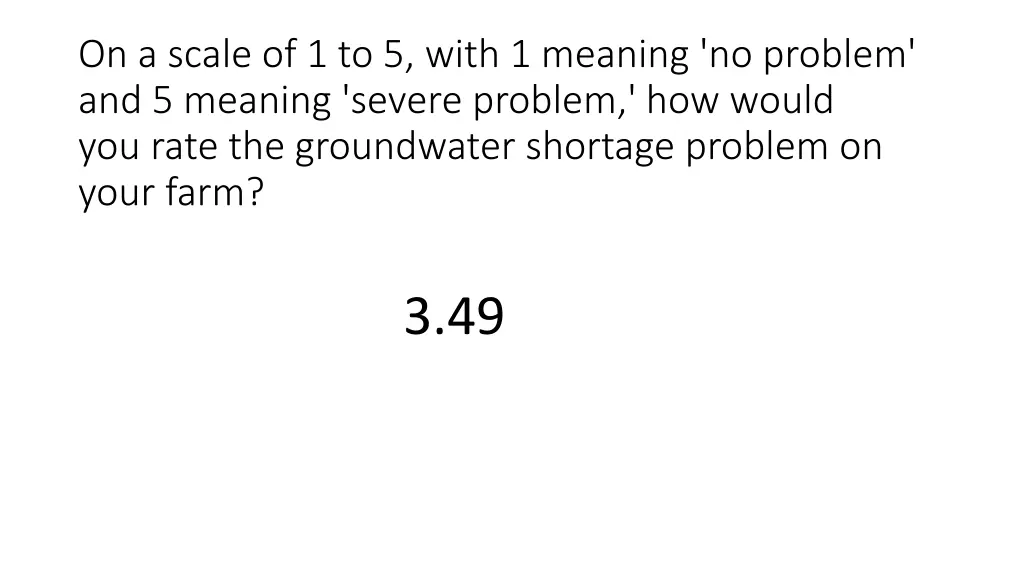
On a scale of 1 to 5, with 1 meaning 'no problem' and 5 meaning 'severe problem,' how would you rate the groundwater shortage problem on your farm? 3.49
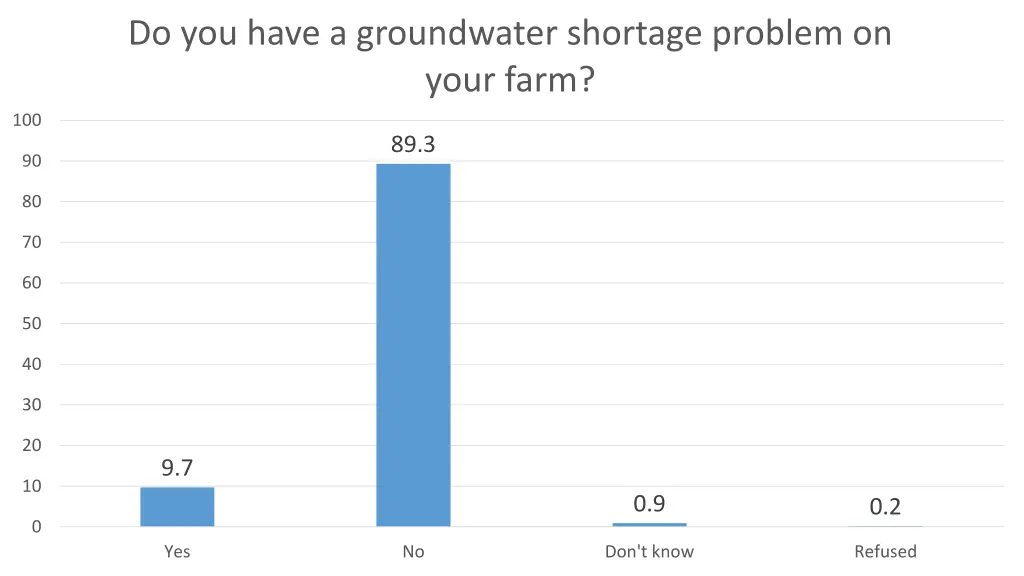
Do you have a groundwater shortage problem on your farm? 100 89.3 90 80 70 60 50 40 30 20 9.7 10 0.9 0.2 0 Yes No Don't know Refused
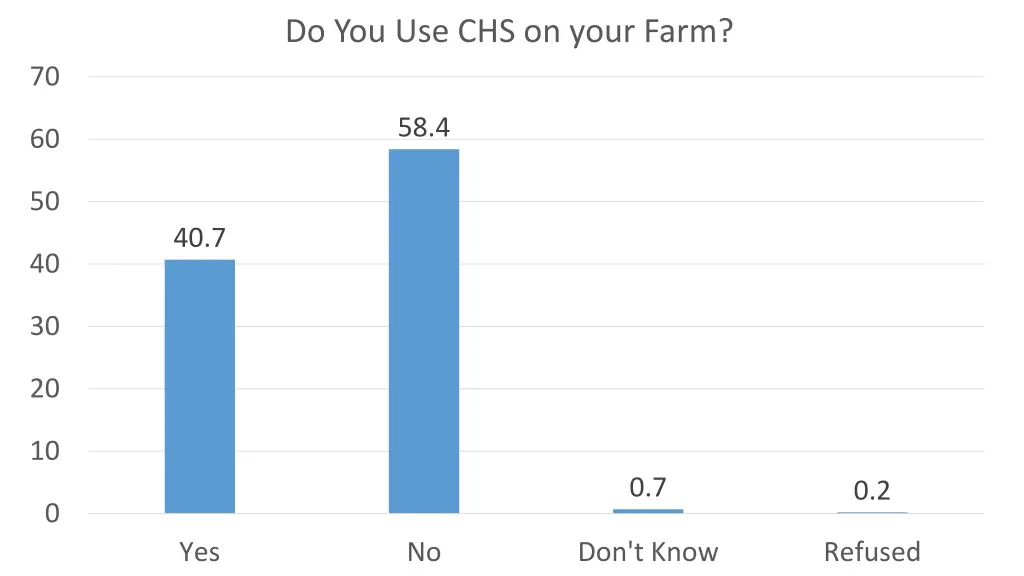
Do You Use CHS on your Farm? 70 58.4 60 50 40.7 40 30 20 10 0.7 0.2 0 Yes No Don't Know Refused
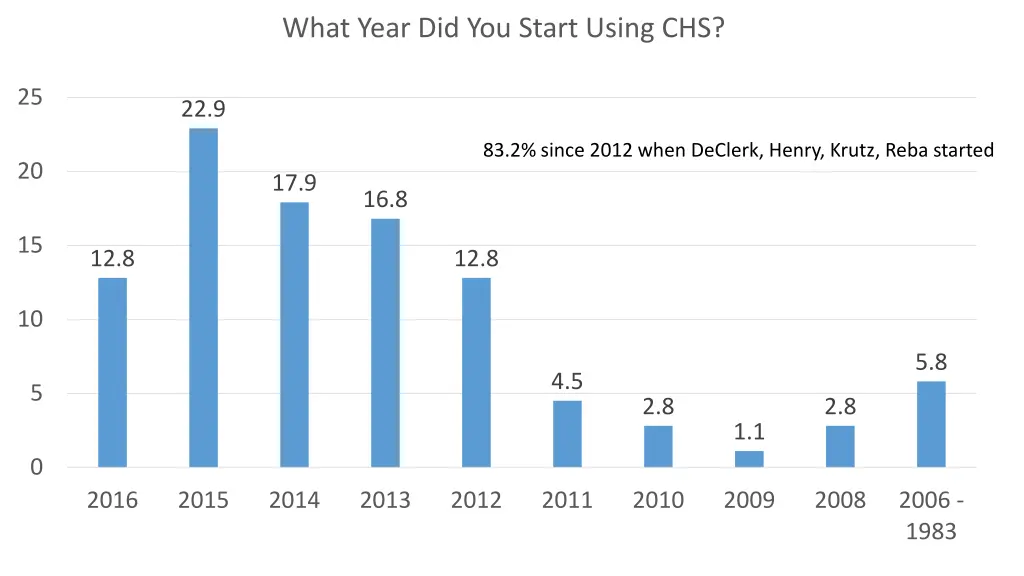
What Year Did You Start Using CHS? 25 22.9 83.2% since 2012 when DeClerk, Henry, Krutz, Reba started 20 17.9 16.8 15 12.8 12.8 10 5.8 4.5 5 2.8 2.8 1.1 0 2016 2015 2014 2013 2012 2011 2010 2009 2008 2006 - 1983
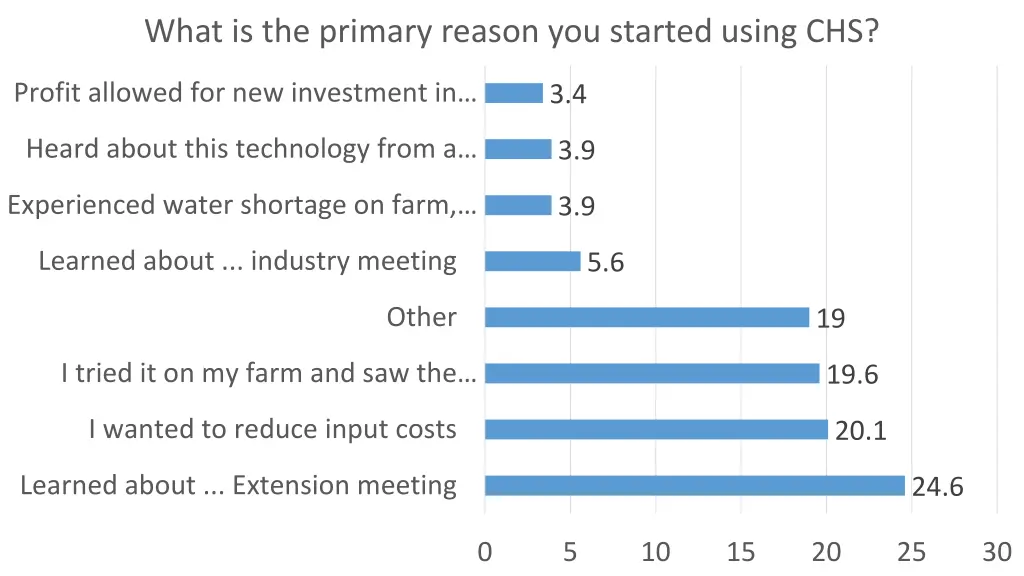
What is the primary reason you started using CHS? Profit allowed for new investment in 3.4 Heard about this technology from a 3.9 Experienced water shortage on farm, 3.9 Learned about ... industry meeting 5.6 Other 19 I tried it on my farm and saw the 19.6 I wanted to reduce input costs 20.1 Learned about ... Extension meeting 24.6 0 5 10 15 20 25 30
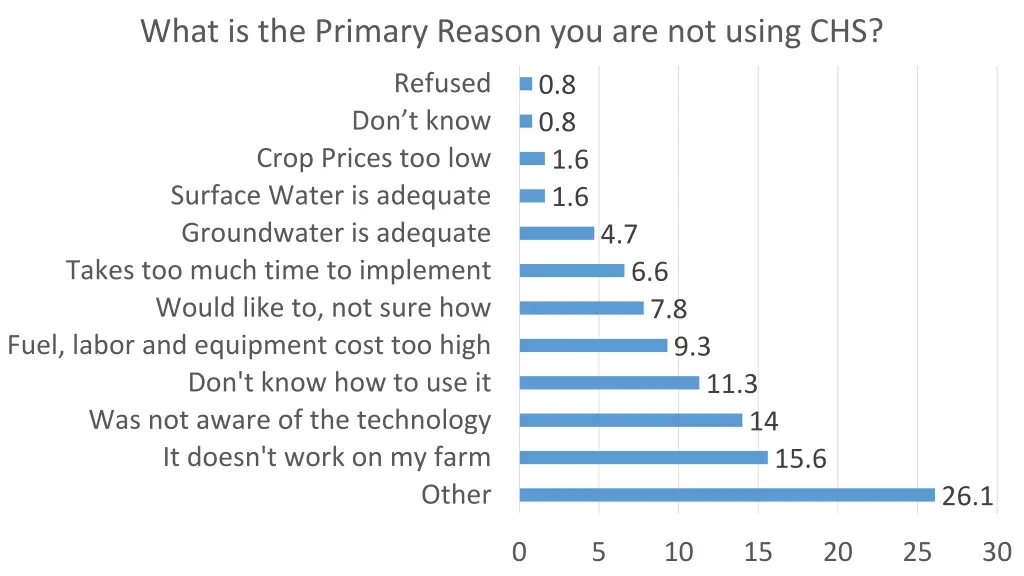
What is the Primary Reason you are not using CHS? Refused 0.8 Don t know 0.8 Crop Prices too low 1.6 Surface Water is adequate 1.6 Groundwater is adequate 4.7 Takes too much time to implement 6.6 Would like to, not sure how 7.8 Fuel, labor and equipment cost too high 9.3 Don't know how to use it 11.3 Was not aware of the technology 14 It doesn't work on my farm 15.6 Other 26.1 0 5 10 15 20 25 30
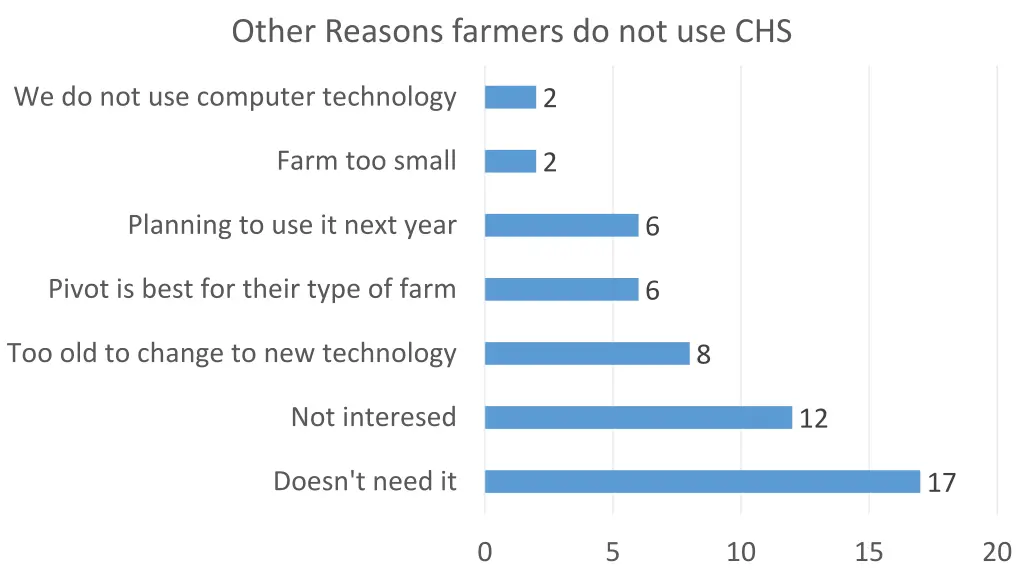
Other Reasons farmers do not use CHS We do not use computer technology 2 Farm too small 2 Planning to use it next year 6 Pivot is best for their type of farm 6 Too old to change to new technology 8 Not interesed 12 Doesn't need it 17 0 5 10 15 20
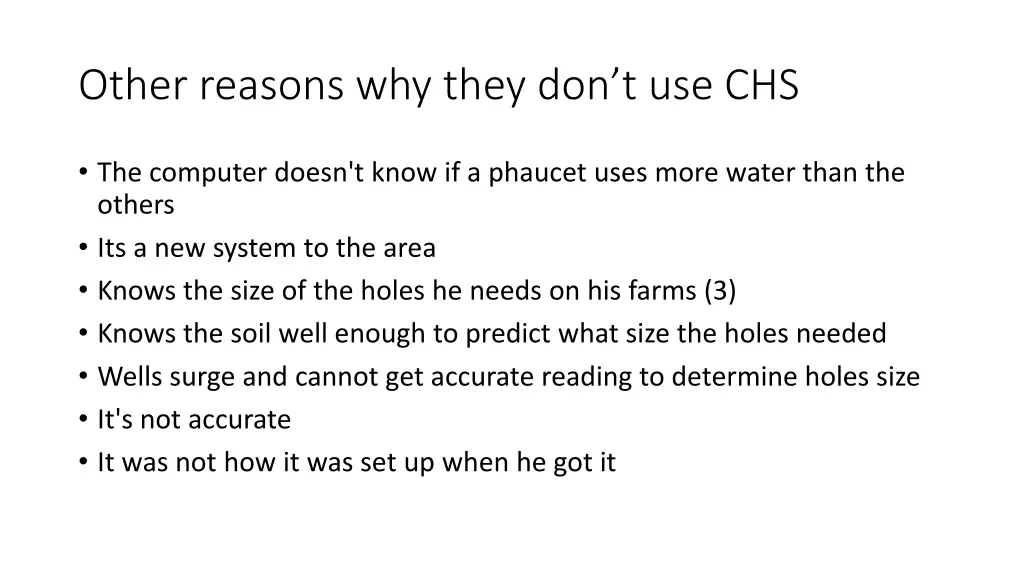
Other reasons why they dont use CHS The computer doesn't know if a phaucet uses more water than the others Its a new system to the area Knows the size of the holes he needs on his farms (3) Knows the soil well enough to predict what size the holes needed Wells surge and cannot get accurate reading to determine holes size It's not accurate It was not how it was set up when he got it
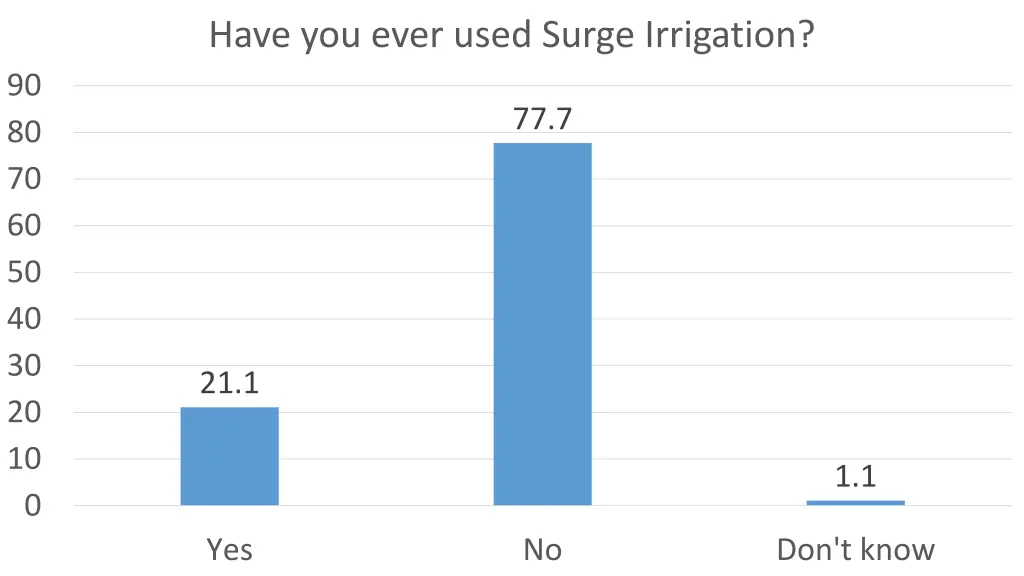
Have you ever used Surge Irrigation? 90 77.7 80 70 60 50 40 30 21.1 20 10 1.1 0 Yes No Don't know
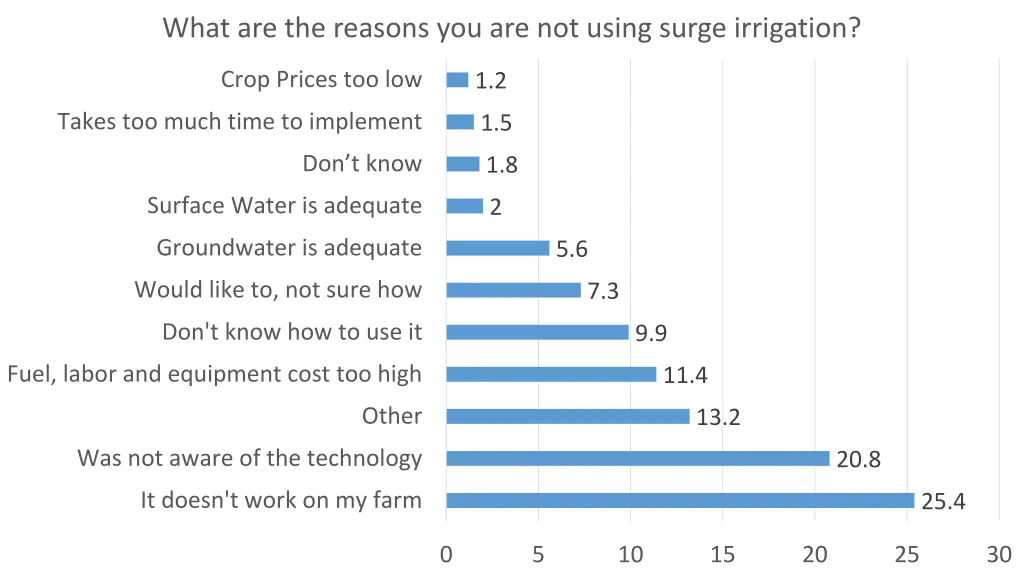
What are the reasons you are not using surge irrigation? Crop Prices too low 1.2 Takes too much time to implement 1.5 Don t know 1.8 Surface Water is adequate 2 Groundwater is adequate 5.6 Would like to, not sure how 7.3 Don't know how to use it 9.9 Fuel, labor and equipment cost too high 11.4 Other 13.2 Was not aware of the technology 20.8 It doesn't work on my farm 25.4 0 5 10 15 20 25 30
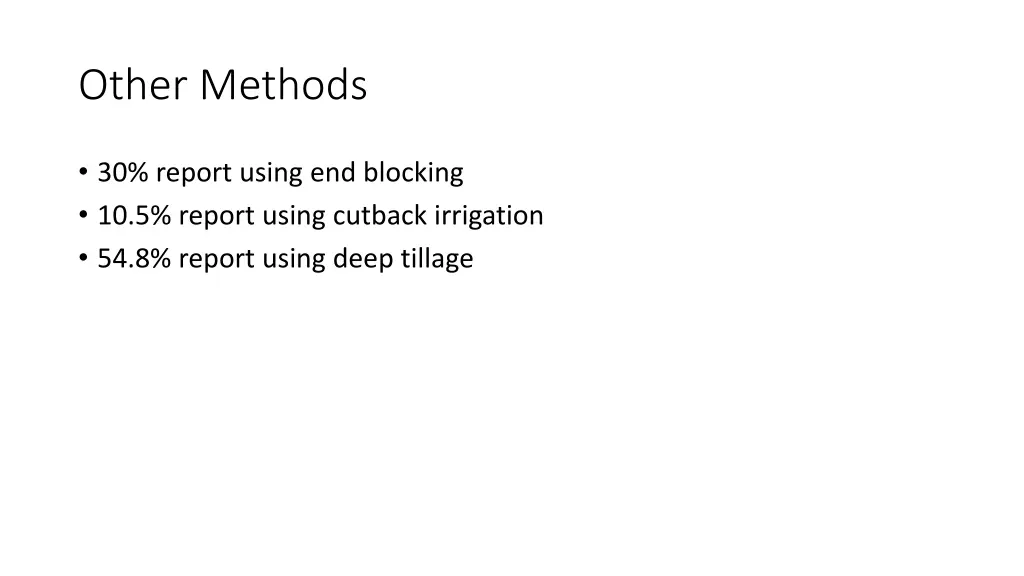
Other Methods 30% report using end blocking 10.5% report using cutback irrigation 54.8% report using deep tillage
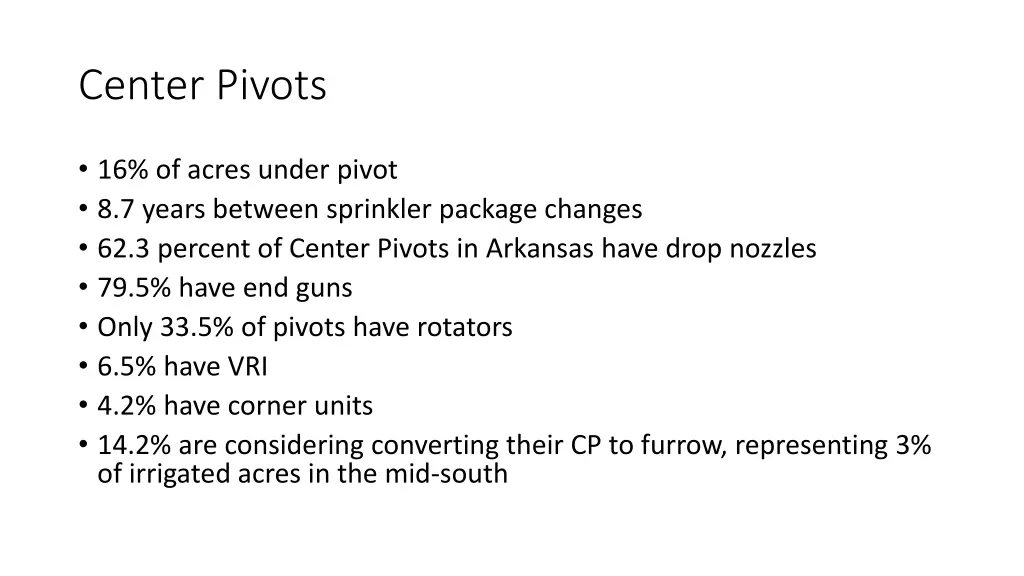
Center Pivots 16% of acres under pivot 8.7 years between sprinkler package changes 62.3 percent of Center Pivots in Arkansas have drop nozzles 79.5% have end guns Only 33.5% of pivots have rotators 6.5% have VRI 4.2% have corner units 14.2% are considering converting their CP to furrow, representing 3% of irrigated acres in the mid-south
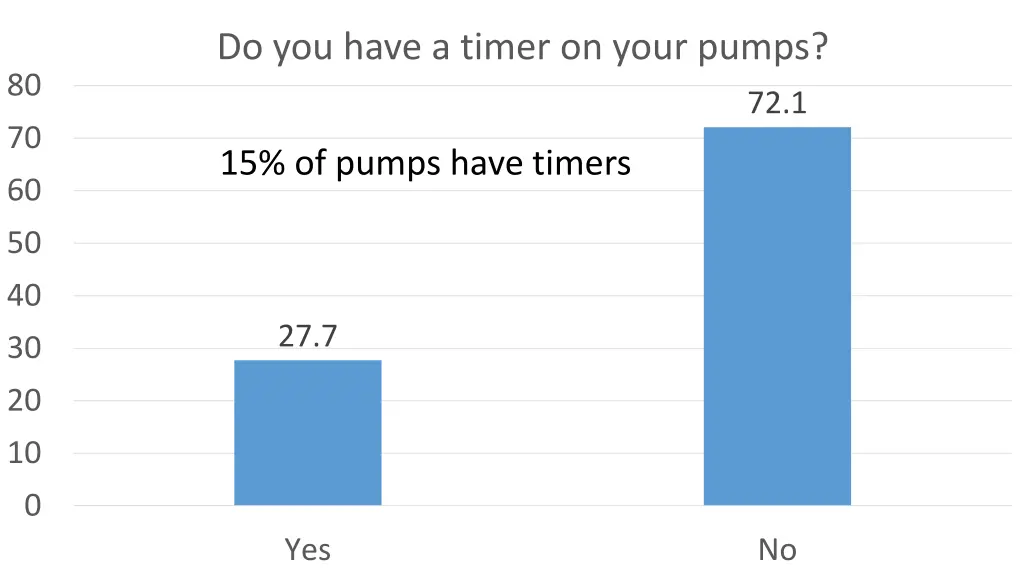
Do you have a timer on your pumps? 80 72.1 70 15% of pumps have timers 60 50 40 27.7 30 20 10 0 Yes No
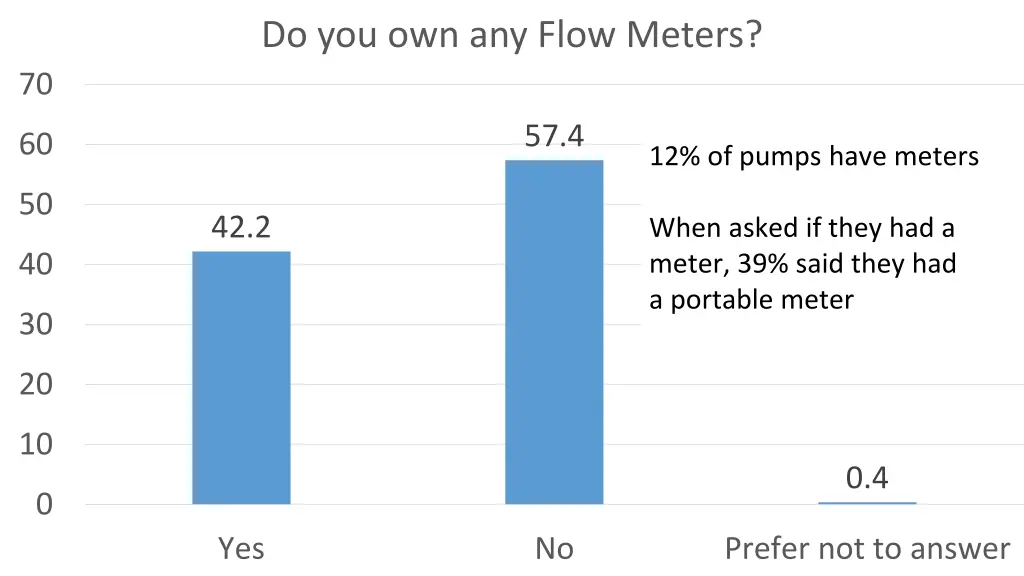
Do you own any Flow Meters? 70 57.4 60 12% of pumps have meters 50 42.2 When asked if they had a meter, 39% said they had a portable meter 40 30 20 10 0.4 0 Yes No Prefer not to answer
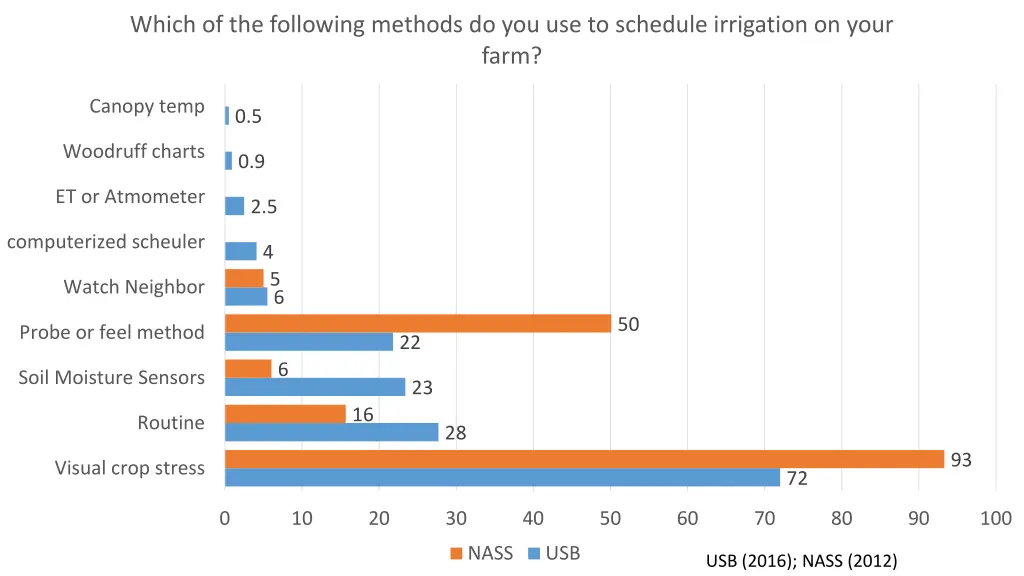
Which of the following methods do you use to schedule irrigation on your farm? Canopy temp 0.5 Woodruff charts 0.9 ET or Atmometer 2.5 computerized scheuler 4 5 Watch Neighbor 6 50 Probe or feel method 22 6 Soil Moisture Sensors 23 16 Routine 28 93 Visual crop stress 72 0 10 20 30 40 50 60 70 80 90 100 NASS USB USB (2016); NASS (2012)
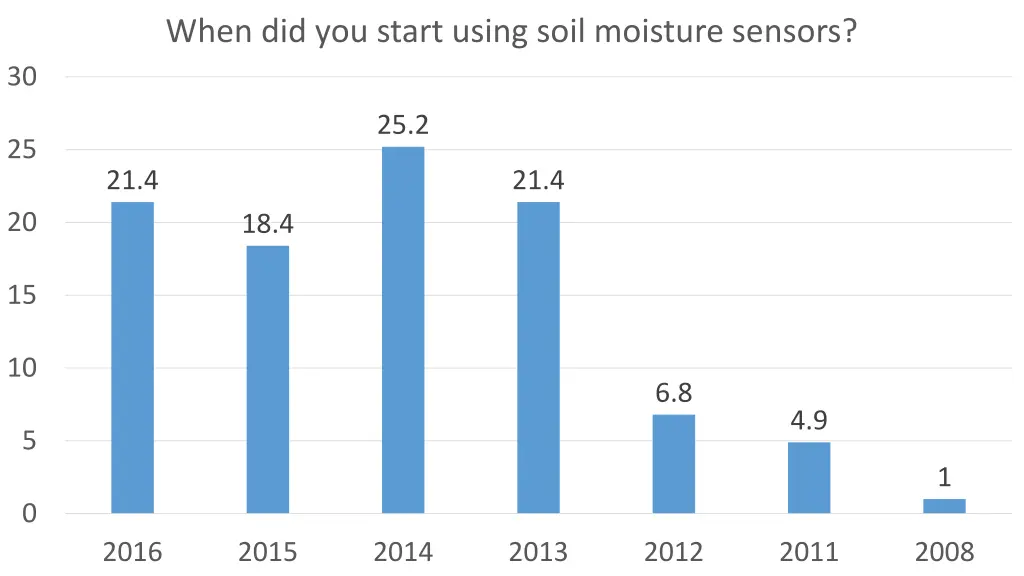
When did you start using soil moisture sensors? 30 25.2 25 21.4 21.4 20 18.4 15 10 6.8 4.9 5 1 0 2016 2015 2014 2013 2012 2011 2008
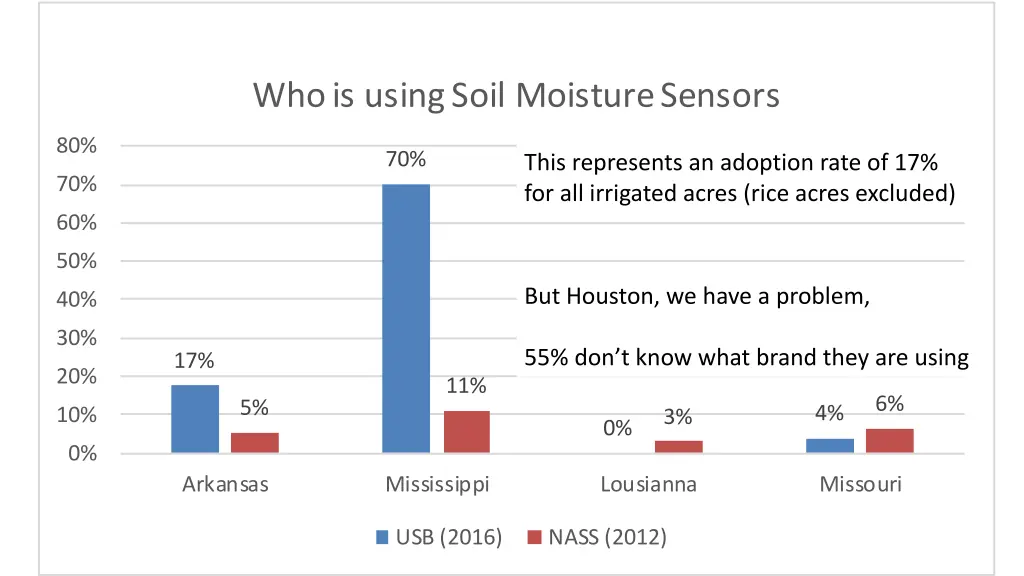
Who is using Soil Moisture Sensors 80% 70% This represents an adoption rate of 17% for all irrigated acres (rice acres excluded) 70% 60% 50% But Houston, we have a problem, 40% 30% 55% don t know what brand they are using 17% 20% 11% 6% 5% 4% 10% 3% 0% 0% Arkansas Mississippi Lousianna Missouri USB (2016) NASS (2012)
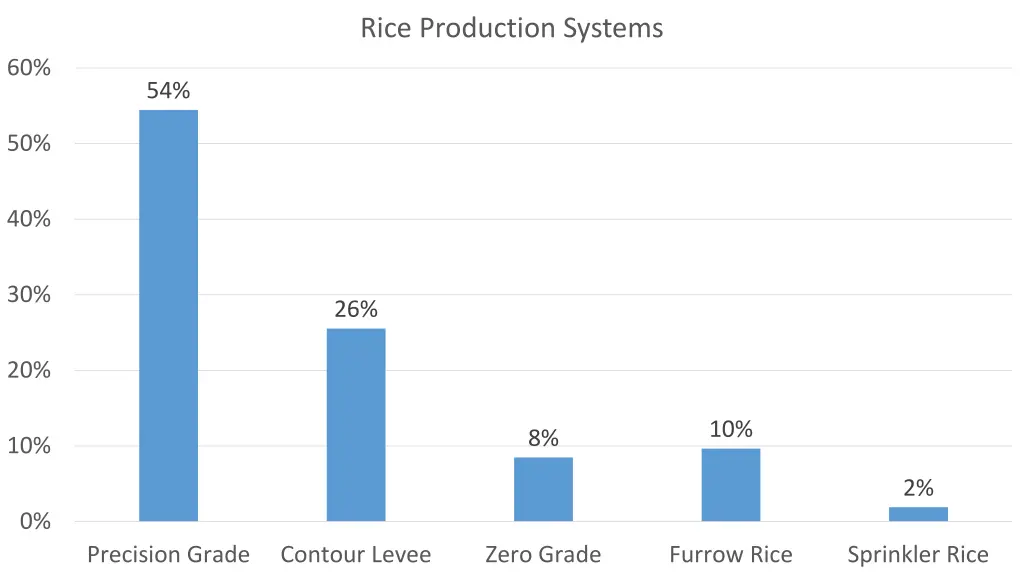
Rice Production Systems 60% 54% 50% 40% 30% 26% 20% 10% 8% 10% 2% 0% Precision Grade Contour Levee Zero Grade Furrow Rice Sprinkler Rice
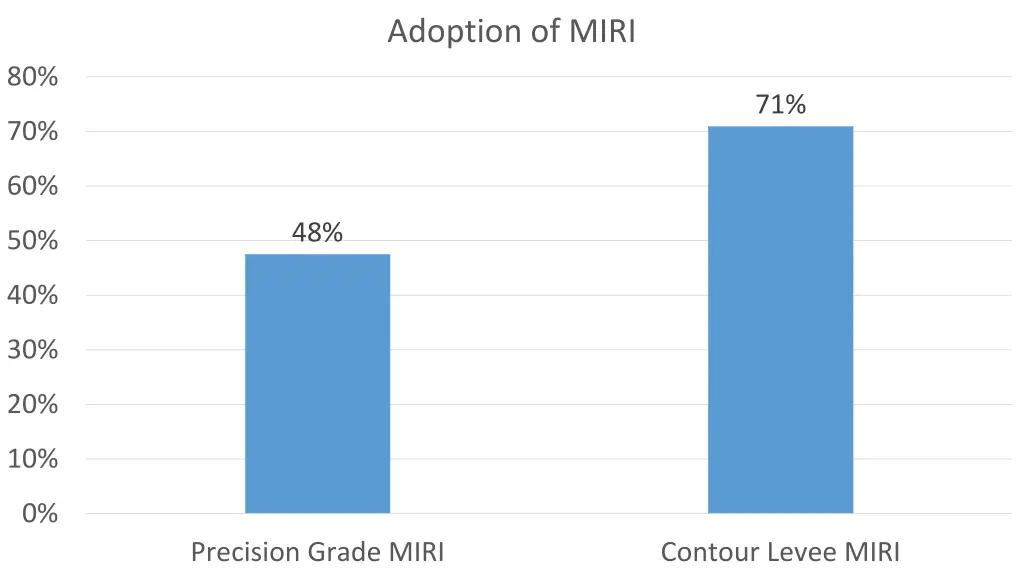
Adoption of MIRI 80% 71% 70% 60% 48% 50% 40% 30% 20% 10% 0% Precision Grade MIRI Contour Levee MIRI
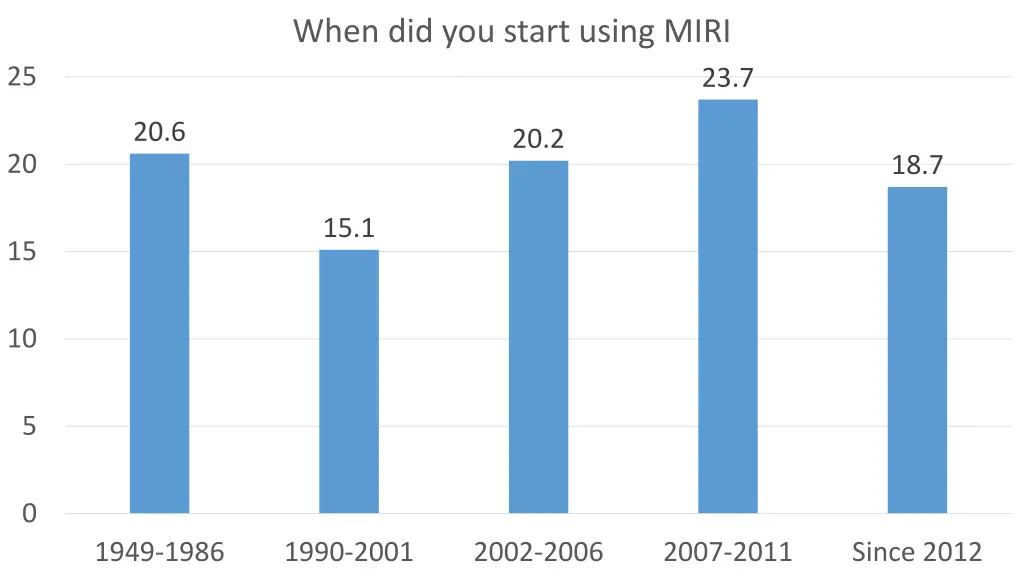
When did you start using MIRI 25 23.7 20.6 20.2 20 18.7 15.1 15 10 5 0 1949-1986 1990-2001 2002-2006 2007-2011 Since 2012
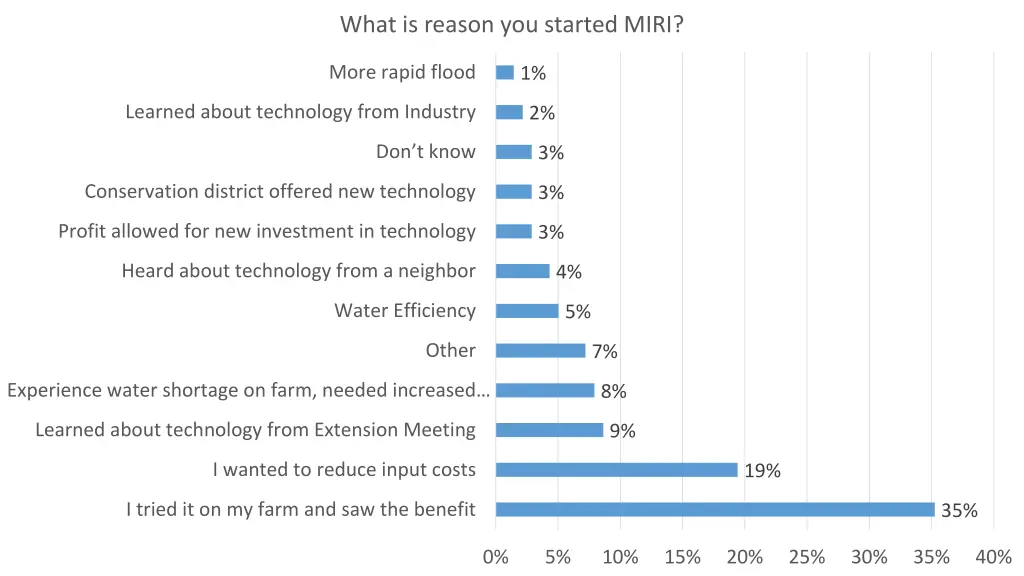
What is reason you started MIRI? More rapid flood 1% Learned about technology from Industry 2% Don t know 3% Conservation district offered new technology 3% Profit allowed for new investment in technology 3% Heard about technology from a neighbor 4% Water Efficiency 5% Other 7% Experience water shortage on farm, needed increased 8% Learned about technology from Extension Meeting 9% I wanted to reduce input costs 19% I tried it on my farm and saw the benefit 35% 0% 5% 10% 15% 20% 25% 30% 35% 40%
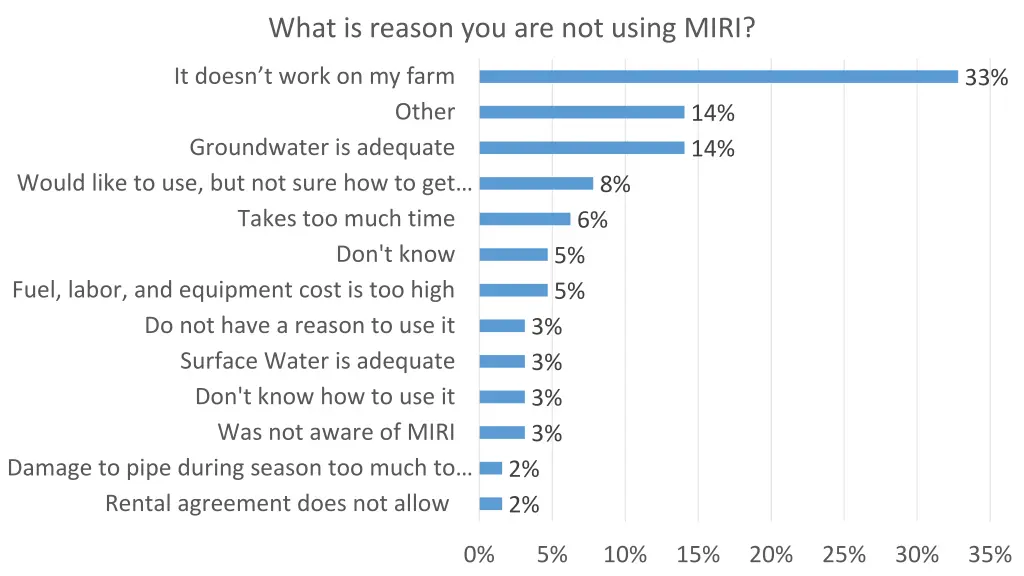
What is reason you are not using MIRI? It doesn t work on my farm 33% Other 14% Groundwater is adequate 14% Would like to use, but not sure how to get 8% Takes too much time 6% Don't know 5% Fuel, labor, and equipment cost is too high 5% Do not have a reason to use it 3% Surface Water is adequate 3% Don't know how to use it 3% Was not aware of MIRI 3% Damage to pipe during season too much to 2% Rental agreement does not allow 2% 0% 5% 10% 15% 20% 25% 30% 35%
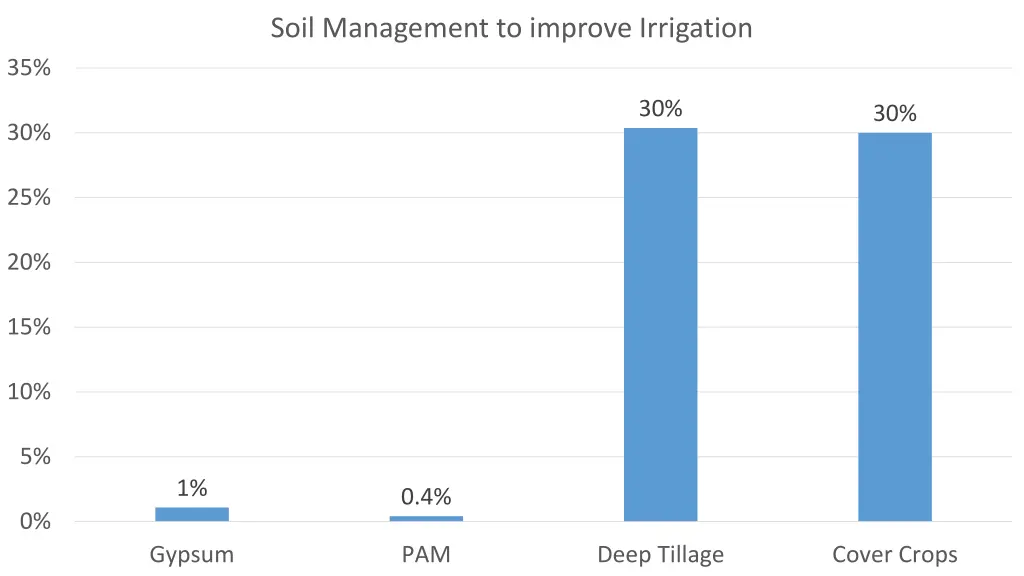
Soil Management to improve Irrigation 35% 30% 30% 30% 25% 20% 15% 10% 5% 1% 0.4% 0% Gypsum PAM Deep Tillage Cover Crops
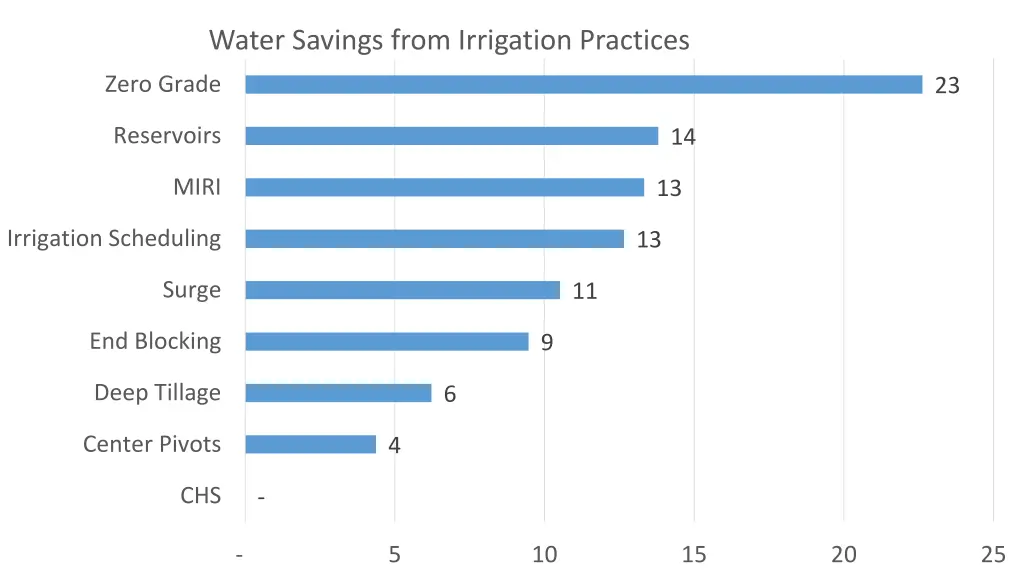
Water Savings from Irrigation Practices Zero Grade 23 Reservoirs 14 MIRI 13 Irrigation Scheduling 13 Surge 11 End Blocking 9 Deep Tillage 6 Center Pivots 4 CHS - - 5 10 15 20 25
Take Home Message Hey guys, the state has a serious water problem, but it s not on my farm. Major improvement in CHS practices showed up in survey, likely due to DP and Extension programs for Pipe Planner. Doesn t work on my farm or Doesn t need it most reported excuse to CHS Doesn t work on my farm or Don t know how to use it most reported excuse for not using MIRI MIRI adoption is high, but questionable. If they tried it and saw the benefit, they adopted it. They also appear to adopt practices because of Extension meetings. Perception is that water savings are small; reason for doing them is to reduce production costs