Learn about the pitfalls of excessive comma usage, particularly with transitions and conjunctions, and how to create more concise and effective sentences by choosing the right punctuation. Explore examples and solutions to improve your writing skills.
Please find below an Image/Link to download the presentation.
The content on the website is provided AS IS for your information and personal use only. It may not be sold, licensed, or shared on other websites without obtaining consent from the author. If you encounter any issues during the download, it is possible that the publisher has removed the file from their server.
You are allowed to download the files provided on this website for personal or commercial use, subject to the condition that they are used lawfully. All files are the property of their respective owners.
The content on the website is provided AS IS for your information and personal use only. It may not be sold, licensed, or shared on other websites without obtaining consent from the author.
E N D
Presentation Transcript
,,,,,,,,,,,,,, The Comma Calamity By Gina Scott ,,,,,,,,,,,,,,
Whats the Problem? Comma overuse, especially with transitions Coordinating conjunctions such as and, but, and for, vs. semicolons vs. periods Too many commas, along with conjunctions, create long and unwieldy sentences Repetition -> Monotony like They Say, I Say Solution: Watch out for sentence length & repetition
Why is there a Problem? Comma shows pause, w/ conjunction joins two independent clauses Independent Clause: phrase where the subject and verb must form a complete thought (Purdue) If 1 subject, 2 actions, change 2nd clause to dependent and add conjunction only; ex: I was dancing. I was singing. vs. I was dancing and singing. Signals that one idea is ending and another is beginning (Bullock et al. 386) But periods & semicolons do the same thing! . separates sentences ; joins related clauses
Which Do I Choose? Step 1 First, decide 1 sentence or 2 Determined by sentence length If it s already long, around 3 lines, separate w/period If it s still short, you can use comma w/ (or if 1 subject w/o) conjunction or semicolon
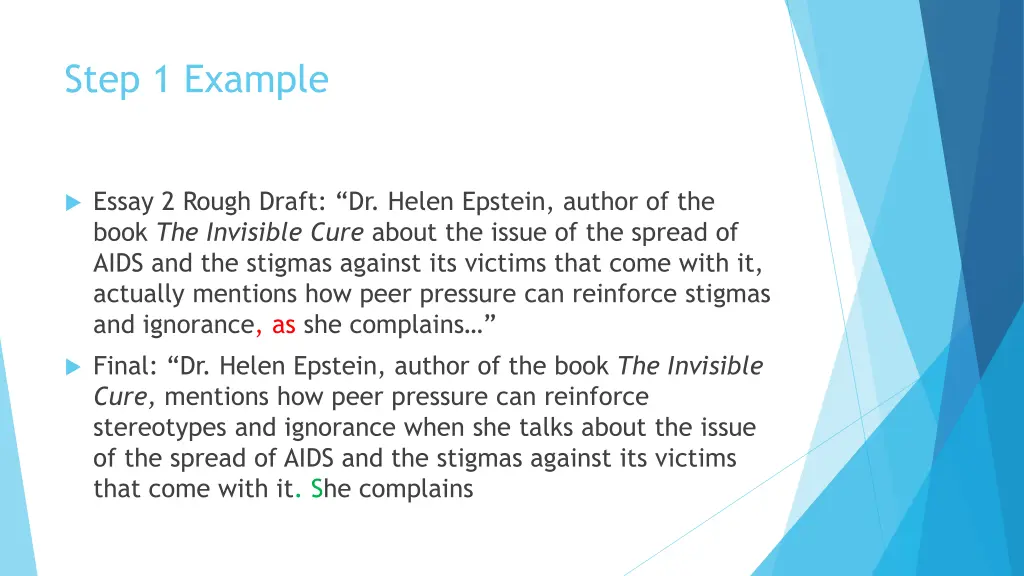
Step 1 Example Essay 2 Rough Draft: Dr. Helen Epstein, author of the book The Invisible Cure about the issue of the spread of AIDS and the stigmas against its victims that come with it, actually mentions how peer pressure can reinforce stigmas and ignorance, as she complains Final: Dr. Helen Epstein, author of the book The Invisible Cure, mentions how peer pressure can reinforce stereotypes and ignorance when shetalks aboutthe issue of the spread of AIDS and the stigmas against its victims that come with it. She complains
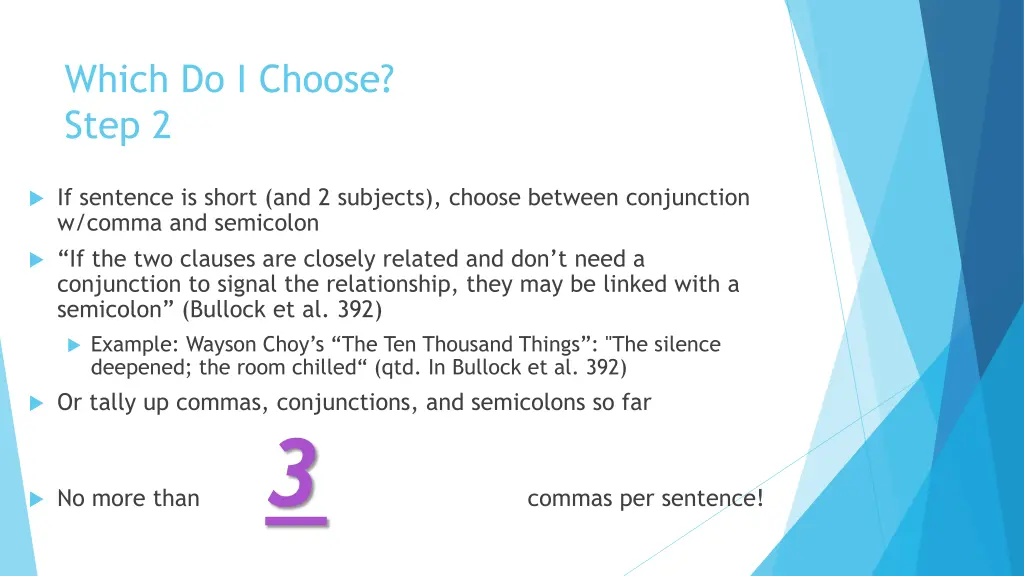
Which Do I Choose? Step 2 If sentence is short (and 2 subjects), choose between conjunction w/comma and semicolon If the two clauses are closely related and don t need a conjunction to signal the relationship, they may be linked with a semicolon (Bullock et al. 392) Example: Wayson Choy s The Ten Thousand Things : "The silence deepened; the room chilled (qtd. In Bullock et al. 392) Or tally up commas, conjunctions, and semicolons so far 3 No more than commas per sentence!
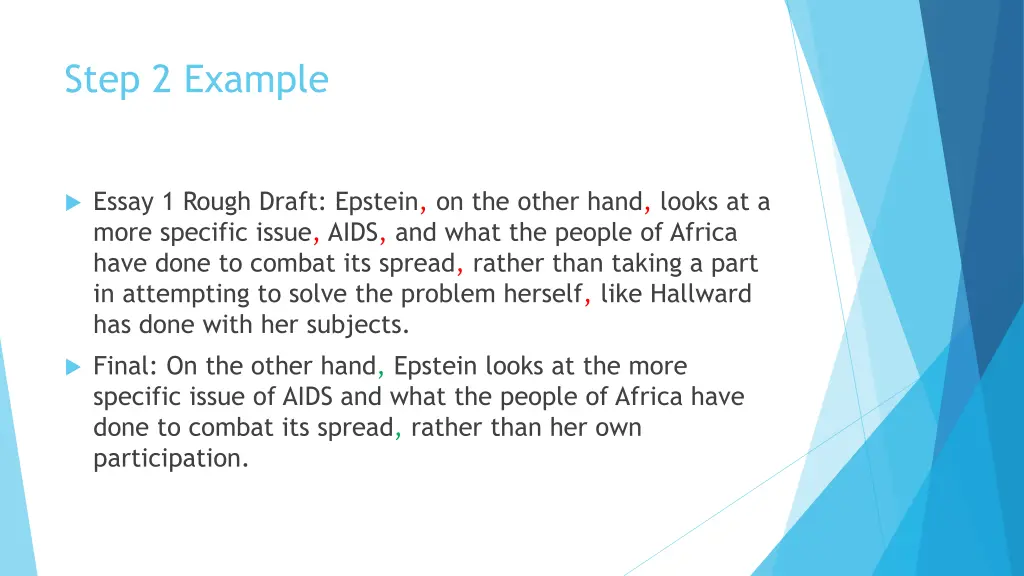
Step 2 Example Essay 1 Rough Draft: Epstein, on the other hand, looks at a more specific issue, AIDS, and what the people of Africa have done to combat its spread, rather than taking a part in attempting to solve the problem herself, like Hallward has done with her subjects. Final: On the other hand, Epstein looks at the more specific issue of AIDS and what the people of Africa have done to combat its spread, rather than her own participation.
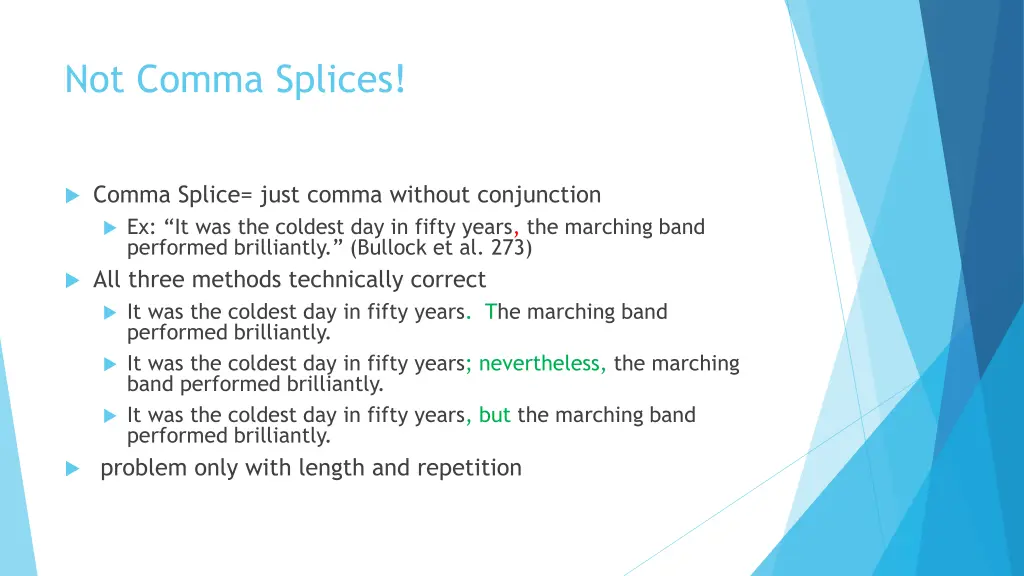
Not Comma Splices! Comma Splice= just comma without conjunction Ex: It was the coldest day in fifty years, the marching band performed brilliantly. (Bullock et al. 273) All three methods technically correct It was the coldest day in fifty years. The marching band performed brilliantly. It was the coldest day in fifty years; nevertheless, the marching band performed brilliantly. It was the coldest day in fifty years, but the marching band performed brilliantly. problem only with length and repetition
References Bullock, Richard, et al. The Little Seagull Handbook. W. W. Norton, 2017. Graff, Gerald & Cathy Birkenstein, They Say, I Say, W-W Norton & Co., New York/London, 2016 Purdue OWL Staff. Conquering the Comma Powerpoint Presentation. Purdue Online Writing Lab, Purdue University, 2017, https://owl.english.purdue.edu/owl/resource/692/ 01/2017. Accessed 11 Nov 2017.