Explore the impact of stress in agriculture, including personal and social challenges faced during tough times. Learn about the prevalence of stress-related issues, such as depression and suicidal thoughts, among farming communities. Discover coping mechanisms and strategies to address stress in agribusiness for improved mental health and overall well-being.
Please find below an Image/Link to download the presentation.
The content on the website is provided AS IS for your information and personal use only. It may not be sold, licensed, or shared on other websites without obtaining consent from the author. If you encounter any issues during the download, it is possible that the publisher has removed the file from their server.
You are allowed to download the files provided on this website for personal or commercial use, subject to the condition that they are used lawfully. All files are the property of their respective owners.
The content on the website is provided AS IS for your information and personal use only. It may not be sold, licensed, or shared on other websites without obtaining consent from the author.
E N D
Presentation Transcript
Managing Tough Times in Agriculture Randy R. Weigel, Ph.D. University of Wyoming Mastering the Dairy Business April 8, 2009
Studies during the 1980s and 1990s found the impact of the farm crisis and economic hardship triggered personal and social pathologies including high levels of stress-related illnesses, hypertension and psychiatric disorders, depression, diminished life satisfaction, marital discord, alcoholism, and even suicide. Ortega, S., Johnson, D., Beeson, P., & Craft, B. (1994). The farm crisis and mental health: A longitudinal study of the 1980s. Rural Sociology, 59(4), 598- 619.
Acknowledgements Robert J. Fetsch, Ph.D. Professor and Extension Specialist Colorado State University Michael R. Rosmann, PhD. Executive Director AgriWellness
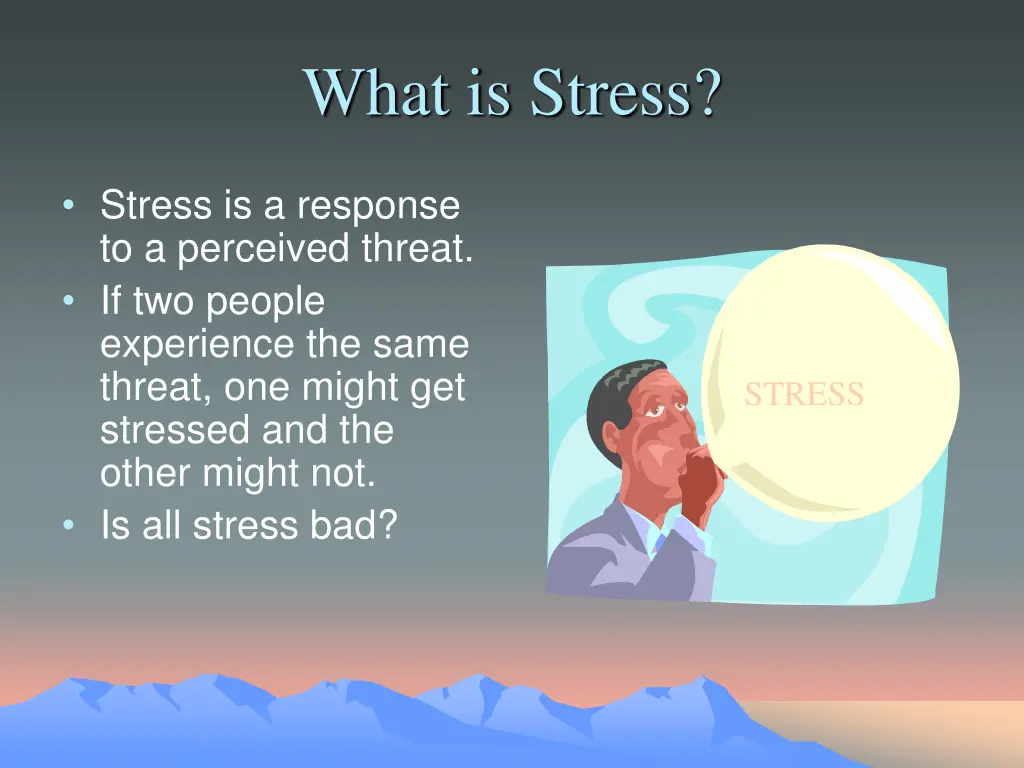
What is Stress? Stress is a response to a perceived threat. If two people experience the same threat, one might get stressed and the other might not. Is all stress bad? STRESS
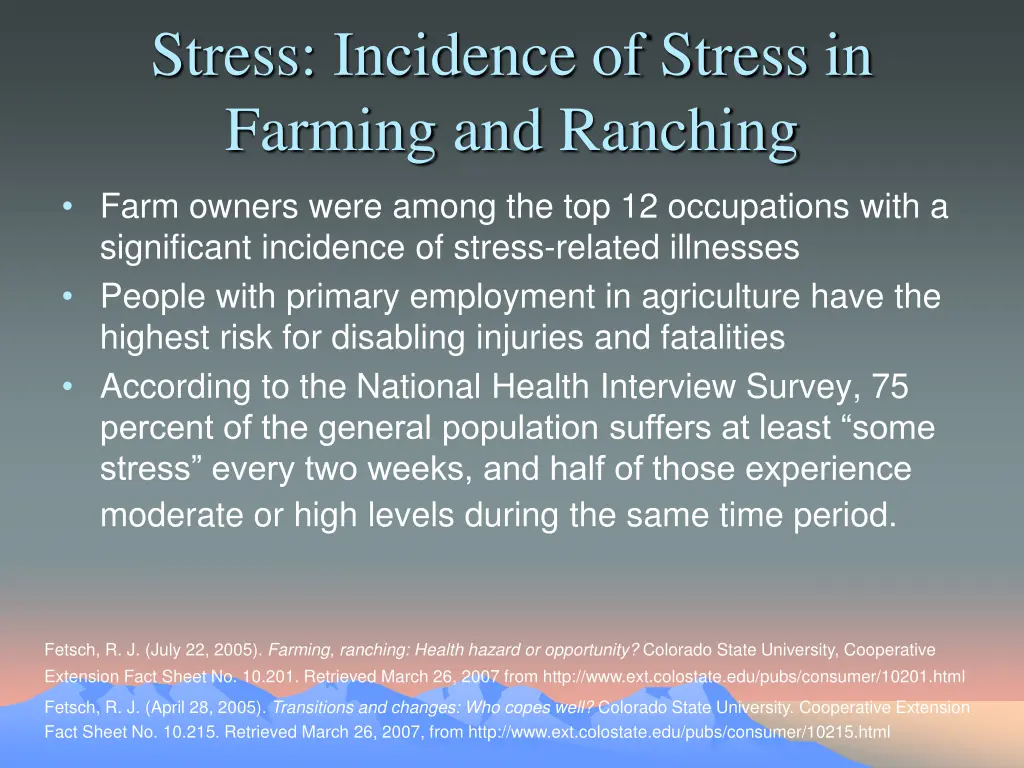
Stress: Incidence of Stress in Farming and Ranching Farm owners were among the top 12 occupations with a significant incidence of stress-related illnesses People with primary employment in agriculture have the highest risk for disabling injuries and fatalities According to the National Health Interview Survey, 75 percent of the general population suffers at least some stress every two weeks, and half of those experience moderate or high levels during the same time period. Fetsch, R. J. (July 22, 2005). Farming, ranching: Health hazard or opportunity? Colorado State University, Cooperative Extension Fact Sheet No. 10.201. Retrieved March 26, 2007 from http://www.ext.colostate.edu/pubs/consumer/10201.html Fetsch, R. J. (April 28, 2005). Transitions and changes: Who copes well? Colorado State University. Cooperative Extension Fact Sheet No. 10.215. Retrieved March 26, 2007, from http://www.ext.colostate.edu/pubs/consumer/10215.html
What are signs of farm stress? Reference: Farm and Ranch Family Stress and Depression: A Checklist and Guide for Making Referrals http://ces.uwyo.edu/LIFE/Ranchers_reacting_to_disaster.htm
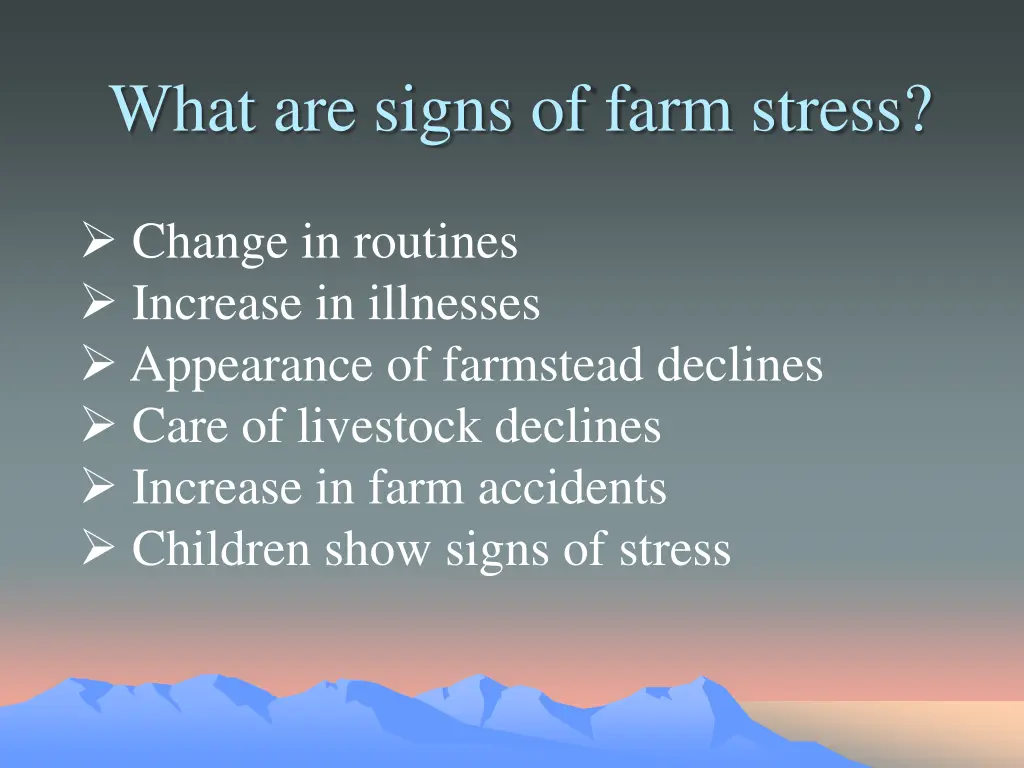
What are signs of farm stress? Change in routines Increase in illnesses Appearance of farmstead declines Care of livestock declines Increase in farm accidents Children show signs of stress
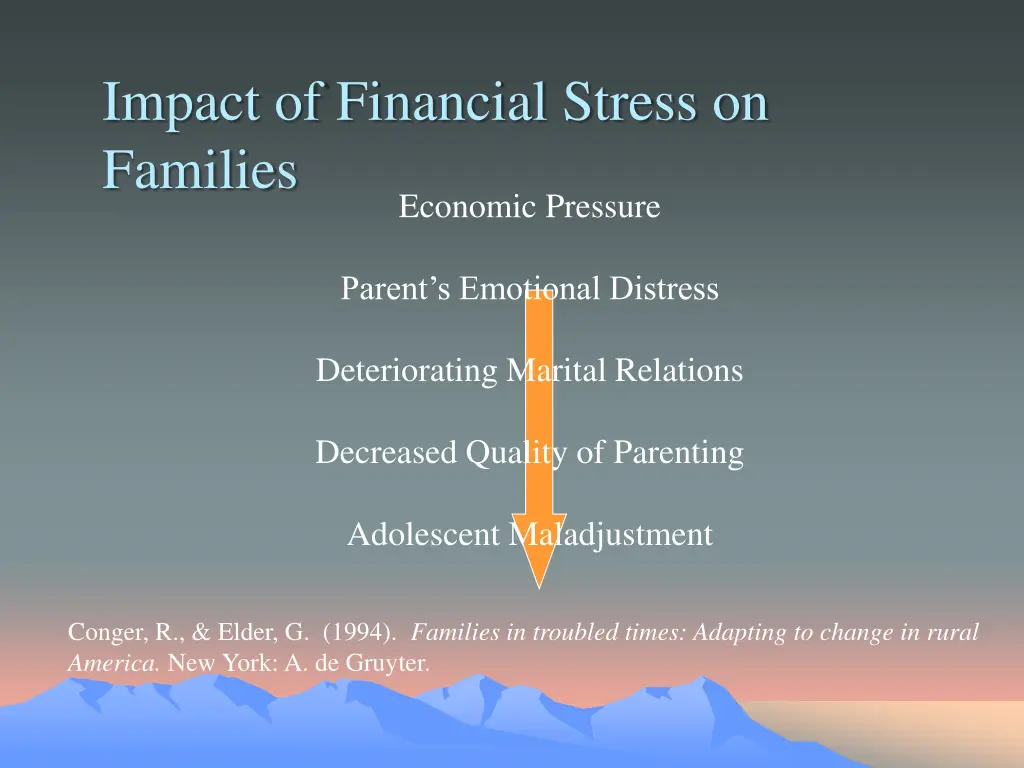
Impact of Financial Stress on Families Economic Pressure Parent s Emotional Distress Deteriorating Marital Relations Decreased Quality of Parenting Adolescent Maladjustment Conger, R., & Elder, G. (1994). Families in troubled times: Adapting to change in rural America. New York: A. de Gruyter.
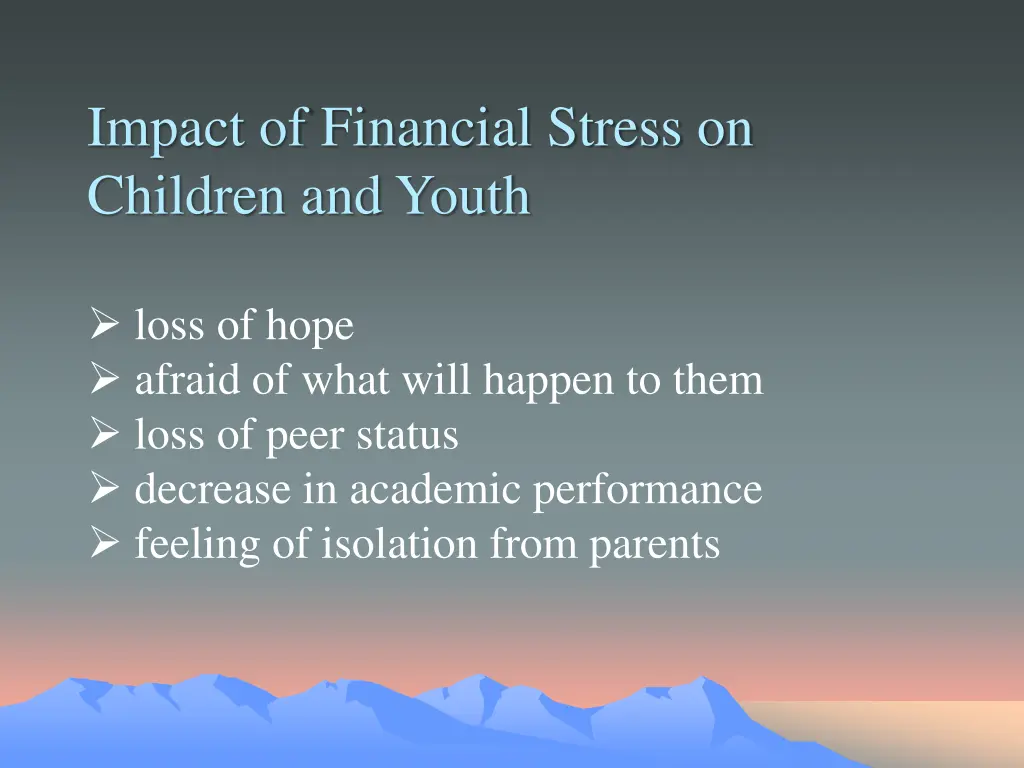
Impact of Financial Stress on Children and Youth loss of hope afraid of what will happen to them loss of peer status decrease in academic performance feeling of isolation from parents
Stress Signals Young Children School-age Children Adolescents
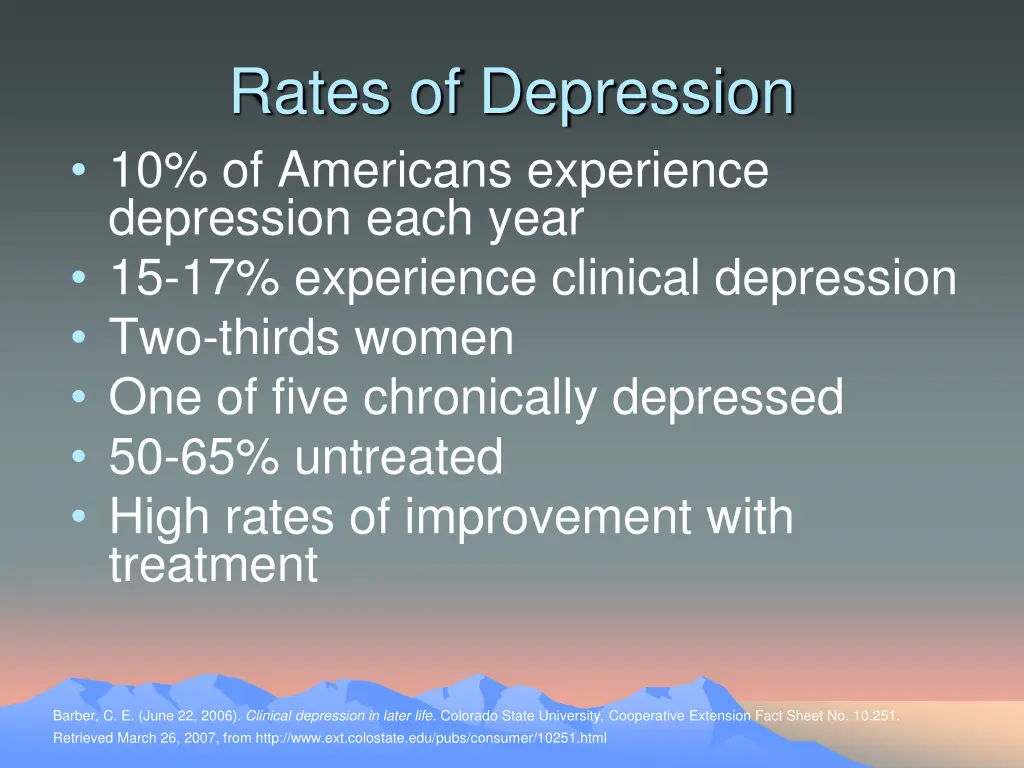
Rates of Depression 10% of Americans experience depression each year 15-17% experience clinical depression Two-thirds women One of five chronically depressed 50-65% untreated High rates of improvement with treatment Barber, C. E. (June 22, 2006). Clinical depression in later life. Colorado State University, Cooperative Extension Fact Sheet No. 10.251. Retrieved March 26, 2007, from http://www.ext.colostate.edu/pubs/consumer/10251.html
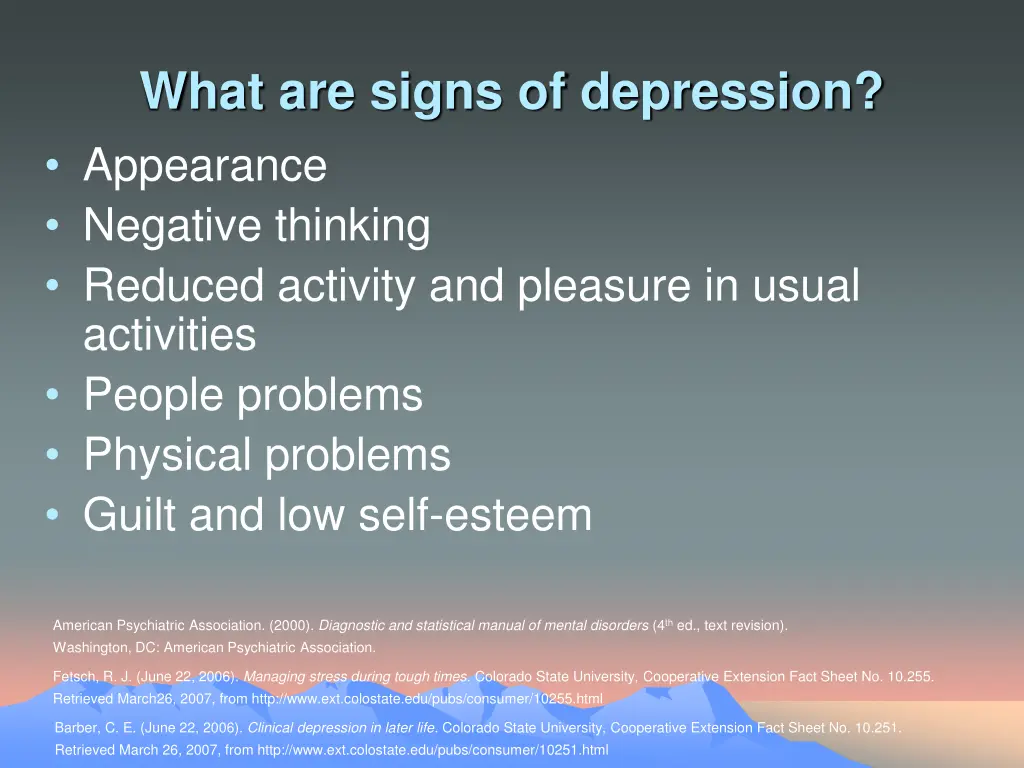
What are signs of depression? Appearance Negative thinking Reduced activity and pleasure in usual activities People problems Physical problems Guilt and low self-esteem American Psychiatric Association. (2000). Diagnostic and statistical manual of mental disorders (4th ed., text revision). Washington, DC: American Psychiatric Association. Fetsch, R. J. (June 22, 2006). Managing stress during tough times. Colorado State University, Cooperative Extension Fact Sheet No. 10.255. Retrieved March26, 2007, from http://www.ext.colostate.edu/pubs/consumer/10255.html Barber, C. E. (June 22, 2006). Clinical depression in later life. Colorado State University, Cooperative Extension Fact Sheet No. 10.251. Retrieved March 26, 2007, from http://www.ext.colostate.edu/pubs/consumer/10251.html
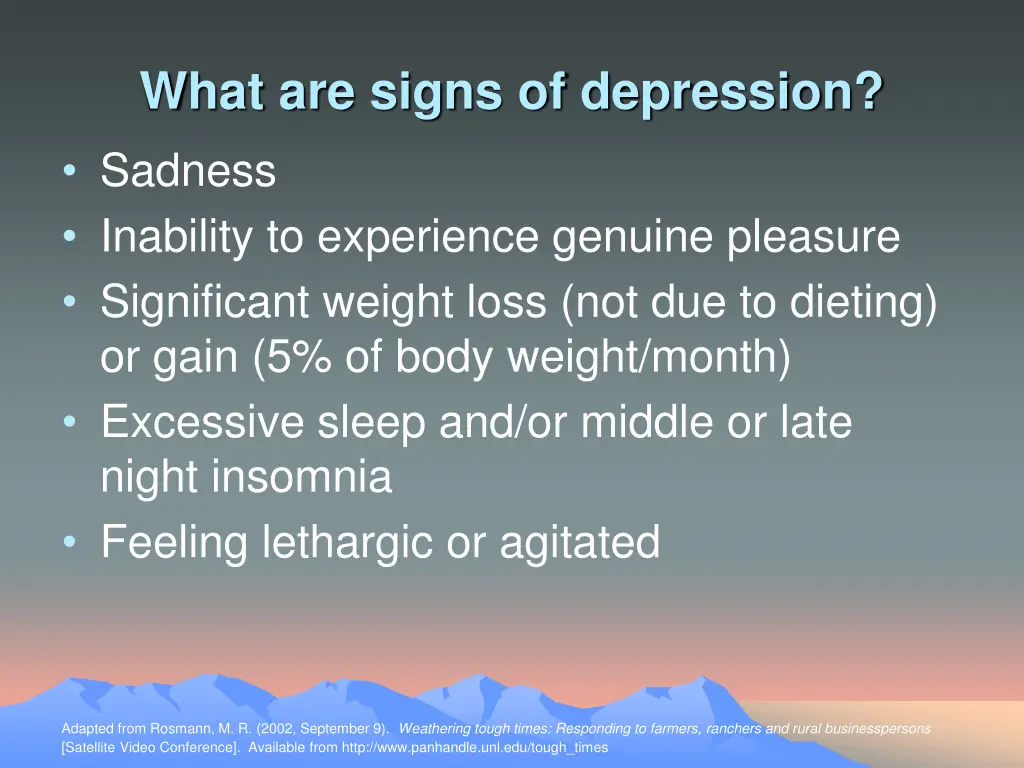
What are signs of depression? Sadness Inability to experience genuine pleasure Significant weight loss (not due to dieting) or gain (5% of body weight/month) Excessive sleep and/or middle or late night insomnia Feeling lethargic or agitated Adapted from Rosmann, M. R. (2002, September 9). Weathering tough times: Responding to farmers, ranchers and rural businesspersons [Satellite Video Conference]. Available from http://www.panhandle.unl.edu/tough_times
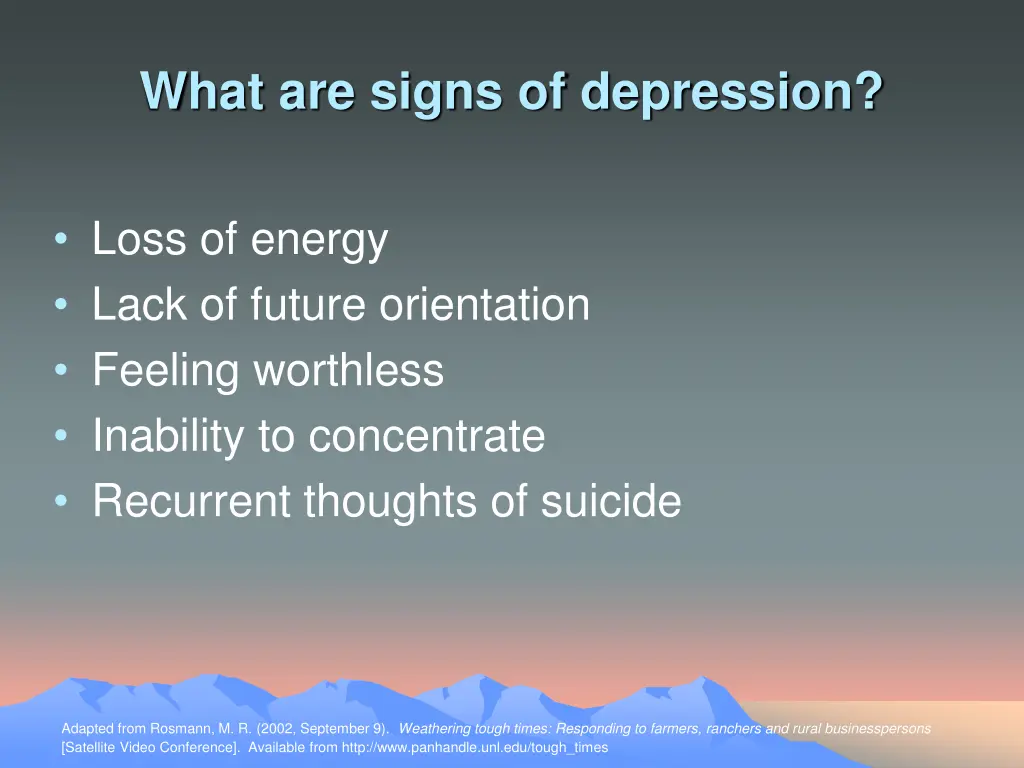
What are signs of depression? Loss of energy Lack of future orientation Feeling worthless Inability to concentrate Recurrent thoughts of suicide Adapted from Rosmann, M. R. (2002, September 9). Weathering tough times: Responding to farmers, ranchers and rural businesspersons [Satellite Video Conference]. Available from http://www.panhandle.unl.edu/tough_times
What are signs of farm stress and depression checklist? Reference: Farm and Ranch Family Stress and Depression: A Checklist and Guide for Making Referrals http://ces.uwyo.edu/LIFE/Ranchers_reacting_to_disaster.htm
Men and Depression Men would rather kill themselves than admit they are depressed
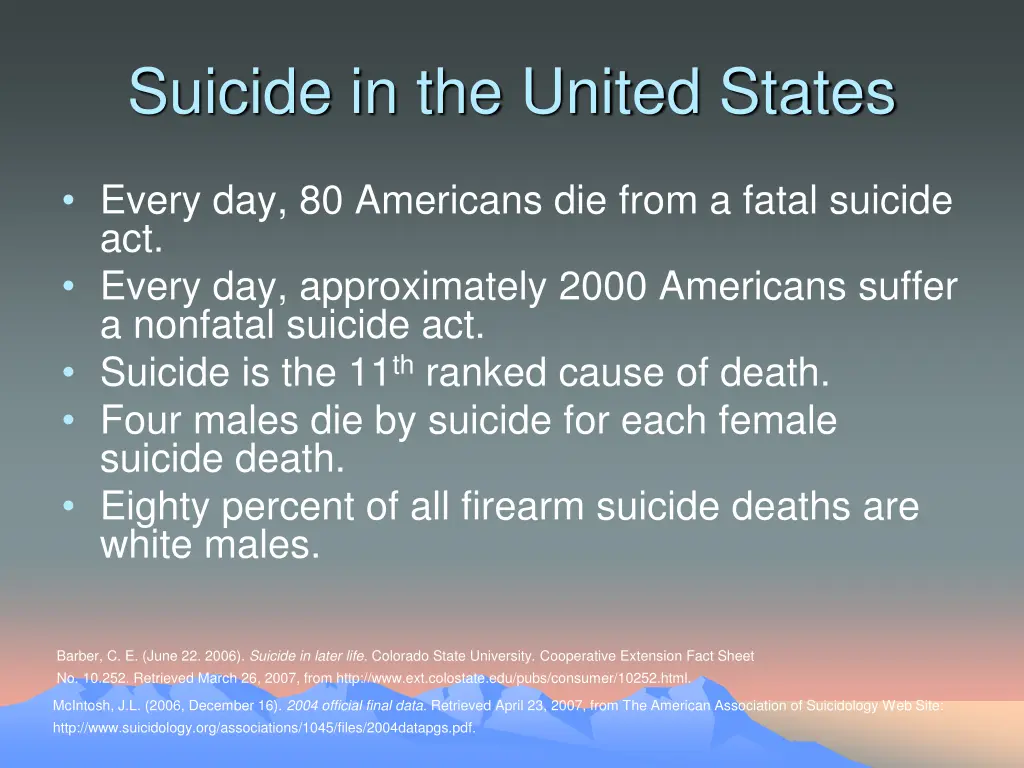
Suicide in the United States Every day, 80 Americans die from a fatal suicide act. Every day, approximately 2000 Americans suffer a nonfatal suicide act. Suicide is the 11th ranked cause of death. Four males die by suicide for each female suicide death. Eighty percent of all firearm suicide deaths are white males. Barber, C. E. (June 22. 2006). Suicide in later life. Colorado State University. Cooperative Extension Fact Sheet No. 10.252. Retrieved March 26, 2007, from http://www.ext.colostate.edu/pubs/consumer/10252.html. McIntosh, J.L. (2006, December 16). 2004 official final data. Retrieved April 23, 2007, from The American Association of Suicidology Web Site: http://www.suicidology.org/associations/1045/files/2004datapgs.pdf.
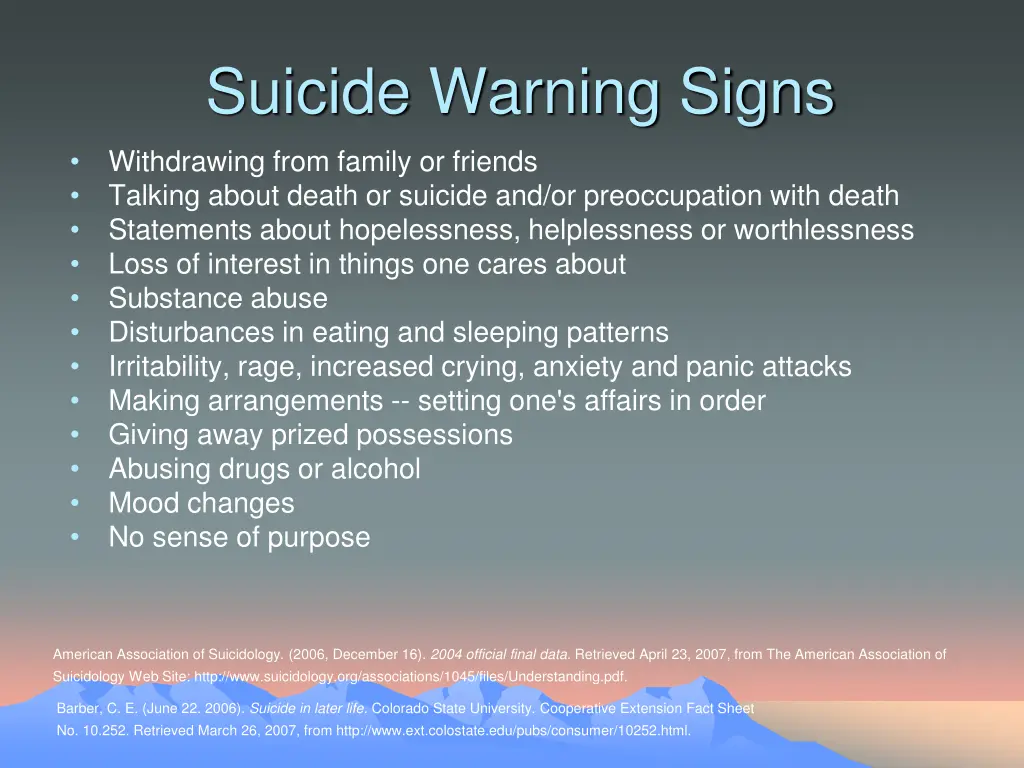
Suicide Warning Signs Withdrawing from family or friends Talking about death or suicide and/or preoccupation with death Statements about hopelessness, helplessness or worthlessness Loss of interest in things one cares about Substance abuse Disturbances in eating and sleeping patterns Irritability, rage, increased crying, anxiety and panic attacks Making arrangements -- setting one's affairs in order Giving away prized possessions Abusing drugs or alcohol Mood changes No sense of purpose American Association of Suicidology. (2006, December 16). 2004 official final data. Retrieved April 23, 2007, from The American Association of Suicidology Web Site: http://www.suicidology.org/associations/1045/files/Understanding.pdf. Barber, C. E. (June 22. 2006). Suicide in later life. Colorado State University. Cooperative Extension Fact Sheet No. 10.252. Retrieved March 26, 2007, from http://www.ext.colostate.edu/pubs/consumer/10252.html.
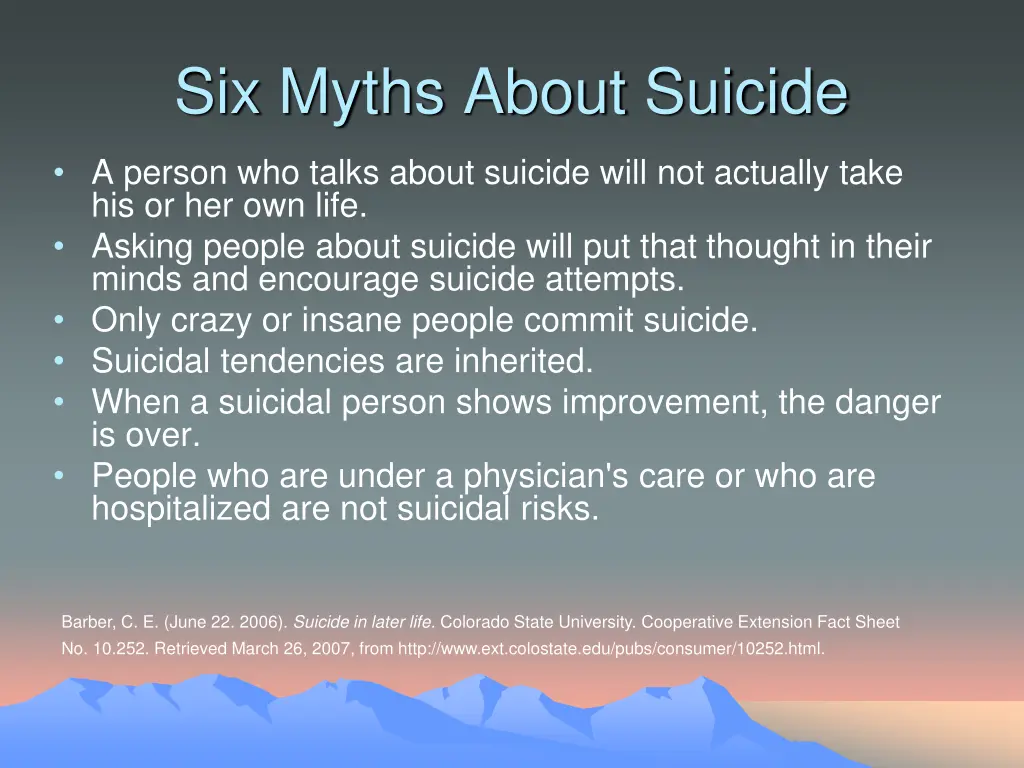
Six Myths About Suicide A person who talks about suicide will not actually take his or her own life. Asking people about suicide will put that thought in their minds and encourage suicide attempts. Only crazy or insane people commit suicide. Suicidal tendencies are inherited. When a suicidal person shows improvement, the danger is over. People who are under a physician's care or who are hospitalized are not suicidal risks. Barber, C. E. (June 22. 2006). Suicide in later life. Colorado State University. Cooperative Extension Fact Sheet No. 10.252. Retrieved March 26, 2007, from http://www.ext.colostate.edu/pubs/consumer/10252.html.
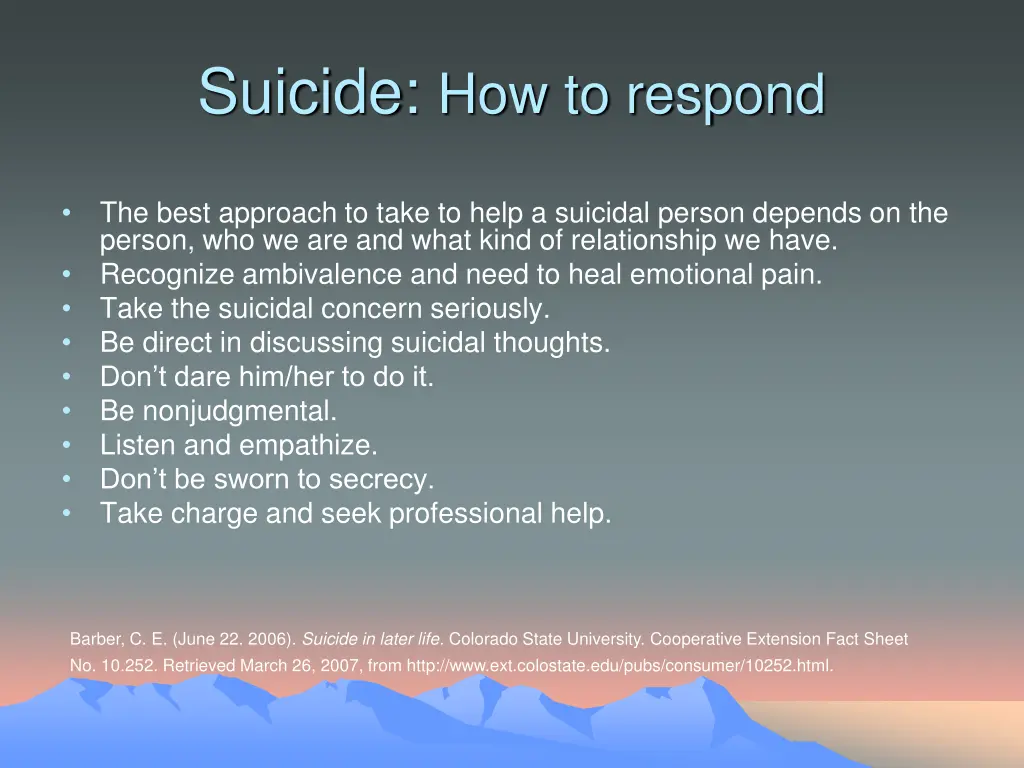
Suicide: How to respond The best approach to take to help a suicidal person depends on the person, who we are and what kind of relationship we have. Recognize ambivalence and need to heal emotional pain. Take the suicidal concern seriously. Be direct in discussing suicidal thoughts. Don t dare him/her to do it. Be nonjudgmental. Listen and empathize. Don t be sworn to secrecy. Take charge and seek professional help. Barber, C. E. (June 22. 2006). Suicide in later life. Colorado State University. Cooperative Extension Fact Sheet No. 10.252. Retrieved March 26, 2007, from http://www.ext.colostate.edu/pubs/consumer/10252.html.
Suicide: How to respond If a person has the intent, and the means to complete the plan, that individual should be assessed as high risk and not be left alone. A helping professional should be contacted immediately. 1-800-SUICIDE National Suicide Prevention Lifeline http://suicidepreventionlifeline.org/
Men Seeking Help Where do Cowboys go to Cry? * Men s Upbringing * Traditional Counseling Weigel, R. R. (2003). Why ranchers and farmers are reluctant to seek counseling and how family practitioners can help. The Forum for Family and Consumer Issues, 8(2). On-line: http://www.ces.ncsu.edu/depts/fcs/pub/8(2)/weigel.html.
Ag. Families Reluctance to Seek Help * reputation * lack of knowledge * solve own problems * upbringing * perceived as lazy * perceived as ill * distrust of help * pride
When Farmers/Ranchers Seek Help: Minimize mental health jargon Speak in terms ranchers & farmers relate to Realize that they seek the status-quo Know that they view STRESS as an agricultural issue, not a personal issue Know that ranching/farming is not a job
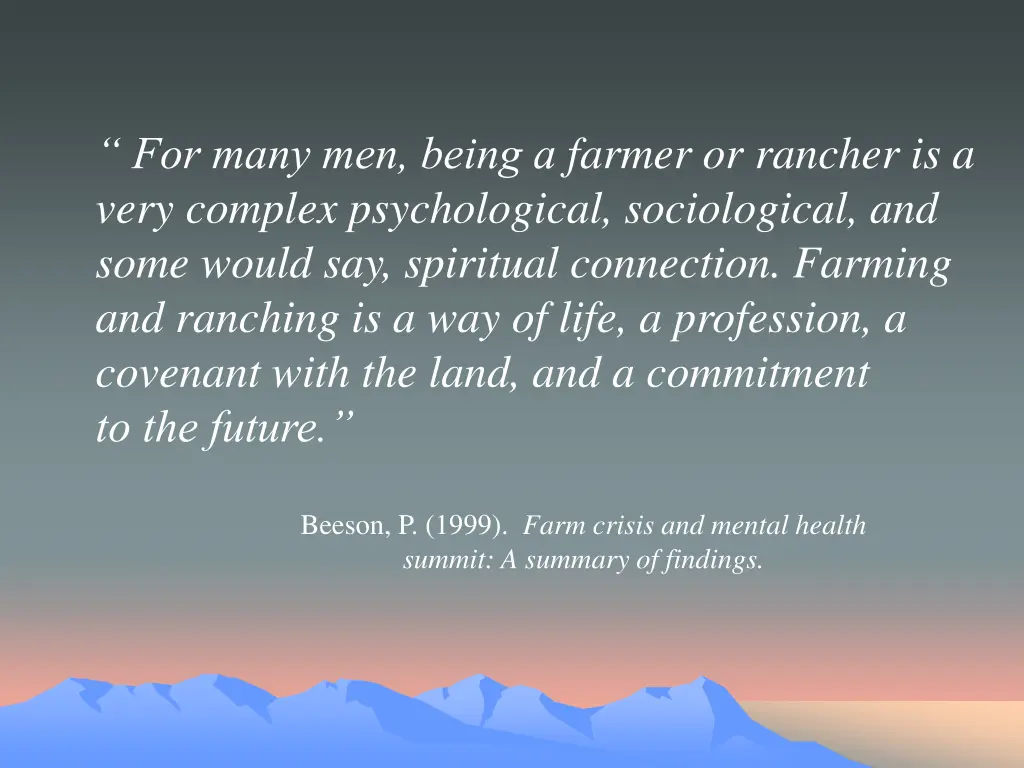
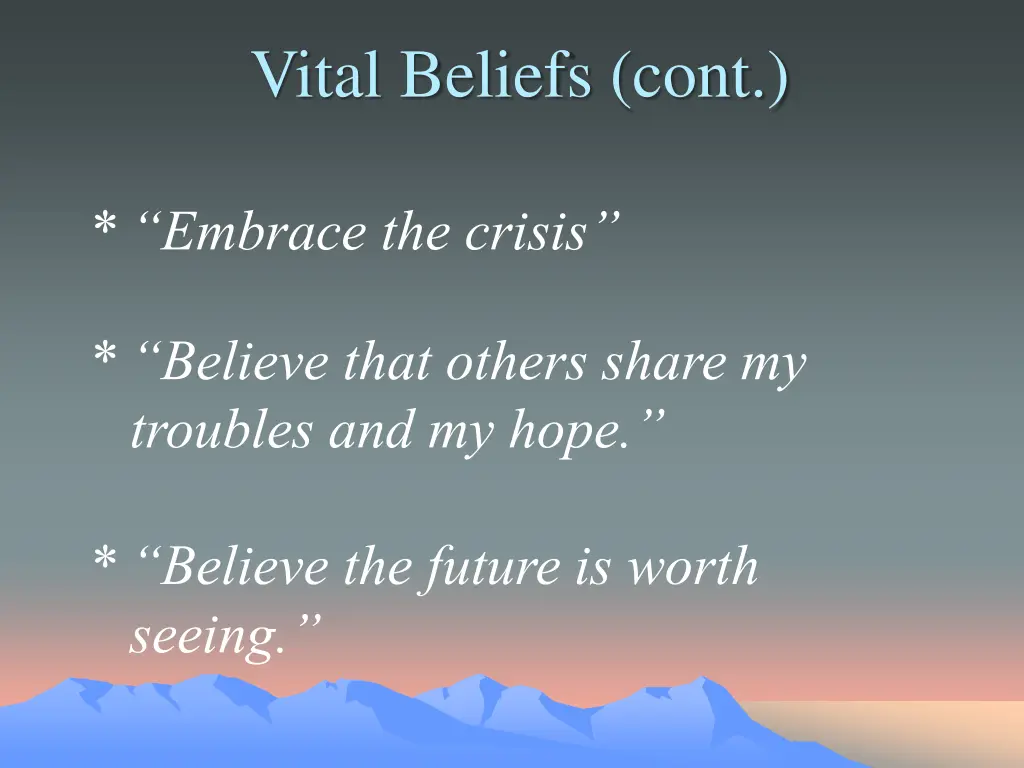
For many men, being a farmer or rancher is a very complex psychological, sociological, and some would say, spiritual connection. Farming and ranching is a way of life, a profession, a covenant with the land, and a commitment to the future. Beeson, P. (1999). Farm crisis and mental health summit: A summary of findings.
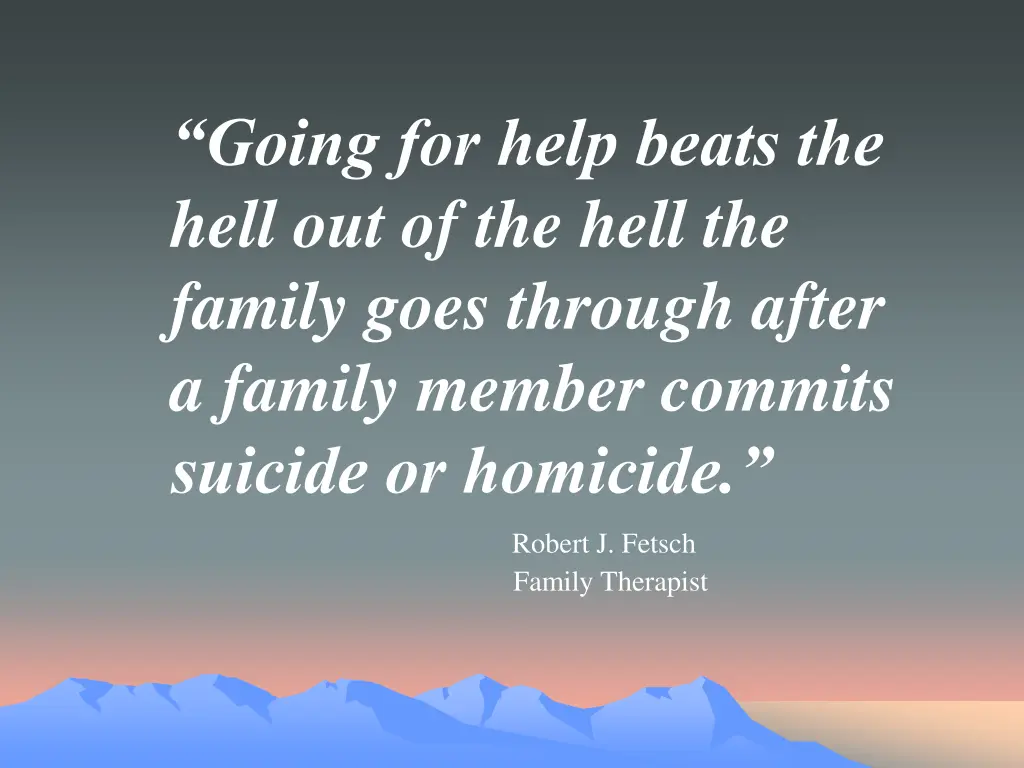
Going for help beats the hell out of the hell the family goes through after a family member commits suicide or homicide. Robert J. Fetsch Family Therapist
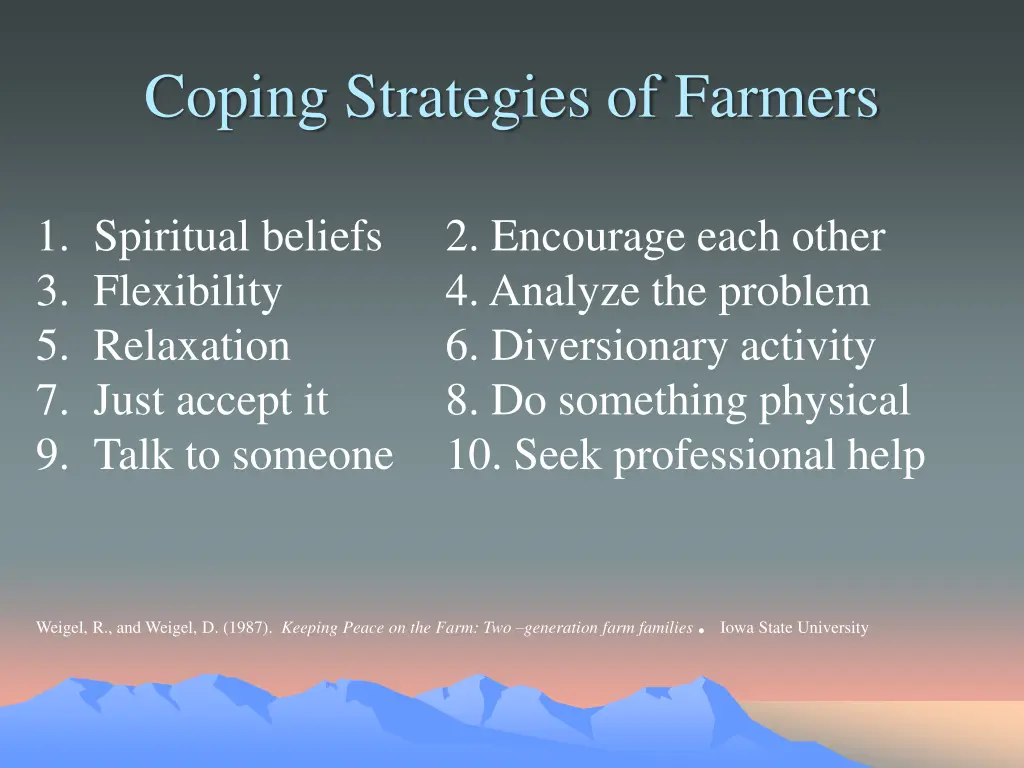
Coping Strategies of Farmers 1. Spiritual beliefs 3. Flexibility 5. Relaxation 7. Just accept it 9. Talk to someone 10. Seek professional help 2. Encourage each other 4. Analyze the problem 6. Diversionary activity 8. Do something physical Weigel, R., and Weigel, D. (1987). Keeping Peace on the Farm: Two generation farm families .Iowa State University
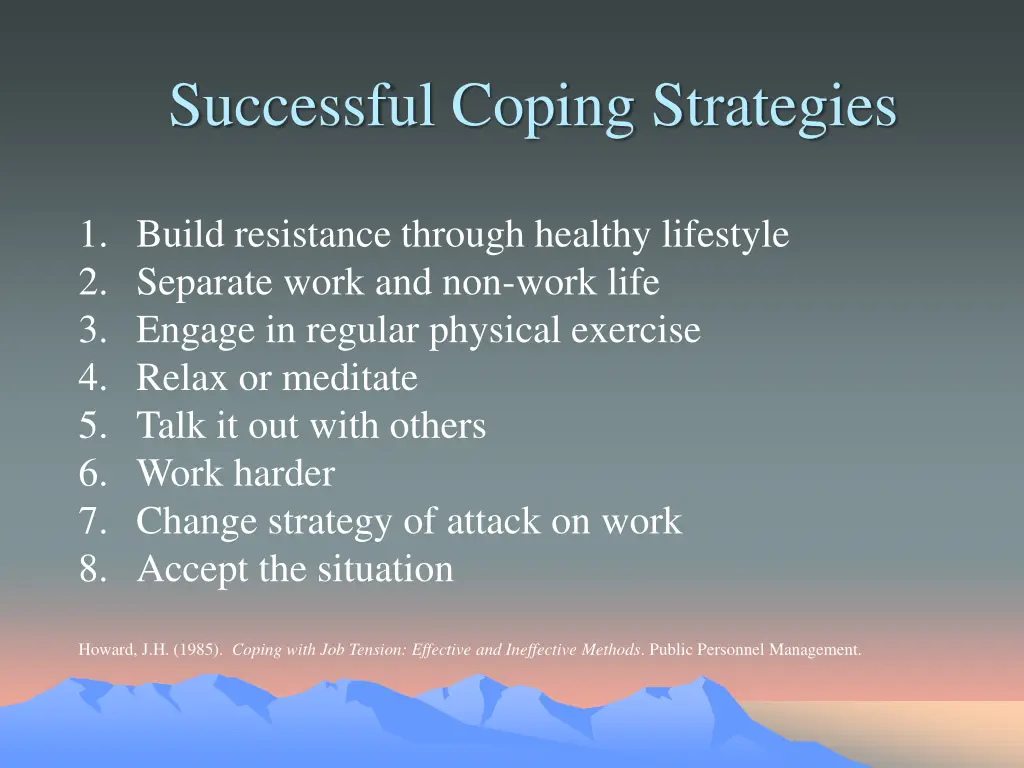
Successful Coping Strategies 1. Build resistance through healthy lifestyle 2. Separate work and non-work life 3. Engage in regular physical exercise 4. Relax or meditate 5. Talk it out with others 6. Work harder 7. Change strategy of attack on work 8. Accept the situation Howard, J.H. (1985). Coping with Job Tension: Effective and Ineffective Methods. Public Personnel Management.
Strategies for Resilience Preparing & Anticipating Previous Success Greater Use of Resources Uniting as a Family Expect to Recover Take Advantage of Help
Recovering from Natural Disasters B-1103 Men and Depression B-1104 Agriculture and Skin Cancer: What You Should Know B-1105 Lenders and Angry Customers B-1113 Surviving Tragedy B-1117 Men Seeking Help B-1134 Suicide: What Leads People to Kill Themselves? B-1182 http://ces.uwyo.edu/LIFE/Personal_Nature_Main.htm
Agricultural Producers and Stress Series B-1124.1 Agricultural Producers and Stress: The Importance of a Healthy Attitude B-1124.2 Agricultural Producers and Stress: When Do You Need a Counselor? B-1124.3 Agricultural Producers and Stress: Eating and Activity for Health and Pleasure B-1124.4 Agricultural Producers and Stress: Identifying Stress on the Ranch and Farm B-1124.5 Agricultural Producers and Stress: Learning to Relax B-1124.6 Agricultural Producers and Stress: Finding Your Team of Experts http://ces.uwyo.edu/LIFE/Stress_Series.html
Online Resources from Land-Grant Universities Anger, managing stress, living through transitions Colorado State Extension http://ext.colostate.edu/pubs/pubs.html #consumer Family communication North Carolina State Extension http://ces.ncsu.edu/depts/fcs/Family.html Taking care of self University of Minnesota Extension http://www.extension.umn.edu/ResourceManagement/toughtimes.html Recovering from disaster North Carolina State Extension http://ces.ncsu.edu/disaster/factsheets/stress.html
How to Get Copies of These Resources Online Center for Dairy Excellence Randy R. Weigel (307) 766-4186 weig@uwyo.edu