Understanding AVL and WAVL Trees
This content explores the concepts and properties of AVL and WAVL trees, including their structures, operations, and applications in balanced search trees. It delves into the challenges faced in maintaining balance, the mechanisms of restructuring through rotations, and the optimization for efficient updates in logarithmic time complexity or less.

Download Presentation

Please find below an Image/Link to download the presentation.
The content on the website is provided AS IS for your information and personal use only. It may not be sold, licensed, or shared on other websites without obtaining consent from the author.If you encounter any issues during the download, it is possible that the publisher has removed the file from their server.
You are allowed to download the files provided on this website for personal or commercial use, subject to the condition that they are used lawfully. All files are the property of their respective owners.
The content on the website is provided AS IS for your information and personal use only. It may not be sold, licensed, or shared on other websites without obtaining consent from the author.
E N D
Presentation Transcript
Data Structures Lecture 4 AVL and WAVLTrees Haim Kaplan and Uri Zwick November 2014 Last updated: April 16, 2018
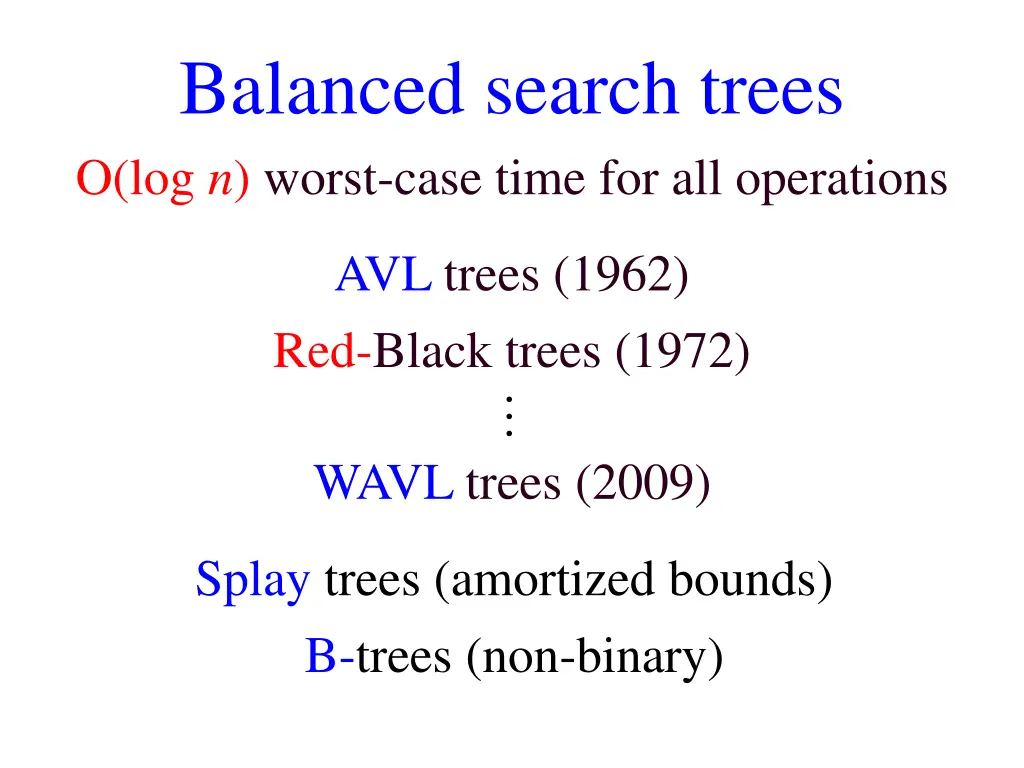
Balanced search trees O(log n) worst-case time for all operations AVL trees (1962) Red-Black trees (1972) WAVL trees (2009) Splay trees (amortized bounds) B-trees (non-binary)
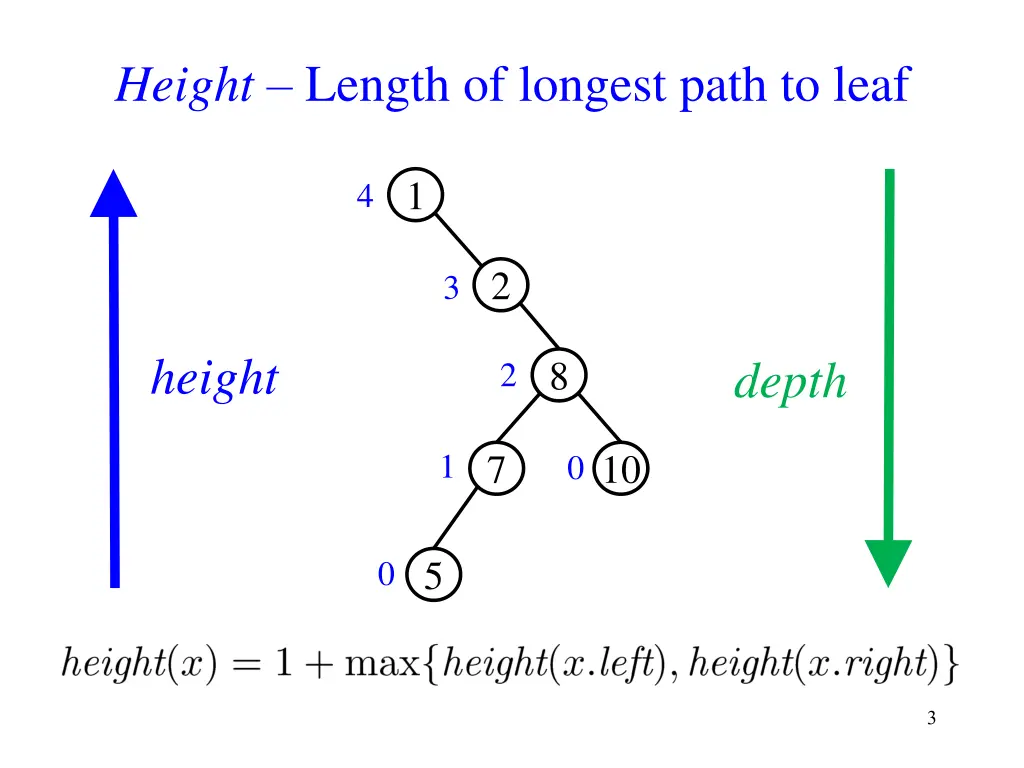
Height Length of longest path to leaf 1 4 2 3 height depth 8 2 1 7 10 0 5 0 3
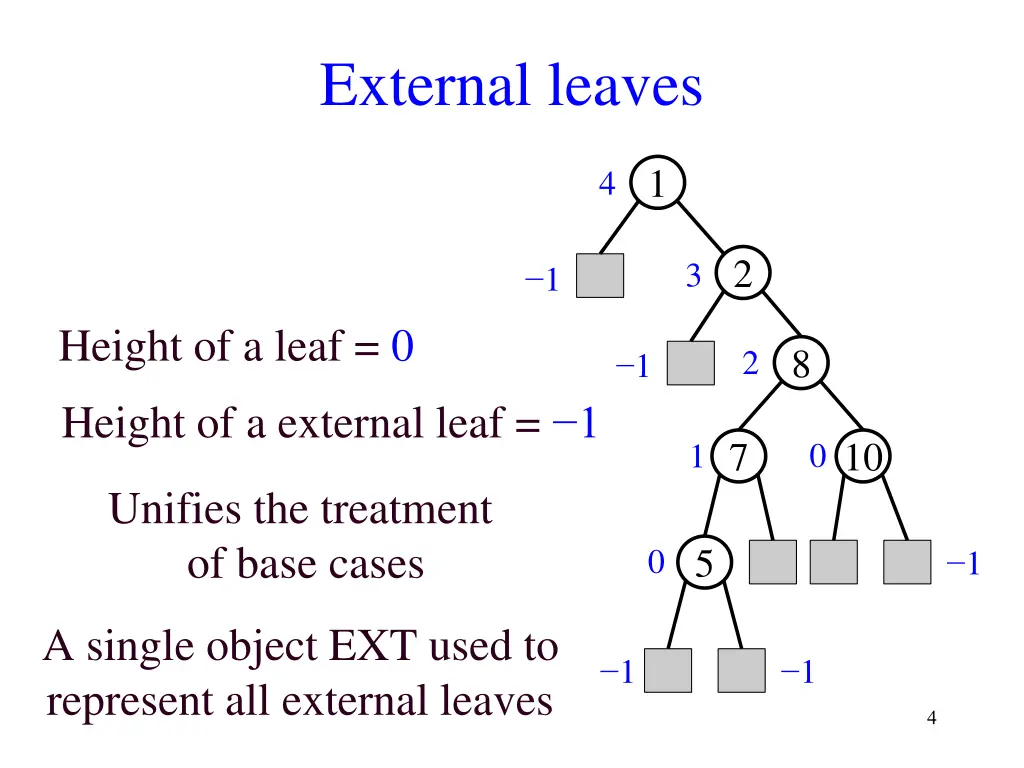
External leaves 1 4 2 3 1 Height of a leaf = 0 8 2 1 Height of a external leaf = 1 7 10 0 1 Unifies the treatment of base cases 5 0 1 A single object EXT used to represent all external leaves 1 1 4
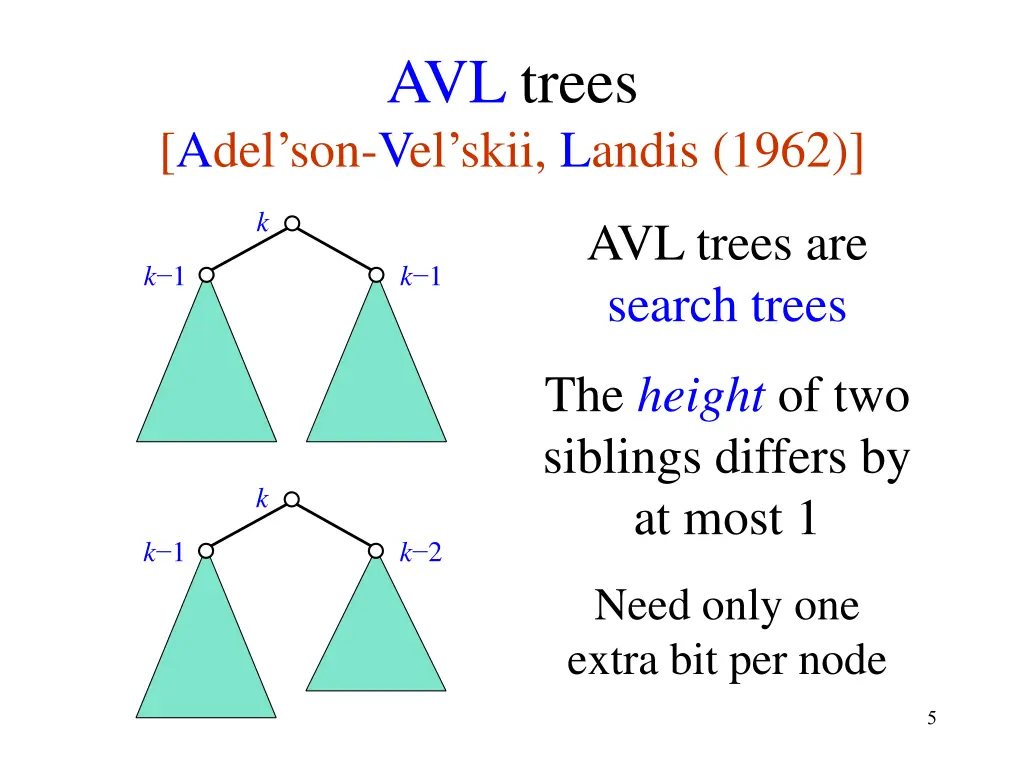
AVL trees [Adel son-Vel skii, Landis (1962)] k AVL trees are search trees k 1 k 1 The height of two siblings differs by at most 1 k k 1 k 2 Need only one extra bit per node 5
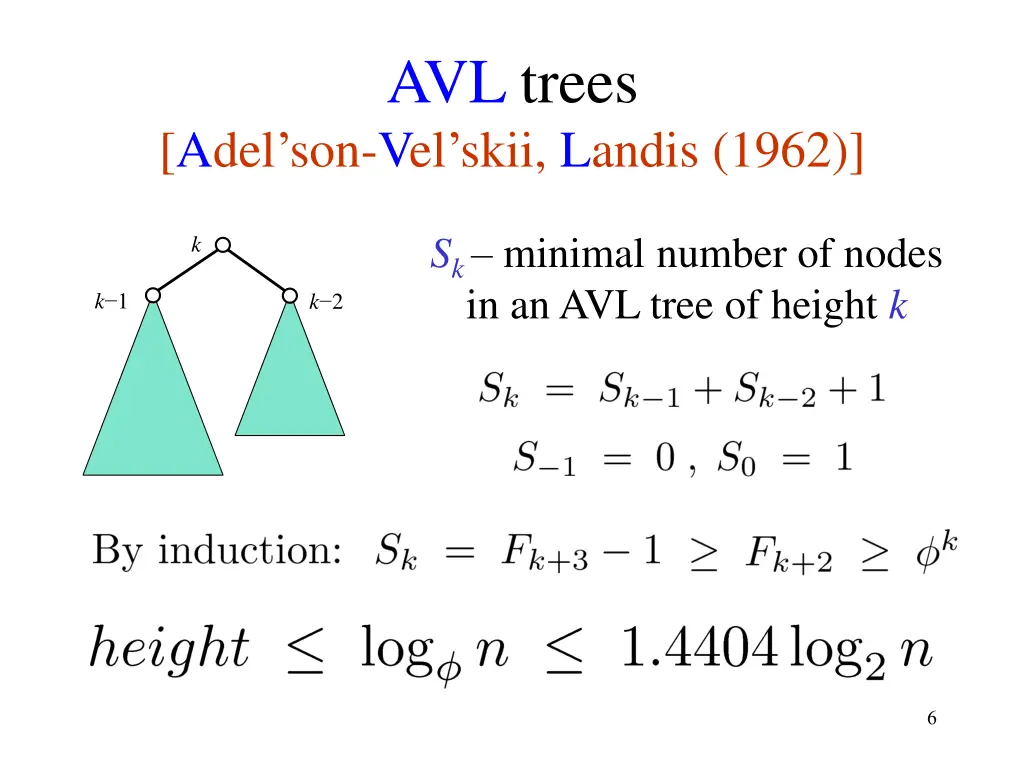
AVL trees [Adel son-Vel skii, Landis (1962)] Sk minimal number of nodes in an AVL tree of height k k k 1 k 2 6
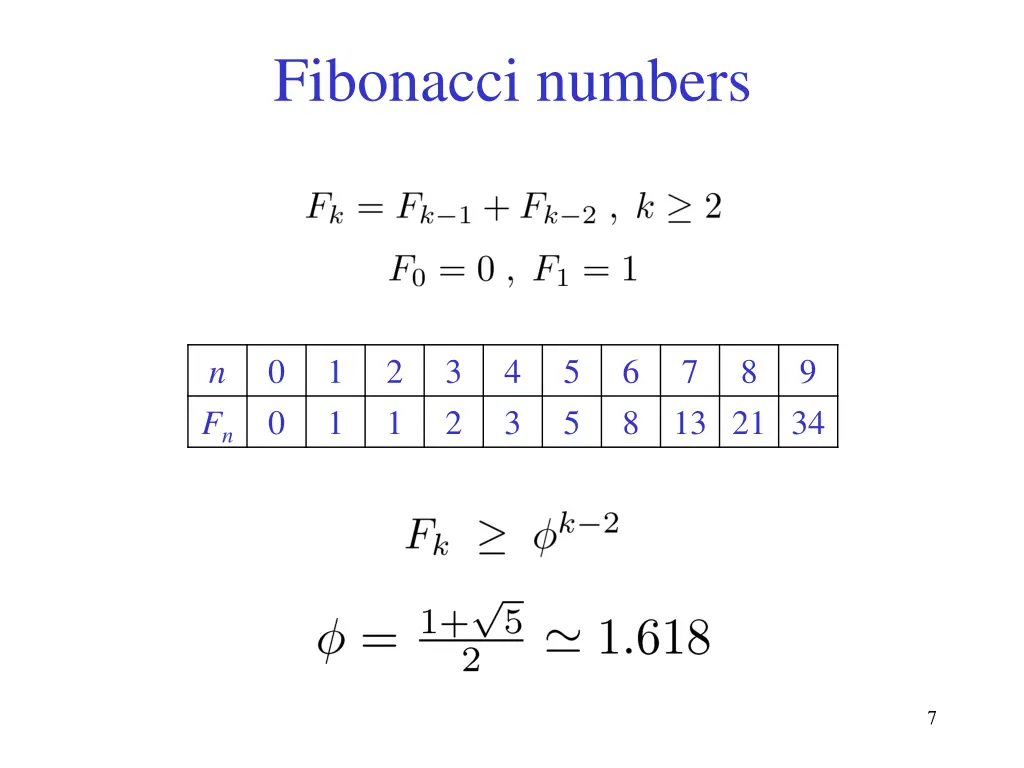
Fibonacci numbers 0 0 1 1 2 1 3 2 4 3 5 5 6 8 7 8 9 n Fn 13 21 34 7
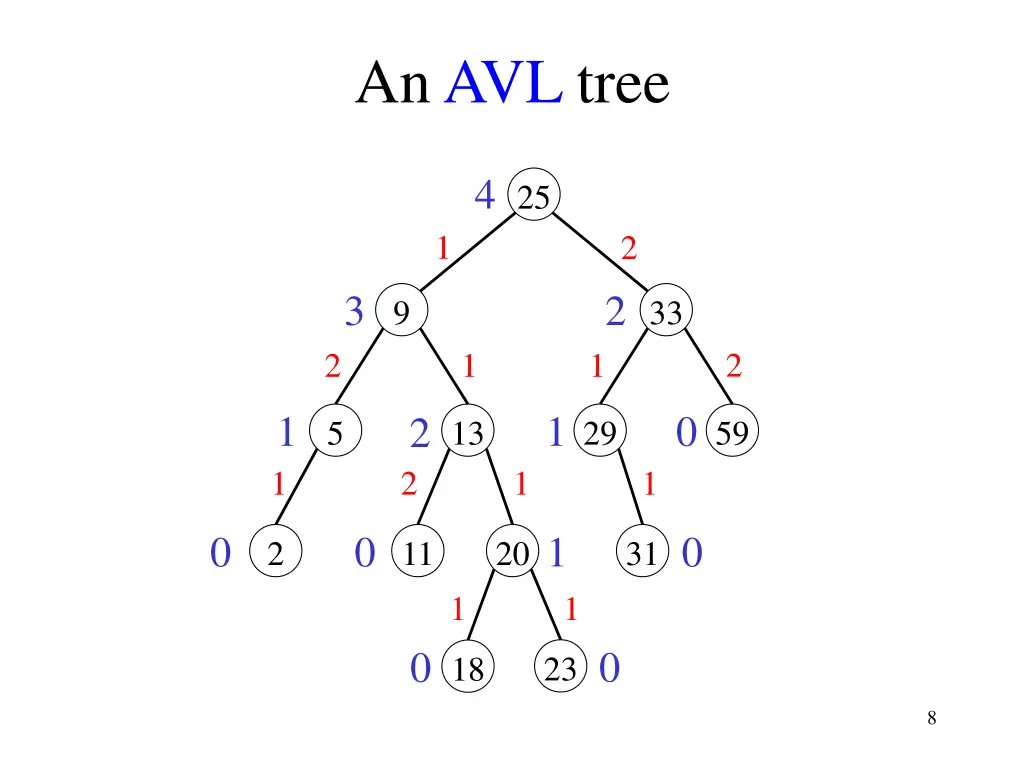
AnAVL tree 4 25 1 2 3 2 9 33 2 2 1 1 1 1 1 29 0 2 2 5 13 59 1 1 0 0 1 31 0 2 11 20 1 1 23 0 0 18 8
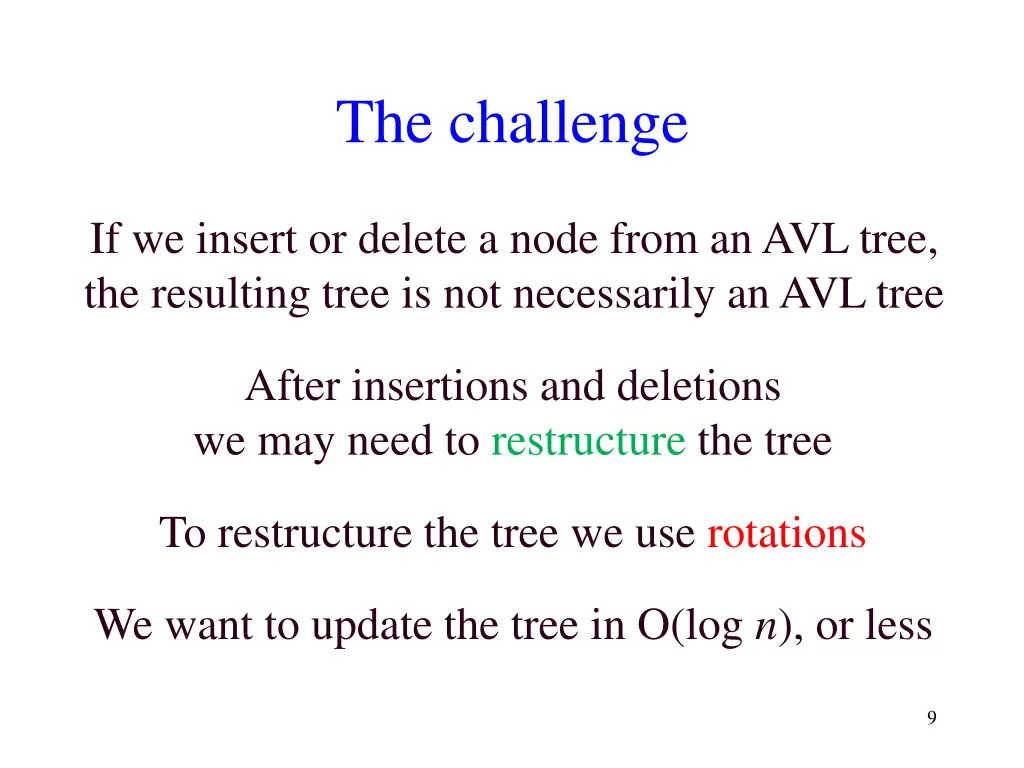
The challenge If we insert or delete a node from an AVL tree, the resulting tree is not necessarily an AVL tree After insertions and deletions we may need to restructure the tree To restructure the tree we use rotations We want to update the tree in O(log n), or less 9
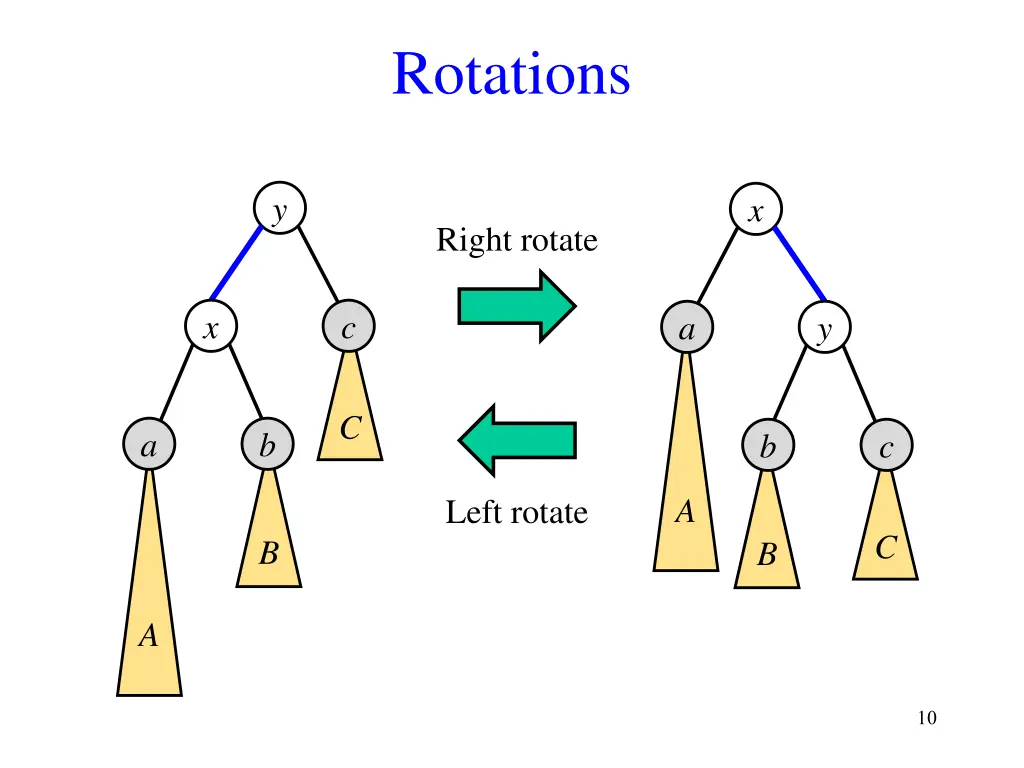
Rotations y x Right rotate x c a y C a b b c A Left rotate C B B A 10
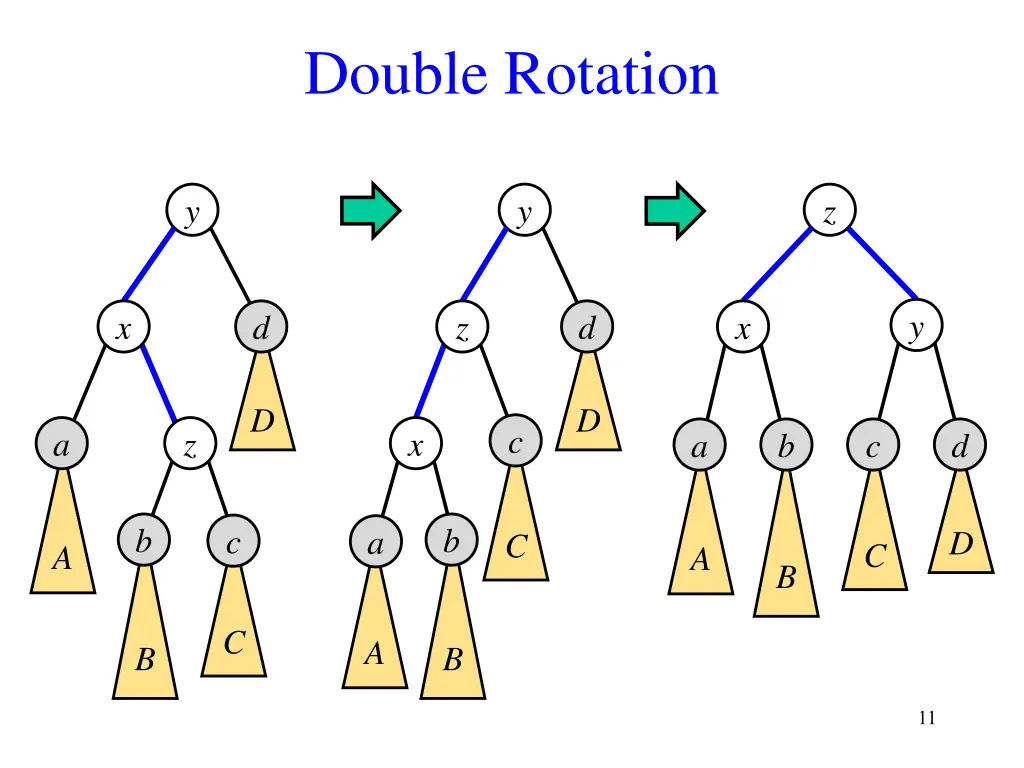
Double Rotation y y z y x d z d x D D c a z x a b c d b b c a D C C A A B C A B B 11
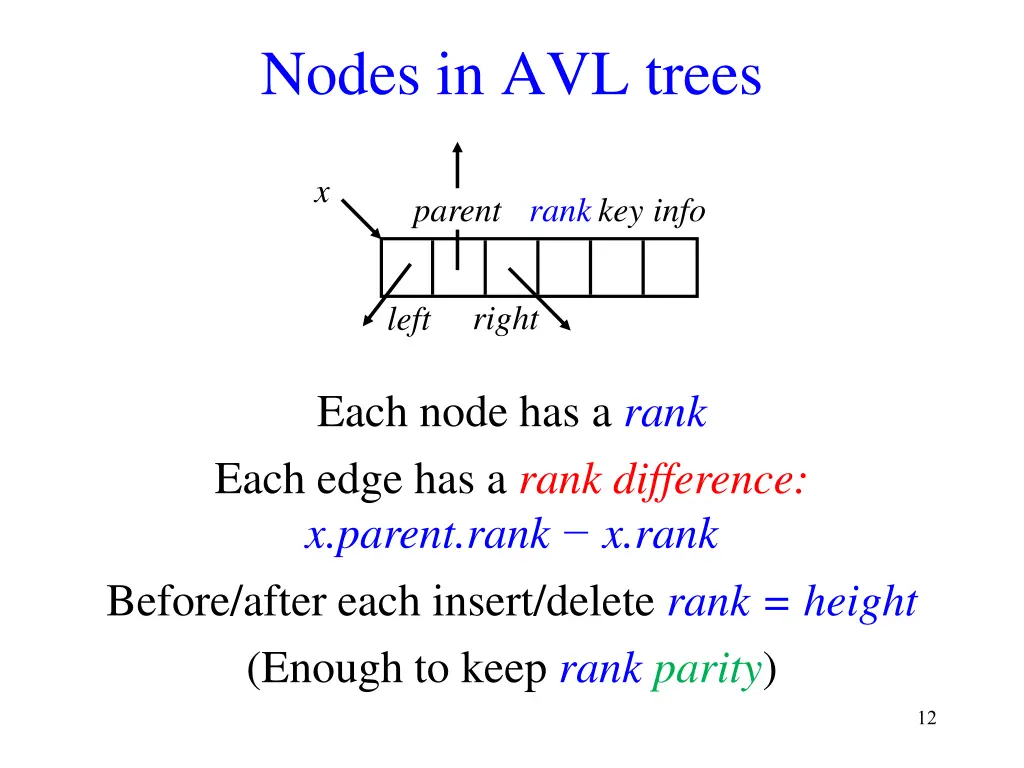
Nodes in AVL trees x parent rank key info right left Each node has a rank Each edge has a rank difference: x.parent.rank x.rank Before/after each insert/delete rank = height (Enough to keep rank parity) 12
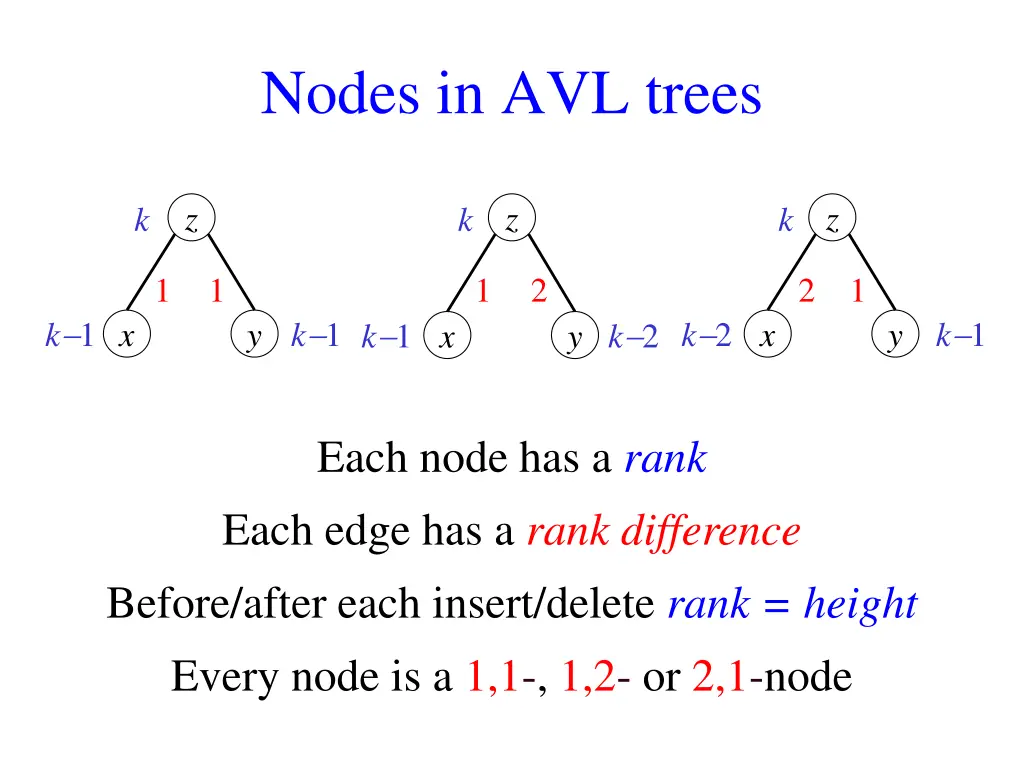
Nodes in AVL trees z z z k k k 1 1 1 2 2 1 k 1 k 1 k 2 k 1 k 1 k 2 x y x y x y Each node has a rank Each edge has a rank difference Before/after each insert/delete rank = height Every node is a 1,1-, 1,2- or 2,1-node
rank = height Lemma: If all leaves have rank 0, all rank differences are positive, and each parent has a child or rank difference 1, then the rank of each node is equal to its height z k Easy proof by induction: k = 1 + max{ k 1 , k } 1 1 k 1 k x y
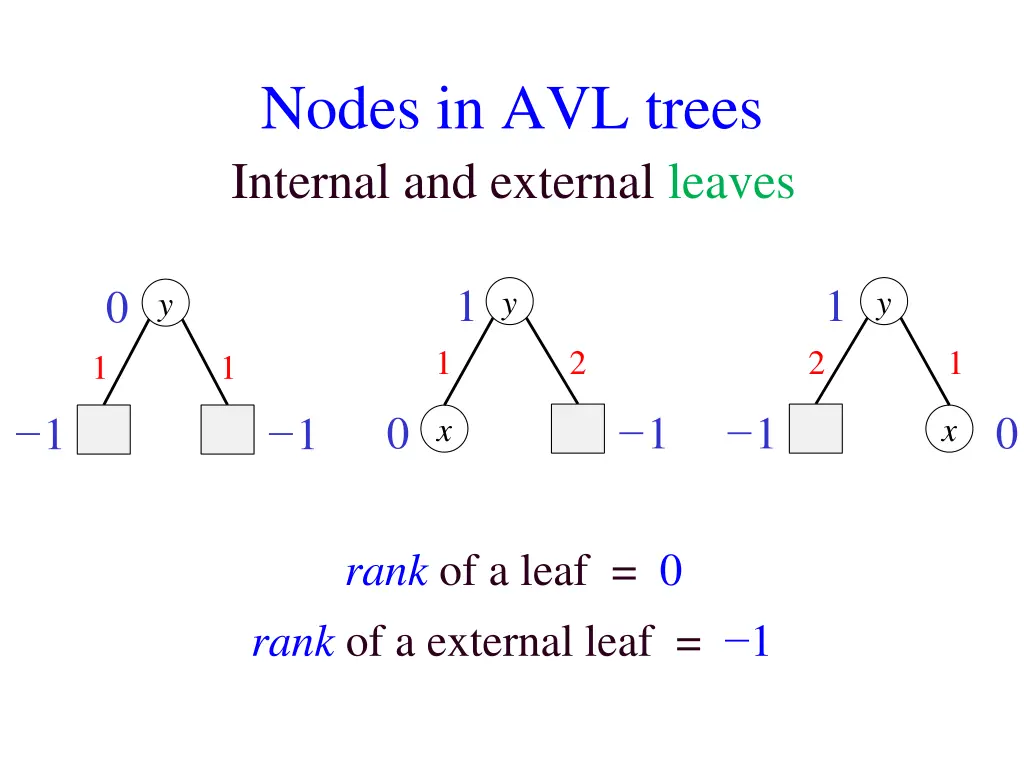
Nodes in AVL trees Internal and external leaves 1 1 0 y y y 1 2 2 1 1 1 1 1 0 x 0 1 1 x rank of a leaf = 0 rank of a external leaf = 1
AVL insertion 16
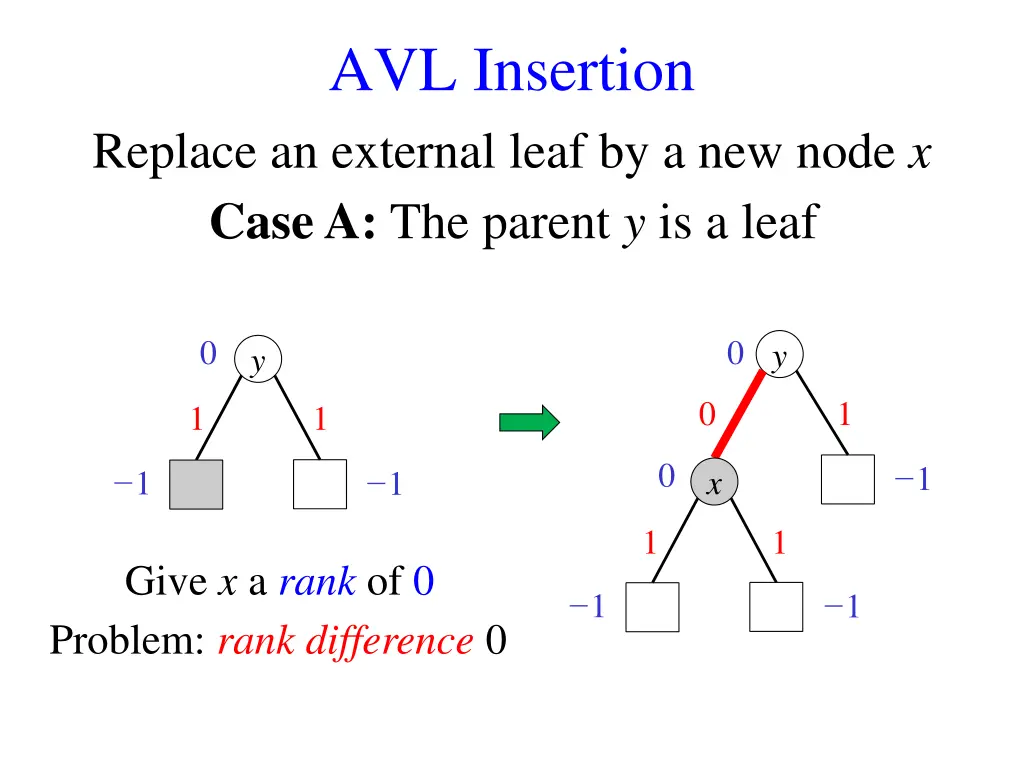
AVL Insertion Replace an external leaf by a new node x Case A: The parent y is a leaf 0 0 y y 0 1 1 1 0 1 x 1 1 1 1 Give x a rank of 0 1 1 Problem: rank difference 0
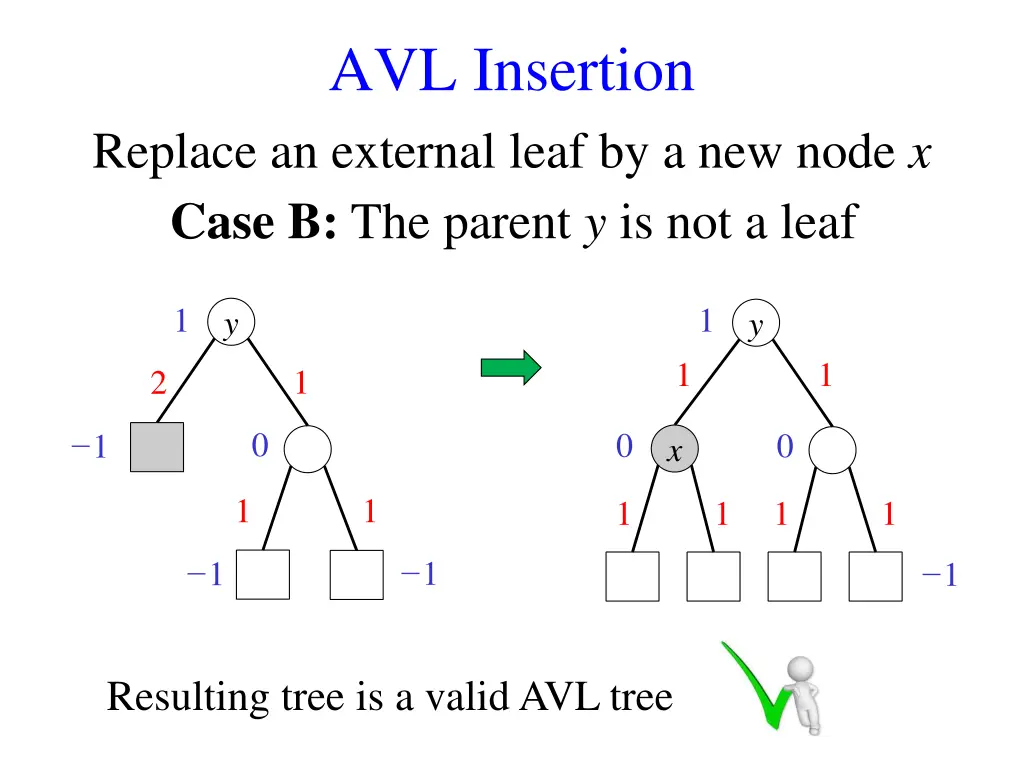
AVL Insertion Replace an external leaf by a new node x Case B: The parent y is not a leaf 1 1 y y 1 1 1 2 0 0 0 1 x 1 1 1 1 1 1 1 1 1 Resulting tree is a valid AVL tree
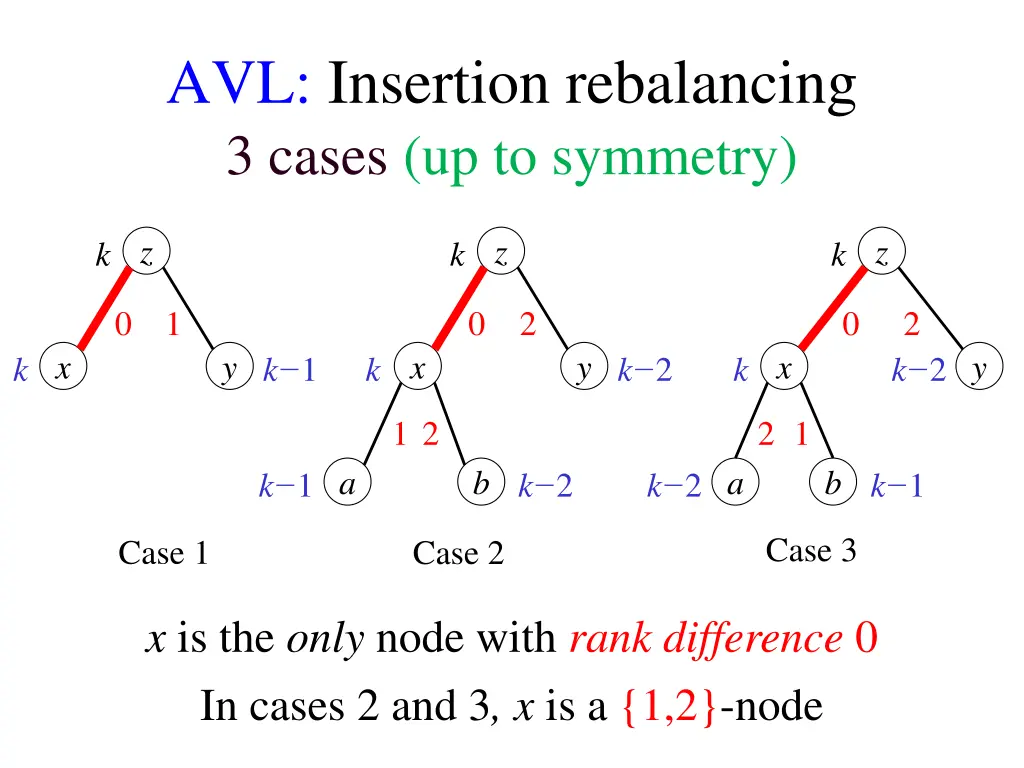
AVL: Insertion rebalancing 3 cases (up to symmetry) z z z k k k 0 1 0 2 0 2 x y x y x y k 1 k 2 k 2 k k k 1 2 2 1 a b a b k 1 k 2 k 2 k 1 Case 3 Case 1 Case 2 x is the only node with rank difference 0 In cases 2 and 3, x is a {1,2}-node
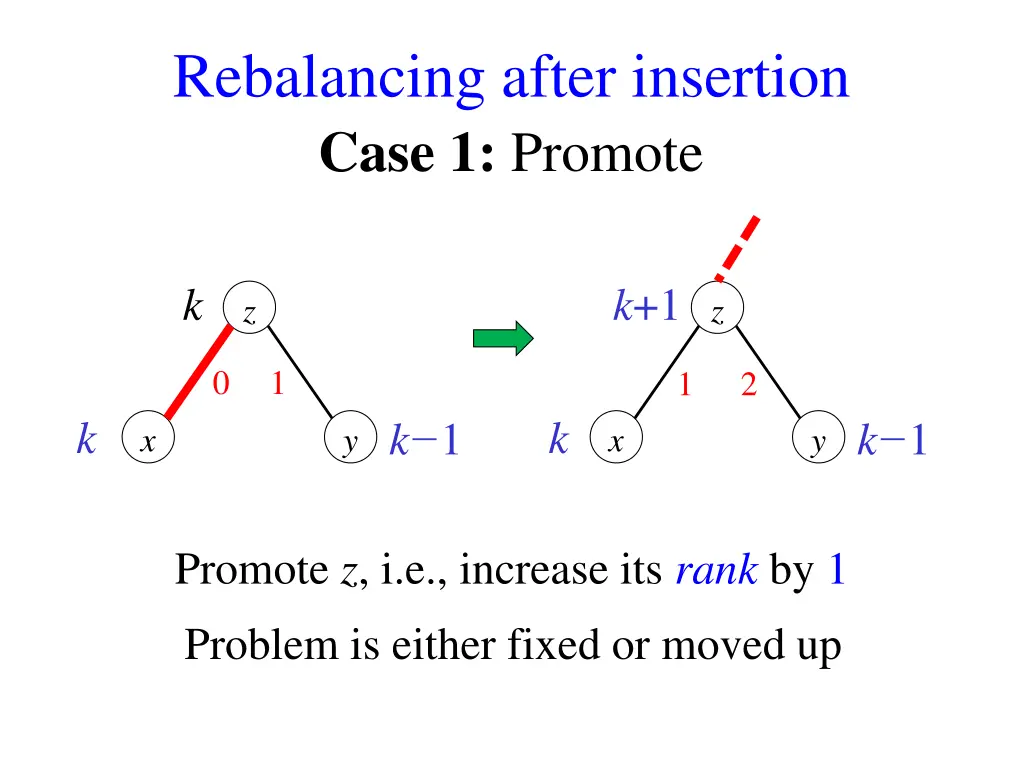
Rebalancing after insertion Case 1: Promote k+1 k z z 0 1 1 2 k k k 1 k 1 x y x y Promote z, i.e., increase its rank by 1 Problem is either fixed or moved up
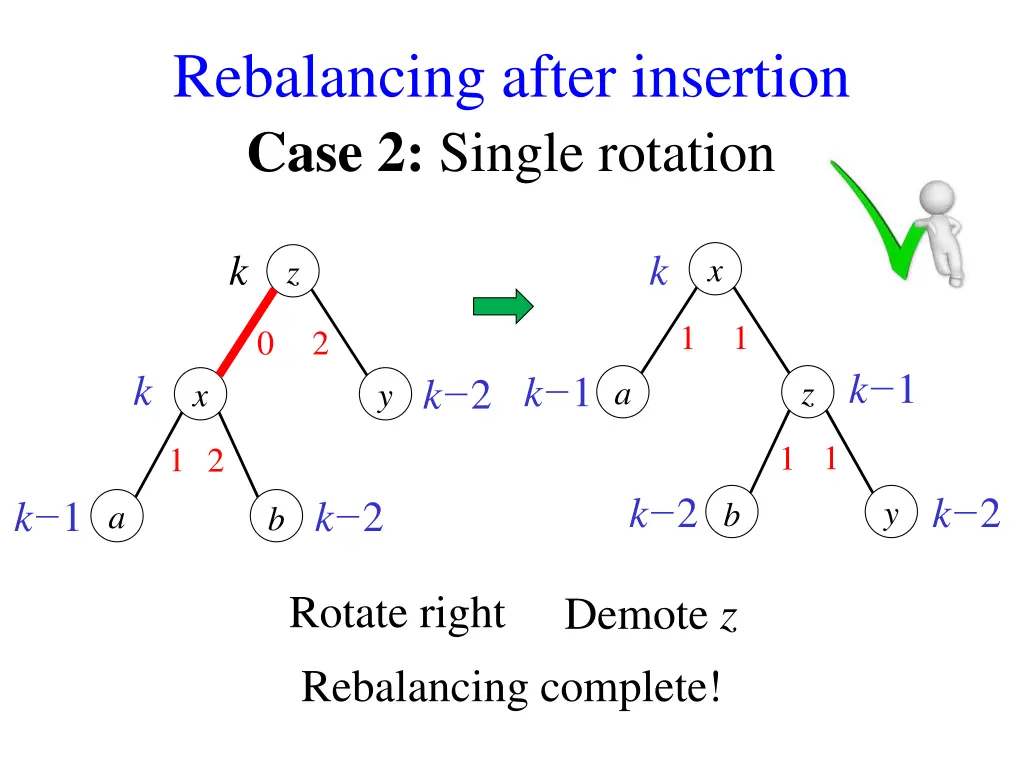
Rebalancing after insertion Case 2: Single rotation k k x z 1 1 0 2 k 1 k k 1 k 2 a z x y 1 1 1 2 k 2 k 2 k 1 k 2 y b a b Rotate right Rebalancing complete! Demote z
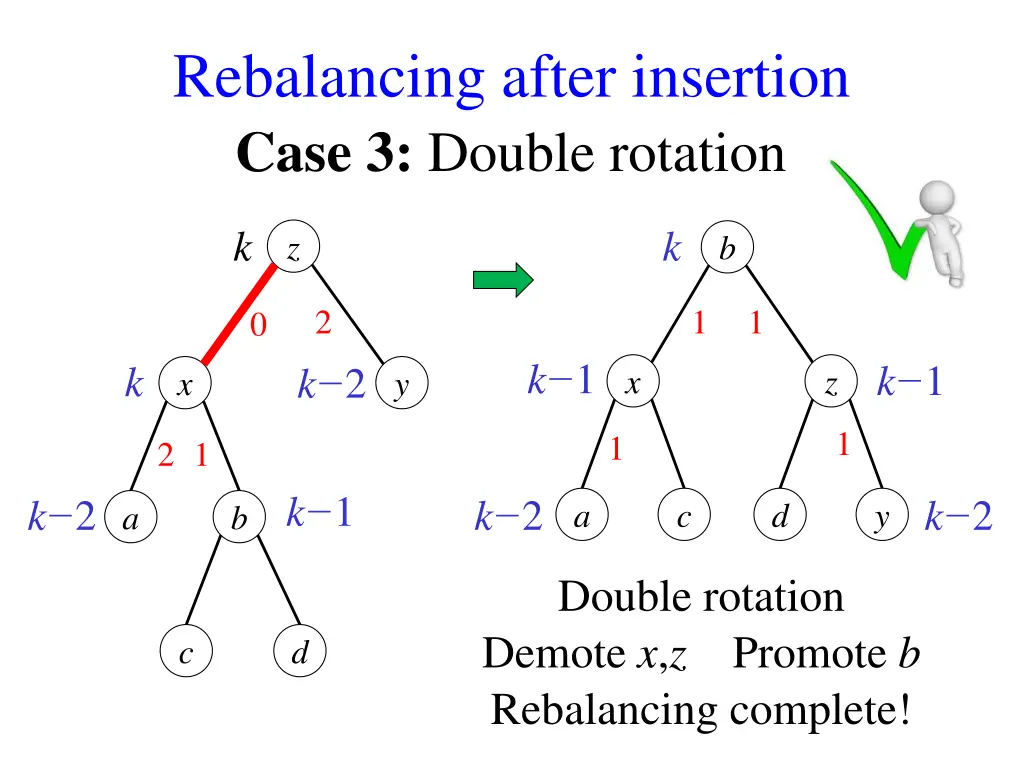
Rebalancing after insertion Case 3: Double rotation k k z b 2 1 1 0 k 1 k 1 k k 2 x z x y 1 1 2 1 k 1 k 2 k 2 k 2 a c d y a b Double rotation Demote x,z Promote b c d Rebalancing complete!
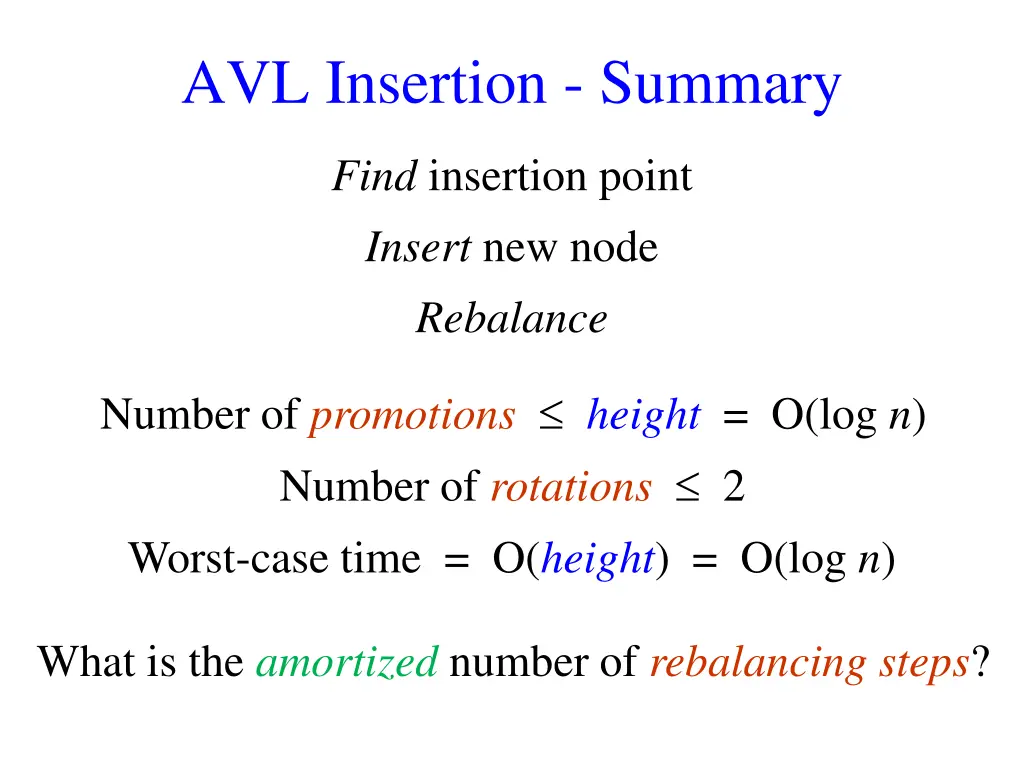
AVL Insertion - Summary Find insertion point Insert new node Rebalance Number of promotions height = O(log n) Number of rotations 2 Worst-case time = O(height) = O(log n) What is the amortized number of rebalancing steps?
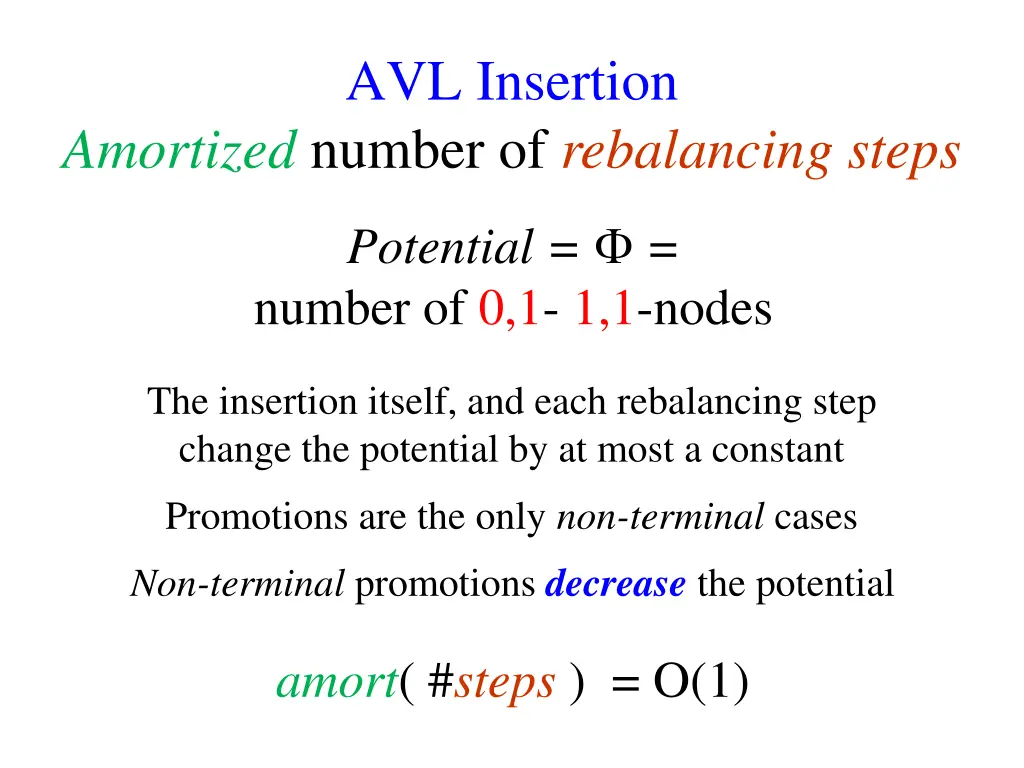
AVL Insertion Amortized number of rebalancing steps Potential = = number of 0,1- 1,1-nodes The insertion itself, and each rebalancing step change the potential by at most a constant Promotions are the only non-terminal cases Non-terminal promotions decrease the potential amort( #steps ) = O(1)
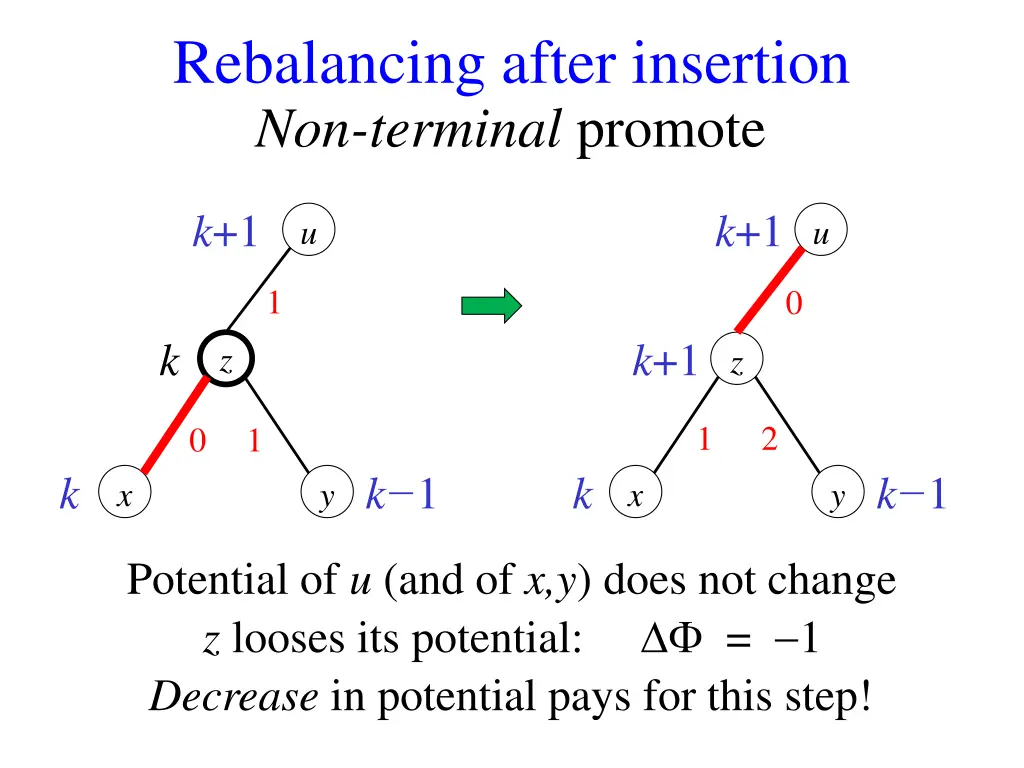
Rebalancing after insertion Non-terminal promote k+1 k+1 u u 1 0 k+1 k z z 1 2 0 1 k 1 k 1 k k x y x y Potential of u (and of x,y) does not change z looses its potential: = 1 Decrease in potential pays for this step!
AVL deletion 27
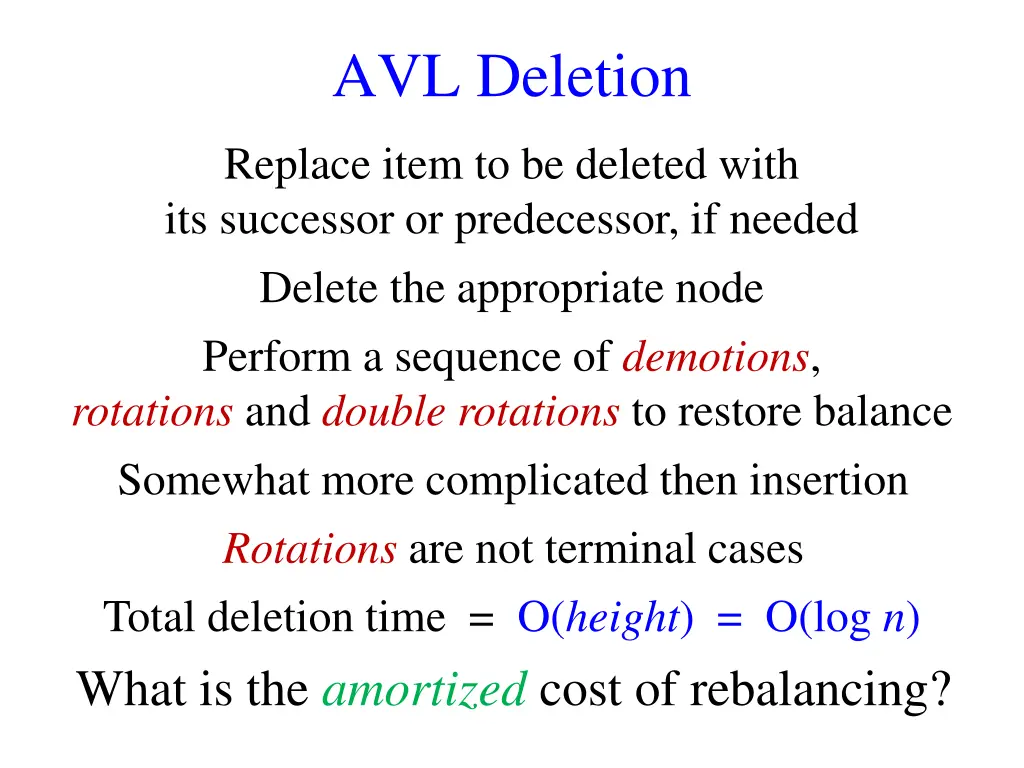
AVL Deletion Replace item to be deleted with its successor or predecessor, if needed Delete the appropriate node Perform a sequence of demotions, rotations and double rotations to restore balance Somewhat more complicated then insertion Rotations are not terminal cases Total deletion time = O(height) = O(log n) What is the amortized cost of rebalancing?
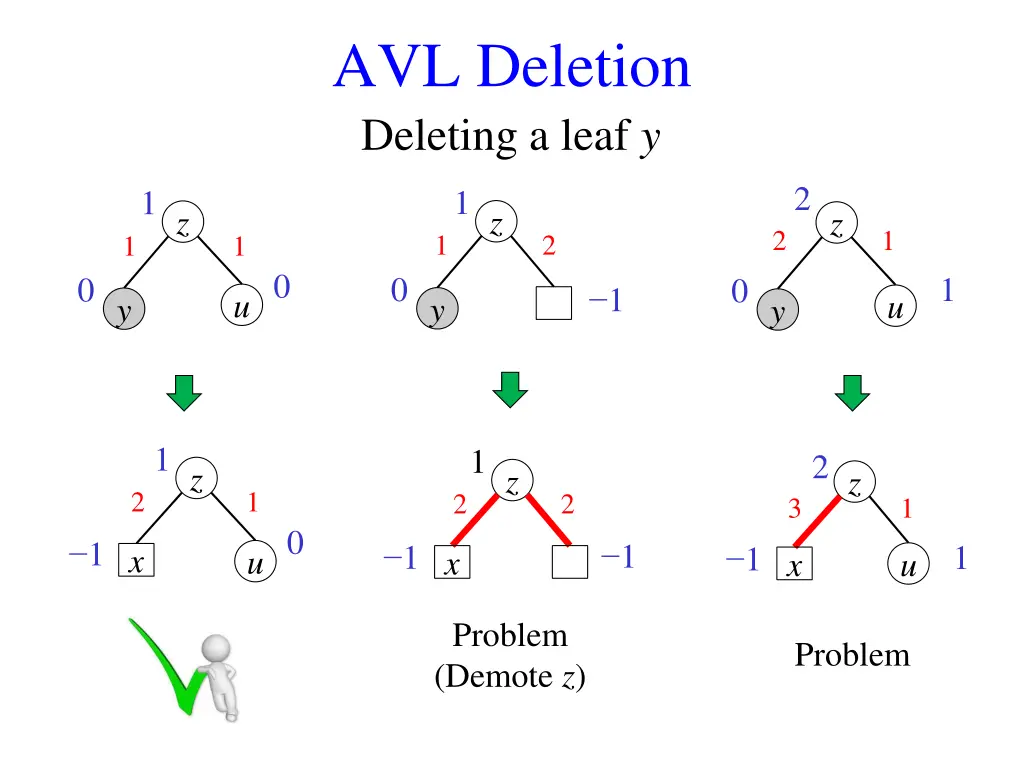
AVL Deletion Deleting a leaf y 2 1 1 z z z 2 1 1 2 1 1 0 1 0 0 0 1 u u y y y 1 1z 2 z z 2 1 2 2 3 1 0 1 1 1 1 1 x u x x u Problem (Demote z) Problem
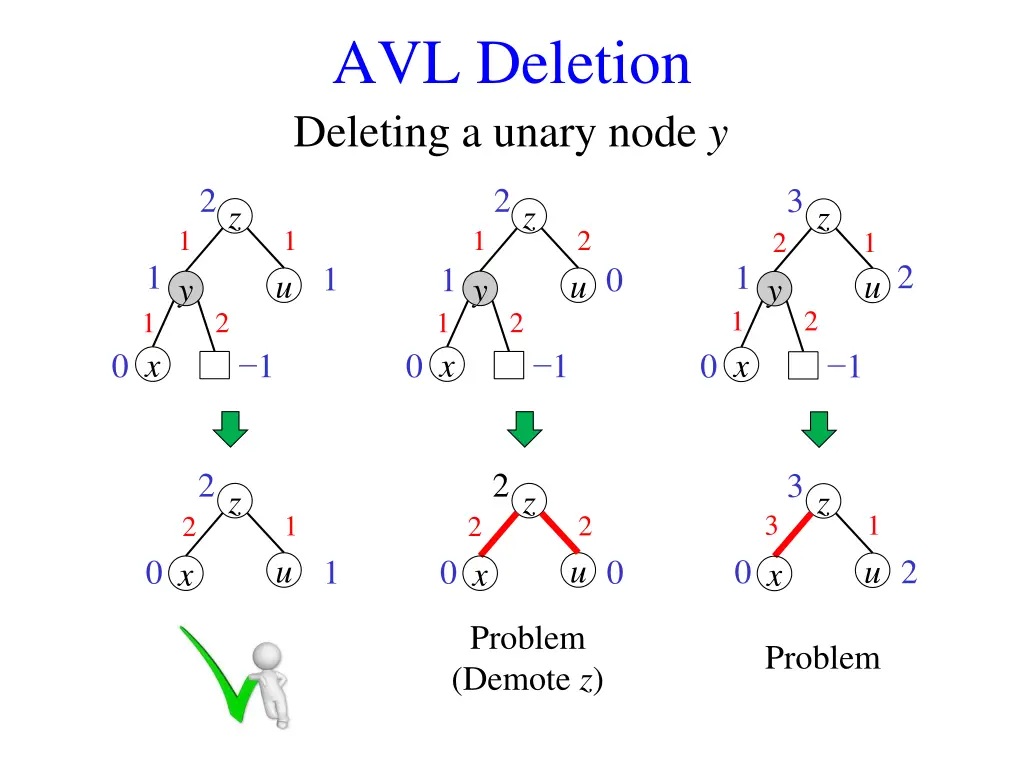
AVL Deletion Deleting a unary node y 2 2 3 z z z 1 1 1 2 2 1 2 1 1 x 1 1 x 1 1 1 x 0 u u u y y y 2 2 2 0 1 0 1 0 1 2 2 3 z z z 3 x 1 1 2 2 x 2 x u u u 0 2 0 1 0 0 Problem (Demote z) Problem
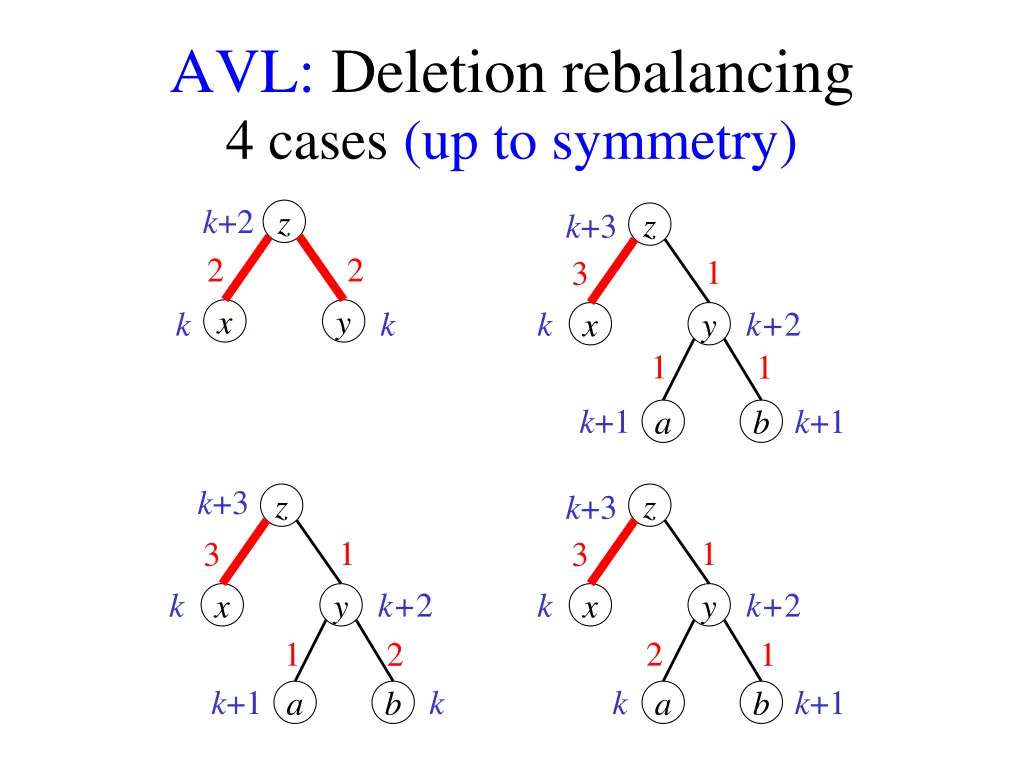
AVL: Deletion rebalancing 4 cases (up to symmetry) k+2 2 z z k+3 3 2 1 x y k+2 1 k k k x y 1 k+1 k+1 a b k+3 3 z z k+3 3 1 1 k+2 2 k+2 1 k k x y x y 1 2 k+1 k+1 k k a b a b
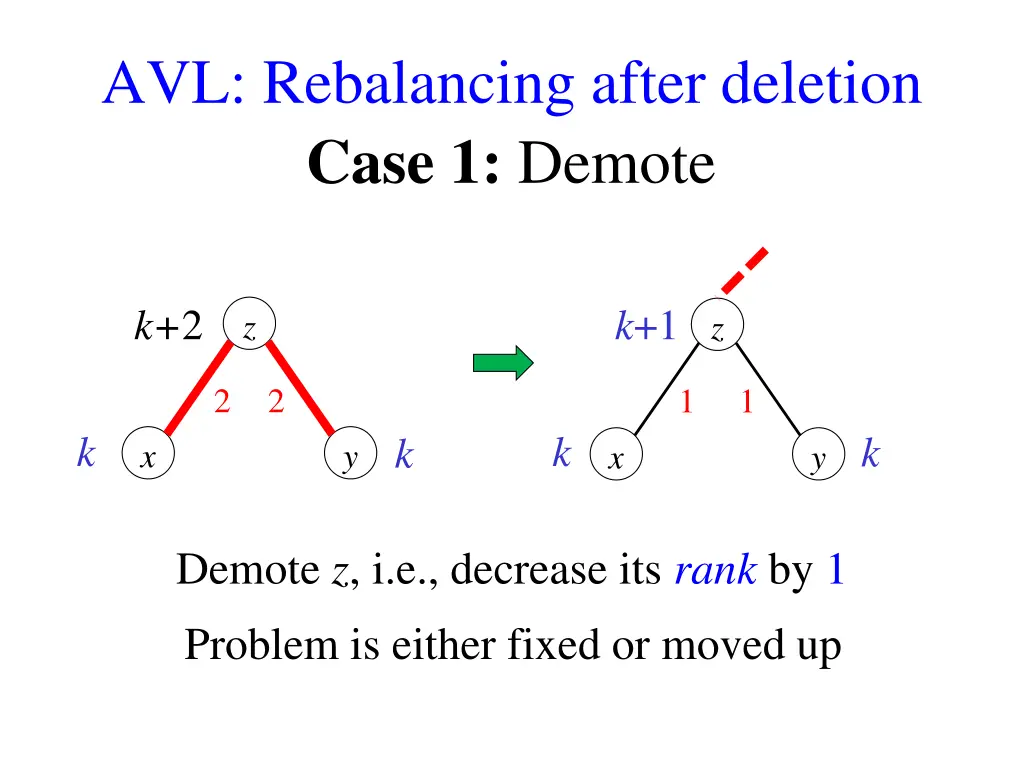
AVL: Rebalancing after deletion Case 1: Demote k+2 k+1 z z 2 2 1 1 k k k k x y x y Demote z, i.e., decrease its rank by 1 Problem is either fixed or moved up
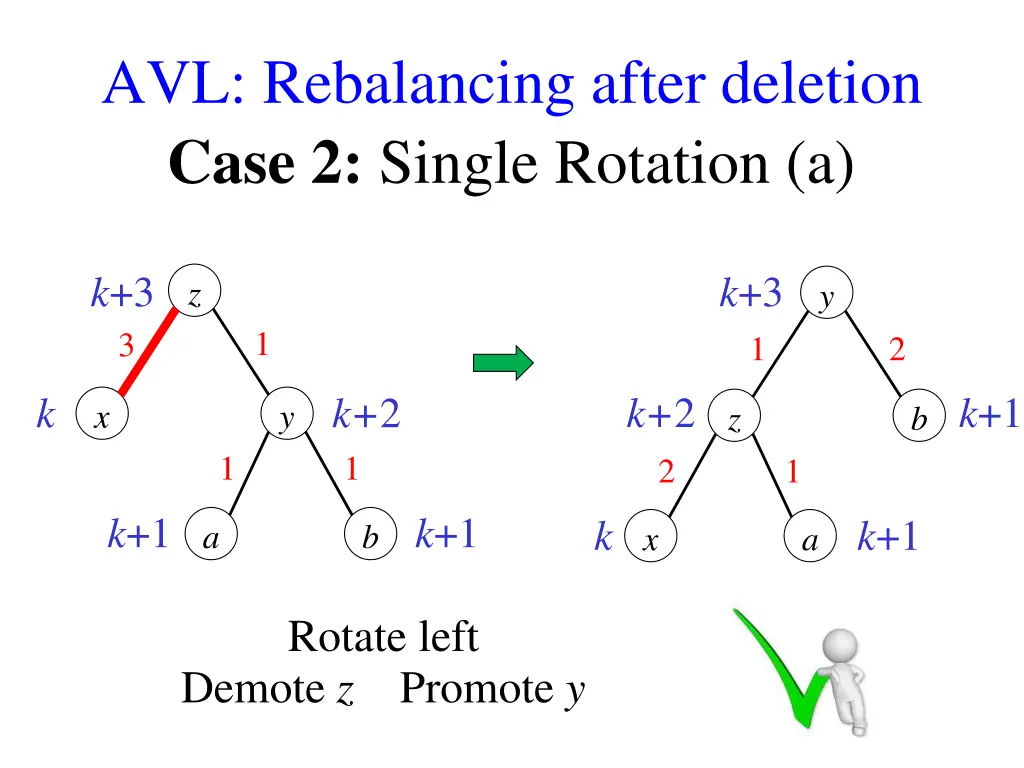
AVL: Rebalancing after deletion Case 2: Single Rotation (a) k+3 3 k+3 1 z y 1 2 k+2 2 k+1 k+2 1 k x y z b 1 1 k+1 k+1 k+1 k a b x a Rotate left Demote z Promote y
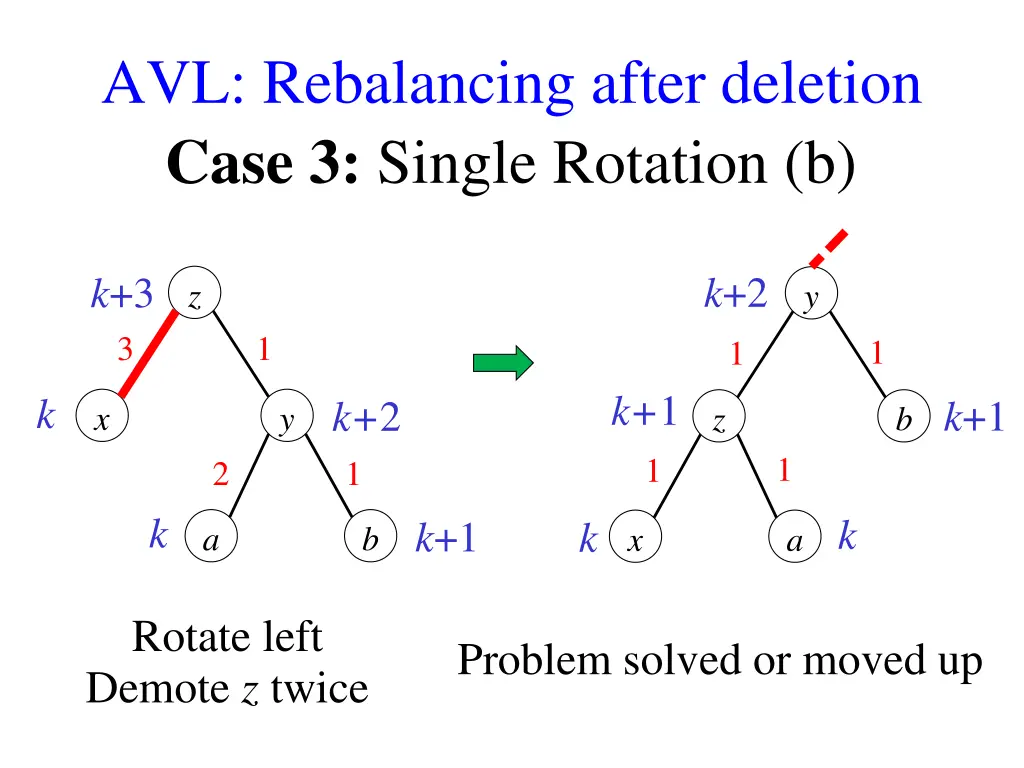
AVL: Rebalancing after deletion Case 3: Single Rotation (b) k+2 k+3 3 z y 1 1 1 k+1 1 k k+1 k+2 1 x y z b 1 2 k k k+1 k a b x a Rotate left Demote z twice Problem solved or moved up
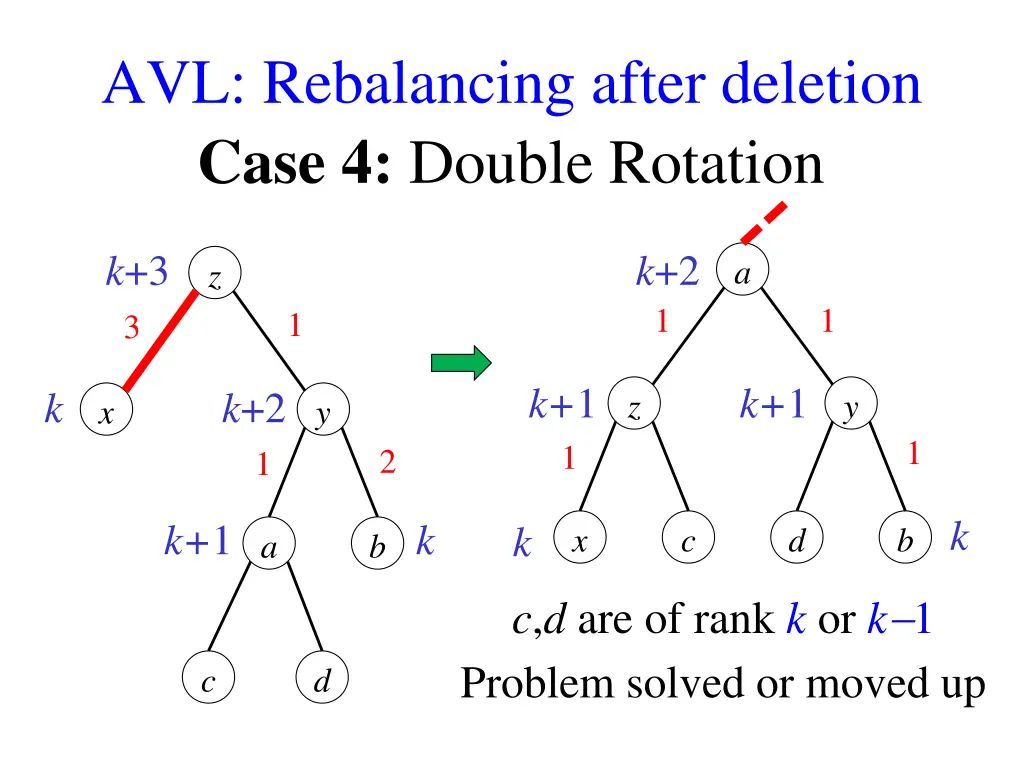
AVL: Rebalancing after deletion Case 4: Double Rotation k+3 3 k+2 a z 1 1 1 k+1 1 k+1 k+2 k z y x y 1 2 1 k k+1 k k c,d are of rank k or k 1 Problem solved or moved up x c d b a b c d
AVL Deletion - Summary Replace item to be deleted with its successor or predecessor, if needed Delete the appropriate node Perform a sequence of demotions, rotations and double rotations Somewhat more complicated then insertion Rotations are not terminal cases Total deletion time = O(height) = O(log n) What is the amortized cost of rebalancing?
AVL Trees Cost of rebalancing Worst-case cost of rebalancing, after both insertions and deletions, is O(log n) If there are only insertions, the amortized cost of rebalancing, as we saw, is O(1) If there are only insertions, and then only deletions, the amortized cost of rebalancing is again O(1) But, if insertions and deletions are intermixed, the amortized cost of rebalancing may be (log n) Can the amortized cost of rebalancing, in the general case, be brought down to O(1)?
WAVL trees [Haeupler-Sen-Tarjan (2009)] At most two rotations both in insertions and deletions Amortized cost of rebalancing is O(1) Allow 2,2-nodes Every (internal) leaf is still a 1,1-node rank height 38
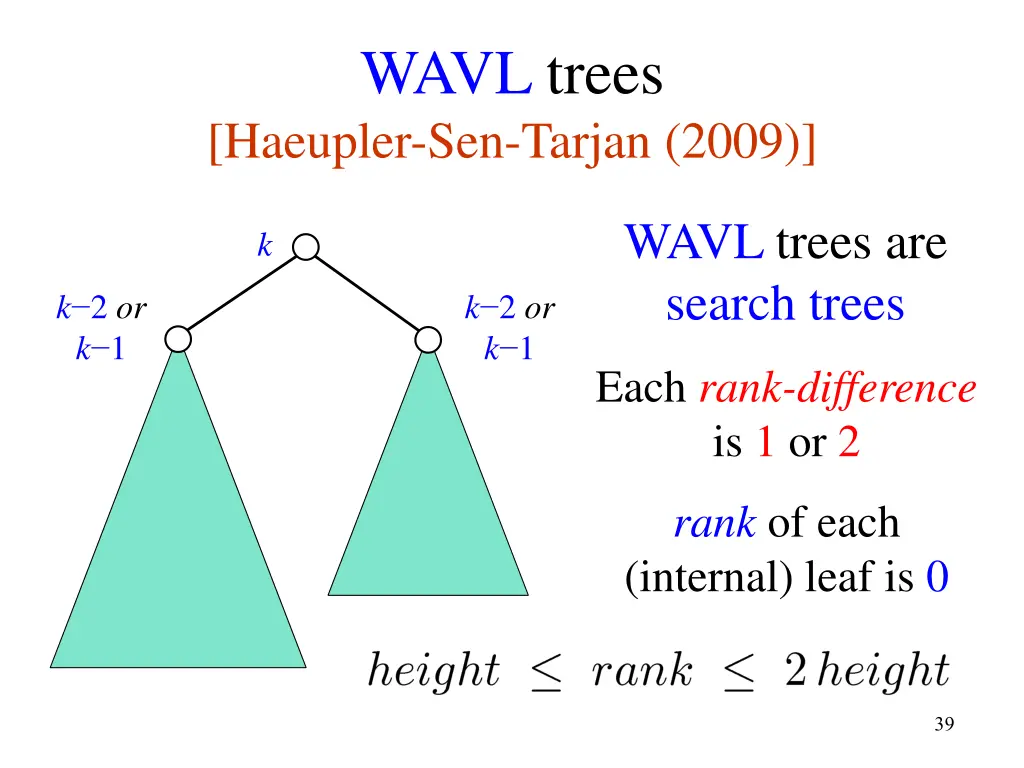
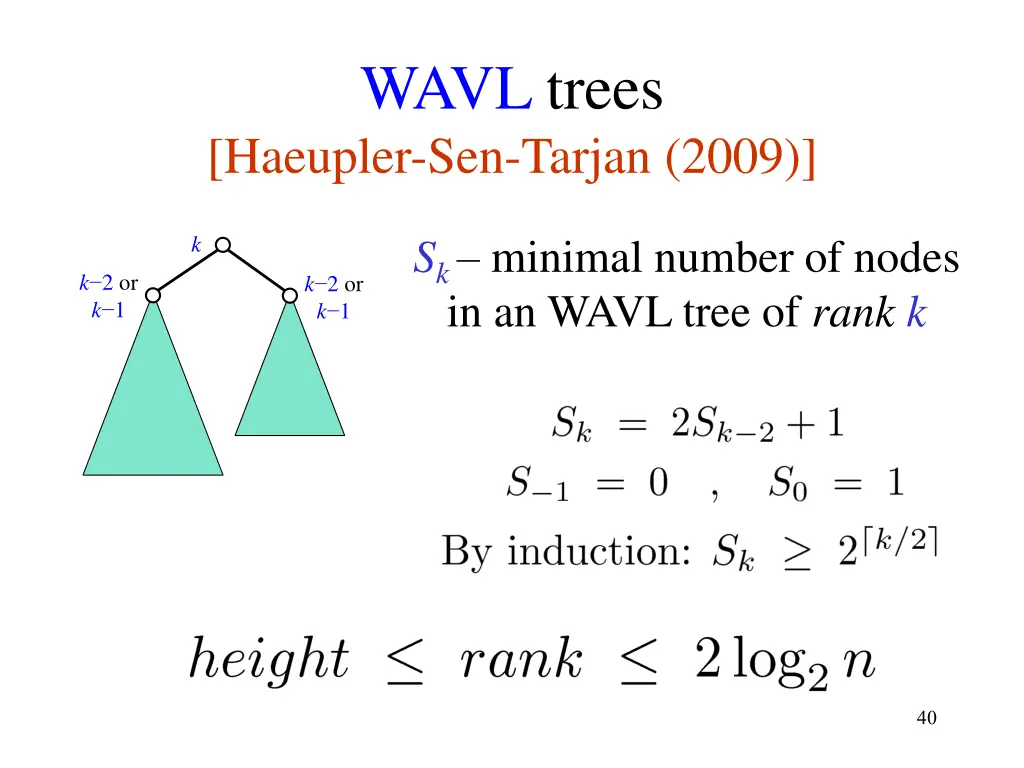
WAVL trees [Haeupler-Sen-Tarjan (2009)] WAVL trees are search trees k k 2 or k 1 k 2 or k 1 Each rank-difference is 1 or 2 rank of each (internal) leaf is 0 39
WAVL trees [Haeupler-Sen-Tarjan (2009)] Sk minimal number of nodes in an WAVL tree of rank k k k 2 or k 1 k 2 or k 1 40
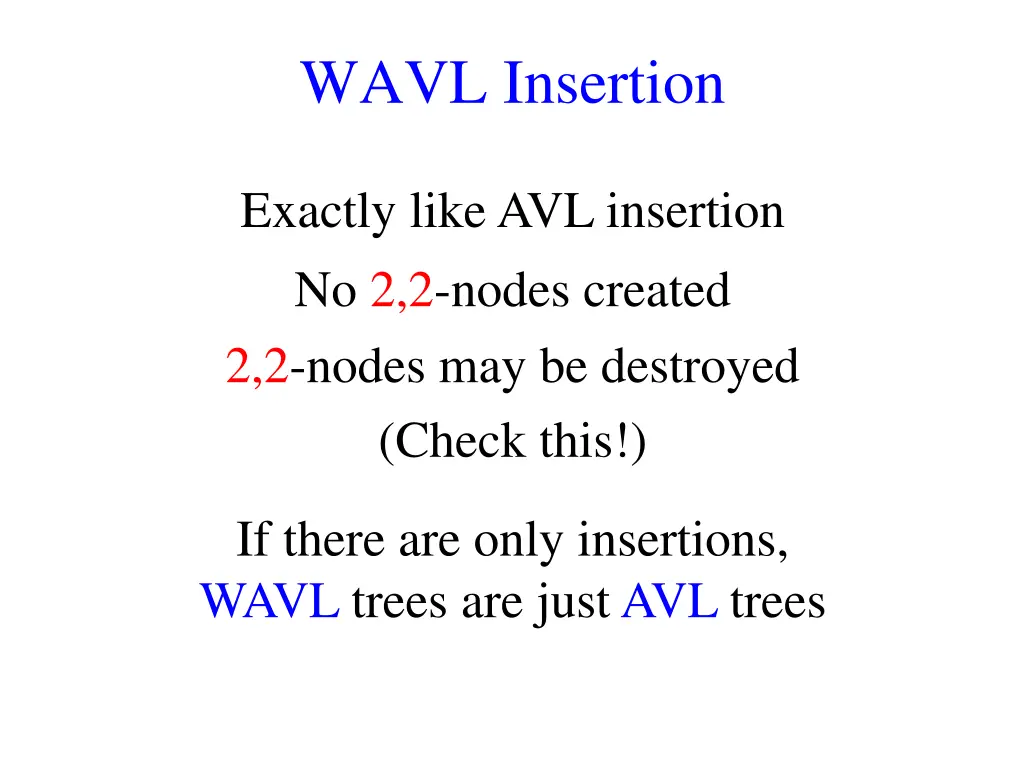
WAVL Insertion Exactly like AVL insertion No 2,2-nodes created 2,2-nodes may be destroyed (Check this!) If there are only insertions, WAVL trees are just AVL trees
WAVL deletion 42
WAVL Deletion New cases to consider Deletion becomes somewhat simpler Rotations are now terminal cases
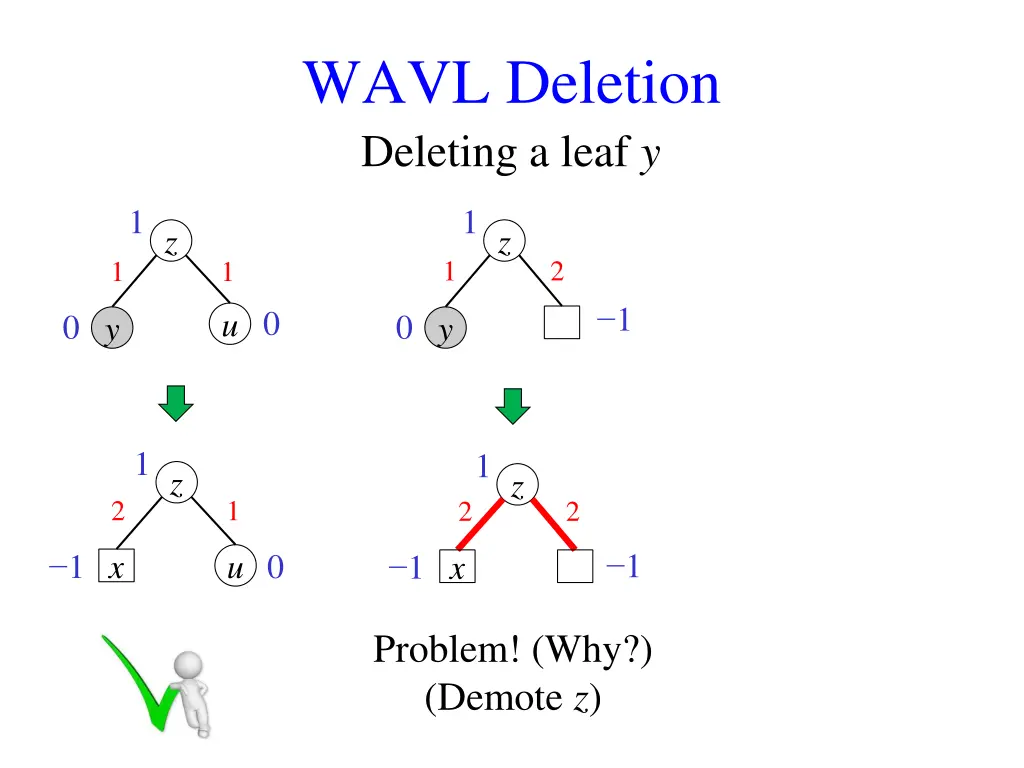
WAVL Deletion Deleting a leaf y 1 1 z z 1 2 1 1 1 0 u 0 0 y y 1 1z z 2 1 2 2 1 1 0 x u 1 x Problem! (Why?) (Demote z)
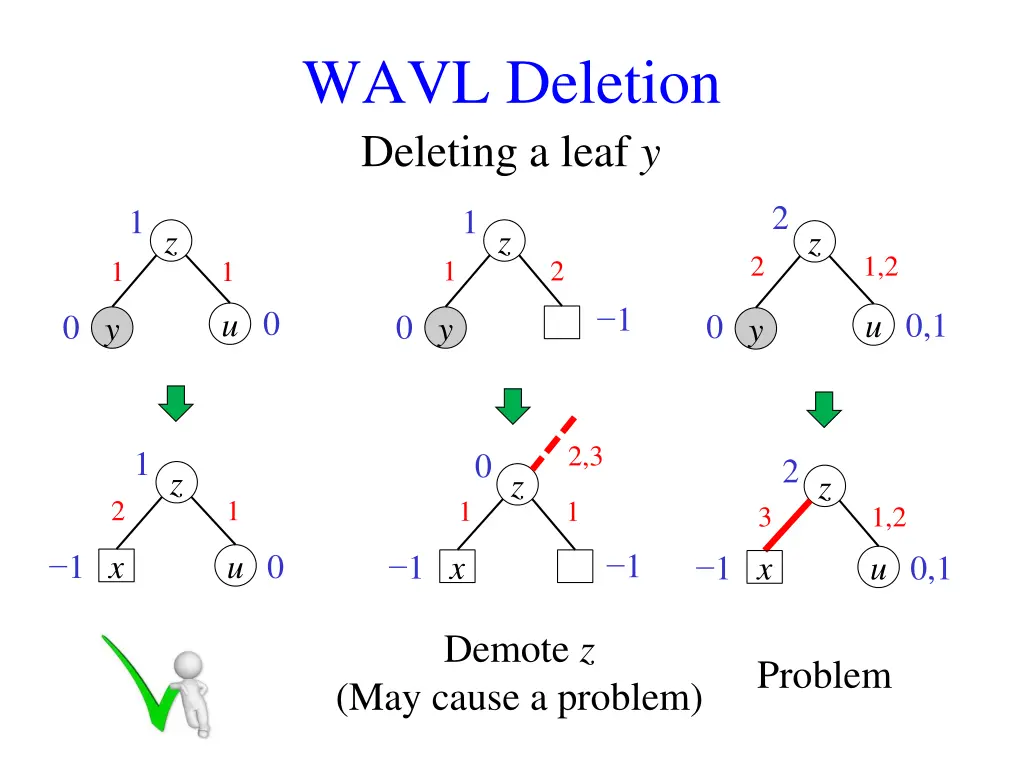
WAVL Deletion Deleting a leaf y 2 1 1 z z z 2 1,2 1 2 1 1 1 0 u 0,1 u 0 0 0 y y y 2,3 1 0z 2 z z 2 1 1 1 3 1,2 u 1 1 0 x u 1 x 1 0,1 x Demote z Problem (May cause a problem)
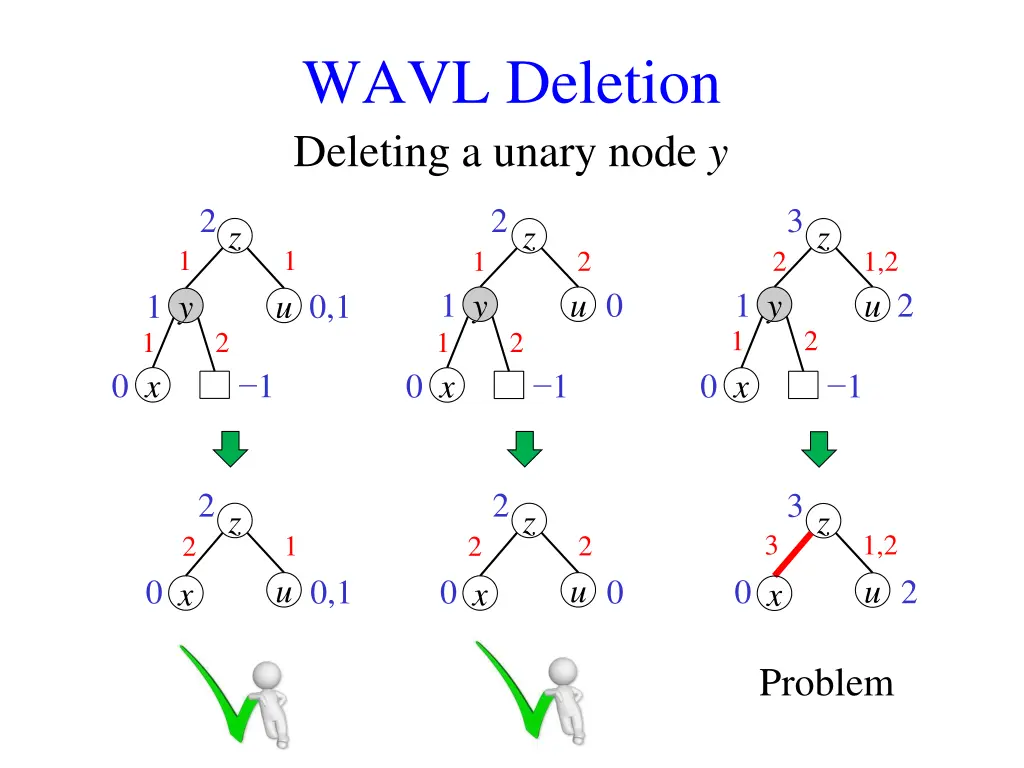
WAVL Deletion Deleting a unary node y 2 2 3 z z z 1 1 1 2 2 1,2 1 1 x 0 1 1 x 2 y u y u 1 1 x 0,1 y u 2 2 2 0 1 0 1 0 1 2 2 3 z z z 3 x 1,2 1 2 2 x 2 x u u u 0 2 0 0,1 0 0 Problem
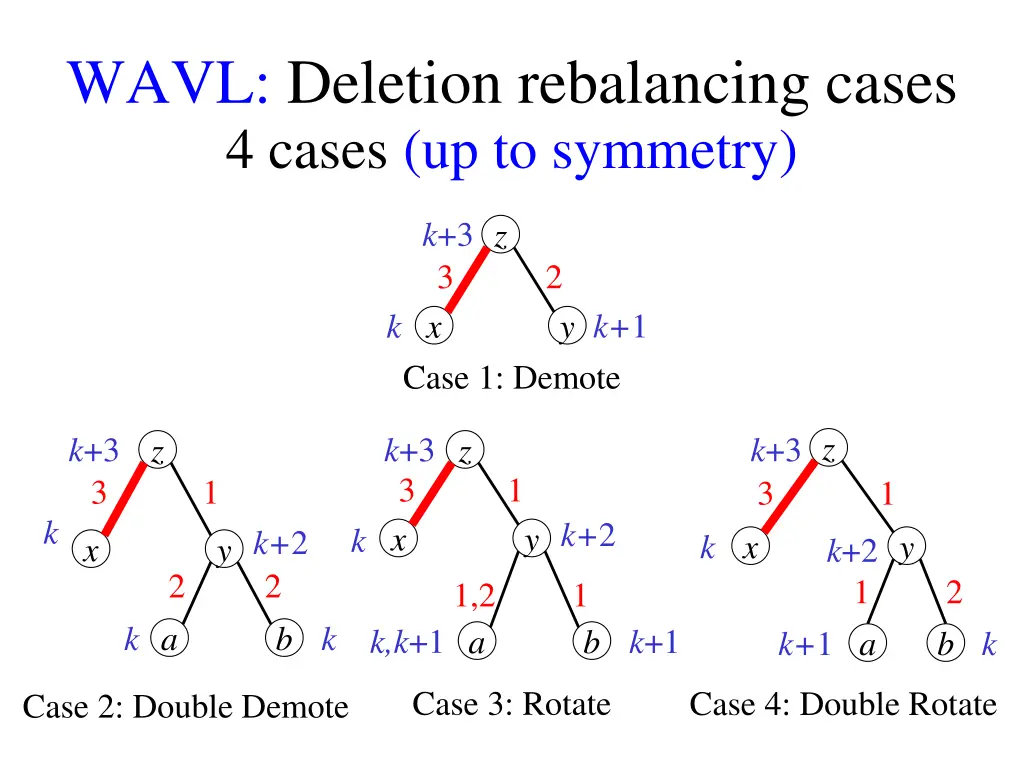
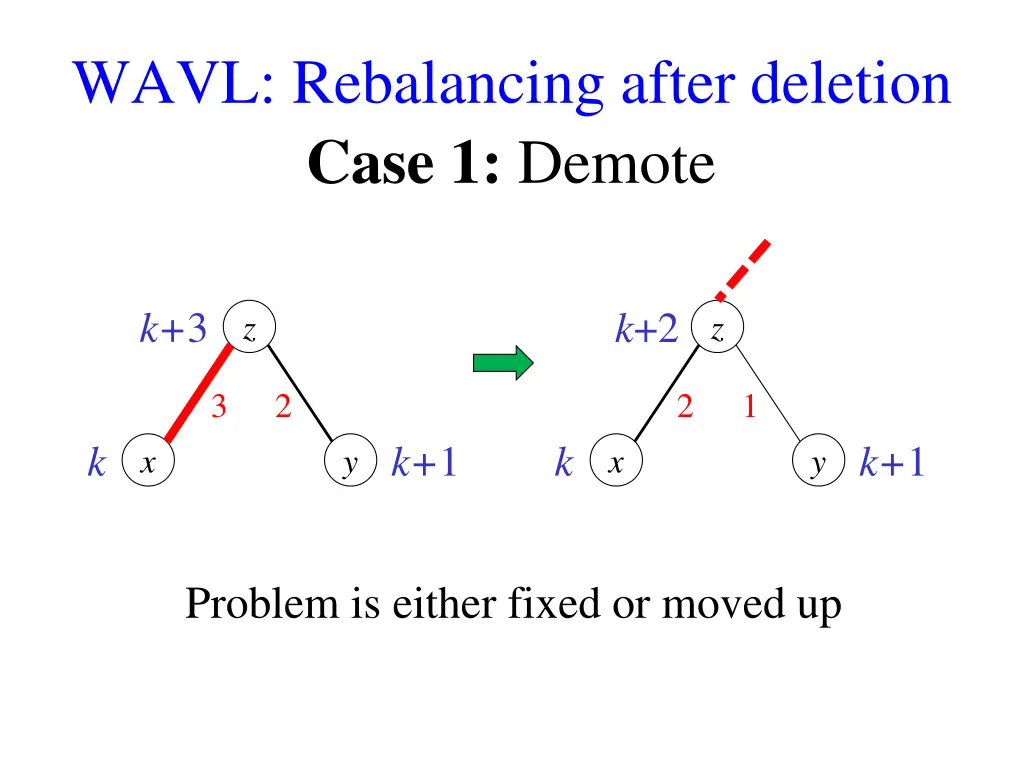
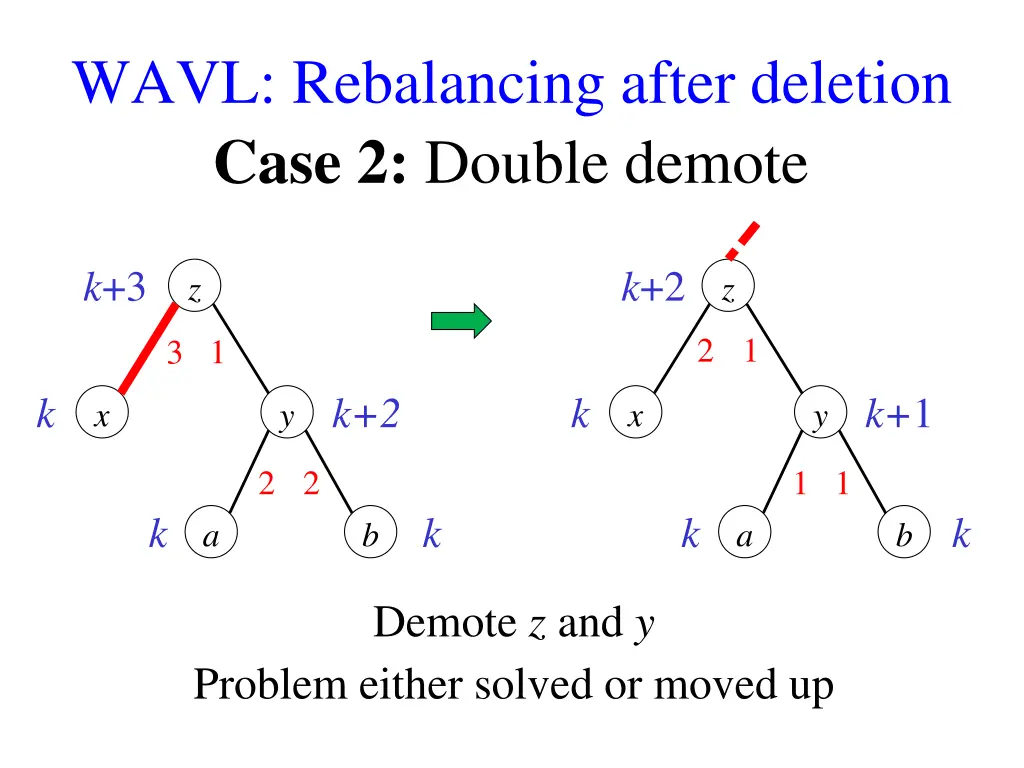
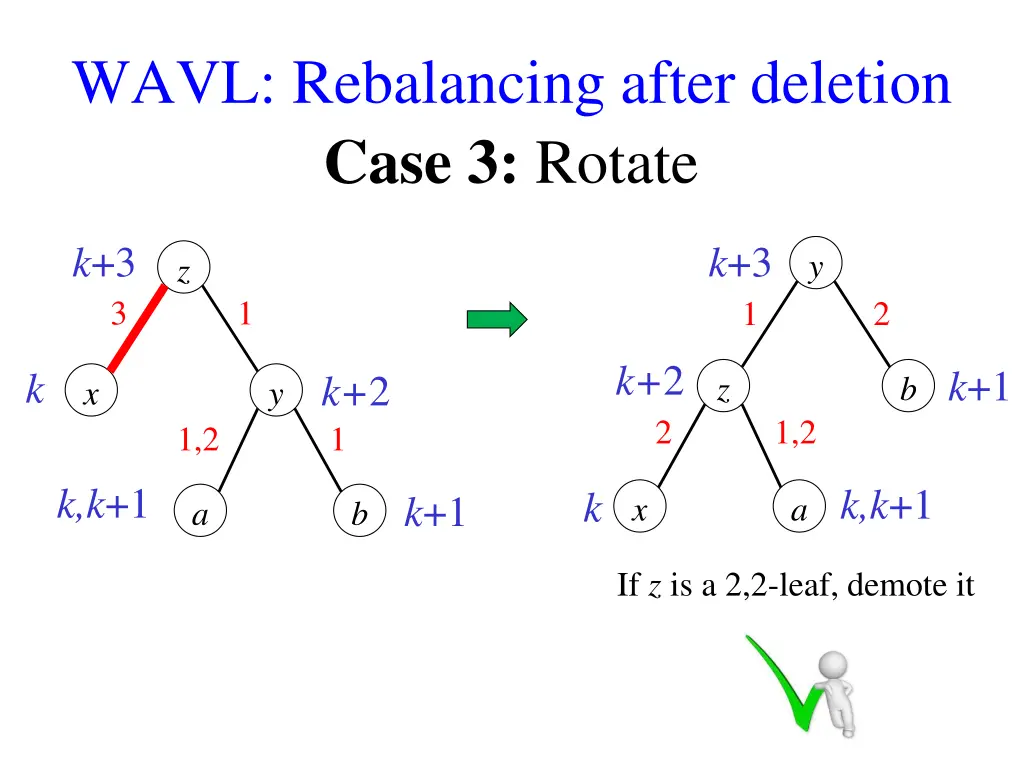
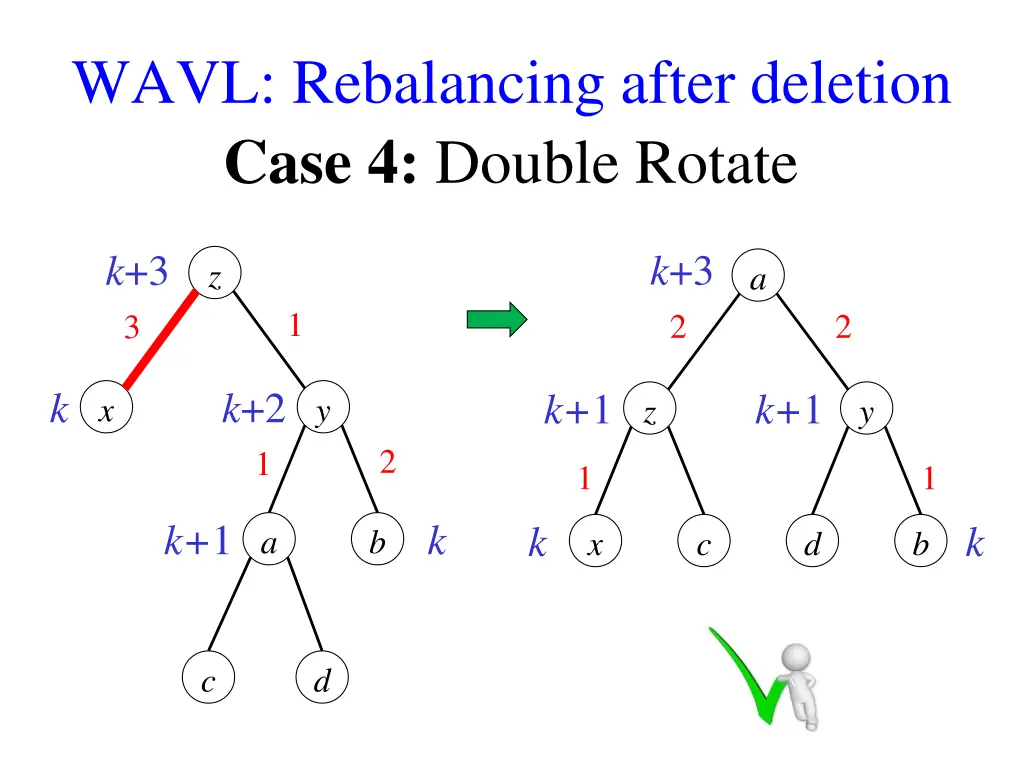
WAVL: Deletion rebalancing cases 4 cases (up to symmetry) k+3 3 z 2 k+1 k x y Case 1: Demote z k+3 3 k+3 3 k+3 3 x z z 1 1 1 k k+2 x y k k+2 2 k y x y k+2 2 1 a 2 1,2 1 k k a b k,k+1 k+1 a b k+1 k b Case 3: Rotate Case 4: Double Rotate Case 2: Double Demote
WAVL: Rebalancing after deletion Case 1: Demote k+3 k+2 z z 3 2 2 1 k+1 k+1 k k x y x y Problem is either fixed or moved up
WAVL: Rebalancing after deletion Case 2: Double demote k+3 k+2 z z 2 1 1 3 k+1 k k+2 k x y x y 2 2 1 1 k k k k a b a b Demote z and y Problem either solved or moved up
WAVL: Rebalancing after deletion Case 3: Rotate k+3 k+3 y z 3 1 1 2 k+2 k+1 k k+2 1 z b x y 2 1,2 1,2 k,k+1 k,k+1 k k+1 x a a b If z is a 2,2-leaf, demote it
WAVL: Rebalancing after deletion Case 4: Double Rotate k+3 k+3 3 z a 1 2 2 k+2 k k+1 k+1 x y z y 2 1 1 1 k+1 k k k a b x c d b c d