Understanding Buddhist Economics and its Relation to Material Wealth
Explore the intersection of Buddhism and economics, where material possessions are seen as means to spiritual advancement, not goals in themselves. Discover how the pursuit of wealth can lead to suffering and the importance of moderation in material pursuits within Buddhist philosophy.

Download Presentation

Please find below an Image/Link to download the presentation.
The content on the website is provided AS IS for your information and personal use only. It may not be sold, licensed, or shared on other websites without obtaining consent from the author. If you encounter any issues during the download, it is possible that the publisher has removed the file from their server.
You are allowed to download the files provided on this website for personal or commercial use, subject to the condition that they are used lawfully. All files are the property of their respective owners.
The content on the website is provided AS IS for your information and personal use only. It may not be sold, licensed, or shared on other websites without obtaining consent from the author.
E N D
Presentation Transcript
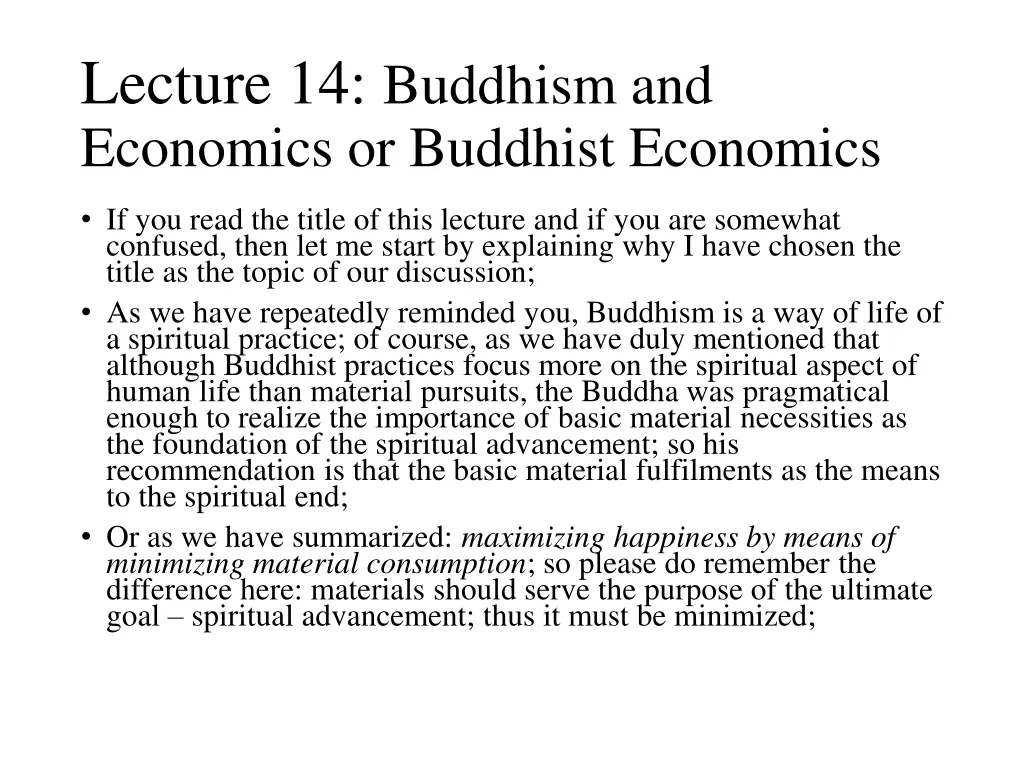
Lecture 14: Buddhism and Economics or Buddhist Economics If you read the title of this lecture and if you are somewhat confused, then let me start by explaining why I have chosen the title as the topic of our discussion; As we have repeatedly reminded you, Buddhism is a way of life of a spiritual practice; of course, as we have duly mentioned that although Buddhist practices focus more on the spiritual aspect of human life than material pursuits, the Buddha was pragmatical enough to realize the importance of basic material necessities as the foundation of the spiritual advancement; so his recommendation is that the basic material fulfilments as the means to the spiritual end; Or as we have summarized: maximizing happiness by means of minimizing material consumption; so please do remember the difference here: materials should serve the purpose of the ultimate goal spiritual advancement; thus it must be minimized;
The laity and the monastics As mentioned in the previous slide, according to Buddhist philosophy, materials are necessary but they are not the main pursuits of Buddhists; so they should be kept at minimum; Another reason is that because of the dangers inherited in material possessions or wealth, the Buddha also warned that ignorant attachment to material possessions or sensual pleasure would result in endless suffering; the reason is that conditioned things are impermanent, so when they are changing, we would be suffering; for instance, if one become a millionaire, he might want to improve his wealth and become a multi-millionaire; then billionaire, and more So when the Buddha talked about issues of material possessions, he differentiated two groups: those of the lay Buddhists and those of the monastics; because the lay Buddhists need to have a normal life, so the Buddha talked about economic issues, but such talks are kept at minimum the level of necessity, not elaborative;
Buddhism, economics, and So here we shall return to the main topic: when we talk about Buddhist economics, what do we mean by that term? As we mentioned in the early lectures, first of all, the term Buddhist economics was used as early as in the 1950s but it only become slightly more often in the recent decades; so it is not a firmly established field of studies; Secondly, instead of Buddhist economics, when people talked about the related issues, they actually talked about Buddhism and economics; or some Buddhist socio-economic ideas and some possible applications of those ideas in understanding of economics; or a comparison of Buddhist ideas/ideals and economics; So here, we use this two terms or all the relevant terms alternately, but what we should understand is that there is no consistent Buddhist economic system as such; may be understand the system as a holistic model the whole picture of economics, includes both normative and positive economics;
The 8 steps Those 8 steps are summarized by Clair Brown and should be considered as a mixture of normative economics and Buddhist socio-economic ideas; We must therefore remember the different emphasis of two branches of economic studies; the positive economics is concerned about economic facts and factors such as consumer prices, consumption, interest rates, and above all, the GDP; on the other hand, normative economics emphasizes on the ethical aspects of economic studies, such as poverty, income inequality and social impact of economic distribution; The 8 steps are divided into 3 broad categories: on the national level, tax and transfer, sustainable agriculture, measure and transform, as well as peace and prosperity; on the company level, green development and sustainable wages are important; and then personally, meaningful life and interdependence are important;
The tax and transfer strategy According to Clair Brown, market economics cannot work properly without the well-structured plans of government; this then seems to suggest a mixed economics/economy: free market with some sort of meaningful plan and necessary intervention; As a result, she propose 4 steps through which the tax and transfer strategy would be carried out: 1, a meaningful tax for the carbon emission: the more those who produce carbon emission, the higher the taxation; 2, share prosperity; 3, keep fossil fuels beneath ground; 4, share green technologies so as to benefit economic development as well as protection of environment;
Regulating the carbon emission? According to Clair Brown, higher tax is a good incentive de- incentivize those who produce too much CO to minimize their carbon emission; if they continue to do so, the required tax payment would be transferred to the protection of environment; For instance, she points out that the price of oil and gas has always been volatile, and this cripples planning by the country and by the consumer. To keep the price of oil and gasoline steady, governments can increase the price of fossil fuels with a carbon tax that moves inversely with the price of oil and gas. This keeps the price high to incorporate the social costs and keeps the price steady to help economic planning. (Clair Brown, 2017:135) The above suggestion is easy said that done, because as long as economic growth is concerned, it is not always the pure economics but a combination of many facts and factors;
The figures and the problem Clair Brown provides some examples, such as advocates by Peter Barnes, which indicates a 5,000 USD dividend to each and every US citizen, if the cap and dividend program is implemented; She also provides the examples of Germany, France and US with the regulated carbon emission and carbon tax; The above figures might be convincing and even practical, but all those countries are developed countries; they might regulate whatever they want at home, but international investments could create so many loopholes that it is simply impossible to implement a unified policy; Beside, some developing countries have been caught in a dilemma: welcome investments with little choice or choice with little investments; but if you choose the investments, then there are not many options about the types of investments; so here we have some good ideals and the reality;
Share prosperity at home According to Clair Brown (pp.137-138), share prosperity scheme would create a more equal society; here proposals are threefold: 1, a guaranteed minimum wage; in some countries, this means that a employer is required, by law, to pay his employee a hourly wage equal or above the fixed minimum rate, say, 10 dollars per hour; this is called statutory rate, which means regardless of types of work an employee is doing; 2, capital endowment for starters; in wealthy countries this means different types of capital endowment but some basic endowment such as education, professional training and housing are essential; 3, shares or ownership of employees; in some European countries, there are two board system: one branch consists of shareholders, while the other consists of representative of workers;
Keep it under the ground Because of the potential negative effect of the fossil fuels on environment and eco-system as well as the issues of global warming and climate change, environmentalists, and to a lesser degree, some economists have suggested that fossil fuels should not be extracted from the under ground but should be remained there keep it under the ground; So according to Clair Brown, 80% of coal reserve, half of gas reserve and 1/3 of the oil reserve globally must be remained explored if the under 2 target of global warming needs to be achieved; But as it is obviously, environmentally beneficial does not mean that it is also true economically; in particularly, in the market system, profits and prosperity generally concentrate on the short term rather than in the long run; so keep it under the ground might be a great reminder, rather than a ready-made solution;
A optimistic outlook As the developed countries possessed the technologies and the means to reduce the carbon emission levels while still making economic growth, their initiatives are important steps that would convince people towards the right direction; So the 80/50 goal, or the reduce the carbon emission to at least 80% below the 1990 level by 2050 is even expected to produce some concrete result by 2030; Furthermore, two of the emerging economies with the largest population by far, China and India seem to be able to fulfil their perspective carbon reduction goals without considerably affecting their economic performance, which is crucial for the other important goal: elimination of extreme poverty; But while the outlook is optimistic, the implementation of some of the necessary but unpopular policies is crucial and it is remained to be seen in the next decade;
Share the green technologies According to Clair Brown, one of the difficult aspects of green development is the politics that involved; for the wealthy countries, it might be necessary to equally share the burdens of economic protection; but for the poor and developing countries, it has been largely the result of the industrialization of those rich developed countries that basically hastened the climate change and global warming; So now that those wealthy countries have been asking the poor countries to adopt a greener approach to economic development is grossly unfair and morally indefensible; furthermore, when the green technologies are installed, they are not free of charge so the poor countries either could not afford or it is not very profitable in the short term that there is simply no incentive of doing it; Clair Brown then suggest the idea of sharing the green technologies; of course this sharing cannot be presented as handouts of green technologies; rather it is a kind of investment without good dividends but only in the long run;
Sustainable agriculture When we discuss about agriculture, as most of us from villages, the picture emerges is a cow or a pair of cows and a plough that are used to cultivate the field; although you may be surprised to realize, but that sort of traditional agriculture has been used for thousand of yeas, until this very day; that why in some part of Asian villages, people refuse to eat beef because cows are regarded as a member of the family part of the agricultural tradition; However, modern day agriculture is different from that of the traditional one; eggs are produced at an industrial scale whereas chickens may never see the natural daylight; it is said that Kobe beef is so expensive because the cows over there were living a lifestyle similar to that of a royal family before they were slaughtered for beef; they were even massaged regularly; But because of the water, land, fuels, fodders and feeds needed for the industrialized farming and agriculture increased quickly, even agriculture seems to be unsustainable;
Unsustainable agriculture and economic consequences Many issues are related to unsustainable agricultural development but the most obvious and urgent ones are economic ones: When food becomes a kind of commodity, its price would be volatile regardless of its distribution; but the problem is that food is the very basic need that people cannot do without it; so when industrialization of agriculture increases its scale, so the control of its price; according to Clair Brown, one of the consequences of the unsustainable agriculture is widespread hunger; Also, because of a great amount of water for the industrialized agriculture, clean water for people are reduced; globally, although many countries encountered periodical floods, access to clean water is constantly problem for many people in many parts of the world;
Measure and transform As discussed in the previous lectures, but in particular the last lecture, there are different criteria to measure a country s or region s economic development and the genuine progress; two key issues, however, are very important: people and the environment; With the environment issues, it includes land, water, resources and eco-system itself; So in terms of economic development, it is not only the figures such as economic growth or the increased income for most people in the region or country, but a growth that is sustainable for social equality as well for environmental sustainability; As Clair Brown points out, it is difficult to come up with a definitive measurement that may be adequate enough as blueprint for the future development; but at least in a holistic economic model, such as Buddhist model, people and the natural world are the keywords that any kind of development should not fail to overlook;
Summary and facts-check In this lecture, we come back to the topics of Buddhism, economics and the issue of Buddhist economics; As we mentioned, it is difficult to say that there is a Buddhist economics, because the subject is both new and not very well established; However, according to Clair Brown, because of some relevant Buddhist socio- economic ideas, Buddhist economics can be seen as a holistic model: studying economics as a whole picture rather than as some parts of it; So the Buddhist ideas of interdependence, sharing prosperities with others, as well as sustainability are important keywords of economic studies; Based on those keywords, measuring life should be carried out by taking people s life and conservation of natural world; otherwise, some of the economic figures are meaningful but problematic; Please read the textbook for more information because the contents of this chapter have been largely explored during the last ten weeks; meanwhile, any question, let me know!
Exercises/assignments Do the following exercises and submit them via email (chuanqing@bcs.edu.sg) to me by 5:00 pm, on 9thDecember (Wednesday); as usual, please send the exercises of the two courses (Buddhism and Economics & Introduction to Buddhist Logic) together in one Word doc. file; 1, Clair Brown suggests in his book that 8 steps can be taken in order to established a economic model that mirrors Buddhist economics; what are those 8 steps? 2, Sustainable agriculture means that we should make sure agriculture and its products are sustainable. One of the ways of doing it is to consume more grains and vegetables and eat less meat or stop eating meat altogether. Do you think we should do this eat less meat or become vegetarians? Or do you think that we should not interfere with people s lifestyle?