Explore various biases and heuristics that influence decision-making processes, such as anchoring bias, availability heuristic, confirmation bias, and more. Understand how these cognitive shortcuts can impact your judgments through real-world examples and scenarios.
Please find below an Image/Link to download the presentation.
The content on the website is provided AS IS for your information and personal use only. It may not be sold, licensed, or shared on other websites without obtaining consent from the author. If you encounter any issues during the download, it is possible that the publisher has removed the file from their server.
You are allowed to download the files provided on this website for personal or commercial use, subject to the condition that they are used lawfully. All files are the property of their respective owners.
The content on the website is provided AS IS for your information and personal use only. It may not be sold, licensed, or shared on other websites without obtaining consent from the author.
E N D
Presentation Transcript
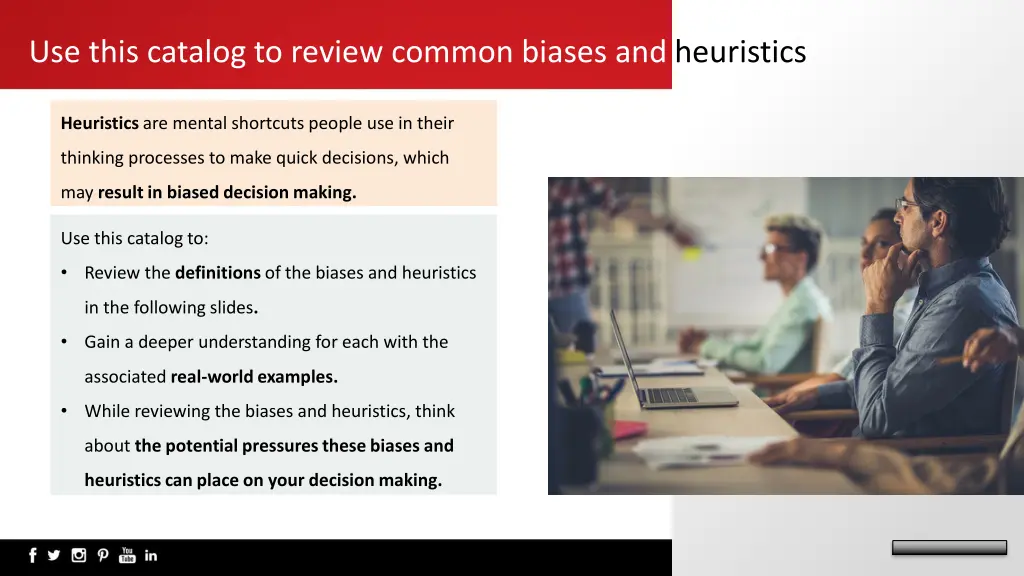
Use this catalog to review common biases and heuristics Heuristics are mental shortcuts people use in their thinking processes to make quick decisions, which may result in biased decision making. Use this catalog to: Review the definitions of the biases and heuristics in the following slides. Gain a deeper understanding for each with the associated real-world examples. While reviewing the biases and heuristics, think about the potential pressures these biases and heuristics can place on your decision making. McLean & Company | 2
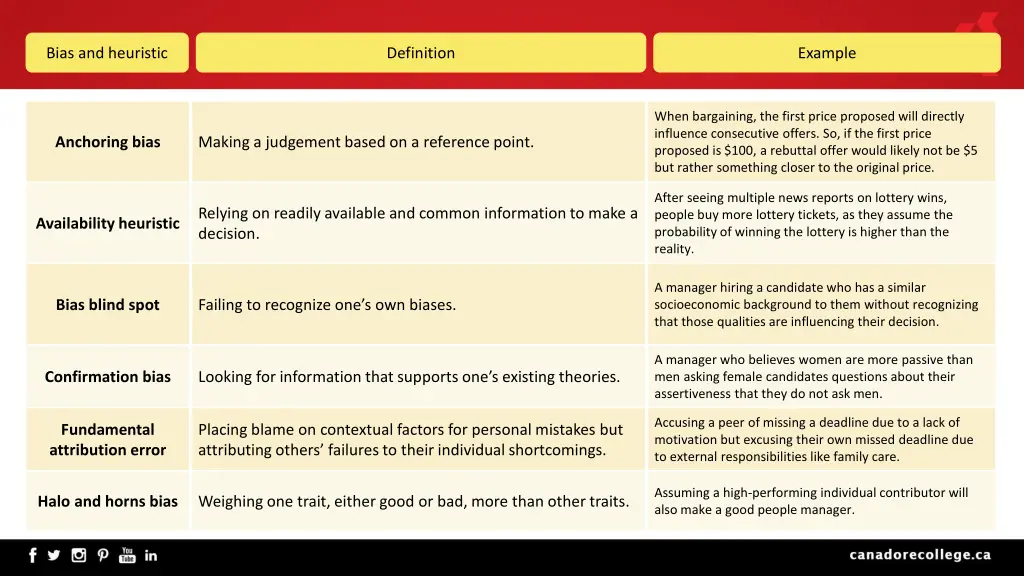
Bias and heuristic Definition Example When bargaining, the first price proposed will directly influence consecutive offers. So, if the first price proposed is $100, a rebuttal offer would likely not be $5 but rather something closer to the original price. Anchoring bias Making a judgement based on a reference point. After seeing multiple news reports on lottery wins, people buy more lottery tickets, as they assume the probability of winning the lottery is higher than the reality. Relying on readily available and common information to make a decision. Availability heuristic A manager hiring a candidate who has a similar socioeconomic background to them without recognizing that those qualities are influencing their decision. Bias blind spot Failing to recognize one s own biases. A manager who believes women are more passive than men asking female candidates questions about their assertiveness that they do not ask men. Confirmation bias Looking for information that supports one s existing theories. Accusing a peer of missing a deadline due to a lack of motivation but excusing their own missed deadline due to external responsibilities like family care. Fundamental attribution error Placing blame on contextual factors for personal mistakes but attributing others failures to their individual shortcomings. Assuming a high-performing individual contributor will also make a good people manager. Halo and horns bias Weighing one trait, either good or bad, more than other traits.
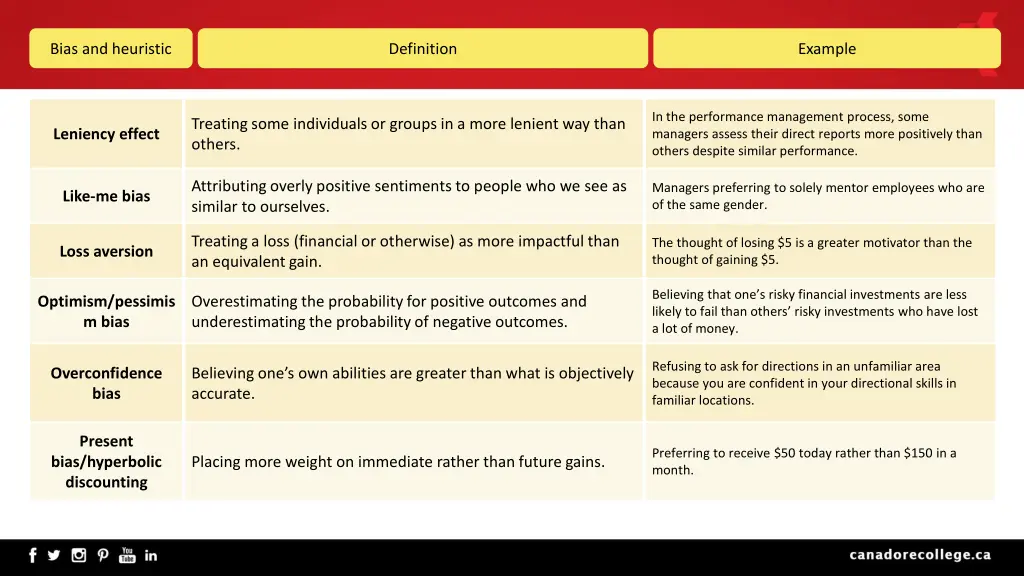
Bias and heuristic Definition Example In the performance management process, some managers assess their direct reports more positively than others despite similar performance. Treating some individuals or groups in a more lenient way than others. Leniency effect Attributing overly positive sentiments to people who we see as similar to ourselves. Managers preferring to solely mentor employees who are of the same gender. Like-me bias Treating a loss (financial or otherwise) as more impactful than an equivalent gain. The thought of losing $5 is a greater motivator than the thought of gaining $5. Loss aversion Believing that one s risky financial investments are less likely to fail than others risky investments who have lost a lot of money. Optimism/pessimis m bias Overestimating the probability for positive outcomes and underestimating the probability of negative outcomes. Refusing to ask for directions in an unfamiliar area because you are confident in your directional skills in familiar locations. Overconfidence bias Believing one s own abilities are greater than what is objectively accurate. Present bias/hyperbolic discounting Preferring to receive $50 today rather than $150 in a month. Placing more weight on immediate rather than future gains.
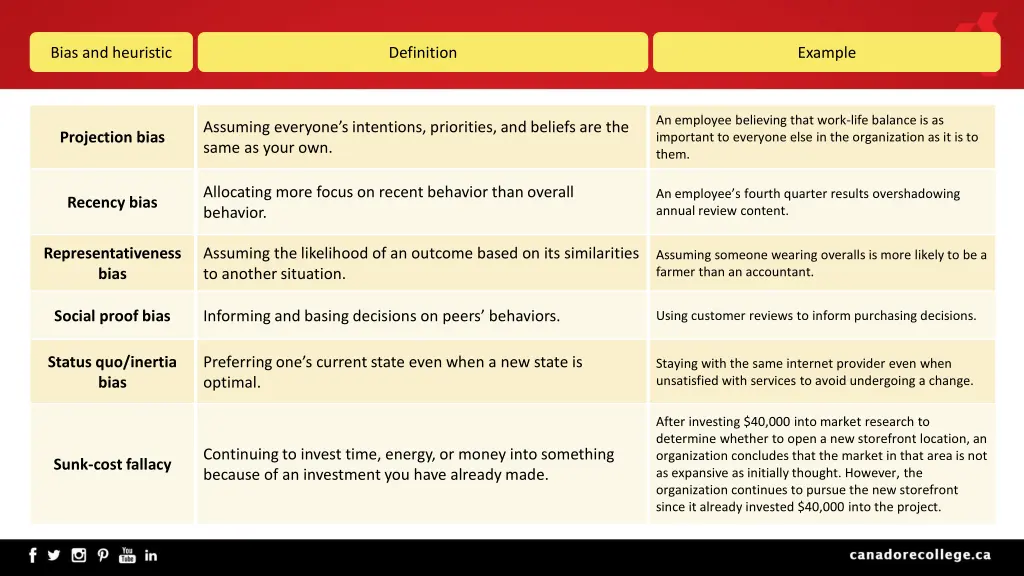
Bias and heuristic Definition Example An employee believing that work-life balance is as important to everyone else in the organization as it is to them. Assuming everyone s intentions, priorities, and beliefs are the same as your own. Projection bias Allocating more focus on recent behavior than overall behavior. An employee s fourth quarter results overshadowing annual review content. Recency bias Representativeness bias Assuming the likelihood of an outcome based on its similarities to another situation. Assuming someone wearing overalls is more likely to be a farmer than an accountant. Social proof bias Informing and basing decisions on peers behaviors. Using customer reviews to inform purchasing decisions. Status quo/inertia bias Preferring one s current state even when a new state is optimal. Staying with the same internet provider even when unsatisfied with services to avoid undergoing a change. After investing $40,000 into market research to determine whether to open a new storefront location, an organization concludes that the market in that area is not as expansive as initially thought. However, the organization continues to pursue the new storefront since it already invested $40,000 into the project. Continuing to invest time, energy, or money into something because of an investment you have already made. Sunk-cost fallacy