"Community water fluoridation is a population-based method that optimizes fluoride levels in water to prevent dental caries. This article explores the benefits, risks, and process of fluoridation, addressing common misconceptions and explaining its role in public health. Learn about the chemicals used, considerations for implementation, and the evidence supporting the safety and effectiveness of fluoridated water for improving oral health."
Please find below an Image/Link to download the presentation.
The content on the website is provided AS IS for your information and personal use only. It may not be sold, licensed, or shared on other websites without obtaining consent from the author. If you encounter any issues during the download, it is possible that the publisher has removed the file from their server.
You are allowed to download the files provided on this website for personal or commercial use, subject to the condition that they are used lawfully. All files are the property of their respective owners.
The content on the website is provided AS IS for your information and personal use only. It may not be sold, licensed, or shared on other websites without obtaining consent from the author.
E N D
Presentation Transcript
Community water Fluoridation Dr. Rihab Abdul Hussein Ali B.D.S , M.Sc. , PhD.
Communal water fluoridation defined as the upward adjustment of the natural fluoride level in a community's water supply to prevent dental caries. It is a population-based method of primary prevention that uses piped water systems to deliver low-dose fluoride over frequent intervals. Fluoridation is a public health measure, the benefits to all individuals consuming drinking water that is optimally fluoridated without regard to socioeconomic status, not expensive, effective in caries reduction of permanent teeth more than primary teeth.
Fluoridated water is used in the manufacturing of beverages and foods that are consumed in non- fluoridated areas. This, in part, explains why it is so difficult to show a difference in caries prevalence rates between fluoridated and non- fluoridated communities. In determining fluorosis risk, total intake of fluoride from all sources should be considered. Excess fluoride intake is common and can lead to side effects that have to be taken into account.
While the disadvantages are political and/or emotional objections to water additives, allergic toxicity and possibility of mild to moderate fluorosis if other sources of fluoride are ingested. According to World Health Organization (WHO), there is evidence that ingestion of fluoride at recommended levels presents no danger to humans.
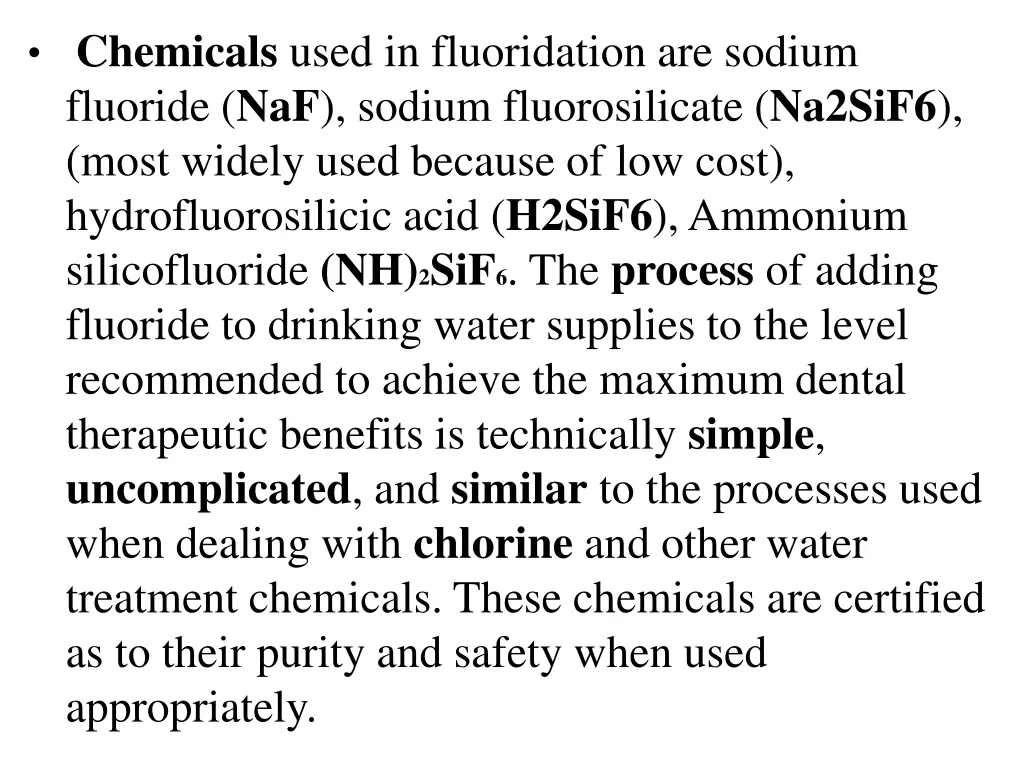
Chemicals used in fluoridation are sodium fluoride (NaF), sodium fluorosilicate (Na2SiF6), (most widely used because of low cost), hydrofluorosilicic acid (H2SiF6), Ammonium silicofluoride (NH)2SiF6. The process of adding fluoride to drinking water supplies to the level recommended to achieve the maximum dental therapeutic benefits is technically simple, uncomplicated, and similar to the processes used when dealing with chlorine and other water treatment chemicals. These chemicals are certified as to their purity and safety when used appropriately.
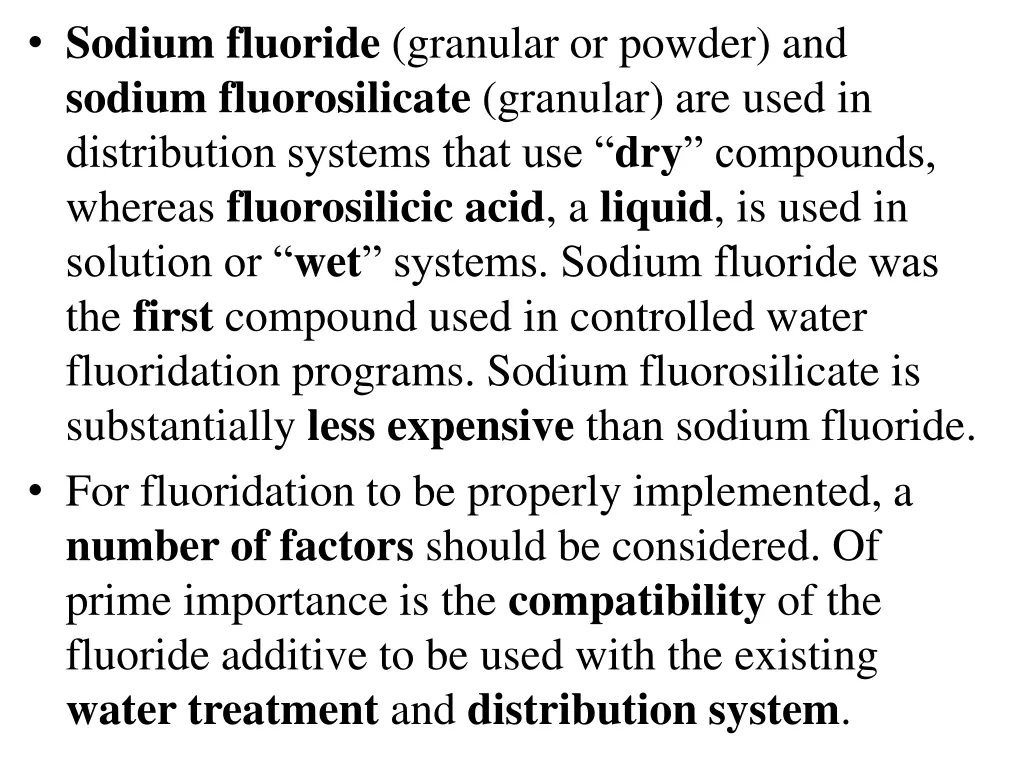
Sodium fluoride (granular or powder) and sodium fluorosilicate (granular) are used in distribution systems that use dry compounds, whereas fluorosilicic acid, a liquid, is used in solution or wet systems. Sodium fluoride was the first compound used in controlled water fluoridation programs. Sodium fluorosilicate is substantially less expensive than sodium fluoride. For fluoridation to be properly implemented, a number of factors should be considered. Of prime importance is the compatibility of the fluoride additive to be used with the existing water treatment and distribution system.
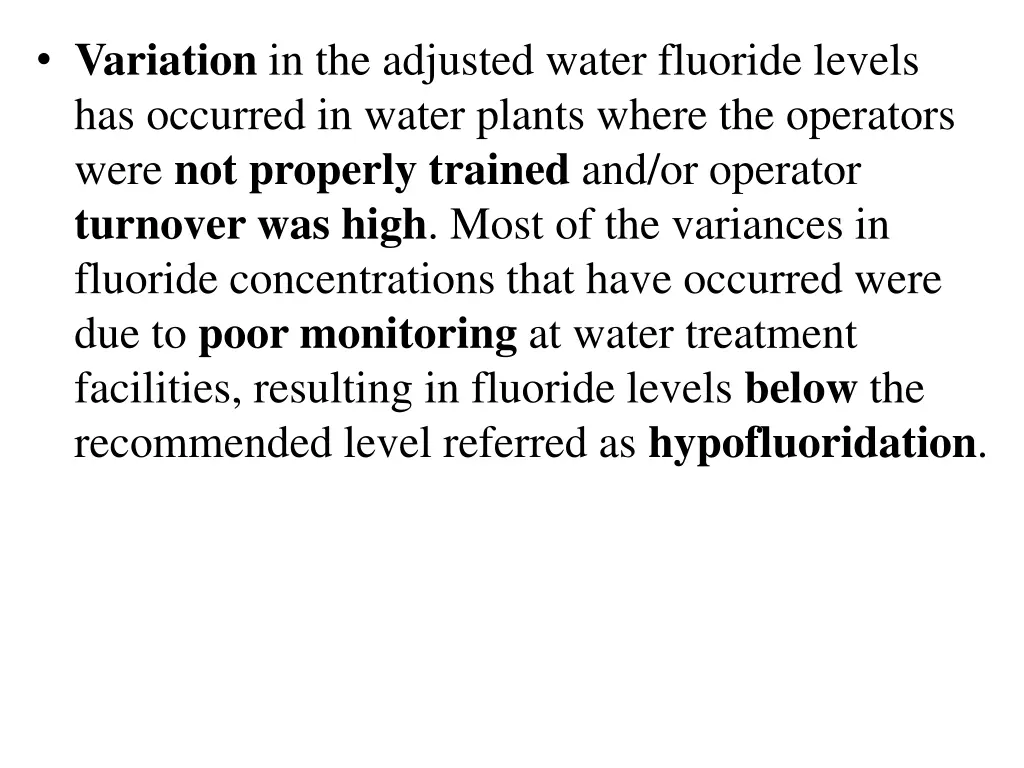
Variation in the adjusted water fluoride levels has occurred in water plants where the operators were not properly trained and/or operator turnover was high. Most of the variances in fluoride concentrations that have occurred were due to poor monitoring at water treatment facilities, resulting in fluoride levels below the recommended level referred as hypofluoridation.
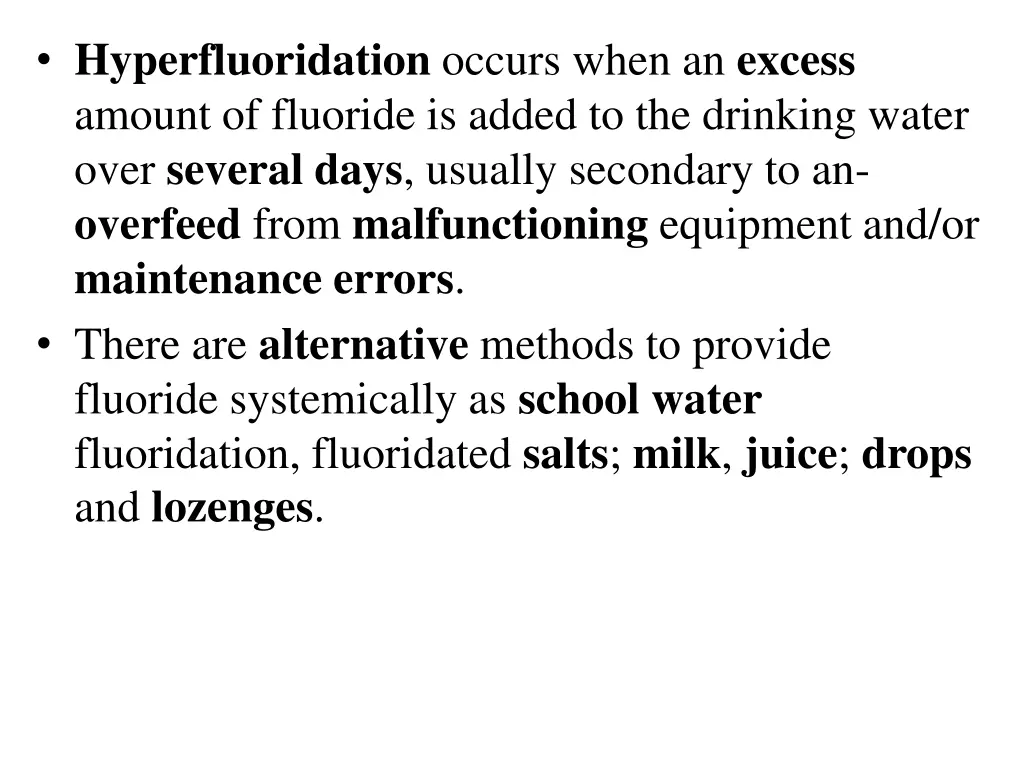
Hyperfluoridation occurs when an excess amount of fluoride is added to the drinking water over several days, usually secondary to an- overfeed from malfunctioning equipment and/or maintenance errors. There are alternative methods to provide fluoride systemically as school water fluoridation, fluoridated salts; milk, juice; drops and lozenges.
School water fluoridation This method was first applied in USA, 1954. This type of water fluoridation used when there is no communal water supply. The optimal level of fluoride equal to 4.5 times that a community due to: 1. Children spent a part of their time in school. 2. Children enter the school at 6- year of age.
Advantage of school water fluoridation - Cost is low. - Technically feasible. - Noeffort is needed. - Effective in caries reduction (40%). Home water fluoridation is effective in caries prevention; the level of fluoride is similar to communal water fluoridation.
Does water fluoridation simply delay dental decay? Fluoride incorporation in the primary dentition and in the alveolar bone, which must be resorbed prior to the eruption of the permanent teeth is believed to be the cause of generalized delay in tooth eruption. It is possible to estimate the effects on dental decay rates of a delay of tooth eruption of 1.0 year (20%) or 1.5 years (33.3%). Studies showed that fluoridated water could reduce coronal caries in adults and reduce root caries. These benefits are topical and likely cumulative.